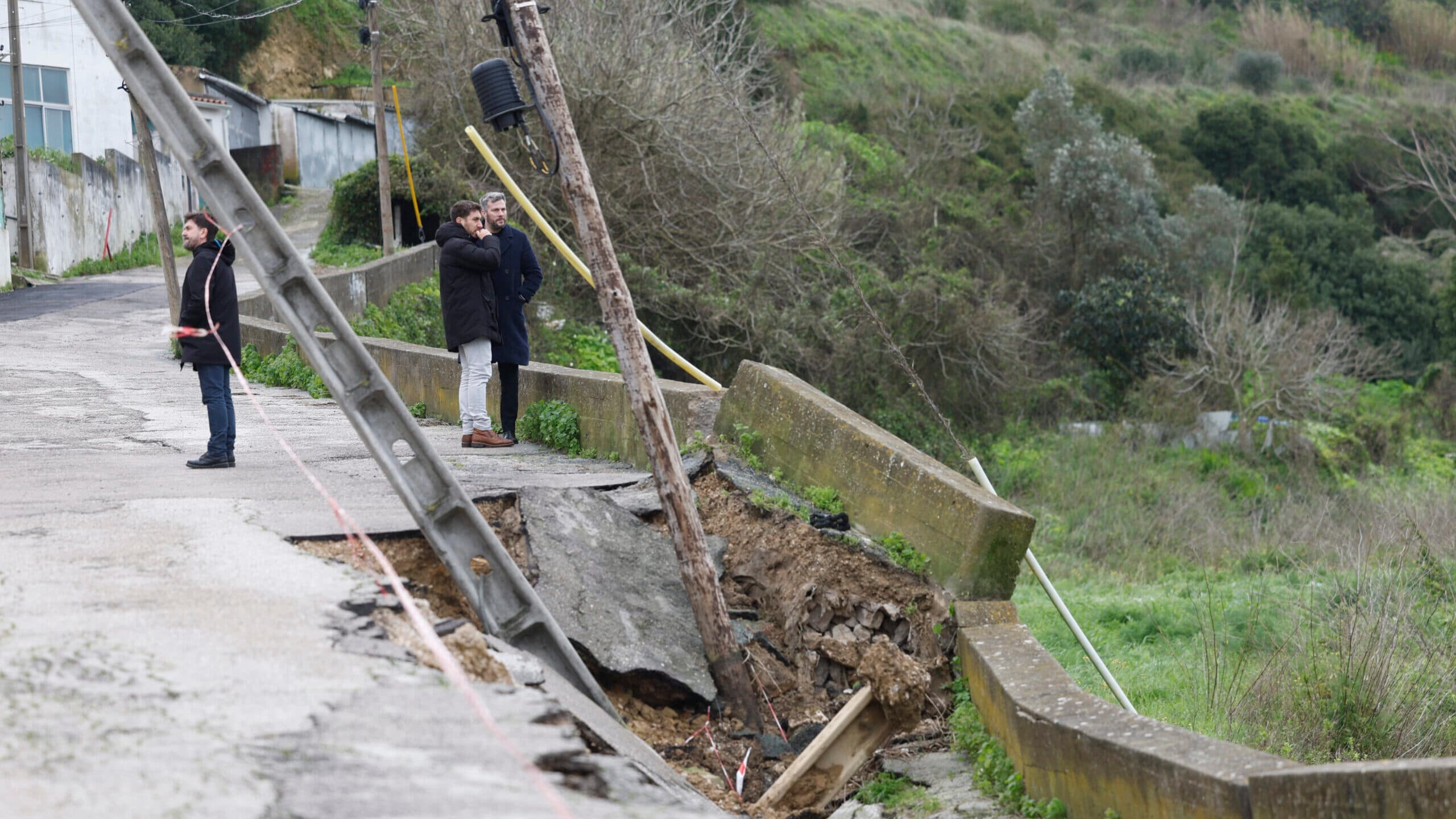
Storm damage: Part of the West Line reopens this Monday
Partial service on the West Line resumes this Monday following severe storm damage, though long-term recovery efforts continue.

Latest news and stories about severe weather in Portugal for expats and residents.
Partial service on the West Line resumes this Monday following severe storm damage, though long-term recovery efforts continue.

The Portuguese Institute of the Sea and Atmosphere (Instituto Português do Mar e da Atmosfera or IPMA) warns of a sharp temperature drop in the Azores this Tuesday and Wednesday. A polar air mass could bring snow to areas above 800 meters in the Central and Oriental island groups. Those in the archipelago should be aware that minimum temperatures are expected to fall between 7 and 9 degrees Celsius.

IPMA is the Portuguese Institute of the Sea and Atmosphere (Instituto Português do Mar e da Atmosfera), the national agency for weather, marine forecasts and climate monitoring. Residents should watch its forecasts and warnings during storms, heatwaves or cold snaps because IPMA issues official advisories used by services, transport operators and local authorities.

Six weeks after Storm Kristin, students in Vieira de Leiria continue to face significant educational disruptions, with classes held in makeshift locations including containers and a former mortuary chapel due to ongoing infrastructure repairs.

Ana Duarte of F. Rego suggests that establishing a catastrophe fund is essential to address the current challenges in the agricultural insurance market.

Recent severe weather events have triggered a 20% to 35% surge in demand for new insurance policies, as both individuals and businesses seek enhanced coverage and better risk management.

A new report from the Portuguese Environment Agency (Agência Portuguesa do Ambiente or APA) reveals that 35 beaches in the Algarve suffered significant erosion during recent winter storms. Peneco beach in Albufeira saw the most dramatic change, with the shoreline retreating by 24 meters. The agency also warned of increased cliff instability across the region due to the severe weather. Algarve residents should be aware of potential safety hazards and restricted access at affected coastal sites this spring.
APA is the Portuguese Environment Agency (Agência Portuguesa do Ambiente), the national authority that evaluates environmental impacts, enforces environmental law and issues licences or opinions on projects. Its opinions—such as the recent unfavourable view on the Lagoa Salgada mine—carry weight in permitting decisions and can delay or block projects that threaten water or other natural resources.

Municipal leaders have pushed back against Minister Castro Almeida's accusations that local councils are responsible for delays in housing reconstruction support, arguing that the government failed to provide necessary resources and shifted the administrative burden onto them without consultation.
The Portuguese Environment Agency (Agência Portuguesa do Ambiente or APA) has announced a ‑111 million plan to repair coastal damage caused by winter storms. Approximately ‑15 million will be spent before the start of the bathing season (época balnear) in May to restore beach access and infrastructure. Beachgoers should note that nearly half of the planned repairs focus on improving safe access to the shoreline.
APA is the Portuguese Environment Agency (Agência Portuguesa do Ambiente), the national authority that evaluates environmental impacts, enforces environmental law and issues licences or opinions on projects. Its opinions—such as the recent unfavourable view on the Lagoa Salgada mine—carry weight in permitting decisions and can delay or block projects that threaten water or other natural resources.

Severe weather earlier this year has led to 616 loans being placed under moratorium at Crédito Agrícola, totaling €124 million in debt relief for affected customers. The damage was particularly heavy in the central region, with the municipality of Arganil alone reporting €1 million in losses to local roads and infrastructure. Local authorities are still working to restore access to areas like Piódão, where landslides have interrupted traffic. Residents in the central interior should be aware of ongoing road repairs and check with their financial institutions if they require assistance due to weather-related property damage.

A resolution project from PAN aimed at ensuring timely support for populations affected by bad weather in Portugal during January and February is expected to be approved this Friday in the Assembly of the Republic. The measure eliminates the requirement for regularised tax and contribution status for access to reconstruction support for homes and facilities destroyed by extreme weather events, likely receiving backing from the left, including PS and Chega. The proposal addresses the vulnerability of affected individuals managing tax debts while seeking support. Additionally, discussions will cover legal criteria for patronage, with various proposals from Chega, PS, and Livre focusing on cultural patronage and emergency kits distribution.
The Environmental Fund has mobilised 137 million euros for emergency support following severe storms that impacted the West region. Of this total, 35 million euros will be directed to municipalities and intermunicipal entities affected by the disaster. The National Association of Portuguese Municipalities reported that many areas are still without communications over a month after the storms. Additionally, Parliament has approved a 100% paid lay-off for workers in the affected regions.

Nine districts in the Centre and South of mainland Portugal are under a yellow warning for rain tonight due to the passage of storm Regina, as reported by the Portuguese Institute of the Sea and the Atmosphere (IPMA). The affected districts include Viseu, Évora, Setúbal, Santarém, Leiria, Castelo Branco, Aveiro, Coimbra, and Portalegre.
Update: Additional Context on the Warning The yellow warning remains in effect as authorities urge residents to stay informed about weather updates and take necessary precautions to ensure public safety during the storm's passage.
The 14 municipalities of Central Alentejo have reported losses caused by severe weather amounting to at least 26 million euros, with ongoing assessments of damage to municipal infrastructure, according to the Intermunicipal Community of Central Alentejo (CIMAC).

This week, rain is set to return and persist until Sunday, with the IPMA warning that areas previously affected by storms may face a heightened risk of flooding due to the expected intensity of the rainfall.

One month after storm Kristin, the Leiria hospital continues to grapple with the aftermath of the disaster, which saw 177 polytrauma patients flood the emergency department in just six hours. Healthcare professionals faced significant challenges, including a lack of communication and blocked roads, forcing patients to arrive in their own vehicles. As attention shifted from the storm's immediate impact, underlying issues in the healthcare system have resurfaced, highlighting ongoing chaos and the need for improved public safety policies.

The Minister of Economy and Territorial Cohesion, Manuel Castro Almeida, has declared the removal of trees downed by severe weather a government priority ahead of the fire season. He emphasized the dangers posed by these fallen trees, particularly in the Central region, and confirmed that financial resources and legislation are in place to facilitate the removal process, including access to private lands. The Minister of Agriculture, José Manuel Fernandes, also considers this issue a top priority. The government's commitment to addressing this problem is part of a broader strategy outlined in the PTRR (Portugal Transformation, Recovery and Resilience) to enhance the country's resilience against climate-related disasters.

During his final trip as President of the Republic, Marcelo Rebelo de Sousa reported that the European Union has shown a willingness to explore ways to assist Portugal in addressing the damages caused by recent severe weather. He highlighted a positive response from various European leaders regarding the situation in Portugal, indicating a readiness to understand and support the country's needs.

Portugal faced severe challenges from January 28 to February 15, 2026, due to successive storms that revealed the country's vulnerabilities and lack of preparedness for such crises. The government introduced the Portugal Transformation, Recovery and Resilience Programme (PTRR) as a response, but questions arose about the state's absence during critical moments. Despite past crises, including wildfires and floods, lasting solutions were not implemented. Immediate and concrete measures are needed, including support for farmers, toll exemptions, and property tax relief in affected areas. The government’s reluctance to adopt a Rectifying Budget is criticized, as billions in losses threaten businesses and families. The PTRR must translate into real action, and a permanent disaster response fund is essential to avoid starting from scratch after each storm. The article emphasizes the need for political courage and a commitment to support those affected, arguing that the state must not fail its citizens during crises.

The Council of Ministers approved on Thursday the extension of the support and simplification scheme for reconstruction to the entire national territory, which had previously been granted to municipalities in a state of calamity due to bad weather. To benefit from the measure, the decision was announced by the Minister of the Presidency, António Leitão Amaro, at the usual briefing.

Brisa has reported that the landslide on the A5 motorway was caused by an abnormal volume of water due to recent storms, leading to soil instability and debris on the road. A technical analysis to determine a solution is expected to be completed next week. The president of Brisa announced that the company will not seek compensation from the Portuguese state for the landslide on the A1 near Coimbra, despite estimated losses exceeding three million euros. The storms have caused significant damage across the country, including fatalities and destruction of infrastructure.
Approximately 1,800 customers of E-Redes in areas affected by storm Kristin remained without electricity as of 5:00 PM on February 22. The EDP group company stated it is focused on restoring electricity supply. Earlier, 4,500 customers were reported without power. The storms have caused significant damage, resulting in 18 fatalities and affecting 90,000 students due to school closures. The Central, Lisbon and Tagus Valley, and Alentejo regions were the most impacted, with estimated damages in Seixal around 15 million euros.
Almost a month after storm 'Kristin', many families, like Filomena's in Souto da Carpalhosa, are still displaced and living in temporary accommodations. This situation has disrupted their plans to return to their homeland after decades abroad, highlighting the ongoing impact of the storm on local communities.

The Azores Meteorological Forecast and Surveillance Centre has issued a red alert for the western Azores islands due to the expected impact of a cold front. This front, linked to a frontal system to the northwest, is anticipated to bring moderate to strong winds and increased sea agitation, raising safety concerns for the region.

Infraestruturas de Portugal has announced that 273 kilometers of railway lines remain closed due to severe weather conditions, with only 20 kilometers expected to reopen next week. The agency has not provided a timeline for when train services will resume on the Oeste and Douro lines, nor has it set a date for the commencement of necessary repair works.

José Luís Carneiro, the Secretary-General of the PS, criticized the PTRR announced by the Prime Minister as merely a plan of intentions, arguing it should be a concrete action plan to support storm victims in central Portugal. He emphasized the need for a definitive strategy to include municipalities currently outside the state of calamity. The PTRR, introduced by Luís Montenegro, aims to address the severe weather impacts that have led to 18 fatalities and numerous injuries since January 28. Carneiro noted that the programme is open for national debate rather than being an immediate implementation plan, and he reiterated the PS's 70 proposals ahead of a meeting with the Prime Minister.

The recent storms have left many families devastated, losing their homes and facing a lack of government support. This report highlights the personal accounts of those affected, shedding light on the fear, destruction, and uncertainty they now endure.

The article discusses the procedures for requesting state assistance for individuals affected by recent storms, addressing the high volume of support requests and clarifying common questions about eligibility and the application process.