26 October 2026 – 1 November 2026
Budget Clears First Hurdle Amid Escalating Housing Unrest Across Portugal
Portugal's parliament advanced the 2027 State Budget this week following fierce debates that coincided with growing public unrest over the cost of living. Police interventions against housing demonstrators in Lisbon and Porto sparked nationwide protests, placing living conditions at the heart of political discourse alongside new climate subsidies for low earners.
Protests Outside Parliament Follow Police Evictions in Lisbon and Porto
Thousands of demonstrators gathered in front of the Portuguese parliament in Lisbon to protest rising housing costs and recent police evictions of protest encampments. The rally at São Bento followed weekend operations by the Public Security Police (Polícia de Segurança Pública or PSP) clearing tent camps in Lisbon and Porto, which led to 31 arrests and left dozens injured according to protest organisers. Prime Minister Luís Montenegro defended the police response before lawmakers as reasonable, while President António José Seguro appealed for calm and urged political leaders and protesters to pursue dialogue. Activists brandished cardboard houses and symbolic keys during the demonstration, which coincided with parliamentary debate on the 2027 State Budget.

The PSP (Polícia de Segurança Pública) is Portugal's national civilian police force, founded in 1867. Responsible for defending Republican democracy and safeguarding internal security and citizens' rights, the PSP polices major cities—Lisbon, Porto, Faro—and large urban areas, covering only 4% of Portugal's territory but roughly half the population. Led by a National Director under the Ministry of Internal Affairs, its approximately 21,500 officers handle preventive policing, crime investigation, public order, airport security, diplomatic protection, private security regulation, firearms licensing, and border control (since 2023).
PSP vs. GNR: The PSP is civilian with police-focused training and urban jurisdiction, while the GNR (Guarda Nacional Republicana) is military (gendarmerie) with military training, covering 96% of Portugal's rural and suburban territory. Both share core public safety missions but differ fundamentally in nature, training, and geographic responsibility.

- Prime Minister, Portugal: 2024 - Present
- Party: Social Democratic Party (PSD)
Luís Filipe Montenegro Cardoso de Morais Esteves (born February 16, 1973, in Porto) is a Portuguese lawyer and center‑right politician who has served as Prime Minister of Portugal since April 2, 2024. A long‑time member of the Social Democratic Party (PSD), he is the leading figure of the post‑Troika generation of Portuguese conservatives. Montenegro was elected to the Assembly of the Republic in 2002 for the Aveiro district and remained an MP for 16 years, becoming PSD parliamentary leader from 2011 to 2017 during the bailout and austerity period under Prime Minister Pedro Passos Coelho. He was a prominent defender of strict austerity measures, arguing in 2014 that “the life of the people is no better, but the life of the country is a lot better,” a phrase that has followed his public image since. After an unsuccessful leadership bid against Rui Rio in 2020, Montenegro won the PSD leadership in 2022. He then forged the centre‑right Democratic Alliance (PSD–CDS‑PP and allies), which won a plurality of seats in the 2024 legislative election. Refusing to partner with the far‑right Chega, which he has called “often xenophobic, racist, populist and excessively demagogic,” he formed a minority government as head of the XXIV Constitutional Government on April 2, 2024. His first government fell in March 2025 after a no‑confidence vote linked to a conflict‑of‑interest affair, but fresh elections saw the Democratic Alliance increase its seat share, allowing Montenegro to return as prime minister leading the XXV Constitutional Government. His importance to Portugal lies in attempting to re‑center the traditional centre‑right after the crisis years, defending liberal‑conservative economics and EU alignment while drawing a sharp line against formal cooperation with the radical right, thus shaping how Portuguese democracy manages its new multi‑party era.

- President of Portugal (since March 9, 2026)
- Party: Independent. Former leader of the Socialist Party (PS), Partido Socialista
- Center-left
António José Martins Seguro (born March 11, 1962, in Penamacor) is a lawyer, political scientist, and the current President of the Portuguese Republic, inaugurated on March 9, 2026 after winning the two-round presidential election in January–February 2026.
Career: He led Socialist Youth (1990–1994), served as MEP (1999–2001), was Minister Adjunct to PM António Guterres (2001–2002), and led the PS parliamentary group (2004–2005). Elected PS Secretary-General in 2011 with 68%, he led the opposition during Portugal's bailout era. In 2014, António Costa defeated him in party primaries by a landslide, prompting Seguro's resignation and a decade-long retreat from politics. He returned in 2025, launching the movement UPortugal and announcing his presidential candidacy in June. He received official PS backing in October 2025 and won the presidency in February 2026.
Political philosophy: Seguro positions himself as representing a "modern and moderate" left, advocating financial responsibility while opposing austerity. As President, he has emphasized institutional trust, efficient governance, and a collaborative relationship with the government while maintaining rigorous constitutional oversight.

Government Plans 80 Percent Electric Car Subsidies for Low Earners
Low-income households will be eligible for state subsidies covering up to 80 percent of an electric car's purchase price under the 2027 state budget. Environment and Energy Minister Maria da Graça Carvalho announced the scheme, which forms part of a €50 million incentive package expected to support approximately 20,000 vehicles. The initiative introduces income-based tiers alongside standard purchase vouchers for cleaner transport.

- Minister of Environment and Energy (2024–present)
- Party: Social Democratic Party (PSD), Partido Social Democrata
- Background: Mechanical engineer, academic, former MEP
Maria da Graça Carvalho (born 1955) is a Portuguese engineer and politician serving as Minister of Environment and Energy in the AD government. She holds a PhD in mechanical engineering and had a distinguished academic career at Instituto Superior Técnico, specializing in energy systems and building physics.
She served as a Member of the European Parliament (2009–2024), where she focused on research policy, innovation funding (Horizon 2020/Europe), and energy policy. Before entering politics, she was a scientific advisor to European Commission President José Manuel Barroso.
As Environment Minister, she oversees Portugal's energy transition, renewable energy expansion, water resources management, climate adaptation, and environmental regulation — portfolios that are central to issues like wildfire prevention, coastal erosion, and meeting EU climate targets.
Mobi.E is Portugal’s national platform for coordinating public electric-vehicle charging infrastructure and enabling interoperability between different charging operators and service providers. For drivers this means public chargers are often available through multiple operators’ apps or RFID cards, so check which providers support roaming and the connector types (Type 2/CCS) and tariffs before you charge.
Riot Police Disperse Housing Protesters in Lisbon and Porto
Riot police moved in around 4:30 AM to disperse housing demonstrators camped overnight in Lisbon's Rossio and Porto's Praça D. João I, resulting in several arrests and dozens of injuries. In Porto, organizers reported 38 injured, including three seriously, after police advanced following three dispersal warnings.
Thousands had marched through both cities demanding affordable housing, rent controls, and the withdrawal of the government's rental bill before setting up tents. Representatives from the Ombudsman's National Preventive Mechanism (Mecanismo Nacional de Prevenção) monitored the rallies and police conduct following earlier tensions with the Public Security Police (Polícia de Segurança Pública or PSP). Socialist Party (Partido Socialista) Secretary-General José Luís Carneiro expressed solidarity with the marchers and called for coordinated political action to address the housing shortage.
José Luís Carneiro is a Portuguese politician and member of the Socialist Party (Partido Socialista or PS). He served as the Minister of Internal Administration (Ministro da Administração Interna) from 2022 to 2024 and currently holds a seat in the Assembly of the Republic (Assembleia da República).
The PSP (Polícia de Segurança Pública) is Portugal's national civilian police force, founded in 1867. Responsible for defending Republican democracy and safeguarding internal security and citizens' rights, the PSP polices major cities—Lisbon, Porto, Faro—and large urban areas, covering only 4% of Portugal's territory but roughly half the population. Led by a National Director under the Ministry of Internal Affairs, its approximately 21,500 officers handle preventive policing, crime investigation, public order, airport security, diplomatic protection, private security regulation, firearms licensing, and border control (since 2023).
PSP vs. GNR: The PSP is civilian with police-focused training and urban jurisdiction, while the GNR (Guarda Nacional Republicana) is military (gendarmerie) with military training, covering 96% of Portugal's rural and suburban territory. Both share core public safety missions but differ fundamentally in nature, training, and geographic responsibility.
Montenegro Defends Police Actions in Heated State Budget Debate
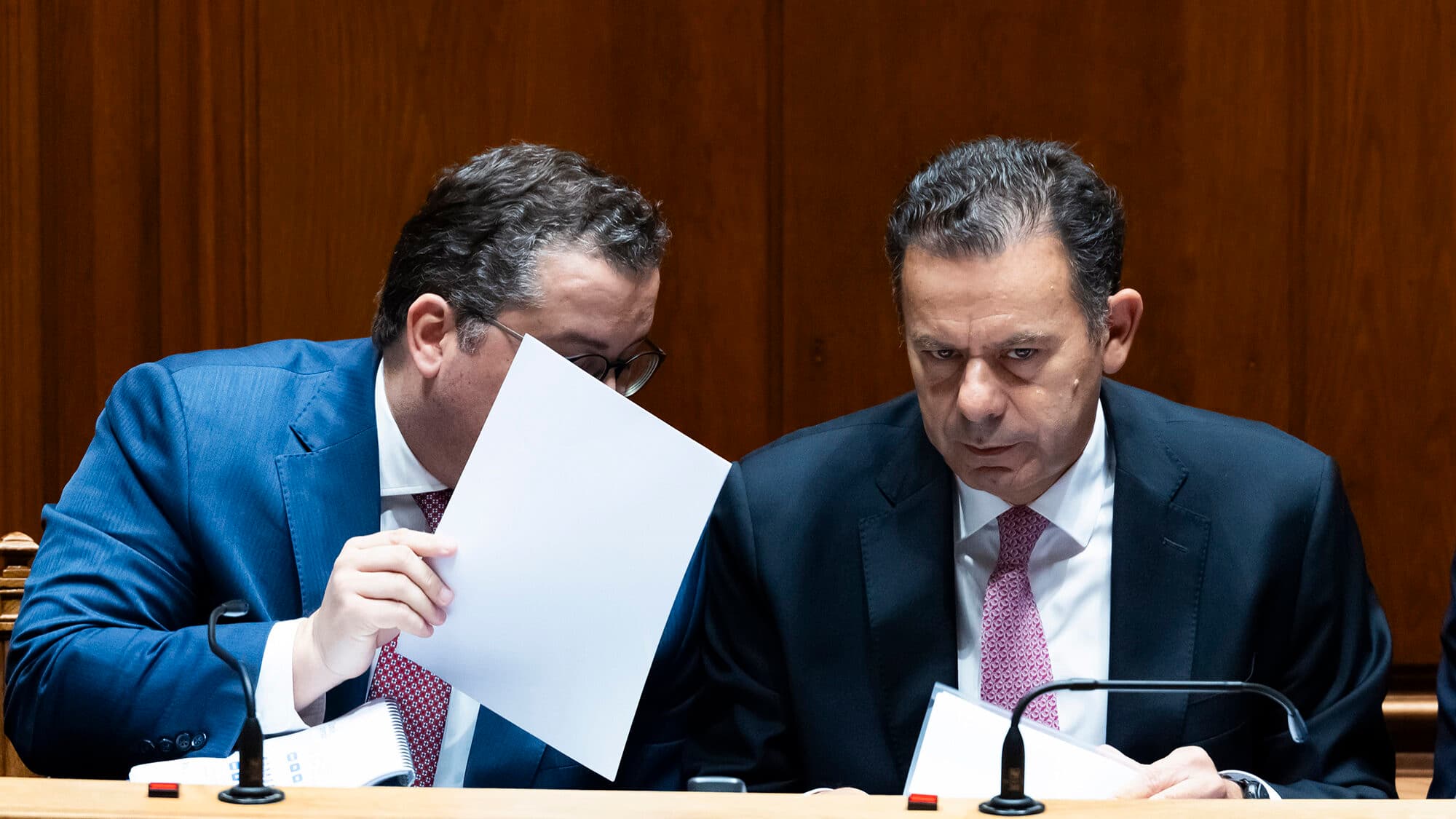
Prime Minister Luís Montenegro defended police handling of recent housing demonstrations as parliament opened the general debate on the 2027 State Budget (Orçamento do Estado para 2027). Montenegro stated that his government remains open to opposition proposals and attentive to living costs, but rejected criticisms from both left-wing parties and Chega leader André Ventura over law enforcement conduct.
The debate took place as demonstrations continued outside parliament in Lisbon. Across the capital, 55 housing activists arrested during a sit-in at Rossio square faced decisions by prosecutors on disobedience charges, while initial approval of the budget bill remains expected after the Socialist Party (Partido Socialista or PS) pledged to abstain on the general vote.

Socialist Party (PS)
- Leader: José Luís Carneiro (since June 2025)
- Ideology: Center-left, Social democracy, pro-Europeanism
Portugal's other traditional major party suffered a historic collapse in the 2025 election, dropping from 78 to 58 seats and falling to third place for the first time in democratic history. The party was led by Pedro Nuno Santos from January 2024 until his resignation following the May 2025 defeat. José Luís Carneiro, a 53-year-old former Minister of Internal Administration known for his moderate positioning within the party, was elected unopposed as the new Secretary-General with 95% of votes in June 2025. The Socialist Party governed Portugal from 2015 to 2024, including an absolute majority from 2022 to 2024 under António Costa, who resigned in November 2023 amid a corruption investigation. The PS previously led the innovative "Geringonça" (contraption) coalition government from 2015-2019, a minority government supported by the Left Bloc and Portuguese Communist Party that reversed austerity measures and presided over economic recovery.
- Prime Minister, Portugal: 2024 - Present
- Party: Social Democratic Party (PSD)
Luís Filipe Montenegro Cardoso de Morais Esteves (born February 16, 1973, in Porto) is a Portuguese lawyer and center‑right politician who has served as Prime Minister of Portugal since April 2, 2024. A long‑time member of the Social Democratic Party (PSD), he is the leading figure of the post‑Troika generation of Portuguese conservatives. Montenegro was elected to the Assembly of the Republic in 2002 for the Aveiro district and remained an MP for 16 years, becoming PSD parliamentary leader from 2011 to 2017 during the bailout and austerity period under Prime Minister Pedro Passos Coelho. He was a prominent defender of strict austerity measures, arguing in 2014 that “the life of the people is no better, but the life of the country is a lot better,” a phrase that has followed his public image since. After an unsuccessful leadership bid against Rui Rio in 2020, Montenegro won the PSD leadership in 2022. He then forged the centre‑right Democratic Alliance (PSD–CDS‑PP and allies), which won a plurality of seats in the 2024 legislative election. Refusing to partner with the far‑right Chega, which he has called “often xenophobic, racist, populist and excessively demagogic,” he formed a minority government as head of the XXIV Constitutional Government on April 2, 2024. His first government fell in March 2025 after a no‑confidence vote linked to a conflict‑of‑interest affair, but fresh elections saw the Democratic Alliance increase its seat share, allowing Montenegro to return as prime minister leading the XXV Constitutional Government. His importance to Portugal lies in attempting to re‑center the traditional centre‑right after the crisis years, defending liberal‑conservative economics and EU alignment while drawing a sharp line against formal cooperation with the radical right, thus shaping how Portuguese democracy manages its new multi‑party era.

André Ventura, born January 15, 1983, is a lawyer, academic, and Portugal's most prominent far-right leader. He founded Chega ("Enough") in 2019 after his PSD mayoral campaign attacked the Romani community. Chega surged from 1.3% in 2019 to 22.8% in May 2025, becoming parliament's second-largest party and making Ventura Leader of the Opposition.
His platform emphasizes immigration restrictions, law-and-order policies, constitutional reform, and contains inflammatory anti-Romani rhetoric that has triggered multiple discrimination convictions and investigations. Politically classified as far-right by international media, Ventura cultivates alliances with European far-right figures including Marine Le Pen and Santiago Abascal.
Housing Protesters Remove Tents Under Police Pressure in Porto
Protesters in Porto's Praça D. João I agreed to take down their tents under pressure from the Public Security Police (Polícia de Segurança Pública or PSP), who permitted them to remain in the square overnight only without camping gear. Demonstrators demanding government action on the housing crisis have maintained temporary encampments across Porto and Lisbon's Rossio square for three weeks, leading to recurring standoffs, dozens of arrests, and several police baton charges.
An open letter signed by more than 400 lawyers accused the PSP of using disproportionate force during earlier clearances of the demonstration sites. In parliament, Defence Minister Nuno Melo defended the security forces, asserting that officers had acted with necessary firmness and restraint under difficult conditions.
Nuno Melo is the leader of CDS-PP (Centro Democrático e Social – Partido Popular), a Christian democratic party on Portugal’s centre-right, and Minister of National Defence in Luís Montenegro’s government, where CDS-PP governs in coalition with the PSD. He was previously a Member of the European Parliament.
The PSP (Polícia de Segurança Pública) is Portugal's national civilian police force, founded in 1867. Responsible for defending Republican democracy and safeguarding internal security and citizens' rights, the PSP polices major cities—Lisbon, Porto, Faro—and large urban areas, covering only 4% of Portugal's territory but roughly half the population. Led by a National Director under the Ministry of Internal Affairs, its approximately 21,500 officers handle preventive policing, crime investigation, public order, airport security, diplomatic protection, private security regulation, firearms licensing, and border control (since 2023).
PSP vs. GNR: The PSP is civilian with police-focused training and urban jurisdiction, while the GNR (Guarda Nacional Republicana) is military (gendarmerie) with military training, covering 96% of Portugal's rural and suburban territory. Both share core public safety missions but differ fundamentally in nature, training, and geographic responsibility.

Lisbon Mayor Condemns Insurer Over Glória Funicular Death Claim
Lisbon Mayor Carlos Moedas labelled statements made by transport insurer Fidelidade “shameful” and “deplorable” in a dispute over compensation for a fatal Glória funicular (Elevador da Glória) derailment. Fidelidade denied that it is refusing payouts to victims and families, but defended court filings challenging a €125,000 wrongful death claim as excessive based on standard legal valuation criteria for human life. The insurer stated that it has already paid or assumed liability for initial expenses and remains open to settling fair compensation.

Carlos Manuel Félix Moedas (born August 10, 1970, in Beja) is a civil engineer, economist, and center-right politician who has served as Mayor of Lisbon since October 2021. He earned degrees in civil engineering from Instituto Superior Técnico and an MBA from Harvard, working at Goldman Sachs and founding his own investment firm before entering politics. During Portugal's 2011-14 bailout, he served as Secretary of State coordinating Troika-mandated structural reforms. From 2014-19, he was European Commissioner for Research, Science and Innovation, managing €77 billion in research funding and designing the €100 billion Horizon Europe program. Moedas narrowly won Lisbon's mayoralty in 2021 with 34.3%, defeating Socialist incumbent Fernando Medina. Governing initially with a minority coalition, he implemented free public transport for youth and elderly residents, launched the "Unicorn Factory Lisboa" innovation hub attracting 82 tech companies and 16,000 jobs, and won Lisbon the 2023 European Capital of Innovation award. He was re-elected in October 2025 with 41.7%, securing eight of nine council seats. His significance lies in shifting Lisbon's political trajectory rightward after decades of Socialist governance, positioning the capital as a European tech hub while prioritizing housing development, carbon neutrality by 2030, and innovation-driven economic growth.
The Glória funicular (Elevador da Glória) is a historic cable railway in Lisbon that connects the Baixa district to the Bairro Alto neighborhood. Opened in 1885, it is one of the city's iconic yellow trams and serves as a public transport link for residents and tourists navigating the steep hills of the city.
Carris is the public transport company responsible for operating buses and trams in Lisbon. It is a state-owned entity that serves as the primary provider of surface public transit within the city limits.

State Budget Clears Initial Parliamentary Vote Following Fierce Debate
The 2027 State Budget (Orçamento do Estado) passed its initial general vote in parliament with support from the governing Social Democratic Party (Partido Social Democrata or PSD) and CDS-People's Party (CDS-Partido Popular). The Socialist Party (Partido Socialista or PS) abstained alongside PAN and JPP, allowing the legislation to proceed to committee review despite opposition from other parties. Following the ten-hour debate, PS leader José Luís Carneiro criticised the governing coalition for what he described as aggressive attacks against socialists who made the budget's passage possible.
José Luís Carneiro is a Portuguese politician and member of the Socialist Party (Partido Socialista or PS). He served as the Minister of Internal Administration (Ministro da Administração Interna) from 2022 to 2024 and currently holds a seat in the Assembly of the Republic (Assembleia da República).

The Social Democratic Party ('Partido Social Democrata' or 'PSD') is a liberal-conservative political party in Portugal that is the leading partner of the The Democratic Alliance (AD) which is the country's ruling party, with Prime Minister Luís Montenegro.
The Social Democratic Party, despite its name, occupies the centre-right of Portugal's political spectrum. Luís Montenegro, who became Prime Minister in April 2024, leads Portugal's current minority government. The PSD has been one of Portugal's two dominant parties since 1974, having formed nine governments including four with absolute majorities. Montenegro, a former party leader from 1996-1999, was elected with the highest approval rating among party leaders at 10.7 points out of 20.
The Democratic Alliance is a centre-right coalition that includes the smaller CDS – People's Party, a Christian democratic party that has historically been the PSD's coalition partner. Together, they govern without a parliamentary majority, requiring case-by-case support from opposition parties to pass legislation.
Parliament Passes 2027 State Budget on First Reading
Parliament approved the 2027 State Budget (Orçamento do Estado) proposal on Wednesday at its first reading, after the Socialist Party (Partido Socialista or PS) abstained to avoid a political crisis. The bill passed with 91 votes from the governing Social Democratic Party (Partido Social Democrata or PSD) and CDS-People's Party (CDS-Partido Popular or CDS-PP), while 79 lawmakers from Chega, the Liberal Initiative (Iniciativa Liberal), and left-wing parties voted against.
Socialist leader José Luís Carneiro confirmed his party allowed the measure to advance while demanding amendments during the committee stage. The PS has urged the government to transfer vacant public properties held by the Institute for Housing and Urban Rehabilitation (Instituto da Habitação e da Reabilitação Urbana or IHRU) directly to municipalities, and to abandon proposed tenancy reforms that the opposition argues reduce tenant stability.
The budget targets a surplus of 0.1 percent of gross domestic product and 2.1 percent economic growth in 2027, alongside corporate tax cuts from 19 percent to 18 percent. The final global vote is scheduled for 24 November.
IHRU is the national Institute for Housing and Urban Rehabilitation (Instituto da Habitação e da Reabilitação Urbana). It manages public housing and urban renewal programmes and runs property offers and application processes — for example the T0–T5 homes listed in Almada, Amadora, Caldas da Rainha, Lisbon, Porto and Vila Nova de Gaia with applications open until 9 February — so residents should check eligibility and how to apply.
The Social Democratic Party ('Partido Social Democrata' or 'PSD') is a liberal-conservative political party in Portugal that is the leading partner of the The Democratic Alliance (AD) which is the country's ruling party, with Prime Minister Luís Montenegro.
The Social Democratic Party, despite its name, occupies the centre-right of Portugal's political spectrum. Luís Montenegro, who became Prime Minister in April 2024, leads Portugal's current minority government. The PSD has been one of Portugal's two dominant parties since 1974, having formed nine governments including four with absolute majorities. Montenegro, a former party leader from 1996-1999, was elected with the highest approval rating among party leaders at 10.7 points out of 20.
The Democratic Alliance is a centre-right coalition that includes the smaller CDS – People's Party, a Christian democratic party that has historically been the PSD's coalition partner. Together, they govern without a parliamentary majority, requiring case-by-case support from opposition parties to pass legislation.
Socialist Party (PS)
- Leader: José Luís Carneiro (since June 2025)
- Ideology: Center-left, Social democracy, pro-Europeanism
Portugal's other traditional major party suffered a historic collapse in the 2025 election, dropping from 78 to 58 seats and falling to third place for the first time in democratic history. The party was led by Pedro Nuno Santos from January 2024 until his resignation following the May 2025 defeat. José Luís Carneiro, a 53-year-old former Minister of Internal Administration known for his moderate positioning within the party, was elected unopposed as the new Secretary-General with 95% of votes in June 2025. The Socialist Party governed Portugal from 2015 to 2024, including an absolute majority from 2022 to 2024 under António Costa, who resigned in November 2023 amid a corruption investigation. The PS previously led the innovative "Geringonça" (contraption) coalition government from 2015-2019, a minority government supported by the Left Bloc and Portuguese Communist Party that reversed austerity measures and presided over economic recovery.
José Luís Carneiro is a Portuguese politician and member of the Socialist Party (Partido Socialista or PS). He served as the Minister of Internal Administration (Ministro da Administração Interna) from 2022 to 2024 and currently holds a seat in the Assembly of the Republic (Assembleia da República).
Health Minister Denies SNS Deficit Represents Financial Loss
Health Minister Ana Paula Martins rejected claims that a projected 2.68-billion-euro negative balance for the National Health Service (Serviço Nacional de Saúde) in 2027 constitutes an operational loss, calling it an estimate of funding needs. During parliamentary hearings on the 2027 State Budget (Orçamento do Estado), Martins pointed out that Portugal's foreign resident population grew to 1.6 million by 2025, adding service pressures to public hospitals. The remarks coincide with health data showing hospital surgeries fell by 4.2 percent in early 2026 despite increased state spending.
Ana Paula Martins is a Portuguese pharmacist and politician who has served as the Minister of Health in Portugal since April 2024. A member of the Social Democratic Party (PSD), she was reappointed to the position in the second government of Prime Minister Luís Montenegro in June 2025.
Professional Background
Pharmaceutical Leadership: She served as the President of the Order of Pharmacists (Bastonária da Ordem dos Farmacêuticos) from 2016 to 2022.
Hospital Management: She was the President of the Board of Directors of Hospital de Santa Maria (CHULN) in Lisbon from December 2022 to January 2024.
Academic Work: She holds a PhD in Clinical Pharmacy and has been an assistant professor at the Faculty of Pharmacy of the University of Lisbon for over 20 years.
Political Career
Government Role: As Minister of Health, she has overseen the implementation of the "SNS Emergency Plan" and recently addressed issues such as INEM staffing and public-private partnerships in healthcare.
Party Leadership: She served as Vice President of the PSD under Rui Rio (2021–2022).
Parliament: She was elected as a member of the Assembly of the Republic representing the Lisbon constituency in 2024.

Housing Activists Coordinate Actions in Lisbon and Seek Porto Talks
Housing activists gathered in Lisbon and Porto on Thursday night to plan upcoming actions following recent police clearances of protest encampments. In Porto, an assembly at Praça D. João I voted to request an in-person meeting with Porto Mayor Pedro Duarte at the Rivoli municipal theatre. In Lisbon, the housing rights group Acampada de Lisboa confirmed plans to march from Largo de Camões at 4:00 PM on Saturday before setting up tents for an overnight demonstration in Rossio square to protest high rents and living costs.
Pedro Duarte is the Mayor of Porto, elected in the most recent local elections. He leads the city's municipal government and is responsible for implementing local policies, such as the recent initiative to provide free public transport for residents.
Acampada de Lisboa (Lisbon Encampment) is a civic activist movement that sets up public tent encampments in central Lisbon to protest the housing crisis. The group organizes demonstrations demanding affordable rent, expanded social housing, and stricter controls on property speculation. Their actions highlight how rising living costs and housing shortages affect residents in the capital.