11 May 2026 – 17 May 2026
Labour Reforms and Political Shifts Dominate Portugal's Weekly Agenda
The Portuguese government has advanced significant labour law reforms this week amid widespread teacher protests and ongoing political restructuring within the CDS-PP. Meanwhile, residents face rising fuel costs and travel disruptions at Lisbon airport as officials address public concerns regarding healthcare staffing and national security infrastructure.
Minister defends Portugal's actions regarding Lajes Base
Minister of National Defence Nuno Melo stated that Portugal acted as a reliable ally regarding the use of the Lajes Base by the United States. Melo dismissed concerns over recent comments by U.S. Secretary of State Marco Rubio, arguing that his statements should not be interpreted literally, while the Socialist Party (Partido Socialista or PS) criticized the government's handling of the situation.
Update: Left Bloc proposes parliamentary inquiry into Lajes Base
The Left Bloc (Bloco de Esquerda or BE) has announced it will propose a Parliamentary Commission of Inquiry to investigate the government's handling of the Lajes Air Base. The party accuses the government of being overly compliant with U.S. requests, following conflicting reports about whether Portugal authorized military flights before specific requests were made.
Nuno Melo is the president of CDS-PP (Centro Democrático e Social – Partido Popular), a Christian democratic party in Portugal. In the story he linked Chega's position to socialism, compared André Ventura to Donald Trump, and urged party members to vote 'in conscience' in the presidential runoff on the 8th, a stance that could affect centre‑right voters.
Health cards are private membership or discount schemes sold by companies that offer access to consultations, tests or reduced fees at private clinics; they are not the public health service. The Socialist Party (Partido Socialista or PS) has proposed regulation to increase transparency and protect consumers from misleading marketing or unexpected charges.

Teachers protest against career and labour reforms
Thousands of teachers marched in Lisbon today in a protest organized by the National Federation of Teachers (Federação Nacional dos Professores or Fenprof). The demonstrators expressed opposition to the government's proposed labour package and the revision of the Teaching Career Statute (Estatuto da Carreira Docente), while also announcing their participation in a general strike scheduled for June 3rd.
Update: Teachers confirm participation in June 3rd general strike
Thousands of teachers gathered in Lisbon this Saturday to protest against the government's proposed labour reforms and the revision of the Teaching Career Statute. During the demonstration, Fenprof officially confirmed that teachers will join the national general strike scheduled for June 3rd.
Fenprof is the National Federation of Teachers (Federação Nacional dos Professores), the main public‑school teachers' union in Portugal that represents teachers in pay, working conditions and education reforms. Its criticism matters because Fenprof can organize strikes and mobilise teachers, which directly affects school operations and the implementation of government changes — something families and expat educators should monitor.
The Teaching Career Statute (Estatuto da Carreira Docente) is the law that sets how teachers are recruited, evaluated, promoted and dismissed in Portugal. The proposed revision matters because it would introduce a centralised national competition for entry, a one-year trial period and an exceptional route for teachers without formal qualifications, changes that affect job access and stability for current and future teachers.

CDS-PP re-elects Nuno Melo as party leader
The CDS-PP party re-elected Nuno Melo as its leader during the 32nd party congress in Alcobaça. While Melo secured a large majority, the congress highlighted internal debates regarding the party's autonomy within the Democratic Alliance (Aliança Democrática or AD) coalition and its future electoral strategy.
Nuno Melo is the president of CDS-PP (Centro Democrático e Social – Partido Popular), a Christian democratic party in Portugal. In the story he linked Chega's position to socialism, compared André Ventura to Donald Trump, and urged party members to vote 'in conscience' in the presidential runoff on the 8th, a stance that could affect centre‑right voters.
The CDS–PP is the Democratic and Social Centre – People's Party (Centro Democrático e Social – Partido Popular), a small centre-right, Christian-democratic party founded in 1974. It often partners with the larger PSD in parliament; in February 2026 it voted with the PSD and IL to approve a housing package, so its parliamentary support can influence housing and other policy outcomes.

CDS-PP proposes doubling tax deductions for large families
During the 32nd CDS-PP congress, parliamentary leader Paulo Núncio announced the party will propose doubling tax deductions for families with three or more children. The measure aims to provide greater support to large families and address the country's declining birth rate.
The CDS–PP is the Democratic and Social Centre – People's Party (Centro Democrático e Social – Partido Popular), a small centre-right, Christian-democratic party founded in 1974. It often partners with the larger PSD in parliament; in February 2026 it voted with the PSD and IL to approve a housing package, so its parliamentary support can influence housing and other policy outcomes.
Health ministry clarifies rules for former NHS doctors
The Ministry of Health clarified that medical professionals who left the National Health Service (Serviço Nacional de Saúde or SNS) before the new service provider regime took effect will face only a one-year incompatibility period. This rule applies to approximately 2,000 doctors who previously exited the public system.
ULS Alto Ave is the Alto Ave Local Health Unit (Unidade Local de Saúde do Alto Ave), a public body that runs hospitals and some primary-care services for the Ave area in northern Portugal. It is part of the National Health Service (Serviço Nacional de Saúde or SNS), and recent staff strikes have affected overtime and complementary work, so residents should check local hospital notices before visiting.

Technical issues cause long delays at Lisbon airport
Passengers at Lisbon's Humberto Delgado Airport experienced significant delays at border control this Saturday due to technical and IT difficulties. Both the airport operator, ANA - Aeroportos de Portugal, and the Public Security Police (Polícia de Segurança Pública or PSP) confirmed that waiting times exceeded one hour for departures outside the Schengen Area.

The PSP (Polícia de Segurança Pública) is Portugal's national civilian police force, founded in 1867. Responsible for defending Republican democracy and safeguarding internal security and citizens' rights, the PSP polices major cities—Lisbon, Porto, Faro—and large urban areas, covering only 4% of Portugal's territory but roughly half the population. Led by a National Director under the Ministry of Internal Affairs, its approximately 21,500 officers handle preventive policing, crime investigation, public order, airport security, diplomatic protection, private security regulation, firearms licensing, and border control (since 2023).
PSP vs. GNR: The PSP is civilian with police-focused training and urban jurisdiction, while the GNR (Guarda Nacional Republicana) is military (gendarmerie) with military training, covering 96% of Portugal's rural and suburban territory. Both share core public safety missions but differ fundamentally in nature, training, and geographic responsibility.

School employee arrested for child abuse in Lisbon
A school educational assistant (auxiliar de ação educativa) in Lisbon was arrested by the Judicial Police (Polícia Judiciária or PJ) for the alleged sexual abuse of four young girls. The suspect, who worked in a preschool setting, is accused of committing at least six crimes during April and May while supervising children during nap time.

The PJ (Polícia Judiciária) is Portugal's national criminal investigation police agency, founded in 1945. Operating under the Ministry of Justice and supervised by the Public Ministry (prosecutors), the PJ is a "higher criminal police body" specializing in serious and complex crimes. Mission: The PJ assists judicial and prosecuting authorities by investigating terrorism, organized crime, homicide, kidnapping, drug trafficking, corruption, cybercrime, financial crime, and money laundering. It conducts forensic examinations, operates Portugal's Interpol and Europol liaison offices, and maintains specialized units including the National Counterterrorism Unit and National Anti-Corruption Unit. Difference from PSP/GNR: While PSP (civilian urban police) and GNR (military rural police) focus on preventive policing, public order, and investigating minor crimes, the PJ exclusively handles serious crime investigation requiring specialized technical and scientific expertise. PSP and GNR report to the Ministry of Internal Affairs; PJ reports to the Ministry of Justice. PJ officers receive higher pay and prestige but face greater operational risk.

Government to approve labour law reform on Thursday
Prime Minister Luís Montenegro announced that the Council of Ministers will approve a proposal to revise labour legislation this Thursday before submitting it to Parliament. Montenegro criticized the General Union of Workers (União Geral de Trabalhadores or UGT) for being intransigent during negotiations, while confirming a meeting with Chega leader André Ventura to discuss the bill and nationality law.
Update: Socialist leader to discuss labour reform with Prime Minister
Socialist Party (Partido Socialista or PS) Secretary-General José Luís Carneiro confirmed he will meet with Montenegro this Thursday to discuss the labour reform proposal. Carneiro warned that the meeting does not imply PS support for what he described as a government counter-reform, while the party leadership denied reports that it had expressed willingness to negotiate the legislation.

- Prime Minister, Portugal: 2024 - Present
- Party: Social Democratic Party (PSD)
Luís Filipe Montenegro Cardoso de Morais Esteves (born February 16, 1973, in Porto) is a Portuguese lawyer and center‑right politician who has served as Prime Minister of Portugal since April 2, 2024. A long‑time member of the Social Democratic Party (PSD), he is the leading figure of the post‑Troika generation of Portuguese conservatives. Montenegro was elected to the Assembly of the Republic in 2002 for the Aveiro district and remained an MP for 16 years, becoming PSD parliamentary leader from 2011 to 2017 during the bailout and austerity period under Prime Minister Pedro Passos Coelho. He was a prominent defender of strict austerity measures, arguing in 2014 that “the life of the people is no better, but the life of the country is a lot better,” a phrase that has followed his public image since. After an unsuccessful leadership bid against Rui Rio in 2020, Montenegro won the PSD leadership in 2022. He then forged the centre‑right Democratic Alliance (PSD–CDS‑PP and allies), which won a plurality of seats in the 2024 legislative election. Refusing to partner with the far‑right Chega, which he has called “often xenophobic, racist, populist and excessively demagogic,” he formed a minority government as head of the XXIV Constitutional Government on April 2, 2024. His first government fell in March 2025 after a no‑confidence vote linked to a conflict‑of‑interest affair, but fresh elections saw the Democratic Alliance increase its seat share, allowing Montenegro to return as prime minister leading the XXV Constitutional Government. His importance to Portugal lies in attempting to re‑center the traditional centre‑right after the crisis years, defending liberal‑conservative economics and EU alignment while drawing a sharp line against formal cooperation with the radical right, thus shaping how Portuguese democracy manages its new multi‑party era.

André Ventura, born January 15, 1983, is a lawyer, academic, and Portugal's most prominent far-right leader. He founded Chega ("Enough") in 2019 after his PSD mayoral campaign attacked the Romani community. Chega surged from 1.3% in 2019 to 22.8% in May 2025, becoming parliament's second-largest party and making Ventura Leader of the Opposition.
His platform emphasizes immigration restrictions, law-and-order policies, constitutional reform, and contains inflammatory anti-Romani rhetoric that has triggered multiple discrimination convictions and investigations. Politically classified as far-right by international media, Ventura cultivates alliances with European far-right figures including Marine Le Pen and Santiago Abascal.
José Luís Carneiro is a Portuguese politician and member of the Socialist Party (Partido Socialista or PS). He served as the Minister of Internal Administration (Ministro da Administração Interna) from 2022 to 2024 and currently holds a seat in the Assembly of the Republic (Assembleia da República).
Government approves labour reform bill for parliamentary debate
The government has approved a proposal to revise labour legislation, which will now move to the Assembly of the Republic (Assembleia da República). The bill includes extending fixed-term contracts and increasing parental leave pay to 100% for up to six months, while also lifting the ban on outsourcing after collective redundancies. Trade union centers, including the General Confederation of Portuguese Workers (Confederação Geral dos Trabalhadores Portugueses or CGTP) and the General Workers' Union (União Geral de Trabalhadores or UGT), have strongly criticized the proposal as a regression in labour rights.
Update: Labour reform heads to parliament amid political tension
The government is now navigating parliamentary negotiations, with the Minister of Labour indicating potential flexibility on specific measures, such as the restoration of three days of leave. Meanwhile, the Socialist Party (Partido Socialista or PS) has signaled it will not support the current package, and political observers are monitoring whether the party Chega will influence the final outcome.
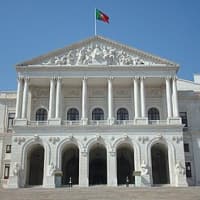
The Assembly of the Republic (Assembleia da República) is Portugal's unicameral parliament, located in the Palácio de São Bento in Lisbon. It consists of 230 deputies elected by proportional representation for four-year terms.
The Assembly's powers include making and amending laws, approving the state budget, ratifying international treaties, and overseeing the government through debates, hearings, and committees. It can also pass votes of no confidence to bring down a government, as happened in March 2025.
Following the May 2025 elections, the current parliamentary composition is led by the Democratic Alliance (AD) with the largest share of seats, followed by Chega, PS, and smaller parties including the Liberal Initiative, Left Bloc, Livre, and PCP.

The General Confederation of the Portuguese Workers (CGTP – Confederação Geral dos Trabalhadores Portugueses) is Portugal’s largest trade-union confederation, grouping most unions in manufacturing, public services and many other sectors.
Founded clandestinely in 1970 as “Intersindical” under the dictatorship, it emerged publicly after the 1974 Carnation Revolution and was legalised in 1975. It has been central to virtually all major labour struggles since then, from defending collective bargaining and the 40‑hour week to leading general strikes against austerity and labour‑law rollbacks.
CGTP is historically close to the Portuguese Communist Party and has a class‑struggle, anti‑neoliberal profile, strongly critical of EU and government policies seen as undermining workers’ rights. It favours grassroots mobilisation and strikes over compromise, often refusing national social‑pact deals that the more centrist UGT is willing to sign.
In today’s Portugal, CGTP remains a key actor in wage bargaining, labour‑law debates and national protests; together with UGT it called the first joint general strike in years in December 2025, signalling its continuing capacity to organise mass action.

The General Union of Workers (UGT – União Geral de Trabalhadores) is one of Portugal’s two main national trade union confederations. Founded in Lisbon on 28 October 1978, it was created as a social‑democratic alternative to the more communist‑aligned CGTP after the 1974 Revolution, grouping unions close to the Socialist Party and moderate centre‑right currents.
UGT represents around 400,000 workers and is affiliated to the European Trade Union Confederation and International Trade Union Confederation, giving Portuguese labour a voice at EU and global level. Its principles stress union independence from the state, employers, churches and parties, internal democracy and active worker participation.
Historically, UGT’s hallmark has been “propositive” social dialogue: it is usually more willing than CGTP to sign tripartite agreements on wages, labour law and social policy with governments and employers, shaping minimum wage increases, working‑time rules and social protection reforms. This makes UGT a key centrist actor in Portugal’s industrial relations, often mediating between left and right while defending collective bargaining and incremental improvements to labour rights.
São Bento refers to São Bento Palace (Palácio de São Bento), the historic building in Lisbon that houses the Assembly of the Republic (Portugal’s parliament) and is often used in the media as a shorthand for the national government. For expats, protests directed at São Bento signal demonstrations at the seat of political power and can cause road closures and increased police presence in central Lisbon.
André Ventura, born January 15, 1983, is a lawyer, academic, and Portugal's most prominent far-right leader. He founded Chega ("Enough") in 2019 after his PSD mayoral campaign attacked the Romani community. Chega surged from 1.3% in 2019 to 22.8% in May 2025, becoming parliament's second-largest party and making Ventura Leader of the Opposition.
His platform emphasizes immigration restrictions, law-and-order policies, constitutional reform, and contains inflammatory anti-Romani rhetoric that has triggered multiple discrimination convictions and investigations. Politically classified as far-right by international media, Ventura cultivates alliances with European far-right figures including Marine Le Pen and Santiago Abascal.
Fuel prices to rise next week
Fuel prices in Portugal are expected to change again between May 18 and May 24, with gasoline prices projected to rise by approximately 4 cents per litre. While diesel prices may see a slight decrease of 1 cent, gasoline is expected to become more expensive than diesel, reaching an estimated average of 2.016 euros per litre.

Labour reform: Government approves proposal and it moves to the Assembly of the Republic
The government meets in the Council of Ministers to approve the bill for the revision of labour legislation. Montenegro expects dialogue with Chega and the PS.
Rubio said Portugal accepted, Rangel claimed authorisation was not even necessary: seven questions and answers…
A breakdown of the conflicting statements between Rubio and Rangel regarding the authorisation of flights from the Lajes Air Base in the Azores.

Minister of Internal Administration admits closure of PSP police stations in Lisbon
“I can guarantee to the residents of Lisbon and Porto that the closure of a police station will lead to them feeling a greater police presence on the streets,” stated Luís Neves.