

1851–1910
Regeneration and the last kings
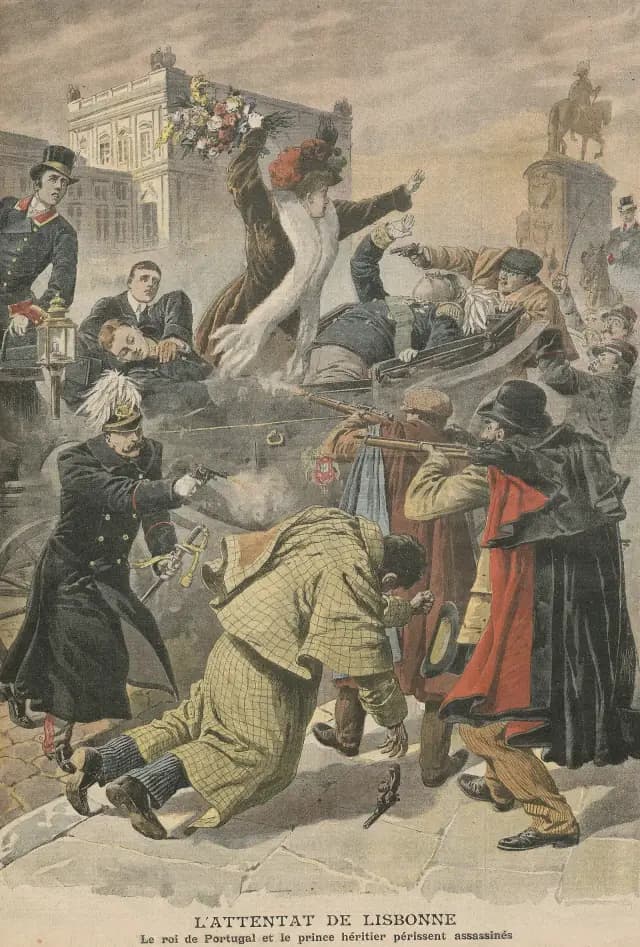
The Regeneração movement ousted Costa Cabral's government, and for decades two parties took turns in power. Portugal's first railway, from Lisbon to Carregado, opened in 1856. Britain's Ultimatum of 1890, which forced Portugal to give up part of its claims in Africa, split the parties and helped the republicans, and on 1 February 1908 King Carlos and his heir were shot dead in Lisbon.
8 key moments · 88 in all
Queen Maria II dies at the Necessidades Palace in Lisbon, aged 34, after giving birth to a stillborn son. Warned by her doctors of the dangers of repeated difficult pregnancies, she had replied 'If I die, I die at my post'; her eldest son succeeds her as Pedro V.
Wenceslau de Moraes is born in Lisbon. A naval officer who fell in love with Japan, he became Portugal's consul in Kobe and later withdrew to Tokushima with his Japanese companions. His books, from 'Dai-Nippon' to 'O Bon-Odori em Tokushima', introduced Japan to Portuguese readers.
João Franco is born in Alcaide, near Fundão. As King Carlos's prime minister he promised to govern 'the English way', but in May 1907 he sidelined parliament and ruled by decree. The resentment stirred by this dictatorship fed directly into the regicide of 1908.
Cesário Verde is born in Lisbon's Madalena parish. He worked in the family hardware business, died of tuberculosis at 31 and never saw a book of his own in print, yet poems such as 'O Sentimento dum Ocidental', a dusk walk through gas-lit Lisbon, made him a master of modern Portuguese poetry, championed by Pessoa.
Birth in Caldas da Rainha of José Malhoa, the leading painter of Portuguese naturalism. His 'O Fado' (1910), showing a guitarist singing in a humble Lisbon room, became the defining image of the genre Caldas da Rainha's art museum bears his name.
King Pedro V rides the inaugural train of Portugal's first railway, a 36-kilometre line from Lisbon to Carregado. It was the first stretch of what became the Linha do Norte, which would eventually link the capital with Porto.
 Long readPortugal's first train: Lisbon to Carregado, 28 October 1856
The painter Columbano Bordalo Pinheiro is born in Cacilhas, younger brother of the caricaturist Rafael. His sombre portraits of Antero de Quental, Teófilo Braga and the artists of the 'Grupo do Leão' made him the leading portraitist of his generation; he later directed the National Museum of Contemporary Art and helped design the republican flag.
Death in Lisbon of Queen Estefânia, the German-born wife of King Pedro V, from diphtheria at just 22, barely a year after her wedding. Known as the 'angel of the poor' for her charitable work, she is remembered in the Hospital de Dona Estefânia, the Lisbon children's hospital that bears her name, and her death left the young king inconsolable.
Portugal and the Tokugawa Shogunate sign a Treaty of Peace, Amity and Commerce in Edo (present-day Tokyo), establishing formal diplomatic relations and reopening trade more than two centuries after the Portuguese were expelled from Japan in 1639.
King Pedro V dies of typhoid fever at the Necessidades Palace in Lisbon, aged just 24, after a reign of eight years. The same epidemic also carried off his brothers, the infantes Fernando and João, that year, plunging the country into mourning.
The future King Carlos I of Portugal is born at the Ajuda Palace in Lisbon, son of Luís I and Maria Pia of Savoy. A noted oceanographer, he reigned from 1889 until his assassination in Lisbon in 1908.
Portugal and Spain sign the Treaty of Lisbon, fixing their frontier from the mouth of the Minho to the confluence of the Caia and Guadiana rivers and abolishing the Couto Misto, a tiny self-governing territory that had eluded both crowns for centuries.
The 'Diário de Notícias' appears in Lisbon for the first time, with a specimen issue. Founded by the journalist Eduardo Coelho and the printer Tomás Quintino Antunes, it grew into one of the country's leading newspapers and is still published today.
The Portuguese Red Cross is founded in Lisbon by the army surgeon José António Marques, as the 'Provisional Commission for Relief of the Wounded and Sick in Time of War' — among the earliest national societies of the international Red Cross movement.
Lisbon's Santa Apolónia station is inaugurated on the riverfront below the Alfama. Its neoclassical building and 117-metre train shed replaced the makeshift terminus in the old convent of Santa Apolónia that had served since Portugal's first railway opened in 1856, and it remains the capital's oldest railway terminus.
Birth at Seixas, near Caminha, of Miguel Ventura Terra, the Paris-trained architect who shaped belle-époque Lisbon. He redesigned the debating chamber of the parliament at São Bento, built the Shaaré Tikvá synagogue, the Liceu Camões and the Teatro Politeama, and won the city's Valmor architecture prize four times.
A landmark royal decree abolishes the death penalty for civil crimes in Portugal — one of the earliest abolitions in the world — and promulgates the new Civil Code drafted by Visconde de Seabra, a foundational text of modern Portuguese law.
António Nobre, whose only book 'Só' became a landmark of Portuguese symbolist and saudosista poetry, is born in Porto.
Birth of Manuel António Gomes, the 'Padre Himalaya', at Cendufe, Arcos de Valdevez. A priest so tall he was nicknamed after the mountains, he pioneered solar energy: his 'pyrheliophor', a 13-metre reflector of mirrors that melted metals with sunlight, won the Grand Prize at the 1904 St Louis World's Fair and was hailed by the 'New York Times'.
Carlos Viegas Gago Coutinho is born in Lisbon. A naval officer and geographer who adapted the sextant for use in aircraft, he navigated the first aerial crossing of the South Atlantic with Sacadura Cabral in 1922, a feat celebrated on both sides of the ocean.
A decree championed by the Marquis of Sá da Bandeira abolishes slavery throughout the Portuguese empire. But the people it freed became 'libertos', still obliged to serve their former masters until a further law in 1875, and forced labour persisted in the African colonies well into the 20th century.
Óscar Carmona is born in Lisbon. The general who emerged as the leading figure of the military dictatorship after the 1926 coup, he remained head of state until his death in 1951, the figurehead under whom Salazar built the Estado Novo.
King Luís I raises Covilhã, the wool-manufacturing town on the slopes of the Serra da Estrela, to the status of city. The date remains the municipal holiday.
Birth of Domitila de Carvalho in Travanca, near Santa Maria da Feira. In 1891 she became the first woman admitted to the University of Coimbra — on condition that she always dress in black — and graduated in mathematics, philosophy and medicine; in 1934 she was one of the first three women elected to Portugal's parliament.
The novelist Júlio Dinis, author of 'As Pupilas do Senhor Reitor', dies of tuberculosis in Porto at only 31 years of age.
The submarine telegraph cable from Carcavelos beach, west of Lisbon, to Recife — via Madeira and Cape Verde — is completed, and its arrival is cabled to Emperor Pedro II of Brazil. News that had taken 15 to 40 days to cross the Atlantic by steamer can now appear in Brazilian papers the next day.
António Egas Moniz is born in Avanca, near Estarreja. Neurologist, foreign minister and head of Portugal's delegation to the Paris Peace Conference, he pioneered cerebral angiography and the prefrontal leucotomy, which brought him Portugal's first Nobel Prize, in 1949.
French President Patrice de MacMahon, asked to arbitrate between Portugal and Britain, awards the whole of Delagoa Bay — today's Maputo Bay — to Portugal. The ruling secured the future capital of Mozambique for the Portuguese, and the city still remembers it: a local beer is called '2M', after the marshal.
The Caixa Geral de Depósitos is created by law in Lisbon, at first to safeguard the deposits that courts and public bodies were required to lodge. Wholly owned by the state ever since, it grew into the country's largest bank and a fixture of every Portuguese high street.
The Dona Maria Pia railway bridge over the Douro between Porto and Vila Nova de Gaia is inaugurated. Built by Gustave Eiffel's Paris firm, its wrought-iron crescent arch was then the longest single-arch span in the world; it carried trains until 1991 and is a National Monument.
Birth in Guarda of Carolina Beatriz Ângelo, Portugal's first woman surgeon. In 1911, as a widow and 'head of household', she won a court case that let her become the first woman to vote in Portugal — prompting the Republic to rewrite the electoral law in 1913 to bar women explicitly.
Lisbon marks the tercentenary of Camões's death with a great 'cortejo cívico' through its streets, organised by a commission of the Portuguese press and echoed by processions in towns across the country. The first large civic commemoration of its kind in Portugal turns 10 June into a national symbol and lays the foundations of today's Dia de Portugal.
Birth in Porto of naval officer José Carvalho Araújo. In October 1918, commanding the small patrol boat 'Augusto de Castilho', he turned to fight the German submarine U-139 for two hours so that the steamer 'São Miguel', carrying 206 passengers from Madeira to the Azores, could escape. He died in the battle, and his ship was sunk.
Birth of Carlos Sampaio Garrido, Portugal's envoy in Budapest during the Nazi occupation of Hungary. In 1944 he hid Jews in his residence — among them relatives of the actress Zsa Zsa Gabor — and, with his deputy Teixeira Branquinho, issued papers credited with saving about 1,000 people. Yad Vashem named him Righteous Among the Nations in 2010.
Birth in Loulé of José Mendes Cabeçadas, the naval officer who helped both to make and to unmake the First Republic. A leader of the mutiny aboard the cruiser Adamastor in the 1910 revolution, he raised the 1926 revolt in Lisbon that toppled the Republic and was briefly head of state, until the generals pushed him aside. He spent his last decades conspiring against Salazar.
The Berlin Conference ends with 14 nations, Portugal among them, signing its General Act on the 'Scramble for Africa'. Its principle that claims needed 'effective occupation' pushed Lisbon to back its claims with expeditions and the 'Pink Map' plan to link Angola and Mozambique, crushed by Britain's 1890 ultimatum.
Birth of Aristides de Sousa Mendes at Cabanas de Viriato, Beira Alta. As Portuguese consul-general in Bordeaux in June 1940, he would defy Salazar's standing orders and issue thousands of visas to refugees — many of them Jews — fleeing the Nazi advance, an act of conscience that cost him his career and would later earn him the title 'Righteous Among the Nations'.
The Elevador da Glória opens in Lisbon, linking the Restauradores to the Bairro Alto. Designed by the engineer Raoul Mesnier du Ponsard and electrified in 1915, the funicular became one of the city's best-loved symbols; its derailment on 3 September 2025 killed 16 people.
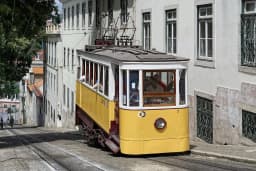 Long readThe Elevador da Glória: Lisbon's hill funicular, 1885 to 2025
Cosme Damião is born in Lumiar, Lisbon. A former Casa Pia pupil, he was the driving force among the young founders of Sport Lisboa in 1904, the club that became Benfica, and served it as captain, coach and journalist for two decades — yet always refused to become its president.
Death in Lisbon of Fernando II, the 'King-Artist' and widower of Maria II, who turned a ruined monastery above Sintra into the fairy-tale Pena Palace. Suffering double vision from a facial tumour, he had fallen on the stairs of the São Carlos opera house three days earlier and never recovered; his will, leaving almost everything to his second wife, the singer Elise Hensler, caused a scandal.
Crown Prince Carlos, the future King Carlos I, marries Amélie of Orléans at the Church of São Domingos in Lisbon; as Queen Amélia she would be the last queen consort of Portugal.
The upper deck of the Ponte Luís I over the Douro, designed by Théophile Seyrig and built by the Belgian Société de Willebroeck, is inaugurated in Porto on the king's birthday. The lower deck followed in 1888, and the two-tier iron arch became the enduring emblem of the city.
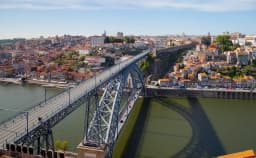 Long readPonte Luís I: the double-decker iron arch that joined Porto and Gaia
Birth at Belém Palace of Luís Filipe, heir of King Carlos I. In 1907 he became the first member of the royal family to tour the African colonies; less than a year later, on 1 February 1908, he was shot alongside his father in the Lisbon Regicide, surviving him by about 20 minutes.
The Associação Académica de Coimbra is founded, the oldest students' union in Portugal. Every student of the University of Coimbra automatically becomes a member, and its football team, Académica, became one of the country's best-loved clubs.
Amadeo de Souza-Cardoso is born at Manhufe, near Amarante. In Paris he befriended Modigliani and in 1913 showed at the Armory Show in New York; his fusion of Cubism, Futurism and Portuguese folk motifs makes him the great pioneer of modern painting in Portugal.
The newspaper 'Jornal de Notícias' publishes its first edition in Porto. The daily has outlived every regime since to become one of Portugal's longest-running and most widely read papers.
Birth of Fernando Pessoa in Lisbon. Educated in Durban and steeped in English-language literature, he would invent dozens of 'heteronyms' — Alberto Caeiro, Ricardo Reis, Álvaro de Campos and others — and is now considered one of the most significant literary figures of the 20th century. His masterwork 'Livro do Desassossego' was published only decades after his death.
Death of Eduardo Coelho, the Coimbra-born typesetter turned journalist who in December 1864 co-founded the 'Diário de Notícias' with the printer Tomás Quintino Antunes. He ran it until his death; still published today, the 'DN' is regarded as Portugal's newspaper of record.
King Luís I dies at the Citadel of Cascais at the age of 50. A translator of Shakespeare, he had reigned for almost 28 years and was succeeded by his son Carlos I.
Lord Salisbury's government delivers the British Ultimatum, demanding that Portugal withdraw its forces from the lands between Angola and Mozambique claimed in the 'Pink Map'. Lisbon's swift capitulation is felt as a national humiliation and fuels the republican movement that would topple the monarchy twenty years later.
Death of Camilo Castelo Branco at his home in Seide, near Vila Nova de Famalicão. Facing progressive blindness from neurosyphilis and overwhelmed by years of personal misfortune, the prolific Romantic novelist takes his own life with a revolver. His vast catalogue — more than 260 works, including 'Amor de Perdição' — secures his reputation as one of the founders of the modern Portuguese novel.
The Coliseu dos Recreios, Lisbon's great iron-domed performance hall on the Rua das Portas de Santo Antão, is inaugurated with a performance of Franz von Suppé's operetta 'Boccaccio'.
In the aftermath of the British Ultimatum, Portugal and Britain sign the Treaty of London defining the frontiers of Angola and Mozambique; public outrage prevents its ratification in Lisbon, brings down the government, and forces its replacement by a new treaty in 1891.
In the first attempt to found a republic in Portugal, soldiers led mostly by sergeants rise in Porto, angered by the monarchy's surrender to the British Ultimatum. They proclaim the republic from the windows of the town hall before the Municipal Guard crushes the revolt; the street where the fighting raged is now Rua 31 de Janeiro.
The poet Antero de Quental, a central figure of the Generation of '70, dies by suicide in Ponta Delgada on his native island of São Miguel in the Azores.
The Campo Pequeno bullring is inaugurated in Lisbon. Designed by the architect António José Dias da Silva in neo-Moorish style with red-brick towers, it remains the city's principal arena for bullfights and concerts to this day.
Birth of Aníbal Augusto Milhais — better known as 'Soldado Milhões' ('Soldier Millions') — in Valongo, near Murça in Trás-os-Montes, a village later renamed Valongo de Milhais in his honour. In April 1918, at the Battle of the Lys, the lone private covers the retreat of his Portuguese and British comrades with a Lewis gun, earning the Tower and Sword on the battlefield.
Poet and educator João de Deus dies in Lisbon aged 65. Celebrated in his day as the great lyric poet of love, he is best remembered for the 'Cartilha Maternal', a method of teaching children to read that was used in Portuguese schools for generations; he lies in the National Pantheon.
Gungunhana, the last ruler of the Gaza empire in southern Mozambique, arrives in Lisbon as a prisoner after his capture by Mouzinho de Albuquerque at Chaimite. Thousands flock to the Tagus to gawp at the man the press hails as a war trophy; he was later exiled to Terceira in the Azores, where he died in 1906.
Death of José Tomás de Sousa Martins, the Lisbon physician revered for treating the poor and for promoting the Serra da Estrela as a refuge for tuberculosis patients. His statue on the Campo dos Mártires da Pátria is still surrounded by candles, flowers and marble ex-voto plaques from people who credit him with cures.
The architect José Ângelo Cottinelli Telmo is born in Alcântara, Lisbon. He designed the modernist Sul e Sueste ferry station on the Terreiro do Paço, directed the hit comedy 'A Canção de Lisboa' and was chief architect of the 1940 Exposição do Mundo Português — but also drew up plans for the regime's Tarrafal prison camp in Cape Verde.
Birth in Lisbon of Amélia Rey Colaço, the towering figure of 20th-century Portuguese theatre. With her husband Robles Monteiro she ran a company that was resident at the Teatro Nacional D. Maria II for 46 years, staging Brecht, Lorca and Tennessee Williams despite the censors and training actors such as Eunice Muñoz.
Birth of novelist José Maria Ferreira de Castro in Ossela, near Oliveira de Azeméis. Emigrating to Brazil at the age of 12, he spent four years on an Amazon rubber plantation, the experience behind his novel 'A Selva' (1930). A pioneer of Portuguese social realism, he was nominated more than once for the Nobel Prize.
António Aleixo is born in Vila Real de Santo António. A barely literate weaver's son who sold lottery tickets and sang his verses at Algarve fairs, he became one of Portugal's best-loved popular poets, his ironic four-line 'quadras' written down and published by a friend, Joaquim de Magalhães.
In a secret declaration signed in London by Lord Salisbury and Portugal's minister Luís de Soveral, Britain and Portugal reaffirm their ancient alliance, including the treaties of 1642 and 1661. Portugal undertakes to stop arms reaching the Boers through its territory and not to declare neutrality, while Britain's old pledge to defend Portugal's colonies is restated.
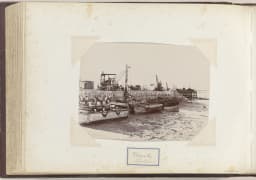 Long read1899: the secret declaration that revived the Anglo-Portuguese alliance
The poet António Nobre dies aged just 32. His book 'Só' (1892), with its homesick, saudade-steeped verses about his native north, had already made him one of the defining voices of Portuguese symbolist poetry.
José Maria Eça de Queirós, master novelist of Portuguese realism and author of 'Os Maias' and 'O Crime do Padre Amaro', dies near Paris, where he was serving as Portuguese consul.
Lisbon's first electric trams enter commercial service, running between Cais do Sodré and Algés — the beginning of the electric tram network that remains an icon of the city.
The writer and poet José Régio, a central figure of Portuguese modernism and co-founder of the influential literary magazine Presença, is born in Vila do Conde.
Joaquim Mouzinho de Albuquerque, the cavalry officer hailed as a national hero for capturing the Gaza emperor Gungunhana at Chaimite in Mozambique in 1895, takes his own life in Lisbon at the age of 46.
Birth in Aveiro of Fernando Pessa. As a BBC announcer in wartime London he brought uncensored news to Portuguese listeners, and decades later he was still filing wry TV street reports for RTP, signed off with the catchphrase 'E esta, hein?' ('How about that, eh?'). He died in 2002, days after turning 100.
Former Casa Pia pupils led by Cosme Damião meet at the Farmácia Franco in Belém and found Sport Lisboa. A 1908 merger with Grupo Sport Benfica created Sport Lisboa e Benfica, which grew into Portugal's record league champion and one of the world's best-supported clubs.
Birth in Balasar, near Póvoa de Varzim, of Alexandrina Maria da Costa. Paralysed after leaping from a window at 14 to escape three men, she lay bedridden for some 30 years and from 1942 was said to take no food but daily communion. She was beatified in 2004.
At the Pembe ford on the Cunene River in southern Angola, Kwanyama (Cuanhama) warriors rout a Portuguese expeditionary column sent to impose colonial rule on the region, killing some 250 men, more than half the force — one of the rare outright African victories over a European army during the colonial wars of conquest.
Henrique de Barros, the agronomist who taught for decades at Lisbon's Instituto Superior de Agronomia, is born in Coimbra. Elected for the Socialist Party after the Carnation Revolution, he presided over the Constituent Assembly that drafted the democratic Constitution of 1976.
Rafael Bordalo Pinheiro dies in Lisbon aged 58. The caricaturist, illustrator and ceramicist created Zé Povinho, the shrugging everyman who still stands for the long-suffering Portuguese public, and helped found the Caldas da Rainha faience factory whose cabbage-leaf tableware and outsized animals remain coveted today.
Kaiser Wilhelm II arrives in Lisbon aboard the liner Hamburg for a three-day state visit hosted by King Carlos I, through streets decked out in his honour; his landing at the Cais das Colunas is captured on film. Four days later he lands at Tangier, sparking the First Moroccan Crisis.
The café A Brasileira opens in Lisbon's Chiado, founded by Adriano Telles to sell coffee from Brazil. It became a meeting place for writers and artists, and since 1988 a bronze statue of its most famous regular, Fernando Pessoa, has sat at a table on the terrace.
Miguel Torga (Adolfo Correia da Rocha), doctor and writer regarded as one of the greatest Portuguese authors of the twentieth century, is born in São Martinho de Anta, Trás-os-Montes.
Hermínia Silva, the fado singer and revue actress whose humorous style made her one of the most beloved performers of Lisbon's stage in the 1930s and 1940s, is born at the Hospital de São José in Lisbon.
Republicans and dissident monarchists attempt a coup against João Franco's dictatorship — the 'Elevador da Biblioteca' plot — but it is betrayed and leaders including Afonso Costa are arrested. The crackdown that followed helped set the stage for the regicide four days later.
King Carlos I and Crown Prince Luís Filipe are assassinated by republican revolutionaries at Terreiro do Paço in Lisbon, in what became known as the Lisbon Regicide.
Manuel II takes his oath before the Cortes in Lisbon at his formal acclamation as King of Portugal, three months after inheriting the throne through the assassination of his father Carlos I and elder brother Luís Filipe. He would be Portugal's last king.
Birth in Funchal of Fernão de Ornelas, the lawyer who as president of the city council from 1935 to 1946 led a sweeping programme of public works that modernised Madeira's capital. Ousted after a clash with the island's governor, he was posthumously awarded Funchal's Medal of Honour in 2008.
A strong earthquake strikes the Tagus valley in the late afternoon, wrecking much of Benavente, Samora Correia and Salvaterra de Magos and killing several dozen people. Aid poured in from across the country, and Benavente was rebuilt on a new, more regular plan.
Club Sport Marítimo, one of Portugal's historic football clubs, is founded in Funchal on the island of Madeira; it would go on to win the national Campeonato de Portugal in 1926.
Miguel Bombarda, the psychiatrist who directed the Rilhafoles asylum and was one of the leaders of the republican conspiracy, is shot in his office by a former patient and dies that evening, hours before the uprising that proclaimed the Republic on 5 October.
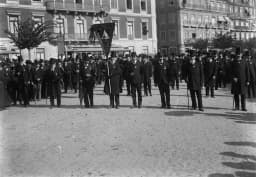 Long readMiguel Bombarda: the shooting at Rilhafoles on the eve of the Republic
The republican revolution breaks out in Lisbon. With the Palácio das Necessidades under threat of bombardment, King Manuel II withdraws to Mafra, and the following day he boards the royal yacht Amélia at Ericeira for exile, never to return.
Back to the full timeline of Portugal, with key moments, search and long reads.