

Portugal's first train: Lisbon to Carregado, 28 October 1856
A cardinal blessed the engines, the king rode up the Tagus to Carregado, and a burst locomotive held the royal party up for an hour on the way home. Getting the line to Porto took another 21 years.
At a glance
- On 28 October 1856 King Pedro V rode the first train on Portugal's first railway, from Santa Apolónia in Lisbon to Carregado, 36.5 kilometres up the Tagus valley.
- The line was begun by the Companhia Central e Peninsular, formed around the promoter Hardy Hislop with the London contractors Shaw & Waring. The company failed and the state finished the works.
- On the way back a locomotive's tubes burst near Sacavém, and the royal party reached Lisbon after dark.
- Trains reached Vila Nova de Gaia in 1864 and crossed the Douro into Porto in November 1877, on the Maria Pia bridge built by Gustave Eiffel's firm.
- In the 1980s about 3,600 kilometres of line were in service. In 2025 trains ran on 2,525 kilometres, and a Lisbon–Porto high-speed line is due to be built in phases from 2026.
Holy water on the engines
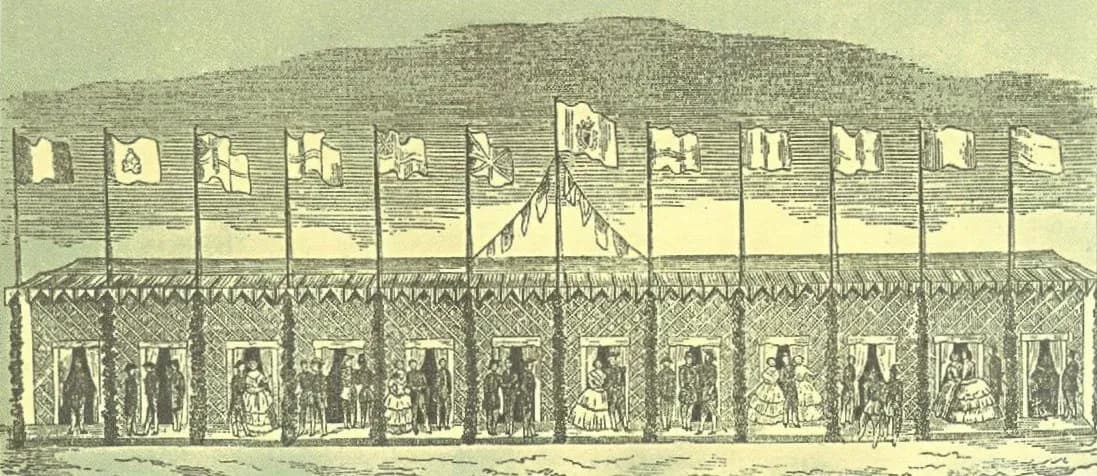
At eleven in the morning of 28 October 1856, King Pedro V arrived at Santa Apolónia, on the Lisbon waterfront, with his father and the princes and princesses of the royal family. The Cardinal Patriarch, the Infanta Isabel Maria, the diplomatic corps and a large crowd were already there. The guests were received in a pavilion divided into three richly hung rooms: one for the royal family, one for the cardinal and his clergy, one for the diplomats and the court.
The ceremony began with the locomotives. Each one drew up in turn beside the dais where the cardinal stood, and he sprinkled it with holy water. Two of them were then coupled to a train of 16 carriages, with the royal family in the middle carriage and the royal guard of archers in the first.
The magazine O Panorama said the run to Carregado took half an hour; the Jornal do Comércio said forty minutes. A second train of nine carriages, pulled by a single engine, followed three quarters of an hour later with the company's shareholders and guests. In the villages along the line, people turned out with bands, rockets and triumphal arches.
At Carregado the guests ate standing up in a flag-hung pavilion beside the temporary station. The royal train started back at about half past four. Near Sacavém, on the edge of Lisbon, the tubes of one of its two locomotives burst. The other engine took six carriages, the king's among them, on to Santa Apolónia, then went back for the remaining eight. The return took two hours, and the rest of the guests were back in Lisbon by ten at night.
“It is now generally known that the cause of yesterday's upset on the railway, on the return journey of the train in which Their Majesties were travelling, was the bursting of the tubes of a locomotive near Sacavém.”
The paper, which counted 14 carriages on the royal train rather than 16, blamed engines that were old and worn out, and a company that had never set up a repair workshop. Four new locomotives from an English maker were expected the following month. The track itself, it added, was sound, and the public trips advertised for that day had run without incident.
- Date
- Tuesday 28 October 1856 in most accounts; public trains within a day or two
- Route
- Santa Apolónia (Lisbon) to Carregado, along the Tagus
- Length
- 36.5 km (36.454 km in the 1956 table of openings)
- Royal train
- Two locomotives and 16 carriages (O Panorama) or 14 (Jornal do Comércio)
- Outward time
- 30 to 40 minutes, depending on the account
- Builder
- Companhia Central e Peninsular, then the state; contractors Shaw & Waring of London until 1855
Why Portugal waited
England's Liverpool and Manchester Railway had opened in 1830. Portugal took another 26 years, and not for lack of plans. On 19 April 1845 the government signed a contract with the Companhia das Obras Públicas de Portugal that included a railway from Lisbon to the Spanish border, but the company sank with the political upheavals of 1846.
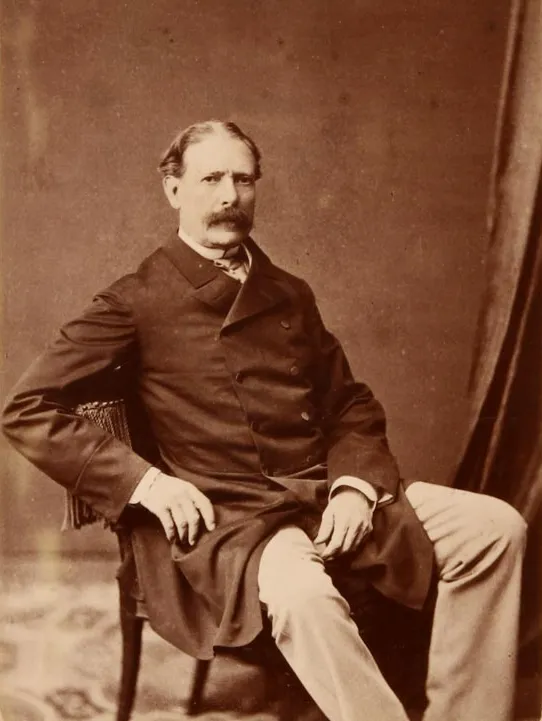
The minister most associated with that policy was António Maria de Fontes Pereira de Melo, then in charge of finance. The railway tender of 1852 was drawn up under his inspiration, and on 30 August 1852 a new Ministry of Public Works, Commerce and Industry was created. Historians call his programme of roads, railways and telegraph lines, paid for largely with loans raised abroad, fontismo.
“Railways are, within an important set of works that runs from roads to the telegraph, leaving aside only canals, the most spectacular and the most expensive element, and so they become a reason for the fall of governments and for international pressure on them.”
The first target was Spain, not Porto. The planners wanted a line from Lisbon to the border near Badajoz, to join the Spanish network and make Lisbon a gateway between Europe and the Atlantic. That is why the first line was called the Caminho de Ferro de Leste, the Eastern Railway. Proposals to link Porto with Vigo were turned down because they were thought to threaten Lisbon's future as Europe's port for the Americas and Africa.
Hardy Hislop's shaky company
The first concrete offer came from Hardy Hislop. On 18 July 1851 a commission that included Almeida Garrett was named to study his proposal for a line from Lisbon to the border near Badajoz. It turned the proposal down, but on 20 October 1851 it drew up the terms for a public tender. The tender, for the first stretch from Lisbon to Santarém, opened on 6 May 1852 under a decree signed by Rodrigo da Fonseca Magalhães and Fontes, and closed on 31 July.
Three bids arrived, one of them from the British contractor Morton Peto. Two were set aside because they did not meet the conditions. The concession went to the third, from Hislop on behalf of the Companhia Central e Peninsular dos Caminhos de Ferro em Portugal, with a state guarantee of interest on the capital spent.
Its finances were weak from the start. The historian Magda Pinheiro found that a list of London shareholders presented in March 1853 was fictitious, and that the government agreed that month to take a third of the capital itself; 5,109 shares were never taken up. The contractors, Shaw & Waring of London, were among the main shareholders, and the company did not inspect the work they handed over. Only the state's engineers did.
The definitive contract was signed on 11 May 1853 and approved by law on 18 August, and work began on 17 September. The company's engineer, Thomas Rumball, had planned a terminus inland at Largo do Intendente, with a branch down to the Tagus at Xabregas. João Crisóstomo de Abreu e Sousa and Carlos Lobo d'Ávila objected that this kept the line away from the river, and the government moved the terminus at the Cais dos Soldados, an old artillery barracks on the waterfront.
Harcourt White, another engineer working for Hislop, warned that the site was too cramped, and later experience proved him right. The first station was set up in the former convent of Santa Apolónia nearby, a state building that had to be adapted for the purpose.
In early September 1855, after a dispute over an unpaid monthly bill, Shaw & Waring stopped work. Pinheiro dates the stoppage to 3 September; the Gazeta dos Caminhos de Ferro gives 5 September. The state took over the works and in February 1856 handed them to Watier, an engineer of the French bank Crédit Mobilier, assisted by Portuguese engineers.
Fontes travelled to London and Paris to settle with the contractors and the holders of Portuguese debt, and to interest the Crédit Mobilier in building a whole network. His government fell before the plan cleared the upper house. Under the Duke of Loulé's government that followed, the young king took a close hand. Pedro V distrusted French capital and used his ties with the British royal family to look for British investors instead.
The Central Peninsular ran the 36 kilometres it had opened, but it never recovered. It dissolved in May 1857, and on 9 July the state took over the line after rescinding the contract. Writing in 1988, the historian António Lopes Vieira called the affair the Central Peninsular swindle. The few Portuguese who might have put money into railways, he wrote, were still recovering from it when French promoters arrived with proposals of their own.
Nine hundred passengers a day
Public trains began within a day or two of the ceremony. Until 22 March 1857 the company ran two trains each way, then three, carrying passengers and their baggage only. Fares were charged by the kilometre and quoted in francs. Under the general tariff the state brought in for 1859, first class cost 0.088 francs a kilometre.
Traffic averaged about 900 passengers a day. In the first year of operation, from November 1856 to October 1857, the line, extended to Virtudes in July 1857, carried 314,276 people, about four in five of them in third class. It still lost money: costs exceeded receipts in each of the first three years.
João Crisóstomo de Abreu e Sousa, the engineer who ran the line for the state, blamed awkward termini, a shortage of rolling stock and costly repairs. A later engineer, Pedro Inácio Lopes, put the route first. The line ran beside the Tagus, where river boats and the Azambuja canal carried goods cheaply, and no roads brought traffic to the stations from the interior. Goods trains did not start until the line reached Virtudes, about 50 kilometres from Lisbon, in 1857.
Twenty-one years to Porto
The state pushed the line on in short stretches: to Virtudes on 31 July 1857, Ponte de Santana in April 1858 and Ponte de Asseca, about 60 kilometres from Lisbon, in June 1858. Pinheiro's verdict is that it had taken six years to build 60 kilometres.
In 1857 the government signed a contract with Morton Peto to build the line to Porto, but that year's financial crisis stopped him forming a company, and the contract was rescinded on 6 June 1859. On 30 July 1859 the government turned to the Spanish financier José de Salamanca. He set up the Companhia Real dos Caminhos de Ferro Portugueses, formally constituted on 11 May 1860 and backed mainly by French capital.
Then the work went fast. In about four years Salamanca's men opened another 426 kilometres: to Santarém on 1 July 1861, to Abrantes on 7 November 1862 and to the Spanish border near Badajoz on 24 September 1863. The Norte line left the Leste at Entroncamento, and on 7 July 1864 the last gap, between Soure and Taveiro near Coimbra, was closed. Lisbon was now linked by rail to Vila Nova de Gaia, across the Douro from Porto.
Getting across the Douro took 13 more years. The site of the Porto station and the line of the crossing were argued over in parliament, and the Companhia Real, hit by the financial crisis of 1868, had little money. Meanwhile the line stopped at Gaia, on the south bank, cut off from Porto and from the state lines being built north of the river.
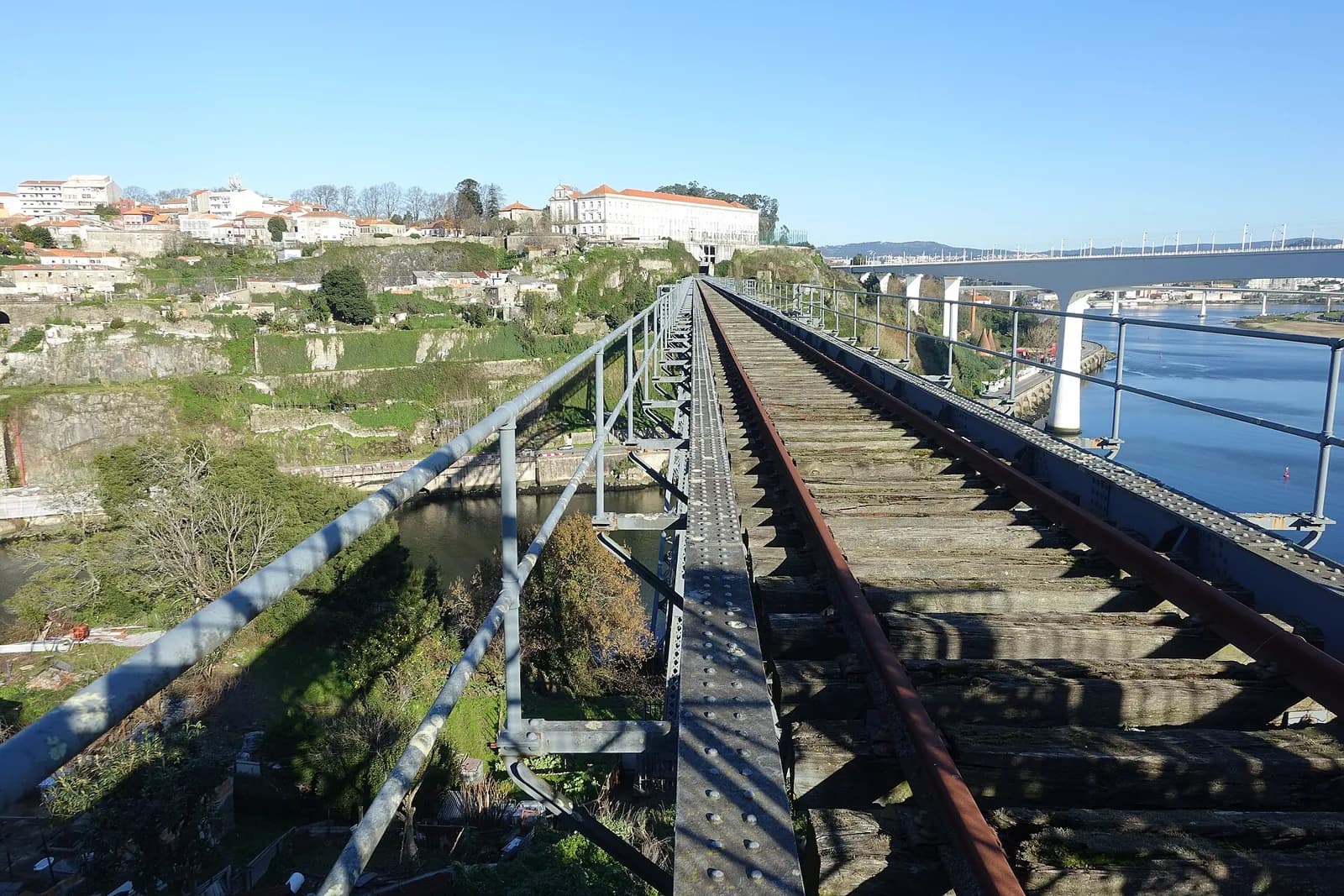
In 1875 the Companhia Real gave the bridge to the firm of Gustave Eiffel, which designed it with Théophile Seyrig. Its iron arch spanned 160 metres, the largest iron arch in the world when it was finished. King Luís and Queen Maria Pia, after whom it was named, inaugurated it on 4 November 1877, and the last stretch into Porto opened the next day.
| Date | Section | Line | Length (km) |
|---|---|---|---|
| 28 October 1856 | Lisbon to Carregado | Leste (now Norte) | 36.5 |
| 29 June 1858 | Ponte de Santana to Ponte de Asseca | Leste | 7.5 |
| 1 July 1861 | Ponte de Asseca to Ribeira de Santarém | Leste | 6.6 |
| 7 November 1862 | Ribeira de Santarém to Abrantes | Leste | 60.2 |
| 24 September 1863 | Elvas to the Spanish border | Leste | 11.1 |
| 7 July 1864 | Soure to Taveiro, completing Lisbon to Gaia | Norte | 25.8 |
| 5 November 1877 | Gaia to Campanhã (Porto) over the Maria Pia bridge | Norte | 3.6 |
| 1 July 1882 | Figueira da Foz to the border at Vilar Formoso | Beira Alta | 252.3 |
| 9 December 1887 | Côa to the border beyond Barca d'Alva | Douro | 18.9 |
| 1 July 1889 | Amoreiras to Faro | Sul | 113.8 |
Lengths, rounded, and dates from the Gazeta dos Caminhos de Ferro's 1956 table of openings, with the 1856 date and length from Manitto Torres (1958). Sources differ by a day or two for some early sections: the 1956 table gives 30 October 1856 for Lisbon to Carregado, the start of regular service rather than the ceremony, and Manitto Torres dates the Pampilhosa to Figueira section of the Beira Alta to 3 August 1882.
19 April 1845
Contract with the Companhia das Obras Públicas includes a Lisbon–border railway
It collapses with the upheavals of 1846.
18 July 1851
Commission named to study Hardy Hislop's proposal
6 May 1852
Tender opens for Lisbon to Santarém
30 August 1852
Ministry of Public Works, Commerce and Industry created
11 May 1853
Contract signed with the Companhia Central e Peninsular
17 September 1853
Construction begins
September 1855
Shaw & Waring stop work; the state takes over the works
28 October 1856
Lisbon to Carregado inaugurated
9 July 1857
The state takes over operation of the line
June 1858
Line reaches Ponte de Asseca, about 60 km from Lisbon
30 July 1859
Provisional contract with José de Salamanca
1 July 1861
Trains reach Santarém
24 September 1863
Line reaches the Spanish border near Badajoz
7 July 1864
Lisbon linked to Vila Nova de Gaia
1 May 1865
New Santa Apolónia station building opens
4–5 November 1877
Maria Pia bridge inaugurated; trains reach Porto
A network that grew, then shrank
Construction came in bursts. Magda Pinheiro describes a slow start, a boom from 1861 to 1865, little building until the mid-1870s, a deep but brief slump in the crisis of 1882 and a new expansion after 1884. By 1879 half the lines in service had been built by the state, and in 1891, with the public finances in crisis, state building stopped too.
Writing in 1958, the railway engineer Frederico de Quadros Abragão tallied the growth: 36 kilometres in 1856, 693.5 in 1864, 812 in 1874, 1,516 in 1884, 2,352 in 1894, 2,753 in 1907 and 3,135 in 1915. Almost everything on those lines, from the rails to the locomotives, wagons and carriages, was imported.
Railway lines open in Portugal, 1856 to 1915
km
The figures Frederico de Quadros Abragão gave in the Gazeta dos Caminhos de Ferro in 1958, for the years he chose. The years are unevenly spaced but the bars are not, so the horizontal axis is not to scale.
Show the data
| Length of line open | |
|---|---|
| 1856 | 36 |
| 1864 | 693.5 |
| 1874 | 812 |
| 1884 | 1,516 |
| 1894 | 2,352 |
| 1907 | 2,753 |
| 1915 | 3,135 |
Modern figures come from a different source and are not directly comparable. According to INE, the national statistics office, whose series PORDATA publishes from 1968, the length of line in operation in mainland Portugal held at about 3,600 kilometres until the late 1980s. It then fell sharply, from 3,607 kilometres in 1988 to 3,061 in 1989, and dropped again from 2,794 in 2011 to 2,541 in 2012.
Railway lines in operation in mainland Portugal, 1970 to 2025
km
Length of line in operation (linhas exploradas) every five years, INE data published by PORDATA. This series differs in source and definition from Abragão's figures for 1856 to 1915, and no consistent figures were found for 1916 to 1967.
Show the data
| Length of line in operation | |
|---|---|
| 1970 | 3,563 |
| 1975 | 3,563 |
| 1980 | 3,588 |
| 1985 | 3,607 |
| 1990 | 3,126 |
| 1995 | 3,065 |
| 2000 | 2,814 |
| 2005 | 2,839 |
| 2010 | 2,843 |
| 2015 | 2,546 |
| 2020 | 2,526 |
| 2025 | 2,525 |
In 2025 trains ran on 2,525 of the 3,622 kilometres of line counted by INE; the rest was out of use. Infraestruturas de Portugal (IP), the state company that manages the track, counts 1,792 kilometres of electrified line and 546 stations and halts in service.
Historians have asked whom the lines were for. The geographer Maria Fernanda Alegria argued in 1988 that they were built mainly to connect Portugal with Europe and its foreign trade, with too many international links and too few branches into the interior. She found that regions the railway had crossed for years still used it little for trade with the rest of the country until near the end of the century.
The same corridor today
For the centenary in 1956, CP, the company that by then ran most of the network, wanted to switch on electric trains on 28 October itself. The rolling stock was not ready, so CP marked the day with an exhibition at the Sociedade Nacional de Belas Artes, the post office issued commemorative stamps, and CP planned a train to Carregado with a parade of old and new stock for the day electric services began. Electrification at 25,000 volts began with the Sintra line and the Norte as far as Entroncamento.
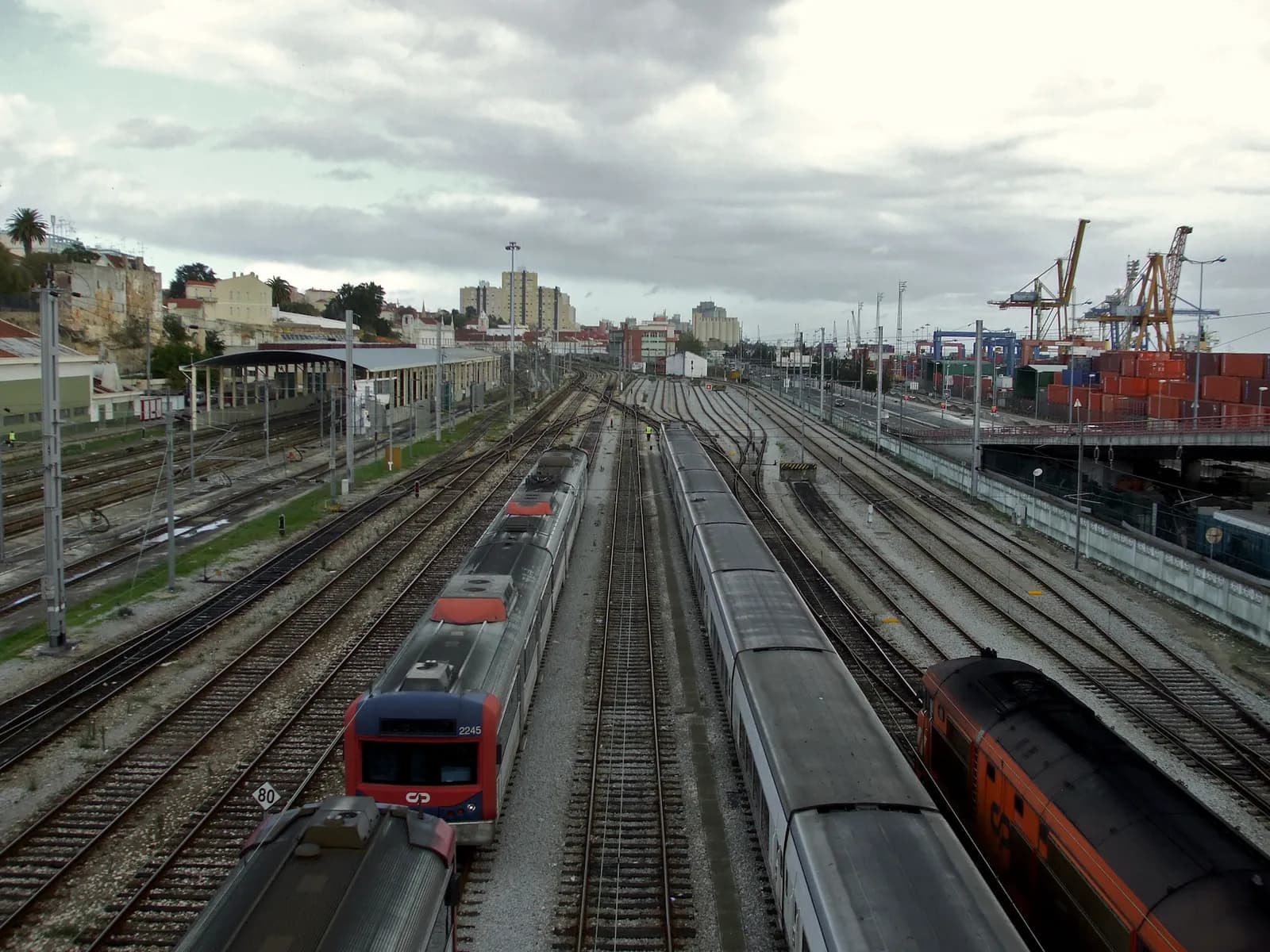
The 1856 line is now the southern end of the Linha do Norte, Portugal's main railway. According to IP, almost half of all passenger trains in the country and more than 90 per cent of freight trains use it for at least part of their journey. Mixing that traffic has caused capacity problems for years, and IP says the line's capacity and scope for higher speeds are practically exhausted.
IP's answer is a new high-speed line meant to cut the Lisbon to Porto journey to about 1 hour 15 minutes. The concession for the first section, from Porto to Oiã, south of Aveiro, was signed on 29 July 2025, with construction due to start in the third quarter of 2026 and end in 2030. A second phase, from Soure to Carregado, is due in 2033.
The last stretch, from Carregado into Lisbon, would save only about five minutes and will be built later. Until then, high-speed trains will run into the capital on the 1856 route, which is to be widened to four tracks between Alverca and Azambuja. The new line will also use the Iberian gauge, on sleepers designed to allow a later change to the European width.
FAQs
When did Portugal's first railway open?
The line from Lisbon to Carregado was inaugurated on 28 October 1856, the date CP kept for its centenary in 1956, with King Pedro V aboard the first train. Public trains followed within a day or two. O Panorama put the ceremony on 29 October, and a 1956 table of openings dates the line to 30 October.
Where did the first train run?
From a temporary station at Santa Apolónia, on the Lisbon riverfront, along the Tagus to Carregado, a distance of about 36.5 kilometres. The route is now the southern end of the Linha do Norte.
Did the inaugural train break down?
Not on the way out, which took 30 to 40 minutes. On the return, near Sacavém, the tubes of one of the two locomotives burst. The other engine took the king's part of the train on to Lisbon and then went back for the rest.
When did the railway reach Porto?
Trains reached Vila Nova de Gaia, across the Douro from Porto, on 7 July 1864. The line entered Porto in November 1877, when the Maria Pia bridge, built by Gustave Eiffel's firm, was opened.
Why do Portuguese trains run on a wider gauge than most of Europe?
The first lines were laid to the narrower European gauge, but in 1859 Portugal switched to Spain's wider gauge so that its network could connect with its only neighbour. The Iberian gauge is 1,668 millimetres, against 1,435 in most of Europe, and the new high-speed line will use it too.
On the timeline
Open the timelineNearby moments from regeneration and the last kings (1851–1910).
João Franco is born in Alcaide, near Fundão. As King Carlos's prime minister he promised to govern 'the English way', but in May 1907 he sidelined parliament and ruled by decree. The resentment stirred by this dictatorship fed directly into the regicide of 1908.
Cesário Verde is born in Lisbon's Madalena parish. He worked in the family hardware business, died of tuberculosis at 31 and never saw a book of his own in print, yet poems such as 'O Sentimento dum Ocidental', a dusk walk through gas-lit Lisbon, made him a master of modern Portuguese poetry, championed by Pessoa.
Birth in Caldas da Rainha of José Malhoa, the leading painter of Portuguese naturalism. His 'O Fado' (1910), showing a guitarist singing in a humble Lisbon room, became the defining image of the genre Caldas da Rainha's art museum bears his name.
Portugal's first railway
The painter Columbano Bordalo Pinheiro is born in Cacilhas, younger brother of the caricaturist Rafael. His sombre portraits of Antero de Quental, Teófilo Braga and the artists of the 'Grupo do Leão' made him the leading portraitist of his generation; he later directed the National Museum of Contemporary Art and helped design the republican flag.
Death in Lisbon of Queen Estefânia, the German-born wife of King Pedro V, from diphtheria at just 22, barely a year after her wedding. Known as the 'angel of the poor' for her charitable work, she is remembered in the Hospital de Dona Estefânia, the Lisbon children's hospital that bears her name, and her death left the young king inconsolable.
Portugal and the Tokugawa Shogunate sign a Treaty of Peace, Amity and Commerce in Edo (present-day Tokyo), establishing formal diplomatic relations and reopening trade more than two centuries after the Portuguese were expelled from Japan in 1639.
Coming up in history
All long reads 30 October 1340The Battle of Salado, 1340: how Portugal helped stop the last Moroccan invasion
 31 October 1886Ponte Luís I: the double-decker iron arch that joined Porto and Gaia
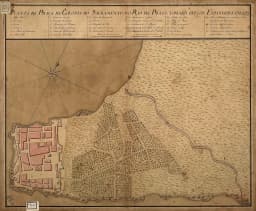 1 October 1777The Treaty of San Ildefonso: Portugal and Spain redraw South America, 1777
 2 October 1969Mr Five Per Cent's museum: the Gulbenkian opens in Lisbon, 1969
15 sources
Archives, scholarship and reporting this article was checked against.
- 1
Gazeta dos Caminhos de Ferro, n.º 1652 (16 October 1956): centenary issue of the Portuguese railwaysGazeta dos Caminhos de Ferro, digitised by the Hemeroteca Municipal de Lisboa
- 2
- 3
Investimentos estrangeiros, política financeira e caminhos-de-ferro em Portugal na segunda metade do século XIX (Magda de Avelar Pinheiro)Análise Social, vol. 15, n.º 58 (1979), pp. 265–286
- 4
- 5
Extensão da rede ferroviária: total, explorada e desativada (Continente), 1968–2025PORDATA, from INE data
- 6
Projeto de Alta Velocidade: FAQ (Linha de Alta Velocidade Porto – Lisboa)Infraestruturas de Portugal
- 7
A Monarquia Constitucional (1820-1910)Assembleia da República
- 8
- 9
Ponte Maria PiaInfraestruturas de Portugal
- 10
2021, Ano Europeu do Transporte FerroviárioArquivo Nacional Torre do Tombo
- 11
- 12
- 13
- 14
Sobre o MuseuFundação Museu Nacional Ferroviário
- 15
Image credits
- The royal pavilion beside the temporary station at Carregado, where the king and his guests were given a meal on 28 October 1856. The engraving appeared in the Lisbon magazine O Panorama on 14 February 1857. Unknown author, Public domain, via Wikimedia Commons.
- António Maria de Fontes Pereira de Melo, the minister behind Portugal's first railway tender, photographed in 1883. Karl Emil Biel and workshop, Public domain, via Wikimedia Commons.
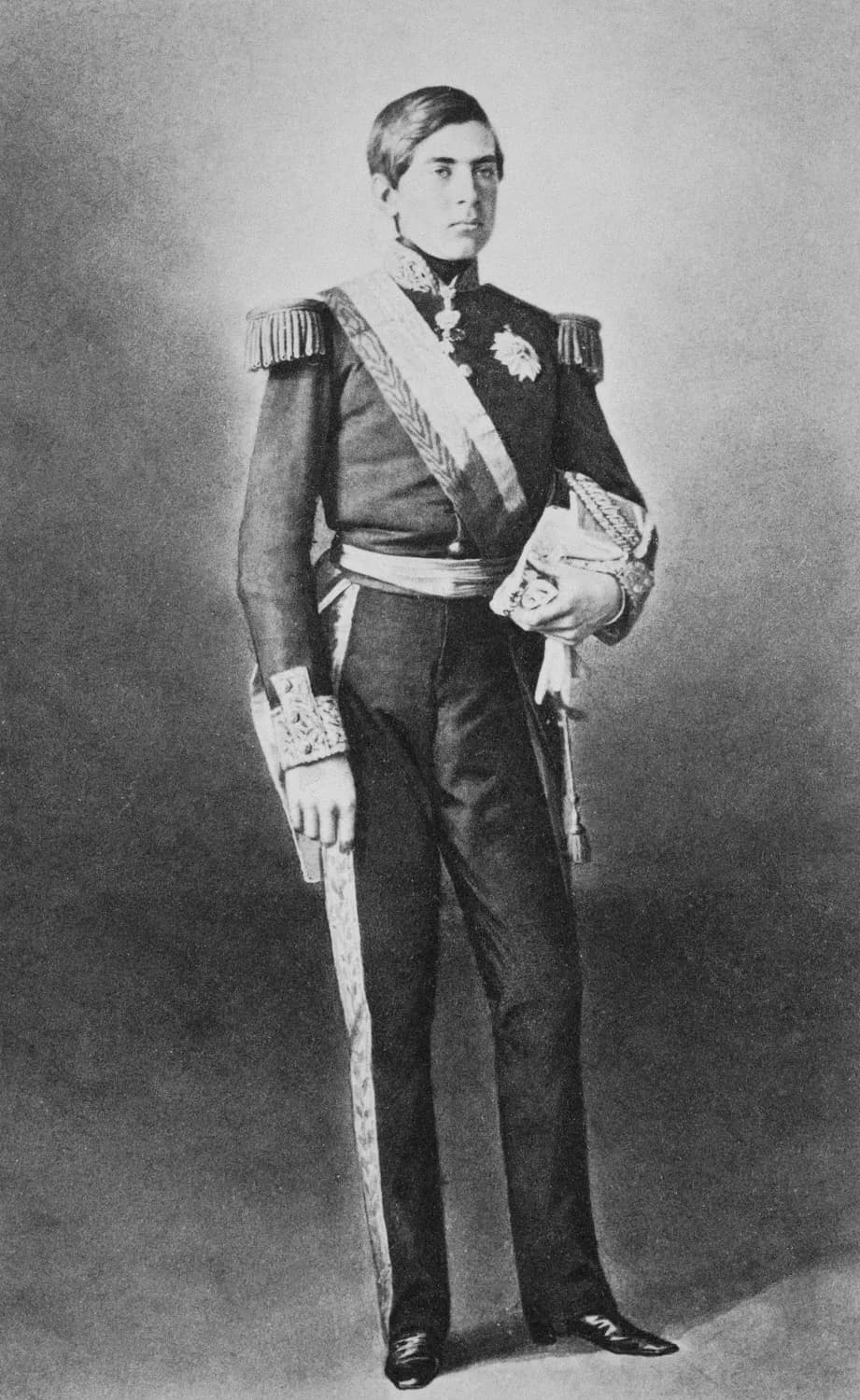
- King Pedro V in a portrait issued by the Paris studio Mayer & Pierson in about 1860. Mayer & Pierson, Public domain, via Wikimedia Commons.
- The deck of the Maria Pia bridge across the Douro in December 2024. The bridge has carried no trains since 1991. Joseolgon, CC BY 4.0, via Wikimedia Commons.
- Tracks leading out of Santa Apolónia station, kilometre zero of the Linha do Norte, in November 2009. Nuno Morão from Portugal, CC BY-SA 2.0, via Wikimedia Commons.
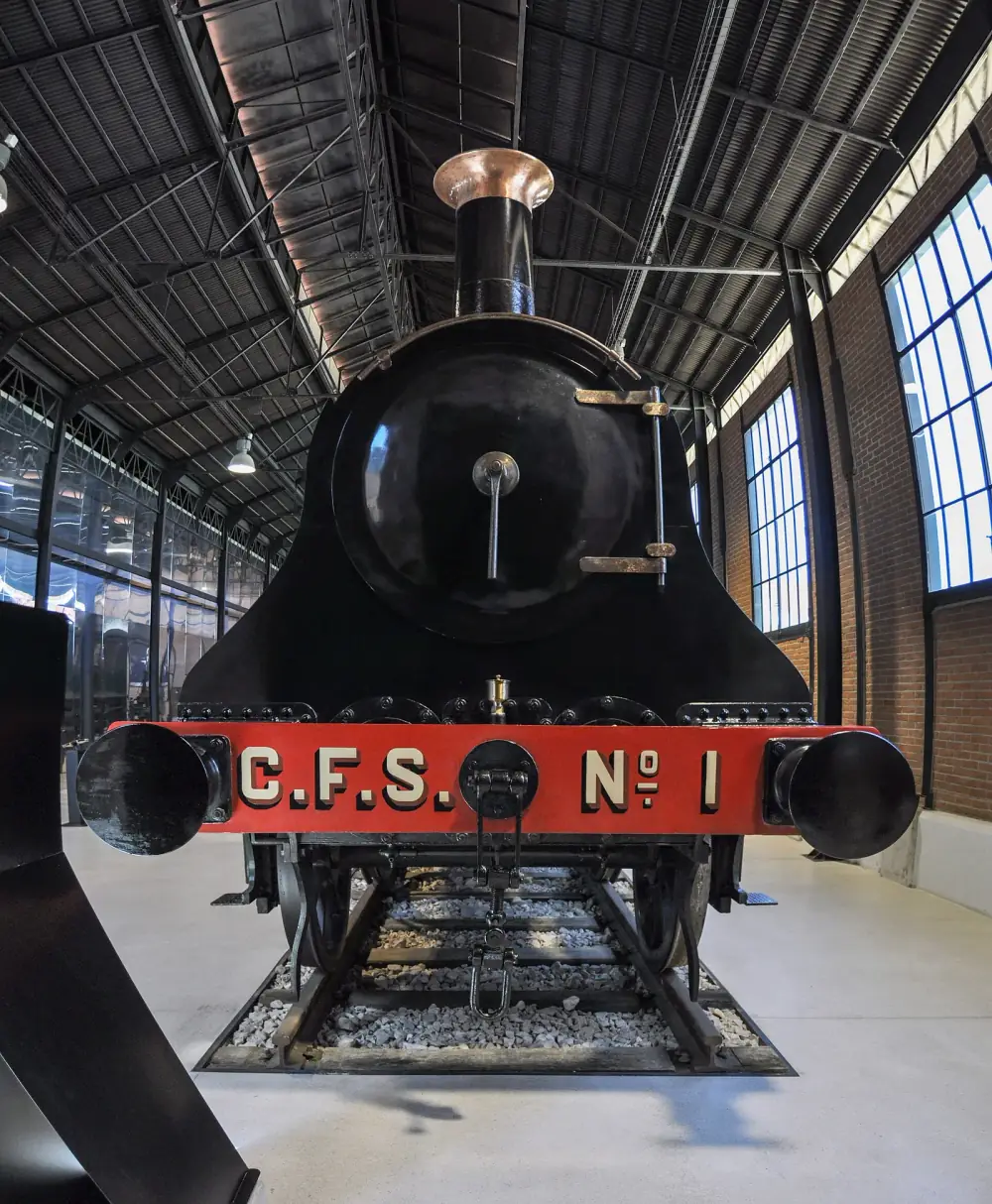
- Steam locomotive No. 1, D. Luiz, of the Caminhos de Ferro do Sul, the railway south of the Tagus, in the Museu Nacional Ferroviário at Entroncamento in July 2015. Tiago Miranda from Valongo, Portugal, CC BY 2.0, via Wikimedia Commons.