

Ponte Luís I: the double-decker iron arch that joined Porto and Gaia
Porto needed a bridge that could reach both its riverside quays and its hilltop streets. A Belgian firm, and the engineer behind the arch of Eiffel's railway bridge over the same gorge, gave it one with two decks.
At a glance
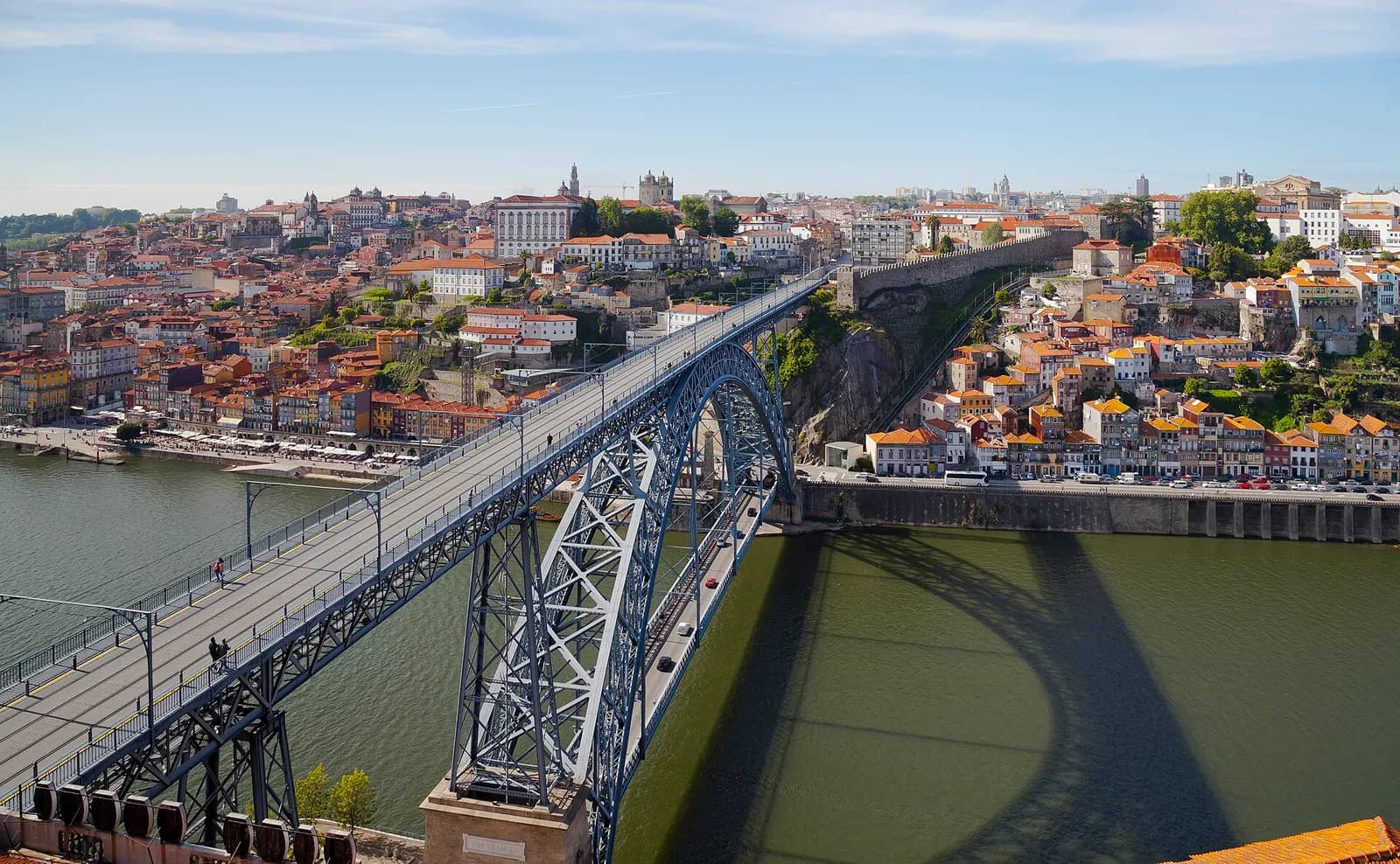
- The Ponte Luís I is a two-deck iron arch bridge over the Douro between Porto and Vila Nova de Gaia. Its upper deck was inaugurated on 31 October 1886, King Luís I's 48th birthday.
- The lower deck came later: Infraestruturas de Portugal, which looks after it, says it was only finished in 1888.
- It was designed by Théophile Seyrig, Gustave Eiffel's former partner, and built by the Belgian Société de Willebroeck, winner of an international competition with twelve entries.
- The arch spans 172 metres. The bridge weighs 3,045 tonnes, and it replaced a suspension bridge of 1843 that stood beside it.
- Since 2005 the upper deck has carried Line D of the Metro do Porto. The bridge is part of the UNESCO World Heritage site of Porto's historic centre, inscribed in 1996.
A Sunday in October, two bridges side by side
On Sunday 31 October 1886, Porto inaugurated the upper deck of its new iron bridge over the Douro. The deck ran high above the river from the cathedral quarter on the Porto bank to the heights of Vila Nova de Gaia opposite, and it rested on a single iron arch 172 metres across.
The date was also King Luís I's 48th birthday. He had been born at the Necessidades palace in Lisbon on 31 October 1838, and as a young prince he had been the first Duke of Porto. The bridge took his name. The plaque over the entrance to the lower deck still spells it the old way, Ponte Luiz I, although almost everyone in Porto calls it the Ponte D. Luís.
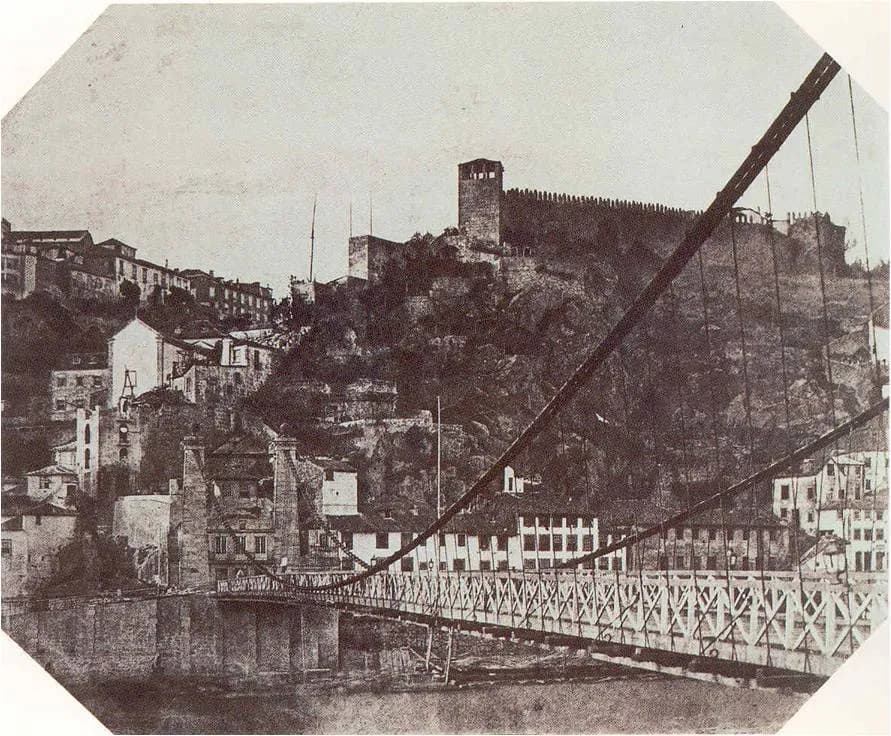
Beside it hung the bridge it was built to replace. The Ponte Pênsil, a suspension bridge opened in 1843, carried a wooden deck six metres wide about ten metres above the water, slung from cables passing over stone obelisks on each bank. Next to the new arch it looked tiny.
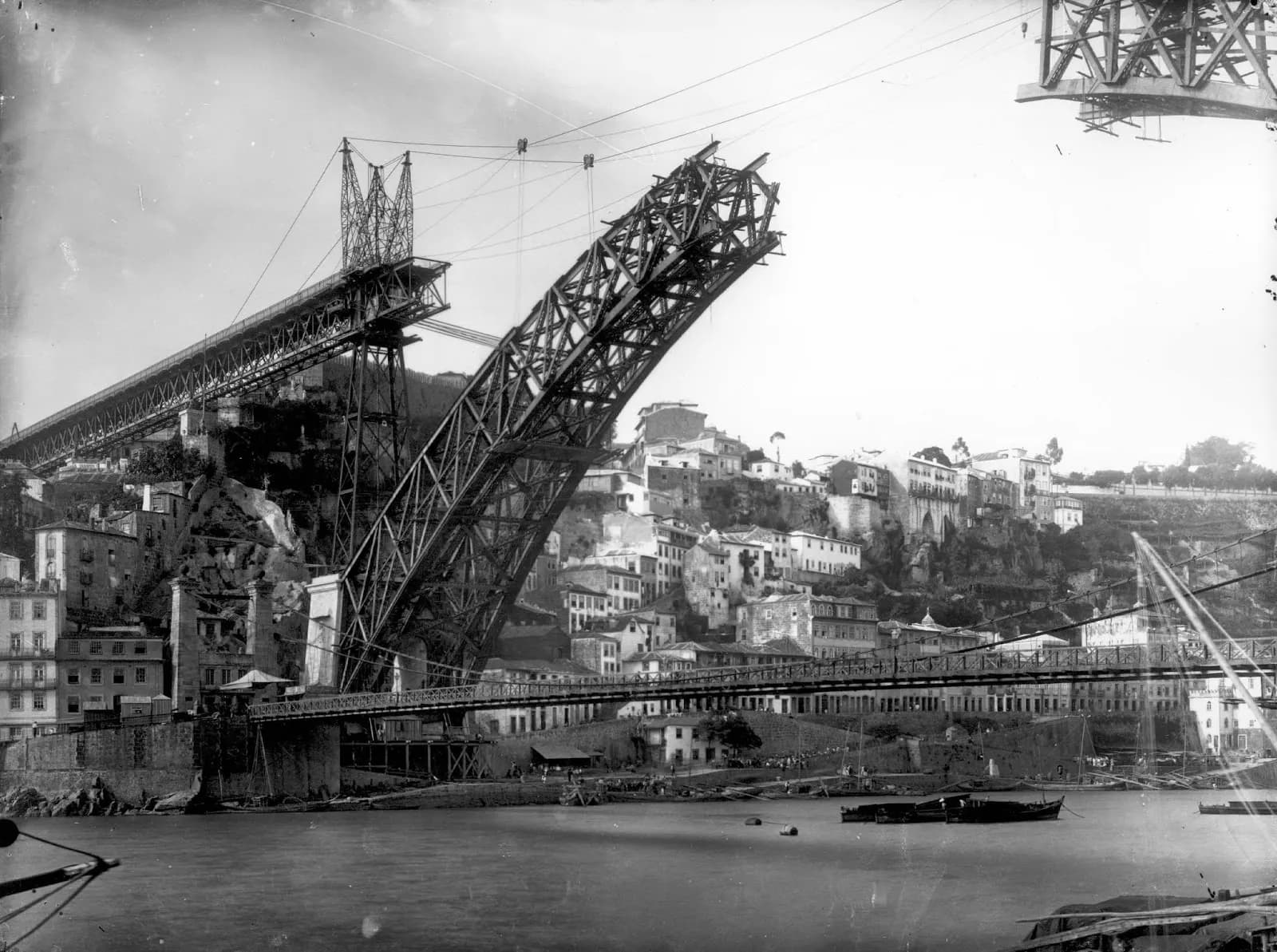
The new bridge did something the old one could not. It had two decks: the upper one at the level of the streets on the hilltops, and a lower one at the level of the quays, which was not yet finished in 1886. Infraestruturas de Portugal (IP), the state company that looks after the bridge today, says the lower deck was only completed in 1888.
Ferries, a bridge of boats and a bridge that trembled
For most of its history Porto crossed the Douro by boat. The river runs through a steep gorge between Porto and Gaia and floods hard. As late as 1787 the priest Agostinho Rebelo da Costa, describing the city, wrote that its heavy current did not allow a bridge. A regular ferry between the two banks had run since 1744.
Bridges of boats were probably laid across when an army had to pass or a great festival called for one, and then taken up again. In 1806 Porto opened one meant to stay: 20 boats moored side by side and anchored upstream and downstream, with a roadway on top for people, animals and carts. It rose and fell with the tide, could be opened to let larger ships through and was taken apart when the river was in flood. It is attributed to the military engineer Carlos Amarante.
On 29 March 1809, during the second French invasion of Portugal, Marshal Soult's army stormed the lines that defended Porto. Soldiers and townspeople ran down the steep streets to the bridge, the only way out across the river. Part of the roadway in the middle was missing, and the crowd behind, unable to see the gap, kept pushing the people in front into the water.
“For more than half an hour, it is said, the rush of fugitives kept thrusting its own front ranks into the death-trap, forty feet broad, in the midst of the bridge.”
Accounts differ on how the gap opened. Oman followed Portuguese witnesses who said the first fugitives across had raised a drawbridge between the central boats to stop the French. The earlier historians Le Noble and Napier, and a witness named Hennegan who was in Porto that day, said the central boats sank under the weight. Nobody counted the dead. Contemporary figures for all the Portuguese killed and drowned in the storming of the city ran from 4,000 to 20,000. Oman put the true total at perhaps 7,000 or 8,000, thousands of them drowned in the river.
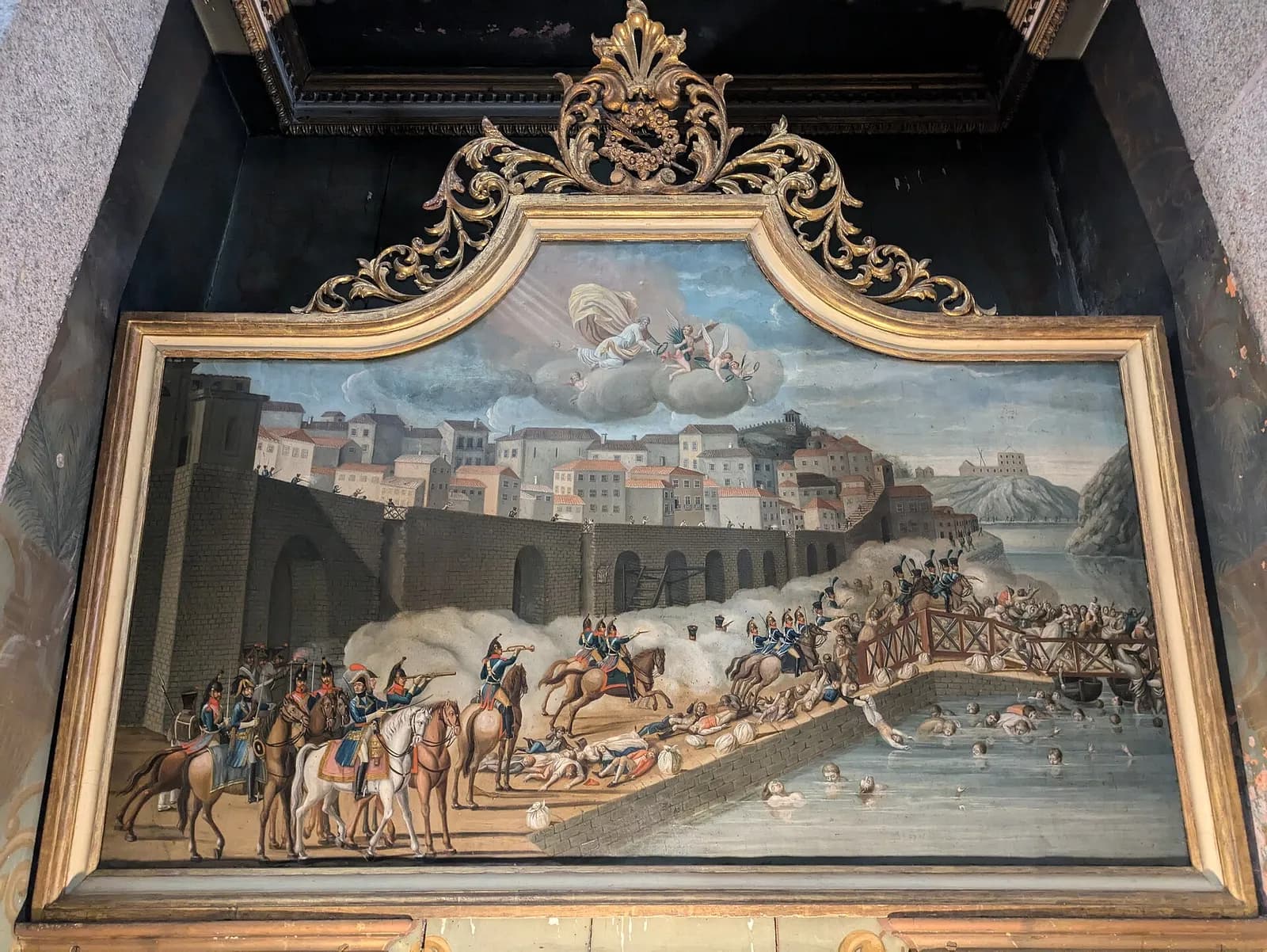
The bridge was repaired, and on 12 May 1809 the French burned it to stop the Anglo-Portuguese army under Arthur Wellesley from crossing. Two improved bridges of boats followed before Porto got its first fixed crossing.
That was the Ponte Pênsil, officially named after Queen Maria II, though nobody called it that. Work began in February 1841 and it opened on 17 February 1843, the first fixed bridge anywhere on the Portuguese stretch of the Douro. It was designed by the engineer Stanislas Bigot and built by the company of Claranges-Lucotte. Eight cables of parallel iron wires, four on each side, held a deck over a span of about 170 metres, and travellers paid a toll at a small booth at the Porto end.
It was light and graceful, and from the start people did not trust it. Some writers said it shook underfoot like a green twig. After suspension bridges of the same type failed at Angers in 1850, where about 200 people died, and at La Roche-Bernard in 1852, the government had the Porto bridge load-tested in March 1853 and ordered an inspection every year. When the builders' concession ended on 17 January 1877 it was tested again and passed, but the doubts remained.
“Part of its anchoring cables are contained in chambers that cannot be inspected… it may be that the iron wires at those points have suffered more or less oxidation, and therefore lost part of their strength.”
A bridge for the quay and for the hill
Porto is built on a slope. Its old streets run steeply down to a broad quay on the river, and the hill of Serra do Pilar rises just as steeply on the Gaia side. A bridge low enough to land on the quays passed far below the upper town, and a high one left the riverside behind.
The idea of serving both levels at once came before the competition. In 1876 Bento Fortunato de Almeida d'Eça, an army engineer, drew a preliminary design with two decks on roughly the present site. Manuel de Azeredo, the Porto engineering professor who wrote the standard account of the city's bridges, thought it was probably the first. In 1878 or 1879 Gustave Eiffel proposed something else: a drawbridge modelled on his Maria Pia railway bridge, with a footway running along the bottom of the arch. That footway sat only a little above the roadway, so it did nothing for the upper town around the cathedral.
When the government held an international competition in 1880, its programme required a link at two different heights. According to the engineer Almeida e Sousa, the programme was written by João Joaquim de Matos, then director of the Minho railway. Ten firms sent in twelve designs.
The winner was one of two similar variants entered by the Société de Willebroeck, a Belgian construction company from Brussels, both signed by Théophile Seyrig. It was one of the most expensive entries, at 369 contos (369 million réis, the currency of the day) against 219 for the cheapest, and the jury chose it on technical grounds. Eiffel's entry was much cheaper. The jury praised it but found it did not fit the programme, while it treated the points on which Seyrig's design strayed from the programme as minor and asked him to change them, which he did.
Seyrig, Eiffel and the Maria Pia arch
Seyrig was born in Berlin on 19 February 1843 and studied engineering at the École Centrale in Paris, where he lived most of his life. At the end of the 1860s, newly qualified and wealthy, he went into partnership with Gustave Eiffel, more than ten years older and already established. Eiffel's share of G. Eiffel et Cie was mostly equipment and know-how; Seyrig put up the larger part of the capital in cash, and he ran the firm's design office.
The firm's great success was the Maria Pia railway bridge over the same gorge, inaugurated by King Luís and Queen Maria Pia on 4 November 1877. It completed the Northern Line, the main railway from Lisbon to Porto, and its iron arch spanned 160 metres. Azeredo and José Manuel Lopes Cordeiro, a historian at the University of Minho, both argue that the arch was Seyrig's idea. In 1878 a booklet the Eiffel firm itself published, to go with a model of the bridge at the Paris Universal Exhibition, credited its design to him.
The partners fell out. Seyrig felt his work was hidden behind the name of the firm, and that the partnership treated him unfairly: Eiffel paid himself three times Seyrig's salary. The quarrel came into the open in 1879, and both historians say Seyrig stopped working with Eiffel that year. Azeredo has him as managing director of the Société de Willebroeck from 1879, in time to enter the Porto competition. Lopes Cordeiro dates his formal exit from the partnership to June 1881, after which Seyrig sued his former partner and lost.
So the competition of 1880 set the two former partners against each other, and Seyrig won. Eiffel, beaten in Porto, won a competition for a bridge at Szeged in Hungary in the same years. Seyrig went on to build bridges in Belgium, Spain and elsewhere, but he treated the Porto bridge as his masterpiece and used the closing of its arch as a worked example in a textbook on graphic statics.
Building the arch, 1881 to 1888
Work began in 1881. The iron arch spans 172 metres between its supports and rises about 45 metres; Azeredo gives 44.6 metres in one place and 45.1 in another. At each end it meets a large masonry portal, which makes the arch look fixed solid to the banks; the abutments are in fact hollow.
The two decks work in different ways. The upper deck runs over the top of the arch on iron piers and continues on both banks to the higher ground. The lower deck crosses where the arch meets the abutments: it hangs from the arch and simply rests on the abutments at each end, free to move. Like the Maria Pia, the arch is hinged at both ends, and Seyrig shaped it so that the lower deck could pass through it.
Seyrig did much of his calculation by graphic methods, working out the forces by drawing rather than by long equations. More than a century later, when engineers in Porto analysed the bridge by computer to see whether it could carry a light metro, they found that his figures held and that only a fairly small number of bars needed strengthening.
- Designer
- Théophile Seyrig
- Builder
- Société de Willebroeck, Brussels
- Type
- Two-hinged iron arch with two decks
- Arch span
- 172 metres
- Arch rise
- About 45 metres (44.6 to 45.1 m in Azeredo's figures)
- Overall length
- 385.25 m (Structurae), 391.25 m (Azeredo) or about 395 m (IP)
- Deck lengths
- Upper about 391 m, lower about 174 m, between abutment axes (IP)
- Width
- 8 metres
- Weight of iron
- 3,045 tonnes
- Winning bid
- 369 contos
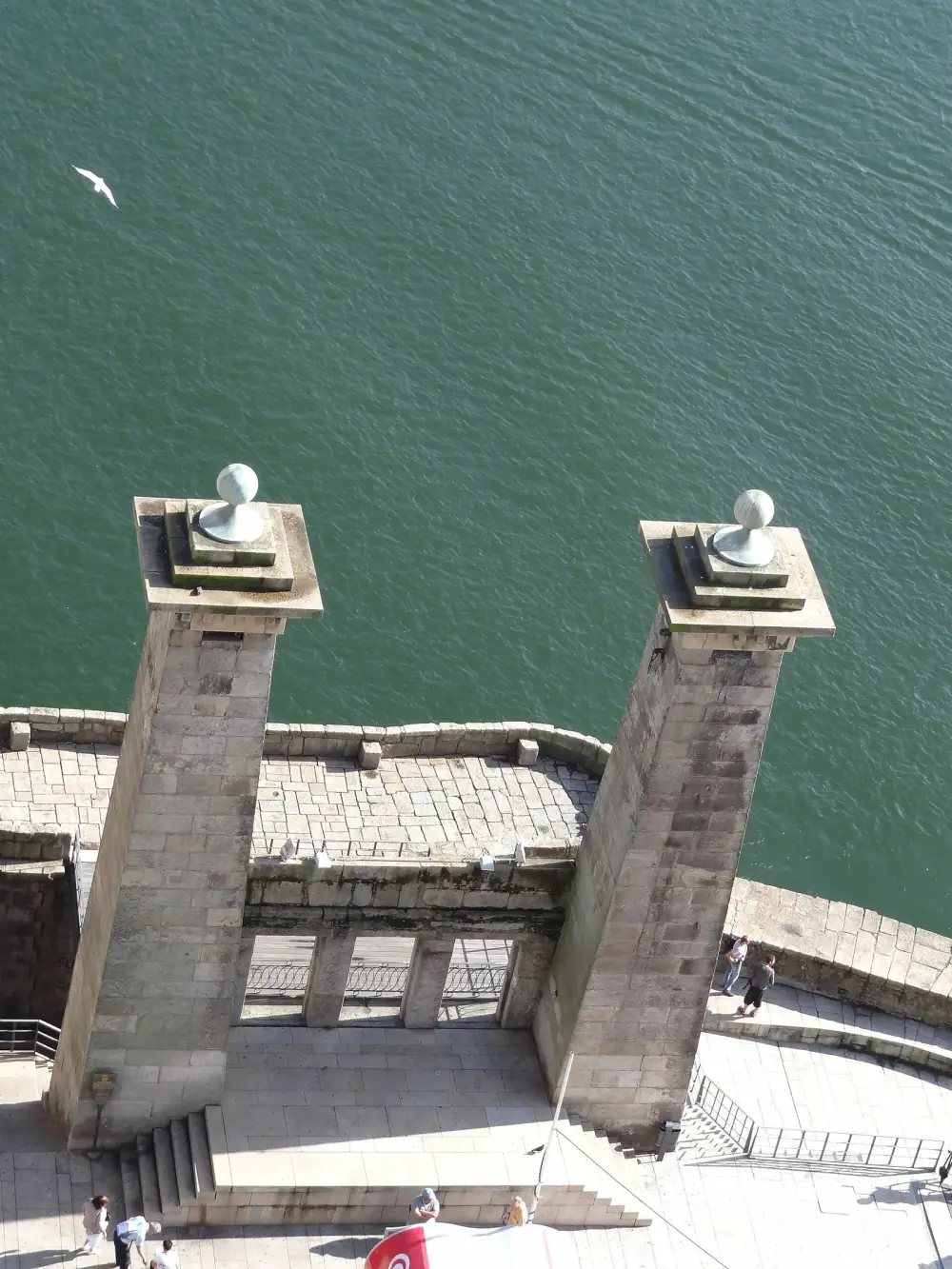
The upper deck opened first, on 31 October 1886. IP dates the completion of the lower deck to 1888. The old suspension bridge was taken down in 1887. On the Gaia bank its obelisks were demolished with the cables, but on the Porto bank only their capitals were removed, to save the guardhouse built between the two towers. The capitals were put back much later, and the two obelisks still stand.
1744
Regular ferry
A regular boat service starts between Porto and Gaia.
1806
Bridge of boats
Twenty boats carry a roadway across the river.
29 March 1809
Disaster
Crowds fleeing Soult's troops are pushed into the river at the bridge of boats.
17 February 1843
Ponte Pênsil
The suspension bridge opens, the first fixed crossing on the Portuguese Douro.
4 November 1877
Maria Pia bridge
Eiffel and Seyrig's railway arch opens.
1880
Competition
Twelve designs compete for a new road bridge with two decks.
1881
Work begins
The Société de Willebroeck starts building Seyrig's design.
31 October 1886
Upper deck opens
Inauguration on King Luís I's birthday.
1887
Pênsil removed
The suspension bridge is dismantled.
1888
Lower deck
The lower deck is completed, according to IP.
1996
World Heritage
Porto's historic centre is inscribed on the UNESCO list.
30 March 2003
Ponte do Infante
A new road bridge opens, freeing the upper deck for the metro.
17 September 2005
Metro Line D
Metro trains start crossing the upper deck.
2023
Lower deck renewed
IP completes the rehabilitation of the lower deck.
From carts to the metro
Until the early 2000s road traffic used the upper deck as well as the lower one. Electric trams reached Porto in 1895, and the city's tram museum says the power station built for them at Massarelos, in full operation from 1915, also electrified the Ponte Luiz I.
Edgar Cardoso, the engineer who designed the Arrábida bridge of 1963 and the São João railway bridge of 1991, later redesigned the upper deck. A plan of his to widen the bridge was never carried out.
In the late 1990s, as Porto planned its light metro, engineers studied whether the Luís I bridge could carry it. The answer was yes. Because the upper deck would be given over to the metro alone, Metro do Porto built a new road bridge, the Ponte do Infante. It opened on 30 March 2003, and the company called it the sixth crossing between Porto and Gaia.
On 17 September 2005 Metro do Porto opened Line D, the yellow line, from Câmara Gaia to Pólo Universitário. Its trains cross the upper deck between the cathedral quarter and the Jardim do Morro on the Gaia side.
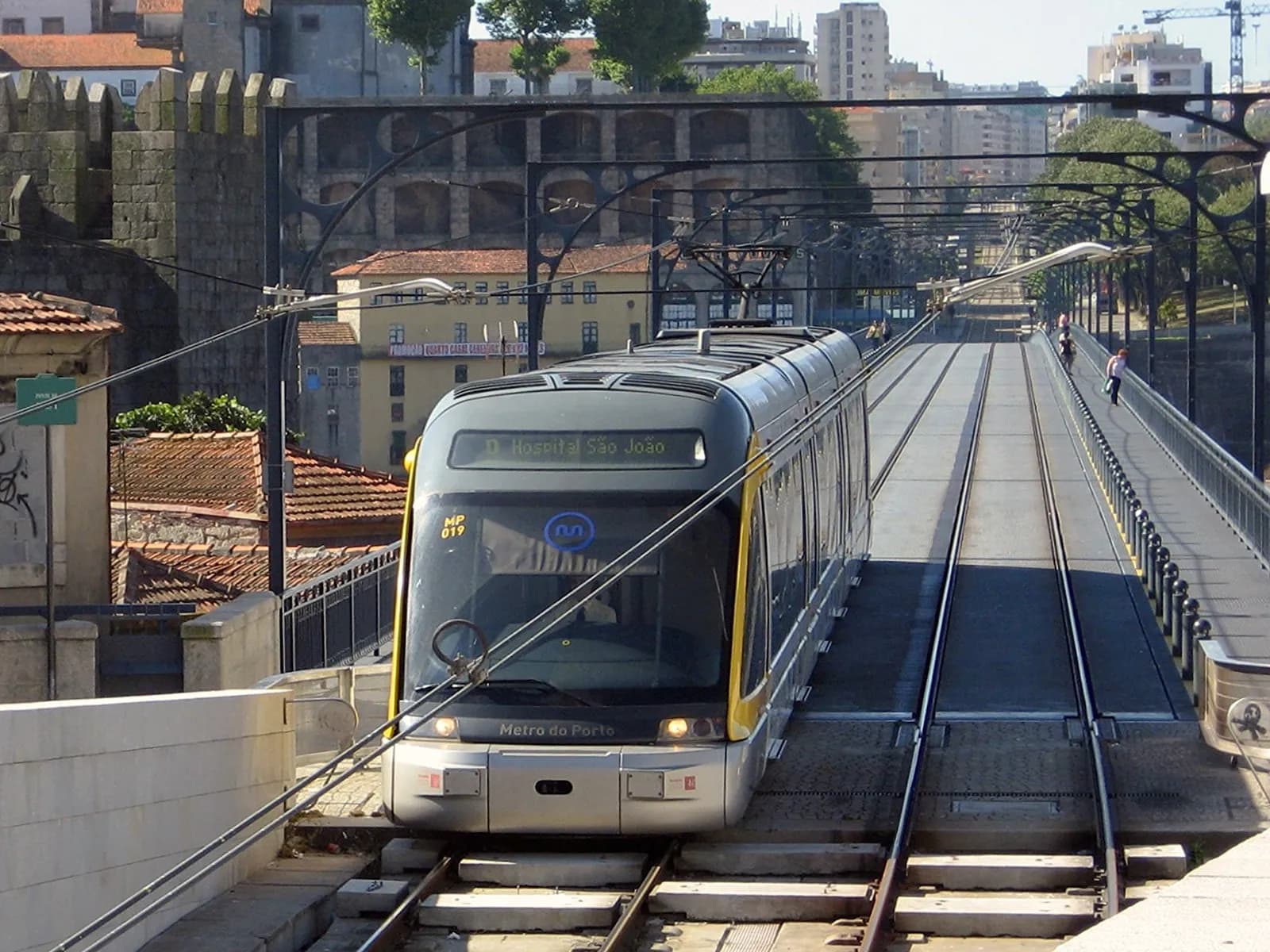
The lower deck needed work too. In 2023 IP finished rebuilding it: corroded iron parts and rivets were replaced, bent plates straightened, and new bearings and expansion joints fitted. The new deck can take vehicles of up to 60 tonnes, where the old one had been limited to 30, and it is heavier and stiffer so that it sways less when big crowds cross on festival nights or after football matches. It is now open to pedestrians, public transport, taxis and bicycles.
| Bridge | Opened | Use | Main span |
|---|---|---|---|
| Bridge of boats | 1806 | Road, on 20 boats; destroyed 1809 and later rebuilt | None (floating) |
| Ponte Pênsil (D. Maria II) | 1843 (removed 1887) | Road | About 170 m |
| Maria Pia | 1877 (closed to trains 1991) | Railway | 160 m |
| Luís I | 1886 (upper deck), 1888 (lower deck) | Road, now metro and lower-deck traffic | 172 m |
| Arrábida | 1963 | Motorway | 270 m |
| São João | 1991 | Railway | 250 m |
| Freixo | 1995 | Motorway | 150 m |
| Infante | 2003 | Road | Not given in these sources |
Azeredo's 1999 data sheet gives the Freixo bridge two different years (1994 and 1985); Structurae dates its completion to September 1995. Metro do Porto put out to tender in 2023 a further bridge, for its new Rubi line, to be named after Dona Antónia Ferreira.
Main span of Porto's Douro bridges
metres
The main span, the longest single stretch between supports, of each fixed bridge built over the Douro between Porto and Gaia up to 1999, from Manuel de Azeredo's technical data. For the Pênsil it is the suspended span between the towers; for Maria Pia, Luís I and Arrábida the arch span; for São João and Freixo the central span of the concrete girder. The Ponte do Infante of 2003 is not shown because these sources give no figure for it.
Show the data
| Main span | |
|---|---|
| Pênsil (1843) | 170 |
| Maria Pia (1877) | 160 |
| Luís I (1886) | 172 |
| Arrábida (1963) | 270 |
| São João (1991) | 250 |
| Freixo (1995) | 150 |
A bridge in a World Heritage view
In 1996 UNESCO added Porto's historic centre to its World Heritage list, under its criterion (iv). The site is now named the Historic Centre of Porto, Luiz I Bridge and Monastery of Serra do Pilar. Portugal's national UNESCO commission describes its value partly as a view: the old town's streets fit together with the river and with Vila Nova de Gaia across it.
That view is about wine as much as iron. For centuries wine from the Douro valley came down the river to be stored and traded in Gaia, which became the warehouse between the vineyards and markets abroad. In March 1809, Oman notes, nearly thirty merchant ships, most of them English and loaded with port wine, were stuck at the Porto quay by contrary winds when Soult's army arrived. The lower deck of the Luís I bridge now joins the Ribeira quays to the Gaia waterfront, and thousands of people walk across it every day.
The bridge has also kept a man's name half hidden. Azeredo, writing in the 1990s, argued that Seyrig had been left out of the history of engineering, even in Porto, and suggested the city name the avenue by the bridge after him. Lopes Cordeiro made the same case about the Maria Pia bridge in 2009. Seyrig's arch over the Douro has now carried walkers, cars, buses and metro trains for 140 years.
FAQs
When did the Ponte Luís I open?
The upper deck was inaugurated on 31 October 1886, the 48th birthday of King Luís I. The lower deck, at the level of the quays, came later: Infraestruturas de Portugal says it was only completed in 1888.
Did Gustave Eiffel design the Ponte Luís I?
No. Eiffel's firm entered the 1880 competition and lost. The bridge was designed by Théophile Seyrig, his former partner, and built by the Belgian Société de Willebroeck. Eiffel's firm built the older Maria Pia railway bridge nearby, whose arch historians also credit largely to Seyrig.
Why does the bridge have two decks?
Porto and Gaia face each other across a steep gorge. The 1880 competition required a bridge linking both the riverside quays and the higher parts of the two cities, so the winning design put one deck over the top of the arch and another near the water.
Is the Ponte Luís I a World Heritage Site?
Yes. It is part of the UNESCO site now called the Historic Centre of Porto, Luiz I Bridge and Monastery of Serra do Pilar, first inscribed in 1996.
Can you still drive across the Ponte Luís I?
Not in a private car. Since the rehabilitation finished in 2023 the lower deck is open to pedestrians, public transport, taxis and bicycles, and the upper deck carries Metro do Porto's Line D.
On the timeline
Open the timelineNearby moments from regeneration and the last kings (1851–1910).
Cosme Damião is born in Lumiar, Lisbon. A former Casa Pia pupil, he was the driving force among the young founders of Sport Lisboa in 1904, the club that became Benfica, and served it as captain, coach and journalist for two decades — yet always refused to become its president.
Death in Lisbon of Fernando II, the 'King-Artist' and widower of Maria II, who turned a ruined monastery above Sintra into the fairy-tale Pena Palace. Suffering double vision from a facial tumour, he had fallen on the stairs of the São Carlos opera house three days earlier and never recovered; his will, leaving almost everything to his second wife, the singer Elise Hensler, caused a scandal.
Crown Prince Carlos, the future King Carlos I, marries Amélie of Orléans at the Church of São Domingos in Lisbon; as Queen Amélia she would be the last queen consort of Portugal.
Porto's Ponte Luís I opens
Birth at Belém Palace of Luís Filipe, heir of King Carlos I. In 1907 he became the first member of the royal family to tour the African colonies; less than a year later, on 1 February 1908, he was shot alongside his father in the Lisbon Regicide, surviving him by about 20 minutes.
The Associação Académica de Coimbra is founded, the oldest students' union in Portugal. Every student of the University of Coimbra automatically becomes a member, and its football team, Académica, became one of the country's best-loved clubs.
Amadeo de Souza-Cardoso is born at Manhufe, near Amarante. In Paris he befriended Modigliani and in 1913 showed at the Armory Show in New York; his fusion of Cubism, Futurism and Portuguese folk motifs makes him the great pioneer of modern painting in Portugal.
Coming up in history
All long reads 2 October 1969Mr Five Per Cent's museum: the Gulbenkian opens in Lisbon, 1969
 3 October 1910Miguel Bombarda: the shooting at Rilhafoles on the eve of the Republic
 4 October 1582The ten days Portugal never had: the calendar change of October 1582
 5 October 1910The morning Portugal became a republic: 5 October 1910
17 sources
Archives, scholarship and reporting this article was checked against.
- 1
As Pontes do Porto (Manuel de Azeredo, 1997–1999)Faculdade de Engenharia da Universidade do Porto (U.Porto web archive)
- 2
Ponte Luiz IInfraestruturas de Portugal
- 3
- 4
Ponte Maria Pia: uma ponte de Eiffel… e de Seyrig (José Manuel Lopes Cordeiro)Universidade do Minho, published by ocomboio.net, 2009
- 5
História (company timeline)Metro do Porto
- 6
Centro Histórico do Porto, Ponte Luiz I e Mosteiro da Serra do PilarComissão Nacional da UNESCO (Portugal)
- 7
A History of the Peninsular War, vol. II: January–September 1809 (Charles Oman)Clarendon Press, Oxford, 1903; Project Gutenberg edition
- 8
- 9
D. Luís I, rei de PortugalPortugal: Dicionário Histórico (Esteves Pereira and Guilherme Rodrigues, 1904–1915), arqnet.pt edition
- 10
- 11
- 12
- 13
Dom Luís I Bridge (Porto/Vila Nova de Gaia, 1886)Structurae, International Database and Gallery of Structures
- 14
O MuseuMuseu do Carro Eléctrico (STCP), Porto
- 15
- 16
- 17
História do vinho do PortoInstituto dos Vinhos do Douro e do Porto (IVDP)
Image credits
- The Ponte Luís I seen from the Vila Nova de Gaia side in May 2012, with Porto's riverside on the far bank and the cathedral on the hilltop. The upper deck carries the metro and pedestrians; the lower deck crosses at the level of the quays. Diego Delso, CC BY-SA 3.0, via Wikimedia Commons.
- Half of the new arch reaching out over the river around 1883, held by cables while it was built, with the 1843 suspension bridge still in use below it. Photograph by Emílio Biel, taken from the Gaia quay. Karl Emil Biel, Public domain, via Wikimedia Commons.
- The disaster of the bridge of boats, 29 March 1809, in the Suffrage of the Bridge of Boats, an oil painting on copper of 1845 by an unknown painter in the church of São José das Taipas in Porto. Photographed in 2025. Atrapalhado, CC BY 4.0, via Wikimedia Commons.
- The Ponte Pênsil in a modern print from a calotype negative by Frederick William Flower, taken at some point between 1843 and 1881. The cables hung from stone obelisks on each bank. Frederick William Flower, Public domain, via Wikimedia Commons.
- The two surviving obelisks of the Ponte Pênsil on the Porto bank, photographed from above in 2011, with the remains of the guardhouse between them. Cristina sousa, CC BY-SA 3.0, via Wikimedia Commons.
- A Line D train leaving the upper deck at the Porto end in June 2008, bound for Hospital São João. A footway runs beside the tracks. hrs51, CC BY 4.0, via Wikimedia Commons.