

The Battle of Salado, 1340: how Portugal helped stop the last Moroccan invasion
A sultan from Fez had wrecked Castile's fleet and laid siege to Tarifa. Castile's queen rode to her father in Portugal for help, and on a Monday morning two kings named Afonso crossed a small stream to fight him.
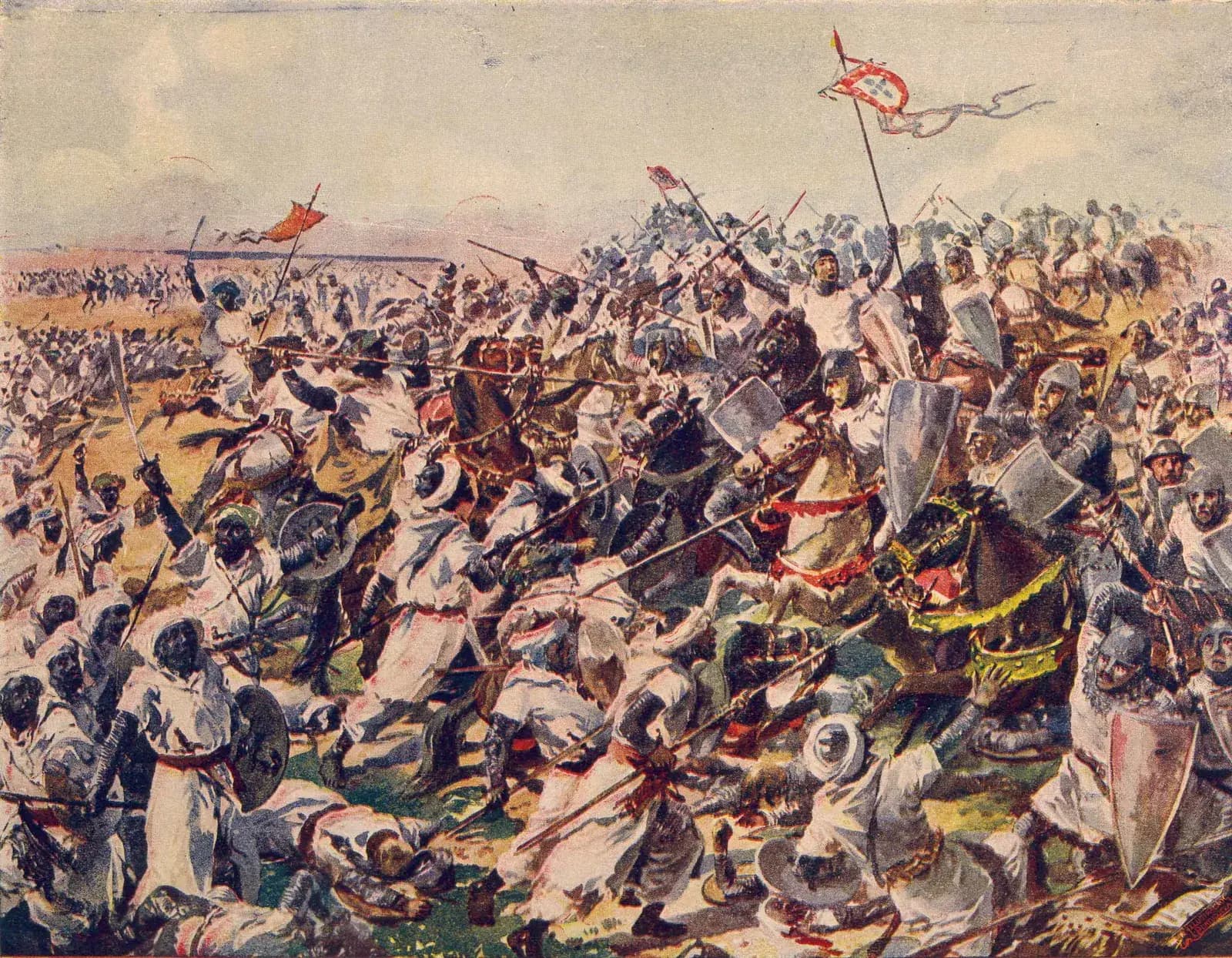
At a glance
- On Monday 30 October 1340, near Tarifa at the southern tip of Spain, Alfonso XI of Castile and Afonso IV of Portugal defeated the Marinid sultan of Morocco, Abu al-Hasan, and Yusuf I of Granada.
- The battle is named after the Salado, a small stream between the Christian camp and Tarifa, which the Marinid army had besieged since 23 September.
- Afonso IV came at the request of his daughter Maria, Alfonso XI's queen. With about 1,000 Portuguese knights and some 3,000 Castilian horsemen he fought Granada's army, while the Castilians fought the Marinids.
- The chronicles claim hundreds of thousands of Muslim soldiers. A modern estimate puts the Muslim army at about 65,000 and the Christian army at about 24,000.
- No Moroccan army invaded the Iberian Peninsula again. Castile took Algeciras in 1344, and in Portugal the victory is remembered by the Padrão do Salado in Guimarães and in Camões's Lusiads.
Monday morning at the Salado
Alfonso XI of Castile got up before dawn. He had confessed before setting out, but he confessed again, and Gil de Albornoz, Archbishop of Toledo, said Mass for him and gave him communion. Most of the army did the same. Then the knights armed themselves and their horses and rode out of the camp at the Peña del Ciervo, a hill outside Tarifa, with the crusade banner sent by the Pope carried beside the royal standard.
Below them ran the Salado, a small stream with several fords. Beyond it, on the hills towards Tarifa, stood the tents of Abu al-Hasan, sultan of the Marinids of Fez, and a little apart, near the sierra, the camp of Yusuf I, king of Granada. Their horsemen were already waiting at the fords.
The Castilian king took the right, along the shore, towards the sultan. On the left, close to the hills, rode his father-in-law, Afonso IV of Portugal, with his own knights and the Castilian troops lent to him, heading for the king of Granada. By the evening of 30 October 1340 both Muslim rulers were in flight, and Abu al-Hasan crossed back to Africa that night.
The Battle of the Strait
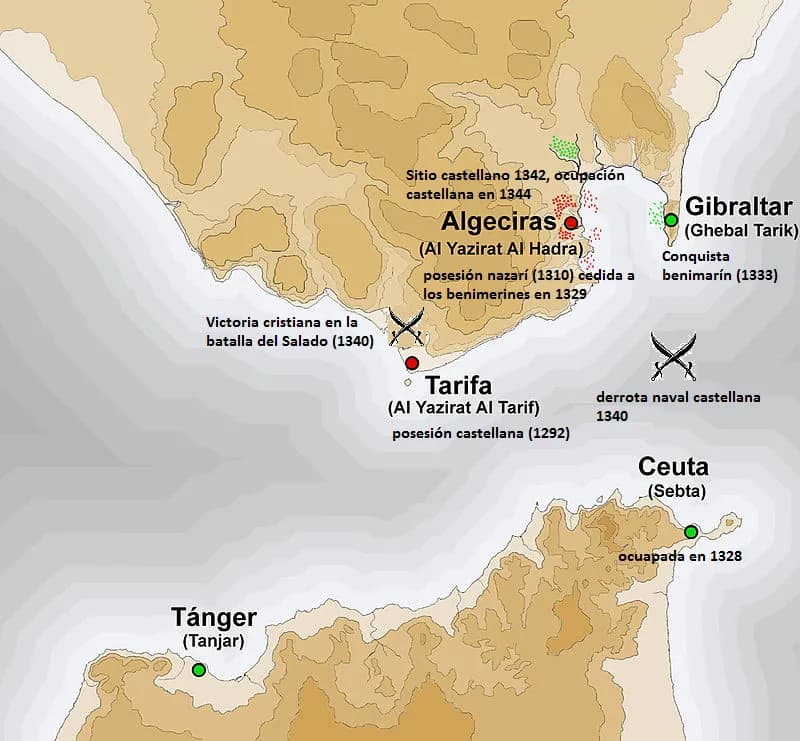
Spanish historians call the long struggle for the ports on the northern shore of the Strait of Gibraltar the “Battle of the Strait”. It ran from the second half of the thirteenth century to 1344, and it was about who held Tarifa, Algeciras and Gibraltar. Whoever held them controlled the shortest crossing between Morocco and Andalusia.
Castile took Tarifa on 14 October 1292 and held it through a Marinid siege in 1294. In 1333 Abu al-Hasan's son Abu Malik crossed with an army and took Gibraltar, which left Tarifa as Castile's only foothold on the Strait. In October 1339 Abu Malik was killed near Alcalá de los Gazules, and his father prepared to cross in person.
This time the aim was conquest. The Castilian chronicle says the sultan's council advised him to besiege Tarifa, then Jerez, and then pitch his tents before Seville, and that he had already promised the towns and lordships of Spain to his followers.
A fleet lost and a town besieged
Castile's plan was to stop the crossing at sea. On 8 April 1340 the Marinid fleet under Muhammad ibn Ali al-Azafi caught the Castilian admiral, Alfonso Jofre Tenorio, at the anchorage of Getares, near Algeciras. Ibn Khaldun, the North African historian, says that sixteen ships came from the Hafsid rulers of Tunis and that the fleet gathered at Ceuta numbered about a hundred.
The Castilian chronicle says few of Tenorio's 33 galleys followed him into the fight. Moroccan sailors boarded his flagship three times. Tenorio held the standard with one arm and fought with the other until his leg was cut and an iron bar thrown from a ship above killed him; his head was cut off. The chronicle says only five galleys were saved. The historian Roberto Muñoz Bolaños reckons that about half of the 33 got away.
In Ceuta the captured galleys were paraded with the heads of Christian dead, and poets recited verses for the sultan. Alfonso XI heard the news at midnight on the eve of Palm Sunday. With the Strait open, he understood, the king of Morocco could now bring over as many men as he wished.
He went looking for ships. Genoa agreed to send fifteen galleys at 800 gold florins a month each, though they arrived only after the battle, and Aragon armed twelve once Castile lent it three months' pay. Through Queen Maria he asked her father for the Portuguese fleet. It came up the Guadalquivir to Seville under Manuel Pessanha, Portugal's Genoese admiral, and his son Carlos, both recently released from a Castilian prison, but they would go no further than Cádiz.
Over the summer the Marinid army crossed. Abu al-Hasan laid siege to Tarifa on 23 September with more than twenty siege engines brought from Africa, and Yusuf I of Granada joined him. The engines battered the walls day and night. The defenders, commanded by Juan Alfonso de Benavides, beat back assaults and made night sorties, while a reorganised Christian fleet in the Strait cut the sultan's supply line.
A queen sent to her father
Alfonso XI's queen, Maria, was the daughter of Afonso IV of Portugal. She was not the woman he loved. The Castilian chronicle says that in 1329, having had no child by the queen, the king took as his mistress Leonor de Guzmán, a rich and noble widow of Seville, and by 1340 Leonor held first place at court and Maria had been pushed aside.
Portugal and Castile had fought a war in the late 1330s, and Pope Benedict XII, in Avignon, worked to end it. The peace that followed freed the prisoners held on both sides. Alfonso XI also let Constanza Manuel, daughter of the great Castilian noble Juan Manuel, travel to Portugal to marry Afonso IV's heir, Pedro; the chronicle says he agreed because he needed Portugal's help.
With Tarifa under siege and some of his council advising him to give the town up, Alfonso XI decided to fight. He sent letters to Aragon, and he asked Maria to go to her father and tell him that Castile could not face so many Moors alone, and that if Castile fell, Portugal could not defend itself either. She left Seville and rode for Portugal as fast as she could.
Rui de Pina's chronicle of Afonso IV, written long afterwards and printed in 1653, adds the details Portuguese readers remember. Maria went first on pilgrimage to Terena, then to Évora, where her parents came out to meet her, and there she made her plea “with great humility and many tears”. Some of the king's councillors advised him not to rush off in person. He promised to go himself.
“Father! thy succour haste, for if delayed, / Perchance thou may'st not find whom thou may'st aid.”
The two kings had not seen each other since before their war. They met at Juromenha on the Guadiana, where Afonso IV crossed the swollen river by boat with his son Pedro to greet his son-in-law. Afonso IV then hurried to Seville with the first men who reached him, arriving four days after Alfonso XI.
How big were the armies?
Before leaving Seville, Alfonso XI held a muster: 8,000 horsemen and up to 12,000 foot. He had pawned the jewels of his treasury and could feed the army for only fifteen days, on money borrowed in Seville. The Portuguese had about 1,000 knights, because most of Afonso IV's men had not yet arrived. A tablet in Évora cathedral records that Évora alone sent 100 knights and 1,000 foot soldiers.
The Muslim figures in Christian sources are fantasies. The Castilian chronicle says 70,000 horsemen and 400,000 foot crossed with the sultan, and on the eve of the battle a Moor who came over to the Christian camp spoke of more than 53,000 horsemen and 700,000 foot for both Muslim armies. The Gran Crónica gives 45,000 and 600,000. Musa II, king of Tlemcen and a contemporary of the sultan, wrote that Abu al-Hasan's army exceeded 60,000 fighting men, a number Muñoz Bolaños finds far more reasonable.
How big was the Muslim army? A modern estimate against the Castilian chroniclers' claims
men, horse and foot together
The two dark bars are the believable numbers. Muñoz Bolaños (2012) accepts the “more than 60,000” that Musa II, king of Tlemcen and a contemporary, gave for the Marinid army, and adds at most 5,000 from Granada: a reasoned estimate, not a count. The three pale bars are Castilian chroniclers' claims, which he calls fantastic and therefore false: 70,000 horse and 400,000 foot crossing with the sultan (Crónica de Alfonso XI), 45,000 and 600,000 (Gran Crónica), and 53,000 and 700,000 for both Muslim armies, reported by a Moor who came to the Christian camp the day before the battle (Crónica). No muster roll survives.
Show the data
| Men | |
|---|---|
| Modern estimate | 65,000 |
| Musa II of Tlemcen | 60,000 |
| Crónica: crossing | 470,000 |
| Gran Crónica | 645,000 |
| Crónica: deserter | 753,000 |
| Force | What the medieval sources say | Modern estimate |
|---|---|---|
| Castilian army mustered at Seville | 8,000 horse and up to 12,000 foot (Crónica de Alfonso XI) | About 20,000 (Muñoz Bolaños) |
| Portuguese army | About 1,000 knights; Évora alone sent 100 knights and 1,000 foot (Crónica; Évora cathedral tablet) | About 4,000, counting the foot soldiers and crossbowmen with each knight (Muñoz Bolaños) |
| Castilians lent to Afonso IV | About 3,000 horse, including the Masters of Calatrava and Alcántara (Crónica) | Part of the Castilian total |
| Sent into Tarifa the night before | 1,000 horse and 4,000 foot (Crónica); Segura González gives 2,000 horse and 4,000 foot | 1,000 horse and 4,000 foot, leaving about 19,000 in the main battle (Muñoz Bolaños) |
| Whole Christian army | Not totalled; one passage of the Crónica speaks of 13,000 Christian horsemen | About 24,000, of whom about 9,000 mounted (Muñoz Bolaños) |
| Granada's army | 7,000 horse (Crónica) | At most 5,000 men (Muñoz Bolaños) |
| Marinid army | 70,000 horse and 400,000 foot crossed with the sultan (Crónica); 45,000 horse and 600,000 foot (Gran Crónica); more than 60,000 (Musa II of Tlemcen, a contemporary) | About 60,000, accepting Musa II's figure (Muñoz Bolaños) |
| Both Muslim armies on the eve of battle | More than 53,000 horse and 700,000 foot (a Moor who came to the Christian camp, in the Crónica) | About 65,000 (Muñoz Bolaños) |
| Christian dead | 15 to 20 horsemen, killed at the start of the fighting (Crónica) | Minimal: some foot soldiers and no one of rank (Segura González) |
| Muslim dead | “More than 200,000” by hearsay, and 400,000 missing from the sultan's rolls by a Genoese informant; the chronicle admits the dead could not be counted | Not known; “very numerous” (Segura González) |
Muñoz Bolaños also counts 200 Navarrese. His totals are reasoned estimates built on Musa II's figure, Granada's known strength in 1319 and the Crónica's muster; no muster roll of either side survives.
30 October: two battles side by side
On the night before the battle, Alfonso XI sent about 1,000 horse and 4,000 foot along the beach to slip into Tarifa. They fought their way past the 3,000 Marinid horsemen guarding the crossing, losing three men. The Castilian chronicle says the guards then told the sultan that no Christians had got through. Ibn Khaldun says that, afraid of his anger, they admitted only to a small troop.
In the morning the Castilian vanguard stopped at the stream. Juan Manuel, one of its leaders, refused to cross, and when his standard-bearer tried, he struck him with his mace. Two brothers, Garcilaso de la Vega and Gonzalo Ruiz, crossed instead at what the chronicle calls “a very narrow bridge”, probably a ford in Segura González's view. They had about 800 horsemen against more than 2,500 Moors, and nearly lost their men before help came.
Part of the vanguard then crossed and charged straight up the hill to the sultan's camp, where the force from Tarifa was attacking from the other side. Fatima, daughter of the ruler of Tunis and Abu al-Hasan's most honoured wife, was killed in the camp with other women of his household. Meanwhile Alfonso XI, left with few men when his own standard went on too far, was caught in the valley. An arrow struck the front of his saddle.
“Strike them, for I am King Alfonso of Castile and León: today I shall see who my vassals are, and they shall see who I am.”
Archbishop Gil de Albornoz grabbed his reins and told him not to put Castile and León at risk, because the Moors were already beaten. Reinforcements from Zamora and Córdoba reached the king, the Castilian heavy cavalry charged, and the Marinids, seeing their camp burning behind them, broke.
On the left, the Portuguese reached the Salado at about ten in the morning and crossed at a ford the Granadans had left unguarded, far from their lines. Granada's army waited for them on higher, wooded ground, cavalry in the centre and archers on the wings. The Portuguese chronicle admits the fighting went badly: three Portuguese battalions were broken and the men around the king nearly gave way.
The sources disagree about what turned it. Portuguese chronicles credit a relic of the True Cross from Marmelar, in the Alentejo, which the prior of the Hospitallers (the crusading Order of St John), Álvaro Gonçalves Pereira, had a priest carry before the army on a white mule. The Castilian chronicle credits the Castilian foot soldiers under Pero Núñez de Guzmán, who reached the Portuguese wing, and Ibn al-Khatib, a Granadan writer who was in the battle, agrees that a reserve tipped it.
8 April 1340
Castilian fleet destroyed off Getares
Admiral Alfonso Jofre Tenorio is killed.
Summer 1340
The Marinid army crosses to Algeciras
23 September
Abu al-Hasan lays siege to Tarifa
Yusuf I of Granada joins him.
14 October
The Castilian and Portuguese armies gather at Seville
29 October, night
A Castilian force slips into Tarifa
30 October, morning
Castilians force the Salado
The force from Tarifa attacks the sultan's camp.
30 October, about 10 am
Portuguese cross at an unguarded ford and engage Granada
30 October, after midday
Both Muslim armies break
The pursuit runs to the Guadalmesí.
30 October, night
Abu al-Hasan sails from Gibraltar to Ceuta
The Granadan and Marinid armies fled together towards Algeciras, and the two kings chased them as far as the river Guadalmesí. Yusuf I went on to Marbella. Abu al-Hasan waited at Gibraltar until he was sure no Christian fleet was patrolling, and crossed to Africa in a galley that night. Pedro de Moncada, the Aragonese admiral, had refused to guard the Strait, and had not left his galley all day.
Gold, banners and the Pope
Many Christians stopped in the sultan's camp to loot instead of pursuing. There were gold coins, gold ingots for minting, bracelets and anklets, pearls, gold-hilted swords, silk belts and enamelled spurs. So much was smuggled out to Aragon, Navarre and Avignon that, by the chronicle's account, gold and silver lost a sixth of their value in Paris, Avignon, Valencia, Barcelona and Pamplona. Segura González suspects exaggeration.
In Seville, Alfonso XI laid out what he had recovered in a palace and invited Afonso IV to take what he liked. The Portuguese king chose some swords, saddles, bridles and spurs and refused the gold. Pressed, he accepted instead a captive prince, the son of the king of Sijilmasa and a nephew of the sultan, with other prisoners. According to the Portuguese chronicle, five captured Moorish banners were taken to Lisbon.
Pope Benedict XII had made the campaign a crusade with the bull Exultamus in te of 7 March 1340, and sent a crusade banner that arrived only days before the battle. No foreign crusaders came, apart from one Aragonese knight and two squires from Majorca, both killed in the battle. The Pope had also granted Castile a share of church revenues for the war.
Alfonso XI sent Juan Martínez de Leyva to Avignon with his own banner, the horse he had ridden, captured horses each hung with a shield and a sword, and 24 Moorish prisoners carrying 24 captured banners. Benedict XII came down from his throne, took the king's banner in his hand and began the hymn Vexilla regis. In his sermon the next day he compared the victory with King David's.
Algeciras and after
Salado did not end the fight for the Strait at once. Alfonso XI had food for four days, so he could not march on Algeciras, which the Marinids still held. In 1341 he took Alcalá la Real, a Granadan fortress a day's march from Granada itself. In May 1342 the Genoese admiral Egidio Bocanegra, commanding Castile's fleet, sank 39 Marinid galleys at the mouth of the Guadalmesí, and Portuguese galleys under Carlos Pessanha joined the blockade.
Algeciras surrendered on 25 March 1344 after a siege so long that the besiegers built themselves wooden houses. Alfonso XI let the garrison sail for Morocco. A ten-year truce followed, with Yusuf I paying 12,000 doblas a year. In 1349 Alfonso XI laid siege to Gibraltar, and he died there of the Black Death on 26 March 1350.
No Moroccan army crossed to conquer in Iberia again. For Muñoz Bolaños, Salado stopped the last attempt to invade Christian Europe from North Africa. The Marinid state began to break up from 1347, fighting in the Strait did not resume until 1406, and in 1415 Portugal crossed the other way and took Ceuta.
Salado in Portuguese memory
Afonso IV is known as “the Brave”, and tradition links the name to Salado, although the historian Bernardo Vasconcelos e Sousa thinks it owed more to his turbulent youth and his tenacity as king. Dioceses in Portugal and Spain kept 30 October as a feast, Victoria Christianorum, some of them for six centuries. Its hymns, in a psalter at Coimbra dated between 1340 and 1360, sing of Portugal and Castile winning at Tarifa. The feast lapsed after the Second Vatican Council.
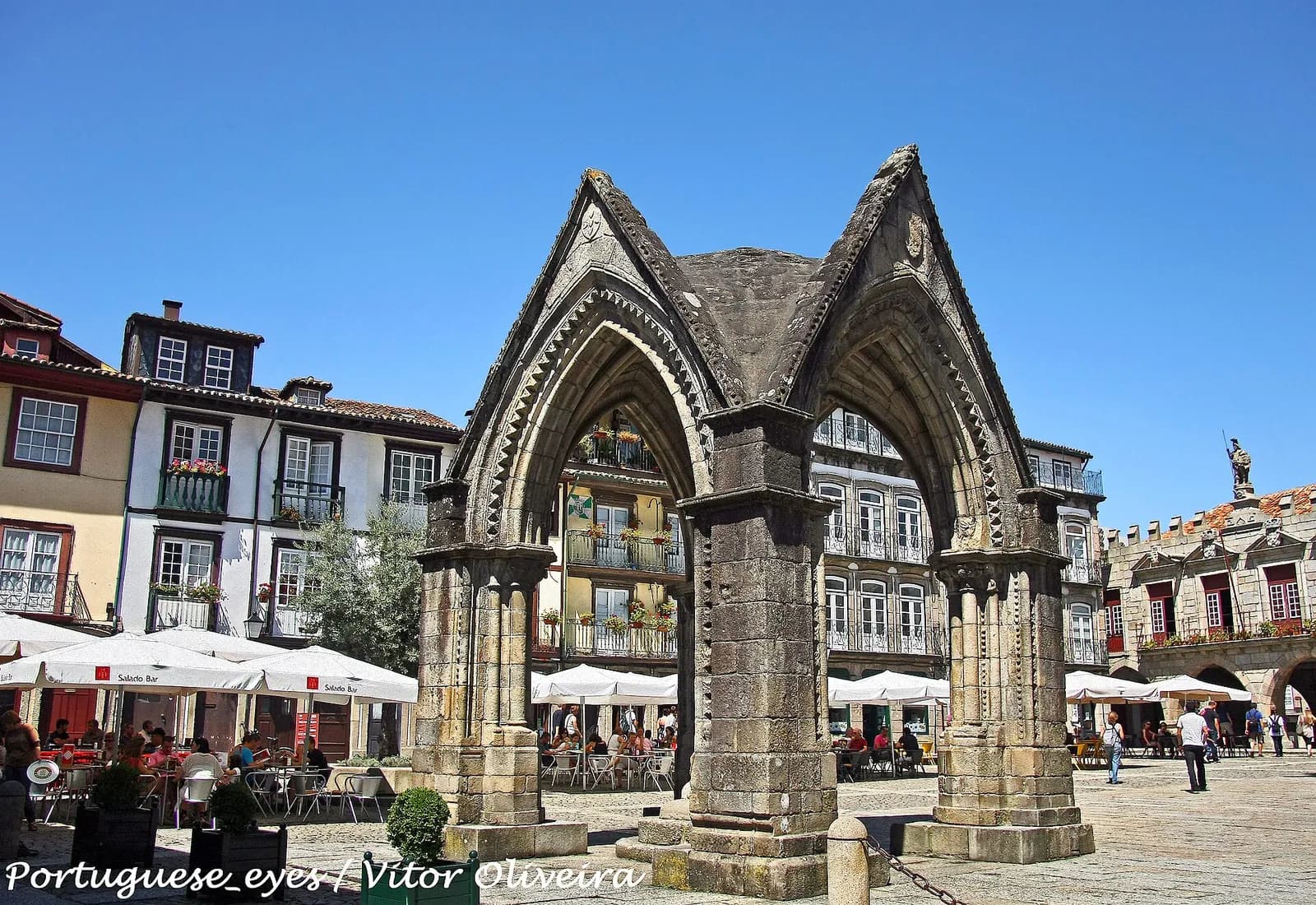
In Guimarães, in the main square of the medieval town beside the church of Nossa Senhora da Oliveira, is the Padrão do Salado, a small open Gothic shrine of four pointed arches under steep gables, carved with the royal arms. It is the only monument built to commemorate the battle. Its date is not certain: Segura González says it is thought to have been built in 1340, soon after the victory, while other accounts give 1342. Nine years after it was built, a cross was set inside it, the gift of a Guimarães merchant, Pedro Esteves, who had bought it in Normandy.
Camões gave the battle nineteen stanzas of the third canto of the Lusiads, 99 to 117: Maria's plea, the two kings on the plains of Tarifa, and the Portuguese routing Granada before going to help the Castilians. Stanza 118 turns to the story of Inês de Castro. Afonso IV, the hero of Salado, is remembered at least as well for consenting to the killing of Inês, his son Pedro's lover, at Coimbra. One of her killers, Diogo Lopes Pacheco, was the son of Lopo Fernandes Pacheco, who had fought beside the king at Salado.
FAQs
Where was the Battle of Salado fought?
Just west of Tarifa, at the southern tip of Spain, on the Strait of Gibraltar. The Christian camp was on the Peña del Ciervo, and the armies met across the Salado, a small stream between that hill and the town. Arab and early Portuguese writers call it the battle of Tarifa.
Why did Portugal fight at Salado?
Alfonso XI of Castile sent his queen, Maria, to ask her father, Afonso IV of Portugal, for help against the Marinid army besieging Tarifa. The two kingdoms had just made peace after a war, and Castile argued that if it fell Portugal would be next. Afonso IV led his army in person.
How many soldiers fought at Salado?
Nobody knows exactly. The Castilian king mustered 8,000 horse and up to 12,000 foot, with about 1,000 Portuguese knights. Christian chronicles give the Muslims up to 753,000 men, which is impossible. A modern estimate is about 24,000 Christians against about 65,000 Muslims.
What is the Padrão do Salado?
A small open Gothic shrine in front of the church of Nossa Senhora da Oliveira in Guimarães, built in the fourteenth century to commemorate the victory at Salado. It is the only monument raised to the battle.
Was Salado the last Moroccan invasion of Spain?
Historians see it as the defeat of the last North African attempt to invade Christian Iberia. Castile took Algeciras, the Marinids' landing port, in 1344, and the Marinid state began to break up from 1347.
On the timeline
Open the timelineNearby moments from the burgundian kings (1249–1383).
By the Treaty of Alcañices, King Dinis of Portugal and Fernando IV of Castile settle the frontier between their kingdoms and seal an alliance of friendship — a border that survives almost unchanged as one of the oldest in Europe.
Pope Clement V dissolves the Knights Templar with the bull 'Vox in excelso'. Unlike France, Portugal's King Dinis shields the knights, and in 1319 their castles and lands pass to his new Order of Christ, whose red cross would later billow on the sails of the caravels.
King Dinis signs a contract with the Genoese mariner Manuel Pessanha, making him hereditary Admiral of the Kingdom and obliging him to bring twenty men 'skilled in the sea' to command the royal galleys — the charter regarded as the founding act of the Portuguese Navy.
The Battle of Salado
Inês de Castro, the Galician noblewoman loved by Crown Prince Pedro, is killed in Coimbra by courtiers acting with the consent of King Afonso IV, who feared Castilian influence over the succession. Once king, Pedro declared they had secretly married, and legend says he had her corpse crowned queen.
Birth of Philippa of Lancaster in Leicester, England. She would marry King João I of Portugal in 1387, becoming Queen consort and mother of the remarkable 'Illustrious Generation' (Ínclita Geração) including Prince Henry the Navigator.
Portugal and England sign the Treaty of Tagilde near Guimarães — a pact between King Fernando I and John of Gaunt, Duke of Lancaster, that prepares the ground for the 1373 Anglo-Portuguese Treaty and the Treaty of Windsor of 1386. It is the diplomatic seed of the longest-lasting alliance in the world.
Coming up in history
All long reads 1 October 1777The Treaty of San Ildefonso: Portugal and Spain redraw South America, 1777
 2 October 1969Mr Five Per Cent's museum: the Gulbenkian opens in Lisbon, 1969
 3 October 1910Miguel Bombarda: the shooting at Rilhafoles on the eve of the Republic
 4 October 1582The ten days Portugal never had: the calendar change of October 1582
11 sources
Archives, scholarship and reporting this article was checked against.
- 1
Crónica de D. Alfonso el Onceno de este nombre, de los reyes que reynaron en Castilla y en León (2nd edition, Madrid, 1787)Internet Archive (scan of the 1787 edition)
- 2
- 3
- 4
El Salado 1340. El fin del problema del Estrecho (Roberto Muñoz Bolaños)Revista Universitaria de Historia Militar 1, no. 2 (2012), pp. 153-184
- 5
- 6
- 7
- 8
- 9
- 10
- 11
Image credits
- The Battle of Salado as Alfredo Roque Gameiro imagined it in Quadros da História de Portugal, 1917, with the Portuguese royal banner raised over the charge. It is a romantic reconstruction made nearly six centuries after the event. Roque Gameiro, Public domain, via Wikimedia Commons.
- The Strait between 1329 and 1350: Castilian Tarifa (taken 1292), Marinid Algeciras (taken by Castile in 1344) and Gibraltar (taken by the Marinids in 1333), and Ceuta on the African shore. Crossed swords mark the naval defeat and the land battle of 1340. A modern map, labelled in Spanish. Nisibis, CC BY-SA 4.0, via Wikimedia Commons.
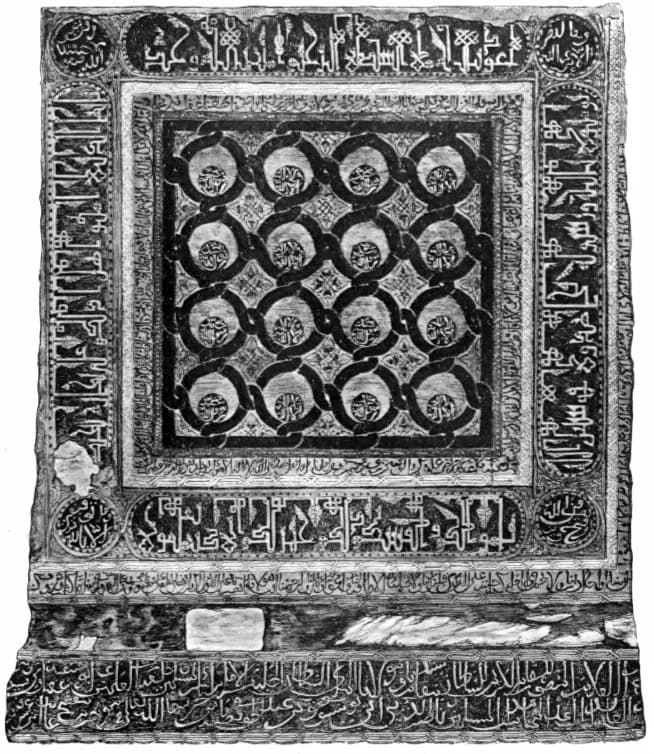
- The royal banner of the Marinid sultan Abu Said Uthman, Abu al-Hasan's father, made in Fez in 1312, as shown at the Historical European Exhibition in Madrid. Engraving from a drawing by Enrique Romero y López, published in La Ilustración Española y Americana in March 1893. The banner is one of three in Toledo cathedral thought to have been captured at Salado; no document records their capture. Grabado basado en un dibujo de Enrique Romero y López., Public domain, via Wikimedia Commons.
- The Padrão do Salado in the square in front of the church of Nossa Senhora da Oliveira in Guimarães. The Gothic shrine commemorates the Portuguese part in the victory of 1340. Vitor Oliveira from Torres Vedras, PORTUGAL, CC BY-SA 2.0, via Wikimedia Commons.
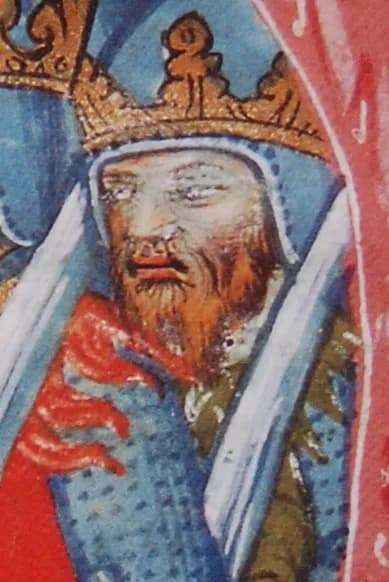
- A crowned king identified on Wikimedia Commons as Afonso IV of Portugal: detail of an illuminated initial in a manuscript of the Grant Crónica de Espanya, the Aragonese-language chronicle compiled for Juan Fernández de Heredia in the late fourteenth century. The full initial shows Alfonso XI and Afonso IV on one side and the defeated kings of Granada and Morocco on the other. Johan Ferrández d'Heredia, Public domain, via Wikimedia Commons.