

1249–1383
The Burgundian kings
By March 1249 Afonso III held Faro, the last stage of the conquest of the Algarve. His son Dinis, king from 1279 to 1325, founded Portugal's first university, in Lisbon, around 1290, and greatly enlarged the Leiria pine forest, which already existed before his reign. The Treaty of Alcañices, which he signed with Castile in 1297, gave Portugal Olivença, Campo Maior and other towns.
5 key moments · 14 in all
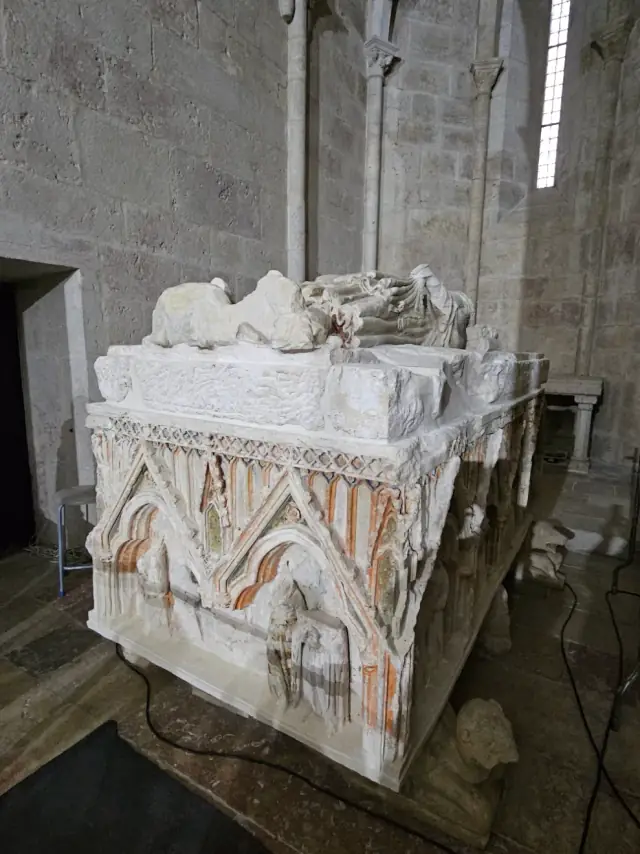
King Dinis is born in Lisbon, son of Afonso III and Beatriz of Castile. Nicknamed 'o Lavrador' and 'o Rei-Poeta', he fixed the frontier with Castile by the Treaty of Alcañices, made Portuguese the usual language of royal documents, founded the first Portuguese university and enlarged the royal pine forest of Leiria.
 Long readKing Dinis, born in Lisbon on 9 October 1261: the poet who ruled 46 years
Pope John XXI — born in Lisbon and the only Portuguese pope in history — dies in Viterbo, days after the ceiling of a new chamber he had added to the papal palace collapses on him. A physician and scholar, he had reigned for barely eight months.
King Dinis celebrates his wedding to Isabel of Aragon in Trancoso, four months after a proxy marriage in Barcelona; the bride is about 11. The king adds Trancoso to her dower, and Isabel goes on to become the 'Rainha Santa' of Coimbra, the saintly queen of the legend of the miracle of the roses.
King Dinis signs 'Scientiae thesaurus mirabilis', founding the Estudo Geral that becomes the University of Coimbra — one of the oldest universities in continuous operation. It actually began life in Lisbon and shuttled between the two cities before settling for good in Coimbra in 1537.
The future Afonso IV is born in Lisbon, son of King Dinis and Isabel of Aragon, the 'Rainha Santa'. Called 'the Brave' for leading the Portuguese army at the Battle of Salado in 1340, he is remembered just as much for allowing the killing of Inês de Castro, his son Pedro's beloved, in 1355.
By the Treaty of Alcañices, King Dinis of Portugal and Fernando IV of Castile settle the frontier between their kingdoms and seal an alliance of friendship — a border that survives almost unchanged as one of the oldest in Europe.
Pope Clement V dissolves the Knights Templar with the bull 'Vox in excelso'. Unlike France, Portugal's King Dinis shields the knights, and in 1319 their castles and lands pass to his new Order of Christ, whose red cross would later billow on the sails of the caravels.
King Dinis signs a contract with the Genoese mariner Manuel Pessanha, making him hereditary Admiral of the Kingdom and obliging him to bring twenty men 'skilled in the sea' to command the royal galleys — the charter regarded as the founding act of the Portuguese Navy.
Afonso IV of Portugal and his son-in-law Alfonso XI of Castile rout the Marinid army of Abu al-Hasan and the forces of Granada at the Battle of Salado near Tarifa, ending the last major Moroccan invasion of the Iberian Peninsula.
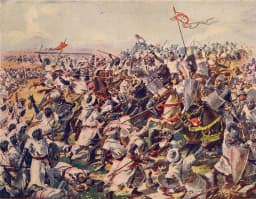 Long readThe Battle of Salado, 1340: how Portugal helped stop the last Moroccan invasion
Inês de Castro, the Galician noblewoman loved by Crown Prince Pedro, is killed in Coimbra by courtiers acting with the consent of King Afonso IV, who feared Castilian influence over the succession. Once king, Pedro declared they had secretly married, and legend says he had her corpse crowned queen.
Birth of Philippa of Lancaster in Leicester, England. She would marry King João I of Portugal in 1387, becoming Queen consort and mother of the remarkable 'Illustrious Generation' (Ínclita Geração) including Prince Henry the Navigator.
Portugal and England sign the Treaty of Tagilde near Guimarães — a pact between King Fernando I and John of Gaunt, Duke of Lancaster, that prepares the ground for the 1373 Anglo-Portuguese Treaty and the Treaty of Windsor of 1386. It is the diplomatic seed of the longest-lasting alliance in the world.
Portugal and England sign the Anglo-Portuguese Treaty in London, a pact of perpetual friendship between King Fernando I and King Edward III. Renewed at Windsor in 1386, the treaty is the oldest still-active diplomatic alliance in the world.
Battle of Saltes. Off Saltes Island, near Huelva, a Castilian fleet of 17 galleys under Fernán Sánchez de Tovar destroys a Portuguese fleet of 23 galleys commanded by João Afonso Telo, Count of Barcelos, capturing all but one. The disaster wipes out Portugal's naval strength and leaves Castile master of the Atlantic coast during the Third Fernandine War.
Back to the full timeline of Portugal, with key moments, search and long reads.