

1096–1249
From county to kingdom
At the end of the eleventh century the County of Portugal, centred on Guimarães, was governed by Henry of Burgundy and his wife Teresa, a daughter of Alfonso VI of León. Their son Afonso Henriques took control after the battle of São Mamede in 1128. León recognised him as king in 1143 and the Pope in 1179, and in 1147 he took Lisbon with the help of crusaders.
4 key moments · 15 in all
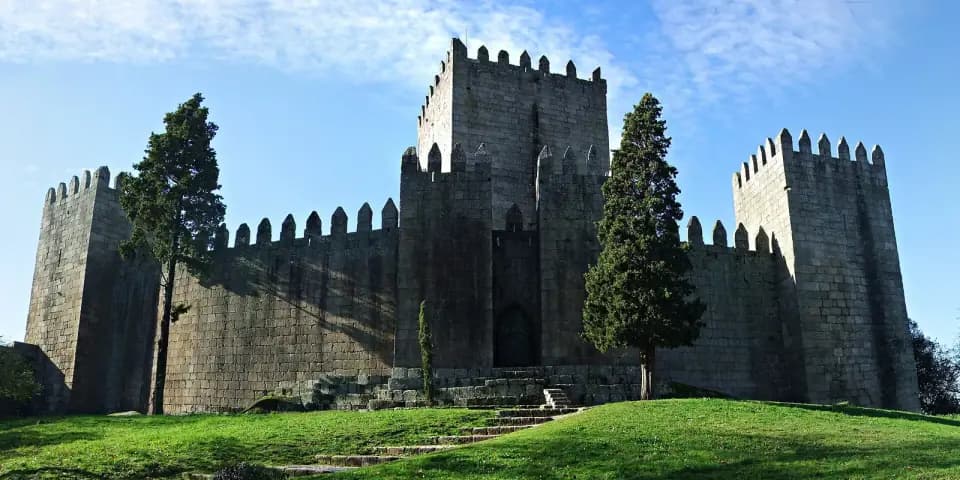
Battle of São Mamede, near Guimarães. Afonso Henriques defeats the army of his mother Teresa and her Galician ally Fernão Peres de Trava, asserting himself as sole ruler of the County of Portugal. The engagement is traditionally considered the founding act of the future Kingdom of Portugal.
Battle of Ourique. In the Baixo Alentejo, on the feast day of Saint James, Afonso Henriques's army defeats a much larger Almoravid force under the governor of Córdoba, Muhammad az-Zubayr. According to tradition Afonso is acclaimed 'King' on his shield by his knights immediately after the victory and begins styling himself 'Rex Portugallensis', founding the Kingdom of Portugal.
By the Treaty of Zamora, Alfonso VII of León and Castile recognises his cousin Afonso Henriques as king, with the papal legate Cardinal Guido de Vico as mediator. The date is traditionally taken as the birth of the independent Kingdom of Portugal.
Afonso Henriques takes Santarém from the Almoravids in a surprise night attack: 25 knights climb the walls on hidden ladders, kill the sentries and open the gate to his army. The prize opens the road to Lisbon, which he captures that October.
The Siege of Lisbon begins. King Afonso I, having struck a deal with Northern European crusaders bound for the Second Crusade, opens the assault on the great Almoravid city on the Tagus. After almost four months the city falls on 25 October, becoming the future capital of the Kingdom of Portugal.
After a siege of about four months, Afonso Henriques and his crusader allies enter Lisbon, whose starving Muslim defenders had agreed to surrender. The capture was the main success of the Second Crusade, and Sintra and Palmela soon surrendered too.
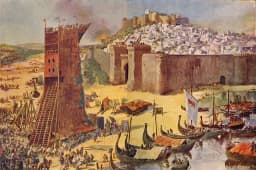 Long readThe siege of Lisbon, 1147: how crusaders and a new king took the city
First naval battle in Portuguese history. Off Cape Espichel, a small fleet assembled by King Afonso Henriques and commanded by Dom Fuas Roupinho intercepts an Almohad squadron returning to Andalusia, kills its admiral and captures several of its galleys. The victory marks the modest birth of Portuguese seapower.
Death in Coimbra of Afonso Henriques, the first King of Portugal, after ruling for more than half a century, first as count and from 1139 as king. He is buried in the Monastery of Santa Cruz in Coimbra; in 2006 a scientific plan to open his tomb and study his remains was halted by the state heritage agency after a public outcry.
Birth in Coimbra of Afonso III, the king who completed Portugal's share of the Reconquista by taking Faro in 1249 and was the first to style himself 'King of Portugal and the Algarve'. He also moved the royal seat from Coimbra to Lisbon, which has been the capital ever since.
King Sancho I of Portugal dies in Coimbra. Known as 'the Populator' (o Povoador), he significantly expanded Portuguese settlement in reconquered territories, founded numerous towns, and strengthened the kingdom's military and economic infrastructure.
Battle of Las Navas de Tolosa. The combined armies of Castile, Aragon and Navarre crush the Almohad Caliph al-Nasir on a plain in the Sierra Morena. Afonso II cannot come in person, but a Portuguese contingent fights in the Christian ranks, its town militias praised by the chronicler Rodrigo of Toledo; the victory tips the Iberian balance decisively against the Almohads.
King Afonso II of Portugal dictates his last will and testament in Coimbra. Drafted in the vernacular rather than Latin, the document is one of the oldest surviving texts written in Galician-Portuguese and a cornerstone of the history of the Portuguese language.
King Afonso II of Portugal dies in Coimbra. Known as 'the Fat' (o Gordo), he was the first Portuguese king to create general laws for the kingdom and convened the first Cortes (parliament) at Coimbra in 1211.
Death of Saint Anthony of Padua at Arcella, near Padua, after collapsing on his way back from preaching. Born Fernando Martins de Bulhões in Lisbon around 1195, he is canonised less than a year after his death — one of the swiftest canonisations in church history — and remains the patron saint of Lisbon, where his feast day is the city's most exuberant municipal holiday.
Sancho II dies in exile in Toledo. The king who had taken much of the Alentejo and Algarve from the Moors was declared unfit to rule by Pope Innocent IV and lost a civil war to his brother, the future Afonso III. Legend says the alcaide of Coimbra, Martim de Freitas, refused to surrender his castle until he had seen the dead king in Toledo with his own eyes.
Back to the full timeline of Portugal, with key moments, search and long reads.