

King Dinis, born in Lisbon on 9 October 1261: the poet who ruled 46 years
His birth was meant to settle a quarrel over the Algarve. He grew up to found Portugal's first university, fix most of its border with Castile and leave some 137 songs. Some of what he is remembered for, he never did.
At a glance
- Dinis was born in Lisbon on 9 October 1261, the son of King Afonso III and Beatriz, an illegitimate daughter of Alfonso X of Castile. He was the first Portuguese king born in the city.
- A treaty of 1253 had promised that Castile would hand its rights over the Algarve to the first son of that marriage, so his birth mattered to two kingdoms.
- He reigned from 1279 until his death in Santarém on 7 January 1325, almost 46 years, and is buried in the monastery he founded at Odivelas, outside Lisbon.
- He founded the Estudo Geral, Portugal's first university, in Lisbon in 1290, signed the Treaty of Alcañices with Castile in 1297 and obtained the creation of the Order of Christ in 1319.
- A database of medieval Galician-Portuguese lyric attributes 137 songs to him. The tradition that he planted the Leiria pine forest goes beyond the evidence: the sources agree it was older, and that he enlarged it.
A son for the Algarve
On 9 October 1261, in Lisbon, the queen of Portugal gave birth to a boy. Beatriz was about 17. Her husband, King Afonso III, had married her eight years earlier, and their first child, born in 1259, had been a girl, Branca. The boy was named Dinis.
Little is known of his childhood. Two facts gave his birth weight. He was the first Portuguese king to be born in Lisbon, and he was the son that a treaty had been waiting for.
Beatriz was a daughter of Alfonso X of Castile, born outside his marriage. When she was promised to Afonso III at Chaves in 1253, the deal came with a clause about the Algarve, the southern coast the Portuguese had just won from its Muslim rulers. Castile would keep some of the region's revenues, but would hand over all its rights to the first son of the marriage once he reached the age of seven. The historian Manuel García Fernández calls Dinis “the awaited heir”.
Portugal in 1261
Portugal was a young kingdom with its southern border freshly drawn. By March 1249 Afonso III held Faro, and the conquest of the Algarve was all but complete. Castile had its own claim to the region. Its heir, the future Alfonso X, held that Ibn Mahfuz, the Muslim ruler of Niebla and his vassal, had handed him his rights over the Algarve in 1248. García Fernández calls that argument unjustified, but the dispute soured relations between the two courts.
The marriage was meant to defuse that rivalry, and it was unpopular. Portuguese nobles saw it as a humiliating sign of submission to Castile. There was a worse problem. When Afonso III was betrothed to Beatriz in 1253 he was still married to Matilde, Countess of Boulogne.
Matilde, whom he had set aside because she gave him no children, appealed to Pope Innocent IV in 1255 and accused her husband of bigamy. In 1258 Afonso III was condemned for adultery and incest and ordered, under threat of excommunication, to return her dowry. Matilde died the same year, and the papal threats were left in suspense.
Pope Urban IV legitimised the second marriage only after Dinis was born. In the eyes of the Church he was the son of an irregular union, and his younger brother Afonso, born in 1263, would later use that against him.
The boy was part of the bargaining. When Alfonso X called for the promised lances in 1264, the four-year-old heir was meant to bring them to Seville. At some point he did ride there with his mother and a troop of soldiers to visit his grandfather, but the date is uncertain.
The Cantigas database gives 1265. The Castilian chronicle of Alfonso X says 1269 and has him sent to be knighted and to ask for the old tribute to be lifted. García Fernández, building on errors already noticed by Antonio Ballesteros, dates the visit to 1266 or 1267, before the treaty of Badajoz. Joseph O'Callaghan preferred 1275 or 1276, though García Fernández finds no record of Dinis in Castile in those years.
Growing up to rule
Dinis was given his own household in 1278. On 16 February 1279 his father died, and the 17-year-old became king. The kingdom he inherited was under a papal interdict, the result of his father's quarrel with the bishops and the Holy See.
His own family was the first trouble. His mother wanted a bigger political role and, after disagreements with her son, withdrew to Castile; by 1282 she was back in Seville with Alfonso X, and she stayed with him until his death in 1284. His younger brother Afonso, lord of Portalegre and Arronches, disputed his right to the throne and rebelled on and off from 1281 until Dinis subdued him in 1299.
Isabel, daughter of Pedro III of Aragon, born in Zaragoza around 1270, was married to him by proxy in Barcelona on 11 February 1282 and received the marriage blessing with him at Trancoso on 24 June. Some accounts, including the Cantigas database, date the marriage to 1281. Their daughter Constança was born on 3 January 1290 and their son Afonso, the heir, on 8 February 1291. Dinis also had at least six children outside the marriage.
Peace with the Church took a decade. A concordat of 40 articles, settling the disputes between the Crown and the clergy, was approved by Pope Nicholas IV in the bull Cum olim of 7 March 1289, and a second agreement of eleven articles followed in 1292. At the same time Dinis sent royal inquiries round the country, in 1284, 1288, 1301, 1303 and 1307, to track down Crown land and rights that had been usurped.
A 46-year reign
9 October 1261
Born in Lisbon
16 February 1267
Treaty of Badajoz sets the border on the Guadiana
16 February 1279
Becomes king on the death of Afonso III
11 February 1282
Married by proxy to Isabel of Aragon in Barcelona
7 March 1289
Papal bull Cum olim approves the concordat with the clergy
1 March 1290
Charter of the Estudo Geral in Lisbon
Confirmed by Pope Nicholas IV on 9 August 1290.
7 February 1295
Founds the Cistercian monastery of São Dinis at Odivelas
12 September 1297
Treaty of Alcañices with Castile
1308
The Estudo Geral moves to Coimbra
1 February 1317
Hires the Genoese Manuel Pessanha as admiral
14 March 1319
Pope John XXII creates the Order of Christ
1321 to 1324
War with his son and heir, the future Afonso IV
20 June 1322
Second will asks for burial at Odivelas
7 January 1325
Dies in Santarém, aged 63
The reign was long by any standard. The encyclopedia entry by Costa Pimpão sums up the tradition it left: the saying that “el-rei D. Dinis fez tudo quanto quis”, King Dinis did everything he wanted. The record supports a good deal of that, but not all of it.
He looked after the land. He encouraged farming, had marshes such as the Paul de Ulmar drained, protected fairs and granted rights to work mines, among them the gold workings of Adiça between Almada and Sesimbra.
A university and a language
Costa Pimpão counts the Estudo Geral as the most important of the king's cultural initiatives. The royal charter founding it in Lisbon is dated 1 March 1290, and Pope Nicholas IV confirmed it on 9 August that year. The University of Lisbon gives 1288 as the year the first Portuguese university was born in the city.
In 1308 the Estudo Geral was moved to Coimbra with wider privileges. It later went back to Lisbon, and was settled in Coimbra for good only in 1537. The University of Coimbra counts its history from Dinis's charter.
His reign is also linked with the Portuguese language. Lisbon's Castelo de São Jorge, in its account of the king, says he made Galician-Portuguese the official language of the royal chancery's charters. The story is more gradual than that.
The troubadour king
Dinis wrote in Galician-Portuguese, the shared language of lyric poetry in the western Iberian courts, at a time when, in Costa Pimpão's words, the troubadour flame was already flickering. He kept it alight. The Cantigas Medievais Galego-Portuguesas database, run by researchers at NOVA University Lisbon, lists 137 songs under his name. Costa Pimpão counts 138, preserved in the Cancioneiro da Vaticana and the Cancioneiro da Biblioteca Nacional, two great songbooks.
Songs attributed to King Dinis, by genre
songs
Count of the 137 songs listed under D. Dinis in the Cantigas Medievais Galego-Portuguesas database (FCSH, NOVA University Lisbon). In cantigas de amor a man addresses his lady; in cantigas de amigo the voice is a woman's, speaking of her lover.
Show the data
| Cantigas | |
|---|---|
| Love songs (cantigas de amor) | 73 |
| Songs of the friend (cantigas de amigo) | 51 |
| Satire (escárnio e maldizer) | 10 |
| Pastorelas | 3 |
He knew where the genre came from. One of his songs opens by granting that the poets of Provence compose very well and say they do it out of love, then mocks them for singing only in the season of flowers. Costa Pimpão credits him with writing cantigas de amigo, songs in a woman's voice, with real talent, and with making the pastorela, the shepherdess song, Portuguese. The best known of his songs asks the flowers of a pine tree for news of an absent lover.
“Flowers of the green pine, oh flowers, do you have news of my lover? Oh God, and where is he?”
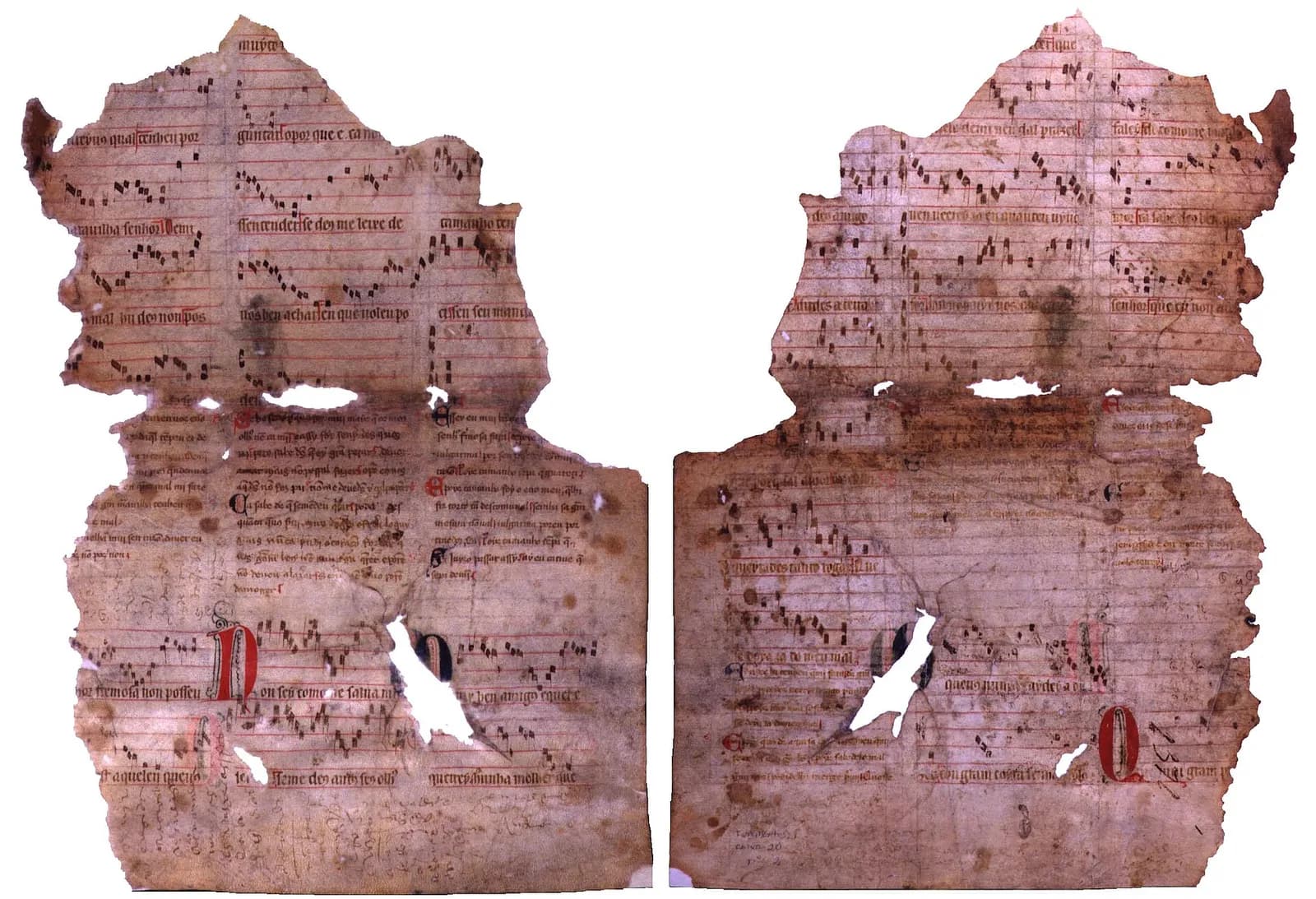
For centuries his songs survived only as words. In 1990 the American musicologist Harvey Sharrer found a damaged parchment leaf in the Torre do Tombo carrying seven of his love songs with their melodies. The musicians who later studied it count it as one of only two medieval manuscripts of secular Iberian song with written music; the other, the Pergaminho Vindel, holds songs by Martin Codax. On 7 January 2025, at Leiria, they performed their reconstruction to mark 700 years since his death.
When he died, the jogral Joham, a professional singer from León, wrote a lament for him. His grandson Alfonso XI of Castile still wrote songs, but in Castilian, and Galician-Portuguese lost its place as the one prestige language of poetry in the Peninsula.
A border, an admiral and an order of knights
In 1295 Castile fell to a boy king, Fernando IV, with his mother María de Molina as regent. Dinis took the side of rival claimants and in 1296 marched into León from Guarda, reaching Simancas. He never got to Valladolid. Instead he turned back over the Douro to Riba-Côa, the border district between the Côa and Águeda rivers, and took its castles, some by force and some by surrender.
The peace was signed at Alcañices on 12 September 1297. For María de Molina it was above all a peace treaty, meant to break Portugal's alliance with Aragon. For Dinis it was a border treaty. It came with two marriages: his daughter Constança to Fernando IV, and his heir Afonso to Fernando's sister Beatriz. Dinis also sent 300 knights to help the young king against his rebels, though García Fernández finds he never fully kept his side of the bargain.
| Place | Where | Outcome |
|---|---|---|
| Serpa and Moura | East of the Guadiana | Promised to Portugal at Guarda in 1295; Castile ordered them handed over that October |
| Olivença | East bank of the Guadiana | Ceded by Castile to Portugal; annexed by Spain later and still Spanish, a claim Portugal has not given up |
| Campo Maior | Alentejo frontier | Ceded by Castile to Portugal |
| Ouguela | Next to Campo Maior | Ceded by Castile to Portugal |
| San Felices de los Gallegos | Kingdom of León | Ceded by Castile to Portugal |
| Riba-Côa, including Castelo Rodrigo, Sabugal and Alfaiates | Between the Côa and Águeda rivers | Occupied by Dinis in 1296–1297; Portuguese rule accepted at Alcañices |
| Aroche and Aracena | Sierra Morena, east of the Guadiana | Promised to Portugal in 1295; Dinis gave up the claim |
Following Manuel García Fernández, who describes Olivença, Ouguela, Campo Maior and San Felices as the dowry Dinis demanded for the marriage alliance, and the renunciation of Aroche and Aracena as what made Castile accept it. The Torre do Tombo, which holds the treaty, sums it up as giving Portugal Olivença, Campo Maior and other towns.
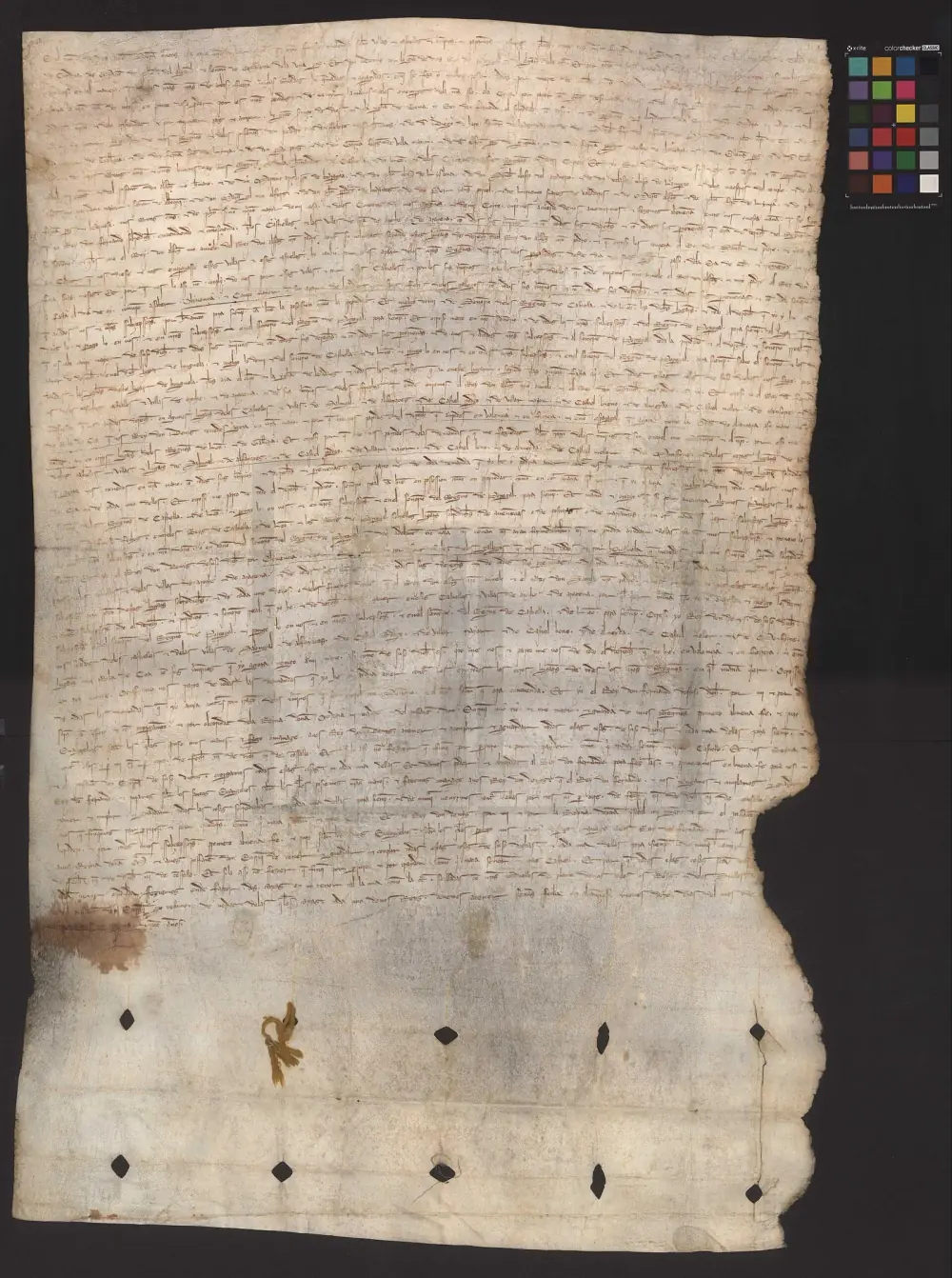
Lisbon's Castelo de São Jorge, in its account of the king, calls the frontier agreed at Alcañices the oldest and most stable in Europe. There is one exception. Spain later annexed Olivença and still holds it, and the Portuguese state has never recognised the town as Spanish territory.
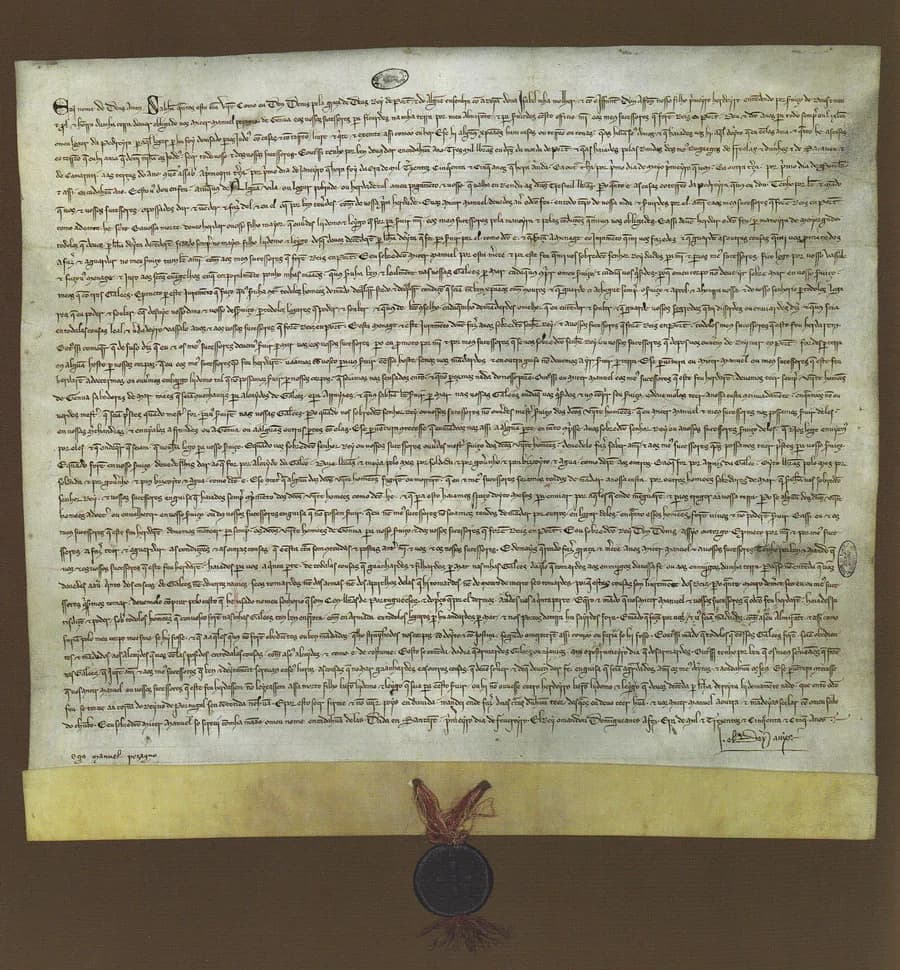
Dinis also looked to the sea. On 1 February 1317 he signed a contract with Manuel Pessanha, a Genoese, who became admiral of Portugal. The office was hereditary. Pessanha received the Pedreira site in Lisbon and 3,000 libras a year, and had to keep 20 Genoese “sabedores de mar”, men who knew the sea, ready to command the king's galleys. The Torre do Tombo notes that the document is often called the birth certificate of the Portuguese navy.
The third piece was the Order of Christ. When the pope dissolved the Knights Templar at the request of the king of France, Dinis made a treaty with Castile in 1310 to keep their property from passing to outsiders, then sent envoys to the pope. On 14 March 1319 Pope John XXII issued the bull Ad ea ex quibus, creating the Order of Christ with its seat at Castro Marim, in the Algarve, and giving it the old Templar castles and revenues, including Tomar and Almourol. The order moved to Tomar in 1357.
The farmer king and the pine forest
The best-known story about Dinis is that he planted the great pine forest of Leiria, on the coast near Marinha Grande, to stop the dunes and supply timber. The national archive still repeats it, and gives it as the reason for his nickname, “o Lavrador”, the farmer. The documents tell a narrower story.
Under its later name, the Mata Nacional de Leiria, it became the first Portuguese forest with a management plan, drawn up in 1883 and published in 1892. On 15 October 2017 fire swept through 86 per cent of it.
Father against son
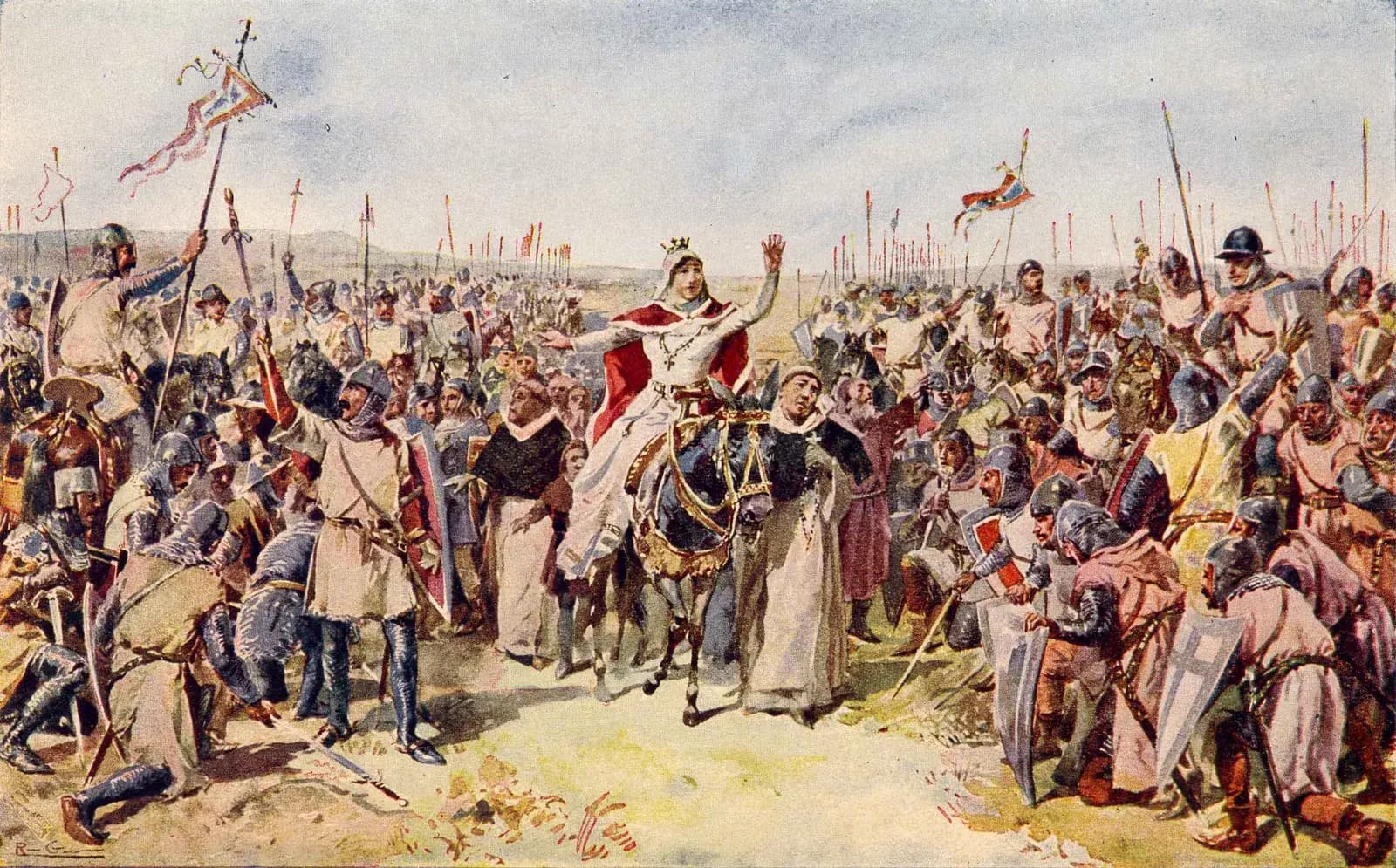
The last years of the reign were the worst. The heir, Afonso, resented the favour his father showed Afonso Sanches, one of the king's sons born outside the marriage and, like him, a troubadour. In 1321 the heir gathered discontented nobles and went to war against his father. The fighting ended only in 1324, with large concessions by the king.
Queen Isabel is remembered as the peacemaker of this war. Costa Pimpão calls her the tireless mediator between father and son. The historian Giulia Rossi Vairo has a sharper view: she argues that in the civil war the queen took her son's side.
Death, a bear and a tomb at Odivelas
Dinis died at Santarém on 7 January 1325. He was buried, as his will of June 1322 asked, not at Alcobaça with earlier kings but in the Cistercian convent he had founded at Odivelas, just north of Lisbon. Building began in 1295, and ten years later the house was handed to the Cistercian order. Isabel, who died at Estremoz in 1336, chose to lie in Coimbra instead.
The tomb has had a hard life. The effigy is thought to have been badly damaged in the 1755 earthquake, which brought down the church vault. Repairs followed, one paid for by Queen Estefânia in the nineteenth century and another in 1961 that added cement and iron, and only an estimated 30 per cent of the original survives. The stone king's sword is gone. A restoration began in late 2016. The tomb had last been opened in 1938.
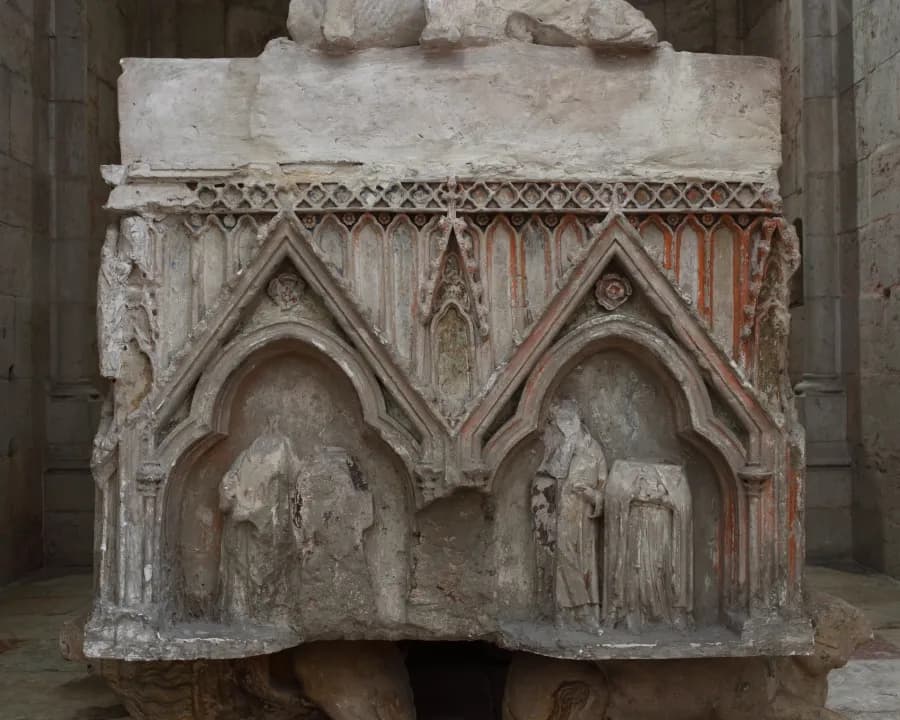
The tomb was opened in 2020. On 24 October 2022 the team lifted out the king's own sword, of iron with a silver hilt decorated with coloured enamel, missing from view for almost seven centuries. Forensic scientists confirmed that he died aged 63, which fits his dates; Costa Pimpão and Odivelas council give 64. He stood about 165 centimetres tall and had blue eyes, fair skin and light hair. Tests on his hair and a nail found no arsenic, lead or mercury.
In January 2025, as the 700th anniversary of his death began, a reconstruction of his face made with the National Institute of Legal Medicine was unveiled, described as the first scientific reconstruction of a Portuguese monarch's face. The tomb was closed again on 28 June 2023, and in February 2026 a government decree classified the sword, a silver buckle and the textiles found with him as a national treasure.
Why it still matters
Several things Portugal still has can be traced to his reign. Apart from Olivença, the frontier fixed at Alcañices has largely held, which is why it is so often called the oldest in Europe. Both the University of Coimbra and the University of Lisbon trace their origins to the Estudo Geral he chartered. The Order of Christ he obtained from the pope was granted in 1454 the spiritual care of Guinea and the other lands Portuguese ships were reaching.
His songs are still sung, and the parchment that preserves seven of their tunes is in Lisbon. The 700th anniversary of his death, in 2025, was marked with a series of medieval music concerts at Leiria castle and a reconstruction of his face from his skull.
FAQs
When and where was King Dinis born?
Dinis was born in Lisbon on 9 October 1261, the son of King Afonso III of Portugal and Beatriz, a daughter of Alfonso X of Castile. He was the first Portuguese king born in Lisbon. He reigned from 1279 until his death on 7 January 1325.
Did King Dinis plant the Pinhal de Leiria?
Not from scratch. The forest service considers the maritime pine native to that coast, and the pinewood already existed before his reign. Under Dinis it became a crown forest and was enlarged with large sowings of maritime pine, which is how the tradition that he planted it grew up. Who first planted it, and whether the older wood was mostly stone pine, is still debated.
Did King Dinis make Portuguese the official language?
Not in one step. Portuguese appears in royal documents from at least 1214. Under Dinis it gradually replaced Latin in the charters of his chancery, above all from 1284, so his reign is when it became the normal written language of royal government.
What was the Treaty of Alcañices?
A peace and border treaty signed at Alcañices on 12 September 1297 between Dinis and Castile, then ruled for the young Fernando IV by his mother María de Molina. Portugal gained Olivença, Campo Maior, Ouguela, San Felices de los Gallegos and Riba-Côa, gave up its claim to Aroche and Aracena, and the two crowns agreed two royal marriages. Spain later annexed Olivença and still holds it; Portugal has never recognised it as Spanish.
Where is King Dinis buried?
In the monastery of São Dinis e São Bernardo at Odivelas, just north of Lisbon, which he founded in 1295. His tomb was opened in 2020 during a restoration and closed again on 28 June 2023, and his sword and the textiles found with him were classified as a national treasure in 2026.
On the timeline
Open the timelineNearby moments from the burgundian kings (1249–1383).
The birth of King Dinis
Pope John XXI — born in Lisbon and the only Portuguese pope in history — dies in Viterbo, days after the ceiling of a new chamber he had added to the papal palace collapses on him. A physician and scholar, he had reigned for barely eight months.
King Dinis celebrates his wedding to Isabel of Aragon in Trancoso, four months after a proxy marriage in Barcelona; the bride is about 11. The king adds Trancoso to her dower, and Isabel goes on to become the 'Rainha Santa' of Coimbra, the saintly queen of the legend of the miracle of the roses.
King Dinis signs 'Scientiae thesaurus mirabilis', founding the Estudo Geral that becomes the University of Coimbra — one of the oldest universities in continuous operation. It actually began life in Lisbon and shuttled between the two cities before settling for good in Coimbra in 1537.
Coming up in history
All long reads 11 October 1810The Lines of Torres Vedras: where Masséna's march on Lisbon stopped, 1810
 12 October 1943Churchill, Salazar and the Azores bases: 12 October 1943
 13 October 1917When the sun “danced” at Fátima: 13 October 1917
 14 October 18991899: the secret declaration that revived the Anglo-Portuguese alliance
25 sources
Archives, scholarship and reporting this article was checked against.
- 1
La política internacional de Portugal y Castilla en el contexto peninsular del Tratado de Alcañices (1267–1297)Manuel García Fernández, Revista da Faculdade de Letras: História, Universidade do Porto, series II, vol. 15 (1998), pp. 901–943
- 2
D. Dinis: nota biográfica e cantigasCantigas Medievais Galego-Portuguesas, Instituto de Estudos Medievais, FCSH, Universidade NOVA de Lisboa
- 3
D. DinisA. J. da Costa Pimpão, Enciclopédia Luso-Brasileira da Cultura, vol. 23 (Verbo), reproduced by the Câmara Municipal de Odivelas
- 4
Nascimento de D. DinisArquivo Nacional Torre do Tombo
- 5
- 6
- 7
A relevância da escrita e a oficialização do uso da língua portuguesa na documentação régia de Portugal no tempo de D. Dinis (1279–1325)Cleusa Teixeira de Sousa, Acta Scientiarum. Education, vol. 44 (2022), e54713
- 8
Plano de Gestão Florestal da Mata Nacional de Leiria 2019–2038Instituto da Conservação da Natureza e das Florestas (ICNF)
- 9
King DenisCastelo de São Jorge (EGEAC, Lisbon City Council)
- 10
A conquista, o padroeiro e os priores de LouléLuís Filipe Oliveira, Universidade do Algarve (via NOVA FCSH)
- 11D. Dinis. Um enigma e um túmulo para ser (re)descobertoObservador
- 12
Datas importantesConfraria da Rainha Santa Isabel, Coimbra
- 13
O Rei Trovador já tem rosto: Medicina Legal reconstitui rosto de D. DinisMinistério da Justiça (Portugal)
- 14
HistóriaUniversidade de Lisboa
- 15
- 16
- 17
- 18Investigação revela canções de D. Dinis em Leiria nos 700 anos da morte do rei trovadorRTP Notícias (Lusa)
- 19Nuno Melo defende que Olivença “é portuguesa”Observador (Lusa)
- 20
A polémica origem e evolução da Mata Nacional de LeiriaFlorestas.pt
- 21
- 22
- 23
Estudo forense a D. Dinis é projeto pioneiro em PortugalCâmara Municipal de Odivelas
- 24Espólio do túmulo de D. Dinis classificado tesouro nacionalObservador
- 25
Image credits
- The Pergaminho Sharrer, both sides of a damaged leaf with seven love songs by King Dinis and their melodies. It was found in 1990 in the Torre do Tombo, Lisbon's national archive. Unknown author, Public domain, via Wikimedia Commons.
- The Treaty of Alcañices, dated 12 September 1297, kept in the Torre do Tombo in Lisbon. The slits along the foot are where the seals hung. Unknown author, Public domain, via Wikimedia Commons.
- The contract of 1 February 1317 between King Dinis and Manuel Pessanha of Genoa, with its lead seal on red and white cords. Pessanha signed at the bottom left as “Ego Manuel Pesagno”. Unknown author, Public domain, via Wikimedia Commons.
- Queen Isabel riding between the armies of her husband and her son at Alvalade, as tradition tells it. Roque Gameiro painted the scene for the album Quadros da História de Portugal, published in 1917. Roque Gameiro, Public domain, via Wikimedia Commons.
- A detail of King Dinis's tomb in the church of the monastery of São Dinis at Odivelas, photographed in January 2015, before the restoration. Manuelvbotelho, CC BY-SA 4.0, via Wikimedia Commons.