

When the sun “danced” at Fátima: 13 October 1917
Three shepherd children promised a sign from heaven at midday. Tens of thousands of people waited for it in the rain, and a reporter from an anticlerical Lisbon daily wrote down what they saw.
At a glance
- On 13 October 1917, tens of thousands of people waited in heavy rain at the Cova da Iria, near Fátima, for a miracle three shepherd children had announced months before.
- Lúcia dos Santos, aged 10, and her cousins Francisco Marto, 9, and Jacinta Marto, 7, said a Lady had appeared to them each month since May: on the 13th at the Cova da Iria, except in August, when they were held in Ourém and reported seeing her on the 19th at Valinhos.
- When the rain stopped around midday by the sun, many in the crowd said the sun trembled, spun, changed colour and seemed to fall towards the earth for about ten minutes. Others saw nothing unusual.
- Estimates written in 1917 put the crowd at 30,000 to 60,000; the often-quoted 70,000 comes from a priest's book of 1921.
- The Bishop of Leiria declared the visions worthy of belief on 13 October 1930. Francisco and Jacinta died in the 1918 to 1920 flu pandemic and were canonised in 2017.
Rain, umbrellas and a silver sun
Avelino de Almeida had to walk. The senior reporter of O Século, Lisbon's big republican daily, got off the train at Chão de Maçãs at about four in the afternoon of 12 October 1917 with the photographer Judah Ruah. Their carriage never came, so they tramped the ten kilometres to the town of Ourém, past barefoot pilgrims praying the rosary, the women with bags on their heads topped by their heavy shoes.
The pilgrims were heading for the Cova da Iria, a stony hollow in the hills near the village of Fátima. Three shepherd children said a Lady had been appearing to them there, and many took her for the Virgin Mary. She would give a sign, they said, at midday on the 13th. Many pilgrims planned to sleep in the open beside the small holm oak where the children said she stood.
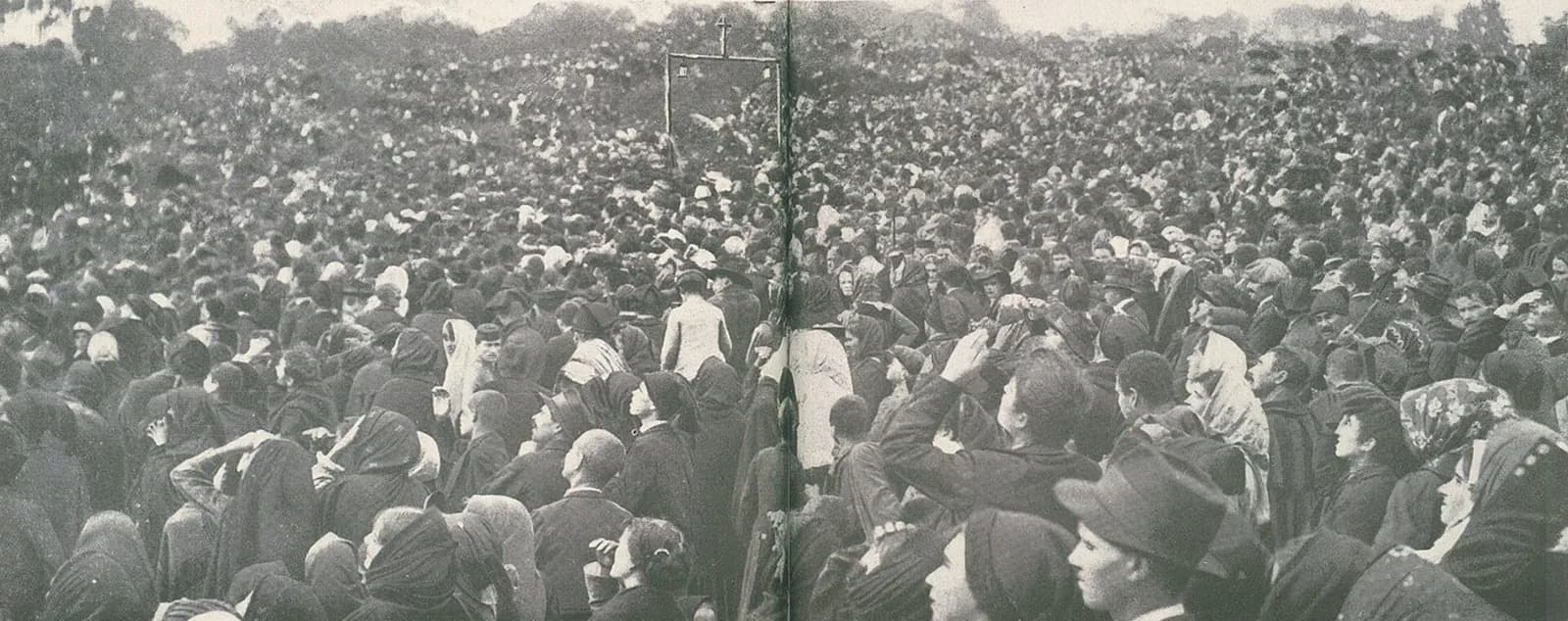
At about ten the next morning it began to pour. Almeida watched from the Leiria road above the hollow, where someone counted more than a hundred motor cars and more than a hundred bicycles. Below him, thousands of people stood in the sodden clay around the oak, over which a rough arch hung with two lanterns had been put up. The children arrived perhaps half an hour before the appointed time. Lúcia told the people to close their umbrellas, and they did.
Then the rain stopped and the clouds broke open over the sun. The whole crowd turned to look at it.
“The sun looks like a plate of dull silver, and it is possible to look at its disc without the least effort. It does not burn, it does not blind. One would say an eclipse was taking place.”
The spectators nearest by began to shout “Miracle, miracle!”. Afterwards, most said they had seen the sun tremble and “dance”. Some swore it had spun like a Catherine wheel or dropped towards the earth; others said it had changed colour. Almeida wrote it all down, and his paper, which had treated the story with suspicion since July, put it on its front page two days later.
A Catholic country under an anticlerical republic
Portugal had been a republic for seven years. The monarchy fell in October 1910, and the first decree of the new Provisional Government, on 8 October, expelled the Jesuits. Republicans saw the Catholic Church as an obstacle to a modern, secular country and set out to shrink its influence.
Portugal was also at war. It entered the European conflict on 9 March 1916, and in January 1917 the first troops of the Portuguese Expeditionary Corps (CEP) were shipped to France. The corps grew to more than 50,000 men and held a sector of the Flanders front under British command. At the Cova da Iria on 13 October, street sellers offered postcards of a CEP soldier “thinking of the help of his protectress for the salvation of the Fatherland”.
Fátima itself was a parish of more than twenty small hamlets in the Serra de Aire. Nobody lived at the Cova da Iria; there were a few trees, a great deal of stone and a small field that belonged to Lúcia's parents, about two kilometres from their hamlet of Aljustrel. Around three in four Portuguese could not read, and in the parish of Fátima the figure in 1920 was about 87 per cent.
Three children and six thirteenths
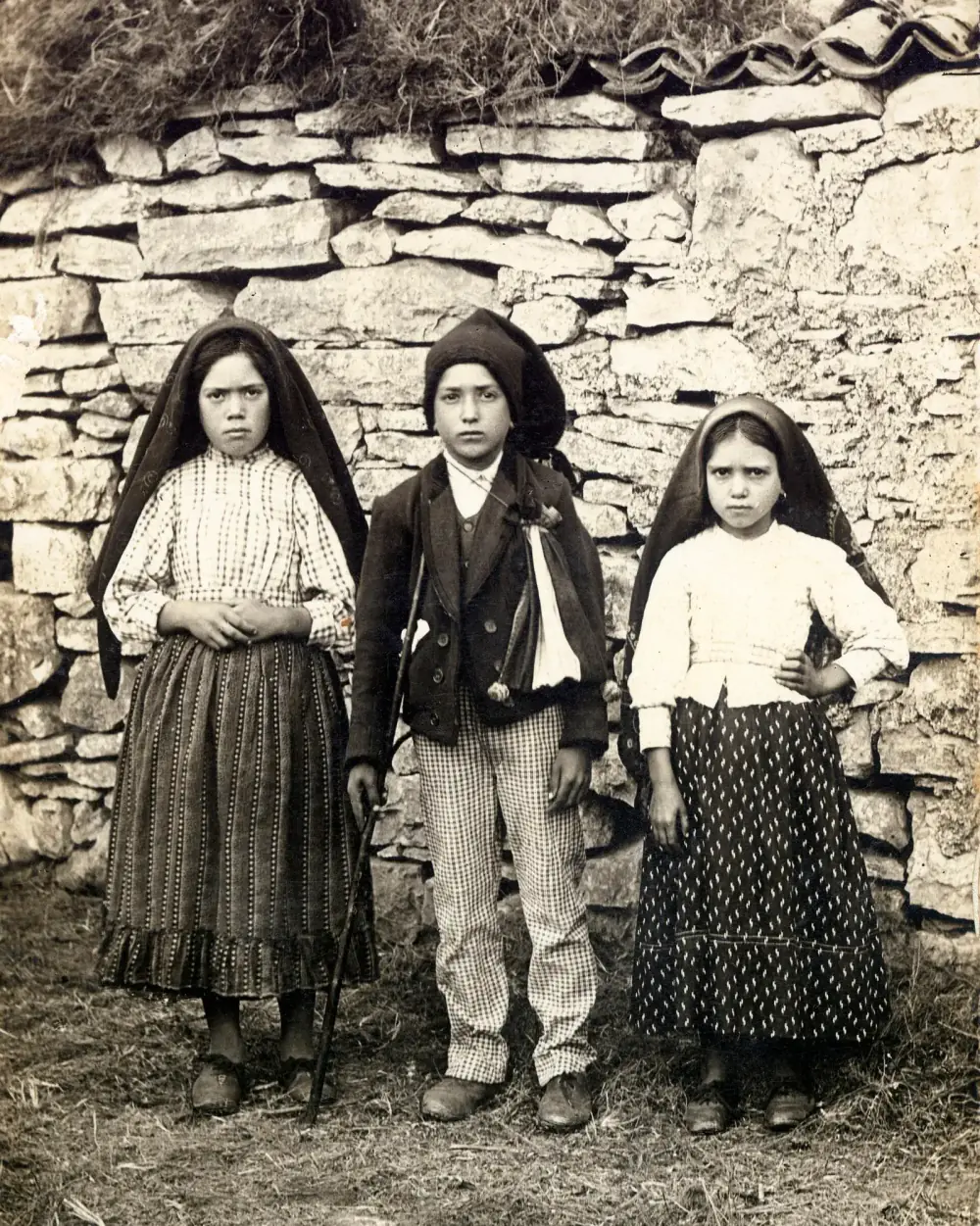
Lúcia de Jesus dos Santos, born in Aljustrel in 1907, lived 200 metres from her cousins Francisco and Jacinta Marto, and the three minded their families' sheep. On 13 May 1917, they said, a Lady “more brilliant than the sun” appeared above a holm oak at the Cova da Iria, said she came from Heaven and asked them to return on the 13th of each month for six months.
The children did not experience the visions in the same way. Carlos de Azevedo Mendes, a lawyer from Torres Novas who questioned them separately in September 1917, wrote that Lúcia saw the Lady, heard her and spoke to her; Jacinta saw and heard her but did not speak; Francisco only saw her. Lúcia did the talking for all three.
Almost everything we know about what the Lady said comes from Lúcia. The parish priest, Manuel Marques Ferreira, began questioning the children on 27 May 1917, and notes of their many interrogations that year survive. The longer dialogues quoted today come from memoirs Lúcia wrote as a nun between 1935 and 1941.
| Date | Place | What Lúcia said the Lady asked | People present (Santuário estimate) |
|---|---|---|---|
| 13 May | Cova da Iria | Return on the 13th for six months; pray the rosary for peace and the end of the war | No crowd recorded |
| 13 June | Cova da Iria | Pray the rosary every day and learn to read | 50 to 60 |
| 13 July | Cova da Iria | The “secret”; a promise of a miracle in October so that all would believe | 4,000 to 5,000, or 2,000 to 3,000 |
| 19 August | Valinhos (on the 13th the children were held in Ourém) | Keep going to the Cova da Iria; the miracle would come in the last month | 15,000 to 18,000 at the Cova on the 13th |
| 13 September | Cova da Iria | Keep praying the rosary to obtain the end of the war | 20,000 to 30,000 |
| 13 October | Cova da Iria | Build a chapel here; she was the Lady of the Rosary | 50,000 to 70,000 |
Requests as given in Lúcia's Fourth Memoir (1941) and the parish priest's 1917 notes, published by the Santuário. For 13 August the Santuário notes that some writings give only 5,000. Letters and notes written in 1917 give lower crowds for some months: over 4,000 and 5,000 to 6,000 for 13 August, and 15,000 to 17,000, with some claiming well over 20,000, for 13 September.
Taken by the administrator
Early on 13 August, Artur de Oliveira Santos, administrator of the municipality of Vila Nova de Ourém and so the Republic's local authority, posted a detachment of the Republican National Guard (GNR), the gendarmerie, at the town hall and went to Aljustrel. He persuaded the parents to let the parish priest of Fátima question the children. Afterwards, the priest wrote, Santos put them in his carriage, telling the parents he was taking them to the Cova da Iria, and drove off at a gallop to Ourém.
“with the aim of bringing the three protagonists to this town and, by this means, of preventing the continuation of the increasing clerical speculation about them.”
The children spent three days in Ourém. In her first written account, in 1922, Lúcia said they were locked in a room, threatened with various punishments and promised gold coins if they revealed the secret, and that they told nothing. Her mother's sworn statement of 1923 is milder: Jacinta's brothers had cycled to Ourém and seen the children playing on the administrator's veranda, well treated. On 15 August Santos brought them back to the parish priest's house in Fátima.
At the Cova da Iria on the 13th the crowd had waited anyway. When a young man on a bicycle brought the news, people turned on the parish priest as an accomplice and called for him to be lynched. On Sunday 19 August, while Lúcia and Francisco were grazing sheep at Valinhos, near Aljustrel, the children reported the fourth apparition; Jacinta was fetched from home in time to see it. According to Lúcia, the Lady said the miracle would have been better known if they had not been taken away.
What the crowd saw on 13 October
People came from the Alentejo and the Algarve, the Minho and the Beiras, by ox cart, carriage, bicycle and motor bus. The rain began in the morning, at eight or ten depending on the witness, and the crowd knelt in the mud to pray.
- Date
- Saturday 13 October 1917, around midday by the sun (about 2 pm by official summer time)
- Place
- Cova da Iria, parish of Fátima, municipality of Vila Nova de Ourém
- Seers
- Lúcia dos Santos (10), Francisco Marto (9), Jacinta Marto (7)
- Weather
- Heavy rain from about 8 or 10 am, by different accounts, until just before the phenomenon
- Crowd
- 30,000 to 70,000, depending on the source
- Duration
- About ten minutes, in several accounts
Nobody counted the crowd. Almeida's report gave 30,000 to 40,000, citing “dispassionate estimates by educated people”, and a postcard he sent his sister from Ourém that day said “some 40,000”. Two weeks later he wrote “some fifty thousand”.
Others differed. Joaquim Ramos Pinto, a Leiria merchant, wrote on 15 October of some 30,000; an undated note by Maria Luísa Garrett Correia spoke of nearly 60,000. The figure of about 70,000 came in 1921 from Manuel Nunes Formigão, a priest who had questioned the children in 1917, and went into the diocesan commission's report of 1930. In 1922 Formigão himself wrote of about 60,000.
Lúcia later wrote that the Lady named herself the Lady of the Rosary, asked for a chapel and promised that the war would end, then opened her hands, which reflected on the sun. Carlos de Azevedo Mendes wrote to his brother that it was at the moment Lúcia cried “look at the sun” that everyone saw it dance.
The accounts written that autumn share a core. The sun appeared at the zenith through thinning cloud, pale enough to look at, like a disc of matt silver. Garrett Correia wrote that it spun dizzily, gave off heat like an open oven and seemed to approach the earth in sudden jerks, turning the scene yellow and then purple, for about ten minutes while the kneeling crowd begged for mercy. Carlos Silva, writing to the Leiria paper O Mensageiro, noticed that he was suddenly dry after being soaked, but did not think it a miracle.
Not everyone saw it. A reader of the Lisbon paper Portugal wrote on 17 October that he had seen nothing miraculous, had learned from O Século that the sun had “danced”, and doubted the size of the crowd it reported.
Before the crowd dispersed, Lúcia was carried from group to group in the arms of Carlos de Azevedo Mendes, announcing, as Almeida heard it, that the war had ended and the soldiers would come home. It had not: the armistice came 13 months later, on 11 November 1918. The crowd left quickly and peacefully, with no need for a patrol of the guard.
The anticlerical paper that printed a miracle
O Século was Portugal's biggest newspaper, with an average print run of 80,000 copies, and a republican paper with a strong political colour. It was probably the first national paper to report on Fátima: on 23 July 1917 its correspondent suspected “a premeditated financial speculation” to turn a hidden mineral spring into “a miraculous resort like old Lourdes”. According to the Catholic daily A Ordem, it was still running stories about exploiters of credulity on 12 and 13 October.
On Monday 15 October the paper's front page carried Almeida's report under the headline “Coisas espantosas! Como o sol bailou ao meio dia em Fátima”, “Astonishing things! How the sun danced at noon at Fátima”. It was the only story on the page with an exclamation mark. Almeida, a former seminarian aged 43, did not call it a miracle. He ended by leaving “the macabre dance of the sun” to those competent to judge it.
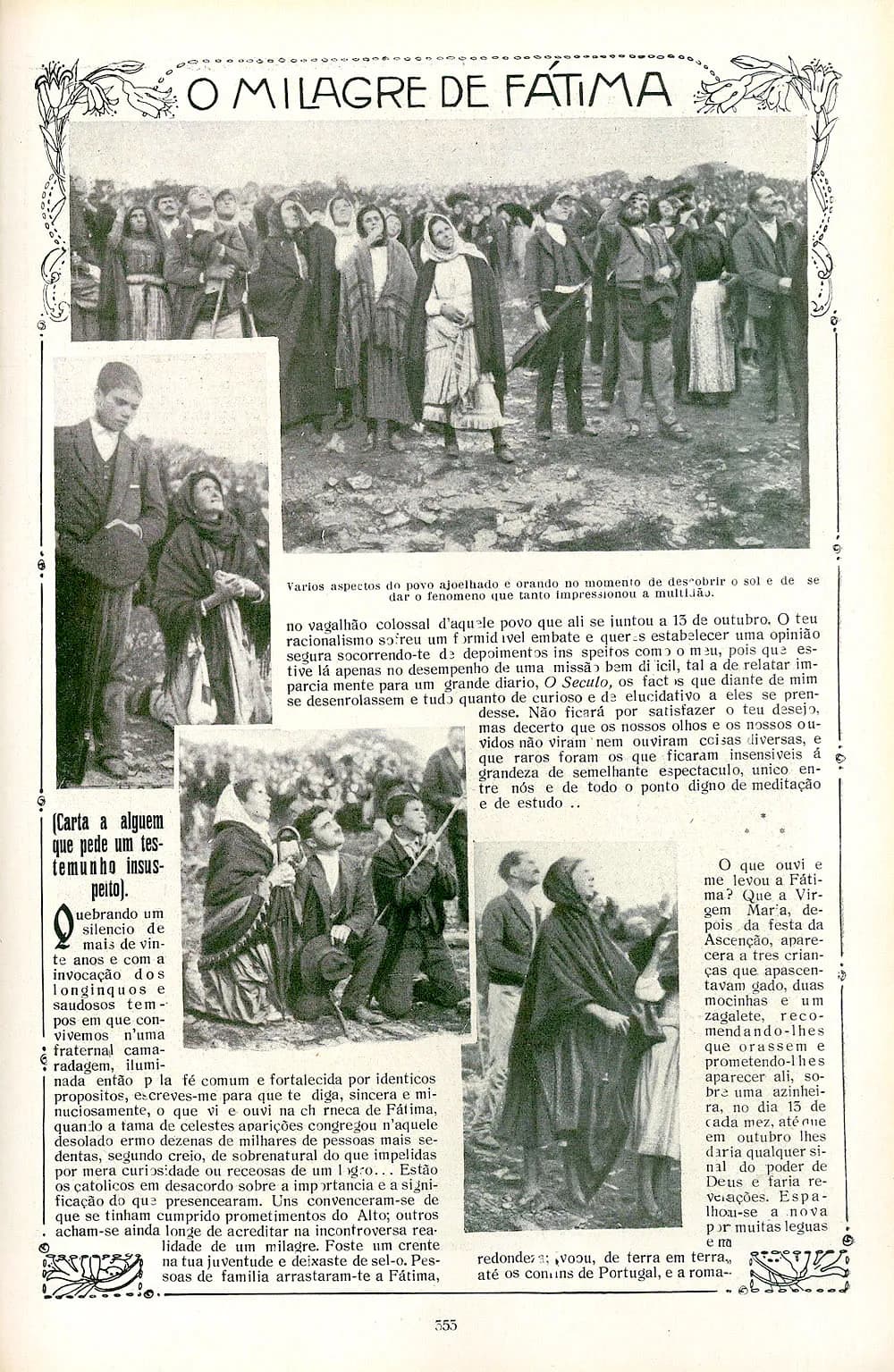
On 29 October he wrote again in Ilustração Portuguesa, the illustrated magazine of O Século, in the form of a letter to an old friend who had lost his faith and wanted an impartial witness. He described the rain stopping at the predicted hour and the sun dancing “in a violent, convulsive ballet”, and still declined to judge it.
“A miracle, as the people cried; a natural phenomenon, as the learned say? I do not care to know that now, only to tell you what I saw... The rest is a matter for Science and the Church...”
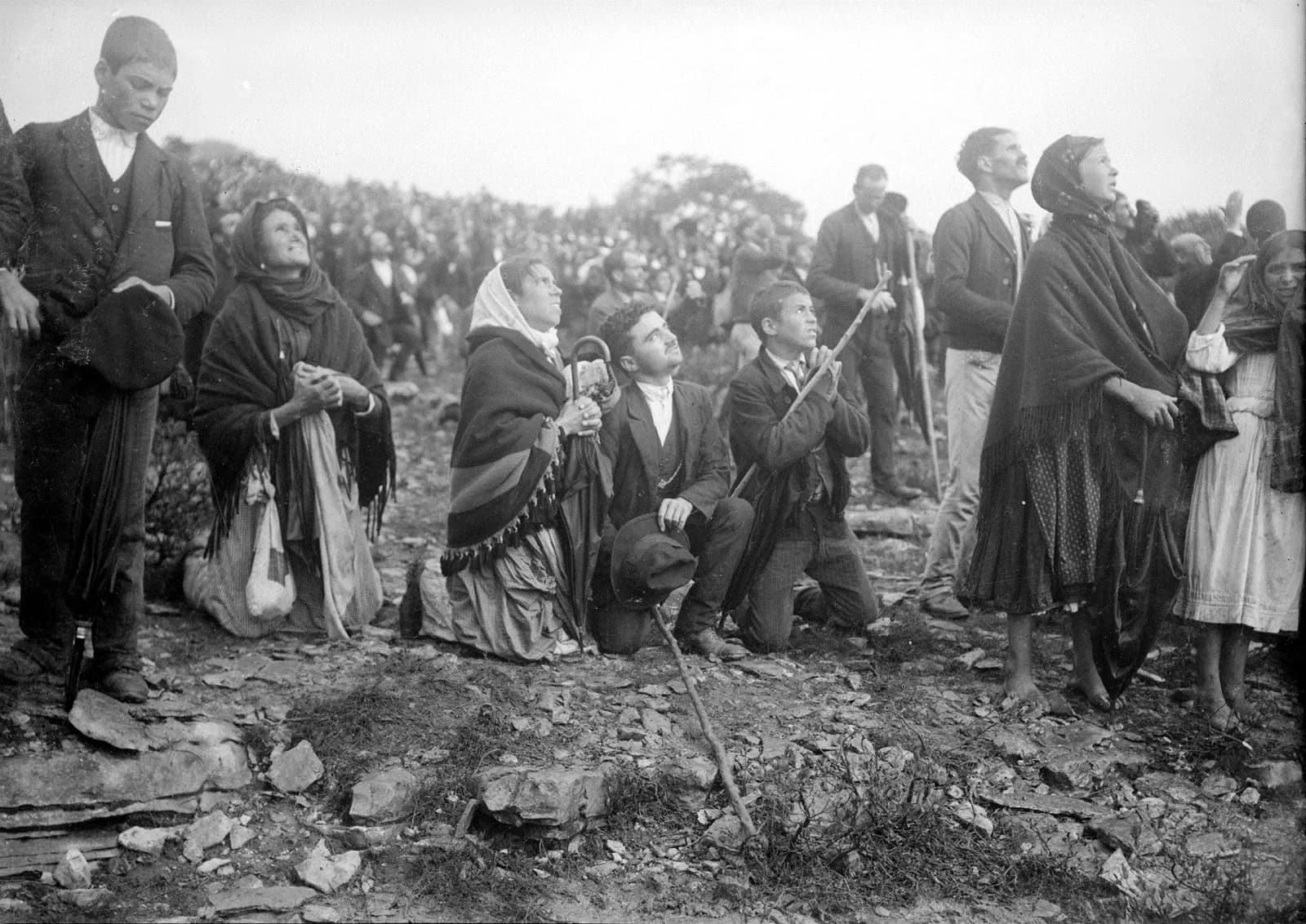
Judah Bento Ruah, who had travelled with Almeida, photographed the crowd. The Santuário has exhibited 13 of his pictures of that day, which the photographer Paulo Catrica calls the only photographs of the moment. In a country where most people could not read, he argues, such pictures were of fundamental importance. They show the crowd staring upwards, not the sun.
Some readers took the report as proof, others as grounds for doubt. In a later letter to her grandchildren, Vitória Sirgado Azevedo Mendes called O Século “a thoroughly Jacobin paper”, and so above suspicion, and said she had lent her copy out so often that she never got it back.
Flu, a bomb and a bishop's verdict
A year later the flu pandemic reached Aljustrel. Francisco fell ill in October 1918 and died at home on 4 April 1919, aged 10. Jacinta, ill since the same autumn, was taken to Lisbon's Dona Estefânia hospital on 2 February 1920, had an operation and died there on 20 February, aged 9.
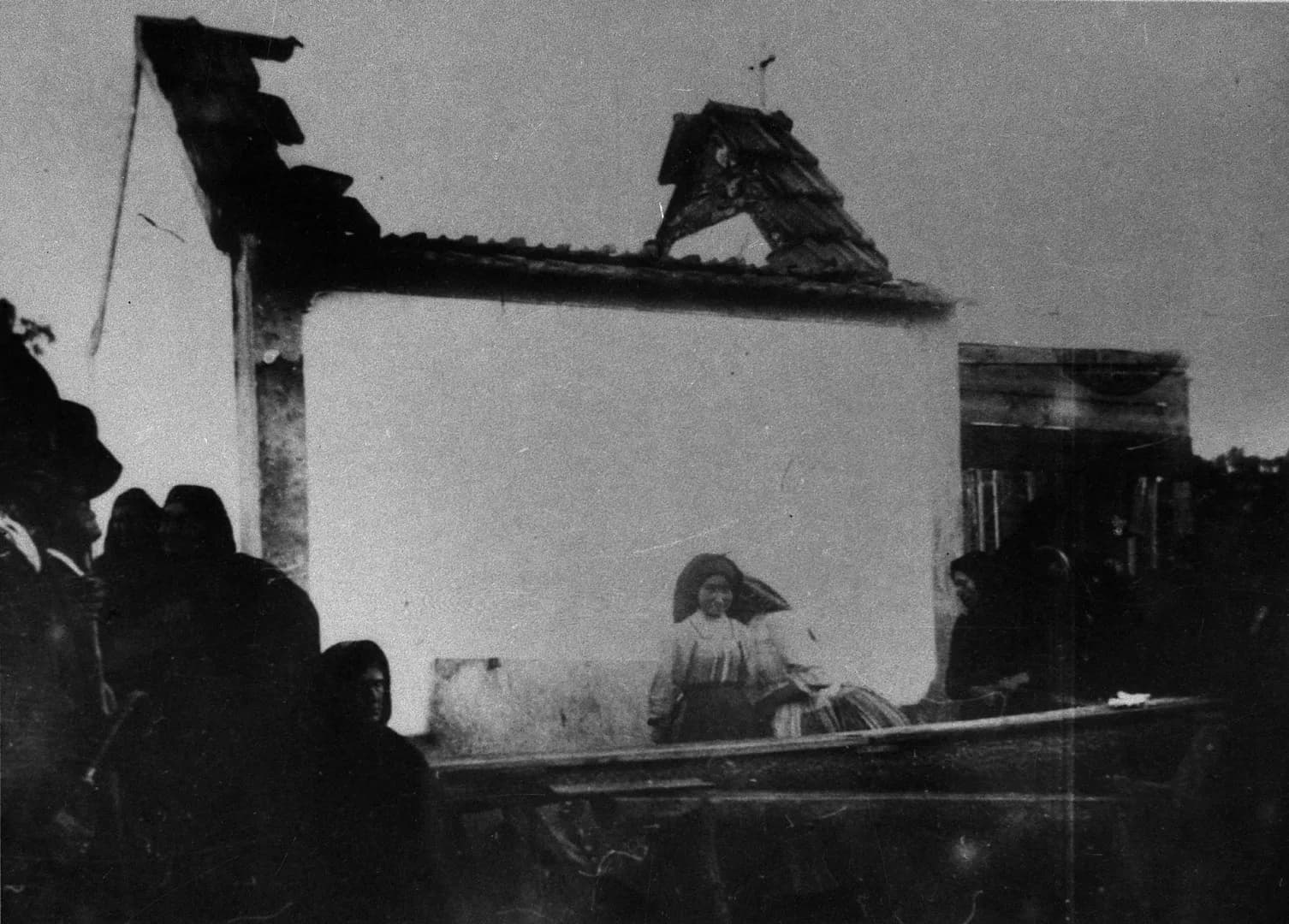
A small chapel was built at the Cova da Iria between April and June 1919, as Lúcia said the Lady had asked. Mass was first said there on 13 October 1921. On the night of 5 to 6 March 1922 it was blown up with dynamite. It was restored and reopened on 13 January 1923.
Lúcia left Fátima. In June 1921, at the invitation of the new Bishop of Leiria, José Alves Correia da Silva, she entered the Asilo de Vilar, a boarding school in Porto, under another name. She became a Dorothean sister in Spain and in 1948 a Carmelite nun in Coimbra, where she died on 13 February 2005, aged 97.
The bishop appointed a commission in May 1922. Its report of April 1930 found nothing to show that the children had lied or been deluded. On 13 October 1930, in a pastoral letter, he declared the visions of 13 May to October 1917 “worthy of belief” and allowed the cult of Our Lady of Fátima. Such approval does not oblige Catholics to believe; it means the message contains nothing contrary to faith and may be accepted with prudence.
13 October 1917
Sixth apparition and the “Miracle of the Sun”
4 April 1919
Francisco Marto dies in Aljustrel, aged 10
June 1919
The Chapel of the Apparitions is completed
20 February 1920
Jacinta Marto dies in Lisbon, aged 9
6 March 1922
The chapel is dynamited; it reopens in January 1923
13 October 1930
The Bishop of Leiria declares the visions worthy of belief
31 August 1941
Lúcia writes down the first two parts of the secret
3 January 1944
Lúcia writes the third part and seals it
7 October 1953
The Basilica of Our Lady of the Rosary is dedicated
13 May 2000
John Paul II beatifies Francisco and Jacinta at Fátima
26 June 2000
The Vatican publishes the third part of the secret
13 February 2005
Lúcia dies in Coimbra, aged 97
13 May 2017
Pope Francis canonises Francisco and Jacinta at Fátima
The three secrets
On 13 July 1917, Lúcia said, the Lady showed the children things they were not to repeat. In 1917 the three refused to reveal them, even in Ourém. Lúcia wrote the first two parts down in her third memoir, dated 31 August 1941: a vision of hell; a call for devotion to the Immaculate Heart of Mary; a warning that a worse war would break out under Pope Pius XI; and a request for the consecration of Russia, which would otherwise “spread her errors throughout the world”.
She wrote the third part on 3 January 1944 and sealed it; the envelope went to the Vatican's archives in 1957. John Paul II asked for it after he was shot in Rome on 13 May 1981, the anniversary of the first apparition. Published on 26 June 2000, it describes a “bishop dressed in white” crossing a ruined city and killed by soldiers on a mountain. The Vatican read it as a vision of the century's persecutions and of the attack on the Pope.
Russia is not mentioned in the children's first interrogations; it appears only in the 1920s, and critics, some of them Catholics, have accused others of shaping Lúcia's account. The warning of a second war was first written down in 1941, with the Second World War already under way. The Vatican's own commentary in 2000 warned readers who expected apocalyptic revelations that they would be disappointed.
Fátima and Salazar's dictatorship
The First Republic ended with a military coup on 28 May 1926. The dictatorship that followed, shaped by António de Oliveira Salazar into the Estado Novo (New State), made peace with the Church and lasted until the revolution of 1974. Historians describe how the regime made political use of Fátima, although Salazar, a devout Catholic, seldom went there.
The bishops tied the shrine to the nation's fate. Cardinal Cerejeira, Patriarch of Lisbon, was cautious at first but backed Fátima from 1933. In 1936 the bishops vowed to return there if Portugal were spared the Spanish Civil War, and in 1938 they consecrated the country to the Immaculate Heart of Mary at Fátima. In April 1940 they promised a monument in Lisbon if Portugal stayed out of the world war; the Concordat with the Holy See followed a month later.
Lúcia was sympathetic too. Before the 1945 elections she sent Cerejeira a card saying that Salazar was the person chosen by God to go on governing. During the colonial wars of 1961 to 1974, families of conscripts came to Fátima to pray, and some Catholics criticised the attitude of the Church and of the shrine's leaders towards the war. In the revolutionary summer of 1975 there were threats to nationalise the sanctuary, but the pilgrimages went on.
Miracle, weather or the eye?
The doubts began immediately, and not only among anticlericals. Domingos Pinto Coelho, a Catholic monarchist lawyer, was at the Cova da Iria and wrote in the Catholic daily A Ordem that what he had seen looked natural. He said he had watched the sun again in similar weather and got the same sensations, and put them down to looking at the sun through thin cloud driven fast by a strong wind. Remove the one extraordinary fact, he argued, and what is left is “the statements of three children”, which was “very little”.
Later explanations follow similar lines. Auguste Meessen, a physicist at the Catholic University of Louvain in Belgium, stared at the sun himself and argued that the spinning, the colours and the apparent fall come from after-images and the bleaching of pigments in the retina. He thought the humid air after the rain could have dimmed the sun enough to look at, and that the seers were honest.
The British sceptic Steuart Campbell blamed atmospheric dust for dimming and colouring the sun. Benjamin Radford points out that if the sun had moved, millions elsewhere would have seen it. The historian A. H. de Oliveira Marques suggested an aurora, which Bruno Cardoso Reis thinks implausible.
Believers answer that the children had named the day and hour months in advance, and that the event came at the time they gave. No explanation has been proved. Wendy Grossman, founder of The Skeptic magazine, notes that, as far as she knows, the kind of miracle was never specified, so anything unusual that day might have counted. She leans towards unusual atmospheric conditions seen by an expectant crowd, but concludes that “we can only say we don't know”.
The sanctuary today
The Santuário counts as pilgrims the people who take part in at least one of its celebrations. In 2017, the centenary, when Pope Francis canonised Francisco and Jacinta at Fátima on 13 May, there were a record 9.4 million. The pandemic cut the 2020 figure to 1.4 million. In 2025 there were about 6.5 million.
Pilgrims at the Santuário de Fátima, 2016 to 2025
million people
Annual figures published by the Santuário de Fátima. 2017 was the centenary year with a papal visit; 2020 and 2021 were cut by the pandemic; 2023 includes more than a million people who came between 24 July and 10 August, during World Youth Day Lisbon and Pope Francis's visit.
Show the data
| People taking part in at least one celebration | |
|---|---|
| 2016 | 5.3 |
| 2017 | 9.4 |
| 2018 | 7 |
| 2019 | 6.3 |
| 2020 | 1.4 |
| 2021 | 2.4 |
| 2022 | 4.9 |
| 2023 | 6.8 |
| 2024 | 6.2 |
| 2025 | 6.5 |
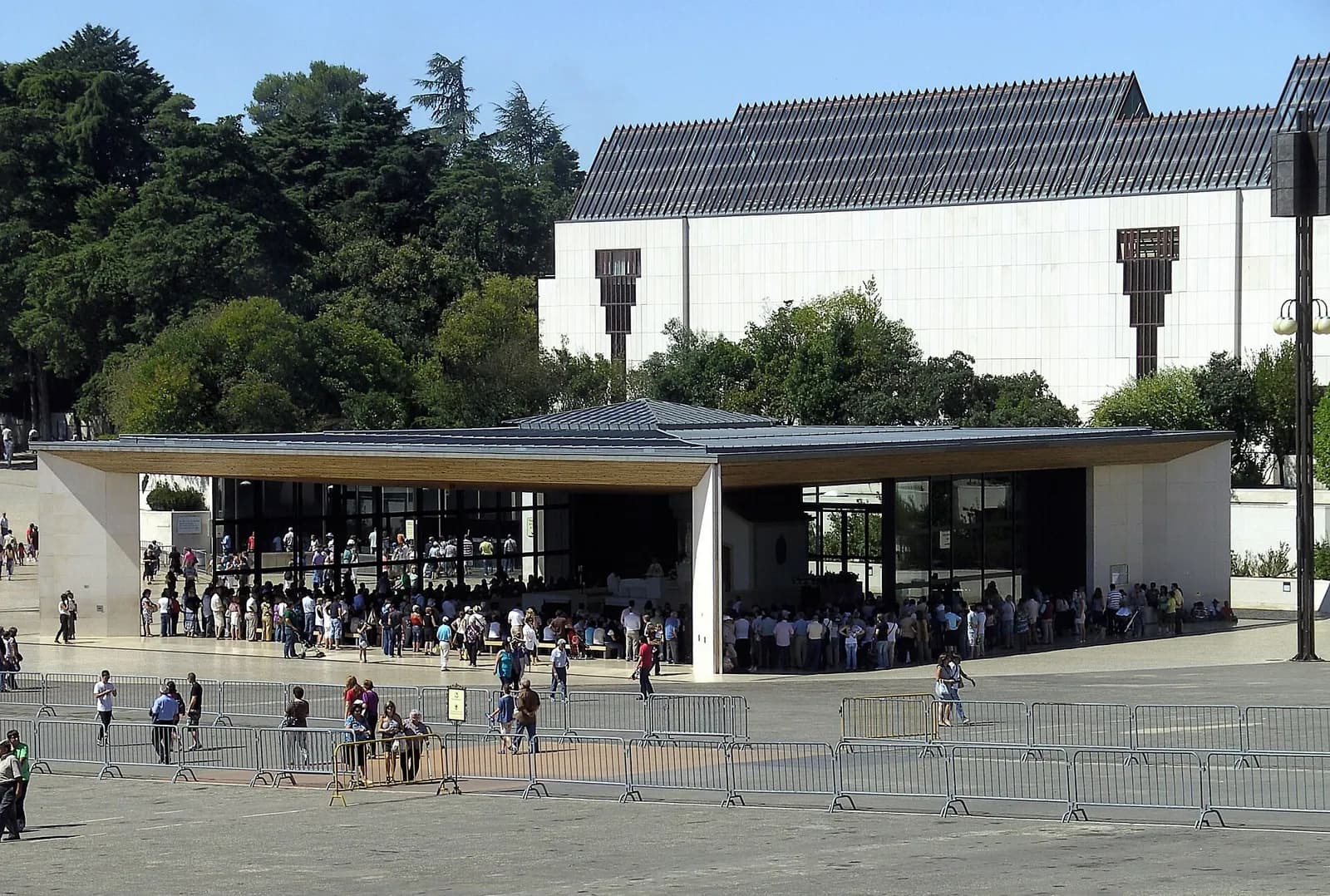
The holm oak is long gone; the plinth of the statue in the Chapel of the Apparitions marks where it stood. The Basilica of Our Lady of the Rosary, begun in 1928 and dedicated in 1953, holds the tombs of Francisco, Jacinta and Lúcia. Across the prayer square, the circular Basilica of the Most Holy Trinity, dedicated in 2007, seats 8,633 people. Fátima became a town in 1977 and a city in 1997.
FAQs
What was the Miracle of the Sun?
On 13 October 1917, at the Cova da Iria near Fátima, a large crowd that had come to see a miracle announced by three shepherd children reported that, after heavy rain, the sun turned pale, trembled, spun, changed colour and seemed to plunge towards the earth for about ten minutes. Not everyone present saw it.
How many people were at Fátima on 13 October 1917?
Nobody counted. Estimates written in 1917 range from about 30,000 to nearly 60,000; the reporter Avelino de Almeida gave 30,000 to 40,000 and later about 50,000. The figure of 70,000 comes from a priest's book of 1921, and the Santuário today gives 50,000 to 70,000.
When did the Catholic Church approve the Fátima apparitions?
The Bishop of Leiria, José Alves Correia da Silva, declared the children's visions worthy of belief and permitted the cult of Our Lady of Fátima in a pastoral letter dated 13 October 1930, after a diocesan commission had studied the events from 1922.
What happened to Lúcia, Francisco and Jacinta?
Francisco and Jacinta Marto died in the flu pandemic, on 4 April 1919 and 20 February 1920. They were beatified in 2000 and canonised by Pope Francis on 13 May 2017. Lúcia became a nun, wrote her memoirs and died in Coimbra on 13 February 2005, aged 97.
Is there a scientific explanation for the Miracle of the Sun?
Several have been proposed, none proved: unusual cloud or dust dimming the sun, and the after-images and retinal effects of staring at it. Sceptics also note that nobody elsewhere saw the sun move. Believers point out that the children announced the day and hour in advance.
On the timeline
Open the timelineNearby moments from the first republic (1910–1926).
Birth in Luanda of José Baptista Pinheiro de Azevedo, the admiral who led Portugal's Sixth Provisional Government through the revolutionary 'Hot Autumn' of 1975. Besieged by protesters and short of military backing, he suspended his own government's work on 20 November that year, saying he was 'tired of being kidnapped' — in effect putting the cabinet on strike.
The third of six apparitions of the Virgin Mary to the three shepherd children of Fátima — Lúcia, Francisco and Jacinta. It is on this day that, according to the seers, Our Lady entrusts them with the famous 'Three Secrets', the third of which would not be made public by the Vatican until the year 2000.
The three Fátima seers — Lúcia, Francisco and Jacinta — are seized and detained by Artur Santos, administrator of Vila Nova de Ourém, preventing the expected apparition at the Cova da Iria.
The Miracle of the Sun at Fátima
Battle of the Lys (La Lys): the Portuguese 2nd Division, about to be relieved after months in the trenches of French Flanders, takes the full force of the German spring offensive. Overrun in a single morning, it suffers some 7,000 casualties, most of them taken prisoner — Portugal's worst defeat of the First World War. 9 April is now the country's day of military commemoration.
The painter Amadeo de Souza-Cardoso, pioneer of modernism in Portugal and friend of Modigliani and Brancusi in Paris, dies of Spanish influenza at Espinho, aged only 30.
President Sidónio Pais is assassinated at Lisbon's Rossio station as he arrives to catch a night train to Porto. José Júlio da Costa, a left-wing activist hiding a pistol under his Alentejo cloak, breaks through the police cordon and fires twice. The charismatic 'President-King', who had seized power a year earlier, dies within hours; in the panic, guards kill four bystanders.
Coming up in history
All long reads 15 October 201715 October 2017: the day Ophelia's winds set central Portugal alight
 16 October 1544Pedro Nunes takes Coimbra's chair of mathematics, 16 October 1544
 17 October 1978Luxembourg, 1978: Portugal opens its talks to join the EEC
 18 October 1739The Inquisition condemns 'o Judeu', Lisbon's comic playwright, in 1739
32 sources
Archives, scholarship and reporting this article was checked against.
- 1
“Coisas espantosas! Como o sol bailou ao meio dia em Fátima”, O Século, 15 October 1917 (DCF III-1, Doc. 87)Santuário de Fátima, Documentação Crítica de Fátima (Fátima 1917 Witnesses edition)
- 2
- 3
Narrative of the ApparitionsSantuário de Fátima
- 4
- 5
The Message of FatimaCongregation for the Doctrine of the Faith, Holy See (26 June 2000)
- 6
Fátima: a recepção nos diários católicos (1917-1930) (Bruno Cardoso Reis)Análise Social, vol. XXXVI (158-159), 2001
- 7
As aparições de Fátima relatadas por carta: redes sociais e familiares da espiritualidade mariana (Isabel Morujão)Via Spiritus 24 (2017), Universidade do Porto
- 8
Para lá do anticlericalismo: a separação das igrejas do Estado como embate cultural (Sérgio Ribeiro Pinto)Centro de Estudos de História Religiosa, Universidade Católica Portuguesa
- 9
- 10
- 11
- 12Papa: Em 100 anos, Fátima atravessou a I República, a ditadura e a democraciaDiário de Notícias, May 2017
- 13
Os portugueses na Grande Guerra: uma experiência de combate e de cativeiro (Carlos Jorge Alves Lopes, MA dissertation)Universidade Aberta, 2012
- 14
- 15
- 16
- 17
Fátima no back office (Pedro Gil)Forma de Vida, Faculdade de Letras da Universidade de Lisboa
- 18
- 19
- 20
- 21
- 22
- 23
- 24
Apparitions and miracles of the sun (Auguste Meessen)Consciências 2 (2005), Universidade Fernando Pessoa; paper to the Porto forum “Science, Religion and Conscience”, 2003 (author's copy)
- 25
Under a dancing sun (Wendy M. Grossman)The Philosophers' Magazine
- 26
- 27
- 28
- 29
- 30
- 31
- 32
Image credits
- The crowd packed around the holm oak at the Cova da Iria on 13 October 1917, printed across two pages of Ilustração Portuguesa. The wooden frame hung with two lanterns matches Avelino de Almeida's description of the rough arch put up over the oak. Judah Bento Ruah, Public domain, via Wikimedia Commons.
- Lúcia dos Santos (left) with her cousins Francisco and Jacinta Marto, photographed in 1917 and published in Ilustração Portuguesa. Attributed to Joshua Benoliel, Public domain, via Wikimedia Commons.
- Pilgrims looking at the sun at the Cova da Iria on 13 October 1917. The photograph was published in Ilustração Portuguesa on 29 October. Judah Bento Ruah, Public domain, via Wikimedia Commons.
- Page 353 of Ilustração Portuguesa, 29 October 1917: the start of Avelino de Almeida's “letter”, illustrated with Judah Bento Ruah's photographs of the crowd looking at the sun. Avelino de Almeida, journalist at O Século, Public domain, via Wikimedia Commons.
- The Chapel of the Apparitions after it was dynamited in March 1922. Unknown author, Public domain, via Wikimedia Commons.
- The Chapel of the Apparitions under its modern porch in 2011, on the spot where the holm oak stood. High Contrast, CC BY 3.0, via Wikimedia Commons.