

Pedro Nunes takes Coimbra's chair of mathematics, 16 October 1544
Portugal's foremost mathematician never sailed to the Indies, but he explained why a ship holding any bearing other than due north, south, east or west spirals towards a pole, and he devised a scale for reading angles to a fraction of a degree.
At a glance
- On 16 October 1544 Pedro Nunes, born in Alcácer do Sal in 1502, was named professor of mathematics at the University of Coimbra, a post he held until he retired in 1562.
- He was royal cosmographer from 1529 and chief royal cosmographer (cosmógrafo-mor) from 1547, and he tutored the princes Luís and Henrique and, later, King Sebastião.
- In his Tratado da Sphera (1537) he showed that a ship holding one compass bearing does not follow a great circle but curves towards the pole: the line later called the loxodrome or rhumb line.
- In De crepusculis (1542) he proposed the nonius: 45 concentric arcs on a quadrant, divided into 90, 89, 88 and so on down to 46 parts, for reading angles to fractions of a degree.
- His name lives on in the nonius, in Nonius, the German word for a vernier scale, in the lunar crater Nonius and in the Instituto Pedro Nunes in Coimbra.
A royal order for a doctor of medicine
On 16 October 1544 a royal appointment named a doctor of medicine, then about 42, to teach mathematics at the University of Coimbra. Pedro Nunes had not lectured at a university for about twelve years. University records do not mention him at all between 1537, when the university left Lisbon, and 1544, when the king's order brought him back, now to Coimbra.
He was already the king's cosmographer, the official expert on the shape of the Earth, the heavens and the charts that Portuguese pilots carried. He had published a book on astronomy and the sea chart in 1537 and a Latin treatise on twilight in 1542. Henrique Leitão, the historian who curated the National Library's 2002 exhibition on Nunes, writes that in national terms the Coimbra chair was the highest distinction that could be given to a mathematician.
Nunes never sailed to Africa, Brazil or India. His contribution to the age of the Portuguese voyages was made at a desk, with geometry. Two of his ideas outlived him: the curve a ship traces when it keeps to one compass bearing, and a way of reading an angle more finely than the degree marks on an instrument allow.
A New Christian at the royal court
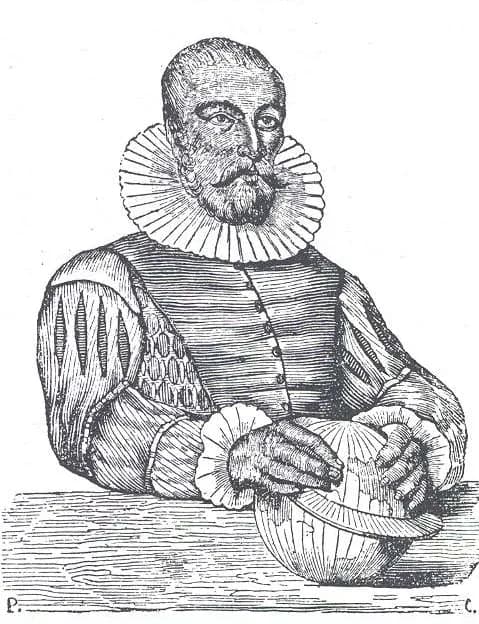
Nunes was born in 1502 in Alcácer do Sal, a river town south of Lisbon, which is why his Latin name was Petrus Nonius Salaciensis. His parents are believed to have been Jewish converts to Christianity, and he was registered as a New Christian, the label Portugal gave to converts from Judaism and their descendants.
He began university studies around 1517 and studied at Salamanca in Spain, where in 1523 he married Guiomar Áreas. They had two sons and four daughters. Sources disagree on whether he studied first in Lisbon or in Salamanca. Back in Portugal he took a degree in medicine, which then included astronomy and mathematics, because doctors were expected to practise astrological medicine.
On 16 November 1529 King João III appointed him cosmographer of the kingdom, on a salary of 20,000 reais. Weeks later he began teaching moral philosophy and then logic at the university, which was still in Lisbon. He became a doctor of medicine in 1532.
The court also made him a tutor. He taught the king's brother Luís until July 1531 and, from October 1531, his brother Henrique, the future cardinal and, in 1578, king. Decades later the young King Sebastião, João III's grandson, was also counted among his pupils. He also taught navigation to two men who would command fleets: Martim Afonso de Sousa, who led an expedition to Brazil in 1530, and João de Castro, later viceroy of India.
A question from Brazil and a curve with no name
Martim Afonso de Sousa came home from his Brazil expedition with a puzzle. Sailing east by the compass, he had expected that, as on a globe, he would eventually cross the equator. He never did. He put the question to his old teacher, and Nunes answered in a short treatise, probably written around 1534 and printed in 1537. The Dictionary of Scientific Biography dates the conversation to 1533.
Nunes recalled the episode in a second treatise, addressed to the king's brother Luís. Some time ago, he wrote, he had produced a little work on certain doubts that Martim Afonso had brought back from Brazil, and answering them had needed points of geometry and theory as well as the practical rules of navigation.
Pilots of the time treated a course on a single compass bearing and a great circle, the shortest route between two points on a globe, as the same thing. Nunes showed they were different. A great circle cuts each meridian it crosses at a different angle. A ship that holds one bearing cuts every meridian at the same angle, and so its track bends round the globe.
In the Portuguese texts of 1537 Nunes thought the curve would eventually reach the pole. In his Latin works of 1566 he corrected this: the ship comes ever closer to the pole but never touches it. He had no word for the line. He wrote of a curved and irregular line. The Greek-derived name loxodrome, meaning slanting course, was coined in the Low Countries early in the next century.
“And this is another advantage of going by a great circle, that one travels a shorter way; but whoever goes by it should know that he must change course every hour, according to the change in the angles of position that the new meridians make with the circle we are following.”
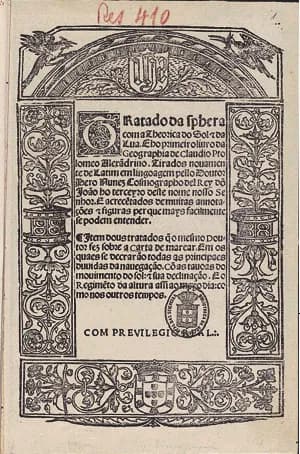
The 1537 book also contains a drawing of curves on a polar plan, which Nunes meant to show rhumb lines at bearings of 45° and 67.5°. Modern analysis has found that the drawing is made of joined arcs of circles, not true spirals. It was a first sketch, and the 1566 Latin version is the fuller treatment.
Twilight and the nonius
Prince Henrique, his former pupil, asked Nunes which day of the year has the shortest twilight. The answer became De crepusculis, printed in Lisbon in January 1542. It is usually considered his most sophisticated work, and it impressed the leading mathematicians of the day.
“He showed with great acuity many things which would seem paradoxes to everyone, were they not founded on the most solid demonstrations.”
Buried in the book was a practical idea. Astronomers and navigators measured the height of the sun or a star with quadrants and astrolabes marked in whole degrees, and the scales were too small to subdivide further. Nunes proposed engraving extra scales. Inside the main arc of 90 degrees he drew 44 more arcs, each divided into one part fewer than the arc outside it: 89, 88, 87 and so on down to 46.
The reading works like this. If the sighting line falls between two degree marks, it will pass almost exactly through a mark on one of the inner arcs. Suppose it crosses the eighth mark of the arc divided into 63 parts. The angle is then 8/63 of 90 degrees, about 11.43°, which a simple calculation or a table turns into degrees and minutes.
In theory the method was very precise, but it was hard to engrave 45 different scales accurately on a small instrument, and the Danish astronomer Tycho Brahe remarked that it did not live up to its promise. Clavius and his associate Jacob Curtius simplified the engraving, and in 1631 Pierre Vernier replaced the fixed inner arcs with a single sliding scale.
| Date | Who | What changed |
|---|---|---|
| 1542 | Pedro Nunes, De crepusculis | 45 fixed concentric arcs: one of 90 divisions and 44 inner arcs of 89 down to 46 divisions |
| Late sixteenth century | Tycho Brahe | Remarked that in practice Nunes's method did not live up to its promise |
| 1593 to 1604 | Christopher Clavius and Jacob Curtius | Clavius made the scales easier to engrave (1593, according to the Dictionary of Scientific Biography). Curtius put the same scale on each arc, each starting one degree further on, so that 60 arcs give degrees and minutes directly; Clavius described these methods in Geometria practica (1604) |
| 1631 | Pierre Vernier, Brussels | The 59 inner arcs replaced by one movable scale attached to the sighting arm |
Vernier's name became attached to the device only around the middle of the eighteenth century. In German the vernier is still called a Nonius.
Eighteen years in the Coimbra chair
In 1537 King João III moved the university from Lisbon to Coimbra. The professorship of mathematics went with it. Nunes was named to that chair on 16 October 1544 and held it until he retired in 1562. The sources disagree on the exact day of his retirement: 4 February according to the Dictionary of Scientific Biography, 4 November according to the National Library's chronology.
Possibly to live up to the post, Leitão suggests, he soon published De erratis Orontii Finaei (1546), a book he had been planning for more than a decade: a demolition of the claims by Oronce Finé, professor at the royal college in Paris, to have squared the circle, trisected the angle and doubled the cube. University council minutes from 1546 to 1556 carry his signature beside the titles doctor in medicine, mathematics lecturer and cosmógrafo-mor.
On 22 December 1547 he was promoted to chief royal cosmographer, a post he kept until his death. From then on his life was split between Coimbra and the court in Lisbon. He spent most of 1557 to 1561 away in Lisbon, and Leitão notes that he published no new book until 1566, after he had left university teaching.
- Born
- 1502, Alcácer do Sal
- Died
- 11 August 1578, Coimbra
- Royal cosmographer
- From 16 November 1529
- Chair of Mathematics, Coimbra
- 16 October 1544 to 1562
- Chief royal cosmographer
- From 22 December 1547
- Key works
- Tratado da Sphera (1537), De crepusculis (1542), Opera (1566)
1502
Born in Alcácer do Sal
1523
Marries Guiomar Áreas in Salamanca
16 November 1529
Named cosmographer of the kingdom
1531
Starts teaching Prince Henrique
1532
Doctor of medicine, Lisbon
1537
University moves to Coimbra; Tratado da Sphera printed in Lisbon (1 December)
January 1542
De crepusculis printed, with the nonius
16 October 1544
Named professor of mathematics at Coimbra
22 December 1547
Named cosmógrafo-mor
1549
Diogo de Sá attacks his ideas in De navigatione
1562
Retires from the university
1566
Opera printed in Basel
1572
Called to court by King Sebastião to advise on weights and measures
1577
Consulted by Pope Gregory XIII on calendar reform
11 August 1578
Dies in Coimbra
The mathematician and the pilots
Nunes insisted that the voyages had been a work of science. In the 1537 treatise addressed to Prince Luís he wrote that the discoveries were not made by chance. In the language of his time, astrology meant what we call astronomy.
“Now it is plain that these discoveries of coasts, islands and mainlands were not made by going at a venture: but our seafarers set out very well taught and provided with instruments and rules of astrology and geometry.”
Working seamen were less sure. António Costa Canas, a naval historian and director of the Museu de Marinha, writes that Nunes's relations with seafarers were never peaceful, mainly because they found his mathematics hard to follow. As cosmographer he also had a hand in certifying instrument makers, chart makers and pilots.
His method for steering along a great circle, with hourly corrections worked out by spherical trigonometry, was never adopted by Portuguese sailors. The instruments of the day were not precise enough, and the calculations were too laborious for the deck of a ship. Randles calls him a savant de cabinet, a scholar of the study.
In 1549 Diogo de Sá, a writer of conservative Aristotelian views and a strong dislike of mathematics, attacked Nunes in De navigatione, a Latin book printed in Paris and partly written as a dialogue between a mathematician and a philosopher. Randles notes that Sá was no more a navigator than Nunes. His objection was practical: a pilot at sea has only a compass and a ship that goes where the wind pushes it.
“Who then is going to show me these angles? Do I ask the sea to show them to me? The sea will tell me that the sea is everywhere, and everywhere the same, and cannot show me any of them.”
Training was the other front. In 1559, under Nunes's auspices, a course known as the Aula do Cosmógrafo-Mor was set up to teach pilots. The Escola Naval, Portugal's naval academy, counts it as its forerunner, but notes that pilots still came to their examinations with a record of voyages more than with mathematics. Nunes's aim of pilots with real scientific training was met only in the eighteenth century.
Last years
Free of teaching, Nunes gathered several of his main works, in Latin, into the Opera, printed in Basel in 1566. It reworked the 1537 treatises into a longer and more developed text. Unhappy with misprints in that edition, he reissued it at Coimbra in 1573 as De arte atque ratione navigandi.
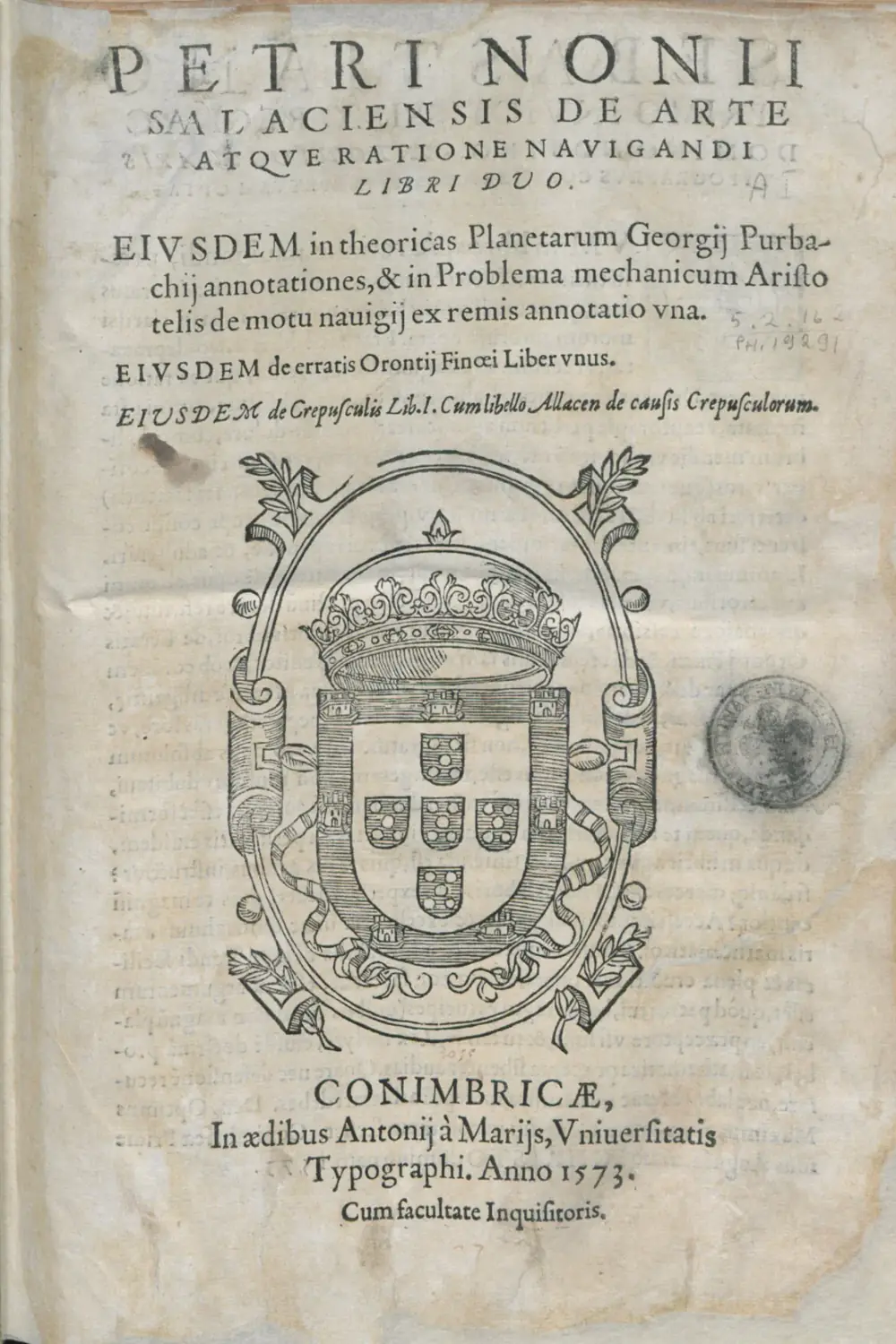
On 11 September 1572 his former pupil, King Sebastião, called him to Lisbon to advise on the reform of weights and measures, which was promulgated in 1575. In 1577 Pope Gregory XIII consulted him on the calendar reform introduced in 1582. He died in Coimbra on 11 August 1578.
Why it still matters
In his 1566 text Nunes asked for charts on which rhumb lines appear as straight lines, and suggested building them from narrow strips, each covering all 360 degrees of longitude. He never joined the strips into a single chart.
Gerardus Mercator's world map of 1569 was the first to show rhumb lines as straight lines. Leitão and the cartographic historian Joaquim Alves Gaspar argue that Mercator most likely drew it with a table of rhumbs, and they trace that path from Nunes's first account of the rhumb line in 1537 through a Portuguese text of about 1540 in which such tables first appear.
The mathematics of the new map was first published in 1599 by the Englishman Edward Wright, whose Certaine Errors in Navigation translated parts of Nunes word for word. Mercator's projection became standard at sea only in the mid-eighteenth century, once longitude could be found reliably. It is still the usual projection of nautical charts.
His peers abroad rated him highly. In 1558 the English mathematician John Dee named Nunes as the man to finish his work if he died, calling him that most learned and grave man who is the sole relic and ornament and prop of the mathematical arts among us. Leitão thinks the two almost certainly never met. Whether the German Jesuit Christopher Clavius studied under him at Coimbra is disputed: the Dictionary of Scientific Biography and MacTutor say so, while the Biographical Encyclopedia of Astronomers calls the claim erroneous.
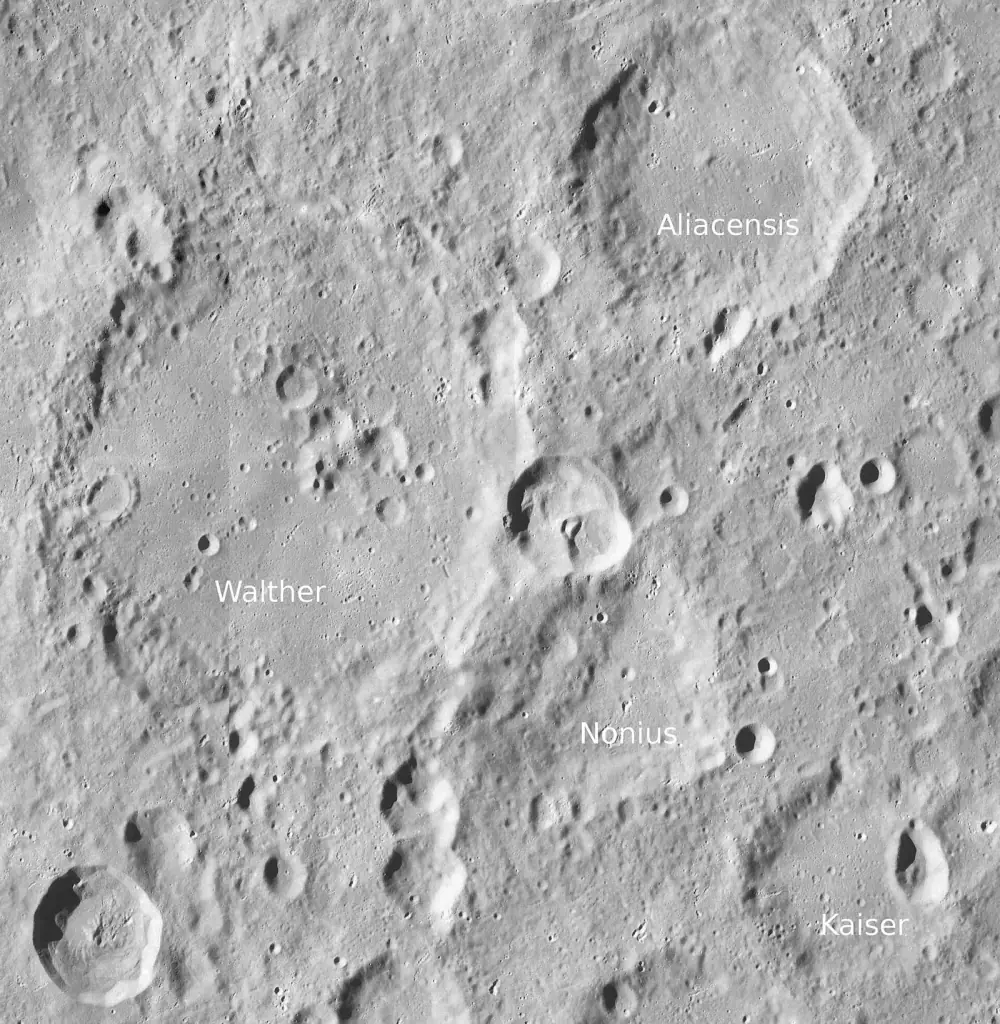
His Latin name is on the Moon. The Jesuit astronomers Giovanni Battista Riccioli and Francesco Grimaldi named a crater Petrus Nonius, and the International Astronomical Union adopted the name Nonius in 1935. The crater measures about 70.6 km across.
In Coimbra, the university set up the Instituto Pedro Nunes in 1991, a non-profit body that links university research with industry. The Escola Naval traces its own lineage to the pilot course founded under his auspices in 1559.
FAQs
What is the nonius, and is it the same as a vernier?
The nonius is the scale Pedro Nunes proposed in De crepusculis (1542): 45 concentric arcs on a quadrant, divided into 90, 89, 88 and so on down to 46 equal parts, so that an angle falling between two degree marks can be read on whichever inner arc has a mark closest to it. In 1631 Pierre Vernier replaced the fixed arcs with one sliding scale. The principle is related, but the devices differ, although in German the vernier is still called a Nonius.
What is a loxodrome or rhumb line?
It is the track of a ship that keeps to one compass bearing, so it crosses every meridian at the same angle. Unless the bearing is due north, south, east or west, the track spirals towards a pole without reaching it. Pedro Nunes was the first to show, in 1537, that this course is not a great circle.
When did Pedro Nunes teach at the University of Coimbra?
He was named to the chair of mathematics on 16 October 1544 and retired in 1562. Sources give the retirement date as 4 February or 4 November 1562. He spent much of 1557 to 1561 away from the university, living in Lisbon.
Did Pedro Nunes influence the Mercator projection?
Probably, though Mercator never explained his method. In 1566 Nunes called for charts on which rhumb lines are straight and suggested drawing them in narrow strips. Henrique Leitão and Joaquim Alves Gaspar argue that Mercator most likely built his 1569 map from a table of rhumbs, and they trace that approach back through Portuguese work that began with Nunes's account of the rhumb line in 1537.
Where can you see Pedro Nunes in Lisbon?
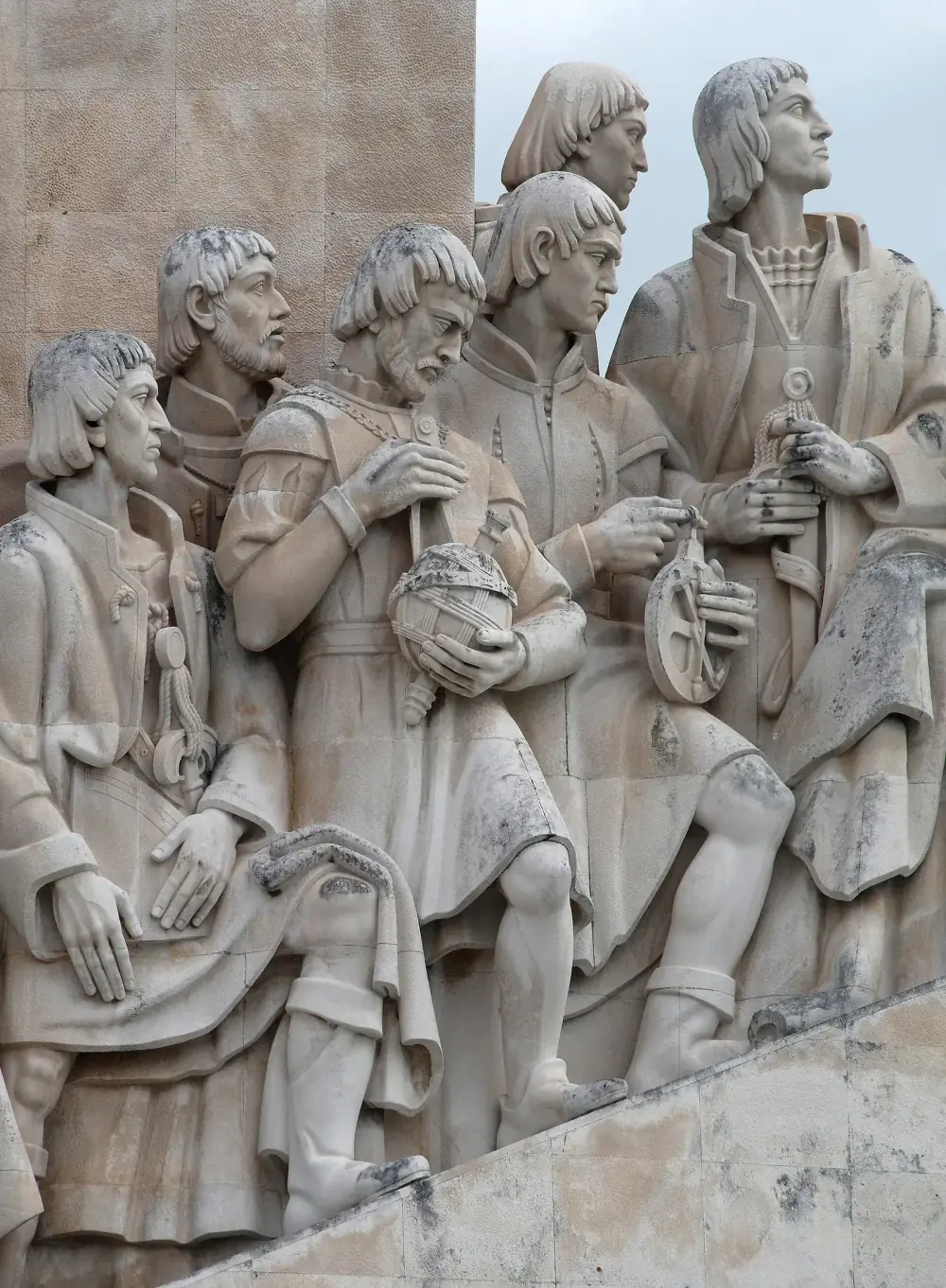
He is one of the figures carved on the Padrão dos Descobrimentos, the monument to the Portuguese voyages on the riverfront at Belém, rebuilt in concrete and stone in 1960. He holds an armillary sphere and a pair of compasses.
On the timeline
Open the timelineNearby moments from the age of discoveries (1415–1580).
Francis Xavier sails from Lisbon on his 35th birthday aboard the 'Santiago', sent east by João III as one of the first Jesuit missionaries to Portuguese Asia. He reached Goa 13 months later and went on to Malacca and Japan; his body still lies in Goa's Basilica of Bom Jesus.
Portuguese musketeers under Cristóvão da Gama, Vasco's son, storm a hillfort held by forces of the Adal Sultanate at the Battle of Baçente in northern Ethiopia, part of Portugal's military alliance with the Christian Ethiopian Empire.
At the Battle of Wofla in the Ethiopian highlands, Cristóvão da Gama, son of Vasco da Gama, is wounded and captured by the forces of the Adal imam Ahmad Grañ, who has him executed the next day. Survivors of his 400 Portuguese musketeers went on to help defeat and kill the imam the following year.
Pedro Nunes at Coimbra
Tomé de Sousa arrives at the Bay of All Saints (Baía de Todos os Santos) in Brazil as the first Governor-General, accompanied by approximately 1,000 settlers, soldiers, and six Jesuits. He founds the city of Salvador, establishing it as the capital of Portuguese Brazil.
Sebastião, the future king known as 'o Desejado' (the Desired), is born in Lisbon and named after the saint whose feast falls that day. His disappearance at Alcácer Quibir in 1578 would give rise to Sebastianism, the enduring legend that he would one day return to save Portugal.
Jesuit missionaries sent by Manuel da Nóbrega, among them the young José de Anchieta, celebrate Mass at a modest new college on the Piratininga plateau on the feast of the Conversion of St Paul, founding the settlement that would grow into São Paulo, the largest city in the Southern Hemisphere.
Coming up in history
All long reads 18 October 1739The Inquisition condemns 'o Judeu', Lisbon's comic playwright, in 1739
 19 October 1921Noite Sangrenta: the night a Portuguese prime minister was hunted down
 20 October 1570João de Barros, the historian of Portuguese Asia who never went there
 21 October 1520Magalhães reaches the Cape of the Virgins: 21 October 1520
25 sources
Archives, scholarship and reporting this article was checked against.
- 1
Nuñez Salaciense, Pedro (Complete Dictionary of Scientific Biography)Charles Scribner's Sons, via MacTutor, University of St Andrews
- 2
Pedro Nunes, 1502-1578: cronologia da vidaBiblioteca Nacional de Portugal, 2002 (scientific curator Henrique Leitão)
- 3
Pedro Nunes na Universidade I: LisboaFernando Taveira da Fonseca, Faculdade de Letras da Universidade do Porto, 2004
- 4
Pedro Nunes e a descoberta da curva loxodrómicaW. G. L. Randles, Gazeta de Matemática 143 (2002)
- 5
Globes, rhumb tables, and the pre-history of the Mercator projectionHenrique Leitão and Joaquim Alves Gaspar, Imago Mundi 66 (2014), via CIUHCT
- 6
- 7
- 8
- 9
- 10
Pedro Nunes' discovery of the loxodromic curve (1537)W. G. L. Randles, The Journal of Navigation 50 (1997), Cambridge University Press
- 11
- 12
Loxodrómias e espirais IIJosé Francisco Rodrigues, Revista de Ciência Elementar 5 (2017), Casa das Ciências
- 13
Ponto de fantasia, ponto de esquadria e cartografia náutica no tempo das descobertasJoaquim Alves Gaspar, Boletim da Sociedade Portuguesa de Matemática, 2011
- 14
- 15
Pedro Nunes (1502 – 11.08.1578)Heinz Klaus Strick, Spektrum der Wissenschaft, 2008
- 16
- 17
Pedro NunezAntónio Costa Canas, Meer, 2014
- 18
Anuário da Escola Naval 2012-2013: resenha históricaEscola Naval, Marinha Portuguesa
- 19
- 20
- 21
- 22
Nonius (lunar crater)Gazetteer of Planetary Nomenclature, USGS and International Astronomical Union
- 23
Sobre o IPNInstituto Pedro Nunes, Coimbra
- 24
O conjunto escultóricoPadrão dos Descobrimentos, EGEAC, Lisbon
- 25
Image credits
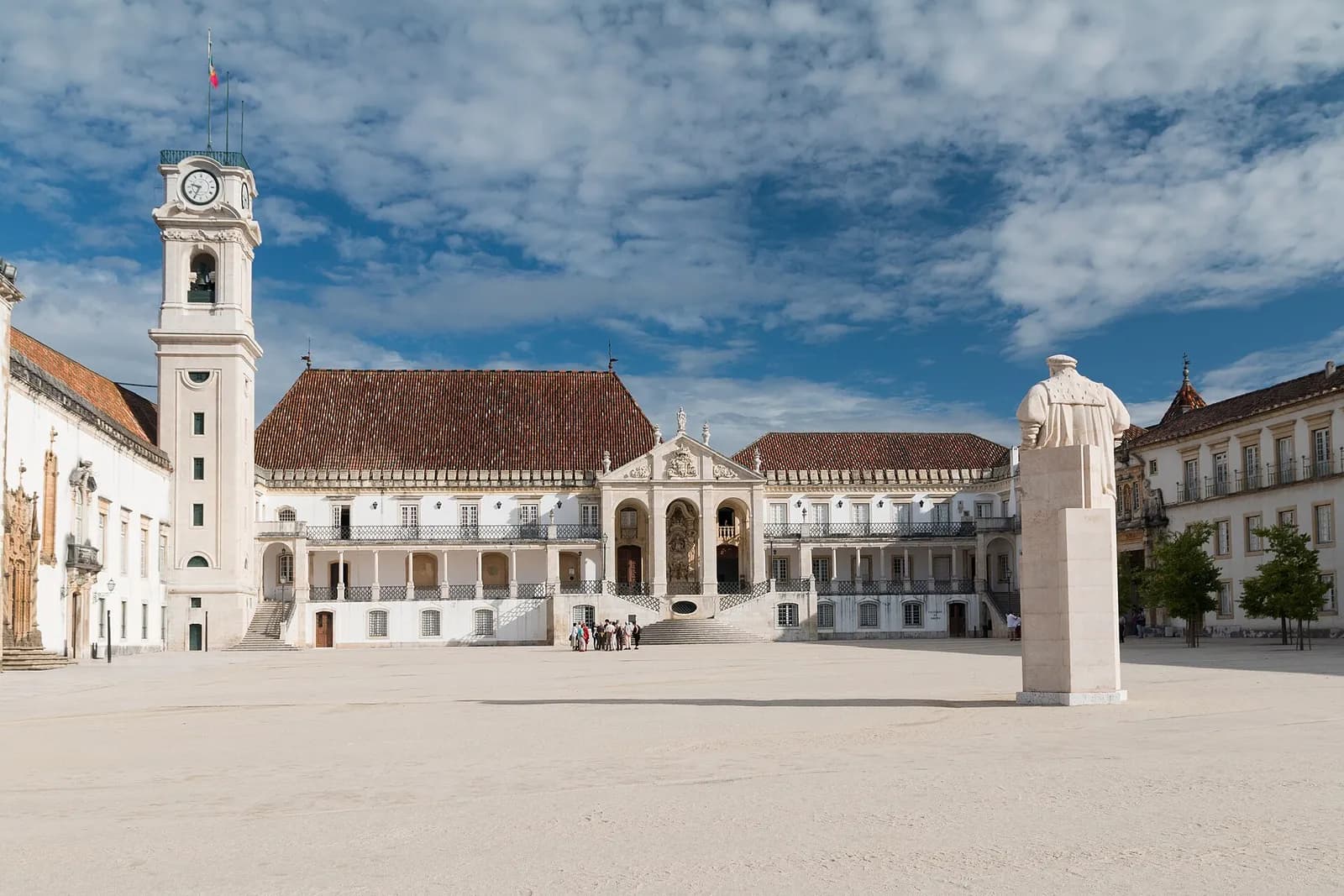
- The courtyard of the Paço das Escolas, the historic home of the University of Coimbra, photographed in September 2014. The statue on the right, seen from behind, is a twentieth-century monument to King João III, who moved the university from Lisbon to Coimbra in 1537. Much of what is seen here was rebuilt or added after Nunes's time. Daniel VILLAFRUELA ., CC BY-SA 4.0, via Wikimedia Commons.
- A portrait of Pedro Nunes printed in the Lisbon magazine O Panorama in 1843, more than 260 years after his death. Unknown author, Public domain, via Wikimedia Commons.
- Title page of the Tratado da Sphera, printed in Lisbon in 1537. Besides translations of Sacrobosco, Peurbach and Ptolemy, it contains Nunes's two treatises on the sea chart and the doubts of navigation. Pedro Nunes; printed by Germão Galhardo, Public domain, via Wikimedia Commons.
- Title page of De arte atque ratione navigandi, printed by the university printer in Coimbra in 1573. The last line, Cum facultate Inquisitoris, records that the book was published with the Inquisitor's licence. Pedro Nunes, Public domain, via Wikimedia Commons.
- The crater Nonius, about 70 km across, in the Moon's southern highlands, with its neighbours Walther, Aliacensis and Kaiser. Detail of a mosaic from NASA's Lunar Reconnaissance Orbiter, 2011. NASA / LRO_LROC_TEAM, Public domain, via Wikimedia Commons.
- Pedro Nunes, holding an armillary sphere and compasses, among the cosmographers and navigators on the Padrão dos Descobrimentos in Belém, Lisbon. The present monument dates from 1960. Photographed in April 2009. Alvesgaspar, CC BY-SA 3.0, via Wikimedia Commons.