

Luxembourg, 1978: Portugal opens its talks to join the EEC
Four years after the Carnation Revolution, a caretaker foreign minister sat down with the Nine in Luxembourg. The talks he opened ended in the Jerónimos cloister in 1985.
At a glance
- Portugal's accession negotiations with the European Communities formally opened at a ministerial session in Luxembourg on 17 October 1978.
- The Socialist government of Mário Soares had applied on 28 March 1977, less than three years after the Carnation Revolution of 25 April 1974.
- The main issues settled in the final deal of March 1985 were agriculture, fisheries, free movement of workers and the budget; Spain's parallel talks had opened in February 1979.
- The Treaty of Accession was signed in the Jerónimos Monastery in Lisbon on 12 June 1985, and Portugal became a member on 1 January 1986.
- Portugal's GDP per head in purchasing power terms was 55.4% of the EU-15 average in 1986; against today's EU-27 it stood at 82% in 2024.
A Tuesday in Luxembourg
On Tuesday 17 October 1978 Portugal's foreign minister, Correia Gago, faced the ministers of the nine member states of the European Communities in Luxembourg, where their Council was meeting that week. In the chair sat Klaus von Dohnanyi, a minister of state at the West German foreign ministry, because West Germany held the Council's rotating presidency.
Dohnanyi welcomed the Portuguese delegation and then set out the terms. Portugal would have to accept the treaties and every decision taken since they came into force, the body of law the Community calls the acquis communautaire. Any problems of adjustment, he said, 'must be resolved by transitional measures and not by a change in Community rules'.
Correia Gago accepted all of it. He asked for longer transition periods for farming, said both sides would need transitional measures for the free movement of people, services and capital, and reminded the room that his country faced serious economic and financial problems. He presented membership as the only way to give full expression to Portugal's European commitment.
“Only accession to the Communities could express, politically and institutionally as well as economically and socially, the depth and irreversibility of my country's European commitment.”
Dohnanyi called the task facing the negotiators substantial. Greece's negotiations were already well advanced and Spain had also applied. The minister speaking for Portugal belonged to a government whose programme parliament had rejected the month before, so he spoke for a caretaker cabinet. The treaty he was negotiating would be signed almost seven years later.
From dictatorship to the Community's door
The European Economic Community, the forerunner of today's European Union, had been building a customs union since 1958. Its founders called on other European peoples who shared their ideal of peace and liberty to join them, and the Commission later read that call as an invitation to states 'sharing the democratic ideal'. Portugal under António de Oliveira Salazar, whose authoritarian Estado Novo dated from 1933, did not qualify.
The dictatorship traded with Europe all the same. In 1960 Portugal was a founding member of the European Free Trade Association (EFTA), with Austria, Denmark, Norway, Sweden, Switzerland and the United Kingdom. When Britain and Denmark left EFTA for the EEC, Portugal signed its own agreement with the Community in Brussels on 22 July 1972, dismantling tariffs on industrial goods and some farm products.
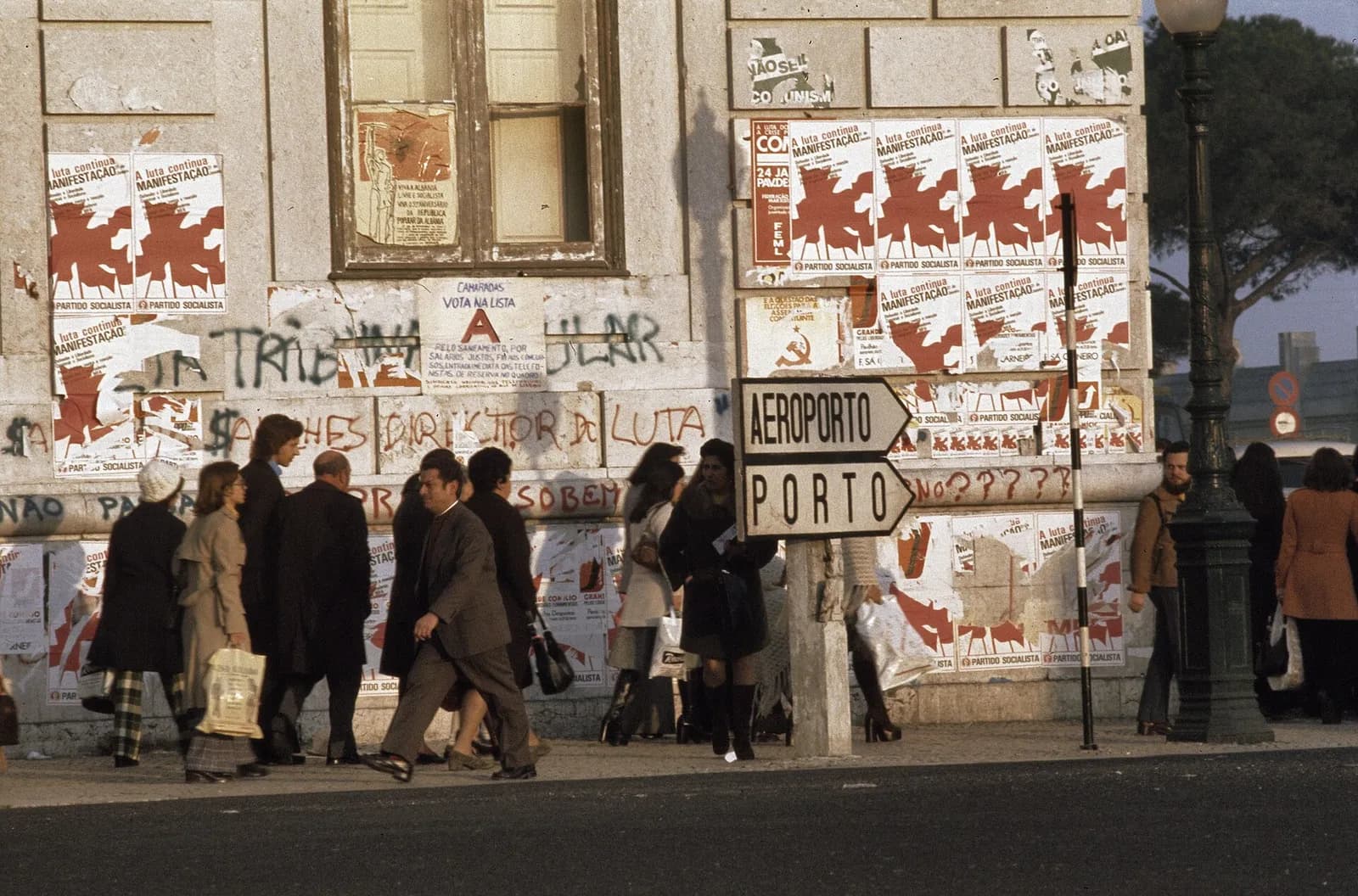
On 25 April 1974 a military uprising, the Carnation Revolution, swept the regime away. The months that followed, known in Portugal as the PREC (Processo Revolucionário em Curso, the 'ongoing revolutionary process'), ended only on 25 November 1975. Banks and much of industry were nationalised, large estates in the Alentejo were taken over under an agrarian reform, and the officers and civilians who had made the revolution split over how far it should go.
Decolonisation was rapid. Hundreds of thousands of Portuguese came back from Africa, above all from Angola and Mozambique; they became known as retornados. The Commission put the figure at half a million in 1978; Le Monde's Lisbon correspondent wrote of almost 700,000 in 1985. A large number of young men were demobilised from the colonial wars at the same time, and Portugal lost an important market.
Democracy took root regardless. A Constituent Assembly elected on 25 April 1975 drafted a constitution adopted on 2 April 1976. Mário Soares, the Socialist leader who had been forced into exile in France and West Germany, became prime minister of the first constitutional government on 23 July 1976, and Portugal joined the Council of Europe that September.
'Europe with us': the application
Soares made Europe the centre of his politics. In 1976 he brought leaders of Europe's main socialist and social democratic parties to the Palácio de Cristal in Porto under the slogan 'A Europa connosco', Europe with us. Membership, he argued, would guarantee that Portugal's turn to democracy held.
As foreign minister and then prime minister, Soares travelled the length and breadth of Europe to argue Portugal's case. In a speech on 11 March 1977 he called membership a challenge for Portugal, 'because we in no way ignore our weaknesses', and a challenge for Europe, which would widen the economic gap between its south and north if it ignored the changes there (translated from Portuguese).
At 14:30 on Monday 28 March 1977, Portugal's head of mission to the Communities, Siqueira Freire, handed three letters to Sir Donald Maitland, chairman of the committee of member-state ambassadors, at the Council's General Secretariat in Brussels. They were Portugal's applications to join the EEC, the Coal and Steel Community and Euratom, sent by Soares to the British foreign secretary, David Owen, who presided over the Council.
The Commission, the Community's executive, delivered its opinion on 19 May 1978. It was blunt on both counts. 'Democracy in Portugal is now an established political fact,' it said, and the Community should give 'an unequivocal yes' to opening negotiations as soon as possible.
“Political considerations must not, however, be allowed to obscure the economic difficulties.”
The difficulties were large. Portugal had 3% of the population of the Nine. Twenty-eight per cent of its workers were still on the land, producing only 14% of output, and industry leant on textiles, footwear and food processing, sectors in trouble across the world. The current account had swung from a surplus of 350 million dollars in 1973 to a deficit of 1,500 million by 1977, about 10% of GDP. On 6 June 1978 the Council gave the application a unanimous yes.
Seven years at the table
After the ministers' opening session, the detailed work passed to their deputies, senior officials who negotiated chapter by chapter in a conference between the Communities and Portugal. Their first session was set for 1 December 1978 in Brussels. Dohnanyi had suggested starting with the customs union and external trade, where the 1972 agreement had already done much of the work.
Spain had applied on 28 July 1977 and opened its own talks on 5 February 1979. The Community promised to judge each candidate on its merits, but the two Iberian files soon moved together. In November 1981 the European Parliament voted for both to join in January 1984, and the next month the Commission's president, Gaston Thorn, argued that they should enter at the same time.
Farming, where Correia Gago had asked for longer transitions from the start, was one of the hardest chapters. Fisheries, the free movement of workers and the budget were the other main issues in the final political agreement of March 1985. Textiles and footwear made up much of Portugal's exports to Europe, and in 1981 the Community proposed that Portuguese textile exports be kept under a system of administrative cooperation after accession.
| Chapter | The problem | The settlement (March 1985) |
|---|---|---|
| Agriculture | 28% of workers on the land, low productivity and a large food trade deficit | Ten years in two five-year stages for major products, a basic seven years for others, and 700 million ECU of extra farm modernisation aid over ten years |
| Fisheries | A small, little-modernised fleet; despite its long coast, Portugal imported fish | No access to Portugal's 12-mile zone for other members' boats; limits on fishing beyond it until 31 December 1995 |
| Free movement of workers | Fear in the Nine of a new wave of Portuguese emigration | Free access to jobs in other member states only after seven years, the same rule as for Spain |
| Budget | A poor country paying into a common budget | Contributions refunded on a sliding scale, a net gain of some 1,200 million ECU over six years, plus 1,000 million ECU in balance-of-payments loans |
Settlement terms as summarised in the Bulletin of the European Communities 3/1985. Problems as described in the Commission opinion of May 1978, Correia Gago's statement of October 1978 and Le Monde in June 1985.
Meanwhile Portugal's economy lurched from crisis to crisis. It agreed stand-by arrangements with the International Monetary Fund in April 1977, June 1978 and October 1983, though it drew nothing under the 1978 one. They came with austerity: a 15% cap on wage rises in 1977 cut real wages by nearly 10%, the Commission noted.
The current-account deficit shrank after the 1978 programme, then grew to 3.25 billion dollars by 1982. Soares, back as prime minister from June 1983, applied a second hard programme that cut it to 0.52 billion dollars in 1984. Governments came and went so often that Le Monde counted sixteen since April 1974.
The Community softened the wait with money. On 18 December 1980 Portugal and the EEC signed a pre-accession agreement, and the Council backed a programme of 'common actions' with 150 million European units of account (the forerunner of the ECU) in European Investment Bank loans and 125 million in grants. On 24 October 1984 in Dublin, Soares, the Irish prime minister Garret FitzGerald and the Commission's Lorenzo Natali signed a declaration naming 1 January 1986 as the target date for entry.
The last deals on agriculture, fisheries, social affairs and the budget were struck at the end of March 1985, with a political agreement on 29 March between the Ten and both candidates.
1960
Portugal is a founding member of EFTA
22 July 1972
Free trade agreement with the EEC signed in Brussels
25 April 1974
The Carnation Revolution ends the dictatorship
2 April 1976
The democratic constitution is adopted
23 July 1976
Mário Soares becomes prime minister
28 March 1977
Portugal applies to join the three Communities
25 April 1977
First IMF stand-by arrangement
19 May 1978
Commission gives a favourable opinion
6 June 1978
Council of Ministers says yes to negotiations
17 October 1978
Negotiations formally open in Luxembourg
5 February 1979
Spain opens its own negotiations
18 December 1980
Pre-accession aid agreement signed
7 October 1983
A new IMF stand-by arrangement is agreed
24 October 1984
Dublin declaration sets 1 January 1986 as the target
29 March 1985
Political agreement on the last hard chapters
12 June 1985
Treaty of Accession signed at the Jerónimos Monastery
1 January 1986
Portugal joins, a day after leaving EFTA
Signing in the cloister
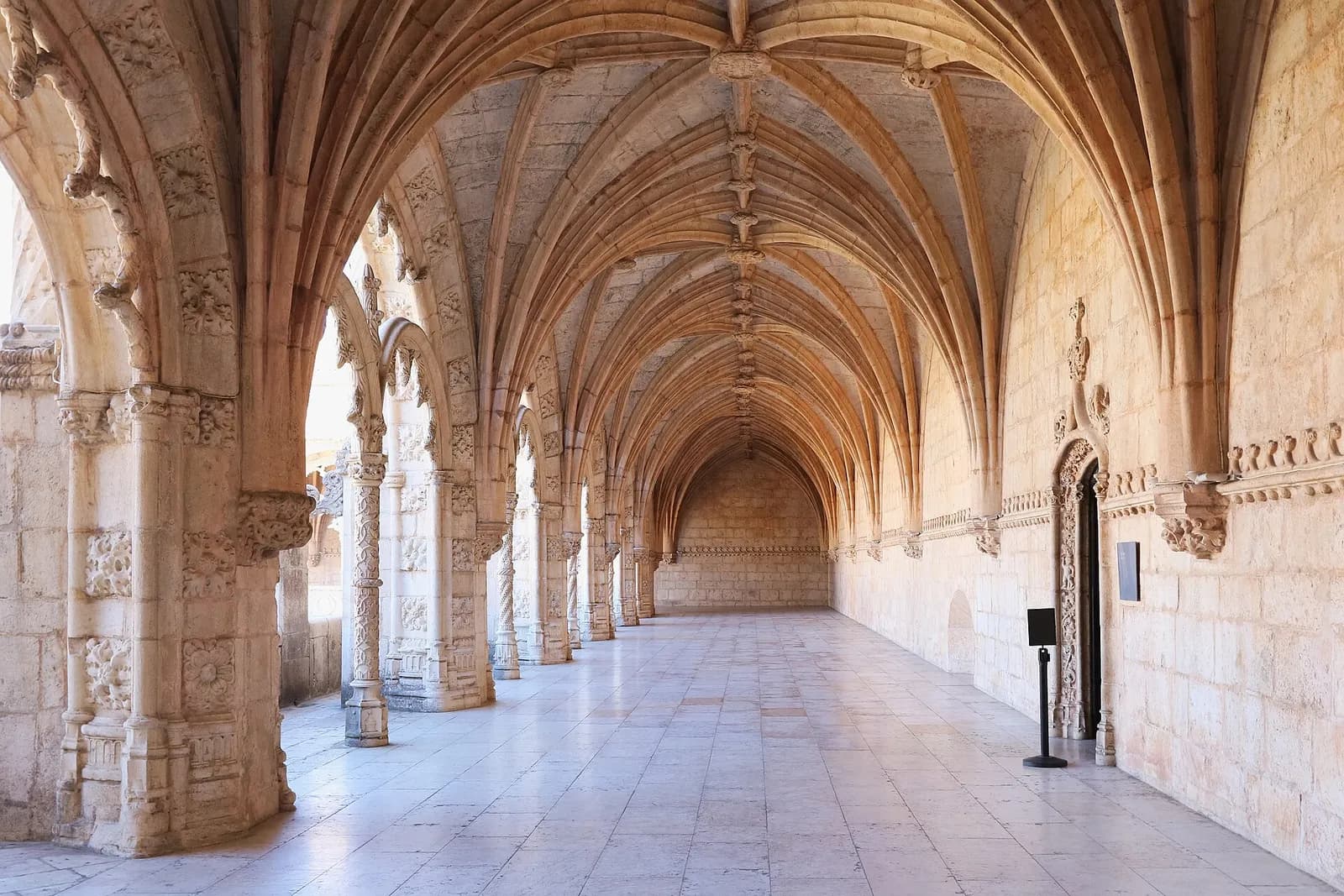
The Treaty of Accession was signed on Wednesday 12 June 1985 in the cloister of the Jerónimos Monastery in Belém. The European Commission's photograph of the ceremony shows Soares with his deputy prime minister, Rui Machete, and his foreign minister, Jaime Gama. Spain signed its own treaty in Madrid the same day.
The speakers at the ceremony were Soares, the Italian prime minister Bettino Craxi, whose country held the Council presidency, the Italian foreign minister Giulio Andreotti and the president of the Commission, Jacques Delors.
“For Portugal, accession to the EEC is a fundamental choice for a future of progress and modernity. But let no one think it is an easy choice. It demands a great deal of the Portuguese, while at the same time opening wide prospects of development to them.”
Le Monde's Lisbon correspondent, José Rebelo, found Soares openly optimistic. 'Five years hence, the country will be radically different,' the prime minister told him. Farmers and many small industrialists were less sure, and Rebelo summed up the choice facing farmers as 'adjust or go bust'.
Soares did not lead Portugal in. On 6 November 1985 Aníbal Cavaco Silva replaced him as prime minister. Portugal left EFTA on 31 December 1985 and joined the European Communities, together with Spain, on 1 January 1986.
What membership brought
Money came quickly. From 1986 Portugal had access to the European Regional Development Fund, and in the Commission's later reckoning EU net transfers averaged about 3% of Portuguese GDP a year between 1986 and 2002. The Commission's economists wrote that the money helped upgrade infrastructure and train workers, and that foreign direct investment was an important catalyst for modernising industry.
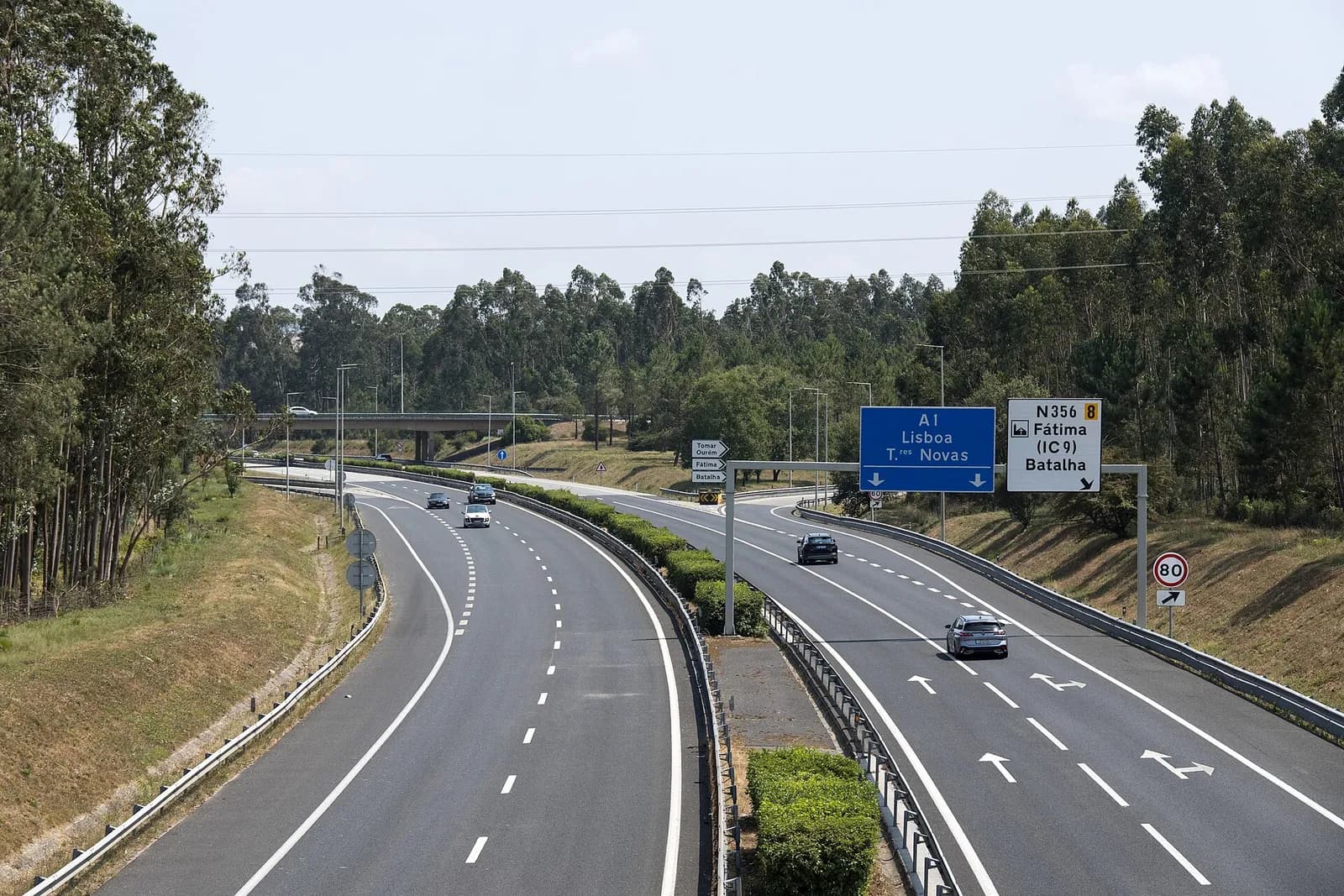
Much of the investment went into transport, which the Commission's economists called the main priority of Portugal's infrastructure policy. Mainland Portugal had 196 km of motorway in 1985 and 3,113 km by 2021, according to PORDATA. The biggest single jump came in 1998, when the network grew from 797 km to 1,252 km.
Motorway network in mainland Portugal, 1985 to 2025
km
Kilometres of motorway in mainland Portugal at five-year intervals. Source: PORDATA, from Estradas de Portugal (to 2010), INE and IMT (from 2011). 1985 is the last year before accession.
Show the data
| Motorway length | |
|---|---|
| 1985 | 196 |
| 1990 | 303 |
| 1995 | 687 |
| 2000 | 1,482 |
| 2005 | 2,341 |
| 2010 | 2,737 |
| 2015 | 3,073 |
| 2020 | 3,111 |
| 2025 | 3,113 |
Portugal adopted the euro from its launch on 1 January 1999, and euro notes and coins went into circulation on 1 January 2002.
Incomes closed some of the gap. Measured in purchasing power standards, a unit that removes differences in price levels, Portugal's GDP per head rose from 55.4% of the EU-15 average in 1986 to 68.8% in 2002, by the Commission's calculation in 2004. That was faster than Spain or Greece over the same years, and much slower than Ireland.
Against today's 27-member EU, which also counts the poorer countries that joined from 2004 onwards, Eurostat puts Portugal at 81% in 1995 and 85% in 1999 and 2000. Then the line stopped rising. On 7 April 2011 Portugal asked the EU and the IMF for help and received a €78 billion programme, which it left in June 2014. GDP per head fell to 75% of that EU-27 average in 2012 and 74% in 2021, then rose to 82% in 2024.
Portugal's GDP per head in purchasing power standards, 1995 to 2025
% of EU-27 average (EU27_2020 = 100)
Portugal's GDP per head in purchasing power standards as a percentage of the average of the 27 countries in the EU today (Eurostat's EU27_2020 aggregate = 100), calculated for every year, including years before many of them joined. Not comparable with EU-15 figures. Source: Eurostat, prc_ppp_ind for 1995 to 2013 and tec00114 for 2014 to 2025 (the two agree where they overlap); 2025 is provisional. Highlighted: euro launch (1999) and the bailout request (2011). Eurostat's series starts in 1995.
Show the data
| Portugal | |
|---|---|
| 1995 | 81 |
| 1996 | 81 |
| 1997 | 83 |
| 1998 | 83 |
| 1999 | 85 |
| 2000 | 85 |
| 2001 | 84 |
| 2002 | 84 |
| 2003 | 84 |
| 2004 | 83 |
| 2005 | 84 |
| 2006 | 84 |
| 2007 | 82 |
| 2008 | 81 |
| 2009 | 82 |
| 2010 | 82 |
| 2011 | 77 |
| 2012 | 75 |
| 2013 | 77 |
| 2014 | 77 |
| 2015 | 76 |
| 2016 | 77 |
| 2017 | 76 |
| 2018 | 77 |
| 2019 | 77 |
| 2020 | 75 |
| 2021 | 74 |
| 2022 | 77 |
| 2023 | 81 |
| 2024 | 82 |
| 2025 | 81 |
| Year | % of EU-15 average | % of EU-27 average (EU27_2020) | Source |
|---|---|---|---|
| 1960 | 40.5 | not published | European Commission, 2004 (from AMECO) |
| 1986 | 55.4 | not published | European Commission, 2004 (from AMECO) |
| 1995 | 68.2 | 81 | AMECO (EU-15); Eurostat (EU-27) |
| 2002 | 68.8 (preliminary, 2004 estimate); 71.1 (current AMECO) | 84 | European Commission, 2004; AMECO; Eurostat |
| 2024 | 78.6 | 82 | AMECO (EU-15); Eurostat (EU-27) |
All figures use purchasing power standards. The EU-15 average is higher than the EU-27 average because it excludes the poorer countries that joined from 2004, so the same Portuguese income looks lower against it. The EU-27 figures use Eurostat's EU27_2020 aggregate, today's 27 members, back-calculated for years before they joined. Revised data also change older figures, as the two values for 2002 show.
Why it still matters
The European Commission's own timeline of Portugal in the EU goes straight from the Council's yes in June 1978 to a pre-accession agreement in December 1980, without the session in Luxembourg. That session set the method, though. Portugal took the Community's rules whole and bargained only over the time it needed, product by product and sector by sector.
The gap the Commission described in 1978 has narrowed without closing. Portugal stood at 81% of the EU average in Eurostat's provisional figure for 2025, close to where it was in 1995 on the same measure. Dohnanyi had warned in 1978 that 'mere accession is not in itself a panacea for the economic problems facing Portugal'.
FAQs
When did Portugal join the European Union?
Portugal applied on 28 March 1977, negotiations opened on 17 October 1978, the Treaty of Accession was signed on 12 June 1985, and Portugal became a member of the European Communities, the forerunner of the EU, on 1 January 1986.
Why did Portugal's accession negotiations take so long?
Agriculture, fisheries, the free movement of workers and budget contributions were hard to settle, the talks moved in step with Spain's long and difficult negotiation, and Portugal went through repeated changes of government and two IMF programmes between 1978 and 1985.
Did Portugal and Spain join the EEC together?
Yes. Both signed their treaties on 12 June 1985, Portugal in Lisbon and Spain in Madrid, and both joined on 1 January 1986. Their negotiations opened separately: Portugal's on 17 October 1978 and Spain's on 5 February 1979.
Where did Portugal's accession negotiations open?
In Luxembourg, at a ministerial session held alongside the Council meeting on 17 October 1978. Some archive catalogues label the speeches 'Brussels', but the texts and a Council paper of November 1978 say Luxembourg.
Has Portugal caught up with the EU average income?
Not yet. Its GDP per head in purchasing power standards rose from 55.4% of the EU-15 average in 1986 to 68.8% in 2002. Against today's EU-27 average it was 82% in 2024 and 81% in Eurostat's provisional figure for 2025.
On the timeline
Open the timelineNearby moments from revolution and democracy (1974–1986).
Portugal holds its first democratic local elections, choosing 304 mayors and thousands of councillors and parish representatives. The Socialists win the most votes, about a third, and take Lisbon and Porto, though they tie with the PPD at 115 mayors each; abstention, at around 35%, is more than double that of the parliamentary election held that April.
Mário Soares's government formally applies for Portugal to join the European Economic Community, less than three years after the Carnation Revolution. Seen as the anchor of the young democracy, membership would follow on 1 January 1986.
TAP Flight 425, a Boeing 727 arriving from Brussels via Lisbon, overruns the short, rain-soaked runway at Funchal in Madeira and plunges onto the beach below, killing 131 of the 164 people on board. It remains the worst accident in TAP's history and led to the runway's later extension over the sea.
Portugal's EEC accession talks
Nicolau Lobato, president of Fretilin and first prime minister of the short-lived Democratic Republic of East Timor, is killed in an ambush by Indonesian special forces in the mountains south of Dili. Born in Portuguese Timor in 1946, he is honoured today as a national hero, and Dili's international airport bears his name.
Maria de Lourdes Pintasilgo is sworn in as Portugal's first female Prime Minister, forming the fifth constitutional government at the invitation of President António Ramalho Eanes. She remains the only woman to have held the office.
José Eduardo dos Santos, a Soviet-trained petroleum engineer, is sworn in as President of Angola, eleven days after the death of the country's first president, Agostinho Neto. He ruled for 38 years, through civil war and an oil boom, while his daughter Isabel became a major investor in Portuguese companies before facing corruption investigations.
Coming up in history
All long reads 19 October 1921Noite Sangrenta: the night a Portuguese prime minister was hunted down
 20 October 1570João de Barros, the historian of Portuguese Asia who never went there
 21 October 1520Magalhães reaches the Cape of the Virgins: 21 October 1520
 22 October 1383Fernando I dies in Lisbon, and the crisis of 1383–85 begins
27 sources
Archives, scholarship and reporting this article was checked against.
- 1
Statement by Minister of State Klaus von Dohnanyi at the opening session of EEC-Portugal negotiations (17 October 1978)CVCE.eu (University of Luxembourg), from the Historical Archives of the Council of the EU
- 2
- 3
Opinion on Portuguese application for membership, COM (78) 220 final, Bulletin of the European Communities, Supplement 5/78Commission of the European Communities, via Archive of European Integration (University of Pittsburgh)
- 4
- 5
- 6
- 7
The Portuguese economy after the boom (European Economy Occasional Papers No 8, April 2004)European Commission, Directorate-General for Economic and Financial Affairs
- 8
- 9
Chefes do Governo desde 1821República Portuguesa, portugal.gov.pt
- 10
- 11
- 12
- 13
EFTA through the yearsEuropean Free Trade Association
- 14
- 15O PCP? Não teve nada a ver com o golpe de 25 de novembroObservador, 24 November 2015
- 16
- 17
Memória do PS de 1976 continua a ter um 'sentido profundo'Sábado, 8 January 2021
- 18
Portugal na UEEuropean Commission Representation in Portugal
- 19
- 20
Portugal: history of lending arrangementsInternational Monetary Fund
- 21
- 22
Extensão da rede de autoestradas: Continente (km)PORDATA (sources: Estradas de Portugal to 2010, INE, IMT from 2011)
- 23
Introduction of the euroEuropean Central Bank
- 24
- 25
Financial assistance to PortugalEuropean Commission, Economy and Finance
- 26
AMECO: GDP at current prices per head of population, PPS, EU-15 = 100, Portugal (HVGDPR)European Commission AMECO database, via DBnomics
- 27
Mosteiro dos Jerónimos e Torre de BelémMuseus e Monumentos de Portugal
Image credits
- The upper gallery of the cloister of the Jerónimos Monastery in Belém, Lisbon, photographed in 2022. Portugal's Treaty of Accession to the European Communities was signed in this cloister on 12 June 1985. Ingo Mehling, CC BY-SA 4.0, via Wikimedia Commons.
- A Lisbon street in early 1975, before the Constituent Assembly elections. The walls carry Socialist Party posters calling a demonstration under the slogan 'A luta continua' (the struggle goes on), alongside communist and far-left posters and slogans. Rob Mieremet / Anefo, CC0, via Wikimedia Commons.
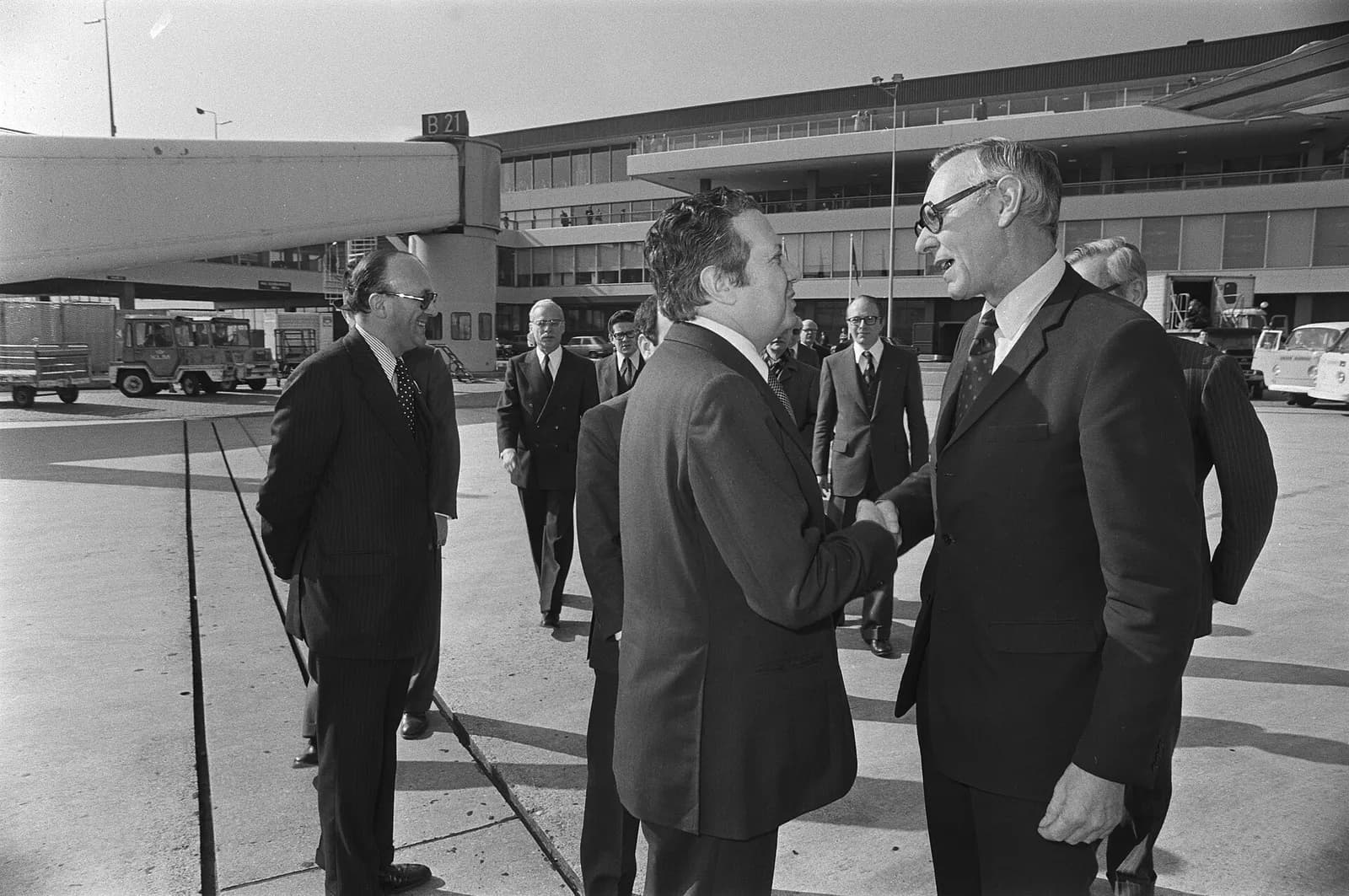
- Prime minister Mário Soares (centre) is seen off at Schiphol airport by the Dutch foreign minister, Max van der Stoel, on 10 March 1977, eighteen days before Portugal lodged its application to join the European Communities. Koen Suyk / Anefo, CC0, via Wikimedia Commons.
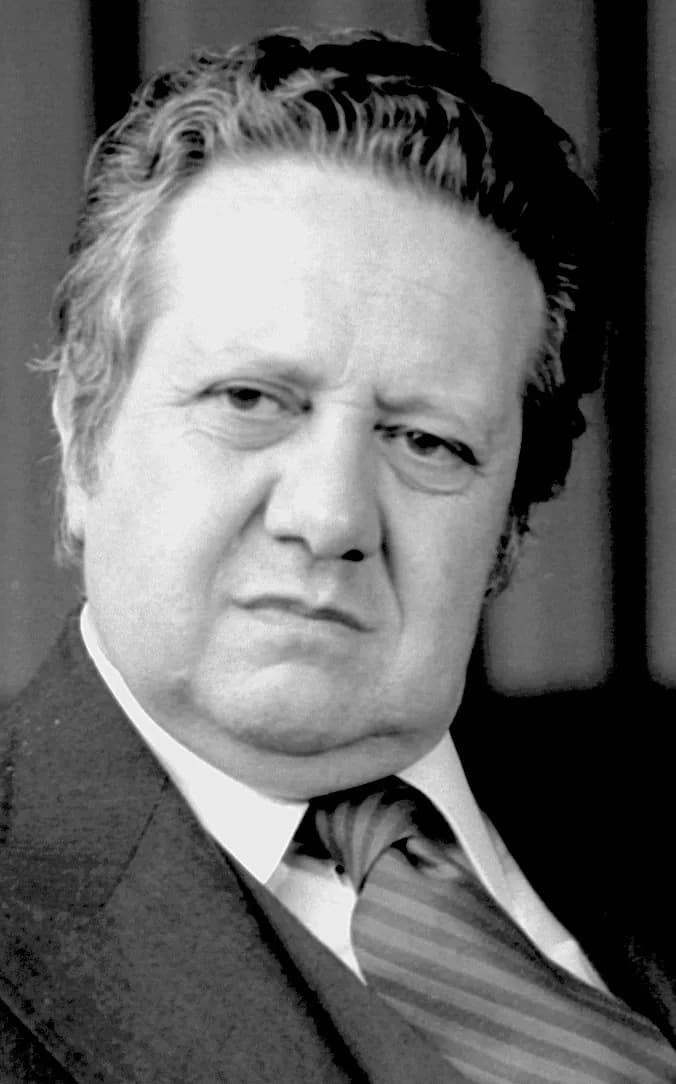
- Mário Soares, photographed in 1978. He left office as prime minister in August 1978, two months before the negotiations opened, and was back in June 1983 to finish them. Photo Claude TRUONG-NGOC, CC BY-SA 3.0, via Wikimedia Commons.
- The A1, Portugal's main north-south motorway, at the Fátima junction in July 2026. Alexkom000, CC BY 4.0, via Wikimedia Commons.