

1910–1926
The First Republic
Republicans overthrew the monarchy on 5 October 1910, and the Constitution of 1911 gave power to a parliament that elected the president. The new regime lived through deep political, social and economic instability. Portugal entered the First World War in March 1916 and sent troops to France, and a military coup on 28 May 1926 dissolved parliament and ended the Republic.
4 key moments · 64 in all
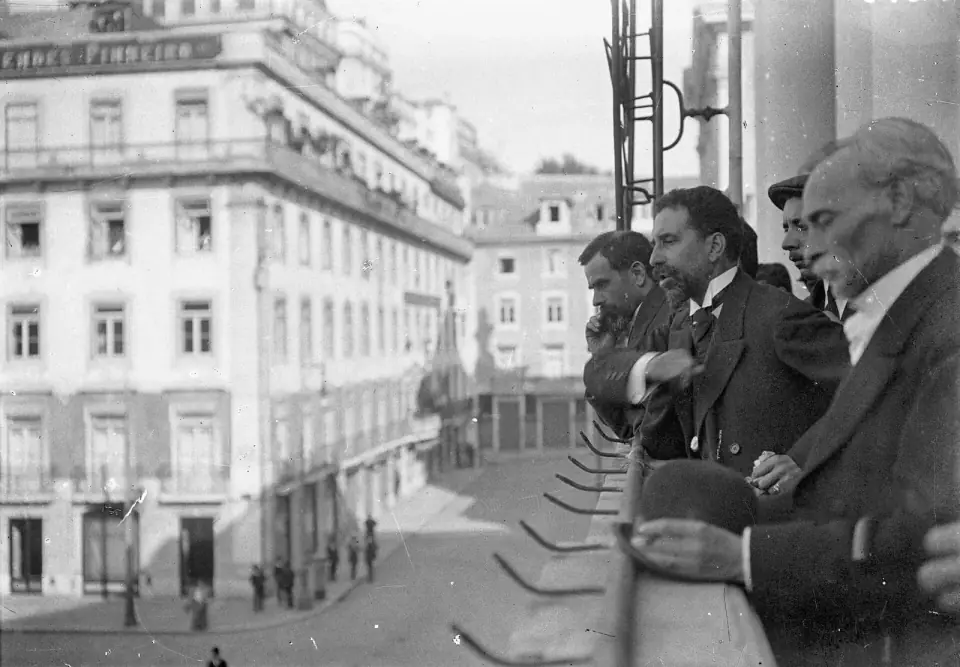
After a day and a half of fighting in Lisbon, the Republic is proclaimed from the balcony of the Câmara Municipal by José Relvas on the morning of 5 October, ending nearly eight centuries of monarchy. A provisional government under Teófilo Braga takes office, and 5 October becomes a national holiday.
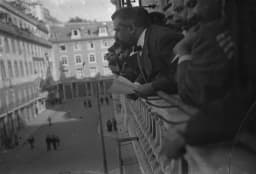 Long readThe morning Portugal became a republic: 5 October 1910
Three days after the proclamation of the Republic, the Justice Minister Afonso Costa revives Pombal's laws expelling the Jesuits and the 1834 law abolishing the religious orders. All Jesuits, whatever their nationality, are ordered out of the country, their property passes to the state, and the goods of other religious houses are inventoried and sealed.
The provisional government decrees a new press law, replacing João Franco's repressive press laws of 1907 and restoring freedom of the press, though restrictive legislation would return within a few years.
Less than a month after the proclamation of the Republic, a decree of the Provisional Government legalises divorce in Portugal, including by mutual consent — one of the first secularising reforms driven by the Minister of Justice, Afonso Costa.
Two months after the fall of the monarchy, the Republic presents its new green-and-red flag to the nation on the 270th anniversary of the Restoration, declared 'Flag Day'. In Lisbon it is paraded from the City Hall to the Restauradores monument, where it is hoisted for the first time — amid fierce debate from those who wanted to keep the old blue and white.
The young Republic founds the University of Porto, built on the city's Polytechnic Academy and Medical-Surgical School, with the mathematician Francisco Gomes Teixeira as first rector. It has grown into one of the country's largest universities.
The Provisional Government of the Portuguese Republic decrees the Law of Separation of Church and State, drafted by Afonso Costa — one of the most sweeping anticlerical measures in Europe, nationalising church property and ending the state religion.
A decree of the Provisional Government creates the escudo as Portugal's new currency, replacing the real at a rate of one escudo to 1,000 réis in the wake of the Republican Revolution.
The Constituent Assembly of the young Republic formally adopts the green-and-red flag bearing the armillary sphere and the shield of Portugal, and confirms 'A Portuguesa', the march written against the 1890 British Ultimatum, as the national anthem. Both remain the symbols of Portugal today.
The Constituent Assembly elects Manuel de Arriaga as the first President of the Portuguese Republic, days after approving the new republican Constitution.
João Chagas, a Rio de Janeiro-born journalist and veteran republican agitator, is sworn in at the head of the first constitutional government of the young Portuguese Republic, following the election of Manuel de Arriaga as president; his appointment had been decreed the previous day.
Portugal makes its Olympic debut as the Stockholm Games open. In the 100-metre heats that day the 18-year-old sprinter António Stromp, a founder member of Sporting, becomes the first Portuguese athlete to compete at an Olympics. The young Republic sent just six competitors, in athletics, fencing and Greco-Roman wrestling.
Francisco Lázaro, a Lisbon carpenter and Portugal's flag-bearer at its first Olympic Games, dies in Stockholm the morning after collapsing near the 30-km mark of the marathon in searing heat. He had coated his body in suet against sunburn, which stopped him sweating; he is the first athlete to die as a result of competing at the modern Olympics.
Afonso Costa, the fiery lawyer behind the 1911 law separating Church and State, forms his first government and also takes the finance ministry. His budgets closed with rare surpluses, but his anticlericalism and his push to deny the vote to illiterate citizens made him the most divisive figure of the First Republic.
Álvaro Cunhal is born in Coimbra. Secretary-general of the Portuguese Communist Party from 1961 to 1992, he was one of the most determined opponents of the Estado Novo and remained a towering figure of the Portuguese left until his death in 2005.
Bernardino Machado becomes prime minister of the young Portuguese Republic. A Coimbra professor and veteran republican, he was later twice elected President of the Republic, and was forced from office both times by military coups, in 1917 and again in 1926.
Birth of Francisco da Costa Gomes in Chaves. Career soldier, Chief of Staff and a key figure in the 25 de Abril 1974 revolution, he would serve as President of the Republic from September 1974 to July 1976, steering Portugal through decolonisation and the most turbulent months of the transition to democracy.
Meeting in special session, the Portuguese Congress unanimously authorises the government to intervene in the First World War as Britain's ally whenever it judges necessary, a step on the road to the Portuguese Expeditionary Corps being sent to Flanders in 1917.
German troops from South West Africa attack the Portuguese post at Naulila in southern Angola. Some 70 Portuguese soldiers are killed and the garrison retreats — fighting in Africa more than a year before Portugal formally entered the First World War. The retreat set off uprisings in southern Angola that Portugal crushed in a bloody campaign in 1915.
A violent uprising in Lisbon, led by republicans including Álvaro de Castro, Sá Cardoso and Norton de Matos, topples the dictatorial government of General Pimenta de Castro and restores constitutional rule. One of the bloodiest episodes of the First Republic, it leaves by some estimates 200 dead and 1,000 wounded, and soon forces President Manuel de Arriaga to resign.
At Britain's request, Portugal requisitions 72 German merchant ships that had sheltered in the Tagus and other Portuguese ports since 1914. Berlin answers by declaring war on 9 March, drawing Portugal into the First World War and, within a year, sending the Corpo Expedicionário Português to Flanders.
The German Empire declares war on Portugal, following Portugal's seizure of German and Austro-Hungarian ships sheltering in Portuguese ports. Portugal formally enters World War I on the side of the Allies.
Death of Mário de Sá-Carneiro in Paris at age 25. He was a leading Portuguese modernist poet, a key figure of the 'Geração d'Orpheu' movement, and Fernando Pessoa's close friend and literary collaborator.
The Portuguese Parliament approves Portugal's active participation in the First World War alongside the Allies, following Britain's formal invitation, paving the way for the Portuguese Expeditionary Corps to fight on the Western Front.
Portugal and Britain sign a convention setting out how the Corpo Expedicionário Português (CEP) will join the Western Front, fighting within the British sector and shipped to France at Britain's expense. The first brigade sailed from Lisbon within weeks; by October almost 60,000 Portuguese soldiers had been sent to Flanders.
Three shepherd children — Lúcia Santos, Francisco Marto, and Jacinta Marto — report the first apparition of Our Lady of Fátima in the Cova da Iria. The events of 1917 would make Fátima one of the most important Catholic pilgrimage sites in the world, drawing millions of visitors annually.
Birth in Luanda of José Baptista Pinheiro de Azevedo, the admiral who led Portugal's Sixth Provisional Government through the revolutionary 'Hot Autumn' of 1975. Besieged by protesters and short of military backing, he suspended his own government's work on 20 November that year, saying he was 'tired of being kidnapped' — in effect putting the cabinet on strike.
The third of six apparitions of the Virgin Mary to the three shepherd children of Fátima — Lúcia, Francisco and Jacinta. It is on this day that, according to the seers, Our Lady entrusts them with the famous 'Three Secrets', the third of which would not be made public by the Vatican until the year 2000.
The three Fátima seers — Lúcia, Francisco and Jacinta — are seized and detained by Artur Santos, administrator of Vila Nova de Ourém, preventing the expected apparition at the Cova da Iria.
At the Cova da Iria near Fátima, a crowd estimated at 30,000 to 70,000 people witnesses the 'Miracle of the Sun' during the sixth and final apparition reported by the shepherd children Lúcia, Francisco and Jacinta, an event that made Fátima one of the great Catholic shrines of the world.
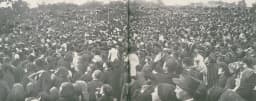 Long readWhen the sun “danced” at Fátima: 13 October 1917
Battle of the Lys (La Lys): the Portuguese 2nd Division, about to be relieved after months in the trenches of French Flanders, takes the full force of the German spring offensive. Overrun in a single morning, it suffers some 7,000 casualties, most of them taken prisoner — Portugal's worst defeat of the First World War. 9 April is now the country's day of military commemoration.
The painter Amadeo de Souza-Cardoso, pioneer of modernism in Portugal and friend of Modigliani and Brancusi in Paris, dies of Spanish influenza at Espinho, aged only 30.
President Sidónio Pais is assassinated at Lisbon's Rossio station as he arrives to catch a night train to Porto. José Júlio da Costa, a left-wing activist hiding a pistol under his Alentejo cloak, breaks through the police cordon and fires twice. The charismatic 'President-King', who had seized power a year earlier, dies within hours; in the panic, guards kill four bystanders.
Monarchist forces under Henrique Paiva Couceiro proclaim the restoration of the monarchy in Porto — the so-called Monarchy of the North — with the garrison declaring for the exiled king at Largo Monte Pedral and a governing junta taking power across much of northern Portugal. Never sanctioned by D. Manuel II, the rising collapses when the junta surrenders to republican forces on 13 February.
Death of Francisco Marto at age 10 in Aljustrel, one of the three shepherd children who reported the apparitions of Our Lady of Fátima in 1917. He died of the Spanish Flu and was canonised by Pope Francis in 2017.
The US Navy flying boat NC-4 takes off from Trepassey, Newfoundland, on the longest leg of the first transatlantic flight, reaching Horta in the Azores some 15 hours later. After repairs at Ponta Delgada it lands in Lisbon harbour on 27 May, the first aircraft ever to cross an ocean.
Jorge de Sena is born in Lisbon. Poet, novelist, dramatist and essayist, he trained as a civil engineer, went into exile in Brazil in 1959 and from 1965 taught in the United States, at the universities of Wisconsin and California, leaving one of the most wide-ranging bodies of work in twentieth-century Portuguese letters.
Sophia de Mello Breyner Andresen is born in Porto. One of the most important Portuguese poets of the twentieth century, she published fourteen books of poetry between 1944 and 1997 and in 1999 became the first Portuguese woman to win the Camões Prize.
Jacinta Marto, the youngest of the three shepherd children who reported visions of the Virgin at Fátima in 1917, dies aged nine in Lisbon's Dona Estefânia hospital, weakened by the Spanish flu. Canonised in 2017, she is the youngest saint in Catholic history who did not die a martyr.
The date entered on the birth registration of Amália Rodrigues in Lisbon's Pena parish. The future queen of fado, who took the genre from Alfama taverns to the world's great stages, always celebrated her birthday on 1 July instead — 'in cherry season', she said — and some researchers believe she was in fact born earlier still.
Birth of Artur do Cruzeiro Seixas in Amadora. A member of the dissident Lisbon surrealist group alongside Mário Cesariny, he joined the merchant navy in 1950 and settled in Angola, where his first solo shows caused a stir, before returning to paint, draw and write poetry — insisting he was not a 'painter' but 'a man who paints'. He died in 2020, weeks short of his 100th birthday.
Artur Agostinho is born in Lisbon. Famous as a football commentator on the state radio, the Emissora Nacional, he also acted in classic comedies such as 'O Leão da Estrela' (1947), emigrated to Brazil for lack of work in 1975 and returned to become a familiar face on television.
The Portuguese Communist Party (Partido Comunista Português, PCP) is founded at a meeting in Lisbon as the Portuguese section of the Communist International. Driven underground by the dictatorship for almost five decades, it is one of the oldest communist parties in Western Europe.
In the 'Noite Sangrenta', a revolt by GNR and navy units under Colonel Manuel Maria Coelho turns into a massacre: a 'phantom lorry' crewed by sailors and guards under the navy corporal Abel Olímpio, 'o Dente de Ouro', rounds up republican figures, and outgoing Prime Minister António Granjo, Machado Santos and Carlos da Maia, two of the heroes of 5 October 1910, are murdered.
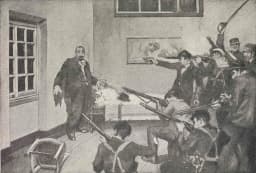 Long readNoite Sangrenta: the night a Portuguese prime minister was hunted down
Portugal's national football team plays its first official match, losing 3–1 to Spain in Madrid. The first win had to wait until June 1925, a 1–0 defeat of Italy.
Death in Lisbon of Anselmo Braamcamp Freire, a nobleman turned republican who was mayor of Lisbon from 1908 to 1913 and the first president of the Republic's Senate. A pioneer of rigorous genealogy, author of 'Brasões da Sala de Sintra' on the coats of arms in Sintra Palace's heraldic hall, he left his library and paintings to Santarém, where his house is now the municipal library.
Naval aviators Sacadura Cabral and Gago Coutinho take off from Lisbon in the Fairey III-D seaplane 'Lusitânia' on the first aerial crossing of the South Atlantic. Navigating with a sextant adapted by Coutinho for use in the air, they would reach Rio de Janeiro in June.
Naval aviators Sacadura Cabral and Gago Coutinho land in Guanabara Bay aboard the Fairey III-D seaplane 'Santa Cruz', completing the first aerial crossing of the South Atlantic. The 79-day journey from Lisbon, using a pioneering artificial horizon designed by Coutinho, is celebrated in both Portugal and Brazil as a feat of modern Portuguese exploration.
Vitória Sport Clube is formally founded in Guimarães, the 'cradle of Portugal', when a group of young football enthusiasts sets up its first board after one of their regular gatherings at the Chapelaria Macedo hat shop. Famed for some of the country's most passionate fans, the club won its first Taça de Portugal in 2013, beating Benfica 2–1 in the final.
Agustina Bessa-Luís, one of the towering figures of twentieth-century Portuguese fiction, is born at Vila Meã near Amarante. Her novel 'A Sibila' (1954) brought her national fame, and she received the Prémio Camões in 2004.
José Saramago is born into a family of landless peasants in Azinhaga, in the Ribatejo. The village clerk added the family nickname 'Saramago' (wild radish) to his name, and his parents registered the birth two days late, as the 18th, to avoid a fine. He went on to write 'Memorial do Convento' and 'Ensaio sobre a Cegueira'.
Poet Eugénio de Andrade, born José Fontinhas, comes into the world in Póvoa de Atalaia, near Fundão. His spare, sensual poems of light, water and the body made him one of the best-loved Portuguese poets of the 20th century, translated into many languages, and he won the Camões Prize in 2001.
Birth in Fundão of fado singer Celeste Rodrigues, younger sister of Amália. She made her debut in 1945 and kept performing into her nineties, a career of 73 years that ended only with her death in 2018.
Birth of Eduardo Lourenço in São Pedro de Rio Seco. He would become Portugal's most influential essayist and philosopher of the 20th century, whose 'O Labirinto da Saudade' reshaped Portuguese self-understanding.
Death of Abílio Manuel Guerra Junqueiro in Lisbon, aged 72. Poet, journalist and Republican militant, his violently anti-clerical and anti-monarchical verses had been instrumental in popularising the cause of the Republic in the years leading up to the 1910 revolution.
Mário Cesariny de Vasconcelos, poet and painter regarded as the leading figure of Portuguese surrealism, is born in Lisbon.
Birth in Fajã de Baixo, on São Miguel in the Azores, of Natália Correia, poet, playwright and firebrand of Portuguese letters. The Estado Novo gave her a suspended prison sentence over an anthology of erotic and satirical verse; after 1974 she sat in parliament, co-founded Lisbon's Botequim bar and wrote the words of the Azorean anthem.
Birth in Lisbon of the novelist Urbano Tavares Rodrigues, son of Alentejo landowners from Moura. An opponent of the Estado Novo, he was jailed in Caxias, spent years in exile teaching in French universities including the Sorbonne, and befriended Albert Camus in Paris, before returning after 1974 to become one of Portugal's most prolific writers and critics.
After 74 days and two aircraft, army aviators Brito Pais and Sarmento de Beires reach Macau on the last leg of the first flight from Portugal to Macau, begun on 7 April in Vila Nova de Milfontes. Caught in a violent storm, they overshoot the colony and crash-land in Hong Kong's New Territories, having flown some 16,760 km.
The poet António Ramos Rosa is born in Faro. Jailed for three months for his part in the anti-Salazar MUD movement, he co-founded the influential poetry magazine 'Árvore' in 1951 while earning his living as an office clerk and translator, and won the Prémio Pessoa in 1988.
Sacadura Cabral, who with Gago Coutinho had made the first flight across the South Atlantic in 1922, vanishes in fog after taking off from Amsterdam for Lisbon in a Fokker seaplane with his mechanic, José Correia. Wreckage was found days later, but neither man was ever seen again.
The poet Alexandre O'Neill is born in Lisbon. A founder of the Lisbon Surrealist Group in the late 1940s, he wrote sharp, ironic verse about Portuguese life and, as an advertising copywriter, coined one of the country's best-known slogans: 'Há mar e mar, há ir e voltar' ('There's sea and sea, there's going and coming back').
Carlos Paredes is born in Coimbra. A virtuoso of the Portuguese guitarra, he freed the instrument from its role accompanying fado, and his instrumental pieces — above all 'Verdes Anos', written for Paulo Rocha's 1963 film — became part of the country's musical identity.
José Cardoso Pires, author of 'O Delfim' and 'Balada da Praia dos Cães', is born at São João do Peso in Vila de Rei; his sharp, ironic novels made him one of the leading Portuguese writers of the second half of the twentieth century.
Back to the full timeline of Portugal, with key moments, search and long reads.