

The morning Portugal became a republic: 5 October 1910
A day earlier the revolt looked lost. Then a white flag was misread, the city poured into the streets, and from a balcony over the Praça do Município Portugal stopped being a kingdom.
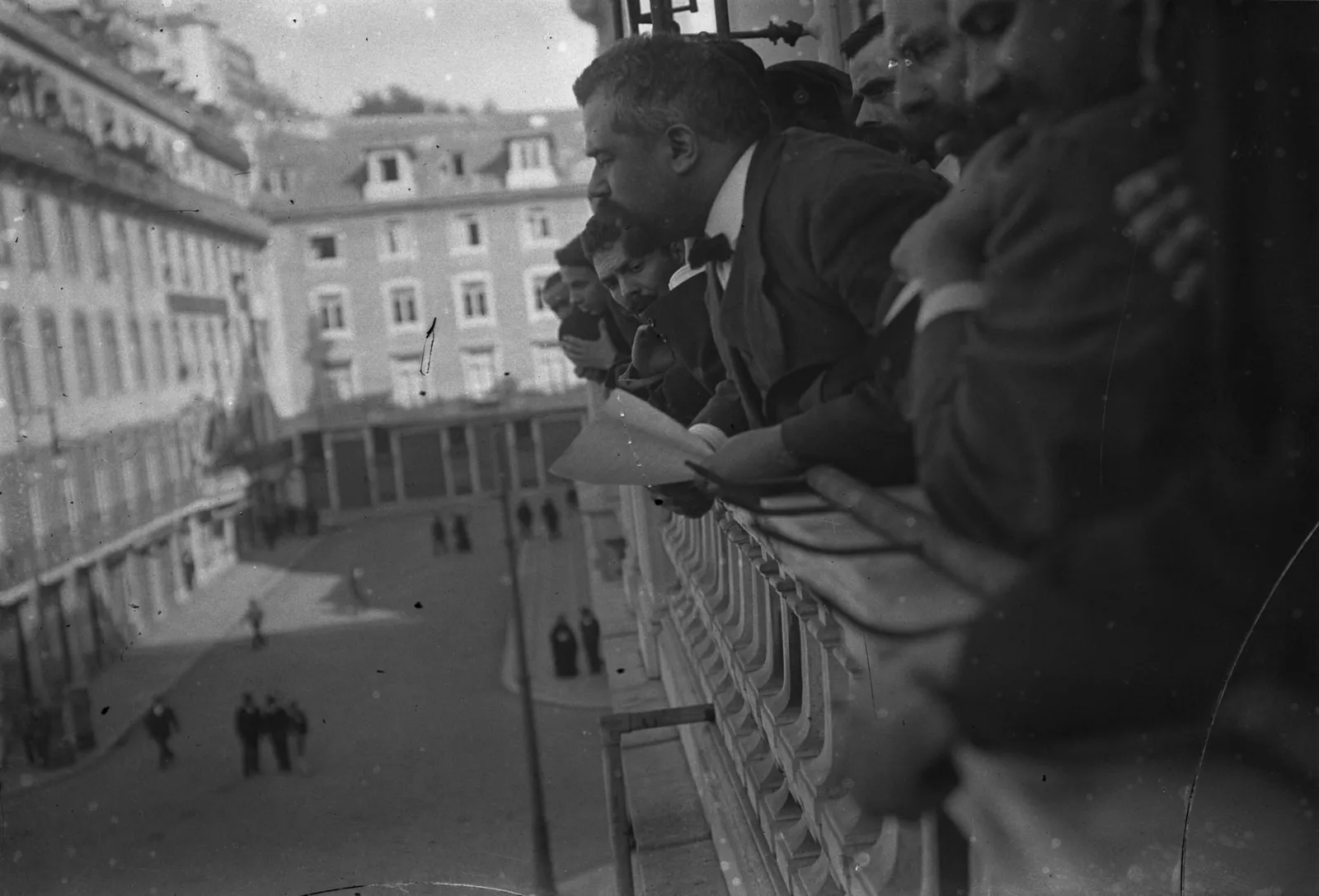
At a glance
- On the morning of 5 October 1910 José Relvas, a leader of the Portuguese Republican Party, proclaimed the Republic from the balcony of Lisbon City Hall, ending the monarchy.
- The uprising began in the early hours of 4 October. Most officers gave it up for lost, but António Machado Santos held the Rotunda, at the top of the Avenida da Liberdade, while rebel cruisers on the Tagus shelled the royal palace.
- King Manuel II fled to Mafra and on 5 October sailed from Ericeira on the royal yacht Amélia. He never returned to rule.
- Historians' counts of the dead run from 65 to about 150, with between 308 and 728 wounded, most of them civilians.
- 5 October is a public holiday. A labour law of 2012 dropped it from 2013 to 2015, and it was restored in 2016.
A balcony over the Praça do Município
By half past eight on the morning of Wednesday 5 October 1910 the shooting in Lisbon had stopped. Soldiers who had fought for the king were firing their rifles into the air, and crowds waving white flags were embracing the men they had been shooting at a few hours before.
At the Paços do Concelho, Lisbon's City Hall, José Relvas stepped onto the balcony with Eusébio Leão and other leaders of the Portuguese Republican Party. Relvas, a Ribatejo landowner, proclaimed the Republic to the square below, and the names of a provisional government were read out. The telegraph carried the news to the rest of the country.
The monarchy had lasted since the beginnings of Portugal in the twelfth century. Only a day earlier, the revolt that ended it had looked like a disaster. Its chief was dead, most of its officers had left their positions, and its political leaders were in hiding.
Twenty years of a monarchy losing its footing
The trouble began in January 1890. On the 11th, Britain sent Portugal an ultimatum to give up its claim, drawn on the “rose-coloured map”, to the land between Angola and Mozambique. The new king, Carlos I, gave way. Public anger fell on the crown, and at the election that March the Republican Party won three seats in Lisbon.
A patriotic march written that year, A Portuguesa, with music by Alfredo Keil and words by Henrique Lopes de Mendonça, was printed in more than 22,000 free copies. When republicans in Porto rose on 31 January 1891, they marched to it. The rising failed.
Money made things worse. The state went into partial bankruptcy in 1891 and 1892. Politics, meanwhile, ran on rotativismo: the Regenerador and Progressista parties took turns in office by agreement, and local bosses delivered the votes. Carlos I appointed and dismissed governments and created batches of peers to give them majorities.
“We have absolute rule in essence, but masked by the costly and corrosive formalism of the parliamentary system, which serves to deceive the unwary.”
From 1901 the old parties split. João Franco left the Regeneradores to found his own party, and in 1907 and 1908 he ruled as a dictator. On 1 February 1908, in the Terreiro do Paço, gunmen shot dead Carlos I and his heir, Luís Filipe. The king's younger son was acclaimed as Manuel II in May. He reigned for two years.
The republicans grew with each crisis, above all in Lisbon. They won 7 seats in April 1908, two months after the regicide, and 14 at the last election of the monarchy, on 28 August 1910, 11 of them in Lisbon. With a narrow franchise and rigged elections, that was as far as the ballot could take them.
Republican deputies elected at each general election, 1878 to 1910
deputies
Table 1 in Tiago Reis (2021), after Maria Cândida Proença's biography of Manuel II. The table gives only a dash for the elections of 1895, 1897, 1900, 1901, 1904 and 1905, so they are left out here. Highlighted: the elections after the British Ultimatum, after the regicide, and the last before the revolution.
Show the data
| Republican deputies elected | |
|---|---|
| 1878 | 1 |
| 1879 | 1 |
| 1881 | 1 |
| 1884 | 2 |
| 1887 | 2 |
| 1889 | 2 |
| 1890 | 4 |
| 1892 | 3 |
| 1894 | 2 |
| 1899 | 3 |
| Apr 1906 | 1 |
| Aug 1906 | 4 |
| 1908 | 7 |
| 1910 | 14 |
So the party prepared a revolution. Its congress of 1909 set up a directorate, a civil committee and a military committee under a retired admiral, Cândido dos Reis. In the navy a conspiracy network recruited sailors, sergeants and junior officers. On the streets the party relied on the Carbonária, a secret society that the historian João Freire calls probably the most decisive instrument of the rising.
3 and 4 October: a revolt that nearly failed
The plot began badly. Around midday on 3 October Miguel Bombarda, a psychiatrist and one of the republican leaders, was shot in his hospital office by a former patient; he died that evening. That evening, while a banquet for the visiting Brazilian marshal Hermes da Fonseca was held at the Belém palace, some fifty conspirators crammed into a flat at 106 Rua da Esperança. They agreed that the warships on the Tagus would fire a 31-shot salvo at one in the morning as the signal.
At about a quarter to one, by the navy's account, Lieutenant Mendes Cabeçadas seized the cruiser Adamastor and fired three shots. The leaders waiting at the São Paulo baths heard only three cannon shots, at about twenty past one by their reckoning.
On the São Rafael the sailors rose without a single officer of their own, led by a gunner, José de Carvalho, and held the ship's officers prisoner. The naval barracks at Alcântara rose too. On land, Machado Santos led civilians to the Infantry 16 barracks at Campo de Ourique, and that regiment and Artillery 1 came out.
Little else went to plan. According to the historian Ricardo Raimundo, most members of the Carbonária had no weapons and stayed away; only about 200 turned out, and the officers and sergeants in the plot succeeded in only two of the city's three regiments. The column marching on the Necessidades Palace ran into the Municipal Guard and turned instead to the Rotunda, the circle at the top of the Avenida da Liberdade.
Believing the revolt had failed, Cândido dos Reis left his sister's house soon after five in the morning. He was found dead at about six in the morning in the Travessa das Freiras, in Arroios. It was called suicide at the time, and doubts remain. As the morning wore on, most of the officers at the Rotunda left, among them Captain Afonso Palla, who had placed the guns.
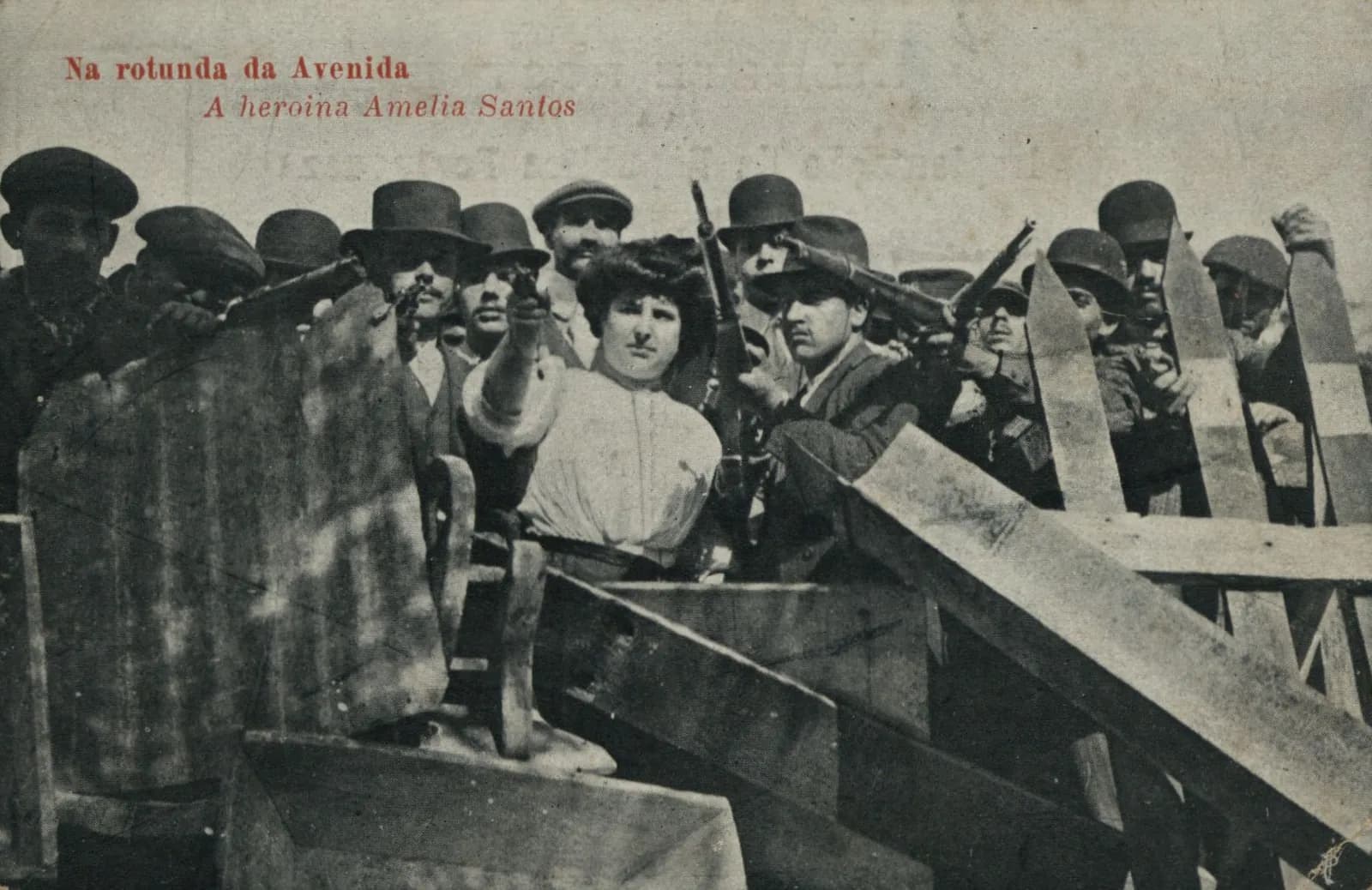
One stayed. Machado Santos, a second-class naval commissary (an administrative officer) and a leader of the Carbonária, asked the sergeants of Artillery 1 whether they would accept his command. They said they would fight to the end. By midday some 400 men were dug in behind barricades he himself called “platonic”.
“I am determined not to abandon this position, whatever it costs!”
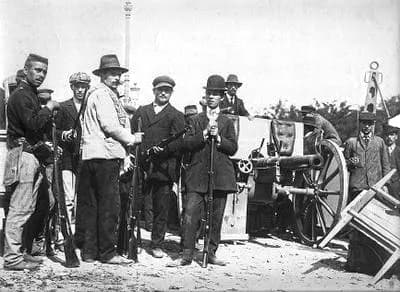
In the cafés of the Chiado that morning, the talk was that the revolution had failed. Yet according to Raimundo, the command of the Lisbon military division never seriously attacked, because its officers had no wish to defend a government that did not represent them. The exception was Paiva Couceiro, whose horse battery from Queluz shelled the rebels from near the Penitentiary that afternoon, until headquarters ordered it to stop.
Shells on the Necessidades
The navy turned it. Around midday on 4 October, messengers reached the rebel sailors at Alcântara with news that the Rotunda was holding. Their officers ordered the cruisers to bombard the Necessidades Palace, where Manuel II was living and where the troops defending it were massed.
According to the navy's own history, the ships fired more than forty shells at the palace. They hit the cornice of its chapel and the king's bedroom. The servants fled, and those who stayed persuaded Manuel to leave. He crossed the Tapada, the palace grounds, to a car called from a private garage and was driven to the palace-convent at Mafra.
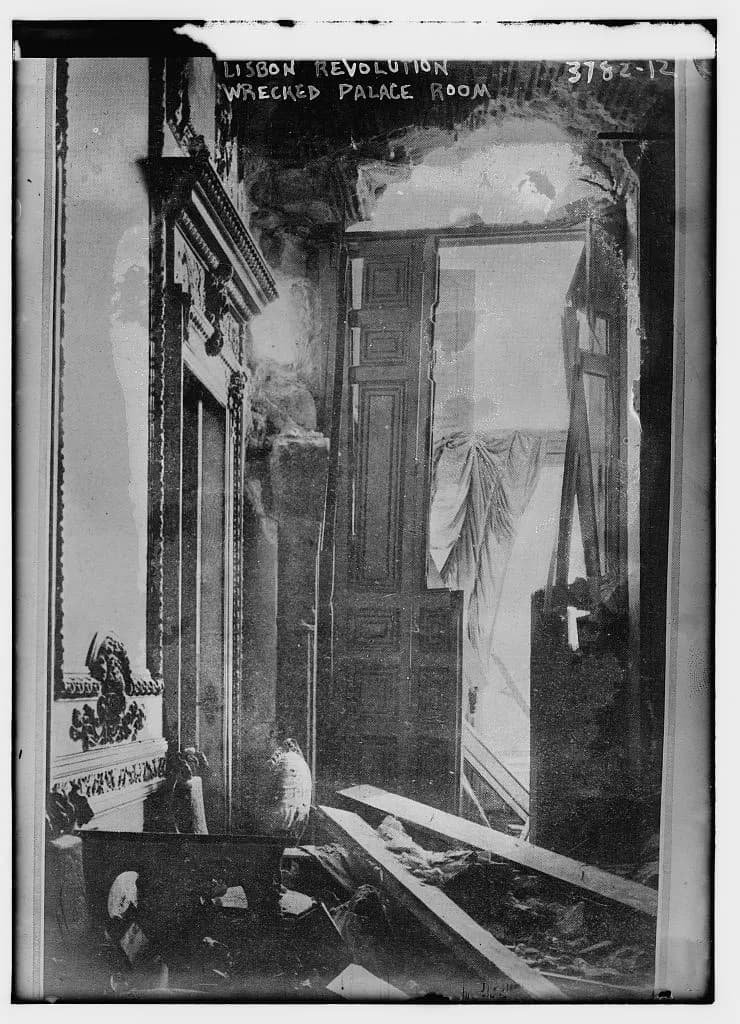
With the king gone, the defence fell into disorder. The cruiser D. Carlos was still flying the blue and white flag of the monarchy. At about half past seven that evening, Abreu writes, a boarding party under Lieutenant Carlos da Maia, who had come from the Alcântara barracks, took it after a gunfight with its officers. The navy's history says the ship went over under Second Lieutenant Silva Araújo. Abreu names him as the one officer on board who was in on the plot, and the only one allowed to stay.
Hour by hour, 3 to 5 October
3 Oct, afternoon
Miguel Bombarda is shot by a patient at his hospital
3 Oct, 8 to 10.30 pm
Last meeting of the conspirators at 106 Rua da Esperança
4 Oct, c. 00.45 to 1.20 am
Three shots from the Tagus signal the rising; accounts differ on the time
4 Oct, small hours
Sailors seize the São Rafael; the Alcântara barracks rise; Infantry 16 and Artillery 1 march
4 Oct, 4 am
Municipal Guard cavalry charge the Rotunda and are driven back
4 Oct, c. 6 am
Cândido dos Reis is found dead in Arroios
4 Oct, morning
Most officers leave the Rotunda; Machado Santos takes command
4 Oct, midday
About 400 men hold the Rotunda
4 Oct, afternoon
Cruisers shell the Necessidades; the king leaves for Mafra
4 Oct, c. 7.30 pm
A boarding party under Carlos da Maia takes the cruiser D. Carlos
5 Oct, before 7 am
The German chargé d'affaires asks for a truce; a white flag sets off celebrations
5 Oct, 8.45 to 9.45 am
One-hour armistice agreed at the Rotunda
5 Oct, 9 to 11 am
José Relvas proclaims the Republic at City Hall; sources give either hour
5 Oct, afternoon
Manuel II sails from Ericeira on the royal yacht Amélia
- Proclaimed
- 5 October 1910, morning, from the balcony of the Paços do Concelho, Lisbon
- Proclaimed by
- José Relvas, with Eusébio Leão, both leaders of the Republican Party
- Fighting
- From about 1 am on 4 October to the morning of 5 October, almost all in Lisbon
- Rebel strongpoints
- The Rotunda, the naval barracks at Alcântara and the cruisers on the Tagus
- Head of the new government
- Teófilo Braga, a veteran positivist and republican
- Last king
- Manuel II, who went into exile in England
A white flag, misread
The end came by accident. Shortly before seven on 5 October, the German chargé d'affaires asked General Manuel Rafael Gorjão, commander of the Lisbon military division, for a one-hour truce so that foreigners could reach their ships. Gorjão agreed and sent the diplomat to the Rotunda with a cavalry orderly carrying a white flag.
The crowds took the flag for a surrender. Soldiers left their ranks and mixed with people waving white flags. At a hurried council Paiva Couceiro told Gorjão he no longer had any soldiers, said he was going north, and left with his battery for Queluz. At the Rotunda Machado Santos refused a truce, then granted one from 8.45 to 9.45 on his own terms, and marched down to Rossio at the head of armed civilians to take over the headquarters.
Then came the balcony. Jorge d'Abreu, writing in 1912, and the historian Vítor Neto put the proclamation at about nine; the navy's history and Fernando Rosas put it at about eleven. Either way it was Relvas who spoke, and the veteran positivist Teófilo Braga who would lead the government.
The rest of Portugal learned of it by wire. Fernando Rosas calls the Republic a “profoundly urban” creation of Lisbon, and the journalist João Chagas had predicted as much in a conversation the writer Raul Brandão recorded.
“What do I care about the provinces! What do I care even about Porto! We'll make the Republic afterwards, by telegraph.”
Telephones were few, and the telegraph was slow to reach some places. Lamego, in the north, took seven days to learn that Manuel II no longer reigned. In Timor, the monarchy lasted in people's minds until the end of October.
Two fishing boats at Ericeira
The king spent the night of 4 October in the convent at Mafra. On the morning of the 5th his mother, Queen Amélia, and his grandmother, Queen Maria Pia, drove over from Sintra. After lunch, breathless messengers arrived from Cascais with the news that the Republic had won, and another with word that the royal yacht Amélia was waiting off Ericeira.
The sea was rough. A courtier, Serrão Franco, promised a large reward, and the crews of two fishing boats agreed to row the family out: the two queens in one, the king in the other. Amélia's luggage was a tin trunk of linen; Manuel's, a box with half a dozen handkerchiefs. Before he left, he gave a letter for the prime minister saying that he was not abdicating, only withdrawing for a time.
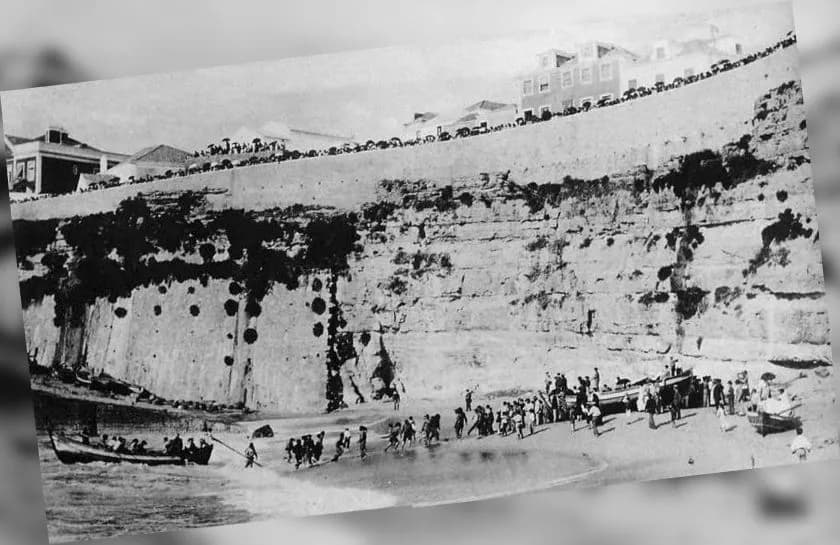
The yacht sailed round the Berlengas islands and on to Gibraltar. Abreu puts the departure at four in the afternoon; the photograph of the embarkation is dated at three. Manuel II went into exile in England, and Portugal's last king never ruled again.
How many died
Nobody kept a single official count, and the estimates differ by more than double. Most of the victims were civilians. There was fighting along the Avenida da Liberdade, all around the Necessidades and in Pedrouços, as well as on the ships. The naval hospital alone treated about 50 wounded sailors, soldiers, police and civilians.
| Source | Dead | Wounded | Note |
|---|---|---|---|
| Douglas L. Wheeler (1978), cited by João Freire | 65 | 728 | Freire: “mostly ordinary people” |
| Vasco Pulido Valente, O Poder e o Povo, cited by João Freire | 72 | 308 | Leaves out murders and accidents |
| Maria Carrilho (1985), cited by João Freire | 76 | 347 | Wounded “many of them serious” |
| Jorge d'Abreu (1912) | About 100 | Not given | “A hundred sacrificed” |
| Fernando Rosas (2025) | 100-odd, 150 at most | “Many” | Interview with Diário de Notícias |
Wheeler's História Política de Portugal de 1910 a 1926 gives the first figures. Pulido Valente leaves out the victims of murders and accidents, which accounts for part of the gap. The 2025 estimate is from an interview, not a new count.
Cândido dos Reis, who planned the rising, did not live to see it succeed. A long avenue in Lisbon, the Avenida Almirante Reis, now carries his name.
A new flag, a new anthem, a new currency
The provisional government was not the one the conspirators had planned. Bombarda and Cândido dos Reis were dead, so Teófilo Braga became its president. Afonso Costa, who had played no major part in the revolution, took Justice and Worship; António José de Almeida took the Interior, Bernardino Machado Foreign Affairs and Relvas Finance. The Carbonária was left out, and so was Machado Santos.
It governed by decree, and fast. Its first act, on 8 October, expelled the Jesuits. Decrees of 12 October replaced the religious holidays with civic ones celebrating the new regime. By Christmas, marriage had become a purely civil contract, and divorce was legal.
| Date | Measure | What it did |
|---|---|---|
| 8 October 1910 | Expulsion of the Jesuits | The Provisional Government's first decree |
| 12 October 1910 | Civic holidays | Secularised the public holidays and created the regime's own commemorations |
| 3 November and 25 December 1910 | Divorce and family laws | Allowed divorce; made civil marriage the only valid kind |
| 29 November 1910 | Green and red flag | Design approved by the government; confirmed by the Constituent Assembly on 19 June 1911 |
| 20 April 1911 | Law of Separation | Separated church and state |
| 22 May 1911 | The escudo | Replaced the real as the national currency |
| 19 June 1911 | A Portuguesa | Adopted as the national anthem by the Constituent Assembly |
| 21 August 1911 | Constitution | Parliamentary republic with a president elected by Congress |
The new flag came from a commission named on 15 October that included the painter Columbano Bordalo Pinheiro, the writer Abel Botelho and João Chagas. Its green and red replaced the blue and white of the Braganças, and the argument it caused was, as the Diário de Notícias put it later, almost as heated as the choice of a site for Lisbon's new airport.
The anthem was the march of 1890. A Portuguesa, written in anger at the British Ultimatum and sung by the Porto rebels of 1891, became the national anthem on 19 June 1911, the day the Constituent Assembly first met.
Relvas, at Finance, investigated the illegal advances the monarchy had paid to the royal household and on 22 May 1911 replaced the real with the escudo. The Constitution, approved on 21 August 1911, abolished titles of nobility and made education secular. It did not give the vote to women or to people who could not read, in a country where about 68 per cent of people were illiterate.
Sixteen years of the First Republic
Former monarchists rushed to join the winners, and people called them “adesivos”, the sticky ones. The writer Ramalho Ortigão joked that when the fighters of the Rotunda counted their losses on the morning of 5 October, they found that of the five hundred who had started the revolt, only five thousand were left.
The regime never settled. Between 1910 and 1926 Portugal had 8 presidents and 45 governments and faced 10 armed conspiracies. Rosas argues that it had no social policy and lost the workers who had helped make the revolution, and that entering the First World War, for which the country was not prepared, did it great damage.
Some of the men of October 1910 died by violence. On the night of 19 to 20 October 1921, the Noite Sangrenta, armed men killed the prime minister António Granjo and two heroes of the revolution, Machado Santos and Carlos da Maia. A military coup on 28 May 1926 dissolved parliament; the military dictatorship that followed led to the Estado Novo.
5 October today
5 October, the Implantação da República, is one of the compulsory public holidays in Portugal's Labour Code. For three years it was not. A labour law of June 2012 cut four holidays from 1 January 2013: Corpus Christi, 5 October, 1 November and 1 December.
The same law said the cut must be reviewed within five years. It took less. Lei n.º 8/2016, published on 1 April 2016, restored all four, and 5 October was a holiday again that autumn.
FAQs
Why is 5 October a holiday in Portugal?
It marks the proclamation of the Republic in Lisbon on 5 October 1910, which ended the monarchy. A labour law of 2012 dropped the holiday from 2013 to 2015, and Lei n.º 8/2016 restored it.
Who proclaimed the Portuguese Republic?
José Relvas, a leader of the Portuguese Republican Party, proclaimed it from the balcony of Lisbon City Hall on the morning of 5 October 1910, with Eusébio Leão beside him. Teófilo Braga became president of the provisional government.
How many people died in the revolution of 1910?
There is no single official figure. Historians' estimates run from 65 dead and 728 wounded (Douglas Wheeler), through 72 dead (Vasco Pulido Valente) and 76 (Maria Carrilho), to about 100 to 150 dead (Fernando Rosas). Most victims were civilians in Lisbon.
What happened to King Manuel II?
After the cruisers shelled the Necessidades Palace on 4 October, he went to Mafra. On 5 October he was rowed out from the beach at Ericeira to the royal yacht Amélia, sailed for Gibraltar and settled in exile in England. He left a letter saying he was not abdicating.
Where was the fighting in Lisbon?
Mainly at the Rotunda, now the Praça do Marquês de Pombal, along the Avenida da Liberdade, around the Necessidades Palace and the naval barracks at Alcântara, in Pedrouços, and on the Tagus, where rebel sailors took the cruisers.
On the timeline
Open the timelineNearby moments from the first republic (1910–1926).
The Republic proclaimed, 1910
Three days after the proclamation of the Republic, the Justice Minister Afonso Costa revives Pombal's laws expelling the Jesuits and the 1834 law abolishing the religious orders. All Jesuits, whatever their nationality, are ordered out of the country, their property passes to the state, and the goods of other religious houses are inventoried and sealed.
The provisional government decrees a new press law, replacing João Franco's repressive press laws of 1907 and restoring freedom of the press, though restrictive legislation would return within a few years.
Less than a month after the proclamation of the Republic, a decree of the Provisional Government legalises divorce in Portugal, including by mutual consent — one of the first secularising reforms driven by the Minister of Justice, Afonso Costa.
Coming up in history
All long reads 7 October 2018Odette Ferreira, HIV-2 and the blood sample carried in a coat
 8 October 1998José Saramago wins the Nobel Prize in Literature: 8 October 1998
 9 October 1261King Dinis, born in Lisbon on 9 October 1261: the poet who ruled 46 years
 10 October 1507Albuquerque at Hormuz: the treaty of 10 October 1507
17 sources
Archives, scholarship and reporting this article was checked against.
- 1
A Revolução Portugueza: O 5 de Outubro (Lisboa 1910), by Jorge d'AbreuLisbon, 1912 (Project Gutenberg edition)
- 2
José Relvas: um político republicano, by Vítor NetoRevista de História das Ideias, vol. 34 (2016), Universidade de Coimbra
- 3
A Marinha e a República, by João FreireLer História, 59 (2010)
- 4
Efeméride: Implantação da República, 5 de outubro de 1910Marinha Portuguesa, Cultura Marinha
- 55 de Outubro. A “aliança da carbonária com o republicanismo radical” que derrubou a monarquia, by Rui Miguel GodinhoDiário de Notícias, 5 October 2025
- 6
Eleições legislativas no Porto (1895 e agosto de 1906), by Tiago ReisOmni Tempore: Atas dos Encontros da Primavera 2020, Faculdade de Letras da Universidade do Porto (2021)
- 7
A 1.ª República (1910-1926)Assembleia da República
- 8
Lei n.º 8/2016, de 1 de abril (restoring national holidays)Procuradoria-Geral Distrital de Lisboa, legislation database
- 9Peripécias do fundador de PortugalDiário de Notícias
- 10
Guardar memórias, abrir caminhosArquivo Nacional Torre do Tombo
- 11“A República só triunfou devido à desorganização, desmoralização e falta de comprometimento dos monárquicos”, by Leonídio Paulo FerreiraDiário de Notícias, 4 October 2025
- 12República: “Adesivos”, “thalassas” e heróis esquecidosDiário de Notícias (archive section), 4 October 2023
- 13
- 14
O relato dos enfermeiros do Hospital de Marinha: fonte inédita para o estudo da adesão e ação dos militares da Armada na revolução republicana de 5 de Outubro de 1910, by Diogo Campos RodriguesRevista Militar, no. 2608 (May 2019)
- 15
Para lá do anticlericalismo: a separação das igrejas do Estado como embate cultural (Sérgio Ribeiro Pinto)Centro de Estudos de História Religiosa, Universidade Católica Portuguesa
- 16
- 17
Image credits
- Inocêncio Camacho reads the names of the Provisional Government from the balcony of Lisbon City Hall after the proclamation of the Republic, 5 October 1910. Photograph by Joshua Benoliel. Joshua Benoliel, Public domain, via Wikimedia Commons.
- Insurgents with a field gun at the Rotunda in October 1910. Photograph by Joshua Benoliel. Joshua Benoliel, Public domain, via Wikimedia Commons.
- “At the Rotunda of the Avenida, the heroine Amélia Santos”: a postcard of the rebels behind their barricade, October 1910. Amélia, a shop assistant, stayed at the Rotunda until the end. Unknown author, Public domain, via Wikimedia Commons.
- A wrecked room in the Necessidades Palace after the bombardment of October 1910, in a print from the American Bain News Service. Bain, Public domain, via Wikimedia Commons.
- The royal party embarks from the beach at Ericeira for the yacht Amélia on the afternoon of 5 October 1910, watched from the clifftop. Photograph by J. M. da Silva. J. M. da Silva, Public domain, via Wikimedia Commons.