

Albuquerque at Hormuz: the treaty of 10 October 1507
With a handful of ships and a few hundred men, Afonso de Albuquerque forced the island city that guarded the Persian Gulf to accept the King of Portugal as its lord. His own captains undid the deal within months, and it took him eight more years to make it stick.
At a glance
- On 10 October 1507 the young king of Hormuz, an island trading city at the mouth of the Persian Gulf, accepted the King of Portugal as his overlord after Afonso de Albuquerque's small fleet destroyed the ships in his harbour.
- The terms recorded in Albuquerque's Commentaries were a yearly tribute of 15,000 xerafins, 5,000 more at once towards the fleet's costs, duty-free entry for goods from Portugal and, soon after, a site for a Portuguese fort.
- Albuquerque's captains refused to back the fort, three of them sailed off to India, and he had to leave Hormuz in early 1508 with the work unfinished.
- He came back as governor in 1515 with a much larger fleet, took over the fortress site without a battle and built the fort of Nossa Senhora da Conceição, but died off Goa that December.
- Portugal held Hormuz until 1622, when a Persian army helped by English East India Company ships forced the garrison to surrender. The fort's ruins still stand on Hormuz Island, in Iran.
A flag for the palace
Early on the morning of 10 October 1507, the captains of a small Portuguese fleet rowed across the harbour of Hormuz in boats hung with flags and carpets, firing guns from the bows. On the beach the city's governors were waiting with saddled horses. Jorge Barreto de Castro, a nobleman of the fleet, rode at the front holding a new flag of white satin with the cross of the Order of Christ. Correia described it differently, as white and crimson damask with the royal arms.
The procession went up the main street to the palace, with the townspeople ahead of it shouting “Portugal, Portugal!” The young king met it on foot, took the flag and had it raised on the highest tower of his palace. When the sailors in the harbour saw it go up, every ship fired a salute.
The flag was the visible part of a treaty. Two weeks or so earlier, Afonso de Albuquerque had sailed into Hormuz with six or seven battered ships and about 450 men, more than a hundred of them sick. Now the richest port in the Gulf had declared itself a vassal of Manuel I of Portugal and promised to pay him tribute every year.
The jewel in the ring
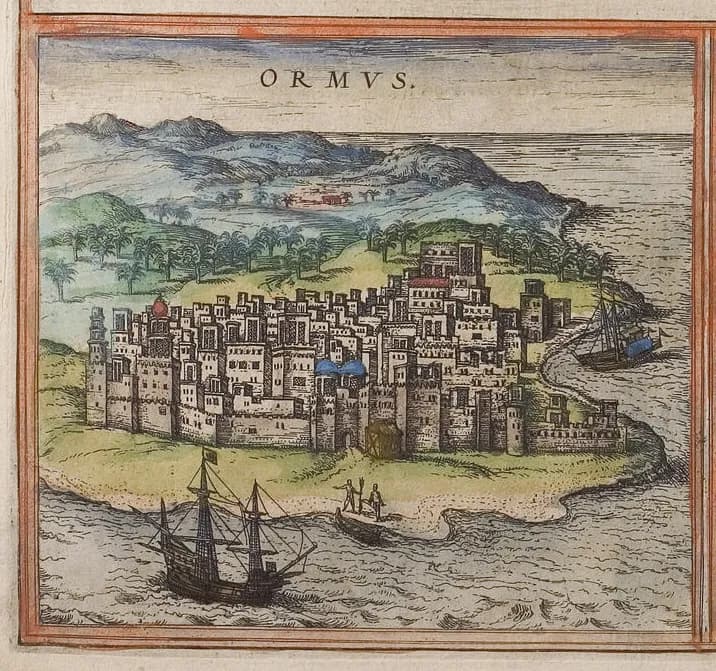
Hormuz did not look like a prize. The city had stood on the Persian mainland until the end of the thirteenth century, when it moved to the island of Jarun near the mouth of the Gulf, apparently to escape raids. The island was rock and salt. Apart from rain caught in cisterns, drinking water came by boat from the mainland and was sold at doorways in clay cups and jars, “as on the riverside of Lisbon”, wrote Gaspar Correia, who served in India and saw the city himself.
Its wealth came from its position. Correia explained that big ships could not reach the shallow ports along the Gulf, so cargoes from India were unloaded at Hormuz and carried on in small boats, many of them to Basra. Goods came from Central Asia, northern Persia, Baghdad, Cairo and all of India. Hormuz shipped costly horses to India, and Correia described a street of pearl sellers whose stock on red cloths was worth more than 100,000 cruzados. He put the king's customs revenue at more than 500,000 xerafins a year.
“The Moors hold Ormuz to be such an important place that they say, “The world is a ring, and the jewel in it is Ormuz”.”
The saying has several versions. Correia gave it as India being the ring and Hormuz the stone. The British historian Percy Sykes called it a Persian proverb: “If the world were a ring, Hormuz would be the jewel of that ring.”
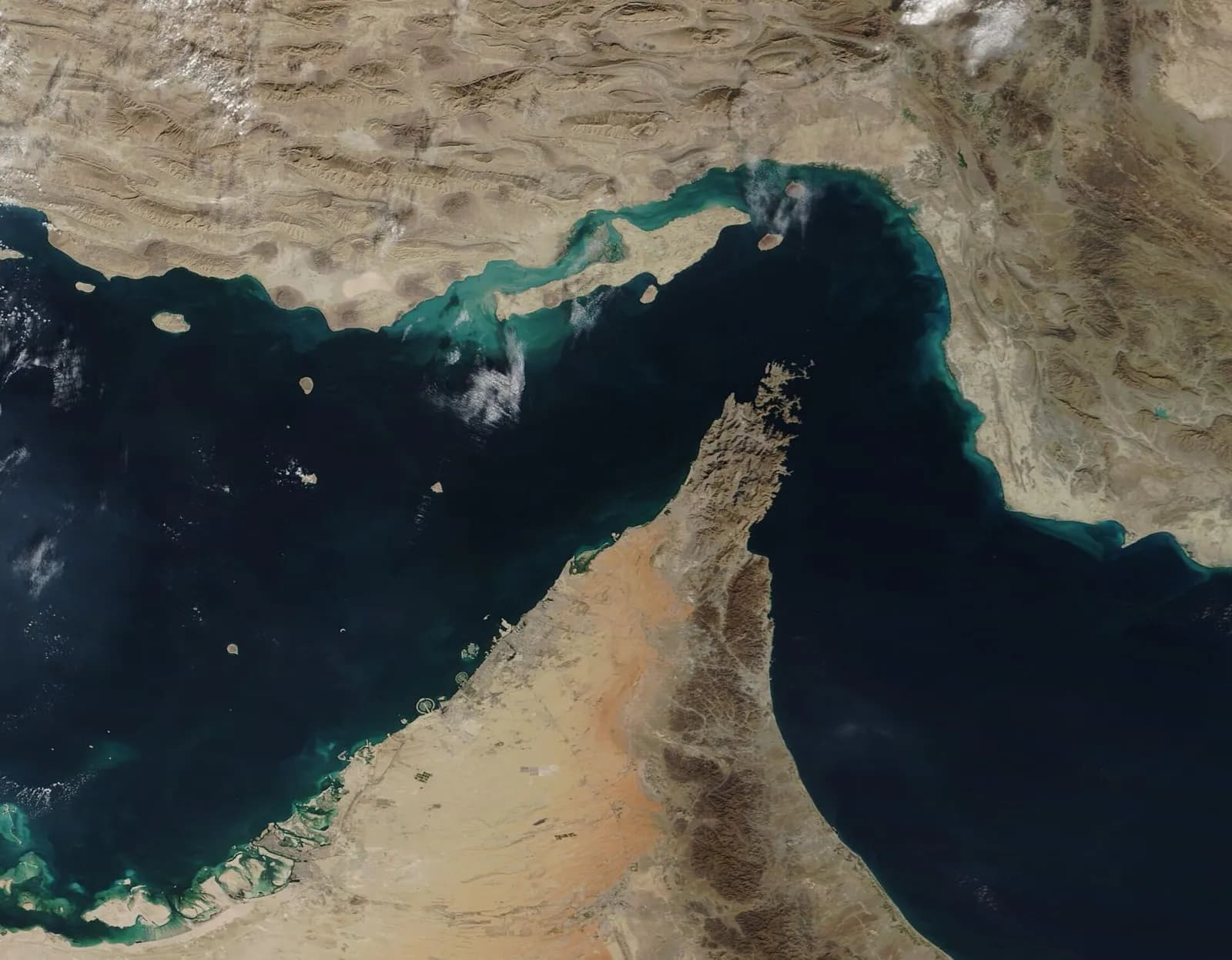
In 1507 Hormuz was ruled by a boy king, Seyf ad-Din, whom the Portuguese called Ceifadim or Çafardim. Real power lay with his ministers, above all Khwaja Ata, the Cogeatar of the chronicles. By his own account, Khwaja Ata had put the boy on the throne after the royal guard murdered his predecessor. The kingdom held towns on the Arabian coast, including Muscat, and paid tribute to Persia, where Shah Ismail I had recently founded the Safavid dynasty and made Shia Islam the state religion.
A plan built on straits
Portugal had reached India by sea in 1498, and in 1505 Manuel I sent Francisco de Almeida out as his first viceroy. Albuquerque followed in 1506 with Tristão da Cunha's fleet, in command of six ships and 400 men on the Arabian coast. He also carried secret orders to take over from Almeida as governor after three years.
The two men wanted different things from what the Portuguese later called the Estado da Índia, their chain of forts, trading posts and fleets in the East. Almeida is said to have opposed settling in India or building more fortresses; his aim was to win the sea-borne trade for Portugal with ships. Whiteway notes that his views survive only second-hand. Albuquerque wanted a lasting Portuguese dominion, based on force, held by fortresses at the points where trade had to pass and by Portuguese settlers.
“If the King of Portugal had made himself master of Adem, with a good fortress, such as those of Ormuz and Malaca, and so held the sway over these three Straits which I have specified, he might well have been called the lord of all the world … for with these three keys in his hands he might shut the doors against all comers.”
Hormuz was the key to the Gulf. In Albuquerque's own reckoning, quoted by Whiteway, once Aden closed the Red Sea all the trade going north would have to pass through Hormuz, where the Portuguese were supreme.
| Place | What it guarded | What the Portuguese did | What became of it |
|---|---|---|---|
| Socotra | The sea route from the Red Sea to India | Took the Arab fort, April 1507 | Abandoned in 1511; Aden, not Socotra, proved to be the gate of the Red Sea |
| Hormuz | The mouth of the Persian Gulf | Made the king a vassal, 10 October 1507; fort begun and abandoned; fortress taken over 31 March or 1 April 1515 | Lost to a Persian and English force in 1622 |
| Goa | The west coast of India | Stormed on 25 November 1510, St Catherine's Day | Albuquerque's chosen base for Portuguese settlers; he was buried there in 1515 |
| Malacca | The Straits of Singapore, between the Indian Ocean and the China seas | Taken in August 1511 after nine days of street fighting | Surrendered to the Dutch on 14 January 1641 |
| Aden | The mouth of the Red Sea | Assault failed on 26 March 1513; a second visit in July achieved nothing | Never taken; in 1517 Governor Lopo Soares refused its keys when they were offered |
The “three keys” of the Commentaries were Malacca, Aden and Hormuz. Whiteway lists Albuquerque's planned fortresses as Aden, Diu, Ormuz and Goa.
The battle in the harbour
Albuquerque left Socotra in August 1507, on the 20th according to Whiteway, who counts seven ships and 450 fighting men, 120 of them sick. He worked his way up the Arabian coast, which belonged to Hormuz, and sacked and burned Qurayyat, Muscat and Khor Fakkan. Prisoners were released only after the women's noses and ears, and the men's noses and right hands, had been cut off, to spread fear ahead of him. Sohar and Qalhat, which chose peace, were spared, according to the Commentaries.
The fleet rounded the point of Hormuz Island at sunrise and anchored at sundown, on 26 September according to the Portuguese historian José Manuel Garcia. The harbour was full. The Commentaries describe 60 large ships, including the Meri of the King of Cambay, of about 1,000 tons, and some 200 oared galleys, with 15,000 to 20,000 armed men on the beach. Whiteway gives some 400 vessels and 30,000 men, 4,000 of them Persian archers.
Albuquerque's captains came alongside his ship and begged him to be careful: this was not one of the small towns they had destroyed. He told them it was too late for advice. When the king sent an Armenian who knew Portuguese, Khwaja Bairam, to ask what he wanted, he answered with an ultimatum.
“If the king be willing to become his vassal and pay him tribute, I will make peace with him and serve him in everything he shall command me against his enemies; but if he be unwilling, let him know that I will surely destroy all this fleet wherein he placeth his trust, and take his city by force of arms.”
Khwaja Ata played for time while he waited for troops from the mainland. After three days of messages, Albuquerque opened fire at dawn. The first two shots sank two big ships with their crews. His men boarded the Meri and killed all 60 men left on board, then went after the galleys in their boats.
Men who jumped into the sea were hunted down in the water; the Commentaries credit one cabin boy with killing 80. Khwaja Ata's own boat was chased ashore, and Albuquerque was wounded attacking a jetty. The fighting lasted from seven in the morning until three in the afternoon.
Neither the Commentaries nor Correia gives the day of the battle. For eight days afterwards, the Commentaries say, sailors fished bodies out of the harbour to strip them of money and jewels. About 80 had died of arrow wounds alone, though no Portuguese carried a bow; the chronicler called it a miracle, but the only archers in the battle were on the Hormuz side.
As the tide carried the dead ashore, families came down to the beach to find their sons and husbands and bury them. Their weeping, the chronicler admitted, was painful to hear from the ships.
Terms of submission
The king sued for peace and sent word that he looked up to Albuquerque as to a father. Albuquerque asked for 30,000 xerafins a year, plus the costs of his fleet. The xerafim was the Portuguese name for the ashrafi of Hormuz, a coin worth 300 Portuguese reais. The king pleaded that his kingdom was ruined and offered 6,000 a year and 5,000 towards expenses. The captains wanted to take it and go.
Albuquerque overruled them and named his own figure. According to the Commentaries, the deal was 15,000 xerafins every year to Manuel I and his successors, and 5,000 in cash at once. Goods coming from Portugal to the royal trading post would pay no duty, and goods the Portuguese bought in Hormuz would pay no more than the local merchants did. The kings of Portugal kept the right to raise the tribute later.
Correia's version agrees on the yearly 15,000 but not on the cash. In his account the king paid 100,000 xerafins towards the cost of the fleet before the flag was raised, and the owners of the captured ships paid another 100,000 to buy them back. The king of Portugal's merchandise was free of all duties, and other Portuguese goods paid nothing coming in but paid duty going out. He has Albuquerque reckon that the tribute would keep a fortress with 400 paid men, 300 on land and 100 at sea.
- Date
- 10 October 1507, according to the Commentaries
- Place
- Hormuz Island, at the mouth of the Persian Gulf
- Portuguese force
- Six or seven ships and about 450 men
- Ruler
- Seyf ad-Din, aged about 15 (Commentaries) or 12 (Whiteway), with Khwaja Ata as chief minister
- Tribute
- 15,000 xerafins a year, plus 5,000 at once (Commentaries) or 100,000 (Correia)
- Copies
- Arabic on gold leaf with three gold seals, and Persian on paper
The treaty was written out twice. One copy was in Arabic on sheets of gold leaf bound like a book, with the seals of the king, of Khwaja Ata and of the city hanging from it on gold chains. The other was in Persian, the common language of the city, in gold letters on paper. Both went to Lisbon in silver caskets, and the chronicler wrote that they ought to be in the Torre do Tombo, the royal archive, unless someone had let them perish.
A few days later Albuquerque met the king on a carpeted jetty. The Commentaries describe him as about 15, short and well made, in a crimson satin robe with a gold dagger and a gold sceptre topped with crystal. Whiteway, writing in 1899, gives his age as 12.
Within weeks, a captain of Shah Ismail arrived on the mainland opposite with a troop of horsemen to collect the tribute Hormuz owed Persia. Albuquerque had cannonballs, guns, matchlocks and grenades sent ashore for the king to forward, “for that was the sort of money wherewith the King of Portugal had ordered his captain to pay the tribute of that kingdom”. Caught between two overlords, the city's rulers sent them on with word that they could no longer pay Persia.
The captains' revolt
What Albuquerque wanted most was a fortress. Khwaja Ata suggested sites on other islands or on the mainland; Albuquerque chose the point of Morona, on Hormuz itself, between the city's two harbours. He laid out the foundations of the main tower on 24 October, according to the Commentaries, or on 6 October, according to Correia, and named the fort Nossa Senhora da Vitória, Our Lady of Victory. Three stone anchors from the captured Meri went into its gateway.
His captains did not want a fort. Their ships were not fit to stay at sea, they said, and they had too few men to leave a garrison. They also wanted the cash shared out among the crews; Albuquerque meant it for the fort and for pepper for the king. At one council he lost his temper and seized João da Nova by the shoulder. Da Nova picked hairs he said had come from his beard off the deck and swore he would have justice from the king.
Four men deserted to the city and told Khwaja Ata how divided the Portuguese were. He stopped cooperating. On 5 January 1508 five captains, João da Nova, António do Campo, Afonso Lopes da Costa, Francisco de Távora and Manuel Teles, signed a letter warning that they would not follow him if he attacked the city.
Albuquerque bombarded Hormuz until his powder ran low, then blockaded it and cut off its water. While he did so, three of his captains, António do Campo, Afonso Lopes da Costa and Manuel Teles, slipped away from their stations and sailed for India. With three ships left he could not hold the blockade. He left early in 1508, in January according to José Manuel Garcia, with the fort unfinished, and João da Nova left him too on the way to Socotra.
The three captains complained to the viceroy, Francisco de Almeida, who on 26 May 1508 ordered an inquiry into Albuquerque's conduct. Almeida also wrote to Hormuz that he was satisfied with the tribute and would punish Albuquerque in due course. When Albuquerque came back that September, the city's ministers refused him everything, and after six weeks off the city he sailed for India. Hormuz went back to its allegiance to Persia, and its king, according to Sykes, adopted Shia practice to please Shah Ismail.
The return in 1515
Albuquerque became governor of India in 1509. In the next four years he stormed Goa on 25 November 1510, took Malacca in August 1511 and failed at Aden on 26 March 1513, when his scaling ladders proved too short and broke under the weight of the men.
On 21 February 1515 he sailed from Goa for Hormuz. The Commentaries give 26 ships carrying 1,500 Portuguese and 700 men from Malabar; Sykes gives 27 ships and 3,000 men. Hormuz had a new king, and real power had passed to Rais Hamid, a Persian nephew of the chief minister, who kept the king close to a prisoner. The Portuguese took over the fortress site without a fight on Palm Sunday, which the Commentaries date to 31 March; in 1515 Palm Sunday actually fell on 1 April.
Soon afterwards Rais Hamid came armed to a meeting with Albuquerque and the king. Albuquerque told his nephew Pero to kill him, and he was stabbed to death on the spot. The young king, who had wanted Rais Hamid banished, not killed, was terrified he would be next, until Albuquerque assured him he would remain king. The Portuguese then disarmed the city's inhabitants and took over its artillery.
Persia was courted rather than fought. Albuquerque received an ambassador from Shah Ismail with great ceremony and sent Fernão Gomes de Lemos to the Shah's court with the terms of a treaty.
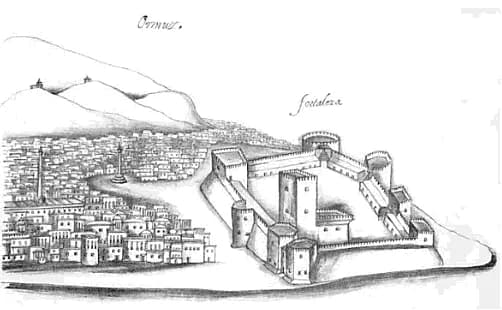
This time the fort was built. Work went on through the summer, and the fortress was named Nossa Senhora da Conceição, Our Lady of the Conception. Albuquerque left his nephew Pero de Albuquerque as its captain.
By then he was ill. He sailed from Hormuz on 8 November 1515 and on the voyage learned that the king had replaced him with Lopo Soares de Albergaria. He died on board on Sunday 16 December 1515, at anchor off the bar of Goa, and was buried in the chapel he had built in the city. The Commentaries call it Our Lady of the Conception; Whiteway names it Nossa Senhora da Serra.
1506
Albuquerque sails from Lisbon with Tristão da Cunha's fleet
April 1507
The Portuguese take the fort on Socotra
20 August 1507
Albuquerque leaves Socotra for Hormuz
26 September 1507
The fleet anchors at Hormuz; the naval battle follows within days
10 October 1507
Flag ceremony and treaty: Hormuz becomes a vassal of Portugal
6 or 24 October 1507
Foundations of the fort laid, depending on the chronicle
5 January 1508
Five captains sign a letter refusing to fight
Early 1508
Albuquerque abandons the blockade and leaves
26 May 1508
The viceroy orders an inquiry into Albuquerque's conduct
September to November 1508
Albuquerque returns to Hormuz but gets nothing
1509
Albuquerque becomes governor of India
31 March or 1 April 1515
The Portuguese take over the fortress site at Hormuz
16 December 1515
Albuquerque dies off Goa
9 February 1622
English ships and a Persian army begin the siege of Hormuz (2 February in Diário de Notícias)
Spring 1622
The garrison surrenders; about 2,000 Portuguese are shipped to Muscat
A century of Portuguese Hormuz, and its fall
For 107 years Hormuz kept its own kings, who paid tribute to Portugal while a Portuguese captain held the fort. The historian Ghoncheh Tazmini, of ISCTE in Lisbon, argues that the Portuguese came as traders, ruthless ones, and that their ambitions there were limited, an episode of economic imperialism rather than full colonial rule.
The end came from Persia. By then the Persians of Shah Abbas I were at war with the Portuguese in the Gulf, and the English East India Company, newly trading in Persian silk, was drawn in. At the end of 1621 the Persian commander Imam Quli Khan, governor of Fars, persuaded the English merchants to lend their fleet, partly by hinting that their trading privileges and the silk already in transit would otherwise be lost. Five ships and four pinnaces sailed from Surat.
A Persian army was already besieging the new Portuguese fort on the neighbouring island of Qeshm. The English ships forced it to surrender on 1 February 1622, by Danvers's date, or 2 February in Diário de Notícias. The Arctic navigator William Baffin was killed there by a shot from the castle while measuring its walls.
From 9 February the English bombarded Hormuz from the sea while the Persians, who had landed and taken the town, attacked the fort by land. They blew up part of its wall, but their assault was beaten back with heavy losses; Sykes notes that English casualties were trifling by comparison. The garrison's commander died during the siege, and his successor, Simão de Melo, opened talks.
The fort surrendered in the spring of 1622. The sources disagree on the day: Danvers gives 22 May for the handover, Diário de Notícias 15 May. About 2,000 Portuguese men, women and children were shipped to Muscat, leaving their property behind. At a later trial Simão de Melo was sentenced to death; he had escaped, so the sentence was carried out on his effigy.
“Both within and without the Castle so regularly built and so well fortified with deep trenches, counterscarp, and great Ordnance commanding both City and Haven, that none exceeded it through all the Orient.”
What remains
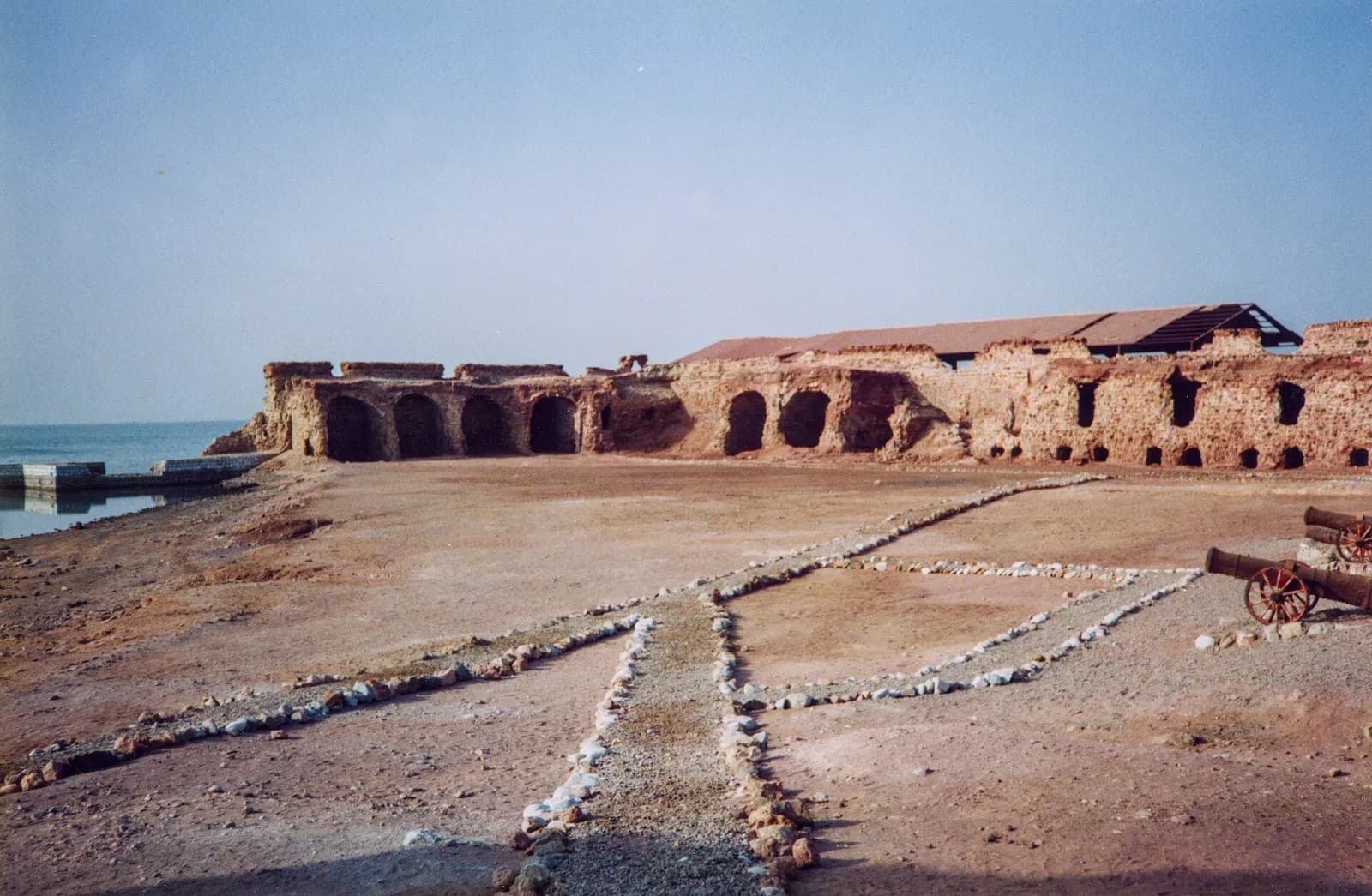
The fort outlived the city. When Percy Sykes visited around 1900, he found it “still practically intact”: a studded gate, bastions, barracks built into a massive 40-foot wall with a parapet 18 feet wide, a great empty cistern and, on the summit, the ruins of a palace among scattered cannon.
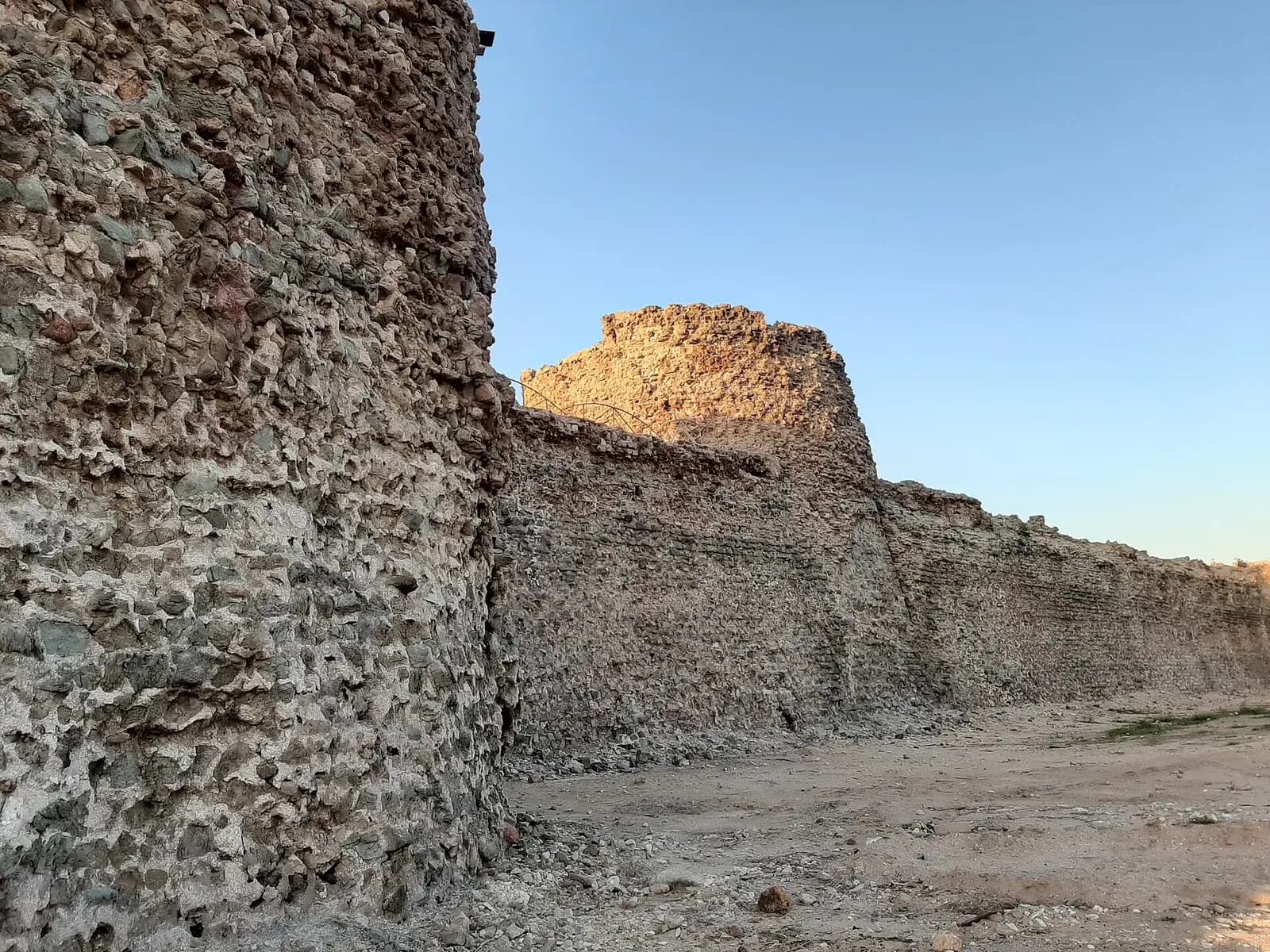
Much of it still stands on the northern point of Hormuz Island, in Iran, though the historian José Manuel Garcia told Diário de Notícias in 2026 that it is little known and very hard to reach. Iranian nationalist accounts treat the Portuguese years as an early chapter of Western colonialism. Tazmini argues that the 107 years should not be reduced to one more dark episode of colonial history.
Other traces were smaller. Writing in 1915, Sykes noted that the Persians called the sweet orange portugale, after the people who had held Hormuz. The strait the island guards is as strategic now as it was 500 years ago, as Garcia put it.
Of Albuquerque's three keys, Aden was never taken, and Hormuz fell 19 years before the Dutch took Malacca in 1641. Goa, which he chose as the seat of Portuguese government in the East, outlasted both.
FAQs
What happened at Hormuz on 10 October 1507?
After Afonso de Albuquerque's small Portuguese fleet destroyed the ships in its harbour, the young king of Hormuz accepted Manuel I of Portugal as his overlord. A Portuguese flag was raised on his palace, and he agreed to pay 15,000 xerafins a year in tribute.
Why did Albuquerque leave Hormuz in 1508?
His captains opposed building a fort, quarrelled over the tribute money and refused to fight. After three of them sailed off to India, he had too few ships to keep up his blockade of the city and left early in 1508 with the fort unfinished.
When did Portugal take control of Hormuz?
Lasting control began in 1515, when Albuquerque returned as governor with 26 or 27 ships, took over the fortress site on 31 March or 1 April and built the fort of Nossa Senhora da Conceição.
How did Portugal lose Hormuz?
In 1622 a Persian army under Imam Quli Khan, carried and supported by English East India Company ships, besieged the fort from February. The garrison surrendered that spring, and about 2,000 Portuguese were shipped to Muscat.
Does the Portuguese fort on Hormuz still exist?
Yes. The fort begun in 1515 survives in large part on the northern point of Hormuz Island, in Iran, though it is little known and hard to reach.
On the timeline
Open the timelineNearby moments from the age of discoveries (1415–1580).
The Infanta Isabel, daughter of Manuel I and Maria of Aragon, is born in Lisbon. Married to the Emperor Charles V in 1526, she became Queen of Spain and Holy Roman Empress and governed Spain as regent during her husband's long absences.
Francisco de Almeida departs Lisbon with a fleet of 22 ships as the first Viceroy of Portuguese India, tasked with establishing permanent Portuguese naval dominance in the Indian Ocean.
The Lisbon Massacre begins: a mob attacks New Christians (forcibly converted Jews) near the Church of São Domingos. The pogrom lasts three days and kills between 500 and 4,000 people — one of the darkest episodes in the history of Portugal's Jewish community, three decades before the Inquisition was established.
Albuquerque at Hormuz, 1507
A Portuguese fleet under Viceroy Francisco de Almeida defeats the combined navies of Mamluk Egypt, the Sultanate of Gujarat and the Zamorin of Calicut, backed by Venice and the Ottomans, at the Battle of Diu in India, establishing Portuguese naval dominance in the Indian Ocean.
The 'Flor de la Mar', the great Portuguese carrack carrying Afonso de Albuquerque and the treasure looted from the sultan's palace at Malacca, is wrecked in a storm off Sumatra. Albuquerque escaped on an improvised raft, but the cargo was lost, and the wreck — one of history's most coveted lost treasures — has never been found.
King Manuel I's embassy to Pope Leo X, led by Tristão da Cunha, parades through Rome in 'Indian style' to flaunt the riches of the East. The star is Hanno, a young white elephant who kneels before the Pope and becomes his beloved pet until it dies in 1516.
Coming up in history
All long reads 12 October 1943Churchill, Salazar and the Azores bases: 12 October 1943
 13 October 1917When the sun “danced” at Fátima: 13 October 1917
 14 October 18991899: the secret declaration that revived the Anglo-Portuguese alliance
 15 October 201715 October 2017: the day Ophelia's winds set central Portugal alight
8 sources
Archives, scholarship and reporting this article was checked against.
- 1
The Commentaries of the Great Afonso Dalboquerque, Second Viceroy of India, vol. I (trans. Walter de Gray Birch)Hakluyt Society, London, 1875 (Internet Archive scan)
- 2
- 3
- 4
- 5
- 6
- 7No Golfo Pérsico além da grande fortaleza de Ormuz os portugueses ainda construíram uma outra em Mascate (Leonídio Paulo Ferreira)Diário de Notícias, 13 March 2026
- 8
If the World Were a Golden Ring, Hormuz Would Be the Jewel in it (Ghoncheh Tazmini)Centro de Estudos Internacionais, ISCTE – Instituto Universitário de Lisboa, 13 February 2017
Image credits
- The courtyard and vaulted storerooms of the Portuguese fortress on Hormuz Island, photographed in 1999. The fort that stands there now was begun by Albuquerque in 1515, eight years after his first attempt. Valdemar Bednarz, CC BY-SA 4.0, via Wikimedia Commons.
- The Strait of Hormuz from space, 2 December 2020. The Persian Gulf is on the left, the Gulf of Oman on the right, and Oman's Musandam peninsula points north between them. Hormuz Island is the small round island near the top, east of the long island of Qeshm. MODIS Land Rapid Response Team, NASA GSFC, Public domain, via Wikimedia Commons.
- Ormus as pictured in the first volume of Georg Braun and Frans Hogenberg's town atlas, Civitates Orbis Terrarum (1572), when the city was under Portuguese control. This hand-coloured copy is from the German edition printed in Cologne in 1582. Georg Braun; Frans Hogenberg, Public domain, via Wikimedia Commons.
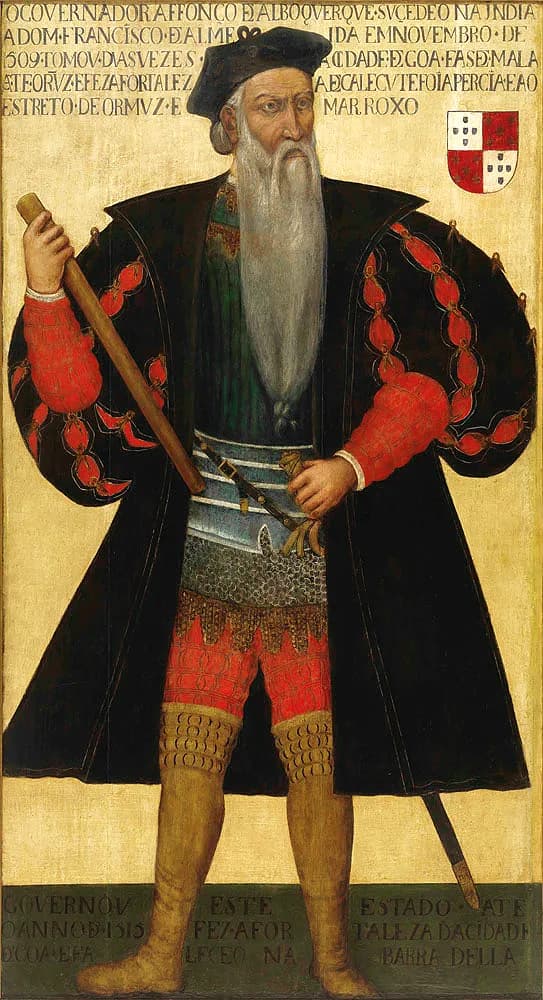
- Afonso de Albuquerque in a portrait painted after 1545 by an unknown artist, now in the Museu Nacional de Arte Antiga in Lisbon. The inscription sums up his governorship, naming Goa, Malacca and Ormuz. Unknown author, Public domain, via Wikimedia Commons.
- The fortress of Hormuz beside the city, labelled “Ormuz” and “fortaleza”, from the mid-sixteenth-century drawings of Gaspar Correia's Lendas da Índia, as reproduced in the Lisbon edition of the chronicle. Gaspar Correia, Public domain, via Wikimedia Commons.
- The outer walls and a ruined bastion of the Portuguese fortress on Hormuz Island, February 2020. ImanFakhri, CC BY-SA 4.0, via Wikimedia Commons.