

The ten days Portugal never had: the calendar change of October 1582
A papal bull, a law signed by a Spanish king of Portugal and a sum about the length of the year removed ten days from October 1582. Britain held out for another 170 years.
At a glance
- In Portugal, Thursday 4 October 1582 was followed by Friday 15 October. The ten days in between were never counted.
- The change was ordered by Pope Gregory XIII in the bull Inter gravissimas of 24 February 1582 and put into Portuguese law by Philip I on 20 September 1582.
- The old Julian calendar assumed a year of 365.25 days, about 11 minutes too long, so by 1582 the spring equinox fell around 11 March instead of 21 March.
- The new leap-year rule drops three leap days every 400 years: 1700, 1800 and 1900 were not leap years, but 1600 and 2000 were.
- Portugal, Spain, most of Italy and Poland-Lithuania switched first. Britain and its colonies waited until 1752, Russia until 1918 and Greece until 1923.
Thursday, the feast of St Francis
Thursday 4 October 1582 was the feast of St Francis of Assisi. The next day was a Friday, as it would have been anyway. But in Portugal its date was 15 October.
Nothing happened in the sky that night. Ten dates had been struck out of the calendar by order of Pope Gregory XIII, and in Portugal by a law that King Philip I had signed a fortnight earlier, on 20 September. The original of that law is still in the national archive, the Torre do Tombo in Lisbon.
The days of the week ran on without a break. Only the numbering jumped. Spain and most of the Italian states made the same jump that night, and Poland changed in the same month. For the next 170 years a letter sent from Lisbon to London carried a date ten or eleven days ahead of the English one.
Why the old calendar had drifted
The calendar Portugal had used until then was the Julian calendar, named after Julius Caesar. It counts 365 days a year and adds a leap day every fourth year, so its average year is 365.25 days long. The year of the seasons, which astronomers call the tropical year, is shorter: about 365.2422 days, or 365 days, 5 hours, 48 minutes and 46 seconds.
The gap is a little over 11 minutes a year. That is 0.0078 of a day, enough to add up to a whole day in about 128 years. Over the 1,257 years from the Council of Nicaea in AD 325 to 1582 it came to almost ten days. Medieval astronomers knew this. A reform worked out at the Council of Basel in 1435, for one, proposed dropping a leap day once every 136 years.
- Julian year
- 365.25 days (365 days, 6 hours)
- Tropical year
- About 365.2422 days (365 days, 5 hours, 48 minutes, 46 seconds)
- Year used by the reformers
- 365 days, 5 hours, 49 minutes, 16 seconds, from the Alfonsine Tables
- Julian error
- A little over 11 minutes a year, or one day in about 128 years
- Spring equinox by 1580
- Around 11 March in the Julian calendar, instead of 21 March
For daily life the drift barely mattered. For the Church it mattered a great deal, because the date of Easter depended on the spring equinox. By 1580, by the reformers' reckoning, the real equinox came around 11 March, while the tables still assumed 21 March. The church's table of new moons, built on a 19-year cycle, had slipped as well, by about four days.
A doctor's idea and a Jesuit's defence
The solution came from Luigi Giglio, better known by his Latin name, Aloysius Lilius. He was a physician and astronomer born around 1510 at Cirò, in Calabria, who studied in Naples and settled in Verona. His proposal reached the papal commission in 1575, presented by his brother Antonio, also a physician. Luigi died in 1576, before it was adopted.
Lilius took the Alfonsine value for the year, which is about 1/134 of a day shorter than the Julian year. Since 1/134 is close to 3/400, the calendar would stay in step if it left out three leap days every 400 years. Here he followed Pietro Pitati of Verona, who had proposed dropping the leap day in century years in 1564.
Lilius's own invention was for the moon. He replaced the old golden numbers with a cycle of epacts, the age of the moon at the start of each year, which could be shifted when it fell behind.
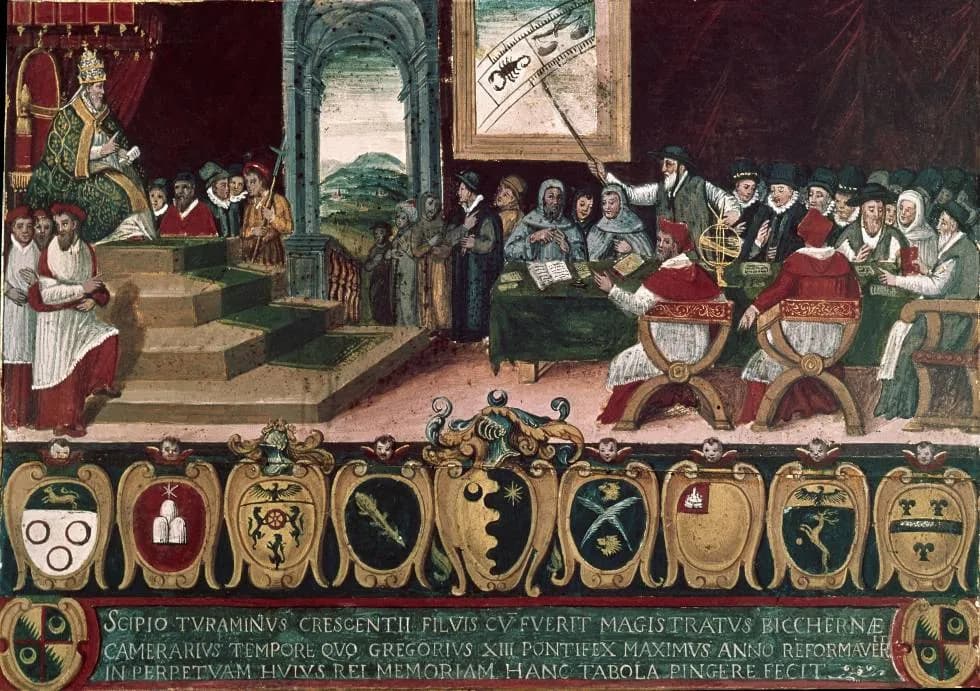
In 1577 the pope consulted Portugal's foremost mathematician, Pedro Nunes, the kingdom's chief cosmographer and for many years professor at Coimbra. Nunes died in August 1578. The commission, chaired from about 1577 by Cardinal Guglielmo Sirleto, printed a summary of the plan, the Compendium, and on 5 January 1578 the pope sent it to Catholic rulers and universities for comment.
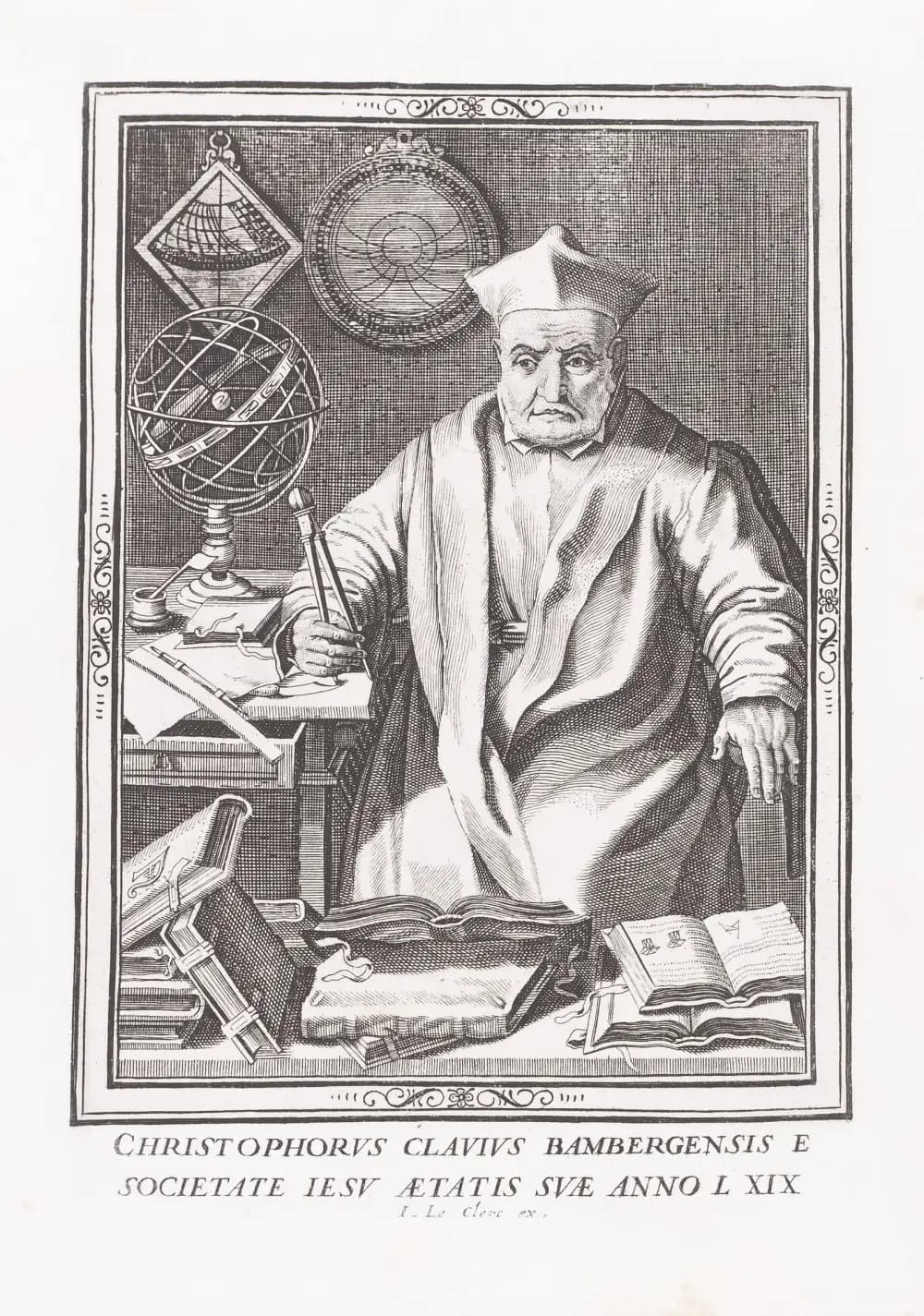
The commission's best-known member was Christopher Clavius, a German Jesuit from Bamberg who taught mathematics at the Collegio Romano. He took part from at least 1577 and spent the rest of his life defending the calendar. As the last surviving member, he wrote the official explanation of it, published in 1603.
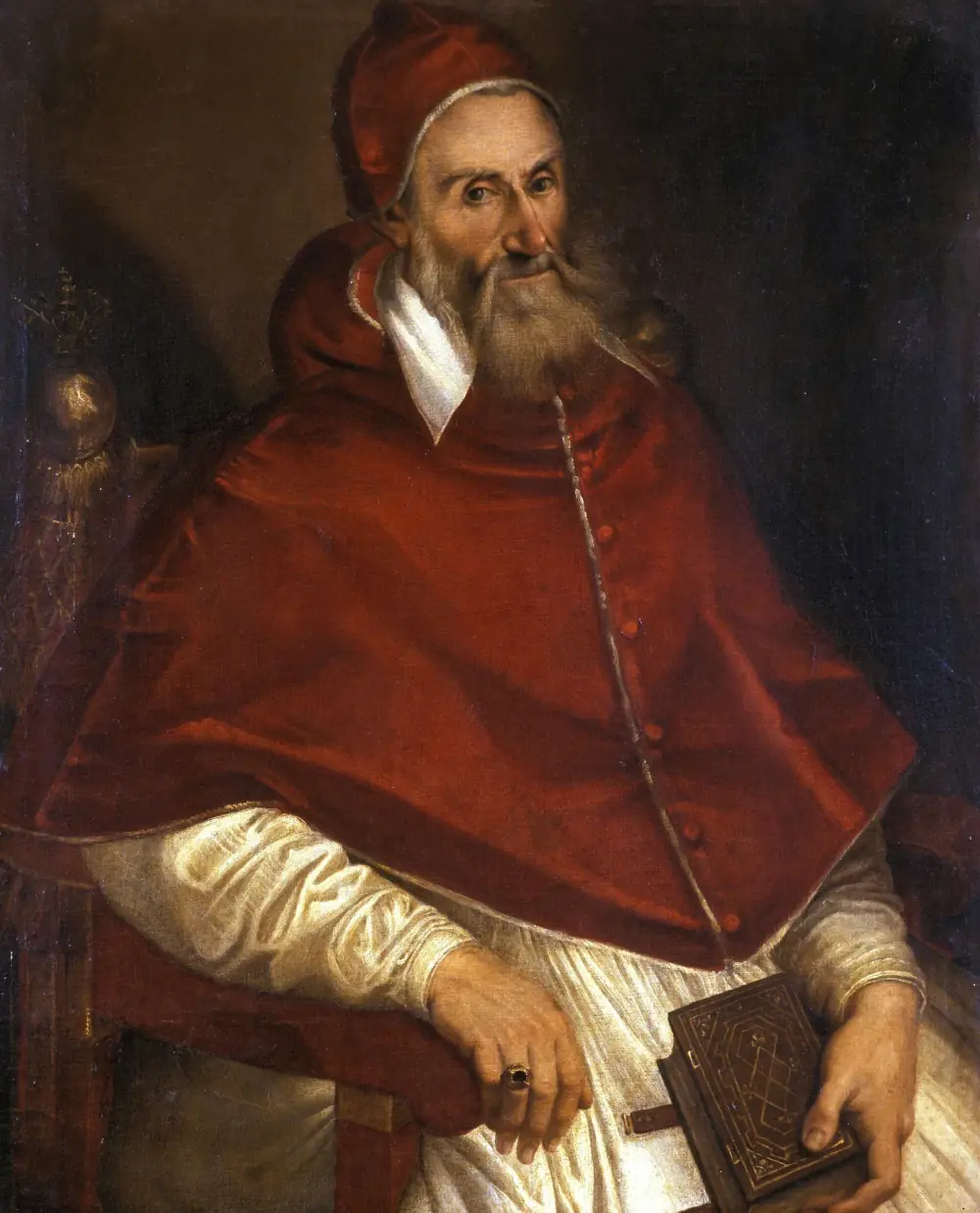
Gregory XIII, then 80, signed the bull on 24 February 1582 at Mondragone, the papal villa near Frascati, and it is dated at Tusculum, the ancient town nearby. On 1 March it was posted on the doors of St Peter's in Rome. It takes its name from its opening words, Inter gravissimas, “among the most serious”. It did two things: it removed ten days once, and it changed the rule for leap years for good.
“Therefore, in order to restore the vernal equinox, which was placed by the fathers of the Council of Nicaea at the twelfth day before the Kalends of April [21 March], and to return it to that same place, we direct and ordain: that ten days shall be removed from the month of October of the year 1582, from the third day before the Nones [5 October] up to the day before the Ides [14 October], inclusive.”
The new rule kept a leap day every fourth year but dropped it in century years, unless the year divides by 400. The bull spelled it out: 1600 would be a leap year, 1700, 1800 and 1900 would not, and 2000 would be. That leaves 97 leap years in every 400 instead of 100, an average year of 365.2425 days. Against the modern figure for the tropical year, 365.2422 days, that is about 26 seconds a year too long, or one day in roughly 3,300 years.
325
Council of Nicaea sets the principles for dating Easter
1575
Lilius's proposal reaches the papal commission
1576
Luigi Giglio (Lilius) dies
1577
Gregory XIII consults Pedro Nunes on the reform
5 January 1578
The Compendium is sent to Catholic rulers and universities
14 September 1580
The commission reports to the pope
24 February 1582
Gregory XIII signs the bull Inter gravissimas
1 March 1582
The bull is posted on the doors of St Peter's in Rome
20 September 1582
Philip I signs the Portuguese law adopting the calendar
4/15 October 1582
Portugal, Spain, most of Italy and Poland switch
1603
Clavius publishes the official explanation of the calendar
A Spanish king's law for Portugal
A papal bull did not change the civil calendar by itself. In each kingdom the ruler had to order it. In 1582 Portugal's ruler was Philip II of Spain. King Sebastião had died in 1578 without an heir, and the crown passed to his elderly great-uncle, Cardinal Henrique. When Henrique died too, Philip claimed the throne, and after his army won at Alcântara, outside Lisbon, on 25 August 1580, he ruled Portugal as Philip I. The two crowns stayed joined until 1640, a period known as the Iberian Union.
On 20 September 1582 Philip I issued the law by which Portugal adopted the new calendar. The Torre do Tombo describes the new calendar as the result of “the correction introduced by the mathematician Lilius” (in translation) to the calendar of Julius Caesar. It is kept in the archive's collection of laws, Leis e Ordenações, under the reference Leis, maço 3, nº 36.
The bull itself set the day. After 4 October, the feast of St Francis, the next day was to be called 15 October and kept as the feast of St Denis and his companions. The Sunday that followed, 17 October, counted as the 18th Sunday after Pentecost. So that nobody lost money, the bull told judges, in any dispute over an annual or monthly payment, to add ten days to the due date.
| Monday | Tuesday | Wednesday | Thursday | Friday | Saturday | Sunday |
|---|---|---|---|---|---|---|
| 1 | 2 | 3 | 4 | 15 | 16 | 17 |
| 18 | 19 | 20 | 21 | 22 | 23 | 24 |
| 25 | 26 | 27 | 28 | 29 | 30 | 31 |
Days 1 to 4 are Julian dates and 15 onwards Gregorian; 5 to 14 October 1582 were never counted, so the month had 21 days and the year 355. Thursday 4 October was the feast of St Francis. The week ran on unbroken, and 17 October was the first Sunday under the new reckoning.
The historian August Ziggelaar counts Italy, Spain and Portugal as the places where the reform went through most easily. In Spain and Portugal the king was the same man, and he had a stake in the details: the commission kept the equinox at 21 March partly because that meant no change to Mass books and breviaries, which Ziggelaar notes was a wish of the King of Spain. Poland, then joined with Lithuania, also switched in October 1582. Some Catholic countries took weeks or months longer.
Overseas and across Europe
News travelled at the speed of ships, and the bull allowed for it: places too far away to hear in time could make the change in October 1583, or later, once the letter reached them.
The Torre do Tombo summary of Philip's law does not say how it was sent to Brazil, to Goa in India or to Macau in China, and no switch date for those places turned up in the sources consulted for this article. The historian Owen Gingerich noted that working out when the reform took effect in the Latin American colonies would need specialised research.
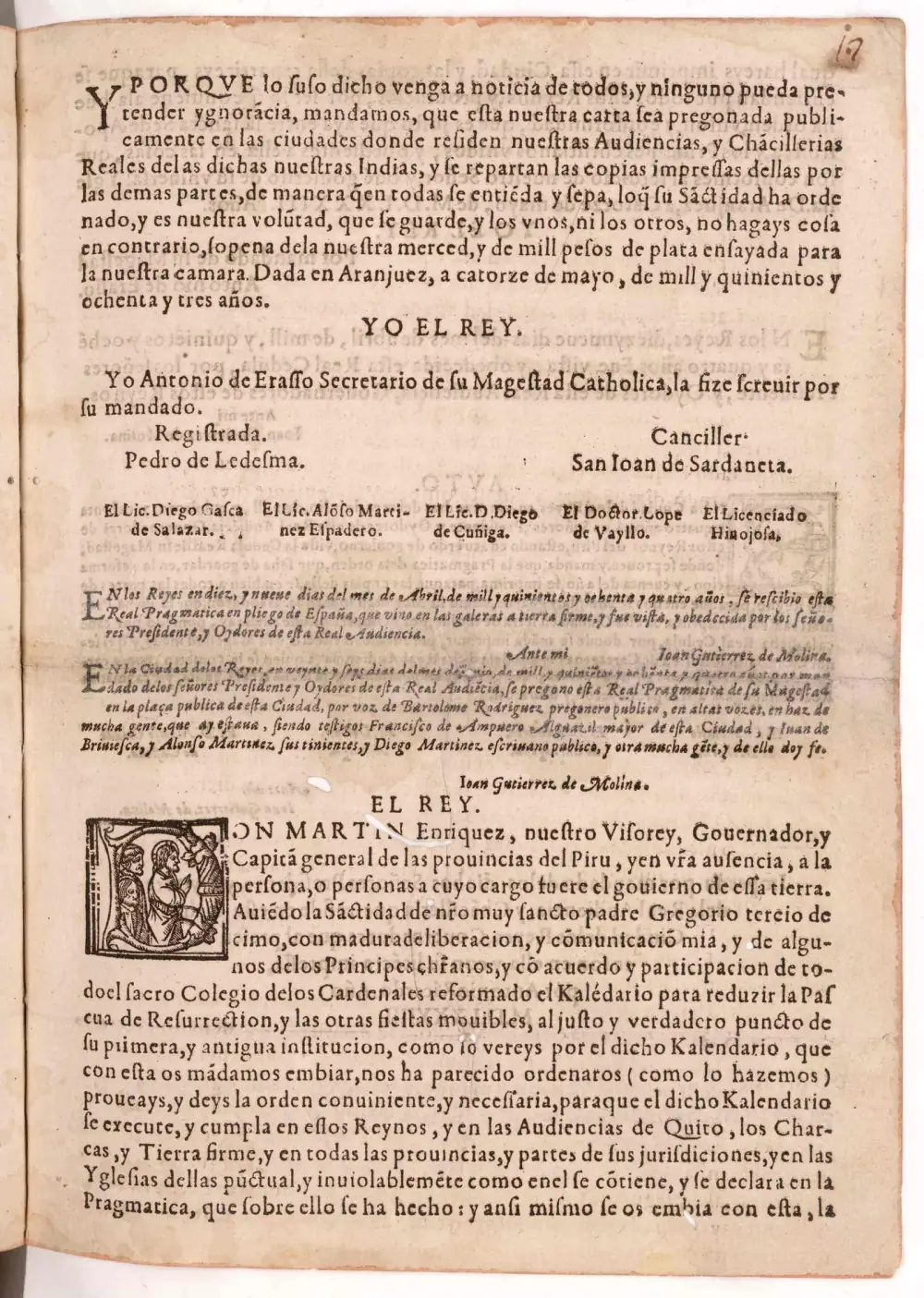
The Spanish side of the empire gives an idea of the delay. Philip signed a separate order for his American territories at Aranjuez in 1583; the printed copy is dated 14 May, though Gingerich gives 14 March. It reached Lima, capital of the Viceroyalty of Peru, on 19 April 1584, and the Jesuit José de Acosta wrote that the change there was set for October 1584. The Lima printer Antonio Ricardo printed the order that July. It is the earliest known printed work from a South American press.
In Europe, France followed in December 1582 after an edict of Henry III. In Flanders the switch came at the end of December, and Christmas that year never happened. An English merchant in Bruges, Thomas Stokes, wrote to Elizabeth I's secretary of state, Sir Francis Walsingham, on 23 December, by the English reckoning, that New Year's Day had just been proclaimed there, “so they have lost Christmas Day here for this year”.
Protestant and Orthodox countries refused a reform issued by the pope. Protestant Germany and Denmark switched in 1700, Sweden in 1753. Britain, with its American colonies, moved in 1752 under the Calendar (New Style) Act, which also moved the start of the English legal year from 25 March to 1 January. Russia changed in 1918, under the Bolsheviks, and Greece in 1923.
“the natural day next immediately following the said second day of September shall be called, reckoned, and accounted to be the fourteenth day of September, omitting for that time only the eleven intermediate nominal days of the common calendar”
| Country or territory | Switch | Days dropped |
|---|---|---|
| Portugal | Thursday 4 October 1582, then Friday 15 October (law of 20 September 1582) | 10 |
| Spain, most Italian states, Poland-Lithuania | October 1582, as Portugal | 10 |
| France | December 1582, after an edict of Henry III | 10 |
| Flanders and the Catholic Netherlands | End of December 1582; Christmas was skipped | 10 |
| Viceroyalty of Peru | October 1584, under a royal order of 1583 | 10 |
| Protestant Germany and Denmark | February 1700 | 11 |
| Great Britain and its colonies | 2 September 1752, then 14 September | 11 |
| Sweden | 1753 | 11 |
| Japan | 1 January 1873 | Not applicable: Japan had never used the Julian calendar |
| Russia | 1918 | 13 |
| Greece | 1923 | 13 |
The number of days dropped grew because the Julian calendar kept the leap days of 1700, 1800 and 1900 that the Gregorian calendar left out. Gingerich gives the 11-day gap from March 1700 and the 13-day gap from 1900; the British figure is in the Act itself.
How far the Julian calendar runs behind the Gregorian
days
Each step comes at the end of February in a century year that is a leap year in the Julian calendar but not in the Gregorian one: 1700, 1800, 1900 and, next, 2100. 2000 was a leap year in both, so the gap stayed at 13 days.
Show the data
| Gap between the two calendars | |
|---|---|
| 1582–1700 | 10 |
| 1700–1800 | 11 |
| 1800–1900 | 12 |
| 1900–2100 | 13 |
| 2100–2200 | 14 |
What it means for reading old dates
For anyone reading Portuguese history, the rule is simple. Dates in Portuguese documents up to 4 October 1582 are Julian dates. To match a Julian date between the reform and the end of February 1700 with its Gregorian equivalent, you add ten days; after that, eleven.
The trouble starts with countries that switched at different times. Between 1582 and 1752 an English letter and a Portuguese one written on the same day carry different dates. Writers of the time sometimes gave both, as in 23/13 December 1688.
In English the two reckonings came to be called Old Style and New Style, and English dates before 1752 have a second trap: the legal year in England began on 25 March, although Scotland already started it on 1 January, so a document from February 1750 belongs to what we would call 1751.
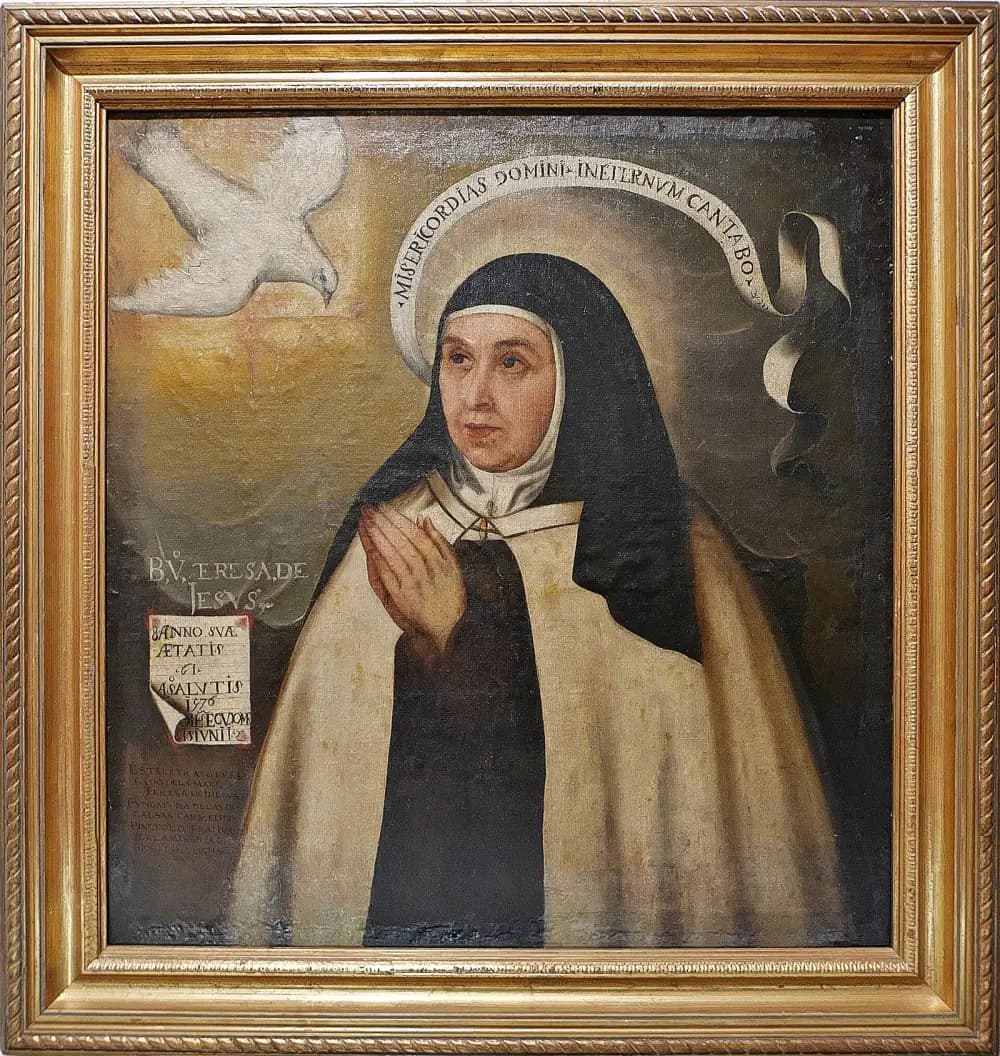
The switch also produced one of history's odd death dates. Teresa of Ávila, the Carmelite reformer and mystic, died at Alba de Tormes during the night of 4 to 15 October 1582, the very night Spain changed calendars. Depending on the source, her death is dated 4 or 15 October: the Catholic Encyclopedia of 1912 gives 4 October, while the Holy See speaks of the night of 15 October. The Church keeps her feast on 15 October.
Why it still matters
The calendar that Philip I put into Portuguese law in 1582 is the one on every phone today. Since 1924, Gingerich noted, the whole world has used Gregorian dates for civil life, although religious calendars such as the Jewish and Islamic ones carry on beside it.
Easter is where the split survives. The Orthodox churches never accepted the papal reform as a whole. Some follow the Julian calendar and the old Easter rules, some the Gregorian rule and some a mixture. Since 1900 the Julian calendar has run 13 days behind, so churches that keep it celebrate Christmas on what is 7 January in the Gregorian calendar.
The arithmetic will need attention again, but not soon. With an average year of 365.2425 days, the Gregorian calendar drifts from the seasons by about a day in 3,300 years. Estimates vary with the figure used for the year: the University of Nottingham's guide to dating documents gives 3,700. The next scheduled change comes sooner, in 2100, which will not be a leap year.
FAQs
When did Portugal adopt the Gregorian calendar?
In October 1582. Philip I signed the law adopting it on 20 September 1582, and Thursday 4 October was followed directly by Friday 15 October, as the papal bull ordered.
Why were ten days removed in 1582?
The Julian year of 365.25 days was a little over 11 minutes longer than the year of the seasons. By the 1580s the spring equinox, which governs the date of Easter, had moved from 21 March to around 11 March, and dropping ten days put it back.
What is the Gregorian leap-year rule?
A year divisible by 4 is a leap year, except century years, which are leap years only if divisible by 400. So 1600 and 2000 were leap years, while 1700, 1800 and 1900 were not. This removes three leap days every 400 years.
Why did Britain change only in 1752?
In 1582 Elizabeth I's mathematicians advised accepting the papal reform, but the Church of England's bishops would not act before consulting their clergy and the other Protestant churches, and the matter lapsed. Parliament finally passed the Calendar (New Style) Act in 1751, and 2 September 1752 was followed by 14 September.
Did Christopher Clavius study under Pedro Nunes?
Clavius did study at the Jesuit college in Coimbra in the late 1550s, but whether he attended Nunes's lectures is disputed. Some reference works say he did; Ugo Baldini and the Biographical Encyclopedia of Astronomers reject the claim.
On the timeline
Open the timelineNearby moments from the iberian union (1580–1640).
The Cortes open at Tomar's Convent of Christ, where Philip II of Spain is sworn in as Filipe I of Portugal, promising to keep the kingdom's laws, coinage, language and offices in Portuguese hands. The 'dual monarchy' would last sixty years, until the Restoration of 1 December 1640.
At the Battle of Salga on Terceira, in the Azores, islanders loyal to Dom António, Prior of Crato, defeat a Spanish landing force sent by Philip II — famously by stampeding a herd of cattle into the invaders' ranks. The victory keeps the island holding out for Dom António for two more years.
In the Battle of Ponta Delgada, fought off Vila Franca do Campo on São Miguel in the Azores, the Spanish fleet of Álvaro de Bazán, Marquis of Santa Cruz, destroys a French fleet under Filippo Strozzi sent to back Dom António, Prior of Crato, in his claim to the Portuguese throne. Strozzi is killed, dooming the last Azorean resistance to Philip II.
Portugal's Gregorian calendar
The Spanish Armada, including Portuguese galleons pressed into service during the Iberian Union, begins to sail out of Lisbon bound for England; the last ships clear the Tagus two days later. The fleet of some 130 ships is one of the largest ever seen in European waters, but would be scattered in the Channel and wrecked off Scotland and Ireland.
Birth of Manuel de Faria e Sousa, the historian and poet who spent most of his life in Madrid writing Portugal's history in Spanish. His vast commentary on Camões's 'Os Lusíadas' (1639) brought him trouble with the Inquisition, which briefly jailed him.
Death in Viana do Castelo of Bartolomeu dos Mártires, the Lisbon-born Dominican Archbishop of Braga who was a leading voice at the Council of Trent and founded one of the first seminaries under its reforms. So revered was he as 'father of the poor' that Viana's townsfolk guarded his body against claims from Braga; Pope Francis declared him a saint in 2019.
Coming up in history
All long reads 6 October 1999Amália Rodrigues, the voice of fado, dies in Lisbon: 6 October 1999
 7 October 2018Odette Ferreira, HIV-2 and the blood sample carried in a coat
 8 October 1998José Saramago wins the Nobel Prize in Literature: 8 October 1998
 9 October 1261King Dinis, born in Lisbon on 9 October 1261: the poet who ruled 46 years
21 sources
Archives, scholarship and reporting this article was checked against.
- 1
Documento do Mês – Julho: Lei de adoção do calendário gregorianoArquivo Nacional Torre do Tombo, 1 July 2011
- 2
Inter gravissimas (bull of Gregory XIII, 24 February 1582), English translationWikisource (translation by Wikisource contributors, CC BY-SA 3.0), from the Latin text in Christopher Clavius, Opera mathematica, vol. 5 (Mainz, 1612), pp. 13–15
- 3
The Papal Bull of 1582 Promulgating a Reform of the CalendarAugust Ziggelaar, in G. V. Coyne, M. A. Hoskin and O. Pedersen (eds), Gregorian Reform of the Calendar, Pontifical Academy of Sciences and Specola Vaticana, 1983, pp. 201–239 (scan provided by the NASA Astrophysics Data System)
- 4
- 5
- 6
Calendar (New Style) Act 1750 (24 Geo. 2 c. 23)legislation.gov.uk, The National Archives
- 7
Dating documents: Julian and Gregorian calendarsManuscripts and Special Collections, University of Nottingham
- 8
- 9
Nunes, Pedro (Biographical Encyclopedia of Astronomers)Springer, 2007, via MacTutor, University of St Andrews
- 10
Pedro Nunes, 1502-1578: cronologia da vidaBiblioteca Nacional de Portugal, 2002 (scientific curator Henrique Leitão)
- 11
- 12
- 13
- 14O dia em que Portugal perdeu a última batalha pela independênciaObservador
- 15
- 16
Antonio Ricardo: A 16th Century Printer on Both Sides of the EquatorJohn Carter Brown Library
- 17
Pragmática sobre los diez días del año (Aranjuez, 1583; printed in Lima by Antonio Ricardo, 1584), page 3John Carter Brown Library copy, via Wikimedia Commons
- 18
Death of St. Teresa of ÁvilaEBSCO Research Starters, 2019
- 19
St. Teresa of AvilaBenedict Zimmerman, The Catholic Encyclopedia, vol. 14 (New York, 1912), via New Advent
- 20
General Audience, 2 February 2011: Saint Teresa of AvilaBenedict XVI, Holy See
- 21

Image credits
- Pope Gregory XIII presiding over the commission for the reform of the calendar, on a Biccherna tablet painted in Siena in 1582 or 1583 for Scipio Turamini, chamberlain of the city's finance office, the Biccherna. Archivio di Stato di Siena. Unknown author, Public domain, via Wikimedia Commons.
- Christopher Clavius, the Jesuit mathematician who sat on the reform commission and later wrote the official explanation of the calendar. The inscription gives his age as 69. A nineteenth-century heliogravure, from the album Galerie illustrée de la Compagnie de Jésus, after an older engraving. Unknown engraver (print published by I. Le Clerc); heliogravure, KU Leuven Libraries, Public domain, via Wikimedia Commons.
- Pope Gregory XIII (1502–1585), who signed the bull reforming the calendar. Portrait attributed to Bartolomeo Passarotti, painted around 1586. Attributed to Bartolomeo Passarotti, Public domain, via Wikimedia Commons.
- Page of Philip II's order on the ten days for the Spanish Indies, dated Aranjuez, 14 May 1583, as printed in Lima by Antonio Ricardo in 1584. The italic notes record its arrival in Lima in April 1584 and its proclamation in the main square. John Carter Brown Library. Reino de España (1583), Public domain, via Wikimedia Commons.
- Teresa of Ávila at 61, painted by Fray Juan de la Miseria in 1576, six years before she died on the night the calendar changed. Convento de las Teresas, Seville. Jl FilpoC, CC BY-SA 4.0, via Wikimedia Commons.