

1580–1640
The Iberian Union
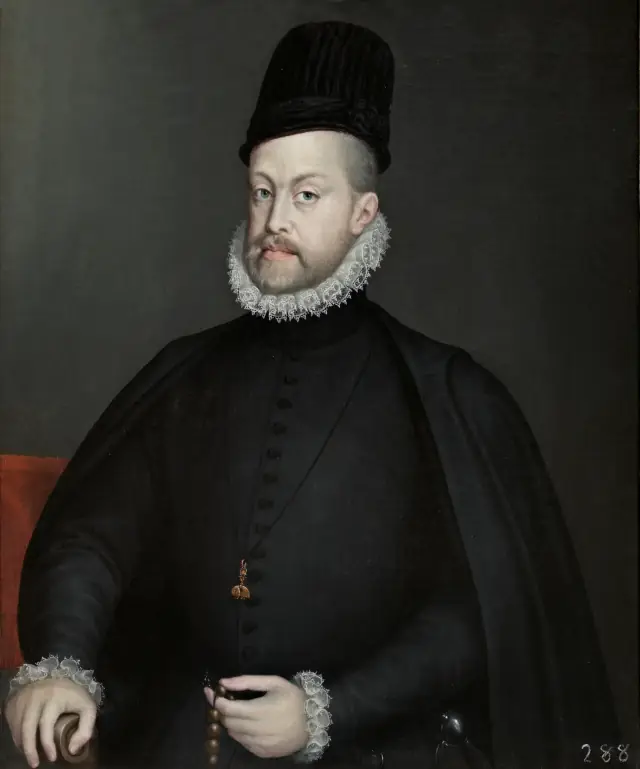
Sebastião died without a direct heir, and the crown passed to his elderly great-uncle, Cardinal Henrique. Philip II of Spain, the most powerful monarch in Europe, then claimed the throne. On 25 August 1580 his army defeated the hastily raised forces of António, Prior of Crato, at Alcântara, outside Lisbon, and Spanish kings ruled Portugal for the next 60 years.
2 key moments · 18 in all
Spanish forces under the Duke of Alba defeat Dom António, Prior of Crato, at the Battle of Alcântara on the outskirts of Lisbon, crushing Portuguese resistance to Philip II; Alba's troops occupied the capital in the days that followed, opening the way to sixty years of Iberian Union.
The Cortes open at Tomar's Convent of Christ, where Philip II of Spain is sworn in as Filipe I of Portugal, promising to keep the kingdom's laws, coinage, language and offices in Portuguese hands. The 'dual monarchy' would last sixty years, until the Restoration of 1 December 1640.
At the Battle of Salga on Terceira, in the Azores, islanders loyal to Dom António, Prior of Crato, defeat a Spanish landing force sent by Philip II — famously by stampeding a herd of cattle into the invaders' ranks. The victory keeps the island holding out for Dom António for two more years.
In the Battle of Ponta Delgada, fought off Vila Franca do Campo on São Miguel in the Azores, the Spanish fleet of Álvaro de Bazán, Marquis of Santa Cruz, destroys a French fleet under Filippo Strozzi sent to back Dom António, Prior of Crato, in his claim to the Portuguese throne. Strozzi is killed, dooming the last Azorean resistance to Philip II.
Portugal adopts the Gregorian calendar by a law signed by Philip I: Thursday 4 October is followed directly by Friday 15 October, and the ten days in between never take place in the country's calendar.
 Long readThe ten days Portugal never had: the calendar change of October 1582
The Spanish Armada, including Portuguese galleons pressed into service during the Iberian Union, begins to sail out of Lisbon bound for England; the last ships clear the Tagus two days later. The fleet of some 130 ships is one of the largest ever seen in European waters, but would be scattered in the Channel and wrecked off Scotland and Ireland.
Birth of Manuel de Faria e Sousa, the historian and poet who spent most of his life in Madrid writing Portugal's history in Spanish. His vast commentary on Camões's 'Os Lusíadas' (1639) brought him trouble with the Inquisition, which briefly jailed him.
Death in Viana do Castelo of Bartolomeu dos Mártires, the Lisbon-born Dominican Archbishop of Braga who was a leading voice at the Council of Trent and founded one of the first seminaries under its reforms. So revered was he as 'father of the poor' that Viana's townsfolk guarded his body against claims from Braga; Pope Francis declared him a saint in 2019.
Roderigo Lopes, a New Christian physician from Crato who had become chief doctor to Elizabeth I, is hanged, drawn and quartered at Tyburn in London after the Earl of Essex accused him of plotting to poison the queen. The only royal physician ever executed in England, he may have inspired Shylock in Shakespeare's 'The Merchant of Venice'.
Philip II of Spain, who had ruled Portugal as King Filipe I since 1580, dies at the palace-monastery of El Escorial; the crowns of the Iberian Union pass to his son Philip III.
The Dutch East India Company (VOC) is formally established in the Netherlands, creating a powerful rival to Portugal's Estado da Índia trading empire. The VOC would systematically challenge Portuguese dominance in the Indian Ocean, capturing key fortresses in the Spice Islands, Malacca, and Ceylon.
The Battle of Sesimbra Bay — an English squadron under Sir Richard Leveson and William Monson defeats a fleet of Spanish galleys and captures a large Portuguese carrack returning from the East Indies. The engagement takes place during the Anglo-Spanish War, while Portugal is bound to Spain under the Iberian Union.
Birth of João, future Duke of Braganza, at Vila Viçosa. In 1640 the conspirators of the Restoration would proclaim him King João IV, ending 60 years of Spanish rule and founding the Braganza dynasty that reigned over Portugal until 1910.
Bento de Góis, a Jesuit lay brother from the Azores, dies at Suzhou (now Jiuquan) on China's western frontier. Disguised as an Armenian merchant, he had trekked for three years from Agra across Afghanistan and the Pamirs, proving that Marco Polo's 'Cathay' and China were one and the same country.
Father António Vieira is born in Lisbon, in a house near the Sé. The Jesuit preacher, diplomat and royal adviser became the great prose stylist of the Portuguese Baroque — Pessoa's 'emperor of the Portuguese language' — and a fierce defender of Brazil's indigenous peoples.
Captain Francisco Caldeira Castelo Branco founds the Forte do Presépio near the mouth of the Amazon, the nucleus of the city of Belém do Pará, securing Portuguese control of the great river against French, Dutch and English rivals.
Death in Goa of the chronicler Diogo do Couto, aged about 74. Sent to India as a teenage soldier, he found his friend Luís de Camões stranded and penniless on the Island of Mozambique in 1569 and, with others, helped him get home with the manuscript of 'Os Lusíadas'. Later keeper of the Goa archives, he continued João de Barros's 'Décadas da Ásia'.
Baruch (Bento) de Espinosa is born in Amsterdam to a family of Portuguese Jews who had fled the Inquisition. Expelled from the city's Portuguese-Jewish congregation in 1656 for his heterodox views, he became one of the great philosophers of the early modern age, author of the 'Ethics'.
Back to the full timeline of Portugal, with key moments, search and long reads.