

1383–1415
Crisis and the House of Avis
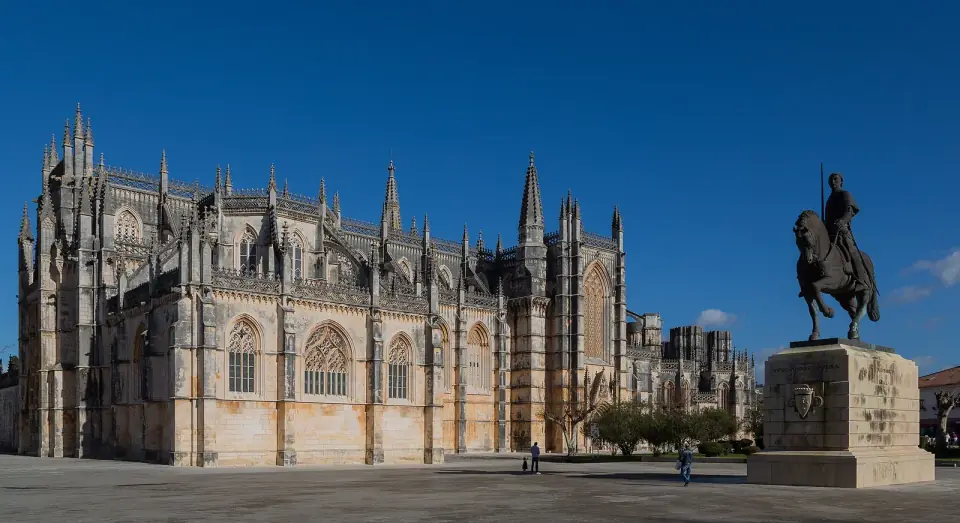
Fernando I died in October 1383, and his son-in-law, Juan I of Castile, moved to take Portugal. Resistance gathered around Fernando's half-brother João, Master of the Order of Avis, who was crowned in April 1385 and beat the Castilians at Aljubarrota on 14 August that year. He built the Batalha monastery in thanks, and the Treaty of Windsor of May 1386 sealed an alliance with England that still stands.
3 key moments · 10 in all
King Fernando I, 'o Formoso', dies in Lisbon aged 37, the last king of the House of Burgundy. His death, leaving the crown to his daughter Beatriz and her husband Juan I of Castile, triggers the crisis of 1383–85 that ended with João I on the throne.
 Long readFernando I dies in Lisbon, and the crisis of 1383–85 begins
Battle of Atoleiros: near Fronteira in the Alentejo, Nuno Álvares Pereira has his roughly 1,400 men fight on foot in a tight formation that breaks the charges of a Castilian army of some 5,000, mostly cavalry. The first pitched-battle victory of the 1383–1385 crisis, it showed that Castile could be beaten.
The Cortes of Coimbra proclaim João, Master of the Order of Aviz, as King João I of Portugal, ending the succession crisis and establishing the House of Aviz dynasty. Nuno Álvares Pereira is appointed Constable of the Kingdom.
A few hundred Portuguese men-at-arms, led by local nobles of the Beira, rout a larger Castilian force near Trancoso as it heads home laden with plunder from the sack of Viseu; six of its seven captains are killed. In the midst of the 1383–85 succession crisis, the victory is a morale-boosting prelude to Aljubarrota that August.
King João I and his constable Nuno Álvares Pereira rout the invading Castilian army at the Battle of Aljubarrota, ending the crisis of 1383–85, securing Portuguese independence and establishing the House of Avis on the throne.
The Treaty of Windsor is signed, sealing the Anglo-Portuguese Alliance first agreed in 1373 — the oldest diplomatic alliance in the world still in force. The following year João I married John of Gaunt's daughter, Philippa of Lancaster.
The future King Duarte, 'o Eloquente', is born in Viseu, son and from 1400 heir of João I and Philippa of Lancaster. A scholar-king and author of the 'Leal Conselheiro', his short reign was marked by the disastrous expedition to Tangier in 1437.
Birth in Lisbon of the Infante Pedro, Duke of Coimbra, son of João I and Philippa of Lancaster. Called 'Pedro of the Seven Parts of the World', he spent ten years roaming Europe, fought the Turks for Emperor Sigismund and brought back from Venice a copy of Marco Polo's book for his brother Henry the Navigator. Regent from 1439, he was killed at Alfarrobeira in 1449 fighting his nephew Afonso V's army.
Birth of Prince Henry the Navigator (Infante Dom Henrique) in Porto. He would become the driving force behind Portugal's Age of Discoveries, sponsoring expeditions along the West African coast.
Infanta Isabel, the only surviving daughter of João I and Philippa of Lancaster, is born in Évora. Jan van Eyck was later sent to Portugal to paint her for her suitor, Philip the Good; as Duchess of Burgundy she proved a shrewd diplomat, governed the Low Countries as regent and bore Charles the Bold.
Back to the full timeline of Portugal, with key moments, search and long reads.