

Mr Five Per Cent's museum: the Gulbenkian opens in Lisbon, 1969
Calouste Gulbenkian made a fortune from a five per cent share of Middle Eastern oil and spent it on art. Fourteen years after he died in Lisbon, where he had lived in a hotel since 1942, his collection finally had a home in a concrete building in a garden.
At a glance
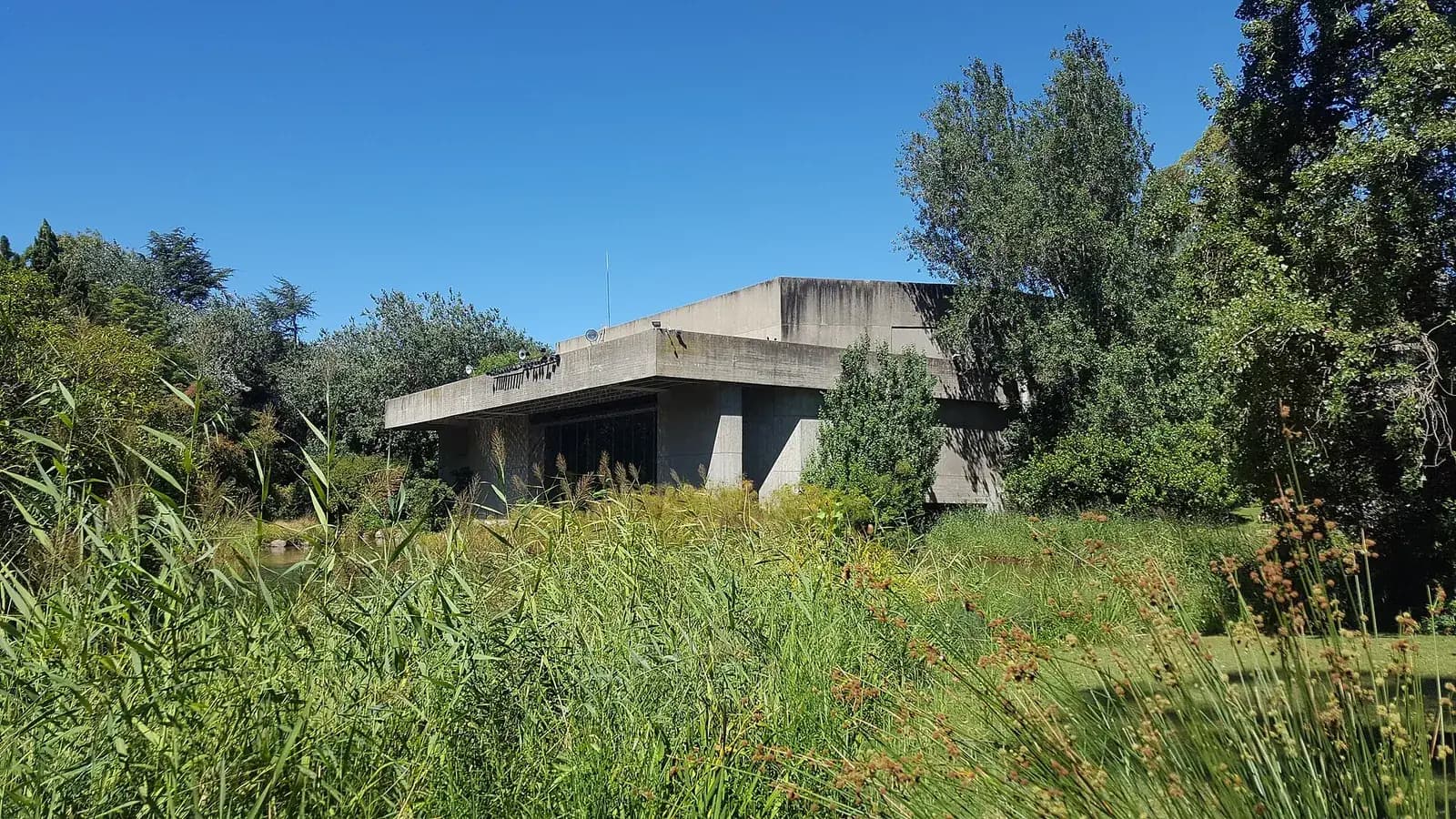
- On 2 October 1969, the centenary year of Calouste Gulbenkian's birth, the head of state opened the headquarters and museum of the Calouste Gulbenkian Foundation in the Parque de Santa Gertrudes, off Avenida de Berna in Lisbon.
- Gulbenkian, an Armenian born in Scutari (now Üsküdar, Istanbul) in 1869, was known as Mr Five Per Cent for his share of the oil of the Turkish Petroleum Company, fixed by the Red Line Agreement of 1928.
- He moved to neutral Portugal in April 1942, lived in suites at the Aviz Hotel in Lisbon and died there in 1955, leaving most of his fortune and some 6,000 works of art to a foundation based in Lisbon.
- His British adviser Lord Radcliffe resigned as trustee in 1956 rather than accept a Portuguese majority on the board, which Salazar's government demanded. The Portuguese lawyer José de Azeredo Perdigão led the Foundation until his death in 1993.
- The complex by Ruy d'Athouguia, Pedro Cid and Alberto Pessoa, with a garden by Gonçalo Ribeiro Telles and António Viana Barreto, won the Valmor Prize in 1975 and became a national monument in 2010.
Half past ten in the Grand Auditorium
At 10.30 on the morning of Thursday 2 October 1969, a formal session opened in the Grand Auditorium of a new concrete building in a park off Avenida de Berna, in Lisbon. More than a thousand guests had been invited to two days of ceremonies. The President of the Republic presided, flanked by the Prime Minister, Marcelo Caetano, and two cabinet ministers. The Cardinal Patriarch of Lisbon, Manuel Gonçalves Cerejeira, sat in a chair of honour.
Among the guests were Lord Clark, the former director of the National Gallery in London, and John Walker, the former director of the National Gallery of Art in Washington. Both had known the man the building was named after, and both had once discussed with him a home for his art collection at their own galleries.
José de Azeredo Perdigão, president of the Calouste Gulbenkian Foundation, spoke first, about the founder and the institution he had left behind. Clark, Walker and a member of France's Economic and Social Council followed. The head of state closed the session by pinning the Grand Cross of the Order of Prince Henry on Perdigão and on Kevork Essayan, the founder's son-in-law, the two executors of the will.
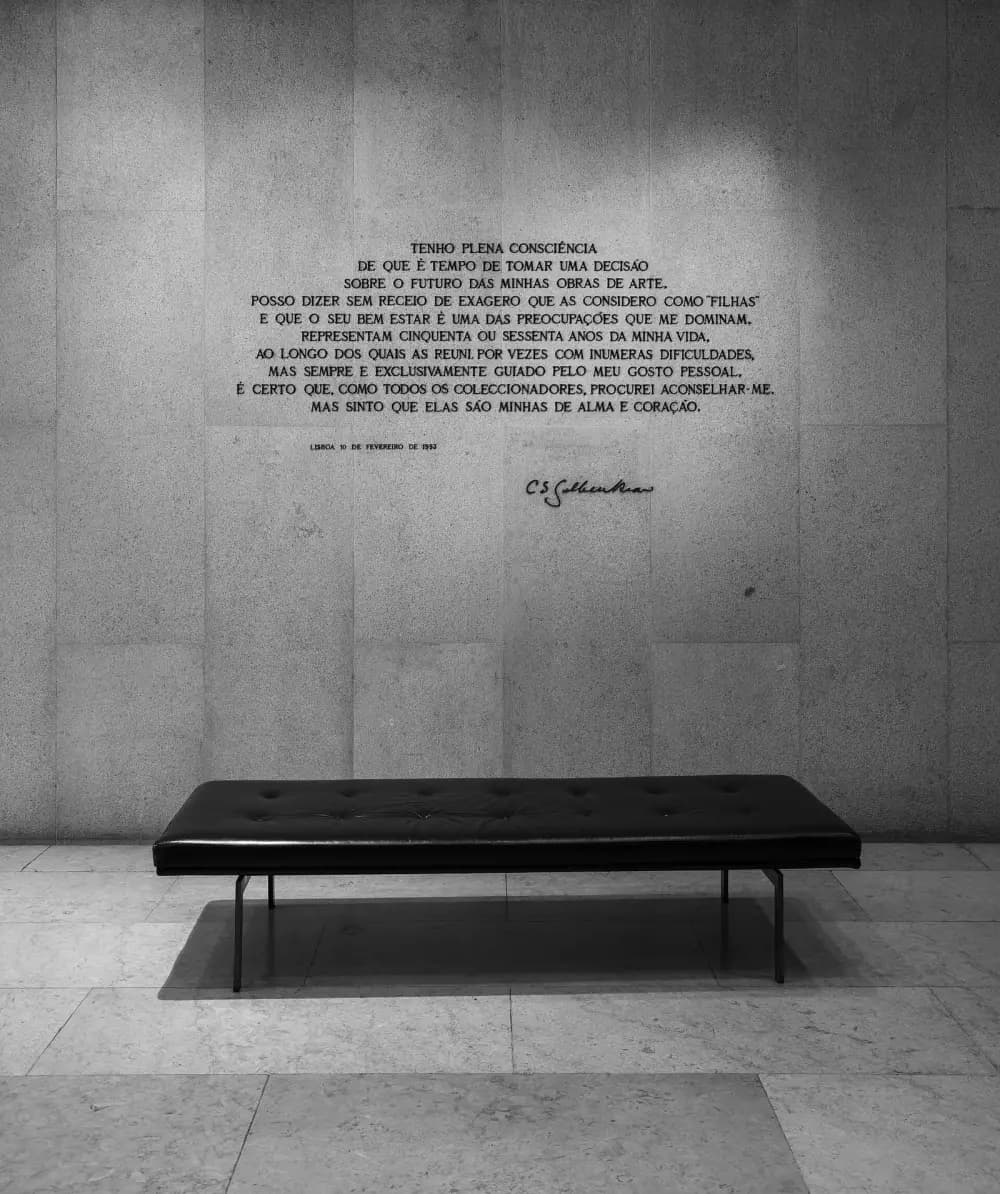
Then the guests walked through to the museum, which showed more than a thousand pieces from the collection. In its entrance hall, in bronze letters, was a passage from a letter Gulbenkian had written to Walker about his collection.
“I am fully aware that it is time to take a decision about the future of my works of art. I can say without fear of exaggeration that I consider them my “daughters”, and that their well-being is one of the concerns that dominate me. They represent fifty or sixty years of my life.”
That night the foreign minister, Franco Nogueira, gave a reception at the Necessidades Palace. The next evening the Gulbenkian Orchestra and Choir gave a choral and symphonic concert in the Grand Auditorium, and the head of state came back to hear it.
Who was Mr Five Per Cent?
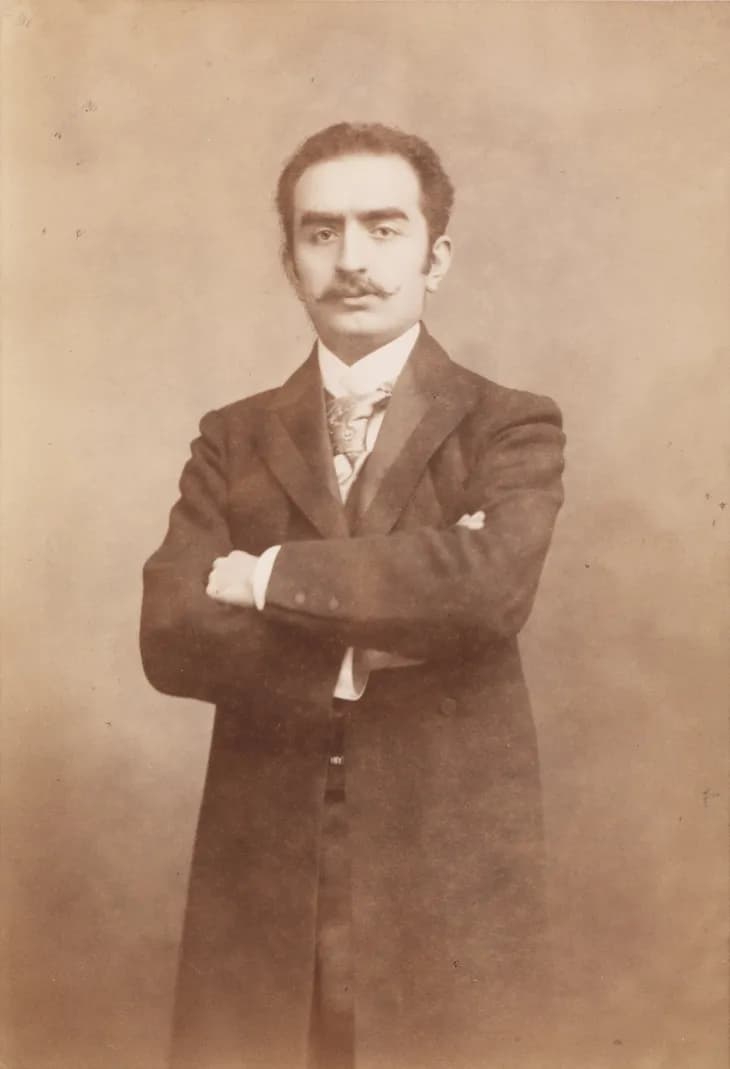
Calouste Sarkis Gulbenkian was born in March 1869 in Scutari, now Üsküdar in Istanbul. His family were Armenian merchants who traded carpets, wool and kerosene. He was sent to Marseille at 14 to perfect his French, then to King's College London, where he studied applied science and became an Associate in 1887.
In 1888 he went to Baku, on the Caspian, to study the oil business, and wrote about it for French journals. He married Nevarte Essayan in London in 1892 and took British citizenship in 1902. He called himself a business architect rather than an oilman, and after 1918 he lived mostly in Paris.
Most of his fortune came from one company. The Turkish Petroleum Company was formed in 1912 to look for oil in the Ottoman provinces of what is now Iraq, and Gulbenkian held 15 per cent of it. In 1914 he cut his stake to 5 per cent to make room for the Anglo-Persian Oil Company. After the First World War the German share passed to France, and in 1925 the company won a concession from Iraq, then under British mandate.
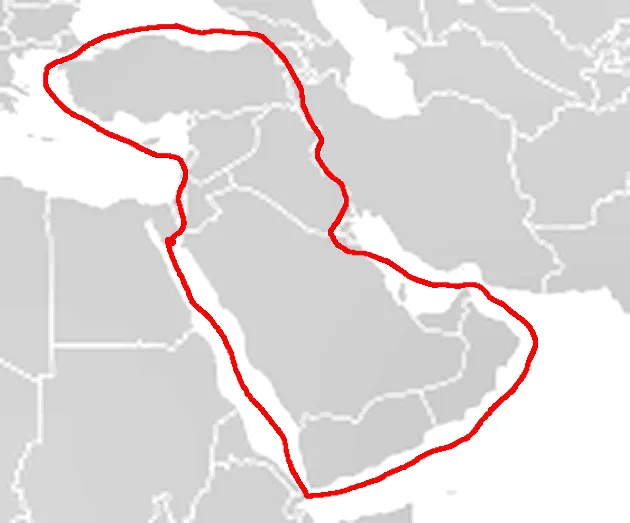
On 31 July 1928, at Ostend in Belgium, the partners signed what became known as the Red Line Agreement. American companies came in, and every partner agreed not to develop oilfields inside a line drawn round the old Ottoman lands without the others. Gulbenkian kept his 5 per cent of the crude, and he regarded the deal as his greatest achievement.
| Partner | Share of crude output |
|---|---|
| Anglo-Persian Oil Company (British) | 23.75% |
| Royal Dutch/Shell (Anglo-Dutch) | 23.75% |
| Compagnie Française des Pétroles (French) | 23.75% |
| Near East Development Corporation (American) | 23.75% |
| Calouste Gulbenkian | 5% |
He spent the money on art. Between 1928 and 1930 he bought pieces from the Hermitage in Leningrad, which the Soviet government was selling through its trading agency Antikvariat. Rubens's portrait of his wife Helena Fourment, once owned by Catherine the Great, became his in March 1930. He also bought about 200 objects from the French jeweller and glassmaker René Lalique, including 82 jewels, directly from the artist.
By his death the collection held more than 6,000 pieces, from Egyptian, Greek, Mesopotamian, Armenian, Persian and Japanese art, with paintings by Rembrandt, Rubens, Van Dyck, Gainsborough, Manet, Degas and Monet. In the 1930s the National Gallery's young director, Kenneth Clark, advised him on purchases, and from 1937 the two discussed a Gulbenkian institute beside the gallery in London.
Why it came to nothing depends on whom you read. The museum's history says the war ended the project, and that in 1947 Gulbenkian refused to let Clark's successor, Philip Hendy, show the paintings he had lent. The historian Jonathan Conlin, writing from the Foundation's archives, says plans and a model were made for a two-storey annexe, and that a series of slights by Clark's post-war successor changed Gulbenkian's mind. Conlin gives only an outline in that article and calls the episode a story in itself, told more fully elsewhere.
Five suites at the Aviz Hotel
When France fell in 1940 Gulbenkian stayed in France. Since 1920 he had been commercial adviser to Persia, and as a member of its diplomatic mission he followed the French government to Vichy. Britain classed him as an enemy and froze his assets, and his oil partners used that as an excuse to stop paying him. In 1942 Persia joined the Allies, and he had to leave.
His son Nubar persuaded him to choose Portugal over Switzerland, because from a neutral Atlantic port it would be easier to escape to the United States. He arrived in Lisbon in April 1942, meaning it as a stopover, and took five suites at the Aviz Hotel. He lived there for the last 13 years of his life, never sold his house on the Avenue d'Iéna in Paris and never learned Portuguese.
On the night of 17 December 1942 he was arrested at the Aviz, in circumstances Conlin calls mysterious, and held briefly in Lisbon's central prison until the Egyptian ambassador arrived and got him released. He demanded to know the charge; under Salazar none was needed. It was his only direct experience of the regime, and he blamed his British partners for it.
From 1942 he also had a Portuguese lawyer, José de Azeredo Perdigão, who kept out of the way when Gulbenkian's closest friend, the British lawyer Cyril Radcliffe, came to visit. Gulbenkian wrote several wills. In 1923 he wanted the collection kept together, ideally in a museum in London or Paris. A will of 1950 proposed a foundation but did not say where. By then many of his best paintings had moved on loan from the National Gallery in London to the National Gallery of Art in Washington.
The last will, signed on 18 June 1953, left most of his fortune to a foundation for charity, art, education and science. Clause 10 made it “a Portuguese permanent Foundation” with its domicile in Lisbon, free to work in any country. Gulbenkian died in Lisbon on 20 July 1955, aged 86.
Accounts differ on what the will said about the art. The museum's collection history, like the report of the 1969 opening, says it sent the works to Lisbon and called for a museum there. The Foundation's biography of its founder and a 2026 museum podcast say it said nothing directly about the collection and left the question open.
London, Lisbon and Salazar
The will named three trustees: Essayan, Perdigão and Radcliffe, one of Britain's senior judges and Gulbenkian's chief legal adviser since the 1930s. Radcliffe was to have “the supreme direction” of the estate and the Foundation and a salary of £20,000 a year. He wanted a board on which no single country would ever have a majority.
Salazar saw it differently. Portugal was poor, and the Foundation's income could be compared, he noted, with the state's whole budget for education, health and welfare.
“The Gulbenkian Foundation has unexpectedly created a public resource that could radically modify the conditions under which we seek to resolve certain fundamental problems facing Portugal.”
Between September 1955 and June 1956 the trustees argued over the conditions Portugal set for treating the Foundation as a tax-exempt charity. The government wanted a Portuguese majority on the board and at least a third of all grants spent in Portugal. Radcliffe would accept at most a third of the seats for Portuguese nationals and a minimum of 15 per cent of grants. Unknown to him, Perdigão was passing their letters to Salazar and to Marcelo Caetano, who drafted at least two of Perdigão's replies.
“If the Foundation were set up on this basis, it would not be realising the founder's intentions: it would be flouting them. It would not be carrying out the terms of his Will: it would be defeating them.”
In the end Essayan sided with Perdigão. Radcliffe renounced his trusteeship on 1 June 1956, and on 18 July Decree-Law 40 690 approved statutes for a private, perpetual foundation based in Lisbon, with Perdigão as chairman of a four-member board.
Conlin also ties the Foundation's early generosity in Britain to the dispute. During it, Perdigão and his allies in the regime proposed a grant of £1.5 million to the National Gallery in London, paid over ten years, and a UK branch with a large starting budget opened in 1956. Such grants, Conlin writes, “could be said to have bought off” any trouble from official London, leaving Radcliffe no one to appeal to.
The collection was the next fight. Perdigão said Gulbenkian had always wanted it kept together in Lisbon, though Conlin found no evidence that he had said so. In the museum's account, Radcliffe replied that there was no such obligation and that the works should go to English museums. In Conlin's, he said Gulbenkian had talked to the end of keeping them in Washington, where John Walker had shown him a film of a site beside the National Gallery of Art.
Conlin is careful about how far this can be settled. No letters or notes by Gulbenkian on his plans survive from after June 1953, so historians must choose between the competing memories of Radcliffe, Perdigão and the family. No architect's plans were ever drawn up for Washington, as they had been in London.
Most of the objects were in Paris, and France required export permits. Curators flagged 55 works, and the permits for the last 43, including Houdon's Diana, came through only at the end of 1959. Conlin writes that France received Gulbenkian's estate at Deauville and promises of future grants. The museum's account adds that his Paris house became a Portuguese cultural centre, and that the Foundation built a residence for Portuguese students in Paris.
More than 1,200 crates left Paris in four shipments between August 1958 and February 1960, mostly by rail to Santo Amaro de Oeiras, west of Lisbon. Manuscripts and medals came by sea from London, and the paintings came from Washington. By June 1960, for the first time, all 6,440 objects Gulbenkian had bought were in one place.
A park, a competition and a concrete museum
The Foundation needed a building. On 30 April 1957 it bought 69,283 square metres, six sevenths of the Parque de Santa Gertrudes, from the Eugénio de Almeida family. The park had been laid out by the Swiss gardener Jacob Weiss in 1866 to 1870 and had since housed Lisbon's zoo, a racetrack and, from 1943, the Feira Popular, the city's funfair.
In 1959 the Foundation launched a limited competition between three teams of three architects. The brief asked for “a perpetual homage to the memory of Calouste Gulbenkian”. Building began in 1962, according to the Foundation's chronology (the garden's history gives 1963), with Luís Guimarães Lobato directing the works and the landscape architects Gonçalo Ribeiro Telles and António Viana Barreto designing lawns, trees, pools and an open-air amphitheatre around the buildings.
| Team | Architects | Result |
|---|---|---|
| 1 | Ruy Jervis d'Athouguia, Pedro Cid, Alberto Pessoa | Won; built in the 1960s, opened 1969 |
| 2 | Arnaldo Araújo, Frederico George, Manuel Laginha | Not built |
| 3 | Formosinho Sanches, Arménio Losa, Pádua Ramos | Not built |
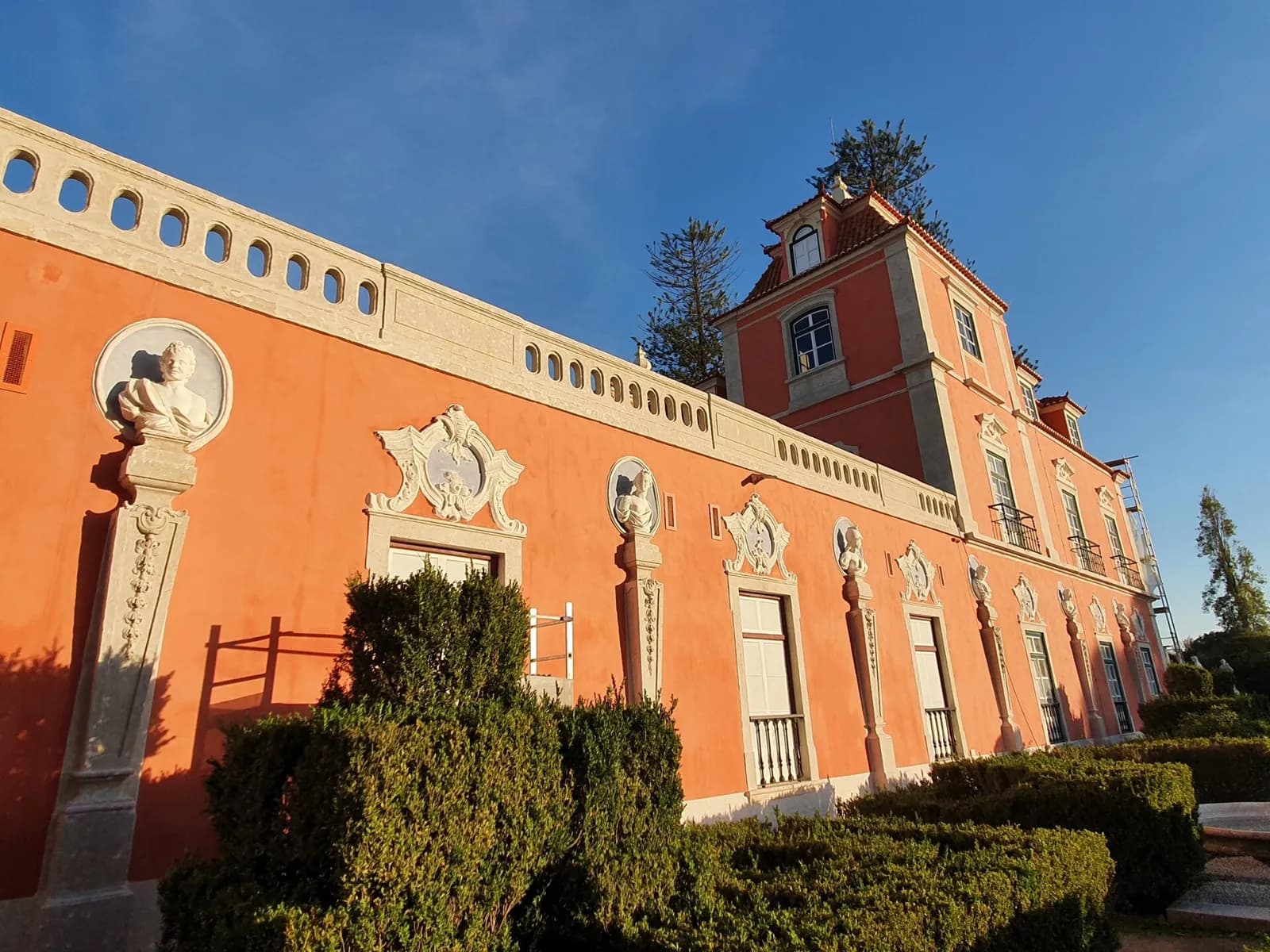
Meanwhile the art went on show near where it had landed. On 20 July 1965, the tenth anniversary of Gulbenkian's death, 300 objects went on permanent display at the Palace of the Marquis of Pombal in Oeiras. They stayed there until 1969. The rest of the collection was stored in the palace, where torrential rains in 1967 damaged some of the pieces.
The finished complex was low and horizontal, built mainly of concrete. The six-storey headquarters block, two floors partly underground, held the entrance hall, offices and a restaurant. The museum and library stood to the east, with a long gallery for temporary exhibitions between the two blocks. The Grand Auditorium seated 1,315, and the amphitheatre in the park about 1,200.
The galleries were laid out as two circuits. The first ran through Egyptian, Greek and Roman, Mesopotamian, Islamic and Far Eastern art. The second covered Europe, from the Middle Ages through French eighteenth-century painting and furniture to nineteenth-century painting and sculpture, with a final section of goldsmiths' work. Lalique's jewels were among the pieces on show.
- Opened
- Thursday 2 October 1969, centenary year of Gulbenkian's birth
- Site
- Parque de Santa Gertrudes (Palhavã), Avenida de Berna, Lisbon; about 8 hectares
- Architects
- Ruy Jervis d'Athouguia, Pedro Cid, Alberto Pessoa
- Garden
- Gonçalo Ribeiro Telles and António Viana Barreto
- Collection
- 6,440 objects, gathered from Paris, London and Washington
- Guests at the opening
- More than 1,000
18 June 1953
Gulbenkian signs his last will in Lisbon
20 July 1955
He dies in Lisbon, aged 86
1 June 1956
Radcliffe renounces his trusteeship
18 July 1956
Decree-Law 40 690 approves the Foundation's statutes
30 April 1957
The Foundation buys most of the Parque de Santa Gertrudes
Aug 1958 to Feb 1960
The collection travels from Paris to Lisbon in four shipments
1959
Limited competition for the headquarters and museum
1962 or 1963
Construction begins (sources differ)
20 July 1965
300 objects go on show at the Pombal Palace in Oeiras
2 October 1969
Headquarters and museum inaugurated
Libraries, ballet and the censor
By 1969 the Foundation was already part of Portuguese life. Its best-known programme was a service of travelling libraries, run by the writer Branquinho da Fonseca from its creation in 1957 until his death in 1974. He modelled it on the mobile library he had run for the Cascais municipal library since 1953. The first 15 vans went out in 1958.
In the second half of 1961 the network covered the whole of mainland Portugal with 47 travelling and 36 fixed libraries, and it reached the Azores and Madeira in 1963.
Gulbenkian Foundation libraries in Portugal, 1958–1987
libraries
- Travelling (vans)
- Fixed
Number of Gulbenkian travelling and fixed libraries every five years. In 1987 the state took on a national network of municipal libraries, and the Foundation closed its service in 2002. Figures from Daniel Melo, Análise Social, 2005, table 2, compiled from the Foundation's library service records.
Show the data
| Travelling (vans) | Fixed | |
|---|---|---|
| 1958 | 15 | 0 |
| 1963 | 50 | 58 |
| 1968 | 61 | 156 |
| 1973 | 62 | 169 |
| 1978 | 62 | 167 |
| 1983 | 58 | 169 |
| 1987 | 59 | 179 |
The historian Daniel Melo argues that under a regime hostile to spreading culture, only the Gulbenkian and Catholic Action had enough independence to survive censorship and political surveillance. That independence had limits. Books were chosen by a committee that Conlin, citing an earlier history, describes as party faithful. Between 1960 and 1963 the political police, the PIDE, watched and denounced library staff, among them the poet Herberto Helder at Castro Verde. The one Gulbenkian library the regime closed was the one at the Coimbra students' union.
The arts followed. The Foundation started a permanent chamber orchestra in 1962 with only twelve musicians, created a choir in 1964 and took in an experimental ballet group in 1965. It gave postgraduate scholarships from its first years and began commissioning new music from Portuguese composers in 1963.
Perdigão kept close to the regime. In 1961, when Portugal was short of foreign currency, he brought about $16 million of the Foundation's investments home, and in a 1962 report he wrote of the great need for “Family, Church and School”.
That closeness did not protect the Foundation from the regime. In June 1968 the government expelled the choreographer Maurice Béjart, whose company the Foundation had invited, after he asked the audience for a minute's silence. The Foundation's chronology says the silence was for Robert Kennedy, shot that month; the history Conlin cites describes it as one for the victims of dictatorship.
Its grants leaned towards Portugal too. In the early years 42 per cent of the money went to Portugal, a share that later rose above 85 per cent, by Conlin's count. After the revolution of 25 April 1974, which ended the dictatorship, two of the Foundation's directors were dismissed (Conlin counts five staff purged), and for a time it looked as if it might be nationalised. Perdigão defended it by arguing, as Radcliffe once had, that it was an international body.
Prizes, a national monument and Kengo Kuma
The complex won the Valmor Prize for architecture in 1975. In 1983 the Foundation opened the Centro de Arte Moderna (CAM) in the garden, a building by the British architect Leslie Martin for a modern art collection that now numbers almost 12,000 works. Perdigão remained chairman until his death in 1993.
Decree 18/2010 of 28 December 2010 classified the headquarters building and park as a national monument, naming Athouguia, Pessoa, Cid, Ribeiro Telles and Viana Barreto as its designers. Docomomo Portugal, which records modern architecture, calls it the first contemporary work to be considered heritage in Portugal. Ribeiro Telles himself led a rehabilitation of the garden from 2002.
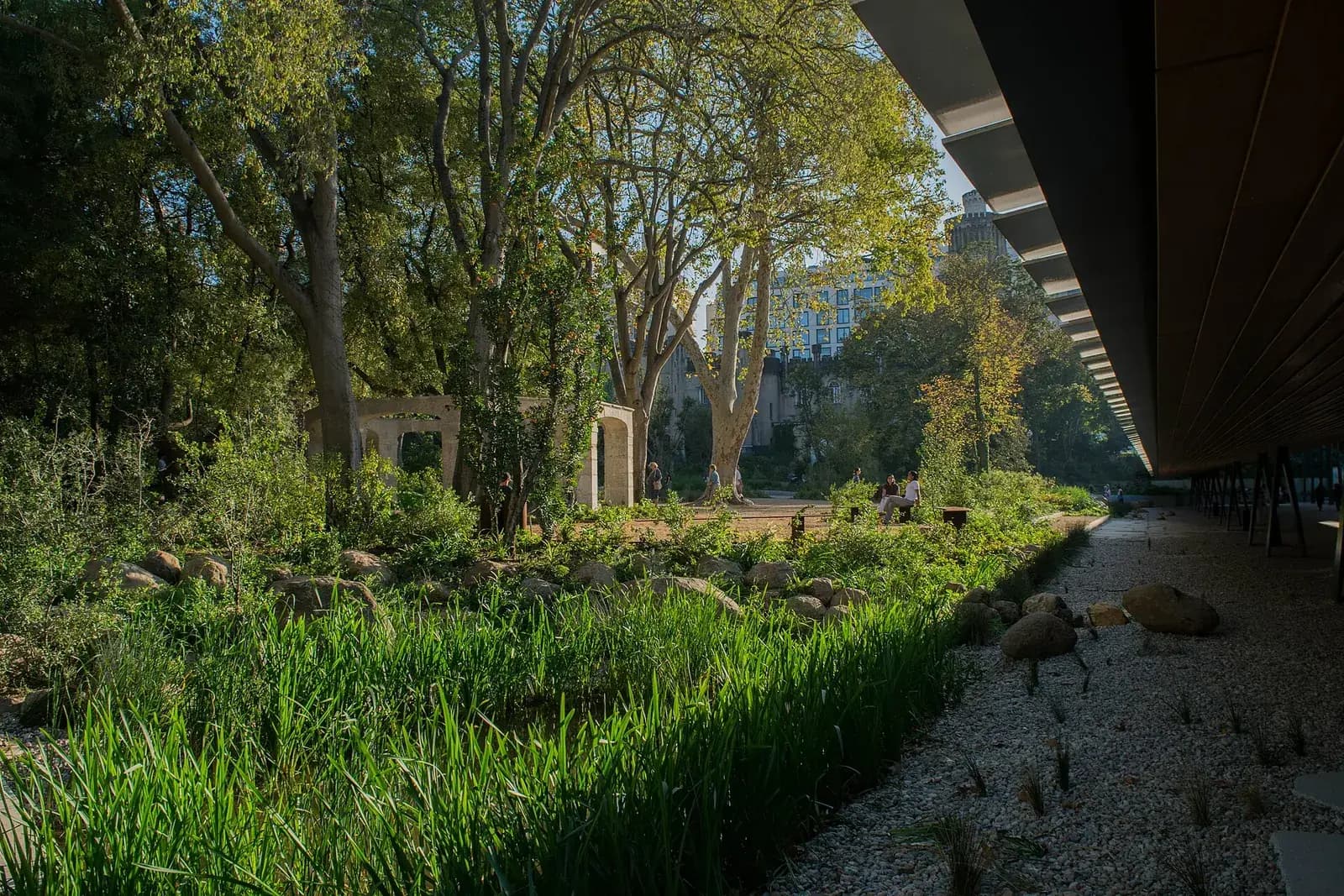
On 21 September 2024 the CAM reopened after more than four years of work, Kengo Kuma's first completed building in Portugal. Kuma added over 900 square metres of exhibition space and a 100-metre canopy of Portuguese ceramic tiles. He calls it an engawa, the Japanese term for a sheltered in-between space, and it faces a new southern extension of the garden.
The museum itself closed for about 18 months for a €7.8 million renovation, driven mainly by security, fire safety, ventilation and lighting. It reopened on 18 July 2026, the Foundation's seventieth anniversary, under a new director, Xavier Salomon, formerly of the Frick Collection in New York. The aim, he said, was to return the display as much as possible to its original 1969 state.
The Foundation now holds assets of around €3.5 billion. In 2024 it awarded 2,105 scholarships, and its garden receives about a million visitors a year.
1975
The complex wins the Valmor Prize
1983
The Centro de Arte Moderna opens in the garden
1993
Perdigão dies after 37 years as chairman
28 December 2010
Headquarters building and park classified as a national monument
21 September 2024
The CAM reopens after Kengo Kuma's redesign
18 July 2026
The museum reopens after an 18-month renovation
FAQs
When did the Gulbenkian Museum open?
The headquarters and museum of the Calouste Gulbenkian Foundation were inaugurated in Lisbon on 2 October 1969, the centenary year of Gulbenkian's birth. From 1965 part of the collection had been on show at the Pombal Palace in Oeiras.
Why was Calouste Gulbenkian called Mr Five Per Cent?
He kept a 5 per cent stake in the Turkish Petroleum Company, formed in 1912 to look for oil in what is now Iraq. Under the Red Line Agreement of 31 July 1928 four oil groups took 23.75 per cent each of its crude and Gulbenkian the remaining 5 per cent.
Why is the Gulbenkian collection in Lisbon and not London?
Gulbenkian lived in Lisbon from 1942 until his death in 1955, and his 1953 will created a Portuguese foundation based there. Sources disagree on whether the will itself sent the art to Lisbon. Plans for a Gulbenkian building beside the National Gallery in London came to nothing, and talks with the National Gallery of Art in Washington never reached the drawing board. His Portuguese lawyer, José de Azeredo Perdigão, insisted the collection belonged in Lisbon, and it arrived there between 1958 and 1960.
Who designed the Gulbenkian buildings and garden?
The architects Ruy Jervis d'Athouguia, Pedro Cid and Alberto Pessoa won a limited competition in 1959. The garden is by the landscape architects Gonçalo Ribeiro Telles and António Viana Barreto. The complex won the Valmor Prize in 1975 and became a national monument in 2010.
Is the Gulbenkian Museum open?
Yes. After about 18 months of renovation it reopened on 18 July 2026, the Foundation's seventieth anniversary, with a display returned as far as possible to its 1969 design.
On the timeline
Open the timelineNearby moments from dictatorship and the estado novo (1926–1974).
Birth in Montijo of Dulce Pontes, whose soaring reworkings of traditional song helped drive the 1990s revival of Portuguese music. Her 'Canção do Mar' found its way onto the soundtrack of the Hollywood film 'Primal Fear', and she later recorded and toured with Ennio Morricone.
At the inauguration of Coimbra University's new Mathematics building, student union president Alberto Martins asks President Américo Tomás for permission to speak and is refused. The snub sparks the 1969 academic crisis — months of strikes and exam boycotts that became one of the boldest challenges to the late Estado Novo.
Birth of Fernanda Ribeiro in Penafiel. The tenacious distance runner became world 10,000 m champion in Gothenburg in 1995 and won Olympic gold over the same distance in Atlanta in 1996, outkicking China's Wang Junxia in an Olympic record time.
The Gulbenkian Museum opens
Portugal holds its first legislative election under Marcelo Caetano. Although no opposition candidate is elected, the vote brings into the National Assembly the 'liberal wing' of Sá Carneiro, Pinto Balsemão and Miller Guerra, who would press for reform from within.
Death of Cassiano Branco, one of the most inventive Portuguese architects of the Art Deco years, designer of Lisbon's Hotel Vitória on Avenida da Liberdade, the Coliseu do Porto and Coimbra's miniature park Portugal dos Pequenitos. An outspoken opponent of Salazar, he was shut out of major state commissions and arrested by the PIDE after backing Humberto Delgado in 1958.
Death of José de Almada Negreiros in Lisbon. Born in São Tomé in 1893, painter, novelist, dramatist and provocateur, Almada was a co-founder of the magazine 'Orpheu' alongside Fernando Pessoa and Mário de Sá-Carneiro and is considered the most exuberant figure of Portuguese modernism. His murals at the Gare Marítima de Alcântara are among the great monuments of 20th-century Portuguese art.
Coming up in history
All long reads 4 October 1582The ten days Portugal never had: the calendar change of October 1582
 5 October 1910The morning Portugal became a republic: 5 October 1910
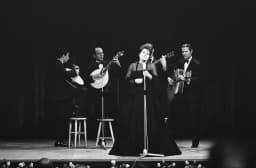 6 October 1999Amália Rodrigues, the voice of fado, dies in Lisbon: 6 October 1999
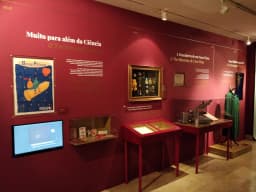 7 October 2018Odette Ferreira, HIV-2 and the blood sample carried in a coat
22 sources
Archives, scholarship and reporting this article was checked against.
- 1
A inauguração do Museu e da Sede da Fundação “Calouste Gulbenkian” em Lisboa, Revista de Guimarães 79 (3-4), July–December 1969, pp. 291-298Mário Cardoso, Sociedade Martins Sarmento (Casa de Sarmento, Universidade do Minho)
- 2
Philanthropy without borders: Calouste Gulbenkian's founding vision for the Gulbenkian Foundation, Análise Social XLV (195), 2010, pp. 277-306Jonathan Conlin, Instituto de Ciências Sociais da Universidade de Lisboa
- 3
- 4
Chronology: Calouste Gulbenkian FoundationCalouste Gulbenkian Foundation
- 5
- 6
- 7
- 8
The 1928 Red Line AgreementOffice of the Historian, U.S. Department of State
- 9
- 10
- 11
- 12
O Estado Novo (1933-1974)Assembleia da República
- 13
- 14
- 15
- 16
TV show Visita Guiada: participation of Ana Tostões, Chair of Docomomo International (on the Gulbenkian headquarters, museum and garden)Docomomo Portugal
- 17
- 18
- 19
Decreto n.º 18/2010, de 28 de Dezembro (classification of the headquarters building and park of the Calouste Gulbenkian Foundation as a national monument)Diário da República, 1.ª série, n.º 250
- 20
- 21
Lisbon's Museu Calouste Gulbenkian returns to its mid-century modern roots following major renovationThe Art Newspaper, 22 July 2026
- 22Museu Gulbenkian reabre com entrada gratuita e atividades de celebraçãoObservador, 18 July 2026
Image credits
- Part of the Gulbenkian headquarters building of 1969, seen from the reeds and long grass of the Foundation's garden in July 2017. The buildings take up about a third of an eight-hectare park. Kilian Evang, CC BY 2.0, via Wikimedia Commons.
- The inscription in the museum's entrance hall, dated Lisbon, 10 February 1953 and signed by Gulbenkian, photographed in 2024. Jules Verne Times Two, CC BY-SA 4.0, via Wikimedia Commons.
- Calouste Gulbenkian in a studio portrait dated to 1892, the year he married Nevarte Essayan in London. Unknown photographer (Calouste Gulbenkian Foundation), Public domain, via Wikimedia Commons.
- A modern, approximate drawing of the “red line” of 1928, which enclosed most of the former Ottoman lands in the Middle East. Inside it, the partners promised not to develop oil on their own. Wikiigb, CC0, via Wikimedia Commons.
- The Palace of the Marquis of Pombal in Oeiras, photographed in 2022. Part of the Gulbenkian collection was shown here from 1965 until the Lisbon museum opened. GualdimG, CC BY-SA 4.0, via Wikimedia Commons.
- The engawa, Kengo Kuma's canopy along the renovated Centro de Arte Moderna, and the new southern garden in 2024. Pedro from Lisboa, Portugal, CC BY 2.0, via Wikimedia Commons.