

The Elevador da Glória: Lisbon's hill funicular, 1885 to 2025
For 140 years two small cars, tied to one cable, carried Lisbon up the steep street from the Restauradores to the Bairro Alto. Its story runs from water ballast and top hats to the derailment that killed 16 people in 2025.
At a glance
- The Elevador da Glória, officially the Ascensor da Glória, opened on 24 October 1885, linking the Restauradores in the Baixa to São Pedro de Alcântara in the Bairro Alto along about 265 metres of steep street.
- It was Lisbon's second hill lift, after the Lavra in 1884, and was built by the Nova Companhia dos Ascensores Mecânicos de Lisboa to a system associated with the Porto-born engineer Raoul Mesnier du Ponsard.
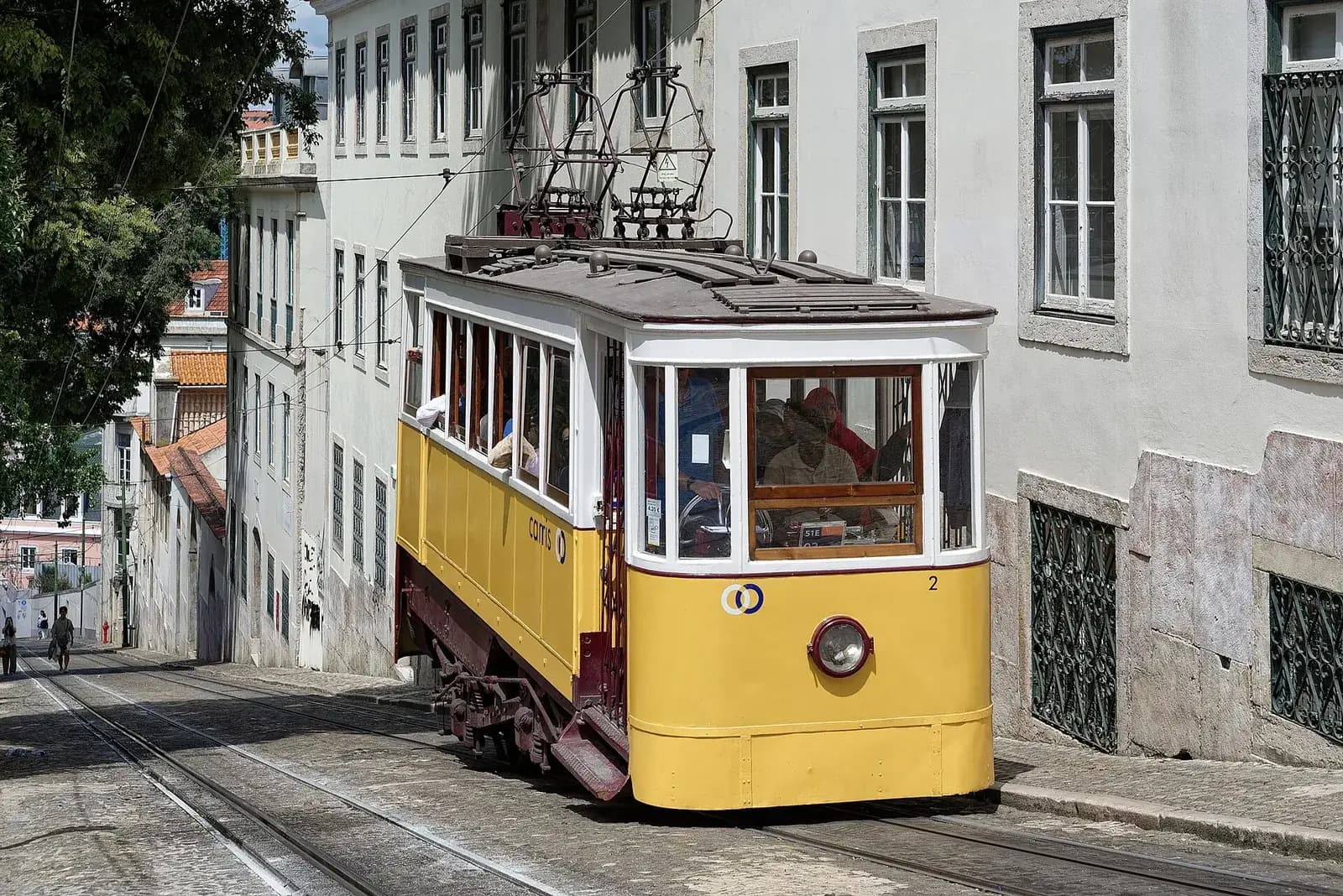
- Its two cars balance each other on a single cable. They first ran on water ballast, then on steam from about 1887, and since 1915 on electric motors in each car.
- Carris took over the company in 1926, and the Glória was classified as a national monument with the Lavra, the Bica and Santa Justa on 19 February 2002.
- On 3 September 2025 the cable broke at its fixing on car 1, the car ran away down the hill and 16 people died. Investigators found the cable did not meet Carris's specification; in October 2026 the line was still closed and the final report was not yet out.
Top hats on the upper deck
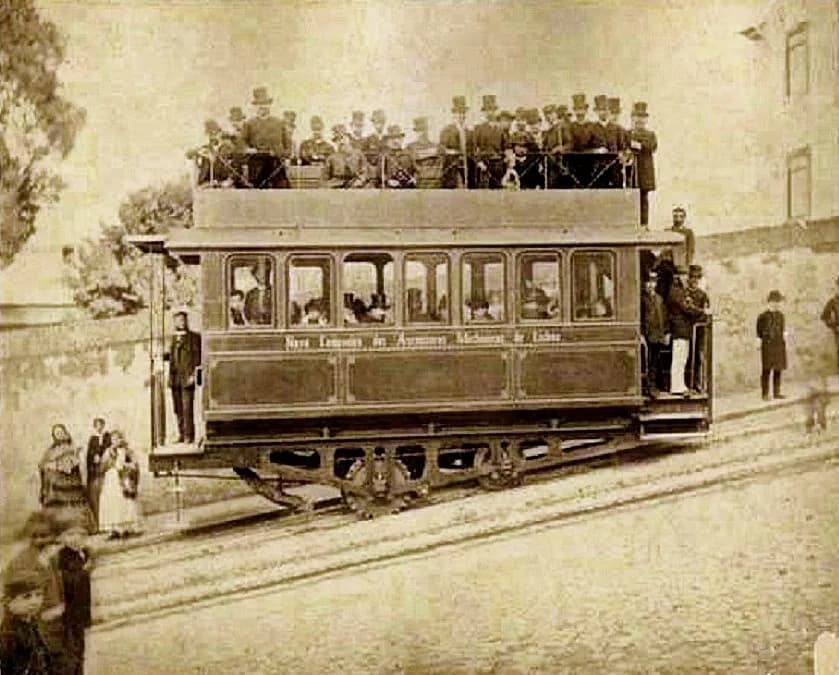
It was a Saturday, 24 October 1885. At the top of the Calçada da Glória, the steep street that climbs from the Restauradores towards the Bairro Alto, a two-storey car waited on its rails. Below was a saloon with windows. Above was an open deck with a railing, the imperial, reached by a spiral stair. For the first trip down, the car was full.
“The car that was to make the first descent was completely full of guests, councillors, engineers, journalists and men of finance, all in frock coats and straight-brimmed top hats, as was then the fashion.”
Two days earlier the city's engineer, Ressano Garcia, had approved the cars on one condition. The brakeman stood at the back of the descending car and could hardly see whether the track ahead was clear, so a second employee had to ride at the front window until a forward platform was built for him.
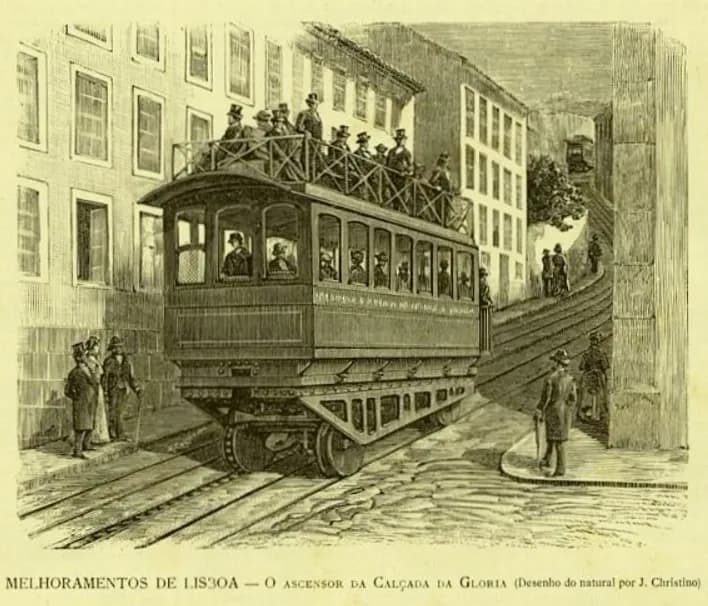
On 11 November 1885 the illustrated magazine O Occidente printed a drawing of the new machine by João Ribeiro Cristino, and its report noted that the way the public received this innovation “fully demonstrates its great usefulness”.
A city built on hills
Lisbon rises in steep slopes from the Tagus. In the sixteenth century the friar Nicolau de Oliveira wrote that it stood on seven hills, like Rome. The Glória climbs the northern flank of one of them, São Roque, where the Bairro Alto sits. For centuries the city grew mostly along the river, because carts and carriages struggled on the slopes.
Public transport came late. Carris opened its first line of americanos, horse-drawn cars on rails, on 17 November 1873, and its experiments with steam locomotives in 1877 and 1878 failed. The horses could not manage streets like the Calçada da Glória. Late-nineteenth-century Lisbon needed something that could.
A concession, two companies and a circus
Six weeks after the Braga line opened, on 10 May 1882, Mesnier asked Lisbon's council for leave to build lifts on its steepest streets, starting with the Calçada da Glória. The council's technical department answered in five days, and the contract with the new Companhia dos Ascensores Mecânicos de Lisboa (CAML) was signed on 3 June 1882.
“The establishment of inclined planes, built and run with due safety, seems not only convenient but even necessary to overcome quickly and cheaply the great differences of level that the capital presents.”
Despite the order of Mesnier's request, the first line built was the Lavra, on the facing hill of Sant'Ana, which opened on 19 April 1884. It was probably the first public transport in Lisbon to run regularly on mechanical rather than animal power. On 27 October 1884 the CAML was wound up and replaced by the Nova Companhia dos Ascensores Mecânicos de Lisboa (NCAML), with more capital.
The Glória was due by 31 May 1885 and opened almost five months late. Not everyone wanted it. The managers of the Recreios Withoyne, a circus in the grounds of the Castelo Melhor palace, had the works stopped for a time, saying the rails would block the passage of their animal cages up the street.
Water, steam, then electricity
The Glória is a funicular, and the idea is simple. Two cars are tied to the two ends of one steel cable. The cable runs in a channel under the street and loops round a large wheel buried at the top of the hill. When one car goes down, it pulls the other up, so the weight of the cars always balances.
Balanced cars need only a small push to move. In 1885 that push came from water. Each car had a tank. The car at the top took on water until it outweighed the car below with its passengers, then gravity did the rest; at the bottom the tank was emptied. The Lavra's first timetable allowed for the pauses “to fill and empty the cars' tanks”.
The brakes relied on a rack. Under the Riggenbach and Mesnier system, patented in Portugal by the Swiss engineer Nikolaus Riggenbach and sold to the company, each Glória car had a toothed wheel that ran in a rack set into the street between the rails. The wheel did not drive the car. It held its speed in check and gave the brakes something to grip.
Water was expensive and not always available. The company had asked the council for room for a steam engine at the Glória as early as October 1883, and in October 1886 it bought land at the Largo da Oliveirinha, near the top of the street, for an engine house. Steam was in regular use by 1887. Two engines turned the great wheel through a second cable that ran in its own underground channel.
“Once the Glória lift was built, it ran for some time on water; but the cost of this motor, its lack of power on certain occasions and interruptions in its supply led the board of the time, in agreement with the company's engineer, to abandon it and replace it with a mechanical motor, in this lift as in the Lavra.”
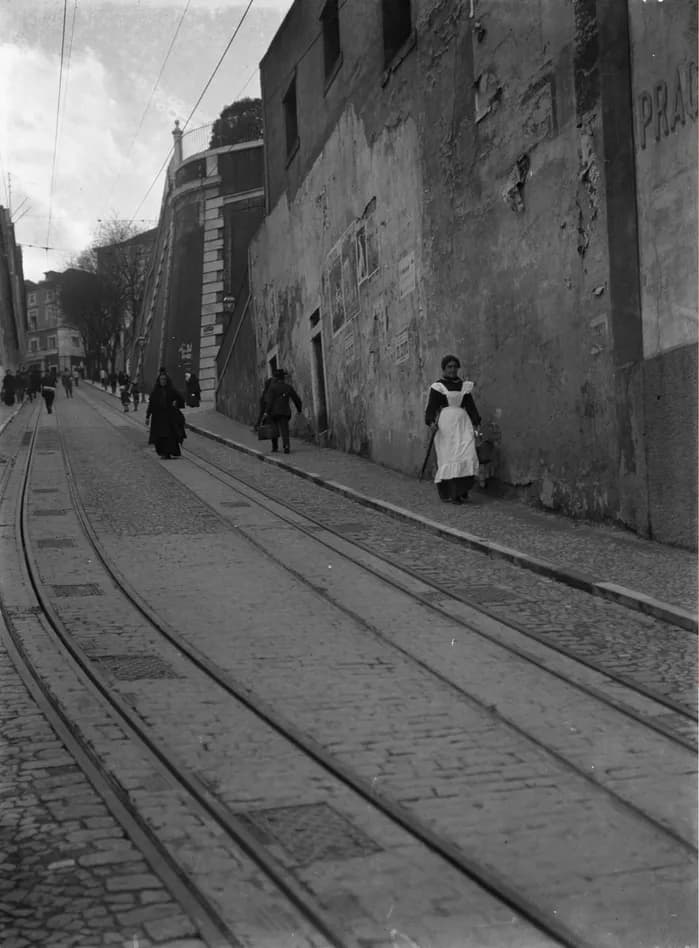
The company first asked to electrify in February 1900. The work was done in 1914 and the Glória reopened in 1915. Each car now had its own electric motors, fed from overhead wires, and the cable stayed in place to keep the two cars in balance. The steam engines were put up for sale in January 1915.
Costa calls the Lavra and Glória hybrids of funicular and electric tram, and the only ones left: similar lines in Seattle, Providence and Sydney closed long ago. Accident investigators in 2025 called the type very rare, if not unique.
- Opened
- 24 October 1885 (31 October in O Occidente)
- Route
- Praça dos Restauradores to Rua de São Pedro de Alcântara, Bairro Alto
- Length
- About 265 metres (Carris); the accident investigators give 260 metres and the BBC 275
- Gradient
- About 17 to 18 per cent (an average of 18 per cent and a rise of 45 metres, per the investigators)
- Cars
- Two, numbered 1 and 2, each for up to 42 people
- Traction
- Water ballast 1885, steam from about 1887, electric motors since 1915
- Operator
- Nova Companhia dos Ascensores Mecânicos de Lisboa, then Carris from 1926
Nine lifts in twenty years
The Glória proved the idea. In 1886, 550 residents of the Calçada da Estrela and 420 in Graça signed petitions asking the council to approve lifts of their own, pointing to the Glória and the Lavra. In the first half of 1889 those two lines sold 704,000 tickets, more than 3,800 a day. Between 1884 and 1902 Lisbon gained nine lifts. Lisbon called them ascensores when they climbed a slope and elevadores when they rose straight up, though the words were used loosely.
| Lift | Opened | Type | Today |
|---|---|---|---|
| Lavra | 19 April 1884 | Funicular | Survives (Carris); closed since September 2025 |
| Glória | 24 October 1885 | Funicular | Survives (Carris); closed since September 2025 |
| Estrela | 14 August 1890 | Cable tramway | Gone |
| Chiado | 15 February 1892 | Vertical lift | Gone |
| Bica | 28 June 1892 | Funicular | Survives (Carris); closed since September 2025 |
| Graça | 26 March 1893 | Cable tramway | Gone |
| Biblioteca (São Julião) | 12 January 1897 | Vertical lift with footbridge | Gone |
| São Sebastião | 15 January 1899 | Cable tramway | Gone |
| Santa Justa (Carmo) | 10 July 1902 | Vertical lift with footbridge | Survives (Carris); closed since September 2025 |
Opening dates from João Costa's 2008 dissertation, except Santa Justa, given by Carris as 10 July 1902 (Costa's table has 10 June). Cable tramways gripped a moving cable and could run on level streets as well as slopes. Santa Justa ran on steam until November 1907.
From company line to national monument
By the time it electrified, the Nova Companhia was run in practice by Carris, which had built Lisbon's electric tram network from 1901. The company was formally wound up on 12 November 1926 and its lifts passed to Carris. In 1927 Carris put up a shelter for queuing passengers at the foot of the line; the press called it an eyesore, and it was demolished in 1934.
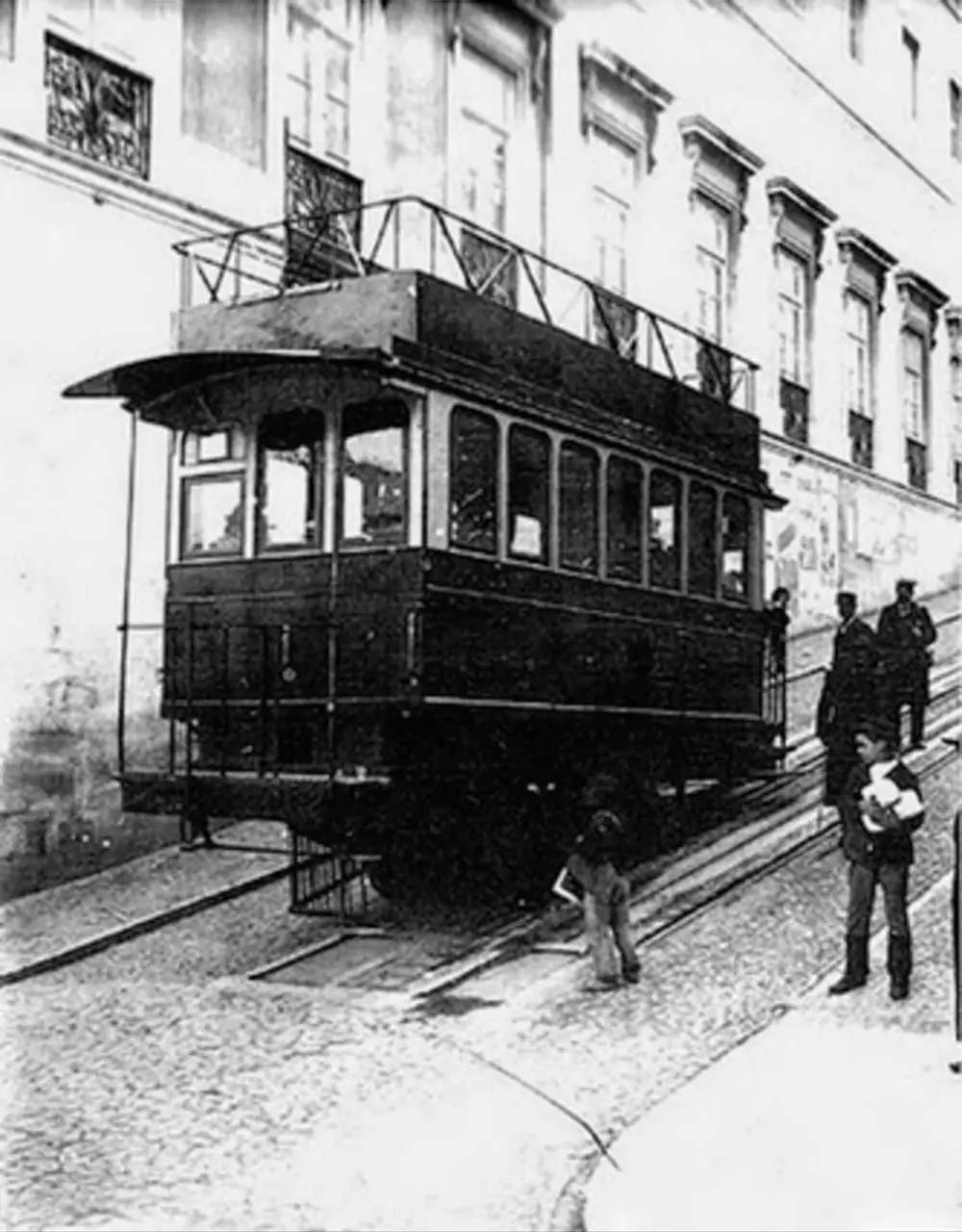
Affection came slowly. For decades the lifts were judged on usefulness and looks. The Glória's centenary in 1985 was marked with free rides, banners and a concert by the Carris band on the Avenida da Liberdade, and the first steps towards heritage protection followed. On 1 August 1995 Carris formally asked for the Lavra, Glória, Bica and Santa Justa to be classified.
“historical references inseparably linked to the image of the city of Lisbon”
Decree 5/2002 of 19 February 2002 made all four national monuments. For residents and workers the Glória remained ordinary transport, the easy way from the Restauradores metro station up to the Bairro Alto. For visitors it became one of the sights of Lisbon. Carris's lifts carried about 1.8 million passengers in 2023, and in 2024 only about a quarter of their riders used a pass.
3 September 2025
At about 6.03 pm on Wednesday 3 September 2025 the two cars set off as usual. Car 1, at the top, carried 27 people, including a child and its brakeman. Car 2, at the bottom by the Restauradores, carried 33, including three children and its brakeman. Both were well below the limit of 42.
Three seconds after the start, having moved a little over two metres, the cable snapped inside the trambolho of car 1, the fitting under the car that reaches down into the cable channel. It broke a few centimetres from the socket that anchored it, at a point that could not be seen without taking the fixing apart.
Both cars lost the balancing pull of the cable, and a safety switch at the top of the hill cut their power. Car 2 jerked back about seven metres and stopped. Car 1 ran downhill. Within a second its brakeman had set the air brake to full, and then he wound on the hand brake. Each action slightly reduced the car's acceleration, but it kept gaining speed.
About 180 metres down, where the street bends to the right, the car left the rails and began to tip over. It tore the steel edges of the cable slot out of the paving, struck the wall of a building, then a street lamp and a post carrying the overhead wires, and came to rest against the corner of another building. The first impact came about 20 seconds after the car began to move, at 41 to 49 km/h.
Those figures come from the GPIAAF's preliminary report of 20 October 2025, which drew on cameras on the cars and in the street. The investigators' first note, three days after the accident, had estimated about 170 metres, about 60 km/h and under 50 seconds, and said the brakes had no effect at all.
“In the current configuration, the brakes do not have sufficient capacity to stop the cabins in motion without their empty masses being mutually balanced by the connecting cable.”
Sixteen people died: 15 at the scene and one in hospital overnight. The authorities first announced 17, then found that one person had been counted twice. The dead were five Portuguese, among them the brakeman André Marques and four employees of the Santa Casa da Misericórdia de Lisboa, and eleven visitors: three Britons, two South Koreans, two Canadians and one person each from the United States, France, Switzerland and Ukraine.
Counts of the injured differ. On 4 September the national health service said 23 casualties had reached its hospitals, 10 of them seriously hurt, one of whom died. The GPIAAF counted 13 seriously and 9 lightly injured at the scene, some of them passers-by. Carris's 2025 annual report gives 18 injured, five seriously, and Lusa reports a year later gave 24.
Portugal held a day of national mourning on 4 September, and Lisbon three days of municipal mourning.
“one of the biggest human tragedies of our recent history”
What the investigators found
The GPIAAF, Portugal's independent investigator of air and rail accidents, published its preliminary report on 20 October 2025. It found that the cable “did not comply with CCFL’s specification for use in the Glória Funicular” (CCFL is Carris), was not certified for installations carrying people, and was not suitable for the swivels fitted at its ends on the Glória and the Lavra.
The report traced the error to a 2022 purchase. For reasons Carris could not explain, the specification sent to suppliers for the Glória and Lavra cables was one written for a Santa Justa cable, with only the diameter changed, and the differences went unnoticed in the contract and on delivery.
When the first cable of the batch was fitted in December 2022, workers saw that it had a fibre core and was far more flexible, but did not have the expertise to recognise the problem. Carris's engineers assumed it was the fibre-core alternative their specification allowed.
The cable that failed went into service on 1 October 2024 and broke after 337 days, well within the 600-day limit Carris set for these cables. An identical cable had run for 601 days on the Glória, and another for 606 on the Lavra, without incident. The GPIAAF said it could not yet say whether the non-conforming cable played a part, only that other factors must also have been at work.
The fixing and the brakes drew questions too. X-rays of the socket where the cable broke, a cone of cast metal gripping the wire ends, showed much less dense or even empty zones inside. Sockets were made by a method handed down among workers and written in an old notebook, which did not match European standards. No one at Carris could remember the emergency brake ever being tested for a cable failure.
The report also criticised the maintenance. Since 2019 the work had been done by a contractor, MNTC, with five technicians trained on the job. Tasks were recorded as done, but investigators found evidence that the records did not match the work actually carried out.
No one outside Carris was checking. The Glória and the Lavra had been treated first as traditional cable-hauled trams and later as heritage installations in service before 1986, so they stayed outside the supervision of the transport regulator, the IMT. The GPIAAF found no other body overseeing their safety, which was the responsibility of Carris alone.
After the report the Carris board resigned. A new board under Rui Lopo took office on 1 January 2026 and set up a project team to prepare the reopening of the historic lifts. In May 2026 the Polícia Judiciária searched Carris's headquarters in an inquiry which, according to CNN Portugal, concerns negligent homicide and breaches of safety rules. Both the GPIAAF and the prosecutors expect to conclude by the end of the first quarter of 2027.
The Glória today
Car 1 could not be repaired. The day after the accident Carris's then chairman, Pedro Bogas, promised Lisbon a new Glória, “with even more safety”, but gave no date. On 3 September 2026, a year after the accident, a memorial to the victims was unveiled.
In October 2026 Carris still listed the Glória as temporarily closed. Since 12 September 2025 a minibus, route 51E, has run in its place from the Restauradores up to the Bairro Alto and the Largo do Carmo. The Lavra, the Bica and Santa Justa also stopped after the accident, and Carris's service notice says its lifts are being tested and remain out of service. No reopening date had been announced.
10 May 1882
Raoul Mesnier asks Lisbon council for leave to build lifts, starting with the Calçada da Glória
3 June 1882
Contract signed with the Companhia dos Ascensores Mecânicos de Lisboa
19 April 1884
The Lavra lift opens, the first in Lisbon
27 October 1884
The Nova Companhia replaces the original company
24 October 1885
The Glória opens, worked by water ballast
1887
Steam engines take over the hauling
1914 to 1915
Electrified, with motors on each car; service resumes in 1915
12 November 1926
The Nova Companhia is wound up and its lifts pass to Carris
1985
Centenary celebrated with free rides
19 February 2002
Classified as a national monument
1 October 2024
The cable that later failed goes into service
3 September 2025
The cable breaks; car 1 derails and 16 people die
20 October 2025
GPIAAF preliminary report on the cable, its fixing, the brakes and maintenance
3 September 2026
Memorial to the victims unveiled
FAQs
When did the Elevador da Glória open?
Carris and most histories give Saturday 24 October 1885. The magazine O Occidente reported that it opened to the public on 31 October, but council records show passengers were already riding before then.
Who designed the Elevador da Glória?
It is credited to Raoul Mesnier du Ponsard (1848 to 1914), a Porto-born engineer of French descent who founded the company behind Lisbon's first lifts and is linked to all of Lisbon's lifts of 1884 to 1902, including Santa Justa.
How does the Glória funicular work?
Its two cars are tied to opposite ends of one cable that loops round a wheel at the top, so one goes down as the other goes up and their weights balance. Water ballast drove it at first, then steam; since 1915 electric motors on each car have moved it.
What caused the 2025 Glória accident?
The cable linking the two cars broke inside its fixing on car 1, and the brakes could not stop a car without the cable. The preliminary report found the cable did not meet Carris's specification but could not yet say whether that caused the break. The final report is expected by the end of March 2027.
Is the Elevador da Glória running now?
No. In October 2026 Carris listed it as temporarily closed, with the 51E minibus running instead between the Restauradores and the Bairro Alto. No reopening date had been announced.
On the timeline
Open the timelineNearby moments from regeneration and the last kings (1851–1910).
Birth in Loulé of José Mendes Cabeçadas, the naval officer who helped both to make and to unmake the First Republic. A leader of the mutiny aboard the cruiser Adamastor in the 1910 revolution, he raised the 1926 revolt in Lisbon that toppled the Republic and was briefly head of state, until the generals pushed him aside. He spent his last decades conspiring against Salazar.
The Berlin Conference ends with 14 nations, Portugal among them, signing its General Act on the 'Scramble for Africa'. Its principle that claims needed 'effective occupation' pushed Lisbon to back its claims with expeditions and the 'Pink Map' plan to link Angola and Mozambique, crushed by Britain's 1890 ultimatum.
Birth of Aristides de Sousa Mendes at Cabanas de Viriato, Beira Alta. As Portuguese consul-general in Bordeaux in June 1940, he would defy Salazar's standing orders and issue thousands of visas to refugees — many of them Jews — fleeing the Nazi advance, an act of conscience that cost him his career and would later earn him the title 'Righteous Among the Nations'.
The Elevador da Glória opens
Cosme Damião is born in Lumiar, Lisbon. A former Casa Pia pupil, he was the driving force among the young founders of Sport Lisboa in 1904, the club that became Benfica, and served it as captain, coach and journalist for two decades — yet always refused to become its president.
Death in Lisbon of Fernando II, the 'King-Artist' and widower of Maria II, who turned a ruined monastery above Sintra into the fairy-tale Pena Palace. Suffering double vision from a facial tumour, he had fallen on the stairs of the São Carlos opera house three days earlier and never recovered; his will, leaving almost everything to his second wife, the singer Elise Hensler, caused a scandal.
Crown Prince Carlos, the future King Carlos I, marries Amélie of Orléans at the Church of São Domingos in Lisbon; as Queen Amélia she would be the last queen consort of Portugal.
Coming up in history
All long reads 26 October 1969Portugal's 1969 election: Caetano's first vote and the opposition it shaped
 27 October 1949Egas Moniz, the lobotomy and Portugal's first Nobel Prize
 28 October 1856Portugal's first train: Lisbon to Carregado, 28 October 1856
 29 October 1936Tarrafal, 29 October 1936: Salazar's prison camp in Cape Verde opens
20 sources
Archives, scholarship and reporting this article was checked against.
- 1
Um caso de património local: a tomada de Lisboa pelos ascensores (João Manuel Hipólito Firmino da Costa, MA dissertation)Universidade Aberta, 2008
- 2
História: Carris, uma empresa ao serviço de LisboaCarris (Companhia Carris de Ferro de Lisboa)
- 3
Relatório preliminar, processo F_Inv20250903: descarrilamento e subsequente colisão das cabinas do Ascensor da GlóriaGPIAAF (Gabinete de Prevenção e Investigação de Acidentes com Aeronaves e de Acidentes Ferroviários), 20 October 2025
- 4
- 5
- 6
- 7Ligação da MNTC à Carris foi maior: contratos entregues à empresa de manutenção atingiram mais de 2 milhões de eurosObservador, 7 September 2026
- 8
- 9
Veículo é “irrecuperável”, mas Lisboa vai ter um “novo” Elevador da GlóriaLisboa para Pessoas, 5 September 2025
- 10
Lisbon crash one of our biggest tragedies, Portuguese PM saysBBC News, 4 September 2025
- 11
- 12
Ascensores e Elevador em teste (service notice)Carris
- 13Elevador da Glória: cabo não estava certificado para transporte de pessoasECO (with Lusa), 20 October 2025
- 14Cabo que unia as duas cabinas do elevador da Glória cedeu, diz relatórioECO, 6 September 2025
- 15Elevador da Glória. Proteção Civil corrige número de mortos para 16RTP, 4 September 2025
- 16Já são conhecidas as nacionalidades dos 16 mortos no acidente do Elevador da GlóriaCorreio da Manhã, 5 September 2025
- 17Vítimas identificadas. Acidente no Elevador da Glória investigado desde o primeiro minutoRTP, 4 September 2025
- 18Elevador da Glória: família de uma das vítimas mortais exige pedido formal de desculpas da CarrisObservador (Lusa), 3 September 2026
- 19Elevador da Glória. A Carris está a trabalhar para “sair por cima” de processo que “machuca muito”Observador (Lusa), 2 June 2026
- 20
Image credits
- Car 2 of the Elevador da Glória on the Calçada da Glória in June 2025, three months before the derailment that halted the line. Jakub Hałun, CC BY 4.0, via Wikimedia Commons.
- “Melhoramentos de Lisboa: o ascensor da Calçada da Gloria”, drawn from life by J. Christino and published in O Occidente on 11 November 1885. The car still lacks the front platform the city demanded. João Ribeiro Cristino da Silva, Public domain, via Wikimedia Commons.
- A Glória car of the Nova Companhia dos Ascensores Mecânicos de Lisboa packed with men in top hats. The photograph is usually dated to the opening in October 1885, but the car already has the front platform the city demanded, and in March 1886 the council was still asking to see its design, so it may be later. The toothed wheel ran in a rack between the rails. Unknown author, Public domain, via Wikimedia Commons.
- The Calçada da Glória in October 1915, after electrification, with the overhead wires that now powered the cars. Joshua Benoliel, Public domain, via Wikimedia Commons.
- A Glória car with its upper deck and front platform, photographed by Joshua Benoliel around 1900. Joshua Benoliel, Public domain, via Wikimedia Commons.