

Portugal's 1969 election: Caetano's first vote and the opposition it shaped
A year after Salazar's fall, his successor let the opposition run for parliament. The União Nacional still won all 130 seats, and the men and women of that campaign went on to found several of the parties of democratic Portugal.
At a glance
- On Sunday 26 October 1969 Portugal elected its National Assembly, the first vote under Marcelo Caetano, who had replaced the incapacitated Salazar in September 1968.
- For the first time since 1957 the opposition stayed in the race to polling day: the CDE, Mário Soares's CEUD and a monarchist list fielded 182 candidates for 100 of the 130 seats.
- Only about 1.8 million people were on the electoral roll, roughly 29 per cent of adults, and about 62 per cent of them voted.
- The regime's União Nacional won 88 per cent of the valid votes and every seat, after a campaign marked by censorship, police harassment and fraud.
- A 'liberal wing' elected on the regime's lists, including Sá Carneiro, Pinto Balsemão and Magalhães Mota, failed to reform it from within and in 1974 founded the PPD, today's PSD.
A Sunday at the ballot box
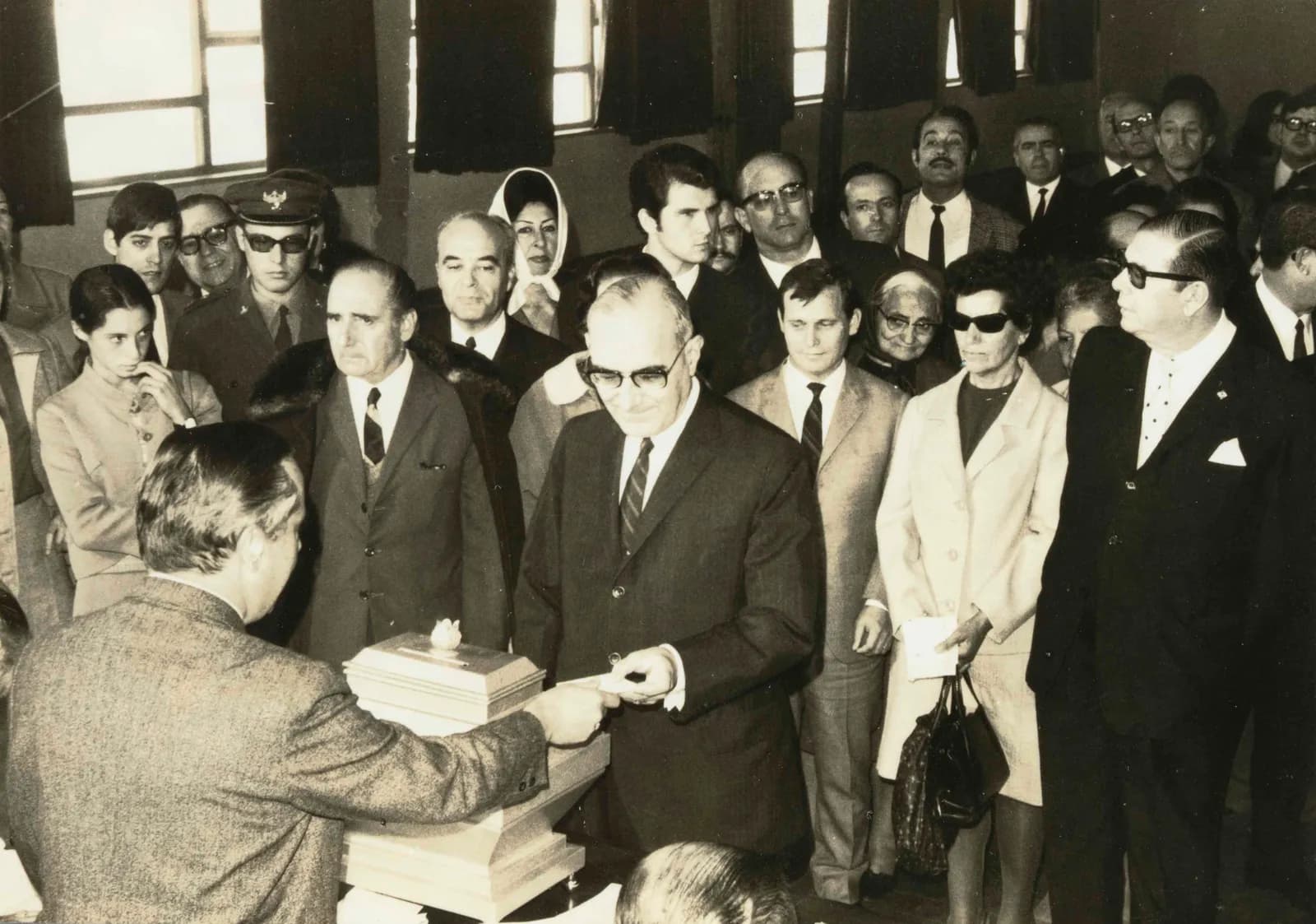
On Sunday 26 October 1969, a photographer caught Marcelo Caetano at the ballot box. The 63-year-old law professor, head of the Portuguese government for just over a year, held out his folded paper across a table while a crowd of voters, officials and a uniformed soldier looked on.
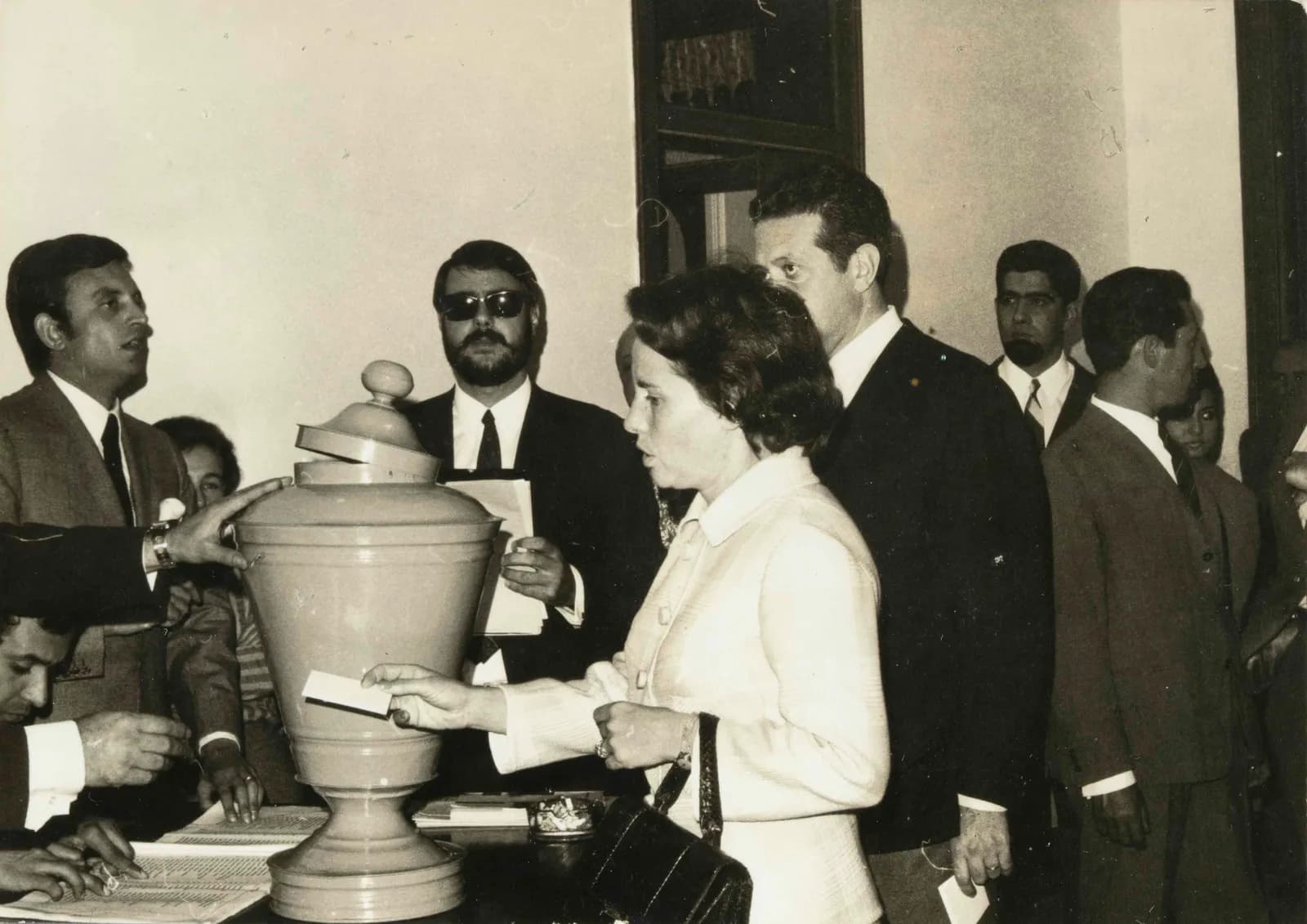
The same day Mário Soares and his wife, Maria Barroso, voted too. In March 1968 Soares had been deported to the island of São Tomé. Now he led the CEUD, one of the opposition lists. Barroso stood for another, the CDE, in Santarém. Voters could strike out names on a list, and she ended up with more votes than anyone else on hers.
Everyone knew who would win. The regime's own organisation, the União Nacional, ran under a winner-takes-all system that gave minorities no chance of a seat. What was new in 1969 was that the opposition stayed in the race to the end, campaigned openly for a month, and tested how far the new man in charge would let Portugal change.
Salazar's chair and Caetano's spring
António de Oliveira Salazar had run the government for 36 years. On 3 August 1968, at the Forte de Santo António da Barra in São João do Estoril, his summer residence since 1950, he fell from a chair. His health collapsed over the following weeks.
On 27 September 1968 the Diário do Governo published Decree 48 597. President Américo Tomás dismissed Salazar as President of the Council, letting him keep all the honours of the office, and named Marcelo Caetano in his place. Caetano had helped draft the 1933 Constitution, served as Minister of the Colonies and Minister of the Presidency, and been rector of the University of Lisbon. Since the late 1940s he had led the regime's reformist current.
His first months raised hopes that became known as the Primavera Marcelista, the Marcelist Spring. Soares was allowed back from São Tomé, and the Bishop of Porto, António Ferreira Gomes, from ten years' exile. The government widened the right to vote, revised union law in workers' favour, created a family allowance for rural labourers and trimmed some powers of the political police. Caetano's own phrase for his programme was renovação na continuidade, renewal in continuity. It is also often quoted as evolução na continuidade, evolution in continuity.
On the issue that mattered most, nothing moved. Portugal had been fighting wars against independence movements in Angola, Guinea and Mozambique since the early 1960s, and Caetano meant to keep the colonies. Abroad, the wars left the regime increasingly isolated.
Who could vote
A decree of 1931, under the military dictatorship, gave some women the vote on stricter terms than men. When the Estado Novo elected its first National Assembly in 1934, voters had to be over 21 or legally emancipated. Illiterates could vote only if they paid at least 100 escudos in tax, and women only if they had completed a special, secondary or higher course of study.
Decrees of 1945 and 1946 widened the female vote a little. Women who were heads of family could vote if they paid the same 100 escudos in tax as illiterate men, and married women who could read and write if they paid at least 200 escudos in property tax. A man who could read and write faced neither test.
Law 2137, published on 26 December 1968, ended the distinction. Any Portuguese citizen over 21, or legally emancipated, who could read and write Portuguese could now vote for the Assembly, along with illiterates who had already been registered under the old rules. Women and men finally faced the same test. The law still barred anyone caught by its incapacities, which, in the Inter-Parliamentary Union's summary, included a criminal conviction and professing opinions that endangered the security of the State.
The literacy test still excluded many people, and the government did not update the electoral rolls. Mainland Portugal, the Azores and Madeira had about 9.5 million inhabitants, but only about 1.8 million were registered, around 29 per cent of the population over 21. The historian José Manuel Tavares Castilho called control of the roll one of the keys to the regime's electoral success.
- Election day
- Sunday 26 October 1969
- Body elected
- National Assembly (Assembleia Nacional), 130 seats
- System
- Winner takes all: the list with most votes in a constituency took every seat there
- Campaign
- Officially from 28 September, about a month
- Registered voters
- 1,784,341, about 29% of the population over 21
- Opposition
- 182 candidates in 22 of 30 constituencies, contesting 100 seats
The opposition goes to the polls
In December 1968 about 400 people signed a manifesto, À Nação, drafted by the Associação Socialista Portuguesa of Soares and Francisco Salgado Zenha. It offered dialogue with the government in return for free speech, an amnesty, curbs on the police and censorship, and an honest electoral law. The Portuguese Communist Party saw Caetano as Salazarism under a liberal cover and accused the socialists of collaboration.
The government gave little ground. In February 1969 the civil governor of Lisbon banned the Comissão Promotora do Voto, a cross-party group that wanted a new electoral roll and a new law. By May the socialists had concluded that the vote would be a farce, as before. On 15 June, at São Pedro de Moel near Marinha Grande, the opposition agreed a common platform: civil liberties, the end of the political police, the release of political prisoners and a peaceful, political solution to the wars.
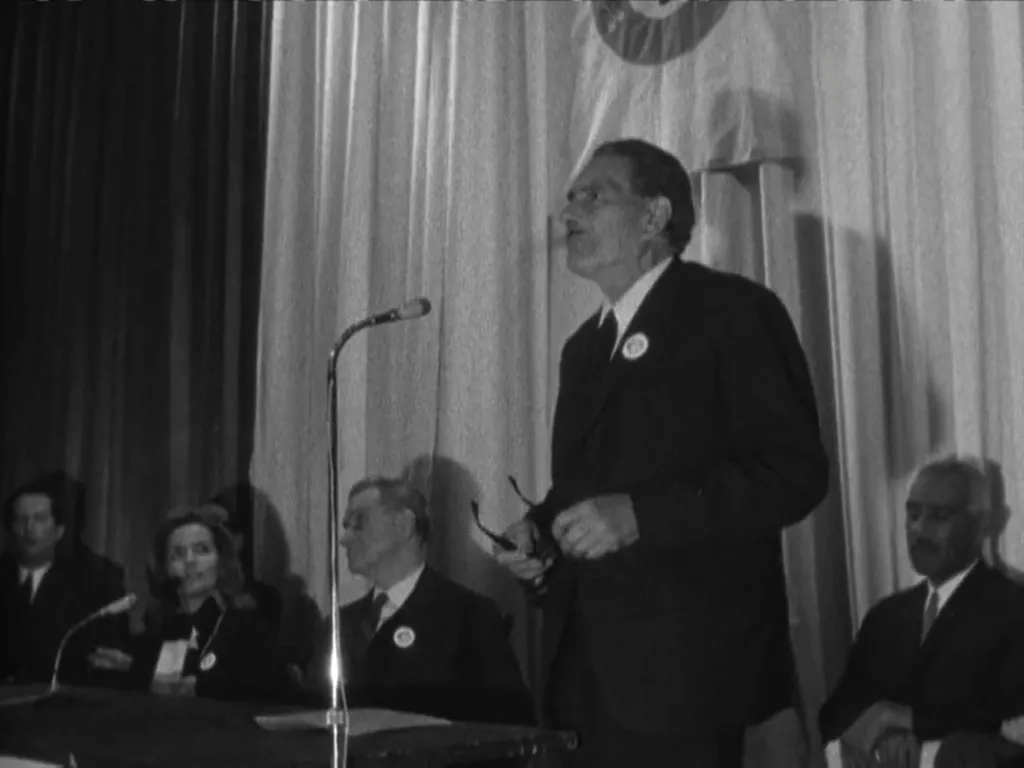
Unity did not last. The historian Mário Matos e Lemos dates the break to a letter Soares sent the CDE on 28 July. In Lisbon, Porto and Braga the socialists ran their own lists as the Comissão Eleitoral de Unidade Democrática (CEUD), with Catholics such as the poet Sophia de Mello Breyner Andresen and monarchists such as Gonçalo Ribeiro Telles.
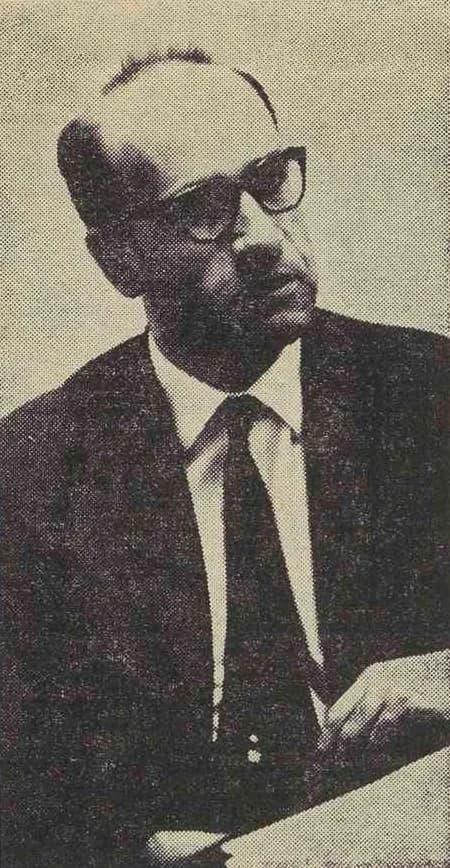
Elsewhere the socialists joined the Comissão Democrática Eleitoral (CDE). Led by the Catholic economist Francisco Pereira de Moura, it brought together Communists and their allies, other Catholic progressives and the independent socialist Jorge Sampaio. In Lisbon a Comissão Eleitoral Monárquica (CEM) also stood.
“Electoral intervention makes it possible to denounce the elections themselves in more effective terms than those that abstention offers.”
Together the three lists fielded 182 candidates in 22 of the 30 constituencies. Nine were women, more than in any other Estado Novo election. Only Bragança, which withdrew at the last minute, and Portalegre, which could not gather the 50 signatures in time, had no opposition list in mainland Portugal. A CEUD list in Mozambique was rejected on the grounds that its candidates had not proved their nationality, a certificate never asked of União Nacional candidates.
A campaign under watch
The election committees were legalised only by a decree-law of 5 September 1969, seven weeks before the vote. Civil governors, appointed by the Ministry of the Interior, could dissolve them on vague grounds. Candidates had to declare that they accepted the Constitution and the established social order, and governors declared five of them ineligible.
The campaign followed the old pattern. Candidates and activists were beaten and arrested, and campaign offices were raided by police and by the Legião Portuguesa, the regime's militia. Halls were refused, meetings broken up, books and leaflets seized. The opposition had no access to radio or television, and the press was censored. Opposition ballot papers were swapped or delivered late by the post office.
The fraud continued on polling day. The Assembleia da República's study, drawing on Soares's memoirs and on Eleições no Regime Fascista, published in 1979 by the post-revolution government's Comissão do Livro Negro sobre o Fascismo, records that more than 1,500 certificates were forged and others used in the names of dead or absent voters. Members of the Legião could then vote several times, with the connivance of polling-station chairmen.
“There is an impression, among supporters of the regime, that if scrutiny is allowed at the polling stations, the percentage of votes for the União Nacional list in some localities will be 3%, with many abstentions as well, while the opposition will reach 50%.”
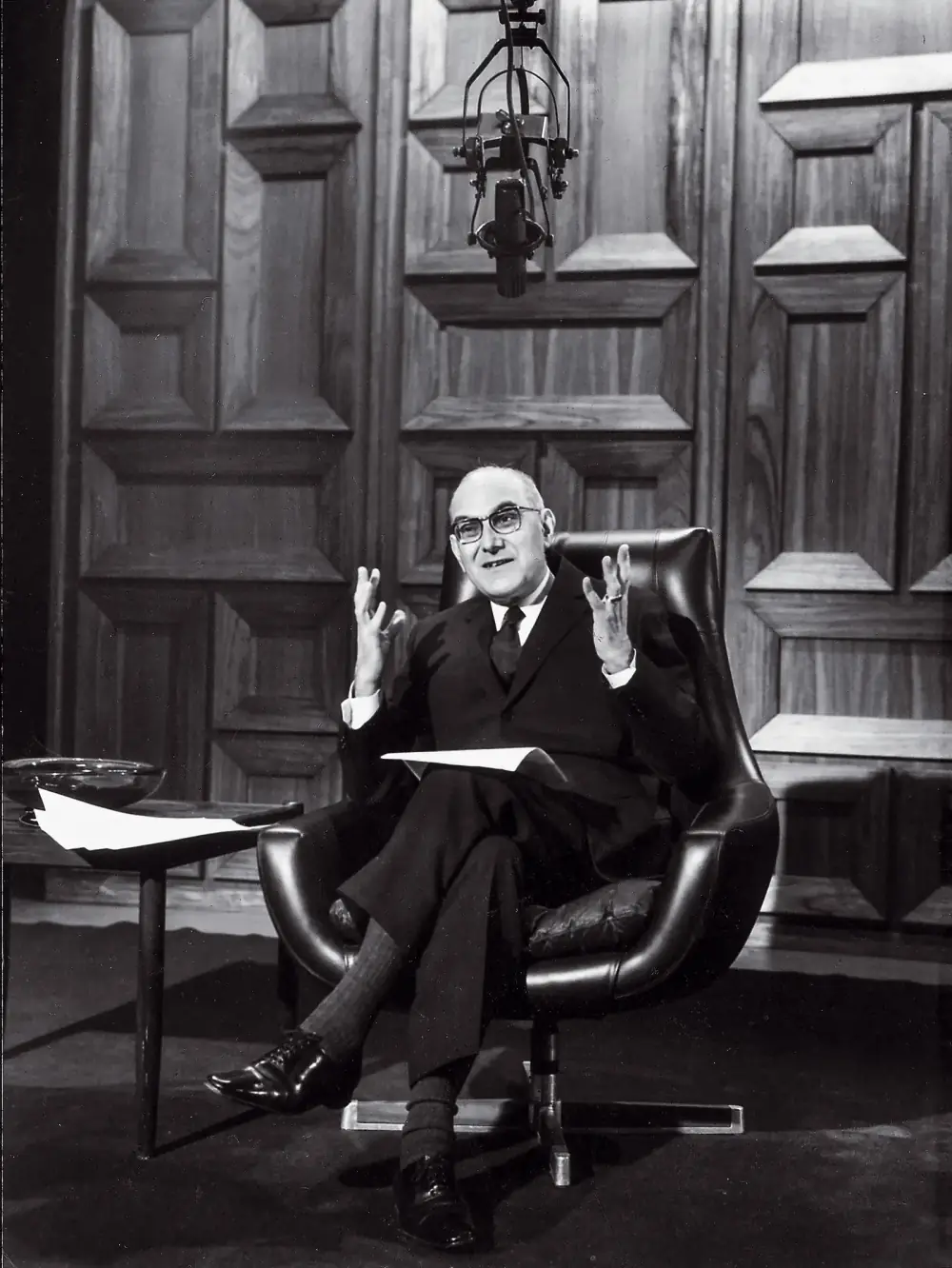
Caetano campaigned in person. In September and October he told voters that choosing the União Nacional meant order, peace and the gradual autonomy of the overseas provinces, and that choosing the opposition meant abandoning them and risking communism and chaos.
“He wants to seek in the vote, in popular assent, the authorisation to continue the military commitment overseas.”
The count: 130 seats out of 130
The União Nacional won every constituency and so every seat. Of 1,784,341 registered voters, 1,115,248 cast a ballot, a turnout of 62.5 per cent by the Inter-Parliamentary Union's figures; the Assembleia da República's study puts abstention at 38.4 per cent. The same study notes that abstention would have been much higher if the fraudulent votes could be counted.
| List | Who was on it | Votes | Share of valid votes | Seats |
|---|---|---|---|---|
| União Nacional | The regime's list, renewed with young technocrats and liberal independents | 981,263 | 88.1% | 130 |
| CDE (Comissão Democrática Eleitoral) | Communists, Catholic progressives, socialists and independents; led by Francisco Pereira de Moura | 114,745 | 10.3% | 0 |
| CEUD (Comissão Eleitoral de Unidade Democrática) | Mário Soares's socialists, with Catholics and monarchists; Lisbon, Porto and Braga only | 16,863 | 1.5% | 0 |
| CEM (Comissão Eleitoral Monárquica) | Opposition monarchists, Lisbon only | 1,324 | 0.1% | 0 |
Votes from the Inter-Parliamentary Union's report, which prints rounded shares of 88, 10.2, 1.5 and 0.1 per cent; the shares here are calculated from its votes (1,114,195 valid, 1,053 void or blank). The Assembleia da República study, drawing on the 1970 compilation As Eleições de Outubro de 1969, gives 88, 10, 1.9 and 0.8 per cent. Neither source explains the gap for the two smaller lists.
Share of the valid vote by list, 26 October 1969
% of valid votes
Calculated from the official vote counts reported by the Inter-Parliamentary Union. The Assembleia da República study gives slightly higher shares for the CEUD (1.9%) and the CEM (0.8%).
Show the data
| Share of valid votes | |
|---|---|
| União Nacional | 88.1 |
| CDE | 10.3 |
| CEUD | 1.5 |
| CEM | 0.1 |
The opposition's best results came south of the Tagus. The CDE took 34.7 per cent in the district of Setúbal, won some parishes in municipalities such as Almada, Moita, Montijo, Palmela and Seixal, and carried every parish in Barreiro. In the districts of Lisbon and Porto together, just over 296,000 people voted.
On 8 November the Minister of the Interior declared the election committees no longer legal and ordered them disbanded. The political scientist Pedro Emanuel Mendes argues that Caetano, though no democrat, believed a leader needed some democratic legitimacy. He spoke often afterwards of the mandato indeclinável, the mandate he could not refuse, that he said the Portuguese people had given him in 1969.
The liberal wing inside the Assembly
Caetano wanted new faces in parliament as well as a vote of confidence. José Guilherme de Melo e Castro, a liberal Catholic who headed the União Nacional's executive committee, recruited young independents for its lists. Among those who accepted were José Pedro Pinto Leite, Francisco Pinto Balsemão, Francisco Sá Carneiro, João Bosco Mota Amaral, João Pedro Miller Guerra and Joaquim Magalhães Mota.
In the Assembly they became the Ala Liberal, the liberal wing, about twenty deputies. They believed the regime could be democratised from inside, and they backed Caetano against the hardliners on condition that he moved towards democracy. Caetano expected them to support him. The misunderstanding did not last long.
Their leader, Pinto Leite, died with other deputies in an air crash during a visit to Guinea on 26 July 1970. In December 1970 Sá Carneiro and Mota Amaral drafted their own constitutional bill, signed by 13 other deputies. It guaranteed civil liberties, removed the basis for prior censorship, protected suspects from indefinite detention and restored the direct election of the President. That had been abolished in 1959, after General Humberto Delgado's opposition campaign in the 1958 presidential election had given the regime a fright.
“The President of the Republic concentrates all powers, exercising them through the Head of Government, but the process of his election is not consistent with the democratic principles of popular sovereignty written into the Constitution […] we are therefore approaching an autocracy.”
Caetano wrote to Mota Amaral of his "deep surprise" and accused the liberals of wanting to "disarm" the government at a time "so full of uncertainties and threats".
On 30 June 1971 the majority voted to debate only the committee's text, built on the government's proposal, and the liberal bill was never voted on clause by clause. Most liberals stayed away from the final sessions, as did the conservative hardliners from the final vote, and the revision passed on 7 July 1971 with the President still chosen by an electoral college.
Caetano saw it differently. In his memoir Depoimento, published in 1974, he wrote that he had never found secure support among the liberals and so had to seek it in the conservative majority, which he called the liberals' sole responsibility.
| Deputy | Constituency | What became of his seat | Later |
|---|---|---|---|
| José Pedro Pinto Leite (b. 1932) | Lisboa | Killed in an air crash in Guinea, 26 July 1970 | Led the group until his death |
| Francisco Sá Carneiro (b. 1934) | Porto | Resigned 25 January 1973 | Founder and leader of the PPD; Prime Minister in 1980; died 4 December 1980 |
| João Pedro Miller Guerra (b. 1912) | Lisboa | Resigned 7 February 1973, in protest at police action against a Catholic vigil at the Capela do Rato | Died in 1993 |
| Francisco Pinto Balsemão (b. 1937) | Guarda | Served 1969 to 1973 only | Co-founder of the PPD |
| Joaquim Magalhães Mota (b. 1935) | Santarém | Served 1969 to 1973 only | Co-founder of the PPD; minister in provisional governments |
| João Bosco Mota Amaral (b. 1943) | Ponta Delgada | Re-elected in 1973 | Co-founder of the PPD; later President of the Assembleia da República |
From the deputies' biographies published by the Assembleia da República.
The spring ends
After the election the opening closed. In 1970 Soares went back into exile in Paris, and Salgado Zenha and Raul Rêgo were arrested. Much of the change was in names. A decree-law of 24 November 1969 abolished the PIDE and handed its work to a new Direcção-Geral de Segurança (DGS). The União Nacional became the Acção Nacional Popular at its congress in February 1970, and a press law of November 1971 renamed censorship exame prévio, prior examination, while keeping it as a tool of state control.
Some opponents turned to bombs. In 1970 the Acção Revolucionária Armada (ARA) tried to sabotage two troopships, the Cunene and the Vera Cruz, and in 1971 it caused heavy damage at the air base at Tancos.
On 30 December 1972 Catholics began a vigil for peace at the Capela do Rato in Lisbon. The next day the PSP police and the DGS broke in and arrested fifteen people. Sá Carneiro gave up his seat on 25 January 1973, saying, as The Daily Telegraph reported, that it would be useless to stay. Miller Guerra followed on 7 February. On 28 and 29 July Magalhães Mota and two other deputies, Oliveira Dias and José da Silva, organised a meeting of liberals in Lisbon.
The next election, on 28 October 1973, was for an enlarged Assembly of 150 seats. On 11 September Caetano warned that any candidate who withdrew would lose his civil rights for five years. On 25 October the 66 CDE candidates withdrew anyway, leaving the Acção Nacional Popular alone on the ballot. In metropolitan Portugal 1,393,294 of 2,096,020 registered voters took part, 66.5 per cent.
| 26 October 1969 | 28 October 1973 | |
|---|---|---|
| Seats | 130 | 150 |
| Opposition on the ballot | CDE, CEUD and CEM, in 22 of 30 constituencies | None: the CDE withdrew on 25 October |
| Registered voters | 1,784,341 | 2,096,020 |
| Voted | 1,115,248 (62.5%) | 1,393,294 (66.5%) |
| Seats won by the regime's list | 130 (União Nacional) | 150 (Acção Nacional Popular) |
Metropolitan Portugal (the mainland, the Azores and Madeira), from the Inter-Parliamentary Union's reports. The 1973 report also counts 962,854 voters in the overseas territories, with no registration figure.
Six months later, on 25 April 1974, a coup by junior officers of the Armed Forces Movement brought the regime down. Caetano was deposed and went into exile in Brazil.
Why it still matters
The losers of 1969 built the parties of the democracy that followed. Soares's socialists founded the Partido Socialista at a meeting in West Germany in 1973. The CDE became a party, the MDP/CDE. On 6 May 1974, eleven days after the revolution, Sá Carneiro, Pinto Balsemão and Magalhães Mota founded the Partido Popular Democrático, today's PSD, with Mota Amaral among its founders.
Sá Carneiro became Prime Minister in 1980. António Reis, a CDE candidate in Santarém in 1969 and later a founder of the PS, wrote thirty years on that the 1969 campaign marked the beginning of the end of the dictatorship.
“The old Democratic Opposition began to free itself of its mythical, unanimist and unitary burden, clearly asserting the plurality of its movements, tendencies and political and ideological currents.”
3 August 1968
Salazar falls from a chair at the Forte de Santo António da Barra
27 September 1968
Decree 48 597 replaces Salazar with Marcelo Caetano
26 December 1968
Law 2137 gives literate women the same vote as men
5 September 1969
Election committees legalised, seven weeks before the vote
26 October 1969
União Nacional wins all 130 seats
24 November 1969
The PIDE is abolished and the DGS takes over its work
February 1970
União Nacional renamed Acção Nacional Popular
26 July 1970
Pinto Leite, leader of the liberal wing, killed in Guinea
7 July 1971
Constitutional revision passes without the liberals' reforms
25 January 1973
Sá Carneiro resigns his seat
28 October 1973
Acção Nacional Popular stands alone after the CDE withdraws
25 April 1974
Carnation Revolution; Caetano goes into exile
6 May 1974
Sá Carneiro, Balsemão and Magalhães Mota found the PPD
26 October 1980
Caetano dies in Rio de Janeiro
Coda: Rio de Janeiro, 26 October 1980
In Brazil Caetano went back to teaching law at the Universidade Gama Filho, where he directed the Institute of Comparative Law. He died in Rio de Janeiro of a heart attack on 26 October 1980, aged 74, eleven years to the day after the election he had hoped would give him a mandate.
Sá Carneiro, the deputy who had walked out of his Assembly, was by then Prime Minister of a democratic Portugal. He died on 4 December 1980, five weeks after Caetano.
FAQs
Did the opposition win any seats in the 1969 Portuguese election?
No. Under the winner-takes-all list system the União Nacional won every constituency and all 130 seats with about 88 per cent of the valid vote. The CDE took about 10 per cent nationally and 34.7 per cent in the district of Setúbal.
Could women vote in Portugal in 1969?
Yes, if they could read and write Portuguese. Law 2137 of December 1968 gave literate women the same right to vote for the National Assembly as literate men. Before that, women needed a secondary or similar education, or had to pay a set amount of tax, conditions a literate man did not face. Literacy and an outdated roll still kept most adults off the register.
How many people voted in 1969?
The Inter-Parliamentary Union reports 1,784,341 registered voters and 1,115,248 votes cast, a turnout of 62.5 per cent. The registered voters were about 29 per cent of the population over 21 in mainland Portugal, the Azores and Madeira.
What was the 'ala liberal'?
A group of about twenty independent deputies, elected on the regime's lists in 1969, who tried to democratise the Estado Novo from inside. Their 1970 constitutional bill was sidelined in 1971. Sá Carneiro and Miller Guerra resigned in 1973, and in 1974 Sá Carneiro, Pinto Balsemão and Magalhães Mota founded the PPD, now the PSD.
When and where did Marcelo Caetano die?
In Rio de Janeiro, of a heart attack, on 26 October 1980, aged 74. He had lived in exile in Brazil since the Carnation Revolution of 25 April 1974.
On the timeline
Open the timelineNearby moments from dictatorship and the estado novo (1926–1974).
At the inauguration of Coimbra University's new Mathematics building, student union president Alberto Martins asks President Américo Tomás for permission to speak and is refused. The snub sparks the 1969 academic crisis — months of strikes and exam boycotts that became one of the boldest challenges to the late Estado Novo.
Birth of Fernanda Ribeiro in Penafiel. The tenacious distance runner became world 10,000 m champion in Gothenburg in 1995 and won Olympic gold over the same distance in Atlanta in 1996, outkicking China's Wang Junxia in an Olympic record time.
The headquarters and museum of the Calouste Gulbenkian Foundation are inaugurated in Lisbon in the centenary year of the collector's birth, opening to the public a collection of some 6,000 works gathered from Paris, London and Washington. The modernist complex by Ruy d'Athouguia, Pedro Cid and Alberto Pessoa became one of the city's landmarks.
The 1969 election under Caetano
Death of Cassiano Branco, one of the most inventive Portuguese architects of the Art Deco years, designer of Lisbon's Hotel Vitória on Avenida da Liberdade, the Coliseu do Porto and Coimbra's miniature park Portugal dos Pequenitos. An outspoken opponent of Salazar, he was shut out of major state commissions and arrested by the PIDE after backing Humberto Delgado in 1958.
Death of José de Almada Negreiros in Lisbon. Born in São Tomé in 1893, painter, novelist, dramatist and provocateur, Almada was a co-founder of the magazine 'Orpheu' alongside Fernando Pessoa and Mário de Sá-Carneiro and is considered the most exuberant figure of Portuguese modernism. His murals at the Gare Marítima de Alcântara are among the great monuments of 20th-century Portuguese art.
Death of António de Oliveira Salazar at the São Bento residence in Lisbon, aged 81. Removed from office in September 1968 after suffering a brain haemorrhage, Salazar was nonetheless kept in the comforting illusion that he was still Prime Minister until his death. His passing closes the personal chapter of the Estado Novo, even as the regime would stagger on for almost four more years under Marcelo Caetano.
Coming up in history
All long reads 28 October 1856Portugal's first train: Lisbon to Carregado, 28 October 1856
 29 October 1936Tarrafal, 29 October 1936: Salazar's prison camp in Cape Verde opens
 30 October 1340The Battle of Salado, 1340: how Portugal helped stop the last Moroccan invasion
 31 October 1886Ponte Luís I: the double-decker iron arch that joined Porto and Gaia
22 sources
Archives, scholarship and reporting this article was checked against.
- 1
As eleições legislativas de 1969Assembleia da República (text by Ricardo Revez)
- 2
Portugal: elections of 26 October 1969 (Chronicle of Parliamentary Elections)Inter-Parliamentary Union, PARLINE archive
- 3
- 4
- 5
Os dilemas da renovação na continuidade e o legado de Marcello Caetano: do outono ao invernoPedro Emanuel Mendes, Revista Tempo e Argumento, vol. 12, no. 29, 2020
- 6
Diário do Governo, I série, n.º 303, 26 December 1968: Lei n.º 2137Imprensa Nacional, via Diário da República Eletrónico
- 7
- 8
Marcelo José das Neves Alves Caetano (Os Procuradores da Câmara Corporativa)Assembleia da República
- 9
- 10
Um golpe na República: 28 de Maio de 1926, da Ditadura Militar ao Estado NovoMuseu da Presidência da República
- 11
Forte de Santo António da BarraCâmara Municipal de Cascais, Cascais Cultura
- 12
- 13
- 14
- 15
- 16
- 17
- 18
- 19
- 20
O PartidoPartido Social Democrata
- 21
Milestones, Nov. 10, 1980Time
- 22
Image credits
- Marcelo Caetano, President of the Council of Ministers, casts his vote in the National Assembly election on 26 October 1969. Unknown author, Public domain, via Wikimedia Commons.
- Caetano in a television studio in 1969, recording an episode of Conversa em Família (Family Chat), the broadcasts in which he spoke directly to the country. Unknown author, Public domain, via Wikimedia Commons.
- Francisco Pereira de Moura, the Catholic economist who led the CDE, in the Lisbon newspaper A Capital on 22 October 1969, four days before the vote. Unknown author, Public domain, via Wikimedia Commons.
- Francisco Rolão Preto, a candidate on the monarchist list in Lisbon, speaks at a campaign meeting of the Comissão Eleitoral Monárquica on 23 October 1969, three days before the vote. Unknown author, Public domain, via Wikimedia Commons.
- Maria Barroso, a CDE candidate in Santarém, votes on 26 October 1969, with her husband Mário Soares, who led the CEUD, behind her. Unknown author, Public domain, via Wikimedia Commons.