

Eusébio: from Mafalala to the National Pantheon, 1942–2014
Born in a poor suburb of colonial Lourenço Marques, he won the European Cup with Benfica and the Ballon d'Or, and was top scorer at the 1966 World Cup. When he died, Portugal gave him three days of mourning and, eighteen months later, a tomb among its heroes.
At a glance
- Eusébio da Silva Ferreira was born in Lourenço Marques, now Maputo, capital of the Portuguese colony of Mozambique, on 25 January 1942, and died in Lisbon in the early hours of 5 January 2014, aged 71.
- Benfica and Sporting fought over him in 1960 and 1961. Benfica won, hid him in a hotel in Lagos under the code name “Ruth” and made him the club's all-time top scorer.
- He scored twice in the 1962 European Cup final, won the Ballon d'Or for 1965, was top scorer at the 1966 World Cup with nine goals and won Europe's Golden Boot in 1968 and 1973.
- In later interviews he said Salazar told him he could not leave Portugal because he was “state property”. The historian Nuno Domingos calls the remark alleged, and accounts of when it happened differ.
- The government declared three days of national mourning. On 3 July 2015 he became the first sportsman, and the first black person, to be laid in the National Pantheon in Lisbon.
A last lap in the rain
Heavy rain fell on Lisbon for most of Monday 6 January 2014. At Benfica's Estádio da Luz the first tier of the stands was full, and about 10,000 people had come to see a coffin. It was carried once around the pitch, a lap of honour for the man the club called its King.
Eusébio da Silva Ferreira had died in the early hours of the day before, aged 71. He had been in hospital several times in the previous year with heart and respiratory problems. Reports gave heart failure or cardiorespiratory arrest as the cause.
From the stadium the cortege drove into the city centre to the Praça do Município, where the Câmara de Lisboa has its seat, and back to the seminary church near the Luz for the funeral mass. Crowds lined the streets in the rain. He was buried in the Lumiar cemetery at about seven in the evening.
Flags were already at half-mast. The government had decreed three days of national mourning, and the President, Aníbal Cavaco Silva, said that Portugal had lost “one of its most beloved sons”. In Brazil, Pelé wrote that he cried for the death of his brother.
“I cry for the death of my brother Eusebio. We became friends during the 1966 World Cup in England.”
Behind the grief was a life that began in a colonial suburb in Africa, at a time when the man Portugal now mourned as its own was classed by Portuguese law as a “native”.
A boy from Mafalala
Eusébio was born on 25 January 1942 in Lourenço Marques, the capital of Mozambique, then a Portuguese colony. His father, Laurindo António da Silva Ferreira, was an Angolan railway worker who died in his mid-thirties; the historian Nuno Domingos describes him as mixed race, the sports daily Record as white. His mother, Elisa Anissabeni, raised the children in a precarious house in Mafalala, one of the city's poorest suburbs.
The city was divided by race. Colonial propaganda showed its European centre as orderly, safe and white; the African suburbs around it held more than 100,000 people, many of them working as domestic servants, dockers, railwaymen or labourers. In his 1966 autobiography Eusébio described a trip downtown as a visit to a “city of pleasures and mysteries unknown”.
He learned the game in the street and at about 12 played for a neighbourhood side called Os Brasileiros. At 15 he twice tried out for Desportivo de Lourenço Marques, Benfica's local affiliate, and was turned away both times. Hilário, a friend of his older brothers, talked him into joining Sporting de Lourenço Marques, the affiliate of Lisbon's Sporting, instead.
Football in the city was segregated too. Until 1959 the clubs of the African Football Association, founded in 1924, could not enter the competitions of the Lourenço Marques Football Association, which grouped the settlers' clubs. Domingos argues that talent and his new status as an assimilado carried him across that barrier. RSSSF counts 39 goals in 25 official matches for Sporting de Lourenço Marques in 1960; Benfica and RTP give 77 goals in 42 games over his years there.
Code name Ruth
By 1960 both big Lisbon clubs wanted him. Sporting, whose Lourenço Marques affiliate held his registration, proposed a trial period in Lisbon. Eusébio's mother wanted money, a signed contract and a clear plan for his arrival. Benfica went to her directly and offered 250,000 escudos, a very large sum for the family. She accepted.
He landed at Portela airport on the night of 15 December 1960. Sporting protested, and in early 1961 the state sports directorate ruled in its favour before the Portuguese Football Federation sided with Benfica. Benfica's coach, the Hungarian Béla Guttmann, praised him after his first training sessions.
While the lawyers argued, Benfica kept him out of sight. On 8 April 1961 a club director, Domingos Claudino, took him to Lagos in the Algarve, where he stayed twelve days at the Hotel da Meia Praia under the code name “Ruth Malosso” and passed his fourth-grade school exam. The ruling went Benfica's way, but only if it paid Sporting de Lourenço Marques 400,000 escudos. The money was found in the early hours of 13 May 1961, when a well-known Benfica supporter, Jaime Catarino Duarte, put it up.
25 January 1942
Born in Lourenço Marques, Mozambique
July 1959
Granted assimilado status at 17
15 December 1960
Lands in Lisbon, claimed by both Benfica and Sporting
8 April 1961
Hidden in a hotel in Lagos as “Ruth”
13 May 1961
The 400,000 escudos owed to Sporting de Lourenço Marques are found, and the deal is closed
23 May 1961
First game in a Benfica shirt: three goals for the reserves against Atlético
15 June 1961
Hat-trick in 15 minutes against Pelé's Santos in Paris
8 October 1961
Scores on his debut for Portugal, a 4-2 defeat in Luxembourg
The delay cost him a medal. Benfica won its first European Cup without him, beating Barcelona 3-2 in Bern on 31 May 1961. His first official match was a Taça de Portugal tie against Vitória de Setúbal, played by a reserve side and lost 4-1; he scored. On 15 June 1961, in the final of a tournament in Paris, he came on at half-time against Pelé's Santos, who led 4-0 and soon made it 5-0. He then scored three times in 15 minutes. Santos still won 6-3.
Amsterdam, 2 May 1962
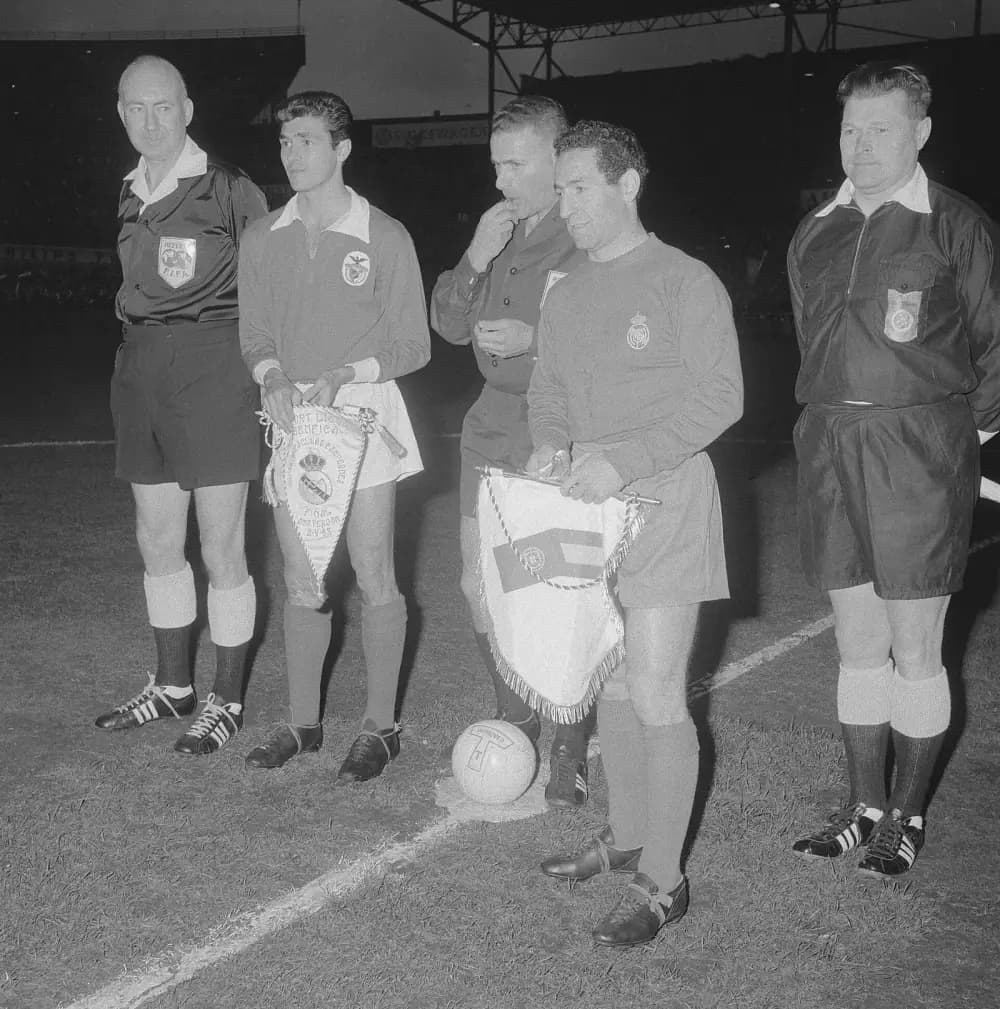
Within a year he was in a European Cup final. On 2 May 1962 Benfica, the holders, met Real Madrid at the Olympisch Stadion in Amsterdam in front of 61,257 people. Real's forwards included Alfredo Di Stéfano, Eusébio's idol, and the Hungarian Ferenc Puskás.
Puskás scored twice in the first 23 minutes. José Águas and Domiciano Cavém brought Benfica level, and Puskás completed a hat-trick before half-time to make it 3-2 to Real. Mário Coluna equalised six minutes into the second half.
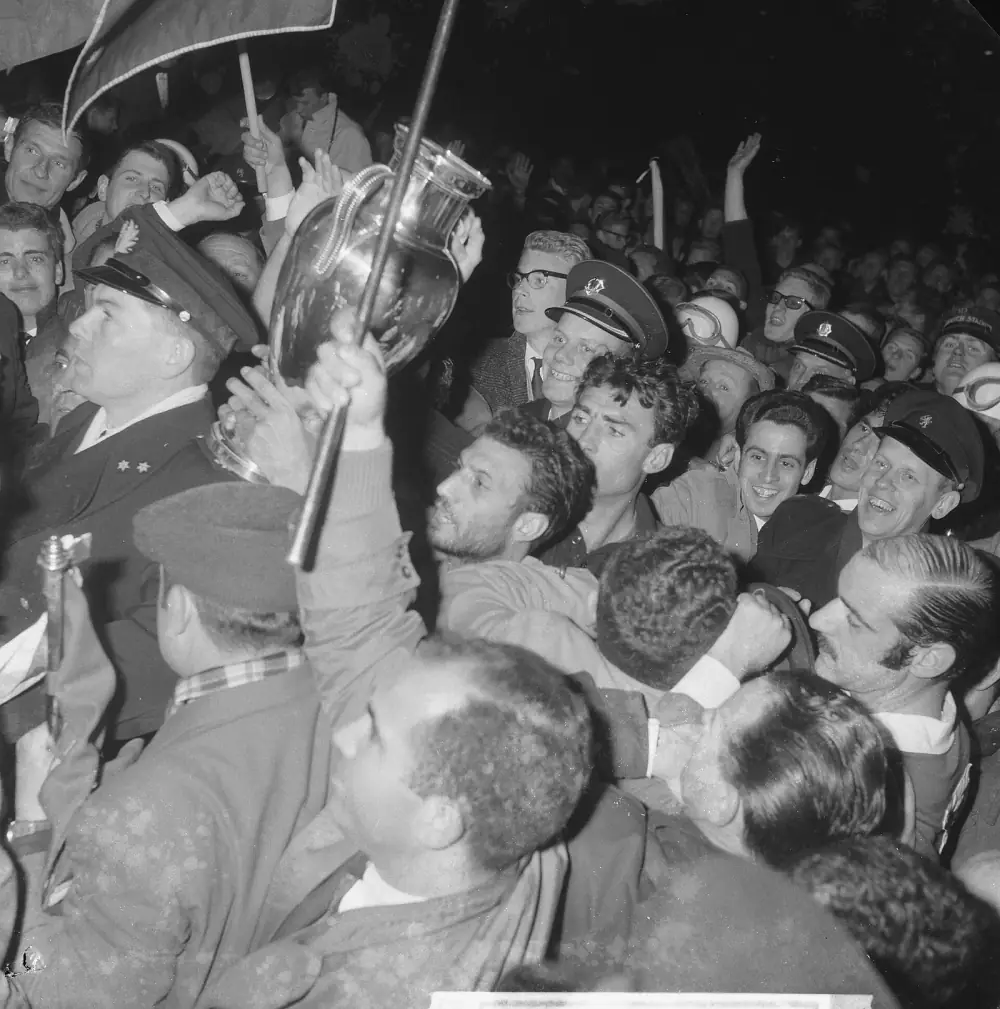
Then the 20-year-old took over. In the 63rd minute Eusébio scored from a penalty, and five minutes later he struck again to make it 5-3. Benfica had won the European Cup for the second year running. After the final whistle he went looking for Di Stéfano and came away with his shirt.
- Match
- European Champion Clubs' Cup final
- Date and place
- 2 May 1962, Olympisch Stadion, Amsterdam
- Score
- Benfica 5, Real Madrid 3 (2-3 at half-time)
- Benfica scorers
- Águas 25', Cavém 34', Coluna 51', Eusébio 63' (pen.), 68'
- Real Madrid scorer
- Puskás 17', 23', 38'
- Attendance
- 61,257
- Benfica coach
- Béla Guttmann
It was the only European Cup he won. Benfica reached three more finals with him and lost them all: 2-1 to AC Milan in 1963, when he scored first, 1-0 to Inter at San Siro in 1965, and 4-1 after extra time to Manchester United at Wembley in 1968.
The best player in Europe
Through the 1960s Eusébio was the most reliable scorer in Portugal. He was the first division's top scorer seven times, a record, and in 1967–68 he scored 42 league goals in 26 rounds. When the Golden Boot for Europe's leading league scorer was created that season, he was its first winner; he won it again in 1973 with 40 goals.
Eusébio's league goals in his seven seasons as Portugal's top scorer
league goals
Highlighted: the two seasons he won the European Golden Boot. The league had 26 rounds until 1970/71 and 30 from 1971/72. In 1965/66 he shared the title with Sporting's Ernesto Figueiredo. Seasons when someone else was top scorer are not shown.
Show the data
| Goals in the first division | |
|---|---|
| 1963/64 | 28 |
| 1964/65 | 28 |
| 1965/66 | 25 |
| 1966/67 | 31 |
| 1967/68 | 42 |
| 1969/70 | 20 |
| 1972/73 | 40 |
France Football's Ballon d'Or, then voted by 21 judges from 21 European countries, went to him for 1965. He took 67 points to 59 for Inter's Giacinto Facchetti and 45 for Luis Suárez. A year later he missed a second award by a single point, 80 to Bobby Charlton's 81.
| Year | Place | Points | Winner |
|---|---|---|---|
| 1962 | 2nd | 53 | Josef Masopust (Dukla Prague) |
| 1963 | 5th | 19 | Lev Yashin (Dynamo Moscow) |
| 1964 | 4th | 31 | Denis Law (Manchester United) |
| 1965 | 1st | 67 | Eusébio (Benfica) |
| 1966 | 2nd | 80 | Bobby Charlton (Manchester United), 81 points |
| 1967 | 5th | 26 | Flórián Albert (Ferencváros) |
He was the first Portuguese player to win the award.
Counting his goals is harder than it sounds. For Benfica, Domingos gives 473 goals in 440 matches and RSSSF 482 goals in 449 official matches. The club's own figure, 638 goals in 614 games, counts far more matches than either. RSSSF's two tables put his first-division total at 319 or 320 goals in 313 matches. On the titles, Benfica's own tally is ten league championships and five Portuguese Cups; RTP, Domingos and many obituaries say eleven league titles.
England, 1966
At the 1966 World Cup in England, Portugal won all three group games, against Hungary, Bulgaria and Brazil, whom they beat 3-1 at Goodison Park in Liverpool with two goals from Eusébio.
The quarter-final, on 23 July at Goodison Park, was against North Korea, who had knocked out Italy. Park Seung-zin scored after less than a minute, and by the 25th minute Portugal were 3-0 down. Eusébio scored in the 27th minute, from a penalty just before half-time, and twice more, in the 56th and 59th minutes, the second of those also a penalty. José Augusto headed the fifth.
“I remember very clearly what Simões said when we were 3-0 down. He kept saying, “As long as we don't go four goals down, we're still in with a chance.” And he was right.”
| Date | Venue | Result | Eusébio's goals |
|---|---|---|---|
| 13 July | Old Trafford, Manchester | Portugal 3, Hungary 1 | 0 |
| 16 July | Old Trafford, Manchester | Portugal 3, Bulgaria 0 | 1 (38') |
| 19 July | Goodison Park, Liverpool | Portugal 3, Brazil 1 | 2 (36', 85') |
| 23 July | Goodison Park, Liverpool | Portugal 5, North Korea 3 (quarter-final) | 4 (27', 43' pen., 56', 59' pen.) |
| 26 July | Wembley, London | England 2, Portugal 1 (semi-final) | 1 (82' pen.) |
| 28 July | Wembley, London | Portugal 2, Soviet Union 1 (third place) | 1 (12' pen.) |
Nine goals made him the tournament's top scorer, ahead of West Germany's Helmut Haller with six. Minutes as recorded by RSSSF, except for the North Korea match, where they follow FIFA's match report (RSSSF gives 42' and 57').
England beat Portugal 2-1 in the semi-final at Wembley, both goals by Bobby Charlton, and Eusébio left the pitch in tears. Portugal beat the Soviet Union for third place, the best result in the team's history at the time. In December 1966 the players were received by Salazar, and Eusébio was given the silver medal of the Order of Prince Henry.
“State property”
The best clubs in Europe tried to buy him. Record lists approaches from Real Madrid, Barcelona, Atlético Madrid, Napoli and Vasco da Gama; the two serious bids came from Italy. Juventus pushed first, and Record says the offer divided the club. In Eusébio's later telling, Salazar settled the matter himself.
“Salazar sent for me and told me I could not leave the country, because I was state property.”
Accounts disagree on when this happened. The Associated Press put it in 1964, Record's own profile in 1965, and Domingos at a reception for the World Cup team in December 1966. Then Inter, whose president was Angelo Moratti, made its move, and Eusébio and his wife Flora, whom he had married in October 1965, went as far as choosing a house near Lake Como. Record says that deal died when the Italian federation, after Italy's defeat by North Korea at the 1966 World Cup, barred its clubs from signing foreign players.
The regime certainly used him. Portugal was fighting independence wars in Angola, Guinea and Mozambique, and defended its empire abroad as a socially and racially harmonious Lusophone community. A black star from Mozambique wearing the national shirt fitted that story. His call-up for military service in 1963 got wide coverage, though fighting in Mozambique began only in 1964 and he never went near a war zone; he served with an anti-aircraft regiment in Queluz.
Eusébio resented suggestions that he had been a kind of “godson” to Salazar, though Domingos notes that in interviews he recalled addressing the dictator as “godfather”. He told Record: “Only later did I realise how far I was used by the regime of that time” (translated from Portuguese).
Seven operations and a long goodbye
His knees were the price of all this. The first operation came in December 1961, before he turned 20, and a second on the same left knee a year later. By Record's count he had seven operations, six of them on the left knee, which defenders kicked and doctors treated with repeated injections; RTP's tally has six on the right knee and one on the left. Recoveries were cut short so he could play, sometimes for lucrative end-of-season tours.
He played his last match for Portugal, as captain, against Bulgaria at the Luz on 13 October 1973: 64 caps and 41 goals. In 1975, after 15 seasons, he left Benfica for North America.
| Club | Country | Season | Matches | Goals |
|---|---|---|---|---|
| Boston Minutemen | United States | 1975 | 9 | 3 |
| Monterrey | Mexico | 1975–76 | 10 | 1 |
| Toronto Metros-Croatia | Canada | 1976 | 25 | 18 |
| Beira-Mar | Portugal | 1976–77 | 12 | 3 |
| Las Vegas Quicksilver | United States | 1977 | 17 | 2 |
| União de Tomar | Portugal (second division) | 1977–78 | 13 | 3 |
| New Jersey Americans | United States | 1978 | 9 | 2 |
RSSSF also lists single appearances for Roodepoort Guild, Moroka Swallows and Lusitano in South Africa in 1978. Benfica's list adds the Buffalo Stallions, an indoor team.
In Toronto, where he scored 18 goals in 25 games, he won the 1976 Soccer Bowl, the final of the North American Soccer League. He later worked for Benfica as an assistant coach and with youth teams, and became an ambassador for the Portuguese Football Federation.
In 1998 a FIFA panel named him one of the ten best players of all time. “Look, there are only two black people on the list: me and Pele,” he said. “I regard that as a great responsibility because I am representing Africa and Portugal, my second homeland.”
In his last months his knees were so bad that he sometimes used a wheelchair at public events.
Mourning and the Pantheon
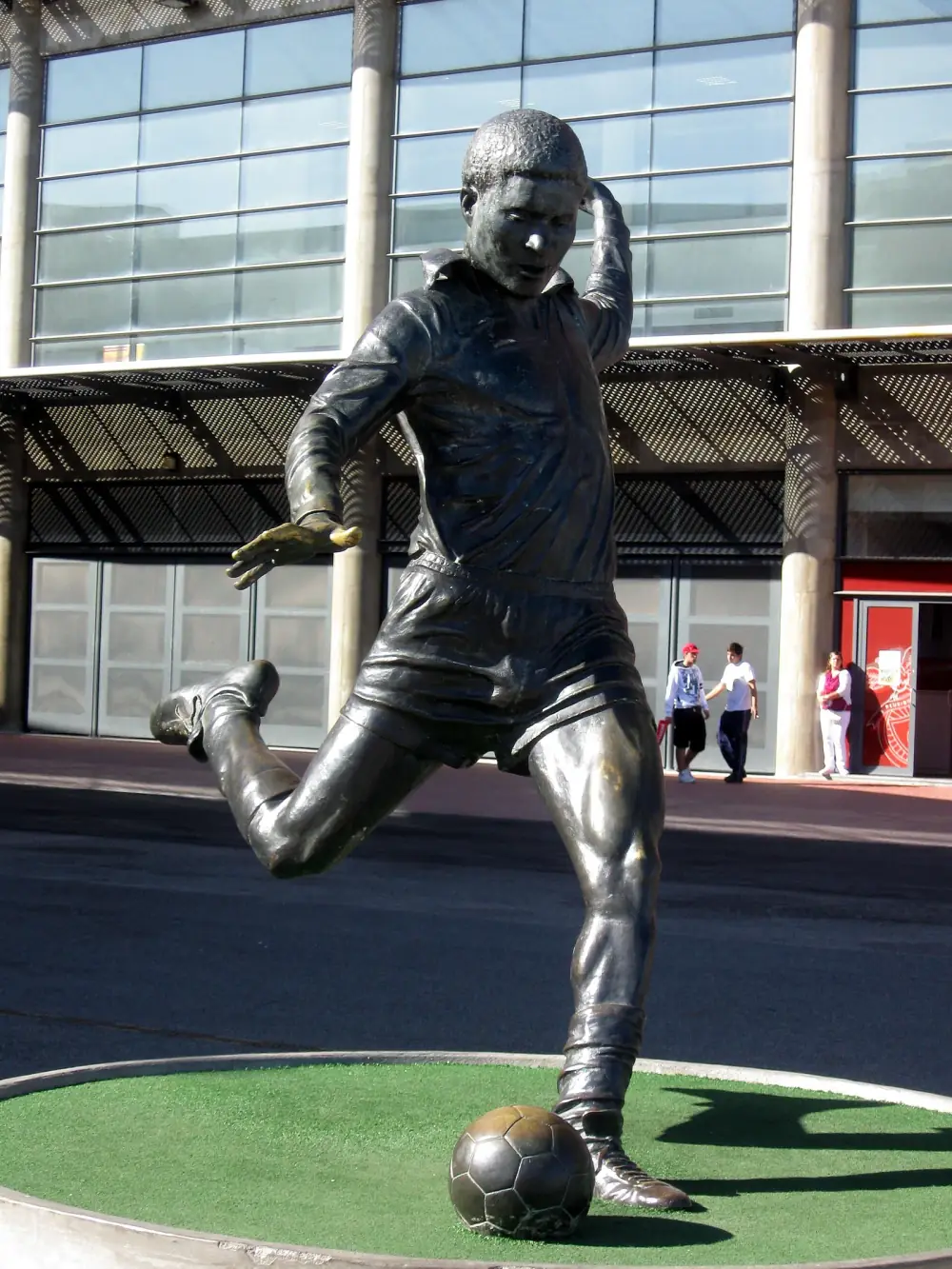
His body was taken to the Luz on the Sunday he died. Fans left flowers, scarves and hand-made posters at his bronze statue outside the stadium, unveiled on his fiftieth birthday, 25 January 1992, and moved near Gate 18 when the new Luz opened in 2003. One banner read: “I haven't come to say goodbye, but to say thank you.”
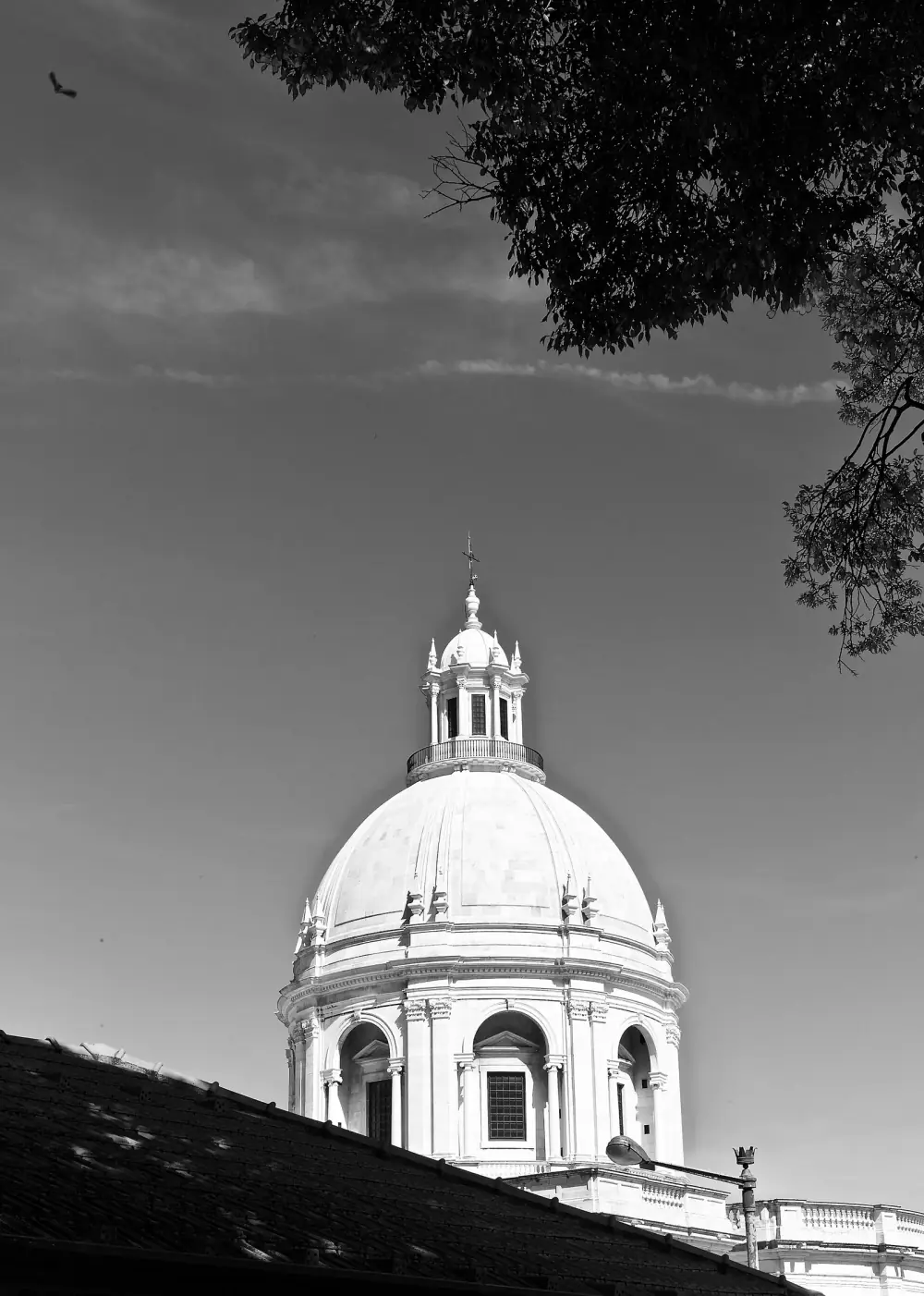
Talk of the National Pantheon began at once. The Pantheon, in the church of Santa Engrácia in eastern Lisbon, holds the tombs of presidents and writers, the general Humberto Delgado and, since 2001, the fado singer Amália Rodrigues. A year after his death, on 20 February 2015, the Assembleia da República voted unanimously to grant him its honours.
“To grant National Pantheon honours to the remains of Eusébio da Silva Ferreira, paying tribute to the national symbol, the man of solidarity, the exceptional footballer and sportsman, recalling his status as a true landmark in the spread and globalisation of the image and importance of Portugal in the world.”
On 3 July 2015 the coffin left the Lumiar cemetery at 15:15 for a private mass at the Seminário da Luz. A horse-drawn carriage, escorted by 54 mounted soldiers and 22 police motorcycles, carried it past the stadium, along the avenue now named after him, to the Football Federation and to parliament, and on to Santa Engrácia, where it was due at seven.
At Santa Engrácia António Simões gave the eulogy, and the President of the Assembleia, Assunção Esteves, and Cavaco Silva spoke. The published programme also had Dulce Pontes singing the national anthem, and the two presidents and the Prime Minister, Pedro Passos Coelho, signing the record of burial. Eusébio was the first sportsman and the first black person to enter the Pantheon. He lies in its second tomb room, with Aquilino Ribeiro, Sophia de Mello Breyner Andresen and Humberto Delgado.
5 January 2014
Dies in Lisbon in the early hours, aged 71; three days of national mourning
6 January 2014
Lap of honour at the Luz, funeral mass and burial at Lumiar
20 February 2015
Parliament unanimously grants him National Pantheon honours
24 June 2015
Exhibition “Portugal Eusébio” opens at the Assembleia da República
3 July 2015
Remains moved from Lumiar to the National Pantheon
Whose hero?
The tributes of 2014 and 2015 were close to unanimous, and they told one story. Politicians from the Communist Party to the right-wing CDS praised the same things, his humility and his simplicity. The draft resolution, signed by every party in parliament, called him a popular hero who had made the Portuguese proud.
Domingos argues that this portrait has colonial roots. Praise for the simple, humble African echoed the “good boy” that Lourenço Marques employers demanded of black workers, and the official biography, little changed since his 1966 autobiography, left out the poverty and racism of the suburb he came from. Team-mates remembered someone else: a ruthless forward who knew his worth and enjoyed a party. Nobody from Mozambique was invited to speak at the Pantheon.
Either way, his story belongs to the end of the empire. His years as a star coincided with the colonial wars in Africa and the last decade of the Estado Novo, which fell in 1974. His tomb in Santa Engrácia is a national honour for a man who was legally a native of a colony until he was 17.
FAQs
When and how did Eusébio die?
He died in Lisbon in the early hours of Sunday 5 January 2014, aged 71. He had been in hospital several times in the previous year with heart and respiratory problems, and reports gave heart failure or cardiorespiratory arrest as the cause. The government declared three days of national mourning.
Where is Eusébio buried?
He was first buried in the Lumiar cemetery in Lisbon on 6 January 2014. On 3 July 2015 his remains were moved to the National Pantheon in the church of Santa Engrácia, after parliament voted unanimously on 20 February 2015 to grant him the honour.
How many goals did Eusébio score at the 1966 World Cup?
Nine, more than anyone else at the tournament, including four in the 5-3 quarter-final win over North Korea at Goodison Park after Portugal had been 3-0 down. Portugal finished third, still the team's best World Cup finish when he died.
Why did Eusébio play for Portugal and not Mozambique?
Mozambique was a Portuguese colony when he was born and for almost all his years at Benfica. He had been granted assimilado status, the legal rank of a “civilised” African, in 1959, and the separate native statute was abolished in 1961. He made his debut for Portugal in 1961 and won 64 caps, scoring 41 goals, before Mozambique became independent.
Did Salazar stop Eusébio from leaving Benfica?
The story comes mainly from Eusébio himself. He said that Salazar summoned him and told him he could not leave because he was “state property”. The Associated Press dated this to 1964, Record to 1965, when Juventus wanted him, and the historian Nuno Domingos, who calls the remark alleged, to a reception in December 1966. A move to Inter fell through in 1966: Eusébio told Expresso in 2011 that Salazar blocked it, while Record blamed Italy's new ban on foreign players.
On the timeline
Open the timelineNearby moments from portugal in europe (1986–today).
Guimarães, hailed as the 'cradle of the nation', opens its year as European Capital of Culture with an official ceremony and an open-air show by La Fura dels Baus in the Largo do Toural. Twelve months of concerts, exhibitions and new venues aimed to recast the old textile city as a cultural destination.
Soldiers seize power in Guinea-Bissau between the two rounds of a presidential election, arresting interim president Raimundo Pereira and front-runner Carlos Gomes Júnior. Portugal's former colony had never seen an elected president finish a full term, and the coup was condemned by Portugal and the Community of Portuguese Language Countries.
Death of José Hermano Saraiva, aged 92, the historian who became Portugal's best-loved television storyteller. A former Estado Novo education minister, he reinvented himself after 1974 with decades of RTP programmes such as 'Horizontes da Memória', strolling through towns and ruins and bringing the nation's past to life with theatrical gestures and an unmistakable voice.
Eusébio, the Black Panther
Eusébio, the 'Black Panther', dies in Lisbon aged 71. Top scorer at the 1966 World Cup with nine goals as Portugal finished third, he won ten league titles (eleven by some counts) and five Portuguese cups in 15 seasons at Benfica and is revered as one of the greatest footballers of all time.
Lisbon's Estádio da Luz hosts the first Champions League final between two clubs from the same city. Real Madrid equalise in stoppage time through Sergio Ramos and beat Atlético Madrid 4–1 after extra time to claim their long-awaited tenth European Cup.
Former prime minister José Sócrates is detained at Lisbon airport on arrival from Paris in the 'Operação Marquês' corruption investigation, the first former prime minister of the democratic era to be arrested. He spent some nine months in preventive detention in Évora prison and has always denied wrongdoing.
Death of Manoel de Oliveira in Porto at age 106. He was the world's oldest active film director, with a career running from the silent short 'Douro, Faina Fluvial' in 1931 to 'O Velho do Restelo' in 2014, and a celebrated figure at Cannes, Venice and other international festivals.
Coming up in history
All long reads 7 January 1355The killing of Inês de Castro: Coimbra, 7 January 1355
 8 January 1455Romanus Pontifex: the papal bull that gave Portugal the African coast
 9 January 1822The Dia do Fico: the day Prince Pedro refused to leave Brazil, 9 January 1822
 10 January 1430Isabel of Portugal and the Golden Fleece: Bruges, 10 January 1430
26 sources
Archives, scholarship and reporting this article was checked against.
- 1
The death of a football player. Eusébio and the struggle for Portuguese HistoryNuno Domingos, Práticas da História, n.º 8 (2019), 163–197
- 2
Prolific Scorers Data: Eusébio, additional dataVladimir Kolos and Dorian Leveque, RSSSF (Rec.Sport.Soccer Statistics Foundation)
- 3
Uma longa viagem da Mafalala ao céuRecord, 5 January 2014
- 4
- 5
- 6
- 7
Resolução da Assembleia da República n.º 21/2015: Honras de Panteão Nacional a Eusébio da Silva FerreiraDiário da República, 1.ª série, n.º 40, 26 February 2015 (copy hosted by the Faculdade de Ciências, Universidade de Lisboa)
- 8
Our King, Eusébio!SL Benfica, 25 January 2022
- 9
Céu em lágrimas: o dia do último adeus a EusébioA Bola, 5 January 2024
- 10
Milhares no adeus a EusébioPostal do Algarve, 6 January 2014
- 11
Football star Eusébio dies at 71Associated Press, in the Mail & Guardian, 5 January 2014
- 12
- 13Eusébio, da Mafalala ao topo do mundoRTP Notícias
- 14
- 15
- 16
- 17
- 18
- 19
- 20
Portugal v Korea DPR, 23 July 1966: match centreFIFA
- 21
- 22
Honouring Toronto Metros-CroatiaToronto FC
- 23
História do Panteão NacionalPanteão Nacional, Museus e Monumentos de Portugal
- 24Eusébio no Panteão: saiba como será a cerimóniaObservador, 11 June 2015
- 25Eusébio no Panteão NacionalRTP Notícias, 3 July 2015
- 26
Panteão NacionalMuseus e Monumentos de Portugal
Image credits
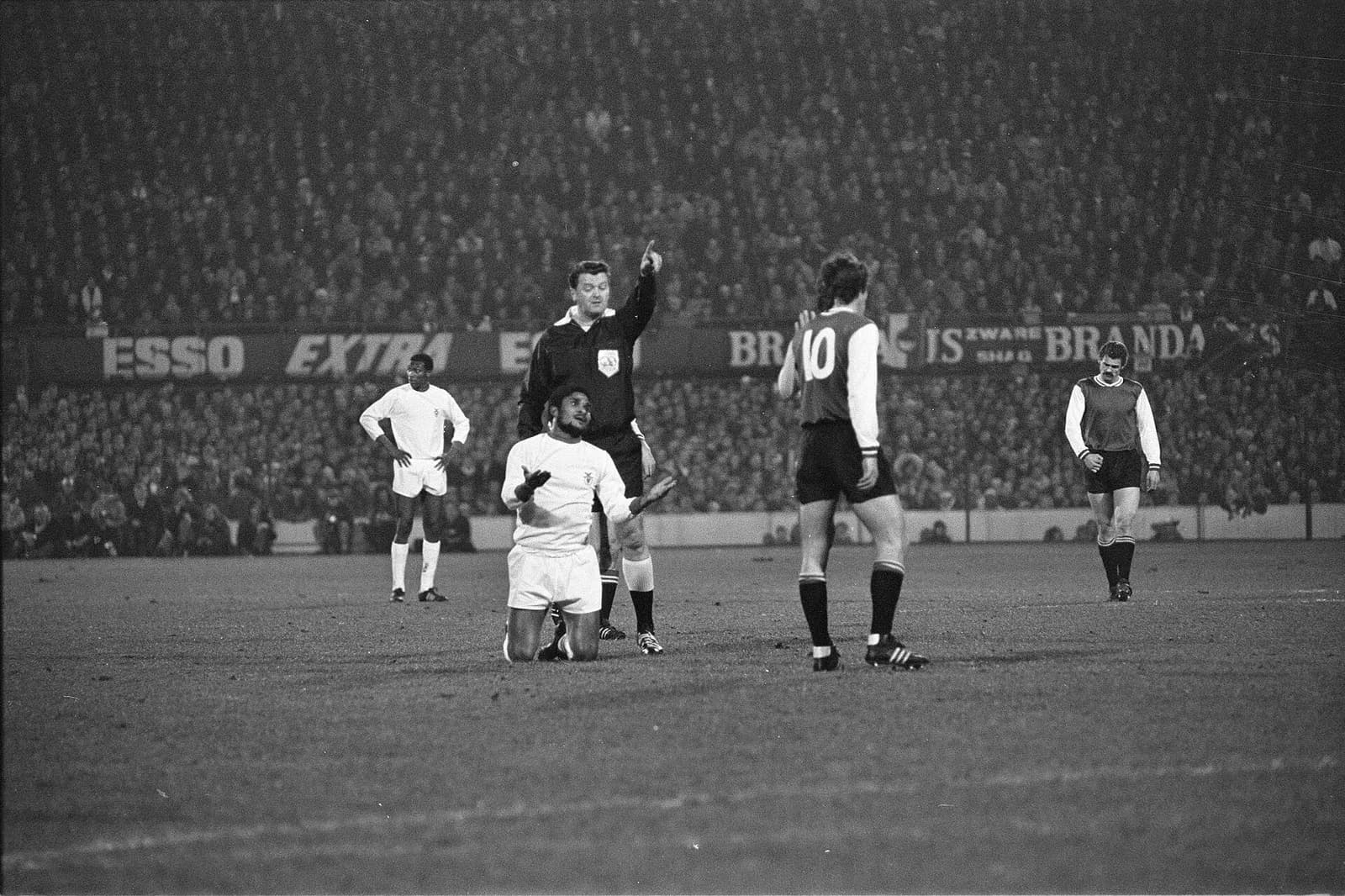
- Eusébio on his knees appealing to the referee, Kunze, during Feyenoord 1, Benfica 0, a European Cup quarter-final in Rotterdam on 8 March 1972. Bert Verhoeff for Anefo, CC0, via Wikimedia Commons.
- The captains, José Águas of Benfica and Francisco Gento of Real Madrid, exchange pennants with the match officials before the European Cup final in Amsterdam, 2 May 1962. The referee was the Dutchman Leo Horn. Jack de Nijs for Anefo, CC0, via Wikimedia Commons.
- Benfica's players and supporters with the European Cup in the crush after the final in Amsterdam, 2 May 1962. Jack de Nijs for Anefo, CC0, via Wikimedia Commons.
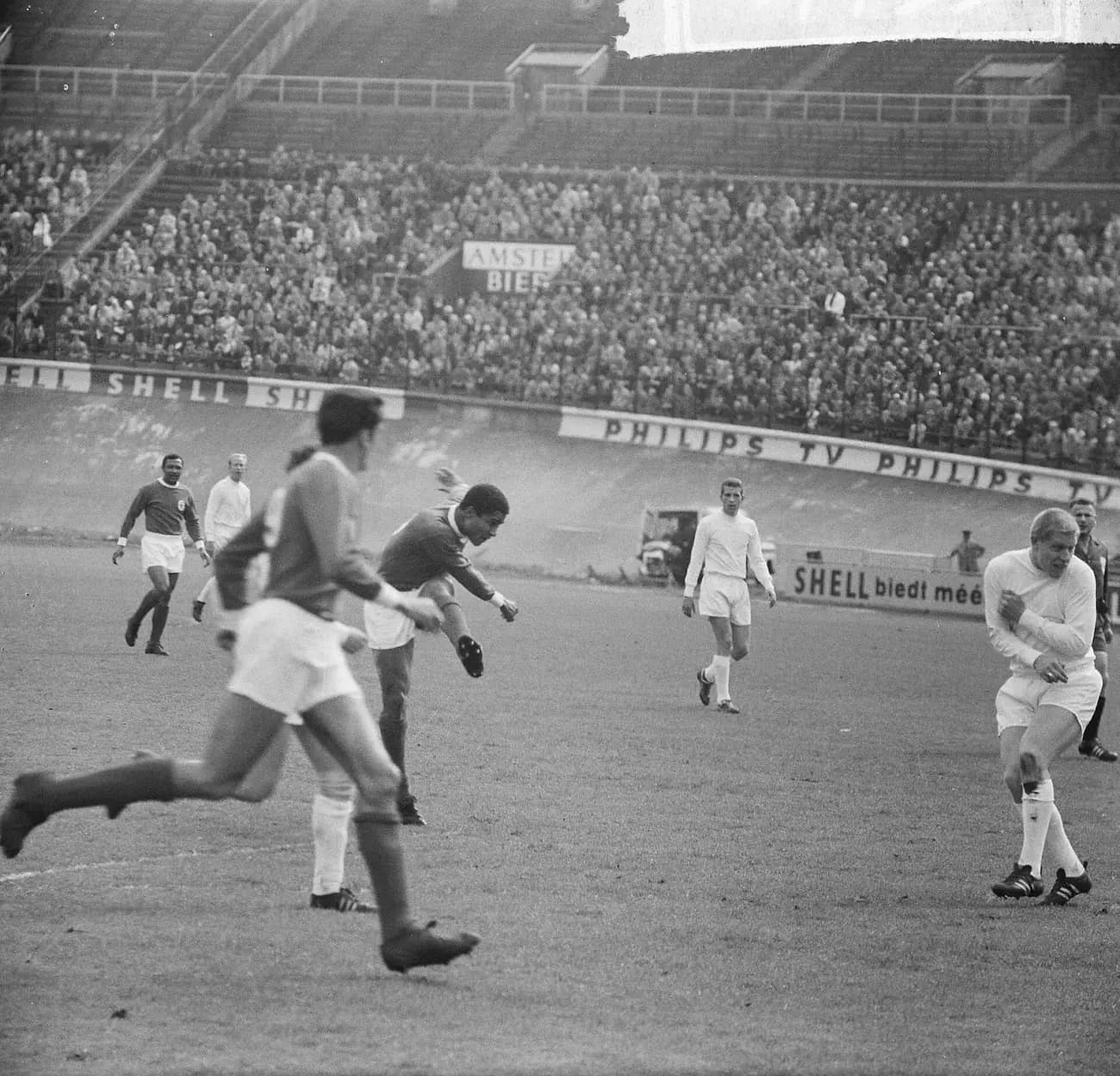
- Eusébio shoots during a friendly against Ajax in Amsterdam on 9 May 1965, played as Benfica prepared for that month's European Cup final. Ajax won 2-1. Jack de Nijs for Anefo, CC0, via Wikimedia Commons.
- The statue of Eusébio outside the Estádio da Luz in 2010. It was unveiled at the old stadium on his fiftieth birthday in 1992. Erik Cleves Kristensen, CC BY 2.0, via Wikimedia Commons.
- The dome of Santa Engrácia, the National Pantheon in Lisbon, photographed in 2017. Eusébio's remains were moved here on 3 July 2015. Pedro Ribeiro Simões from Lisboa, Portugal, CC BY 2.0, via Wikimedia Commons.