

Romanus Pontifex: the papal bull that gave Portugal the African coast
A Latin letter sealed in lead in Rome gave the kings of Portugal and Prince Henry a monopoly of the West African coast and confirmed their licence to enslave its people. In 2023 the Vatican was still answering for it.
At a glance
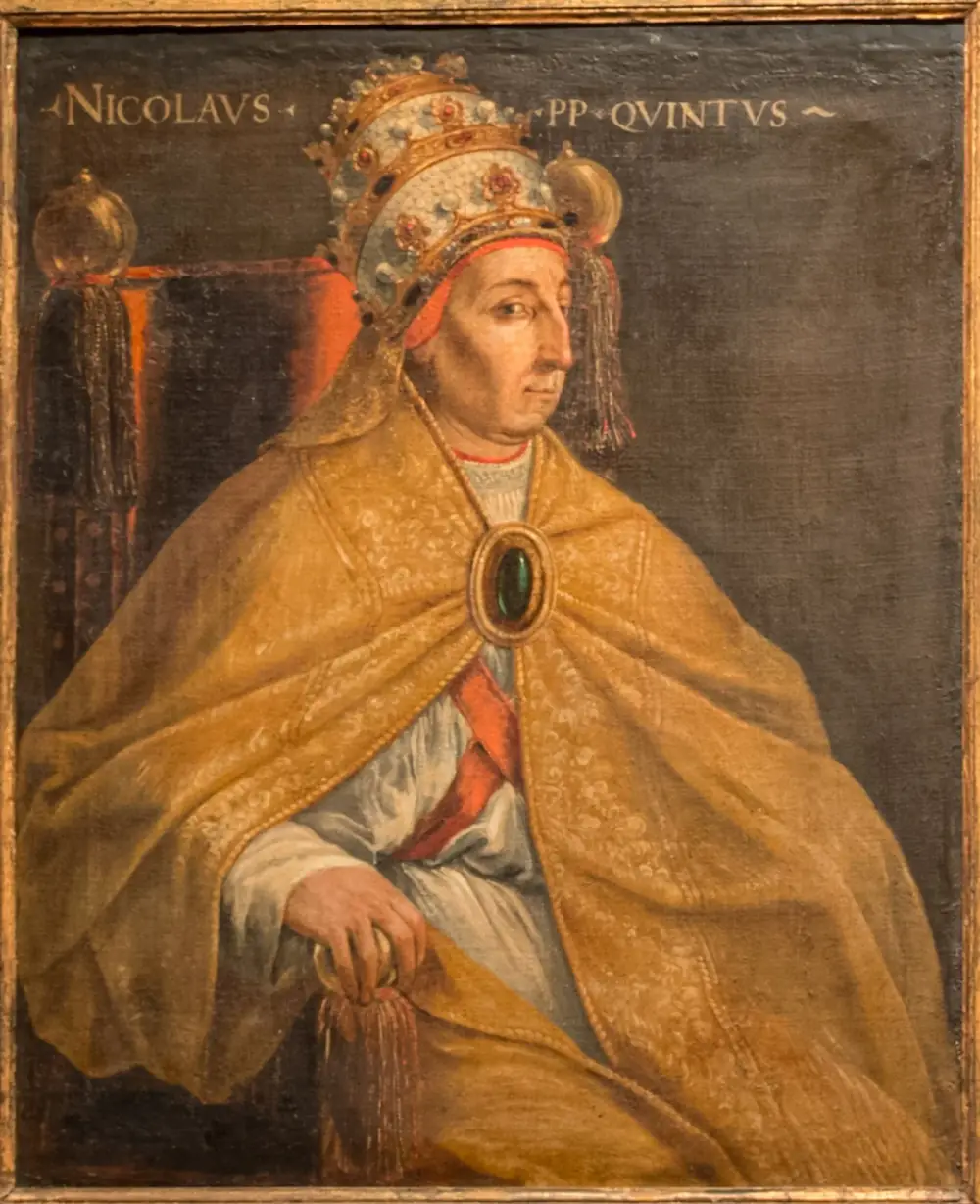
- On 8 January 1455 Pope Nicholas V issued the bull Romanus Pontifex in Rome. The text is dated 1454 because the papal year then began on 25 March.
- It gave King Afonso V of Portugal, his successors and his uncle Prince Henry the sole right to conquer, trade and sail from Capes Bojador and Nao through all Guinea and beyond, and threatened any other Christian who went there without a Portuguese licence with excommunication.
- It confirmed the bull Dum Diversas of 18 June 1452, which allowed the king to reduce Muslims and pagans to perpetual slavery, and it described Africans already brought to Portugal by force.
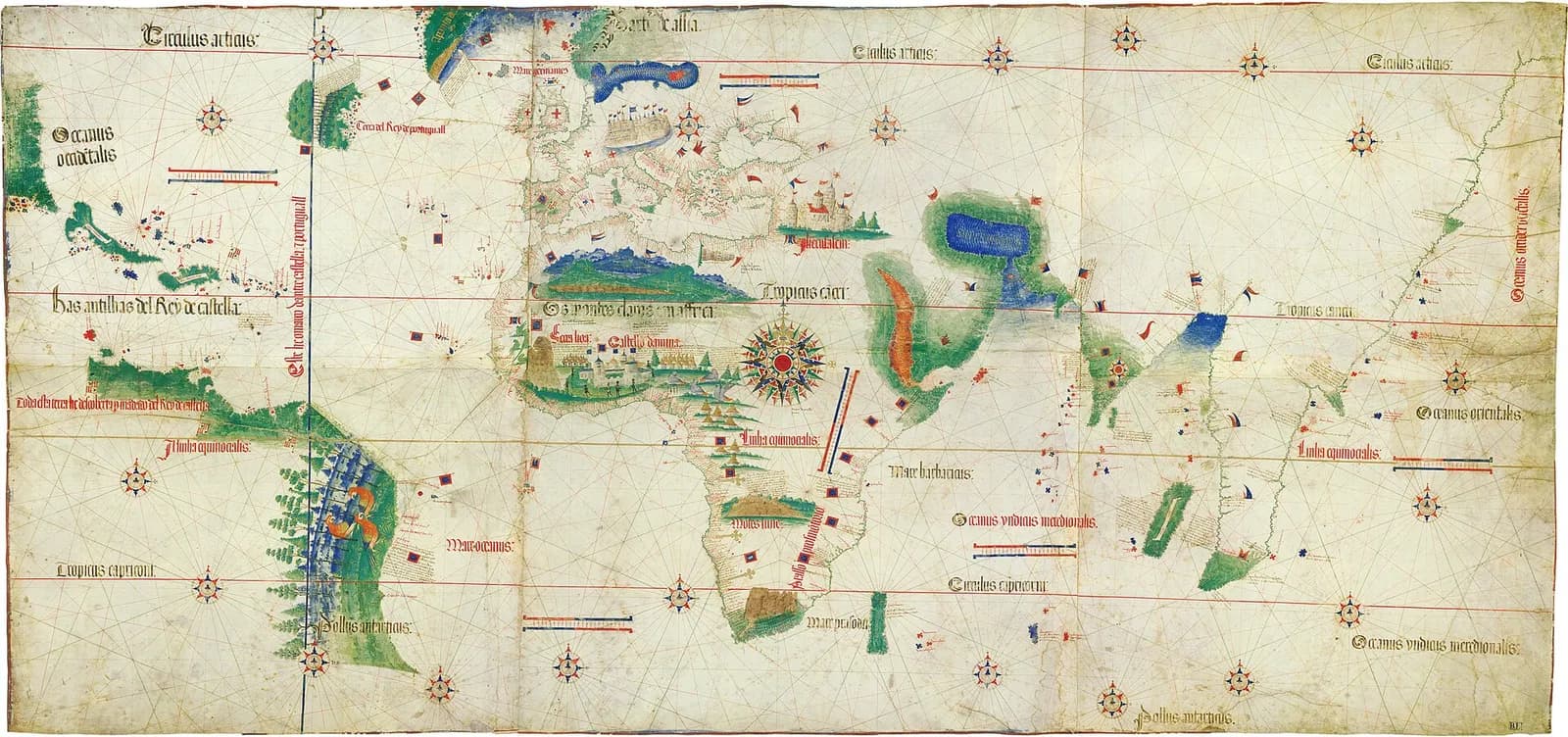
- Later bulls and the treaties of Alcáçovas (1479) and Tordesillas (1494) built on it to divide the oceans between Portugal and Castile.
- Some scholars link it to the legal “doctrine of discovery” used in US courts from Johnson v. M'Intosh (1823). On 30 March 2023 the Vatican repudiated that doctrine.
A letter from Rome, sealed in lead
The long Latin letter is dated at St Peter's in Rome on 8 January 1455. At its foot is the name of Pietro da Noceto, the private secretary of Pope Nicholas V. The parchment measures 57 by 84 centimetres. A lead seal hangs from it on a cord of silk, and the clerks of the apostolic chamber, the papal treasury, noted on it that it had been registered.
The letter took its name from its first two words, Romanus Pontifex, “the Roman pontiff”. Its business was Africa. It praised Prince Henry of Portugal for sending caravels down the African coast for a quarter of a century and declared that the lands, harbours and seas his men had reached belonged to the king of Portugal, his successors and Henry, and to no one else, for ever.
The pope wanted the whole of Christendom to know. A copy was to be fixed to the doors of the church of Lisbon, and two months after that its sentences of excommunication would bind every offender as if each had been served in person. The archbishop of Lisbon and the bishops of Silves and Ceuta were told to denounce offenders in church on Sundays and feast days, when the most people were there.
Two kingdoms and one coast
Portugal's push into Africa began with war. In 1415 King João I took Ceuta, a Muslim port across the Strait of Gibraltar, and his son Henry, remembered as Henry the Navigator, spent the next decades sending ships south along the Atlantic coast. In 1434 one of them passed Cape Bojador, the point beyond which sailors had refused to go, and in 1441 the first captives and gold dust were brought home from beyond it. The voyages and Henry's part in them are told in Lisboeta's article on his death in 1460.
Castile, Portugal's larger neighbour, wanted the same prizes. The two crowns had quarrelled over the Canary Islands for a century. In 1344 a French admiral who promised to convert the islands was crowned “Prince of Fortunia” at the papal court in Avignon, but he never took possession. Papal bulls favoured one side and then the other, and the case was argued before the Council of Basel in 1435. Castile's kings also claimed Africa itself, as heirs of the Visigothic kings, and taxed goods brought from Guinea.
By 1454 the Guinea trade was worth fighting over. On 10 April that year King Juan II of Castile wrote to Afonso V of Portugal demanding the return of an Andalusian caravel, which a Portuguese captain had seized within a league of Cádiz on its way home from Guinea, and his envoys threatened war unless Portugal gave up the “conquest” of Barbary and Guinea. Afonso replied that the conquest was his. Juan II died that July, and his successor, Enrique IV, was soon negotiating to marry Afonso's sister.
Afonso turned to the pope. He stood high in Nicholas V's favour: after the Ottoman Turks took Constantinople in 1453, he was the only western king who seriously prepared to answer the pope's call for a crusade, and in April 1454 Nicholas sent him the consecrated golden rose, a mark of special papal favour. The bull says it was issued “motu proprio”, on the pope's own initiative, but its American editor Frances Davenport judged that it was “doubtless” issued at Afonso's request.
Dum Diversas: the licence of 1452
Romanus Pontifex built on an earlier bull. In 1443 Pope Eugenius IV had stayed neutral between Portugal and Castile. Then, on 18 June 1452, Nicholas V issued Dum Diversas, which gave Afonso V general powers to attack non-Christians, enslave them and take their lands and goods. It named no particular place.
Romanus Pontifex repeats the grant of 1452 in its own words before extending it to Africa. This is the clause that licensed enslavement:
“to invade, search out, capture, vanquish, and subdue all Saracens and pagans whatsoever, and other enemies of Christ wheresoever placed, and the kingdoms, dukedoms, principalities, dominions, possessions, and all movable and immovable goods whatsoever held and possessed by them and to reduce their persons to perpetual slavery”
What Romanus Pontifex says
The bull opens with a history of the Portuguese enterprise as Lisbon wished it told. Henry had peopled “certain solitary islands in the ocean sea” with Christians and built churches there. For 25 years he had sent caravels south to find a sea route to “the Indians who are said to worship the name of Christ”, hoping to recruit them against the Muslims. His ships had reached Guinea and the mouth of a great river thought to be the Nile.
Then it turns to profit and rivals. Portugal had banned anyone from sailing to these coasts without a licence and a payment of tribute, but foreigners “induced by covetousness” might go anyway, sell iron, arms and timber to the infidels, or teach them navigation. To prevent wars between Christians, the pope settled the matter in Portugal's favour.
- Issued
- Rome, 8 January 1455 (dated 1454 in the text)
- Pope
- Nicholas V
- In favour of
- Afonso V, his successors and Prince Henry
- Area
- From Capes Bojador and Nao through all Guinea and beyond
- Penalty for intruders
- Excommunication; interdict for whole towns
- Original
- Torre do Tombo, Lisbon, Bulas, maço 7, n.º 29
“the right of conquest which in the course of these letters we declare to be extended from the capes of Bojador and of Nao, as far as through all Guinea, and beyond toward that southern shore, has belonged and pertained, and forever of right belongs and pertains, to the said King Alfonso, his successors, and the infante, and not to any others.”
| Provision | What it meant in practice |
|---|---|
| Dum Diversas extended to Ceuta and all lands taken from “infidels or pagans”, before or after 1452 | Past and future conquests in Africa covered by the licence to conquer and enslave |
| Exclusive right of conquest from Capes Bojador and Nao through Guinea and beyond | No other Christian ruler could claim the coast |
| Power to make laws, impose penalties and levy tribute there | The crown and Henry could sell licences and tax the trade |
| Trade with Muslims and pagans allowed, except iron, timber, cordage, ships and armour | An exception to the Church's ban on trading with the infidel |
| Churches, monasteries and clergy may be sent, with power to hear confessions | Church presence tied to Portuguese rule |
| Everyone else barred from the seas, the trade and the fishing without a Portuguese licence | Excommunication for individuals, interdict for towns |
Summarised from the bull's text in Davenport's edition. The Portuguese diplomatic historian Diogo Faria describes the result as a practical mare clausum, a closed sea, a doctrine only theorised later.
The people the bull described
In the middle of its praise for Henry, the bull mentions the people his ships were carrying north. It counts their conversion as one of the enterprise's achievements.
“Thence also many Guineamen and other negroes, taken by force, and some by barter of unprohibited articles, or by other lawful contract of purchase, have been sent to the said kingdoms. A large number of these have been converted to the Catholic faith.”
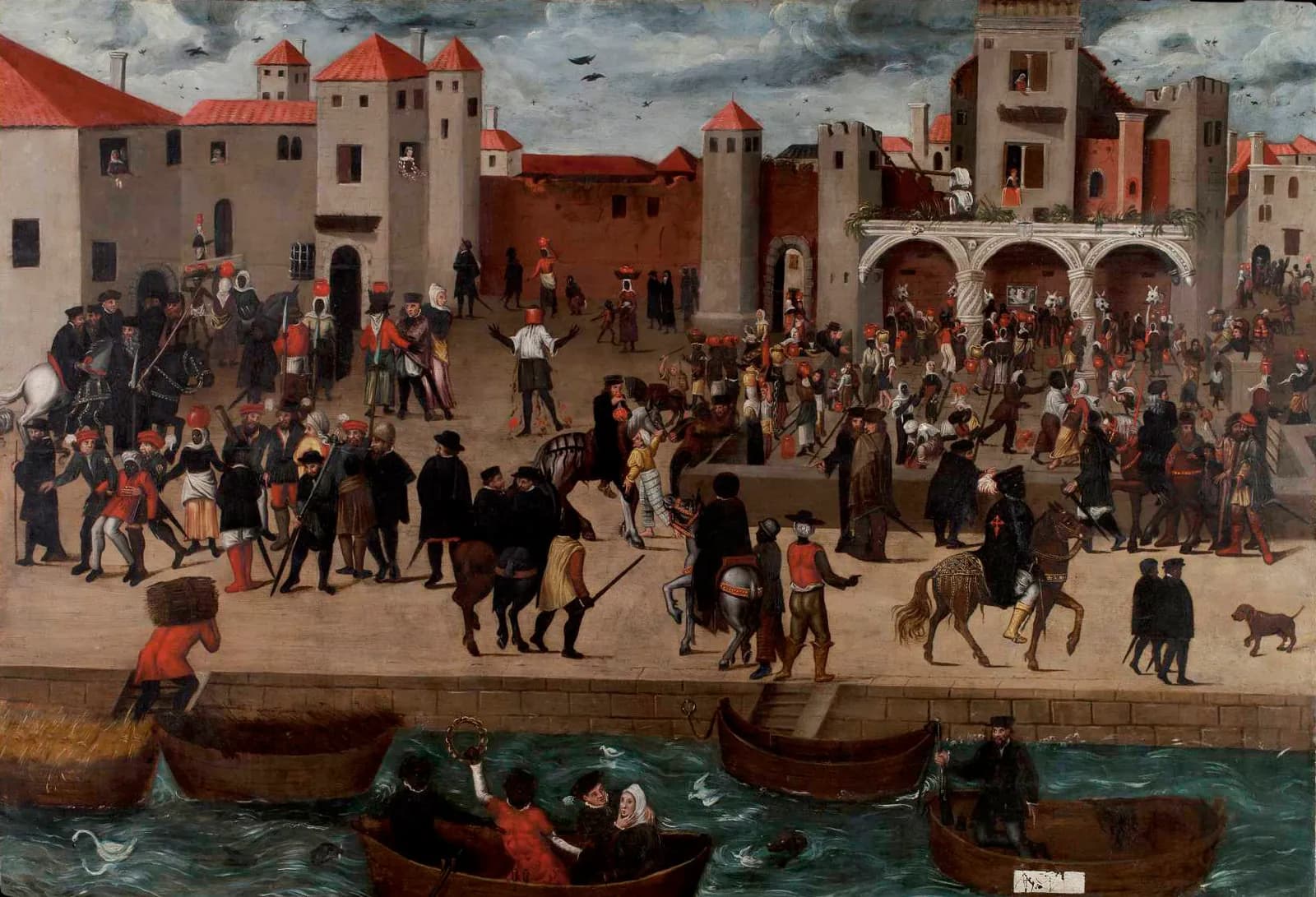
Some of those people had been landed at Lagos, in the Algarve, on 8 August 1444. Six caravels brought back 235 captives seized on the coast and islands beyond Bojador, and at dawn they were led into a field outside the town gate to be divided into five lots, one of them Henry's. The only description comes from Gomes Eanes de Zurara, the royal chronicler, who finished his Chronicle of Guinea in 1453 for Afonso V.
“But what heart could be so hard as not to be pierced with piteous feeling to see that company? For some kept their heads low and their faces bathed in tears, looking one upon another; others stood groaning very dolorously, looking up to the height of heaven, fixing their eyes upon it, crying out loudly, as if asking help of the Father of Nature.”
Zurara's pity is real, but so is his purpose. In the same chapter he ranks the captives by the colour of their skin, and he ends by praising Henry for saving their souls. In the next he insists that he never saw one of them put in irons, that they never tried to escape and that their owners treated them almost as family. By 1448, he wrote, 927 captives had been brought to Portugal.
The ground at Lagos tells a harsher story. In 2009, building work for an underground car park at the Vale da Gafaria, outside the old walls, uncovered a rubbish dump holding the remains of 158 people, men and women, adults and children. They had been thrown into the town's rubbish and covered over, many in atypical positions, and three had their hands or feet bound. The dump was used between the fifteenth and seventeenth centuries; one skeleton was radiocarbon dated to between 1420 and 1480, and DNA from two pointed to West African or Bantu-speaking ancestry.
A century later, enslaved Africans were part of daily life in Lisbon. The Flemish scholar Clenardus wrote in 1535 that it was hard to find a house in the city without at least one enslaved woman. In 1551 Cristóvão Rodrigues de Oliveira, in his survey of the city, found “a hundred thousand souls” in the city's 18,000 households, “including nine thousand nine hundred and fifty slaves” (translated from Portuguese): about one person in ten.
Enslaved Africans carried across the Atlantic, by flag of the ship, 1519–1867
thousand people
People embarked in Africa, as estimated by David Eltis (William and Mary Quarterly, 2001, Table VII) from the Trans-Atlantic Slave Trade Database: 11.06 million in all, 45.9 per cent of them on ships he counts as Portuguese. The database's estimates have been revised since 2001, and Lisboeta could not open its current figures. Counting those who arrived, Vos and Kananoja (2013) say Portuguese and Brazilian vessels carried more than five million people to the Americas.
Show the data
| People embarked in Africa | |
|---|---|
| Portuguese | 5,074.9 |
| British | 3,112.3 |
| French | 1,456.4 |
| Dutch | 527.7 |
| Spanish | 517 |
| United States | 280 |
| Danish and others | 94.2 |
Romanus Pontifex did not create this trade, and the vast majority of those people were taken to the Americas long after 1455. But by Eltis's estimate, ships he counts as Portuguese carried more Africans across the Atlantic than those of any other nation, about 5.1 million people, and they were still carrying more than 1.2 million between 1826 and 1850. Vos and Kananoja describe the trade as carried by Portuguese and Brazilian vessels.
From one coast to half the world
Nicholas V did not live long after sealing the bull: his successor, the Spaniard Calixtus III, took office on 8 April 1455. Afonso and Henry asked him to confirm it. On 13 March 1456 the bull Inter caetera repeated Romanus Pontifex word for word and gave the Order of Christ, which Henry governed, spiritual jurisdiction over the lands from Bojador through the whole of Guinea and beyond, “as far as to the Indians”. Historians have long argued over whether that meant the subjects of Prester John, the legendary Christian king, or the peoples of India.
Castile kept contesting Guinea until a war over its own throne ended in the Treaty of Alcáçovas of 4 September 1479. Castile left Guinea, Madeira, the Azores and Cape Verde to Portugal, and Portugal recognised the Canaries as Castilian. The pope confirmed the deal in 1481.
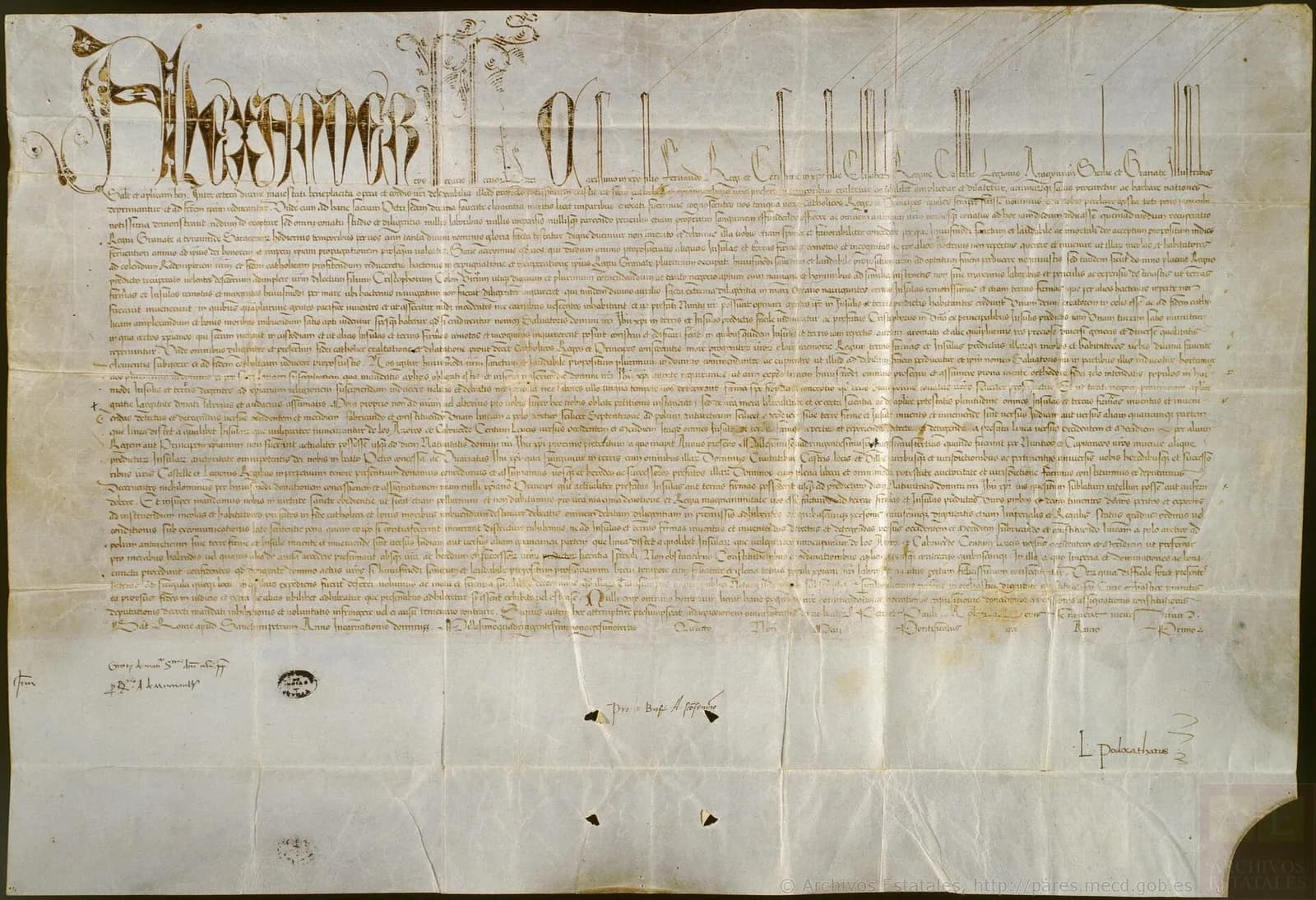
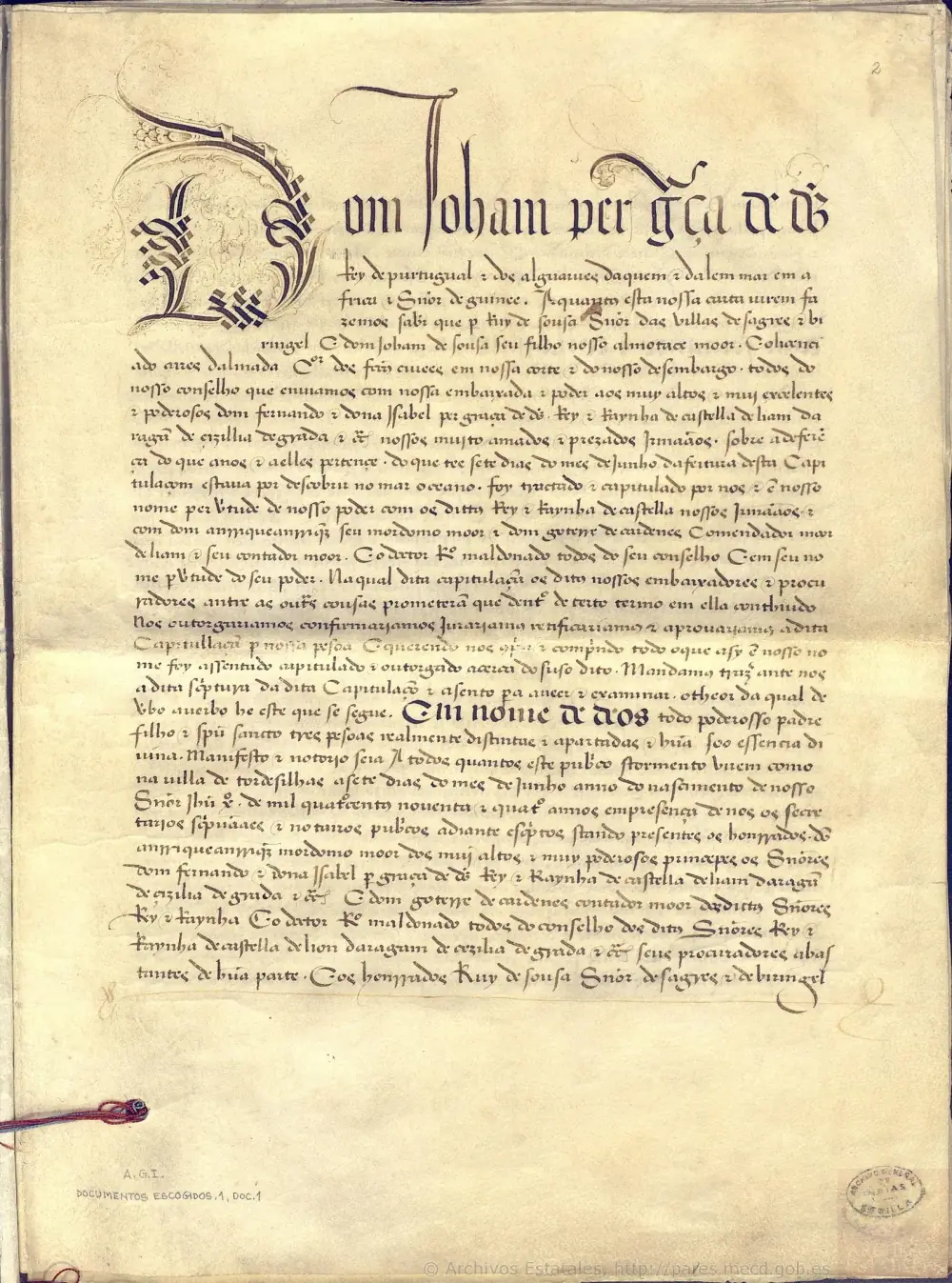
Then Columbus came back. Driven into the Tagus by storms, he was received by João II on 9 March 1493, and the king said the new lands fell within his lordship of Guinea. The Spanish pope Alexander VI ruled for Castile, and his Inter caetera of 4 May 1493 gave it every land west of a line 100 leagues beyond the Azores and Cape Verde. João II persuaded Castile to move it: at Tordesillas on 7 June 1494 the two crowns agreed a line 370 leagues west of the Cape Verde islands.
18 June 1452
Dum Diversas
Nicholas V licenses Afonso V to attack, enslave and dispossess non-Christians.
8 January 1455
Romanus Pontifex
Exclusive rights from Capes Bojador and Nao through Guinea for Portugal.
13 March 1456
Inter caetera (Calixtus III)
Confirms the 1455 bull; spiritual jurisdiction to the Order of Christ.
4 September 1479
Treaty of Alcáçovas
Guinea and the Atlantic islands to Portugal, the Canaries to Castile.
21 June 1481
Aeterni regis
Sixtus IV confirms Alcáçovas.
3 and 4 May 1493
Inter caetera (Alexander VI)
Columbus's discoveries to Castile; the version dated 4 May gives it every land west of a line 100 leagues beyond the Azores and Cape Verde.
26 September 1493
Dudum siquidem
Extends Castile's grant to lands it might reach by sailing west to the Indies, and revokes earlier grants to Portugal that could stand in the way.
7 June 1494
Treaty of Tordesillas
The line moves to 370 leagues west of Cape Verde.
3 November 1514
Praecelsae devotionis (Leo X)
Renews the earlier grants to Portugal and extends them to lands taken from non-Christians anywhere, even lands still unknown.
From papal grant to American law
In 1823 the Supreme Court of the United States heard a dispute over land in Illinois. The plaintiffs held deeds bought in 1773 and 1775 from chiefs of the Illinois and Piankeshaw nations; the defendant, William M'Intosh, held a grant from the United States. Chief Justice John Marshall ruled for M'Intosh. Indians could occupy their land, he wrote, but could not sell it to whomever they pleased, because European discovery had given the ultimate title to the discovering power.
“This principle was, that discovery gave title to the government by whose subjects, or by whose authority, it was made, against all other European governments, which title might be consummated by possession.”
Marshall's opinion does not mention Romanus Pontifex or any other bull. Its one reference to the papacy is the remark that Spain “did not rest her title solely on the grant of the Pope”, followed by “Portugal sustained her claim to the Brazils by the same title”, meaning discovery. He traced the principle mainly through English charters, starting with the 1496 commission to the Cabots to claim countries “then unknown to all Christian people”. Some scholars argue that this idea, that discovery by Christians overrode the rights of the people already there, runs back to the bulls of 1452, 1455 and 1493.
The doctrine is not only history. In 2005, in City of Sherrill v. Oneida Indian Nation, Justice Ruth Bader Ginsburg's opinion for the Court, quoting earlier rulings, noted in a footnote that under the “doctrine of discovery” title to Indian lands had vested first in the discovering European nation and later in the original states and the United States.
Rome's repudiation, 2023
On 30 March 2023, eight months after Pope Francis's penitential visit to Canada, two Vatican departments, the Dicasteries for Culture and Education and for Promoting Integral Human Development, published a joint statement on the doctrine of discovery. It said that “certain scholars” had found its basis in papal documents “such as” Dum Diversas, Romanus Pontifex and Inter caetera.
“The “doctrine of discovery” is not part of the teaching of the Catholic Church. Historical research clearly demonstrates that the papal documents in question, written in a specific historical period and linked to political questions, have never been considered expressions of the Catholic faith.”
The statement admitted that the bulls “did not adequately reflect the equal dignity and rights of indigenous peoples”. It said competing colonial powers had manipulated their contents to justify “immoral acts against indigenous peoples”, at times without opposition from church authorities, and it asked for pardon. It quoted Pope Paul III's bull Sublimis Deus of 1537, which said such peoples must not “be in any way enslaved”. It repudiated the doctrine but did not revoke the bulls themselves.
The statement spoke of indigenous peoples and their land. It does not mention Africans. Slavery comes up only in its claim that popes had condemned it and in the lines from Sublimis Deus, so the people Romanus Pontifex described as “taken by force” go unnamed. The bull itself is still in Lisbon, in the national archive of the Torre do Tombo, under its old shelfmark: Bulas, maço 7, n.º 29.
FAQs
What did the bull Romanus Pontifex grant Portugal?
Issued by Nicholas V on 8 January 1455, it gave King Afonso V, his successors and Prince Henry the exclusive right to conquer, trade and sail from Capes Bojador and Nao through all Guinea and beyond, the power to make laws and levy tribute there, and permission to trade with non-Christians in everything except arms and shipbuilding materials. Any other Christian who went there without a Portuguese licence faced excommunication.
Did Romanus Pontifex authorise slavery?
Yes. It confirmed and extended to Africa the bull Dum Diversas of 1452, which allowed the king of Portugal to reduce Muslims and pagans to “perpetual slavery” and take their lands and goods, and it described Africans “taken by force” and sent to Portugal as part of the enterprise it praised.
Why do some sources date the bull to 1454?
The text is dated “1454” because the papal chancery then counted the new year from 25 March. In modern reckoning, 8 January of that year is 8 January 1455.
What is the doctrine of discovery, and has the Church rejected it?
It is the legal idea, set out by the US Supreme Court in Johnson v. M'Intosh (1823), that discovery by a European power gave it title to land against other Europeans and limited the rights of the indigenous people living there. Some scholars trace it to the bulls of 1452, 1455 and 1493. On 30 March 2023 the Vatican said the doctrine is not Catholic teaching and repudiated it.
Where is the original Romanus Pontifex kept?
The sealed original, a parchment of 57 by 84 centimetres with a lead seal on a silk cord, is in the Arquivo Nacional Torre do Tombo in Lisbon, under the reference Bulas, maço 7, n.º 29.
On the timeline
Open the timelineNearby moments from the age of discoveries (1415–1580).
King Duarte I of Portugal, known as 'the Eloquent' for his philosophical writings, dies of plague at Tomar. He was succeeded by his six-year-old son Afonso V, with Queen Leonor named regent under his will.
Death of Infante Fernando, 'the Constant Prince', in captivity in Fez, Morocco. Captured at the disastrous Tangier expedition of 1437 and offered as ransom for the Portuguese surrender of Ceuta, he chose to remain a prisoner rather than see his country lose its African foothold. His death after six years in chains turned him into a symbol of sacrificial chivalry, later immortalised in Calderón's play 'El príncipe constante'.
The first large auction of enslaved Africans in Europe takes place at Lagos in the Algarve, where 235 captives brought back by caravels sponsored by Prince Henry the Navigator are sold, marking the grim beginning of the European Atlantic slave trade.
The bull Romanus Pontifex
Pope Nicholas V issues the bull 'Romanus Pontifex', granting the Portuguese crown exclusive rights to conquest, trade and navigation along the African coast south of Cape Bojador and sanctioning the enslavement of non-Christians — a papal charter for Portugal's overseas expansion.
Birth of King João II ('The Perfect Prince') in Lisbon. He would become one of Portugal's most important monarchs, sponsoring Bartolomeu Dias's voyage around the Cape of Good Hope and negotiating the Treaty of Tordesillas.
Cardinal Jaime of Portugal, a grandson of King João I and archbishop of Lisbon, dies in Florence in his mid-twenties on his way to a papal congress at Mantua. His funerary chapel at San Miniato al Monte, with a tomb by the Rossellino brothers and decoration by Luca della Robbia and the Pollaiuolo brothers, is one of the great monuments of the Florentine Renaissance.
Infante Henrique — Prince Henry the Navigator — dies at his Vila do Infante near Sagres, aged 66. Patron of the voyages down the African coast that opened the Age of Discovery, he lies in the Founder's Chapel of the Monastery of Batalha.
Coming up in history
All long reads
15 sources
Archives, scholarship and reporting this article was checked against.
- 1
European Treaties bearing on the History of the United States and its Dependencies to 1648, vol. IFrances Gardiner Davenport (ed.), Carnegie Institution of Washington, 1917 (Internet Archive)
- 2
Bula «Romanus Pontifex», Papa Nicolau V, Roma, 8 de Janeiro de 1455Deutsches Historisches Museum, exhibition Novos Mundos – Neue Welten: Portugal e a Época dos Descobrimentos (with the Instituto Camões), 2007
- 3
Para lá das Alcáçovas e de Tordesilhas: o mar e a diplomacia portuguesa do final da Idade Média (Diogo Faria)Negócios Estrangeiros n.º 22, Instituto Diplomático, Ministério dos Negócios Estrangeiros, July 2022
- 4
The Chronicle of the Discovery and Conquest of Guinea, vol. I (chapters I–XL)Gomes Eanes de Zurara, translated by C. R. Beazley and Edgar Prestage (Hakluyt Society, 1896), Project Gutenberg
- 5
Genetic evidence of African slavery at the beginning of the trans-Atlantic slave trade (Martiniano, Coelho, Ferreira, Neves, Pinhasi and Bradley)Scientific Reports 4, 5994 (2014), via PubMed Central
- 6
Table VII: Volume of the Transatlantic Slave Trade from Africa by Nationality of Carrier, 1519–1867 (supplement to David Eltis, “The Volume and Structure of the Transatlantic Slave Trade: A Reassessment”)William and Mary Quarterly, 3rd series, vol. LVIII, no. 1 (January 2001), Omohundro Institute
- 7
Johnson and Graham's Lessee v. M'Intosh, 21 U.S. 543 (1823)Supreme Court of the United States, via Legal Information Institute, Cornell Law School
- 8
Joint Statement of the Dicasteries for Culture and Education and for Promoting Integral Human Development on the “Doctrine of Discovery”Holy See Press Office, 30 March 2023
- 9
Bulls and Briefs (Herbert Thurston)The Catholic Encyclopedia, vol. 3 (1908), New Advent
- 10
- 11
Núcleo Rota da Escravatura – Mercado de EscravosCâmara Municipal de Lagos
- 12
Escravatura e tráfico negreiro nos documentos dos Cartórios Notariais de Lisboa do Arquivo Nacional Torre do Tombo (Maria Manuel Ferraz Torrão)In Subsídios para a história da escravatura insular, séculos XV a XIX, Edições CHAM, Universidade NOVA de Lisboa
- 13
Portuguese slave trade in the Americas (Jelmer Vos and Kalle Kananoja)Encyclopedia of Global Human Migration, Wiley-Blackwell, 2013 (University of Glasgow repository)
- 14
- 15
Vatican formally repudiates “Doctrine of Discovery”Vatican News, 30 March 2023
Image credits
- The Cantino planisphere, drawn by an unknown Portuguese mapmaker in 1502. The vertical line in the Atlantic marks the 1494 Tordesillas boundary between Castile and Portugal; flags and forts line the African coast that the bull of 1455 had granted to Portugal. anonymous Portuguese (1502), Public domain, via Wikimedia Commons.
- Pope Nicholas V, who reigned from 1447 until his death in 1455, in an early sixteenth-century portrait from the collection of Paolo Giovio. Collected by Paolo Giovio (1483–1552), Public domain, via Wikimedia Commons.
- The Chafariz d'El-Rey, the King's Fountain, in Lisbon's Alfama, painted by an unknown Netherlandish artist around 1570 to 1580 (Berardo Collection). Many of the people at the fountain are Black Africans; the painting does not say which of them were enslaved and which were free. anonymous, Public domain, via Wikimedia Commons.
- Pope Alexander VI's bull Inter caetera, dated 4 May 1493, which drew a line 100 leagues west of the Azores and Cape Verde in Castile's favour. The archive stamp on the parchment is that of the Archivo General de Indias in Seville. Unknown author, Public domain, via Wikimedia Commons.
- The first page of King João II's ratification of the Treaty of Tordesillas, in Portuguese, opening “Dom Johan per graça de Deus rey de Portugal”. This copy is in the Archivo General de Indias in Seville. King John II, Public domain, via Wikimedia Commons.