

The Távora executions at Belém: 13 January 1759
Shots fired at a royal carriage one dark night in 1758 ended four months later on a scaffold by the Tagus. A special court sat for a matter of days, and two great noble houses were wiped out.
At a glance
- At about eleven on the night of 3 September 1758, shots were fired into the back of a carriage carrying King José I in Belém, on the western edge of Lisbon. He was wounded in the arm and survived.
- The attack was kept quiet for three months. In mid-December 1758 the Duke of Aveiro, the Marquis and Marchioness of Távora, their sons and their son-in-law, the Count of Atouguia, were arrested.
- A special court, the Junta da Inconfidência, heard the case in summary proceedings. Several defendants were tortured on the rack, and the defence was given twenty-four hours to answer.
- On 13 January 1759 ten people were put to death on a scaffold at Belém: the Marchioness was beheaded, and the others were strangled, broken on the wheel or burned. A gunman who had fled was condemned in his absence.
- In 1781, under Queen Maria I, a board of judges cleared the memory of the five Távoras and the Count of Atouguia, but not the Duke of Aveiro. Historians still debate how far the plot was real.
Shots at the king's carriage
The lock had been jammed. When Pedro Teixeira, the king's personal servant, tried to open the gate of a royal estate in Belém on the night of 3 September 1758, something had been stuffed into the keyhole and the key would not go in. He had it cleared, and the light two-wheeled carriage carrying him and King José I set off at walking pace along a lane between the estate wall and the houses of a government official.
It was about eleven o'clock, the night after the new moon. The carriage turned the corner by the Quinta do Meio, another royal estate also known as the Pátio das Vacas, and the coachman, Custódio da Costa, suddenly urged the mules on. He later said he had seen three horsemen ride out from under an arch and one of them fire at him, but the gun misfired. Some forty or fifty palmos further on, perhaps ten metres, there was a roar of gunfire.
Two loads of heavy shot tore two great holes in the back of the carriage. The king was badly wounded in the right arm, Teixeira was hit, and the coachman was riddled with pellets. According to the royal decree published three months later, three men on horseback had waited by the gate with blunderbusses, and only two of the guns went off.
José did not go on to his palace up the hill at Ajuda. Each step towards the palace would take him further from the kingdom's chief surgeon, who lived at Junqueira, so he ordered the carriage turned round and driven to the surgeon's house. There, Teixeira later testified, he received absolution from a priest before letting the surgeon uncover the wounds. A later tradition, recorded by the city's toponymy office, has him taken instead to the house of the Marquis of Angeja at Junqueira.
A king, his minister and two great houses
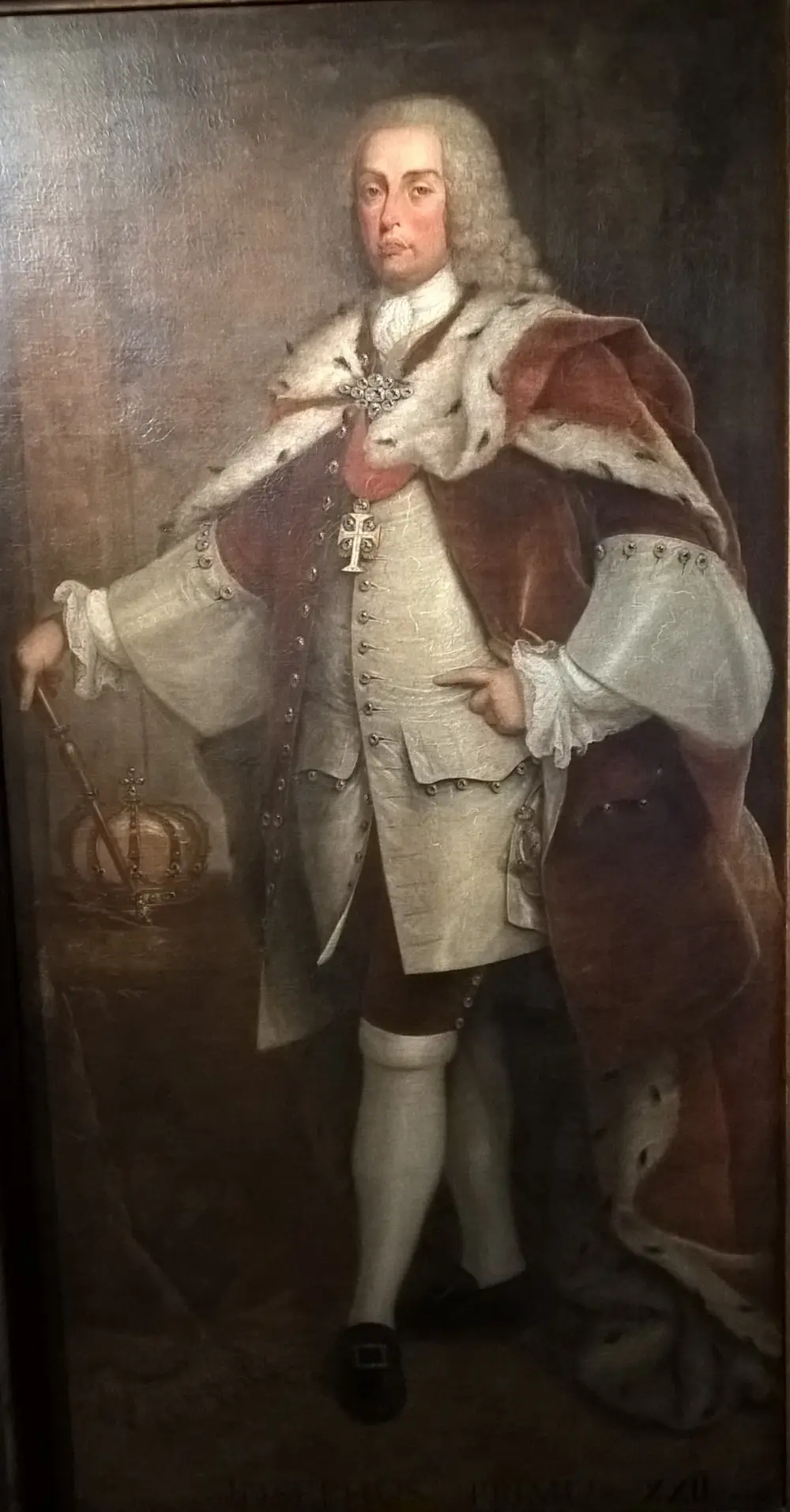
José I came to the throne in 1750 and left the government largely to Sebastião José de Carvalho e Melo, his Secretary of State for the Kingdom, who would become Count of Oeiras in 1759 and Marquis of Pombal in 1770. Carvalho e Melo's power grew after the Lisbon earthquake of 1 November 1755 (told in our article on the earthquake), and much of the old nobility distrusted him as an upstart.
The Távoras were among the proudest families at court. Francisco de Assis de Távora, Marquis of Távora by his marriage to the heiress Leonor Tomásia, had been viceroy of India from 1750 to 1755. Unusually for the high nobility, the family ran its own estates, and the historian Nuno Gonçalo Monteiro has calculated that three-quarters of its income came from the remote northern province of Trás-os-Montes.
José de Mascarenhas, Duke of Aveiro, was the Marquis's brother-in-law and held the post of Mordomo-mor, the king's chief steward. Under José's father he had presided over the Desembargo do Paço, the highest royal court. He had grievances against the new reign: commanderies that were not renewed, and a refusal to let his heir marry a daughter of the Duke of Cadaval.
Then there was the affair. The king was involved with Teresa de Távora, the Marquis's sister, who had married his elder son, Luís Bernardo, her own nephew. She was called the younger Marchioness of Távora to tell her apart from her mother-in-law. The French chargé d'affaires passed on the gossip that the king had been coming from a mistress that night, and Lisbon tradition holds that he had just left her rooms.
Three months of silence
Queen Mariana Vitória took over as regent and a story circulated that the king had had an accident. By 12 and 13 September, though, the French, Austrian and British envoys had sent home fairly detailed reports of an assassination attempt, and rumours ran around Lisbon. Meanwhile, inquiries went on in secret.
The silence broke in mid-December. A decree dated 9 December 1758, signed by Carvalho e Melo and posted up in public on the 13th, announced the attack and promised titles to anyone who exposed the conspirators: commoners would be made noblemen, noblemen raised in rank, and accomplices who talked would be pardoned unless they were ringleaders. Keeping quiet about the crime, it warned, carried the same penalties as the crime itself, even for parents shielding their children.
On the morning of 13 December the arrests began. A Jesuit writing six days later listed both Marquises of Távora, the Marquis of Alorna, the Count of Atouguia, Manuel de Távora and José Maria de Távora, with guards posted at the families' houses and at every Jesuit house in the city. A day or two later the Duke of Aveiro was brought in from Azeitão, south of the Tagus, with his son. Around the turn of the year the Counts of Óbidos and Ribeira were also taken, to the Tower of São Julião.
Even the queen claimed she had been kept in the dark. On 17 December she wrote to her mother, Isabel Farnese, the dowager queen of Spain.
“My very dear mother, they deceived me and I deceived you. For three or four days I have known the truth of what I am going to tell you [...] on the night of 3 September, as the king was returning from the house of one of the other lords, which is so close to here that I can see it perfectly from my windows, they fired two shots at his carriage almost point-blank.”
3 September 1758
The attack
Shots are fired into the king's carriage in Belém at about 11 at night.
12 to 13 September
Envoys report
Foreign diplomats tell their governments of an assassination attempt.
9 December
The decree
The attack is announced, rewards are offered, and summary procedure is ordered.
13 December
Arrests
The Távoras, the Count of Atouguia and others are seized; the Duke of Aveiro a day or two later.
20 December
Torture allowed
A royal decree lets the judges use torture, at the request of the people of Lisbon.
29 to 30 December
The rack
Luís Bernardo, José Maria, their father and the Count of Atouguia are tortured for the names of accomplices.
4 January 1759
Judges named
Five judges are appointed to sit with the judge of the Inconfidência.
9 to 11 January
The defence
One lawyer is given twenty-four hours to answer for the accused; his defence is handed in at 6 pm on the 11th.
12 January
Sentence
The sentence is signed and read to the prisoners between 7 and 9 in the morning.
13 January
Execution
Ten prisoners die on the scaffold by the quay at Belém.
A court without formalities
The case went to the Junta da Inconfidência, a special tribunal for crimes against the king, under the judge Pedro Gonçalves Cordeiro Pereira. The decree of 9 December swept away the ordinary rules of evidence and procedure. There was to be no time limit and no minimum number of witnesses, and sentences were to be carried out on the day they were given.
“that the ringleaders as well as the other followers of the conspiracy be prosecuted and judged in simply verbal and most summary proceedings, by which the mere fact of the truth of the crimes may appear, observing only the terms of Natural and Divine Law, without any attention to the formalities or nullities arising from the provisions of common and national law.”
The three Secretaries of State, Carvalho e Melo among them, were to preside over the interrogations. The prisoners were questioned in rooms of the royal estates at Belém where they were held in secret. The witnesses were few, and hardly any of them were noble.
On 20 December a royal decree, answering a petition from the people of Lisbon, allowed the judges to put suspects to torture. The method was the potro, a rack on which the prisoner was tied by the arms and legs while the cords were tightened, in turns called tratos, with a surgeon present to say how much he could bear. Servants of the Duke went on the rack, and so did the Távoras and the Count of Atouguia.
Luís Bernardo, the younger Marquis, began to talk three-quarters of the way into his first turn and named his parents and the Duke. His brother José Maria kept denying everything through a turn and a half until the surgeon called a halt. Their father was racked more gently because the surgeon found he had a hernia and asthma, and he too denied. Carvalho e Melo's signature heads the records of the sessions with Luís Bernardo, the Count of Atouguia and the elder Marquis. The count gave names after a turn and a quarter.
The Duke of Aveiro denied everything when first questioned on 24 December. The next day he confessed and blamed four Jesuit priests, and on 28 and 29 December he named the Távoras and the Count of Atouguia. The judges who reviewed the case in 1781 concluded that these last statements had been extracted by torture or the fear of it.
On 9 January the court ordered the accused to reply within twenty-four hours through a single lawyer named by the king, Eusébio Tavares de Sequeira. He received the summary of the charges at five in the afternoon of 10 January and handed in his defence at six in the evening of the 11th. The same day the court asked the king for leave to go beyond the penalties fixed by law, and the sentence was drawn up on the 12th.
The sentence named three heads of the conspiracy: the Duke, the Marquis and the Marchioness. It said the plotters meant to kill the king and put government in the hands of his brother, Infante Pedro, who would later marry the king's heir, the future Maria I, and that Jesuit priests had guided them. It also banned anyone, on pain of losing all property, from using the surname Távora.
The scaffold at Belém
The scaffold went up on the large square by the quay at Belém, high enough, the sentence said, for the whole people to see. Ten proclamations were prepared, one for each prisoner, announcing that the King was doing justice on a person who had been Portuguese and had been stripped of that status for conspiracy, high treason and parricide.
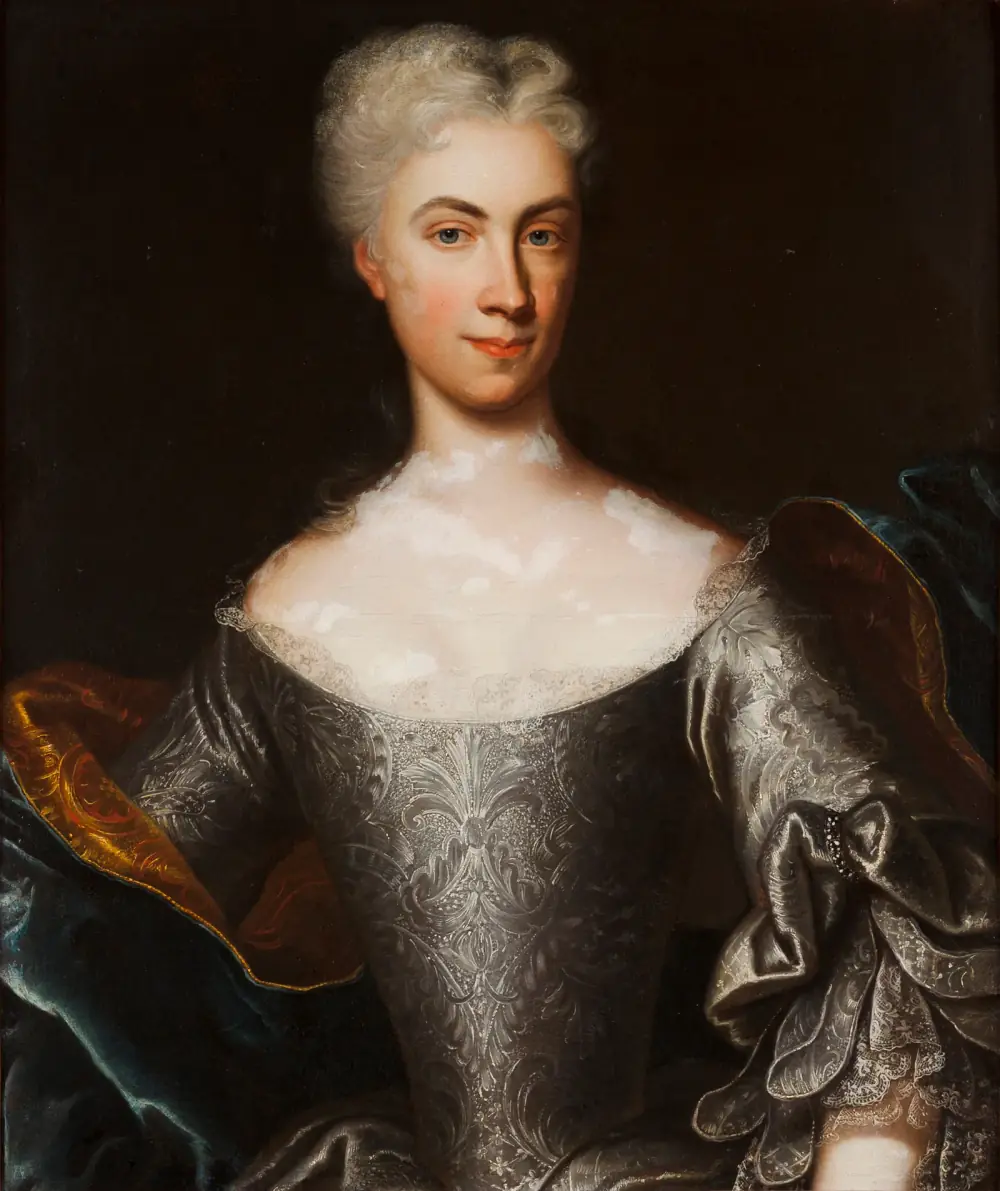
Leonor de Távora, born in 1700, came first, carried in a black sedan chair with priests beside her. According to a contemporary account quoted by the historian Nuno Gonçalo Monteiro, the executioner walked her round the scaffold and showed her, one by one, the instruments with which her husband, sons and son-in-law were to die. Then she was tied to a bench, blindfolded with her own handkerchief, and beheaded.
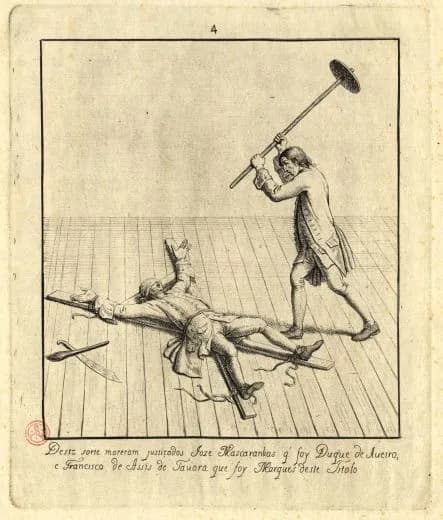
Her sons José Maria and Luís Bernardo, her son-in-law the Count of Atouguia and three servants followed. Each was tied to an X-shaped wooden cross, and the sentence ordered them strangled with a garrotte and the bones of their arms and legs broken with iron mallets. The account says the garrotte cord snapped at the first turn on José Maria, who died from the blows.
The Marquis and the Duke came last. The sentence ordered them broken alive, exposed on a wheel and then burned alive with the scaffold. For the Marquis the executioner used an iron mace weighing 18 arráteis, about 8 kilograms, and the account says he died within minutes. The court's secretary certified that the sentence had been carried out on everyone named in it, on the square by the quay at Belém, on 13 January 1759.
António Álvares Ferreira, named as one of the two gunmen, was sentenced to be burned alive on a post. All the bodies were burned and the ashes thrown into the Tagus so that, as the sentence put it, nothing should remain of their memory.
| Name | Who they were | Sentence | Review of 1781 |
|---|---|---|---|
| José de Mascarenhas, Duke of Aveiro | The king's chief steward; one of the three named heads | Broken alive, exposed on a wheel, burned alive; palace razed and salted | Not cleared |
| Francisco de Assis de Távora, Marquis of Távora | General and former viceroy of India; a named head | Broken alive, exposed on a wheel, burned alive | Cleared |
| Leonor Tomásia de Távora, Marchioness of Távora | His wife and heiress of the house; a named head | Beheaded, body burned | Cleared |
| Luís Bernardo de Távora, the younger Marquis | Their elder son, husband of the king's mistress | Strangled, limbs broken, put on the wheel, burned | Cleared |
| José Maria de Távora | Their younger son, his father's aide-de-camp | Strangled, limbs broken, put on the wheel, burned | Cleared |
| Jerónimo de Ataíde, Count of Atouguia | Their son-in-law | Strangled, limbs broken, put on the wheel, burned | Cleared |
| Manuel Álvares Ferreira | Keeper of the Duke's wardrobe | Strangled, limbs broken, put on the wheel, burned | Not covered |
| Brás José Romeiro | Corporal in the younger Marquis's company | Strangled, limbs broken, put on the wheel, burned | Not covered |
| João Miguel | The Duke's attendant | Strangled, limbs broken, put on the wheel, burned | Not covered |
| António Álvares Ferreira | Named as one of the gunmen | Burned alive on a post | Not cleared |
| José Policarpo de Azevedo | Named as the other gunman, António's brother-in-law | Burned alive; declared an outlaw in his absence | Not cleared |
Sentence as published from the 1784 copy of the trial file and in the English translation of 1759. Policarpo had fled; the court offered 10,000 cruzados for his capture in Portugal and 20,000 abroad, and he was never taken. A separate sentence of 11 January exiled the Duke's equerry, José Manuel da Silva Bandeira, to Angola for life. The 1781 review revoked the sentence only for the five Távoras and the Count of Atouguia, and held that the crime was the work of the Duke and the two gunmen alone.
The families did not end on the scaffold. The Marchioness's daughters, the Duchess of Aveiro and the children were shut in convents and religious houses. The Marquis of Alorna, the executed couple's son-in-law, spent the rest of the reign in the fort of Junqueira, and the Duke's son, the young Marquis of Gouveia, was held there for eighteen years. Teresa, the king's lover, was spared but had to take vows in a convent.
The Jesuits in the dock
The sentence named Malagrida, and Jesuits were soon in custody. On 16 January the queen told her mother that ten priests of the Society of Jesus had been arrested, and thirteen were eventually confined in the fort of Junqueira. Malagrida himself was taken into custody about the time of the sentence; one recent study dates his arrest to 11 January.
On 18 January the judges and Carvalho e Melo signed a set of proposals, the Providências, at the Ajuda palace where the court sat. They called for the Jesuits' property to be sequestered and their schools at Coimbra, Évora and elsewhere to be closed and replaced by teachers of reading, writing, arithmetic and Latin paid from the confiscated funds. Rather than expel the Jesuits, the ministers proposed to scatter them around the kingdom and its African outposts.
A law of 3 September 1759, the first anniversary of the attack, declared the Jesuits outlaws and expelled them from Portugal and all its territories. Members who had not taken the fourth vow could declare themselves innocent and leave the order. Other Catholic kingdoms followed, and the pope suppressed the order in 1773.
Voltaire wrote that a lay court could not put a priest to death for regicide without Rome's consent, which never came. Malagrida was handed instead to the Inquisition, then directed by Carvalho e Melo's brother Paulo, and tried for heresy over visionary writings he produced in prison. His sentence was read at an auto-da-fé in the cloister of the São Domingos convent on 20 September 1761, which ran past midnight. In the early hours of 21 September he was taken to the Rossio, garrotted, and his body burned.
Was there a plot?
That shots were fired and the king was wounded is not in doubt. Who fired them, and on whose orders, has been argued over since 1759. Even the condemned families did not agree. The Marquis of Alorna wrote to his wife from prison, between the lines of his letters in lemon juice, and blamed two people.
“Everyone knows perfectly well that it is the Marchioness of Távora we have to complain of, for were it not for the illicit dealings she had with the King nobody would have thought of your parents and your brothers. After that we also have reason to complain of the Duke of Aveiro, who besides being the only one to whom the deed belonged, had the weakness to drag in all the others and bear false witness against them, which Sebastião José used to kill them without admitting any kind of defence.”
Others doubted the king was even the target. Witnesses whom Alorna was allowed to call from 1777 said they had been told the gunmen did not know José was in the carriage and were after Pedro Teixeira. A friar repeated what his uncle, one of the prisoners' jailers, had told him: the coachman had shouted that the king was inside, and the attackers stopped following.
Pedro de Azevedo, the Biblioteca Nacional archivist who published the trial file in 1921, accepted that the Duke was guilty. He found no sign that any Jesuit took part, and he judged that the Marchioness was killed without proof, without being heard and without a real defence. The court, he wrote, decided eleven lives in a few hours.
José Oscar de Almeida Marques points to the three months of secrecy, a trial and executions completed in under three weeks against every established legal practice, and an implausible motive. He writes that Carvalho e Melo himself set the details of the executions, and he does not rule out that the whole affair was staged. Patrícia Alves sees the trial as part of a wider drive to assert royal authority over the Church and the great noble houses.
After José I died in 1777, his daughter Maria I dismissed Carvalho e Melo and freed the surviving prisoners (told in our article on Maria I). Alorna pressed for a retrial, and on 23 May 1781 a board of judges revoked the sentence for the Marquis and Marchioness, their two sons and the Count of Atouguia, finding no proof that they took part. The Duke of Aveiro was not cleared.
The Crown's prosecutor lodged objections, Maria never ruled on them, and the new sentence said nothing about returning the confiscated estates. A certificate taken from it recorded that it had not been put into effect, and it was printed only in 1808, during the French occupation, without legal force.
Salted ground and a church of thanks
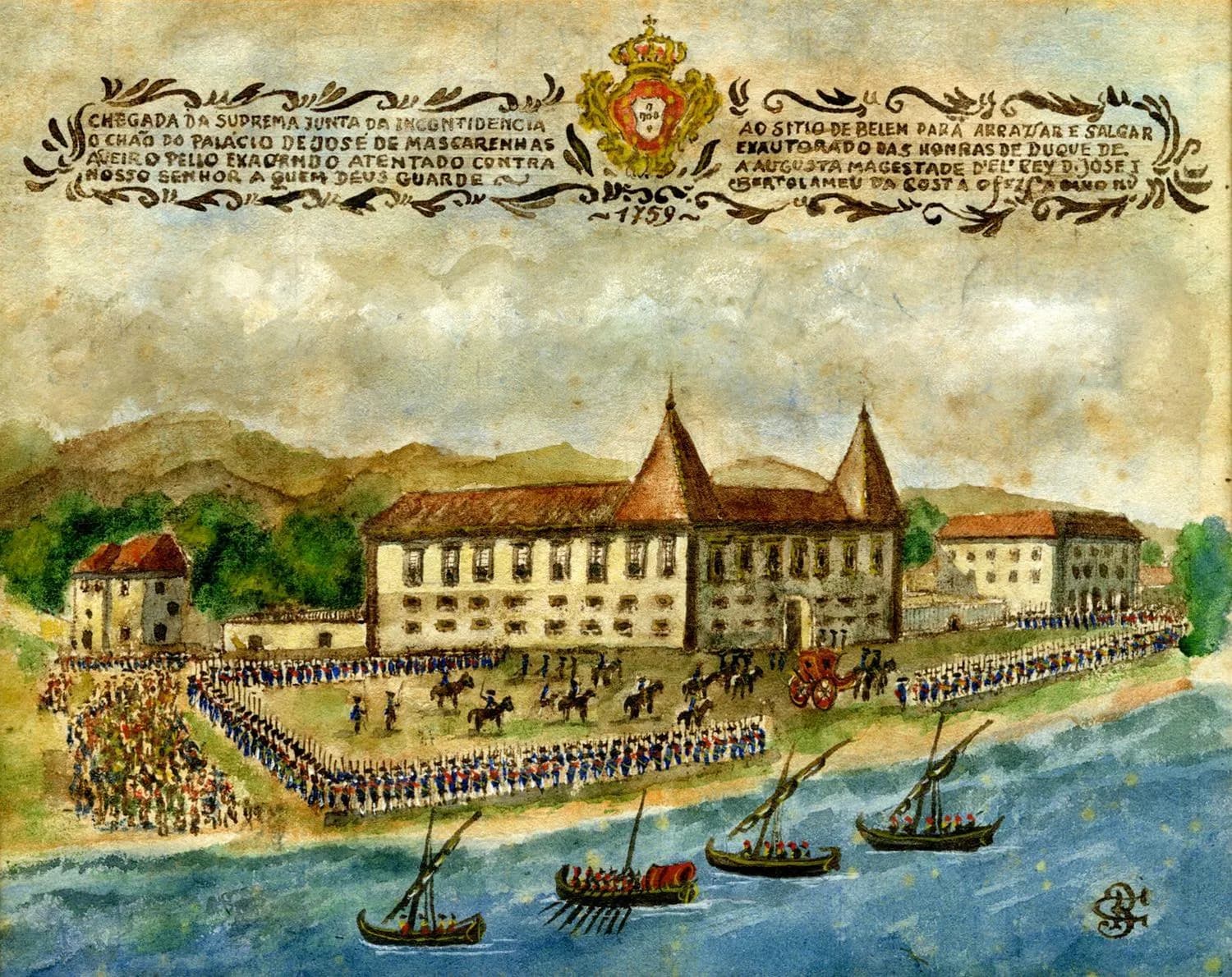
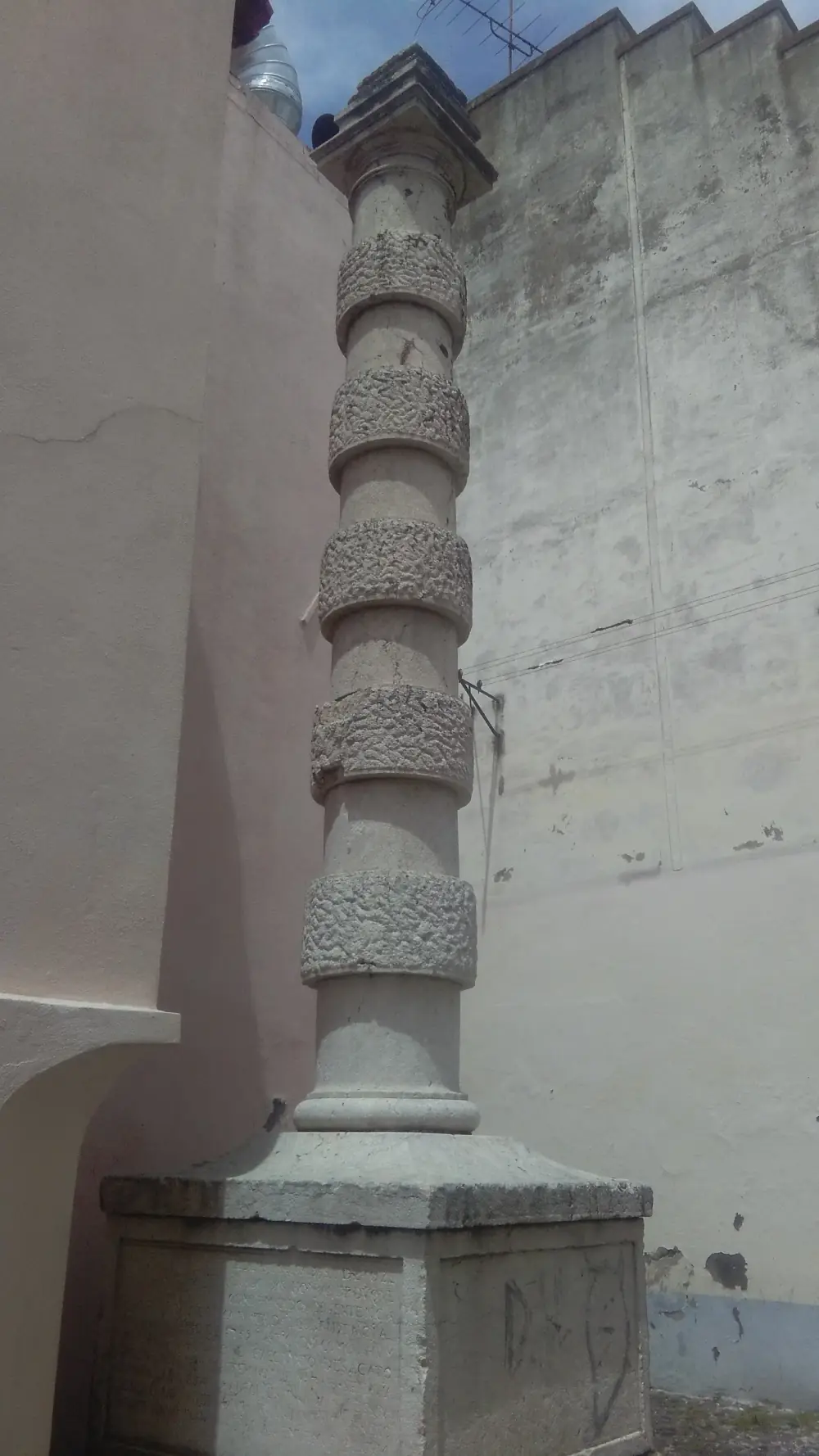
The sentence ordered the houses of the condemned razed and their ground salted. In Belém the Duke of Aveiro's palace was pulled down, and in 1759 a stone pillar about five metres high, ringed with five carved bands, was set up on the site with an inscription telling passers-by why.
“Here the houses of José de Mascarenhas, stripped of the honours of Duke of Aveiro and others, were razed and salted [...] On this infamous ground nothing may be built at any time.”
The ban did not last. Building resumed on the site in Maria I's reign, and what remains of the Chão Salgado, the salted ground, is a narrow alley off the Rua de Belém.
Up the hill, José gave thanks for his escape. On the spot where he was shot, work began in May 1760 on a church dedicated to Our Lady of Deliverance and Saint Joseph, designed by Giovanni Carlo Bibiena, and its first stone was laid on 3 September 1760. Work stopped more than once for lack of money and resumed in November 1779 under the architect Mateus Vicente. It is known as the Igreja da Memória.
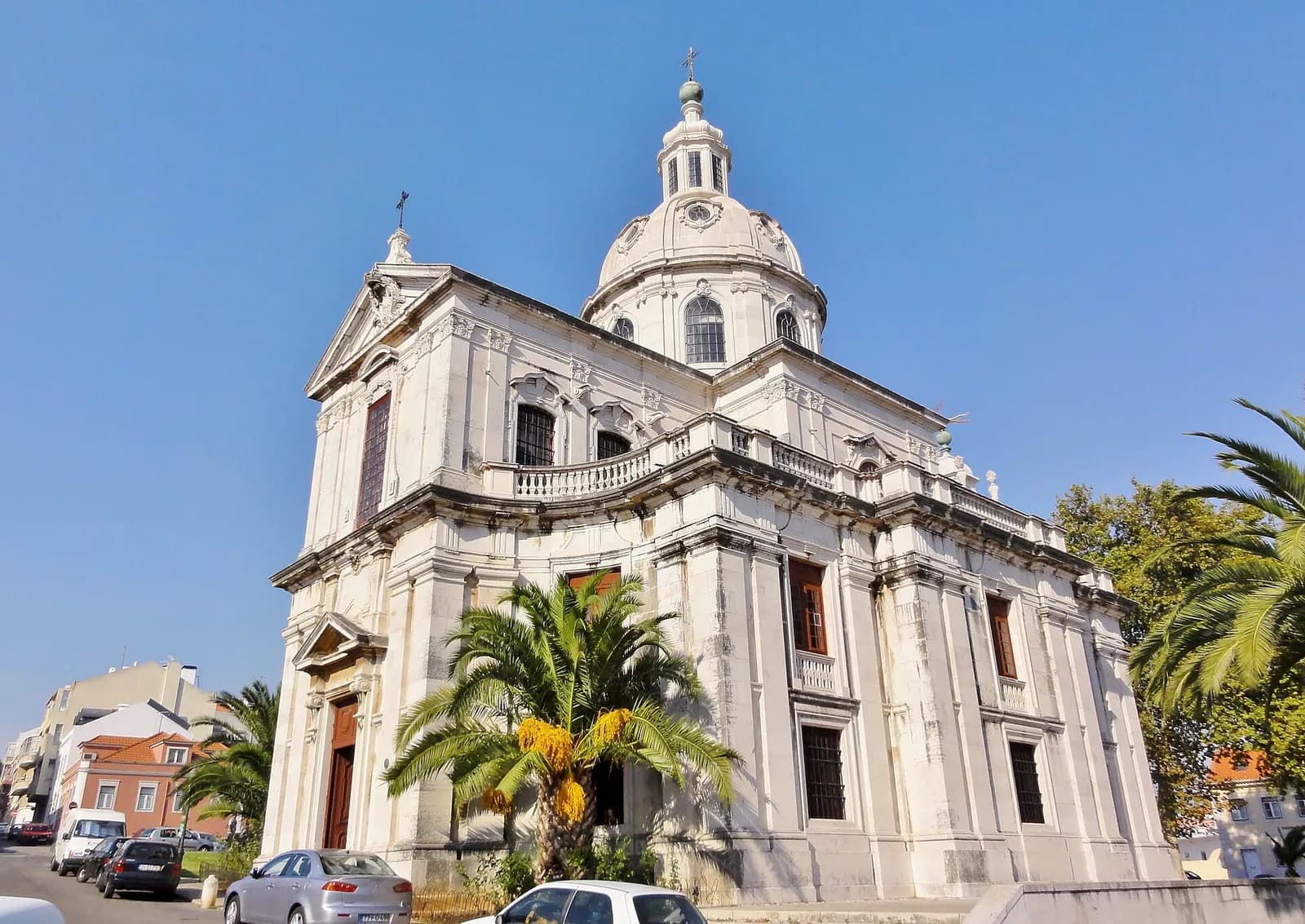
The pillar still stands among the backs of houses in Belém. Its inscription names only the Duke of Aveiro, the one great noble whom the review of 1781 left condemned. In 1923 the remains of the Marquis of Pombal were moved into the Igreja da Memória, the church built to give thanks for the king's escape that night.
FAQs
Why were the Távoras executed?
A special court found that the Duke of Aveiro, the Marquis and Marchioness of Távora and members of their family had plotted the attack on King José I on the night of 3 September 1758. They were sentenced on 12 January 1759 for conspiracy, high treason and parricide, and executed at Belém the next day.
Who died at Belém on 13 January 1759?
Ten people: the Duke of Aveiro; the Marquis of Távora, his wife Leonor and their sons Luís Bernardo and José Maria; their son-in-law the Count of Atouguia; the servants Manuel Álvares Ferreira, Brás José Romeiro and João Miguel; and António Álvares Ferreira, named as a gunman. A second alleged gunman, José Policarpo de Azevedo, escaped and was condemned in his absence.
Was the Marquis of Pombal behind the Távora affair?
Sebastião José de Carvalho e Melo, later Marquis of Pombal, signed the decree that announced the attack and the records of the torture sessions with the elder Marquis and his son. That shots were fired is not in doubt. Many historians doubt that the Távoras took part, and José Oscar de Almeida Marques does not rule out that the whole affair was staged.
Were the Távoras ever cleared?
Partly. On 23 May 1781 a board of judges appointed by Maria I revoked the sentence for the Marquis and Marchioness of Távora, their two sons and the Count of Atouguia, and allowed the families to use the name Távora again. The Duke of Aveiro was not cleared, the Crown's objections were never resolved, and the confiscated property was not returned.
What is the Beco do Chão Salgado?
An alley off the Rua de Belém on the site of the Duke of Aveiro's palace, which was razed and its ground salted after the sentence of 1759. A stone pillar put up that year still stands there, with an inscription forbidding anyone to build on the infamous ground.
On the timeline
Open the timelineNearby moments from earthquake and enlightenment (1750–1807).
By royal charter, King José I and his minister Sebastião José de Carvalho e Melo, the future Marquês de Pombal, create the Companhia Geral da Agricultura das Vinhas do Alto Douro to control the port wine trade. Its granite boundary stones, the 'marcos pombalinos', went on to mark out what is considered the world's oldest demarcated wine region.
Gomes Freire de Andrade is born in Vienna, son of Portugal's ambassador to the Austrian court. A soldier of fortune who fought for Catherine the Great against the Turks and marched into Russia with Napoleon, he was hanged in 1817 as the alleged leader of a liberal plot against the British-dominated regency; Lisbon's Campo dos Mártires da Pátria honours the conspirators.
King José I survives an assassination attempt when horsemen ambush his carriage outside Lisbon, wounding him in the arm and shoulder; the affair leads to the trial and brutal execution of the Távora family, strengthens the hand of the future Marquês de Pombal and paves the way for the expulsion of the Jesuits a year later.
The Távora executions
The Duke of Aveiro and leading members of the Távora family, condemned for the September 1758 attempt on King José I's life, are executed on a scaffold at Belém, most of them broken on the wheel. Many historians doubt the Távoras' guilt, and some suspect the future Marquis of Pombal of using the case to break the old aristocracy.
The Jesuit priest Gabriel Malagrida is garrotted in Lisbon's Rossio square and his body burned, hours after his sentence was read at an Inquisition auto-da-fé in the cloister of São Domingos. He had been condemned as a heretic at the instigation of Carvalho e Melo, the future Marquis of Pombal, whom he had enraged by preaching that the 1755 earthquake was God's punishment for Lisbon's sins.
A charter law of King José I, countersigned by the future Marquis of Pombal, creates the Real Erário (Royal Treasury), abolishing the medieval Contos do Reino e Casa and channelling all crown revenue into a single treasury kept by double entry. Portugal's Court of Auditors, the Tribunal de Contas, counts it among its direct ancestors.
Birth in Lisbon of Marcos Portugal, the most internationally successful Portuguese composer of his age. He premiered at least 21 operas in Italian theatres in the 1790s, then joined the exiled court in Rio de Janeiro in 1811 and stayed on in Brazil until his death in 1830.
Coming up in history
All long reads 15 January 1432Afonso V, the African king: born in Sintra, 15 January 1432
 16 January 1711Saint Joseph Vaz, the Goan priest who rebuilt Ceylon’s banned church
 17 January 1995Miguel Torga, doctor and poet of Trás-os-Montes, dies: 17 January 1995
 18 January 193418 January 1934: the general strike and the night in Marinha Grande
13 sources
Archives, scholarship and reporting this article was checked against.
- 1
O processo dos Távoras (prefaced and annotated by Pedro de Azevedo)Biblioteca Nacional, Lisbon, 1921 (Inéditos 1), digitised by the Internet Archive
- 2
- 3
D. João de Almeida Portugal e a revisão do processo dos Távoras: conflitos, intrigas e linguagens políticas em Portugal nos finais do Antigo Regime (c. 1777-1802) (Patrícia Woolley Cardoso Lins Alves, PhD thesis)Universidade Federal Fluminense, Niterói, 2011
- 4
Voltaire e um episódio da história de Portugal (José Oscar de Almeida Marques)Mediações: Revista de Ciências Sociais 9 (2), 2004, pp. 37-52, Universidade Estadual de Londrina
- 5
A tentativa de regicídio do Rei D. José I e as consequências nobiliárquicas advindas para a História do Direito do Portugal setecentista (Guilherme Marchiori Assis)Revista Maracanan 38, 2025, Universidade do Estado do Rio de Janeiro
- 6
O Beco do Chão Salgado dos TávoraToponímia de Lisboa, Câmara Municipal de Lisboa, 17 July 2017
- 7
- 8
Nascimento de D. José IArquivo Nacional Torre do Tombo
- 9
O processo inquisitorial do jesuíta Gabriel Malagrida: aspectos históricos e jurídicos (Guilherme Marchiori de Assis)Ciclo de Palestras do Grupo de Estudos Modernidade Ibérica, Universidade Federal do Espírito Santo, 2018
- 10
A sinistra conduta de um ex-jesuíta na colônia: religiosidade e antijesuitismo no império português, 1759-1763 (Fabricio Lyrio Santos)Revista Brasileira de História das Religiões 16 (46), 2023, ANPUH
- 11
- 12
- 13
Image credits
- The arrival of the Supreme Junta da Inconfidência at Belém to raze and salt the ground of the Duke of Aveiro's palace, painted by Bartolomeu da Costa in 1759. The work is in the Museu de Lisboa. Bartolomeu da Costa, CC BY-SA 4.0, via Wikimedia Commons.
- José I, king of Portugal from 1750 to 1777, in a portrait painted between 1750 and 1760 and attributed to Francisco José Aparício and André Gonçalves. It hangs in the Museu Nacional dos Coches in Lisbon. André Gonçalves, Public domain, via Wikimedia Commons.
- Leonor Tomásia de Távora, 3rd Marchioness of Távora (1700 to 1759), painted by an unidentified Portuguese artist in the eighteenth century. Unidentified painter, Public domain, via Wikimedia Commons.
- “In this manner died, executed, José Mascarenhas, who was Duke of Aveiro, and Francisco de Assis de Távora, who was Marquis of that title”: one of a series of prints of the executions made in 1759 or 1760, in the Biblioteca Nacional de Portugal. Unknown author, Public domain, via Wikimedia Commons.
- The Igreja da Memória in Ajuda, begun in 1760 on the spot where José I was shot. The remains of the Marquis of Pombal were moved here in 1923. Photographed in 2012. Jose Manuel, CC BY-SA 4.0, via Wikimedia Commons.
- The pillar of 1759 in the Beco do Chão Salgado, Belém, on the site of the Duke of Aveiro's palace. Photographed in 2016. RicardoFilipePereira, CC BY-SA 4.0, via Wikimedia Commons.