

Afonso V, the African king: born in Sintra, 15 January 1432
He became king as a boy, fought the uncle who raised him, conquered Moroccan towns and had them woven into giant tapestries, then lost a bid for Castile. Portugal's Atlantic monopoly was settled at the end of his reign.
At a glance
- Afonso V was born in Sintra on 15 January 1432, a son of Duarte, then heir to the throne, and Leonor of Aragon. An older brother, João, born in 1429, died in childhood. Afonso became king in September 1438, aged six.
- His mother and his uncle, the Infante Pedro, fought over the regency. Pedro ruled from 1439, and in 1449 he was killed at Alfarrobeira fighting the army of the nephew he had raised.
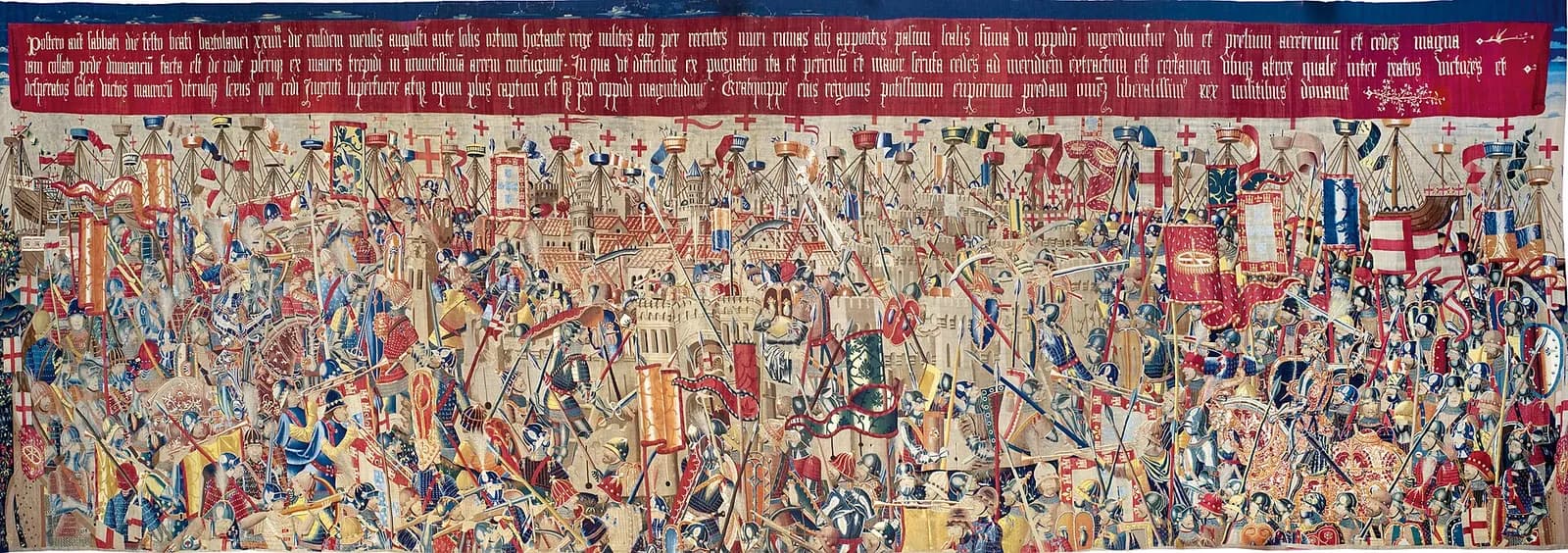
- Afonso took Alcácer Ceguer in 1458 and Arzila and Tangier in 1471, which earned him the nickname “o Africano”. He had the 1471 campaign woven into four huge tapestries, now at Pastrana in Spain.
- In 1475 he invaded Castile to claim its crown for his niece and bride, Juana. The Battle of Toro on 1 March 1476 was claimed by both sides, but the war was lost and the Treaty of Alcáçovas ended it in 1479.
- The same treaty left Portugal the African coast and the seas beyond the Canaries. Afonso died at Sintra on 28 August 1481 and was buried at Batalha.
A knighthood in a captured mosque
On the morning of 24 August 1471, St Bartholomew's day, the Portuguese poured over the walls of Arzila, on the Atlantic coast of Morocco. The fighting was worst in the mosque and then in the castle. By the end, the royal chronicler Rui de Pina wrote, every defender was dead or captive: about 2,000 killed and 5,000 taken, by common estimate.
Among the Portuguese dead was João Coutinho, Count of Marialva, a young lord killed in the mosque. King Afonso V went there when the town fell and found a cross already laid on the count's body. Beside the corpse he knighted his son and heir, the 16-year-old Prince João, whose sword was bent from the fighting.
“My son, may God make you as good a knight as this man who lies here.”
Afonso was 39 and had been king since the age of six. Within five years he would be beaten at Toro in a war for the crown of Castile, and within ten he would die in Sintra, the town where he was born on 15 January 1432.
A king at six, and a fight over the regency
Afonso belonged to the House of Avis, the dynasty founded by his grandfather João I. His father, Duarte, was heir to the throne when Afonso was born and became king when João I died on 14 August 1433. Duarte and Leonor already had a son, João, born in Lisbon in October 1429, who died in childhood, before that August. His mother, Leonor, was the sister of King Alfonso V of Aragon; she and Duarte had married in Coimbra in 1428.
Duarte died at Tomar in September 1438, on the 9th according to Pina and the 13th according to the modern Encyclopaedia of Portuguese Expansion. The boy was proclaimed king at once, aged six and, as Pina put it, entering his seventh year. His father's will left the regency to Leonor alone. The towns' representatives, led by Lisbon's, wanted Duarte's brother Pedro, Duke of Coimbra, instead.
The Cortes at Torres Novas, late in 1438, tried to split the power. Leonor would be the king's guardian and control revenues and offices, Pedro would be “defender” of the kingdom, and the Count of Arraiolos would run justice. It did not hold. In Lisbon the townsmen met in the refectory of the São Domingos friary to back an agreement making Pedro sole regent, and so many craftsmen added their names that they would not fit in one large book.
On 10 December 1439 the Cortes in Lisbon confirmed Pedro as regent in the king's name. Leonor's supporters held castles in the Alentejo, and after they were besieged she fled across the border to Albuquerque, in Castile, at the end of December 1440. She died in Toledo in 1445, poor enough to live on gifts from Castilian prelates and widows.
Pedro raised the boy. Afonso was taught by tutors his uncle chose, Estêvão de Nápoles and Mateus Pisano, and in 1445 he married Pedro's daughter, his cousin Isabel. Pedro, a famous traveller, was remembered as the prince “das Sete Partidas”, of the seven parts of the world.
Alfarrobeira: the nephew against the uncle
In January 1446 Afonso turned 14, the age at which, Pina wrote, Spanish custom gave a prince full power over his kingdom. At the Cortes in Lisbon, Pedro handed him the rod of justice. The boy asked him to carry on governing in his name, and he did.
Pedro's enemies worked on the young king: chief among them Afonso, Duke of Bragança, João I's illegitimate son, with his son the Count of Ourém and the Archbishop of Lisbon, who visited the king at night. Afonso soon demanded the government for himself. Pedro gave it up, and in May 1447 the king set up his household with his wife at Santarém. Historians date his personal rule from 1447 or 1448.
Rumour and accusation, much of it false according to Pina, did the rest. Afonso declared his uncle disloyal. In May 1449 Pedro marched south from Coimbra with his supporters and camped by the Alfarrobeira stream near Alverca, north of Lisbon. The king's much larger army surrounded him on Tuesday 20 May.
Pina says the king had decided not to attack that day. A stone from one of Pedro's bombards landed near the royal tent, and the king's men charged without orders. Pedro, on foot in a mail shirt and a crimson velvet tunic, was struck in the chest by a crossbow bolt and fell dead within a few paces. Pina gives his age as 57, but Fernão Lopes recorded his birth in Lisbon on 9 December 1392, which makes him 56. His friend the Count of Abranches died soon after.
Pedro's body lay three days in a hut without candle or prayer; Pina blamed the old courtiers more than the 17-year-old king. In 1455, at Queen Isabel's request, her father's bones went to the royal chapel at Batalha. Five centuries later the art historian António Filipe Pimentel wrote that memory still pictured Afonso with hands “forever stained with the blood of his tutor”.
Crusade in Morocco
Portugal had held Ceuta, on the African side of the Strait of Gibraltar, since 1415. An attack on Tangier in 1437 had ended in disaster, and Afonso's uncle Fernando, left as a hostage, died a captive in Fez in 1443. After his death, taking Tangier became a duty for the new reign.
When Constantinople fell to the Ottomans in 1453, the pope called a crusade. Afonso was one of the few princes who answered, offering 12,000 men for a year at his own cost. When the rest of Christendom held back, he turned the effort on Morocco.
| Year | Target | What happened |
|---|---|---|
| 1458 | Alcácer Ceguer, between Tangier and Ceuta | A fleet Pina puts at about 220 sail left Lagos on 17 October. The town surrendered on 23 October, after the king of Fez chose to guard Fez instead. Its garrison then held out through two sieges in 1458 and 1459. |
| 1463 to 1464 | Tangier and the hills near Ceuta | Attempts to take Tangier by escalade failed, at a cost of more than 1,000 Portuguese dead. In a raid in the hills the king was nearly caught; Duarte de Meneses, Count of Viana, died covering his retreat. |
| 1471 | Arzila (Asilah) | About 477 ships and up to 30,000 men, by Pina's count, sailed in August; the historian João Paulo Oliveira e Costa puts the army in Africa at about 20,000. The town was stormed on 24 August. |
| 1471 | Tangier | The townspeople, fearing Arzila's fate, abandoned the city. It was occupied without a fight in late August or early September. |
Ship and troop numbers are Rui de Pina's and are probably rounded. The printed edition of Pina dates the fleet's departure from Setúbal, on Saturday 30 September, to 1457, but 30 September fell on a Saturday in 1458, the year of the conquest.
Afonso's uncle Henry the Navigator sailed with him to Alcácer Ceguer and talked him out of turning on Tangier. The town was a corsairs' port. Afonso turned its mosque into a church. The king of Fez besieged it for 53 days that winter and again in 1459, and its 800 or so inhabitants depended wholly on supplies from Portugal.
In 1471 he took his son. Pina says the town's commander, its alcaide, had just offered to negotiate when the Portuguese swarmed over the walls. The historian Maria Dávila calls it a policy of terror: this time the king would not accept a surrender.
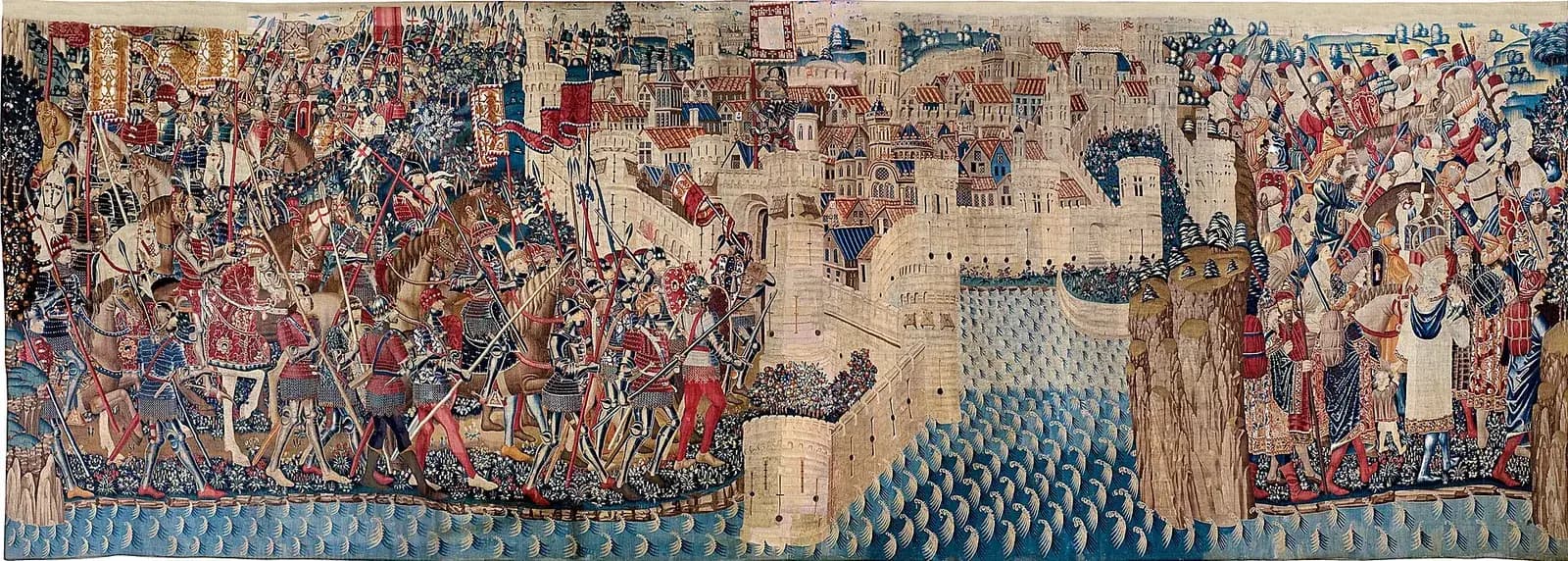
The lord of Arzila, Muley Sheikh, was away fighting for the throne of Fez and chose a kingdom over a town. He signed a twenty-year truce that left Ceuta, Alcácer Ceguer and Arzila to the Portuguese, and a year later he became the first sultan of the Wattasid dynasty. The chroniclers dated the entry into abandoned Tangier to 28 August, the feast of St Augustine, a saint believed to have been born there.
From then on the kings of Portugal called themselves “King of Portugal and of the Algarves on this side and beyond the sea in Africa”. Afonso himself became “o Africano”, the African.
A war woven in wool and silk
Within a few years of 1471, Afonso ordered a record of the campaign from the workshops of Tournai, in present-day Belgium. The Pastrana set has four hangings, each up to about 11 metres long and 4 metres high. Three tell the story of Arzila, landing, siege and assault; the fourth shows the taking of Tangier, where the king was not present.
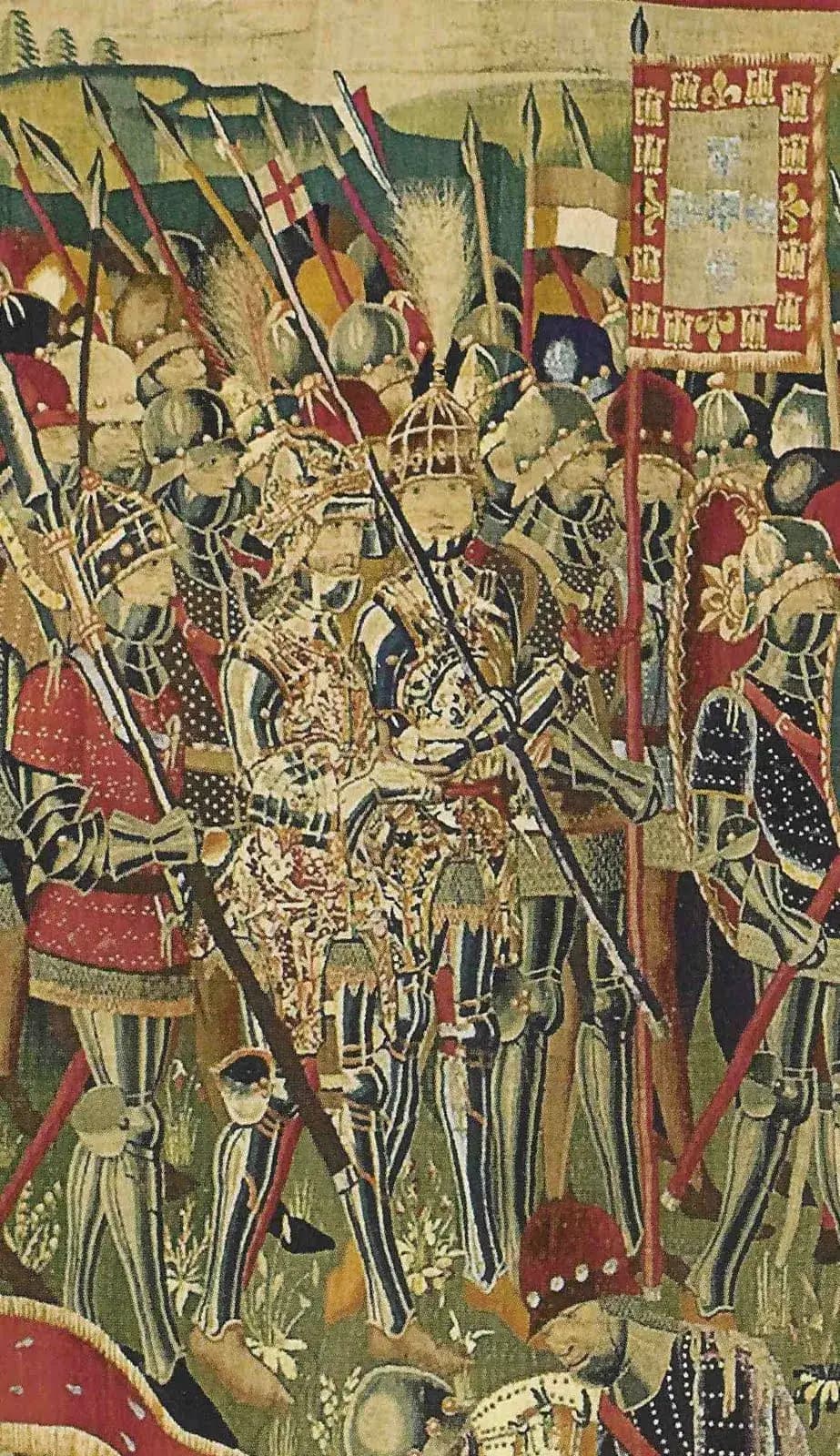
Most tapestries of the time showed scenes from the Bible or classical myth. These showed events that had just happened, with ships, cannon and handguns in detail. Banners across the Arzila scenes carry the king's emblem, a wheel spraying drops of water. The textile historian Maria Antónia Quina reckons that 16 to 20 weavers on four looms needed three to five years to make them.
Nobody knows for certain how they left Portugal. The leading theory, according to the Meadows Museum in Dallas, is that Rui Gomes da Silva, the Portuguese-born Prince of Éboli and later first Duke of Pastrana, gave them to Philip II of Spain in the sixteenth century. Since at least the seventeenth century they have belonged to the Collegiate Church of Our Lady of the Assumption in Pastrana, in the Spanish province of Guadalajara.
Restored by the De Wit workshops in Mechelen, the four went on tour in 2010. Lisbon's Museu Nacional de Arte Antiga showed them together from 12 June to 12 September 2010, for the first time in Portugal since they left. Pimentel, then its director, called them a deliberate “record of glory” by a king who understood images.
The man the chroniclers described
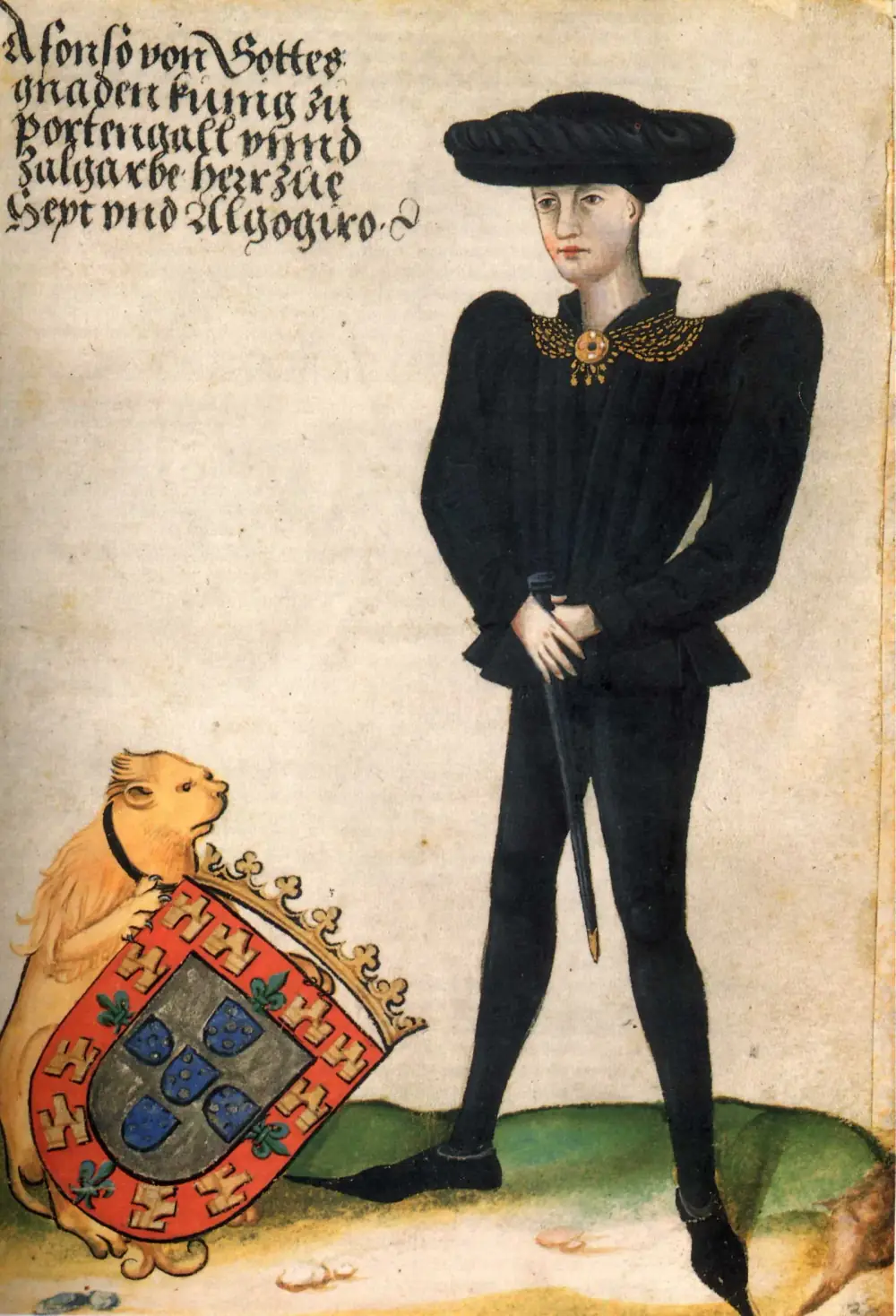
Around 1457 or 1458 a German knight, Georg von Ehingen, met the king, then about 25, and a portrait of him survives with Ehingen's papers: slim, beardless, dressed in black. Beside it Ehingen wrote a verdict.
“The king was a handsome and well-formed prince, and the most Christian, most bellicose and fairest king that I have ever met.”
Rui de Pina, writing for Afonso's nephew Manuel I, drew a man of graceful presence and easy manners, so easy that courtiers forgot to show him respect. He was a good writer and loved music. He was also, Pina said, “more properly called prodigal than truly liberal”, giving away Crown lands and rents without great merit or need.
“He was the first king of these kingdoms who gathered good books and made a library in his palaces.”
He minted coins called espadins, stamped with a hand holding an upright sword, and founded a chivalric Order of the Sword. Sixteenth-century chroniclers such as Damião de Góis and João de Barros painted him as weak and uninterested in the voyages. The historian João Paulo Oliveira e Costa reads the documents of his own time differently: they show a king closely involved in them.
Gold, pepper and the Atlantic
In 1443, during Pedro's regency, the Crown had given Henry the Navigator a lifelong monopoly of voyages south of Cape Bojador. On 8 January 1455 Pope Nicholas V's bull Romanus Pontifex recognised the Portuguese Crown's exclusive right to navigation, trade and dominion along the African coast that Henry's caravels had reached; a separate article tells that story. When Henry died in 1460, Afonso kept the overseas trade for the Crown.
In 1466 he let settlers of Santiago, in Cape Verde, trade in Guinea, to get the island peopled. In 1468 he leased the Guinea trade to Fernão Gomes, a squire of modest rank, for 200,000 reais a year. Between 1470 and 1474 Portuguese caravels explored the Gulf of Guinea, reaching the islands of São Tomé and Príncipe and the gold of Mina in 1471.
Later writers said the lease obliged Gomes to explore the coast. Costa notes that the only surviving document of it, a royal charter of 1 June 1473, says nothing of the kind. From 1474 Afonso left overseas affairs to Prince João, the future João II.
A bride and a crown in Castile
Afonso's sister Joana had married Henry IV of Castile. In 1462 she bore a daughter, Juana, whom enemies of the king called “la Beltraneja”, claiming her real father was the royal favourite Beltrán de la Cueva. Henry's half-sister Isabella disputed Juana's right to the throne and married Ferdinand of Aragon in 1469.
Henry IV died on 12 December 1474, and Isabella proclaimed herself queen the next day. A party of great Castilian nobles backed Juana, and her uncle Afonso, a widower since 1455, set out to marry her and win her the throne. The Cortes at Évora granted him money for a war in February 1475.
Afonso crossed into Castile in May 1475, on the 25th by the usual reckoning, though the Aragonese chronicler Zurita says the 10th. At Plasencia, on 30 May, he married the 13-year-old Juana and was proclaimed King of Castile. The marriage was never consummated: it needed a papal dispensation, because they were uncle and niece, and Pope Sixtus IV granted one in 1477 only to revoke it the next year.
Mounted men in Afonso V's army entering Castile, May 1475, by chronicler
mounted men (lances)
Figures compiled by Marcelo Encarnação (Table 1 of his thesis). The Portuguese chroniclers add 14,000 foot soldiers; Palencia and Valera give 15,000 and Zurita 14,000, while Bernáldez says only “many”. Pulgar and Lucio Marineo Sículo give no number. Ferdinand of Aragon, writing to his father, put the king's own horse at up to 3,000, with 600 or 700 more under the Duke of Guimarães.
Show the data
| Cavalry, as each chronicler gives it | |
|---|---|
| Rui de Pina (Portuguese) | 5,600 |
| Damião de Góis (Portuguese) | 5,600 |
| Garcia de Resende (Portuguese) | 5,600 |
| Alonso de Palencia (Castilian) | 5,000 |
| Diego de Valera (Castilian) | 5,000 |
| Jerónimo Zurita (Aragonese) | 5,000 |
| Andrés Bernáldez (Castilian) | 3,500 |
Toro: one battle, two victories
The war dragged on through 1475, and the town of Zamora went over to Isabella in December. By February 1476, after eight months in enemy country, Afonso's army was short of food and money, and he was camped opposite Ferdinand at Zamora, across the Douro.
Before dawn on 1 March Afonso broke camp and marched back upstream towards Toro. Castilian light horse caught him around midday. With part of his army already in Toro, he turned to fight. The battle began late in the afternoon in rain, and darkness ended it about three hours later.
- Date
- Friday 1 March 1476, from late afternoon into the night
- Place
- Between Zamora and Toro, on the south bank of the Douro, Castile
- Portugal and Juana's party
- Afonso V, Prince João, the Archbishop of Toledo Alfonso Carrillo
- Isabella's party
- Ferdinand of Aragon, Cardinal Pedro González de Mendoza, the Duke of Alba
- Weather
- Rain, then darkness, after about three hours of fighting
- Portuguese dead
- More than 800 to 1,500, in Castilian chronicles; Portuguese chronicles give no figure
Both sides agree on the outline. Prince João, on the left with 800 picked men-at-arms and the handgunners, charged first and routed the Castilian divisions facing him. In the centre, Ferdinand's main body broke Afonso's; Pina blamed heavily armoured Castilian men-at-arms and a mass of handgunners whose fire made the Portuguese horses shy. The royal standard was taken, and Afonso fled with a handful of riders to the castle of Castronuño.
The accounts part company at nightfall, as Marcelo Encarnação shows in his doctoral study of more than twenty chronicles. Each side wrote down its own victory.
| Episode | Portuguese chronicles (Pina, Góis, Resende) | Castilian and Aragonese chronicles (Pulgar, Palencia, Valera, Zurita) |
|---|---|---|
| The centre | Pina admits Ferdinand's main body broke Afonso's “without any force or resistance” | Ferdinand's horsemen rout Afonso's centre and take the royal standard |
| Where Ferdinand was | Watching from a small reserve at the rear, ready to escape if the day went badly | Leading the charge against Afonso's centre in person (Palencia) |
| Prince João at night | Held the field most of the night, so close to the enemy that each side heard the other talk; nobody dared attack him | Afraid, he slipped off to Toro under cover of darkness and rain (Palencia, Valera); Pulgar's version is closer to the Portuguese one |
| The standard-bearer, Duarte de Almeida | Lost both hands defending the standard, held it in his teeth, and survived | Killed (Ferdinand's own report, cited by Zurita) or taken prisoner (Pulgar) |
| Casualties | No figures | Portuguese dead more than 800 (Valera) to 1,500 (Cronicón de Valladolid); Castilian dead 9 (Palencia) to 300 (Zurita) |
| Remembrance | From 1482 João II ordered a yearly procession for the victory; he stopped it in 1491 as the crowns drew closer | Letters to the towns and public devotions by Isabella; a yearly procession from 1480; the Catholic Monarchs founded San Juan de los Reyes in Toledo |
Encarnação treats the Castilian casualty figures with caution: chroniclers on both sides used numbers to magnify their own side's glory.
“From this the Portuguese took occasion to write shamelessly to Lisbon that the Prince had remained on his field as the victor.”
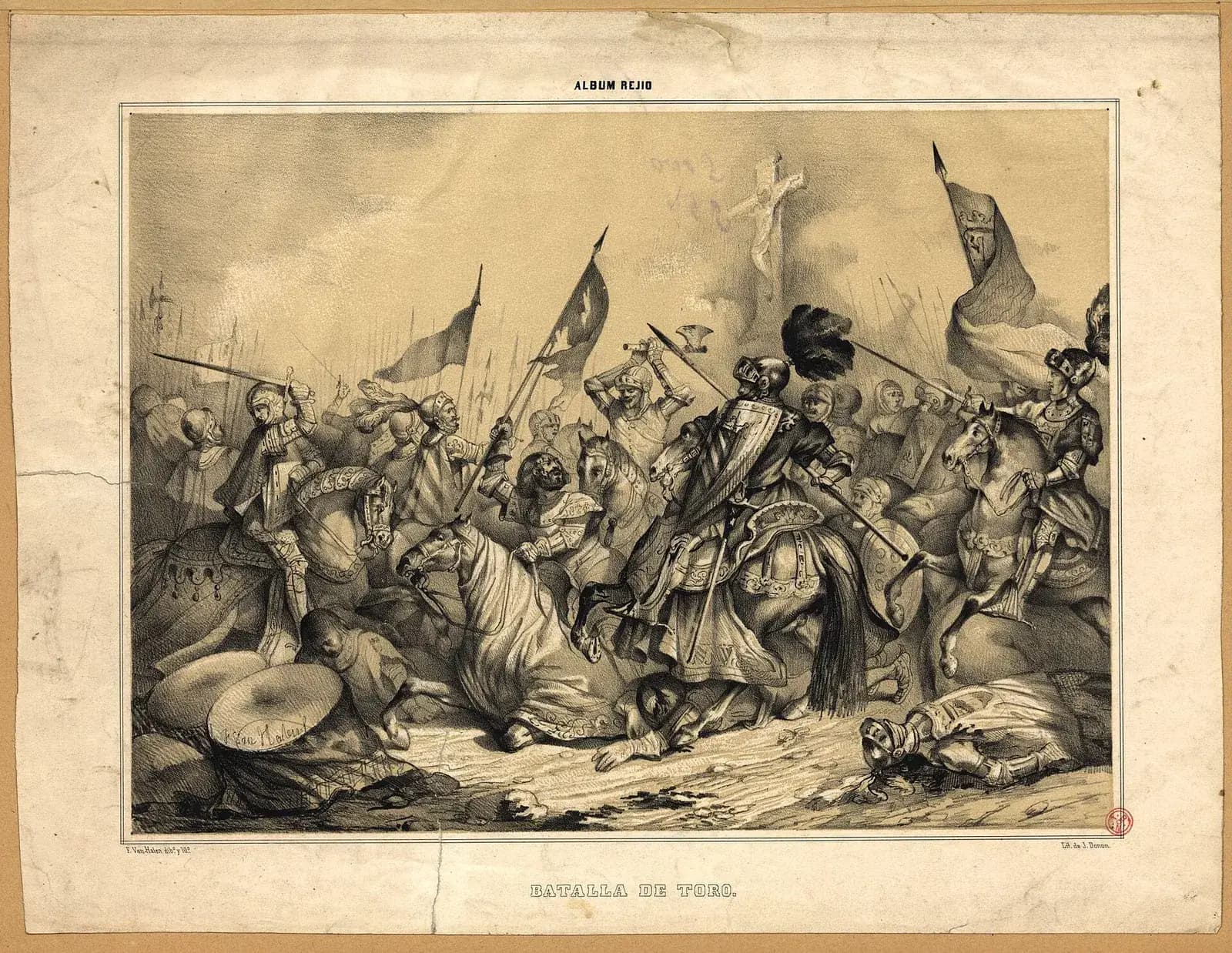
On the ground, Encarnação concludes, Toro was inconclusive. In politics it was the beginning of the end for Afonso. Castilian nobles changed sides, Zamora's castle surrendered on 19 March, and in April the Cortes of Madrigal swore allegiance to Isabella as queen.
A king who walked away
Afonso looked for help from Louis XI of France. In August 1476 he sailed from Lisbon with 16 ships and 2,200 men. He met Louis at Tours in November, visited Charles the Bold, Duke of Burgundy, at the end of December, and spent months waiting while the French king made promises.
Charles the Bold was killed in January 1477, and by the end of the year Louis was negotiating peace with Castile. In September 1477, at a Norman port at the mouth of the Seine where his fleet was being made ready, Afonso decided that God was against him.
Before dawn on 24 September he rode off with two servants of his chamber and two grooms, meaning to go to Jerusalem unrecognised. He left a locked chest of letters: one ordered Prince João to proclaim himself king. Louis XI's men tracked him down two days later at his lodging in a village. Persuaded by his own nobles and a letter from the French king, Afonso agreed to go home.
João was acclaimed king in the porch of São Francisco at Santarém on 10 November 1477, in tears. Days later his father reached Cascais and learned that he had a successor. When they met at Oeiras, João knelt, kissed his hand and gave the crown back.
Peace at Alcáçovas, and death in Sintra
The war wore on along the border until a Portuguese force under the Bishop of Évora was beaten at La Albuera, in Extremadura, on 24 February 1479. Two women prepared the peace: the Infanta Beatriz, Afonso's sister-in-law and Isabella's aunt, met Isabella at Alcántara in March 1479.
At Alcáçovas, in the Alentejo, the treaties were signed on 4 September 1479 and ratified at Toledo on 6 March 1480. Afonso gave up the title of King of Castile, and Isabella and Ferdinand gave up their claim to Portugal. Juana was to marry Isabella's infant son or enter a convent. Prince João's son Afonso was to marry Isabella's eldest daughter, with both children held in the care of the Infanta Beatriz at Moura.
The sea clauses mattered more in the long run. Castile kept the Canary Islands and the right to conquer Granada. Portugal kept Madeira, the Azores and Cape Verde, the conquest of Fez and the whole coast of Guinea “discovered and to be discovered”, with its seas and trade. Pope Sixtus IV confirmed the terms in 1481. It was the first division of the ocean into zones, 15 years before the Treaty of Tordesillas.
Juana chose the convent. On 15 November 1480, at Santa Clara in Coimbra, she took the black veil before Castilian envoys. Pina says Afonso fell gravely ill at Coimbra that season, from grief over the choice she was forced into. The Portuguese went on calling her “the Excellent Lady”.
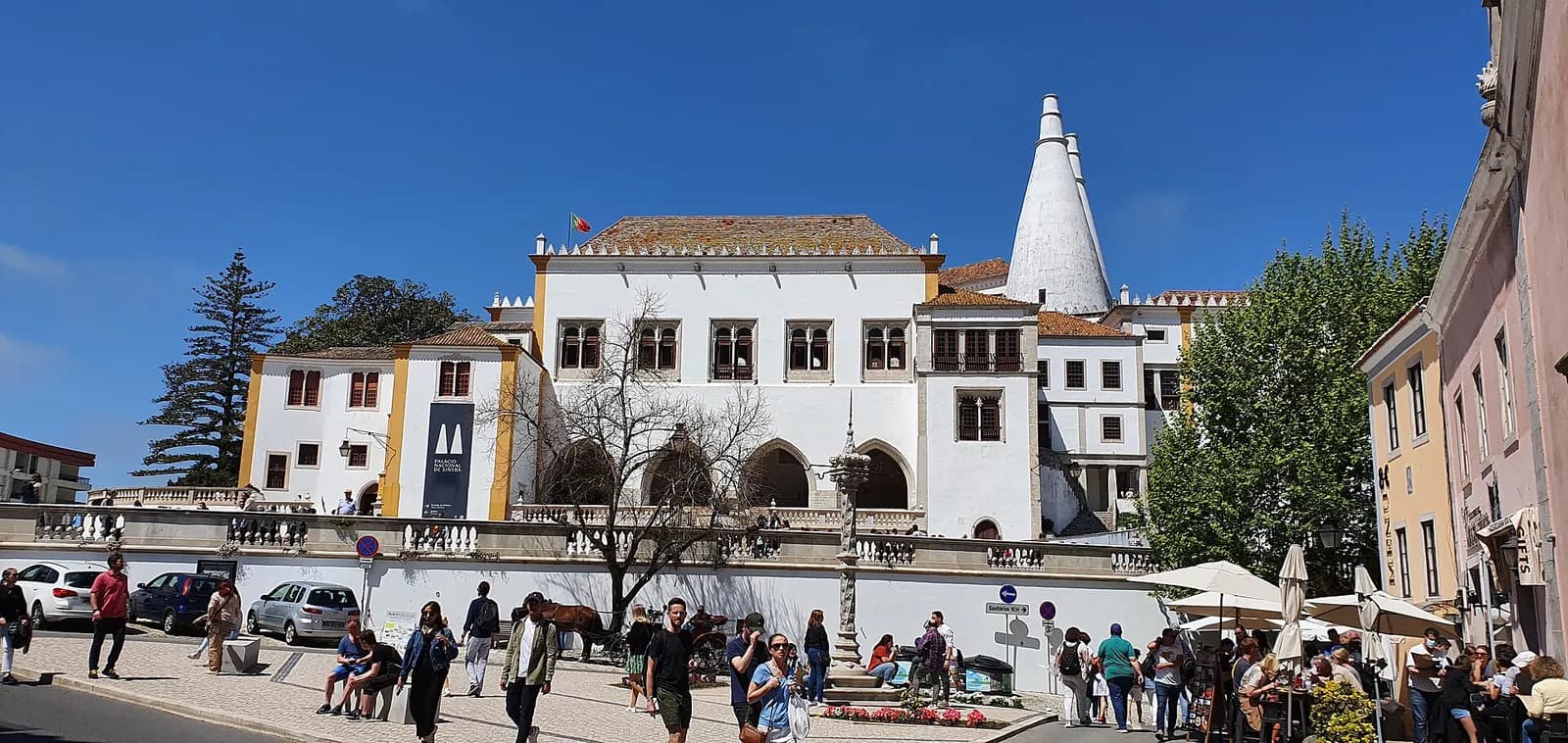
In 1481 Afonso planned to hand the kingdom to his son at Cortes in Estremoz and retire, as a layman, to the friary he had founded at Varatojo, near Torres Vedras. Early in August he went to Sintra. There he caught an acute fever and died on 28 August 1481, aged 49, “in the very house in which he was born”. His body was carried to Batalha by mule.
15 January 1432
Born in Sintra
9 or 13 September 1438
Duarte dies at Tomar; Afonso is king at six
10 December 1439
The Cortes in Lisbon confirm the Infante Pedro as regent
December 1440
Queen Leonor flees to Castile
1445
Afonso marries his cousin Isabel, Pedro's daughter
1447 to 1448
Afonso takes over the government
20 May 1449
Pedro killed at Alfarrobeira
3 May 1455
Prince João, the future João II, is born in Lisbon
23 October 1458
Alcácer Ceguer taken
1463 to 1464
Failed attacks on Tangier
1468
Guinea trade leased to Fernão Gomes
24 August 1471
Arzila stormed; Tangier occupied days later
May 1475
Invades Castile; marries Juana at Plasencia
1 March 1476
Battle of Toro
August 1476
Sails for France to seek Louis XI's help
10 November 1477
João acclaimed king; he returns the crown when his father lands
4 September 1479
Treaty of Alcáçovas
15 November 1480
Juana takes the veil at Coimbra
28 August 1481
Dies at Sintra; buried at Batalha
Why it still matters
Afonso V's reputation suffered from the men around him. His uncle Pedro and his son João II, the “Perfect Prince”, were cast as the able rulers, and he as the knight-king between them. Pimentel noted that the uncle was remembered for his travels while Afonso, who went from Castile to France, was never given any credit for his.
Yet João II inherited from him the gold of Mina, the islands of São Tomé and Príncipe, two military orders and a treaty that kept Castile out of the African Atlantic. Costa calls it an extraordinary and often undervalued legacy. The towns Afonso took in Morocco were less lasting: Alcácer Ceguer was abandoned in 1550.
FAQs
Why was Afonso V called “o Africano”?
For his conquests in Morocco: Alcácer Ceguer in 1458 and Arzila and Tangier in 1471. After 1471 the kings of Portugal styled themselves kings “of Portugal and of the Algarves on this side and beyond the sea in Africa”.
Who won the Battle of Toro in 1476?
Both sides claimed it. Ferdinand's centre routed Afonso V's, and Afonso fled; Prince João routed the Castilian right and, by Portuguese accounts, held the field into the night. Historians generally see it as militarily inconclusive but a political victory for Isabella and Ferdinand, whose claim to Castile it settled.
Where are the Pastrana tapestries?
The four originals, woven in Tournai for Afonso V, belong to the Collegiate Church of Pastrana in Guadalajara, Spain. They were shown in Lisbon at the Museu Nacional de Arte Antiga in 2010. Copies made in Madrid in 1936 are at the Paço dos Duques in Guimarães.
Why did Afonso V go to war with his uncle Pedro?
Pedro had ruled as regent from 1439 and raised the king, who married his daughter. After Afonso took power, the Duke of Bragança and other enemies of Pedro turned the young king against him with accusations Rui de Pina considered false. Afonso declared Pedro disloyal, and Pedro was killed at Alfarrobeira on 20 May 1449.
What did the Treaty of Alcáçovas decide?
Signed on 4 September 1479, it ended the war over the Castilian succession. Afonso V gave up his claim to Castile, and the treaty divided the Atlantic: the Canaries to Castile, and Madeira, the Azores, Cape Verde and the Guinea coast, found and yet to be found, to Portugal.
On the timeline
Open the timelineNearby moments from the age of discoveries (1415–1580).
At the request of King João I, the Pope appoints Prince Henry the Navigator administrator of the Order of Christ, the Portuguese successor to the Templars. The order's great wealth would help fund the voyages of exploration down the West African coast.
By royal charter, King João I abolishes the old Hispanic Era of Caesar and orders that documents in Portugal be dated by the Christian era of Anno Domini — the last Iberian kingdom to make the change.
In Bruges, Philip the Good, Duke of Burgundy, founds the Order of the Golden Fleece during the celebrations of his marriage to Isabel of Portugal, daughter of King João I and Philippa of Lancaster, who would become a leading figure of Burgundian diplomacy.
Afonso V, “o Africano”
The future King Afonso V is born in Sintra, son of Duarte, then heir to the throne. Left king at the age of six, he would earn the nickname 'o Africano' for his conquests in Morocco.
King Duarte I of Portugal, known as 'the Eloquent' for his philosophical writings, dies of plague at Tomar. He was succeeded by his six-year-old son Afonso V, with Queen Leonor named regent under his will.
Death of Infante Fernando, 'the Constant Prince', in captivity in Fez, Morocco. Captured at the disastrous Tangier expedition of 1437 and offered as ransom for the Portuguese surrender of Ceuta, he chose to remain a prisoner rather than see his country lose its African foothold. His death after six years in chains turned him into a symbol of sacrificial chivalry, later immortalised in Calderón's play 'El príncipe constante'.
The first large auction of enslaved Africans in Europe takes place at Lagos in the Algarve, where 235 captives brought back by caravels sponsored by Prince Henry the Navigator are sold, marking the grim beginning of the European Atlantic slave trade.
Coming up in history
All long reads 17 January 1995Miguel Torga, doctor and poet of Trás-os-Montes, dies: 17 January 1995
 18 January 193418 January 1934: the general strike and the night in Marinha Grande
 19 January 1919The Monarchy of the North: Porto's 25-day kingdom of 1919
 20 January 1554Sebastião the Desired: the king born in Lisbon on 20 January 1554
19 sources
Archives, scholarship and reporting this article was checked against.
- 1
Chronica de El-Rei D. Affonso V, vol. III (Rui de Pina, ed. Gabriel Pereira, 1902)Project Gutenberg
- 2
- 3
D. Afonso V (b. 1432-r. 1438-1481) (João Paulo Oliveira e Costa)Encyclopaedia of Portuguese Expansion (EVE), CHAM, NOVA FCSH, 2009
- 4
A Batalha de Toro (Marcelo Augusto Flores Reis da Encarnação, PhD thesis, 2 vols.)Faculdade de Letras da Universidade do Porto, 2011
- 5
Afonso V and the Invention of Glory: the Pastrana Tapestries at the Museu Nacional de Arte Antiga (António Filipe Pimentel)Museu Nacional de Arte Antiga and Fundación Carlos de Amberes, 2010 (Estudo Geral, Universidade de Coimbra)
- 6
- 7
The Invention of Glory: Alfonse V and the Pastrana TapestriesMeadows Museum, Southern Methodist University, Dallas (exhibition, 2012)
- 8
- 9
D. DuarteO Portal da História (Manuel Amaral), after Joel Serrão's Pequeno Dicionário de História de Portugal (1976) and Veríssimo Serrão
- 10
- 11
Chronica de el-rei D. João I, Part II (Fernão Lopes), volumes 4 to 6Bibliotheca de Classicos Portuguezes, Lisbon, 1897 (digitised by Internet Archive)
- 12
- 13
- 14
Pastrana Series: The Taking of Tangier (PD0333)Paço dos Duques de Bragança, Guimarães (Museus e Monumentos de Portugal)
- 15
La invención de la gloria: el rey Alfonso V y los tapices de Pastrana (Museu Nacional de Arte Antiga, 12 June to 12 September 2010)CODART
- 16
Bula «Romanus Pontifex», Papa Nicolau V, Roma, 8 de Janeiro de 1455Deutsches Historisches Museum, exhibition Novos Mundos – Neue Welten: Portugal e a Época dos Descobrimentos (with the Instituto Camões), 2007
- 17
Monastery of San Juan de los ReyesSpain.info, official tourism website of Spain (Turespaña)
- 18
Visita ao Mosteiro da BatalhaMosteiro da Batalha (Museus e Monumentos de Portugal)
- 19
Image credits
- The Assault on Arzila, one of the four Pastrana tapestries woven in Tournai in the last quarter of the fifteenth century for Afonso V. A Latin inscription across the top describes the scene below. Pasquier Grenier (attributed), Public domain, via Wikimedia Commons.
- Detail of the Landing at Arzila, one of the Pastrana tapestries. The two richly dressed figures at the centre are identified as Afonso V and Prince João coming ashore in August 1471. Pasquier Grenier, Public domain, via Wikimedia Commons.
- The Fall of Tangier: Portuguese troops under João, son of the Duke of Bragança, arrive at the city as its inhabitants leave with their belongings for what the Paço dos Duques museum calls a forced exile, late August 1471. Pasquier Grenier (attributed), Public domain, via Wikimedia Commons.
- Afonso V in the journal of Georg von Ehingen, who served him in Ceuta in 1458 and 1459. The German inscription names him king of Portugal and the Algarve and lord of Ceuta. Württembergische Landesbibliothek, Stuttgart. Unknown author (Georg von Ehingen? 1428-1508), Public domain, via Wikimedia Commons.
- The Battle of Toro imagined by the Spanish artist Francisco de Paula Van Halen for his Album Rejio, a lithograph of about 1850. Francisco de Paula Van Halen, Public domain, via Wikimedia Commons.
- The Palácio Nacional de Sintra in 2022, the royal palace in the town where Afonso V was born in 1432 and died in 1481. Yair Haklai, CC BY-SA 4.0, via Wikimedia Commons.