

18 January 1934: the general strike and the night in Marinha Grande
Anarchists, communists and socialists called a revolutionary general strike to save Portugal's free trade unions. It failed in Lisbon, held peacefully in Almada and Silves, and in the glassmaking town of Marinha Grande armed workers disarmed the local gendarmes before dawn.
At a glance
- On 18 January 1934, Portugal's free trade unions, stripped of legal recognition at the end of 1933, tried a revolutionary general strike against the Estado Novo's corporatist labour laws of September 1933.
- It was organised by the anarcho-syndicalist CGT, the communist Comissão Intersindical, the socialist Federation of Workers' Associations of Lisbon and autonomous unions. Lisbon did not strike; Almada and Silves did, peacefully.
- In Marinha Grande, a glassmaking town of about 9,000 people, armed groups cut the roads, took the post office and forced the 12-man GNR post to surrender at about 5 a.m. By 9 a.m. they had scattered before police and troops from Leiria.
- Arrests ran into the hundreds: Patriarca counts 227 in Lisbon, 122 in Marinha Grande and 83 in Coimbra and Anadia. A special military tribunal convicted about 45 Marinha Grande men, with sentences reported at 3 to 20 years of banishment or exile.
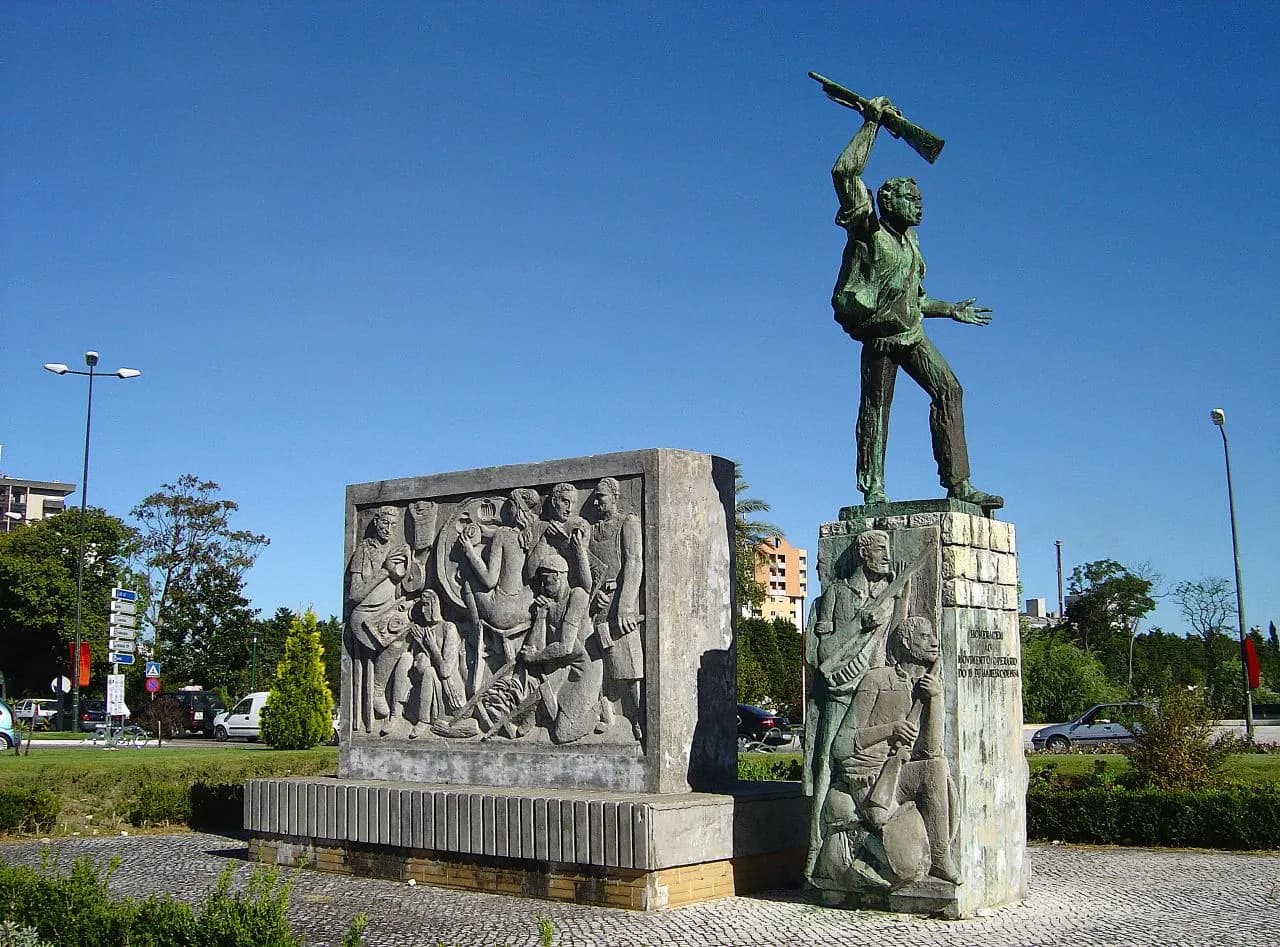
- Some accounts add the town hall and a short-lived “soviet of Marinha Grande”, but Patriarca found neither in the police files or prisoners' statements of 1934. A monument by Joaquim Correia, unveiled in 1984, and a house museum keep the date in the town.
A pistol shot before dawn
Late on the night of Wednesday 17 January 1934, men gathered in a shed at Casal Galego, a hamlet on the edge of Marinha Grande. The historian Maria de Fátima Patriarca counts at least 59 of them. Weapons were handed out, along with axes and saws for felling pine trees across the roads. The men were split into groups, each with a target, and each group's leader wore a red armband.
Three groups went out to block the roads to Leiria and Vieira de Leiria and the railway, and telephone and telegraph poles came down. Three more went into the town. At about three o'clock a pistol shot gave the signal. A tailor known as Amarante, the local communist organiser, later said he fired it.
The post office was taken quickly. The post of the Republican National Guard (GNR), the country's rural gendarmerie, was harder: the attackers threw bombs, there was shooting, and then António Guerra, a shop clerk, talked to the sergeant by telephone. At about five the post's 12 guards gave up their weapons. They were walked to the national glass factory and locked in, unharmed.
For an hour or so the town belonged to the insurgents. They opened up the glassworkers' union building and threw a bomb at the house of the industrialist Emílio Galo. Most of them simply went home to eat. At six the first shots came from police who had come out from Leiria, and by nine the rebels were scattering into the pine forest in groups of four or five.
That night in Marinha Grande became the best-known episode of the 18 January general strike. Of the three places where the movement had real support, it involved the fewest workers and was the quickest to be broken.
Salazar's new order for labour
Portugal had been a dictatorship since a military coup in 1926. In 1933 a constitution drafted by António de Oliveira Salazar, the head of government, founded the Estado Novo, or New State. It was approved by a plebiscite in which abstentions counted as votes in favour, and it left freedom of expression, assembly and association to be regulated by special laws.
The special laws for workers came on 23 September 1933. A single issue of the official gazette carried six decree-laws, led by the National Labour Statute (Decree-Law 23:048). Its article 9 made it a punishable act for workers to stop or disrupt economic activity to win better conditions, and for employers to do so without good reason. Decree-Law 23:050 created state-approved “national unions”. The old workers' associations had until 31 December 1933 to adopt approved statutes; those that did not would lose recognition and be dissolved.
The regime also built the tools to enforce the new order. A political police, the PVDE (State Surveillance and Defence Police), was created on 29 August 1933. A decree of 6 November 1933 treated strikes as rebellion and sent them to special military tribunals. In late November it arrested republican officers suspected of plotting a military rising and deported about 150 of its most dangerous opponents to Angra do Heroísmo, in the Azores.
Anarchists, communists and socialists
Rather than accept the new system, the four labour currents of the day agreed, for once, on joint action. Their plan combined a general strike with sabotage of railways and telephone lines, bombs and armed attacks, and counted on a republican military rising that would strike at the centres of power at the same time.
| Organisation | Current | Where it was strong |
|---|---|---|
| Confederação Geral do Trabalho (CGT) | Anarcho-syndicalist | Almada and the south bank of the Tagus, Silves; it also claimed actions in Coimbra and the Alentejo |
| Comissão Intersindical (CIS) | Communist, linked to the Portuguese Communist Party | Marinha Grande glassworkers; small elsewhere |
| Federação das Associações Operárias de Lisboa (FAO) | Socialist | Lisbon |
| Comité das Organizações Sindicais Autónomas (COSA) | Independent unions | Not detailed in these sources |
Patriarca concludes that the CGT and the anarcho-syndicalists were the main actor and the communists a secondary one, the reverse of the version that later took hold.
The police were waiting. Mário Castelhano, the railway clerk who led the CGT, was arrested on 14 January and held in the military prison at Trafaria, accused of preparing the strike in Sines and making weapons for Marinha Grande. On 7 January police had already seized bombs and arrested militants at São Bartolomeu de Messines, near Silves, and on the night of 17 January the government took precautions across the country.
What happened across the country
The strike failed first in Lisbon, where most workers ignored the call. The capital saw scattered violence instead: a bomb at Poço do Bispo, the railway cut at Xabregas and a passenger train derailed near Póvoa de Santa Iria. In Coimbra a bomb at the power station put out the lights. Telephone lines were cut around Leiria, there were explosions on the line at Martingança, sabotage near Tunes in the Algarve and the road between Vila Boim and Terrugem, near Elvas, blocked.
Almada, across the Tagus from Lisbon, was the opposite of Marinha Grande. The only violence was a cut telephone line and a sabotaged submarine cable between Trafaria and Porto Brandão. But the whole industrial workforce of the municipality stopped: cork workers, millers, dockers and 500 men building the Alfeite naval arsenal. Thirty GNR troopers and 40 sailors patrolled the streets. When the cork workers and millers stayed out on the 19th, 24 of the municipality's union leaders were arrested; the strikers went back only on the 20th.
In Silves, an Algarve town with a thousand or so cork workers, the 7 a.m. train was the signal. When it failed to arrive, the leaders took it to mean that the railwaymen had struck and Lisbon had risen, and the cork factories stopped to a man. Strikers occupied their dissolved association's hall and raised a red flag. The train pulled in hours late, and the plan to attack the GNR post was dropped. The strike held all day and partly on the 19th and 20th.
| Place | What happened | Lead current |
|---|---|---|
| Marinha Grande | Roads and lines cut, post office and GNR post taken, town held for about an hour; no general stoppage | Mainly communist, with bombs supplied by the anarcho-syndicalists |
| Almada | Total stoppage of industry on 18 January, partial until the 20th; cable sabotage | Anarcho-syndicalist |
| Silves | Total cork strike on the 18th, partial on the 19th and 20th; red flag on the old union hall | Anarcho-syndicalist |
| Lisbon | Strike failed; bomb at Poço do Bispo, railway cut at Xabregas, derailment at Póvoa de Santa Iria | Unclear; the derailment was communist work |
| Coimbra | Bomb at the power station | Anarchists from Anadia |
| Barreiro, Sines | Strikes; a bomb in Barreiro | Not established in these sources |
Marinha Grande, hour by hour
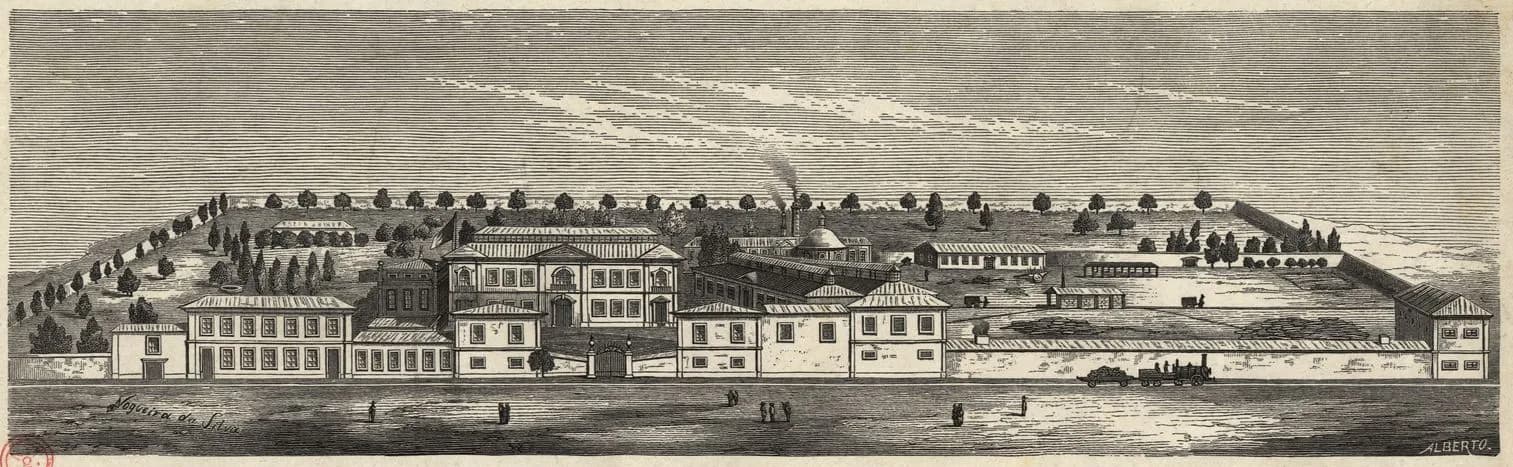
Marinha Grande had about 9,000 inhabitants and 2,000 glassworkers. Its glass industry had been hit hard by the depression of the early 1930s, and the town had a long record of strikes. Communist cells had spread through the factories only in the months before the revolt; a prison record shows there was still no cell in the glassworkers' union at the end of September 1933.
22:00 to 01:00
Meeting at Casal Galego
Accounts place the start between 10 p.m. and 1 a.m. At least 59 men gather in a shed; weapons and tools are handed out.
c. 02:00
Groups take up positions
Three groups block roads and cut lines; three move into the town.
c. 03:00
The signal shot
Simultaneous attacks on the post office, taken at once, and the GNR post.
c. 05:00
The GNR surrenders
The 12 guards are disarmed and held in the national glass factory.
05:00 to 06:00
The town in rebel hands
The union is reopened; many insurgents go home to eat.
c. 06:00
First shots from Leiria
Police forces reach the outskirts of the town.
c. 08:00
Police enter the town
Troops of Artillery Regiment 4 and Infantry Regiment 7 follow.
c. 09:00
The rebels disperse
Small groups slip into the pine forest to escape the cordon.
11:20
“Order restored”
Major Jaime da Fonseca telegraphs the Interior Minister: he has taken military command and suspended constitutional guarantees.
19 January
Factories reopen
Nine firms list just 67 absentees; the post's guards are expelled from the GNR for “cowardice”.
How long the town was held depends on who tells it. Patriarca, working from official telegrams and the press, gives about an hour of calm control, from the GNR surrender at five to the first police shots at six. A regime-friendly Leiria weekly, O Mensageiro, wrote that the town had been “at the mercy of the rebels” for two hours. The communist leader interviewed in O Proletário that spring said the town was theirs from five and that troops entered only at about eleven.
“It was madness to prolong the resistance. Little more than twenty of us had firearms. The Government set against us artillery, cavalry, infantry, machine guns… and even an aeroplane already flying over the town to direct the artillery fire!”
The numbers were modest. Newspapers of the time put the insurgents at 150 to 200, and estimates in government papers ranged from 150 to 300. Only four people were wounded, two on each side, and nobody was killed. When the military reopened the factories the next morning and asked employers for lists of absentees, nine firms reported 67 missing workers, some of them already in jail or in hiding. As Patriarca puts it, there was no strike in Marinha Grande, on the 18th or the 19th.
Where the “soviet” came from
Within hours the government decided what 18 January had been. The press, censored but allowed to cover the story at length, ran it on the front page for four days. The correspondent in Marinha Grande called the rebels communists almost line by line, while reports from Coimbra, Barreiro, Almada and Silves never gave the strikers a political label. A photograph of the prisoners now in the national archives is captioned as showing men who had taken part in the “communist uprising of Marinha Grande”.
The Communist Party, then a small group, accepted the label gladly. Its secretariat called Marinha Grande “a completely positive case of proletarian action” and blamed the CGT, the socialists and the autonomous unions for the bombings and for the strike's failure to spread. The CGT, which had staked its whole organisation on the strike, answered defensively and never told its own story of Almada and Silves.
“one of the founding myths of the revolutionary image of the Portuguese proletariat”
“Now, naturally, the sanctions follow”
Late on 18 January the Interior Minister read out a note from Salazar: “Now, naturally, the sanctions follow.” The next evening the Council of Ministers spelled them out. Employers in Marinha Grande, Almada and Silves were told not to take back anyone who had stayed away during the strike. Strikers as well as leaders would face the special military tribunals, and the main organisers would be shipped within days to a “concentration camp” to be set up at the mouth of the Cunene, in southern Angola.
Some of this proved impossible. The Silves cork firms, unable or unwilling to replace a thousand strikers, closed their factories on 22 January; three days later 23 industrialists employing 878 people petitioned the minister, and the government gave way in early March. In Almada, close to the capital, the order to sack strikers was never enforced. The tribunals in the end tried only leaders, militants and activists.
People detained after 18 January 1934, the three largest totals
people detained
Figures from Maria de Fátima Patriarca, Sindicatos contra Salazar (2000), p. 458, as quoted by Ferreira (2018). A 2024 Lusa report says detentions in Marinha Grande may have reached 131. The sources consulted here give no national total.
Show the data
| Detained | |
|---|---|
| Lisbon | 227 |
| Marinha Grande | 122 |
| Coimbra and Anadia | 83 |
PVDE agents questioned the Marinha Grande prisoners in Leiria and sent them on to Lisbon by lorry. Joaquim Gomes, a teenage glassworkers' activist already in jail at the time, recalled seventy years later that men came back from interrogation recognisable only by their clothes. The PVDE then sent its case files to the Special Military Tribunal, which tried the Marinha Grande men in February and March.
| Penalty | What it meant | Examples reported at the time |
|---|---|---|
| Degredo, 10 to 20 years | Exile to a colony chosen by the government, with imprisonment there, and a fine of 20,000 escudos | António Guerra of Marinha Grande, 20 years; Francisco Pereira da Silva, 14 years; Joaquim de Oliveira, 10 years |
| Desterro, 3 to 6 years | Banishment to a place chosen by the government, fines of 3,000 to 12,000 escudos and loss of political rights for 5 to 10 years | Augusto Costa, glassworker, 5 years; six Marinha Grande men tried on 26 February, 3 years each |
| Banishment in the colonies, 16 years | With imprisonment and a fine of 20,000 escudos (sentence of 8 March 1934) | Mário Castelhano, CGT leader |
Marinha Grande sentences as published by O Mensageiro in February and March 1934, quoted by Ferreira (2018). Ferreira and Lusa (2024) both put the number of Marinha Grande men convicted at 45. Lusa gives terms of 3 to 14 years, which leaves out the 20-year sentence reported in 1934.
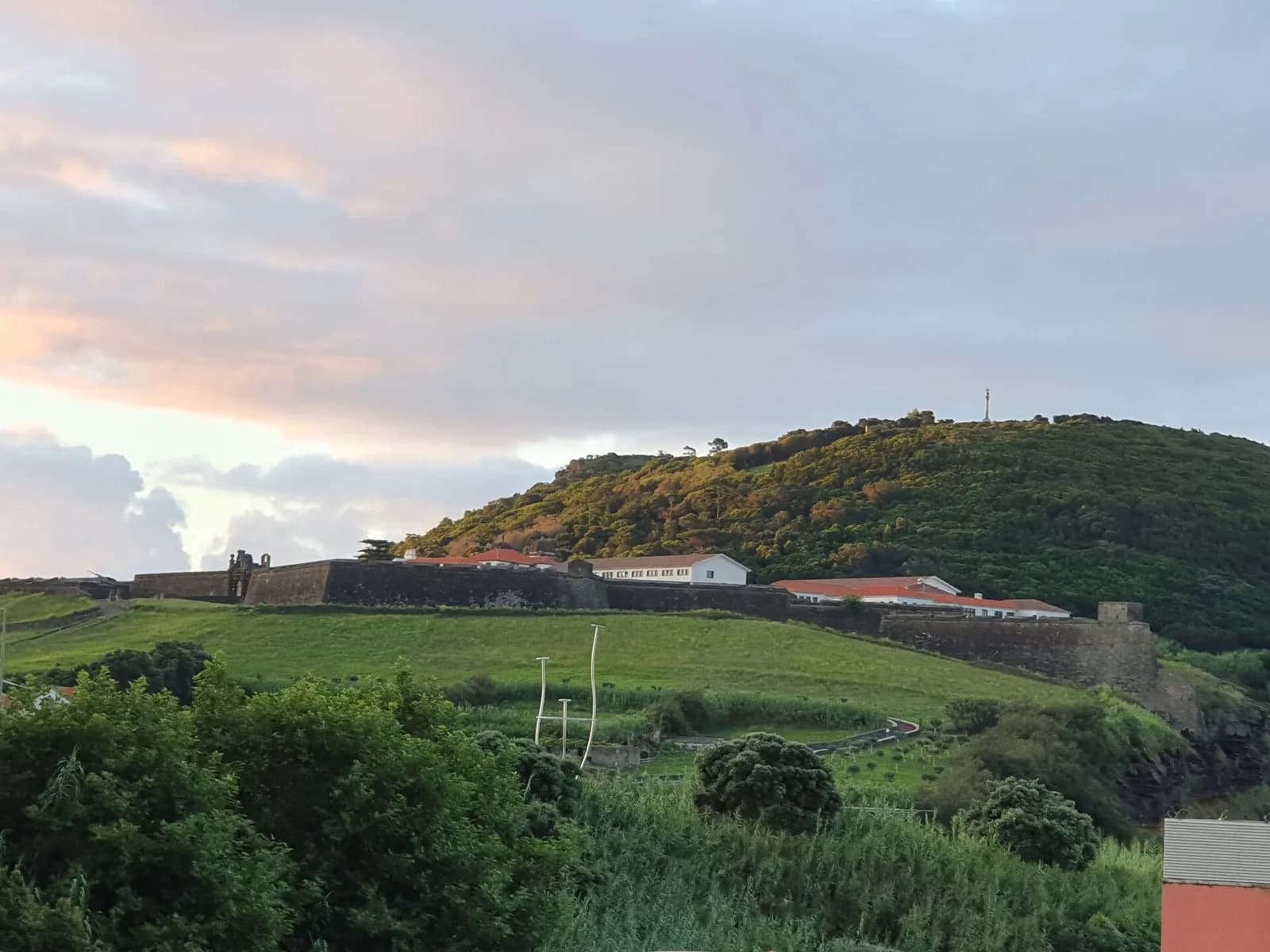
Some of the convicted men were sent to Angra do Heroísmo, on Terceira island. A survey by URAP, an association of anti-fascist veterans, counts about 500 political prisoners held there during the dictatorship, in the Fortress of São João Baptista and a smaller fort, and says Marinha Grande glassworkers were probably among the first. Castelhano reached the fortress on 8 September 1934. In October 1936 he and others were moved to the new camp at Tarrafal, in Cape Verde: an overseas camp of the kind the government had promised in January 1934, though not in Angola.
Lisboeta's article on Tarrafal follows them there. The Museu do Aljube names ten participants in 18 January who died in that camp, among them Castelhano in 1940 and the communist leader Bento Gonçalves in 1942. Two were from Marinha Grande: the glassworker Augusto Costa, who died in September 1937, and António Guerra, who died in December 1948.
The end of free unions, and a town's memory
The strike ended half a century of free trade unionism in Portugal. The CGT lost almost all its leaders and the anarcho-syndicalists lost their hold on the labour movement, while the Communist Party, rebuilt within months in the Marinha Grande factories, became the one permanent organisation of the opposition. Ten days after the strike, on 28 January, Salazar told a rally in Lisbon that communism was “the great heresy of our age”.
Marinha Grande itself did not forget. While prisoners' families went without wages, young people collected money at factory gates for them. After 25 April 1974 the Communist Party made the town the centre of public commemorations. Patriarca wrote that these rested on the canonical version, the one the main evening news repeated on the anniversary in 1993: a communist revolt that failed everywhere except Marinha Grande.
In 1984, fifty years on, the town unveiled a monument to the revolt by the local sculptor Joaquim Correia, placed in the middle of the Rotunda do Vidreiro. In 2021 the council planned to restore it and move it a short distance, to the site the mayor said the sculptor had intended. Councillors of the communist-led CDU coalition and the glassworkers' union opposed the move. On the anniversary the union, the STIV, lays flowers on the graves of the 1934 prisoners in the cemeteries of Casal Galego and Marinha Grande and holds a rally by the monument.
FAQs
What was the general strike of 18 January 1934?
A revolutionary general strike called by Portugal's anarcho-syndicalist, communist, socialist and independent unions against the Estado Novo's National Labour Statute and the decree that dissolved free unions which did not accept state control by 31 December 1933. It combined strikes with sabotage and was meant to coincide with a republican military rising that never came. It failed in Lisbon and most of the country.
What happened in Marinha Grande on 18 January 1934?
Armed groups of mostly communist glassworkers blocked the roads, cut the telephone lines, took the post office and forced the 12 men of the GNR post to surrender at about 5 a.m. Police from Leiria arrived around 6 a.m., troops followed, and by 9 a.m. the insurgents had dispersed. Four people were wounded and nobody was killed.
Was there really a “soviet of Marinha Grande”?
There is no evidence of one from 1934. Neither the police files nor the prisoners' statements mention a soviet being elected or a red flag being raised. The story grew in later communist accounts and was set down in full in a book of 1975. Some accounts, including the Museu do Aljube's, still mention a short-lived soviet.
How many people were arrested and sentenced?
Maria de Fátima Patriarca counts 227 detainees in Lisbon, 122 in Marinha Grande and 83 in Coimbra and Anadia; a 2024 Lusa report gives 131 for Marinha Grande. About 45 Marinha Grande men were convicted by the Special Military Tribunal, with sentences reported at between 3 and 20 years of banishment or exile.
What does the 1934 strike have to do with the Tarrafal camp?
On 19 January 1934 the government announced an overseas concentration camp for the strike's organisers. Some of those convicted were held first at Angra do Heroísmo in the Azores and moved to Tarrafal, in Cape Verde, when it opened in October 1936. Ten participants in 18 January died there.
On the timeline
Open the timelineNearby moments from dictatorship and the estado novo (1926–1974).
The historian A. H. de Oliveira Marques, author of landmark histories of Portugal and pioneering studies of daily life in the Middle Ages, is born in São Pedro do Estoril, near Lisbon.
A decree-law creates the PVDE (Polícia de Vigilância e de Defesa do Estado), the Estado Novo's political police and forerunner of the PIDE, which would enforce the dictatorship's repression for four decades.
'A Canção de Lisboa', the first sound feature film made entirely in Portugal, premieres at the São Luiz theatre in Lisbon. Directed by José Cottinelli Telmo and starring Vasco Santana, Beatriz Costa and António Silva, its comedy of a medical student fooling his rich aunts left lines and songs the Portuguese still quote.
The 18 January 1934 strike
An insurrectionary general strike against the Estado Novo's corporatist labour laws is attempted across Portugal, most dramatically in Marinha Grande, where glassworkers cut roads, telephone lines and the railway and seize the post office and GNR post; some accounts add the town hall and a short-lived “soviet”. The revolt is crushed within hours and followed by mass arrests, and the regime uses it to justify deeper repression of the labour movement.
Paula Rego is born in Lisbon. Settling in London, she became one of the great figurative painters of her time, known for unsettling fairy-tale scenes and her 'Abortion' series; the Casa das Histórias in Cascais is dedicated to her work.
Death in Setúbal of Ana de Castro Osório, writer, suffragist and republican. In 1908 she co-founded the Liga Republicana das Mulheres Portuguesas with the doctor Adelaide Cabete and others, helped Afonso Costa draft the Republic's divorce law, and with her 18-volume series 'Para as Crianças' became a founder of Portuguese children's literature.
The Emissora Nacional, Portugal's new state radio, begins regular broadcasts from Lisbon, three days before its official inauguration on 4 August. For four decades a mouthpiece of Salazar's Estado Novo, it was folded into the new public broadcaster RDP after the 1974 revolution and is today part of RTP.
Coming up in history
All long reads 20 January 1554Sebastião the Desired: the king born in Lisbon on 20 January 1554
 21 January 1951Castelo do Bode, 1951: the dam that lit Lisbon and now fills its taps
 22 January 1961Operation Dulcineia: Galvão's rebels seize the liner Santa Maria
 23 January 1963The attack on Tite and Portugal's war in Guinea, 1963 to 1974
22 sources
Archives, scholarship and reporting this article was checked against.
- 1
O «18 de Janeiro»: uma proposta de releitura (Maria de Fátima Patriarca)Análise Social, vol. XXVIII (123-124), 1993, pp. 1137-1152, Instituto de Ciências Sociais, Universidade de Lisboa
- 2
O 18 de janeiro de 1934 na Marinha Grande: a imprensa local na (re)construção do mito (António José Lopes Ferreira, doctoral thesis)Universidade Lusófona de Humanidades e Tecnologias, 2018
- 3
Diário do Governo, I série, n.º 217, 23 September 1933: Decretos-Leis n.º 23:048 (Estatuto do Trabalho Nacional) to 23:053Diário do Governo (Presidência do Conselho), via Diário da República
- 4
18 de Janeiro de 1934Museu do Aljube: Resistência e Liberdade (EGEAC), 18 January 2025
- 5
- 6
O Essencial sobre a PIDE (Irene Flunser Pimentel)Imprensa Nacional, 2023
- 7
- 8
Há 90 anos, vidreiros da Marinha Grande revoltaram-se contra a opressão do fascismoAbrilAbril, 18 January 2024
- 9
O Estado Novo (1933-1974)Assembleia da República
- 10
Um golpe na República: 28 de Maio de 1926, da Ditadura Militar ao Estado NovoMuseu da Presidência da República
- 11
Retrospetiva sobre a revolta do 18 de janeiro de 1934Câmara Municipal da Marinha Grande, Casa-Museu 18 de Janeiro de 1934
- 12
70 anos do 18 de Janeiro de 1934, na Marinha GrandeAvante! n.º 1572 (2004), republished by the Lisbon regional organisation of the Portuguese Communist Party
- 13“O 18 de Janeiro deixou marca na Marinha Grande” (Lusa)Observador, 15 January 2024
- 14
- 15Cerca de 500 presos políticos estiveram detidos em Angra do Heroísmo durante o Estado Novo (Lusa)RTP Notícias, 30 September 2018
- 16
- 17
- 18Marinha Grande. A polémica mudança de local do monumento ao vidreiroDiário de Notícias, 1 December 2021
- 19
- 20
- 21
- 22
Image credits
- The monument to the workers' movement of 18 January 1934 in Marinha Grande, photographed in 2007. The work of the Marinha Grande sculptor Joaquim Correia, it was unveiled in 1984; the inscription on the pillar pays homage to the workers' movement of 18 January 1934. Vitor Oliveira from Torres Vedras, PORTUGAL, CC BY-SA 2.0, via Wikimedia Commons.
- The Royal Glassworks at Marinha Grande around 1865, drawn by Nogueira da Silva and engraved by Alberto. Glassmaking made Marinha Grande an industrial town: by 1934 it had about 2,000 glassworkers among some 9,000 inhabitants. Francisco Augusto Nogueira da Silva / Caetano Alberto da Silva, Public domain, via Wikimedia Commons.
- The Fortress of São João Baptista below Monte Brasil, Angra do Heroísmo, in 2022. The CGT leader Mário Castelhano was held here from September 1934, and Marinha Grande glassworkers were among the early political prisoners sent to Angra. GualdimG, CC BY-SA 4.0, via Wikimedia Commons.
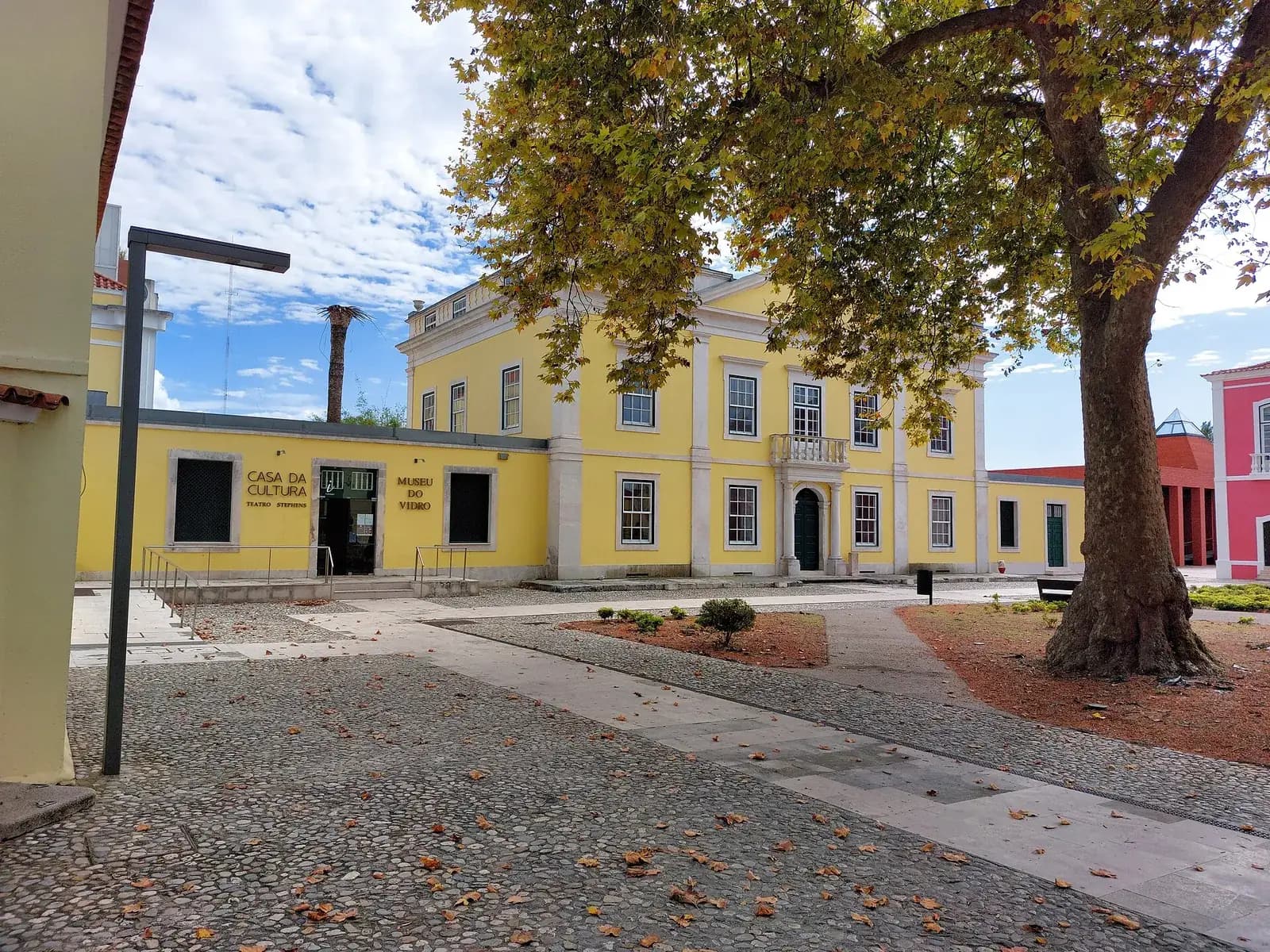
- The Palácio Stephens in Marinha Grande, home of the Museu do Vidro, in 2021. Threeohsix, CC BY-SA 4.0, via Wikimedia Commons.