

Sebastião the Desired: the king born in Lisbon on 20 January 1554
His birth kept Portugal's royal line alive for 24 more years. His death on a Moroccan river plain ended it, and left a legend of a hidden king who would one day come home.
At a glance
- Sebastião was born in Lisbon on 20 January 1554, the feast of Saint Sebastian, 18 days after his father, Prince João, died aged 16. He was the only living descendant of João III.
- He became king at three when his grandfather João III died in 1557. His grandmother Catarina of Austria governed for him until 1562, and his great-uncle Cardinal Henrique until he took power at 14 in 1568.
- On 4 August 1578 his army of about 14,000 to 20,000 men was destroyed near Ksar el-Kebir in Morocco, at the battle Moroccans call Wadi al-Makhazin. All three kings on the field died that day.
- Captive Portuguese noblemen identified his body on 5 August, and in 1582 Philip II of Spain, by then also king of Portugal, had it moved from Ceuta to the Jerónimos monastery in Lisbon.
- Many Portuguese refused to believe he was dead. Four men claimed to be him between 1584 and 1598, and the hope of his return, Sebastianism, runs from Bandarra's verses to Fernando Pessoa's Mensagem of 1934.
A son born on Saint Sebastian's day
On 20 January 1554, in Lisbon, Joana of Austria, a daughter of the Emperor Charles V, gave birth to a son. It was the feast of Saint Sebastian, the martyr whose name the boy would carry. Nobody had yet told her that she was a widow.
Her husband, Prince João, heir to the throne, had died on 2 January, 18 days earlier, aged 16. He had been married to his cousin at 14, in 1552, and had always been frail. Marcio Honorio de Godoy, who has written on the king's legend, says he died of a severe attack of diabetes.
The baby was the only living descendant of João III. The king and Queen Catarina had outlived every one of their own children: nine, by Godoy's count, ten in the guide published by the Jerónimos monastery. Marriage after marriage had bound the family to the Habsburgs who ruled Castile, and the court feared that Portugal would end up ruled from there. So the boy was the Desired, o Desejado, even before he was born.
A few months later Joana went back to Castile, and she never saw her son again. He was 24 when he rode into a battle in Morocco from which he did not return, and the hope that he would come back lasted for centuries.
A kingdom in a child's hands
João III died in 1557, and the crown passed to his grandson, aged three. His widow, Catarina of Austria, a sister of Charles V, governed as regent. In 1562 she handed the regency to Cardinal Henrique, a son of King Manuel I and the boy's great-uncle, who held it until Sebastião took power at 14, in 1568.
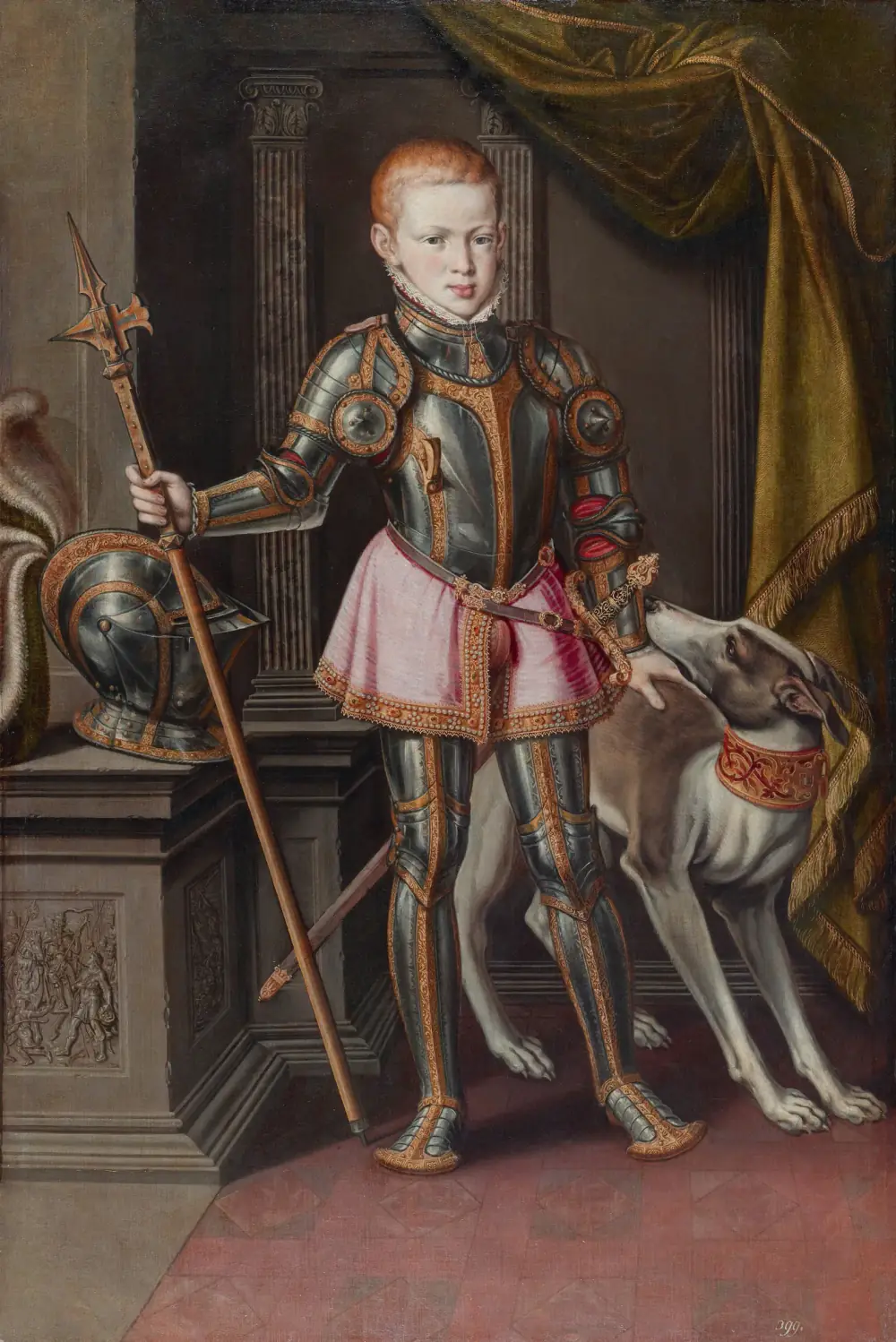
His teachers were chosen when he was five. The Jesuit Luís Gonçalves da Câmara, just back from Rome, taught him history, philosophy and grammar, and Amador Rebelo taught him to write. Rebelo, who also chronicled the reign, later set down what the boy had been taught.
“When the King was a boy, they not only urged him on with words and examples of great kings and the great victories they had won, but in his writing and in the books from which he was given his lessons, they persuaded him towards such enterprises and military exercise.”
How far his teachers made him is still argued over. Godoy describes an education aimed at a war against the Moors and the spread of the faith. Filipe Duret Athaide, writing on the king's legend, notes a long debate about his upbringing and the urge that took him to Africa twice. The Jerónimos monastery's guide sums it up as a rigorous training in religion and the art of war.
A king who drilled for war
The young king's reign produced a stream of military law. Companies of 300 men were first raised in Porto on 6 March 1568, and the Regimento dos Capitães-Mores of 1570 extended the system to the whole kingdom, in companies of 250 with regular drill. In 1573 Sebastião inspected 122 companies in the Alentejo and the Algarve, more than 20,000 men.
In 1572 Luís de Camões published Os Lusíadas, his epic of the Portuguese voyages to India, with a long dedication to the 18-year-old king. It cast him as the hope of Christendom and urged him to outdo his ancestors.
“And you, well-born guarantee of Lusitania's ancient liberty, and no less certain hope of the growth of little Christendom; you, new terror of the Moorish lance, fateful wonder of our age.”
Morocco was where he meant to fight. Portugal had held towns on its coast since the capture of Ceuta in 1415, but in 1550 it abandoned Arzila and Alcácer Ceguer, keeping only Ceuta, Tangier and Mazagão. In 1574 Sebastião crossed to North Africa with about 2,000 men so that, in his own words, his people could train in that war and produce experienced captains and soldiers.
A Moroccan quarrel becomes a Portuguese crusade
Morocco was ruled by the Saadis, a dynasty of sharifs, men claiming descent from the Prophet. When Sultan Abdallah al-Ghalib died in 1574, his son Muhammad was proclaimed, against the old rule that the eldest man of the family came first. The sultan's brother Abd al-Malik, who had fought in the Ottoman army, came back with a small force lent by the governor of Algiers and entered Fez on 31 March 1576.
Muhammad, who took the title al-Mutawakkil, was chased out of Marrakesh and fled north to the Spanish outpost of Vélez de la Gomera. Philip II refused to help him, so he turned to Portugal. There, as the Moroccan historian Mohammed El Fasi puts it, a young king had dreamed since childhood of conquering Morocco and going on to free Christ's tomb in Jerusalem, and he took the exile's arrival as the argument his reluctant councillors could not refuse.
At the end of 1576 Sebastião spent a week with his uncle Philip at Guadalupe, in Castile. Spanish diplomacy had backed Abd al-Malik as the stronger candidate, and Philip agreed to help only on conditions he knew were hard to meet. In April 1578, on the eve of departure, he banned recruiting in Andalusia.
Abd al-Malik tried to talk the young king out of it. El Fasi quotes a letter whose Italian translation survives in French archives and was published by the historian Henry de Castries.
“What you are preparing to do, that is, to come and make war on me in my country, is an injustice and an aggression without reason, because I wish you no harm, nor do I think it of you, and I have undertaken no evil deed against you.”
Raising the army was hard. Of 12,000 Portuguese militiamen planned, just over 9,000 were found. Mercenaries were hired in the Low Countries, where most of the weapons were bought too, and Spanish volunteers slipped across the border. Catarina, the grandmother who had brought him up, died in 1578, shortly before he sailed.
Alcácer Quibir, 4 August 1578
The fleet left Lisbon in late June 1578, and in July the army landed at Arzila, on Morocco's Atlantic coast, a town its governor had handed to the Portuguese in 1577. The declared target was Larache, a corsair base down the coast, and the plan was to attack it from the sea. At a council of war the king chose to march overland instead.
The column left Arzila on Tuesday 29 July and took six days over rough country to reach the plain between the rivers Makhazin and Loukkos, near the town of Ksar el-Kebir, which the Portuguese called Alcácer Quibir. Abd al-Malik had left Marrakesh on 20 April and made the town his headquarters. On 3 August the two armies faced each other for about two hours, but the Christian soldiers were judged too tired to fight. That night, according to Moroccan accounts, Abd al-Malik's men broke the bridge behind the invaders.
- Date
- Monday 4 August 1578 (the end of Jumada II, 986 in the Islamic calendar)
- Place
- Wadi al-Makhazin, near Ksar el-Kebir (Alcácer Quibir), northern Morocco
- Sides
- Sebastião and al-Mutawakkil against Sultan Abd al-Malik and his brother Ahmad
- Christian army
- About 14,000 to 20,000, depending on the source
- Moroccan army
- Never reliably counted: Costa e Sousa estimates about 15,000 foot soldiers in the centre and 10,000 to 20,000 horsemen; an EBSCO reference article by Richard L. Smith cites modern estimates of about 70,000
- Length
- 3 to 6 hours in modern estimates; one veteran says the fighting began at 11 and the king was fleeing by 4 or 5 in the afternoon
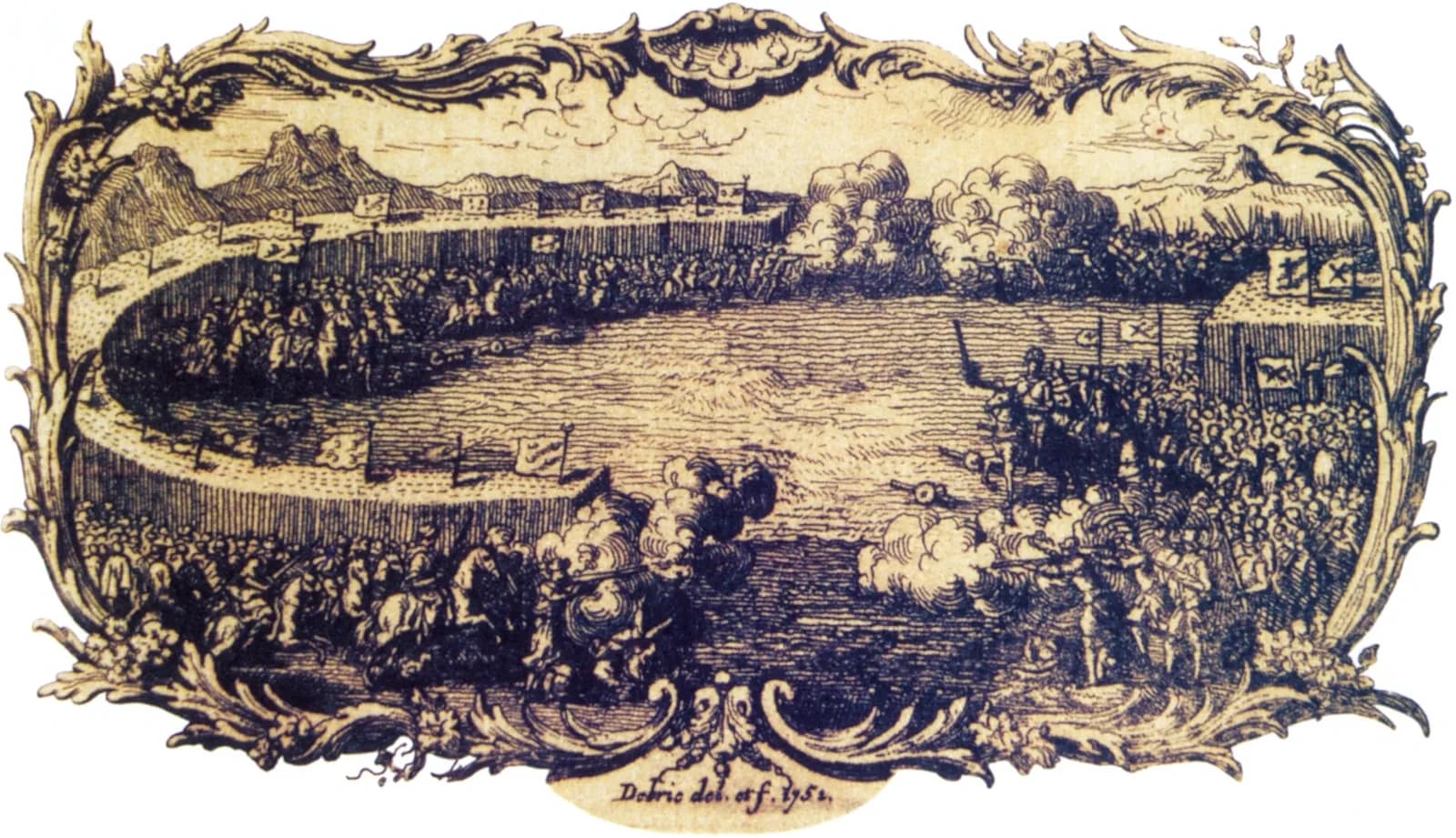
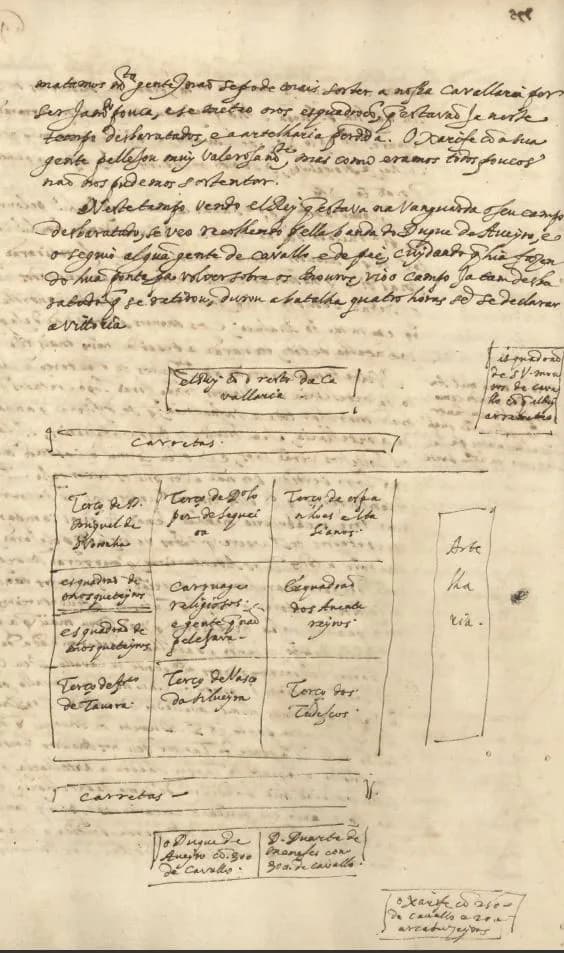
On the morning of 4 August the Christians marched out in one great block, with their baggage carts along the exposed flank. Gentlemen volunteers, the aventureiros, led in the centre, with the German mercenaries on their right and the Spanish on their left. El Fasi and Richard L. Smith, in an EBSCO reference article, put the Italians beside the Spanish. Luís Costa e Sousa, a military historian at Lisbon's NOVA University, puts them with the volunteers. Cavalry rode on the wings, and a few hundred of al-Mutawakkil's men came too.
The Moroccans spread out in a crescent, infantry and guns in the centre and horsemen on the horns, ready to close round the enemy. Costa e Sousa puts the centre at about 15,000 foot soldiers, with Abd al-Malik's best troops in its second line: 4,000 azuagos from the region of Bejaia, in Algeria, 2,500 elches, Christian-born converts to Islam, and 1,000 Turks.
There were 24 field guns, and horsemen Costa e Sousa estimates at 10,000 to 20,000. Christian veterans spoke of countless cavalry, but he thinks they overstated it, since loose masses of riders looked larger than tight European ranks.
Where Sebastião's army came from
men
Approximate make-up of the Christian army as given by Filipe Duret Athaide, out of a total he puts at 14,000 to 20,000, joined by al-Mutawakkil's few troops. Other modern counts differ: Richard L. Smith gives 2,000 to 3,000 Germans, as many Spaniards and 600 Italians.
Show the data
| Approximate number | |
|---|---|
| Portuguese | 10,000 |
| Germans | 3,000 |
| Castilians | 2,000 |
| Italians | 600 |
Accounts of the opening differ. El Fasi says the mercenaries charged the Moroccan left; Costa e Sousa, following Christian eyewitnesses, has the volunteers and the king's heavy cavalry break the Moroccan right. Either way the Moroccan line gave ground, and Abd al-Malik, gravely ill and directing the battle from a litter, tried to rally his men.
El Fasi writes that the sultan got up, drew his sword and pushed forward, and that the effort killed him; Costa e Sousa reports a faint, or a shot by other accounts. His death was kept secret. In El Fasi's version he ordered it himself; in Costa e Sousa's, his commanders covered the body in the litter and said he had fainted.
Then the Moroccan cavalry closed in. As the Christian block broke, men fled to the river, found the bridge gone and drowned. Al-Mutawakkil drowned too, trying to swim to safety. His body was pulled out and taken to Ahmad, who was proclaimed sultan after the victory and took the name al-Mansur, the Victorious.
Sebastião kept fighting. When the last resistance gave way he rode with five companions towards the ford the army had crossed the day before and was surrounded by Moroccan horsemen. He resisted capture and took a fatal blow to the head. One companion, Nuno de Mascarenhas, saw it, and saw someone tear a strip from the king's shirt and tie it round his neck to mark the body.
| Source | Christian army | Moroccan army | Losses |
|---|---|---|---|
| Filipe Duret Athaide (2016) | 14,000 to 20,000, about 10,000 of them Portuguese | About three times larger, according to the chronicles of the time | Not given |
| Luís Costa e Sousa (2017) | Just over 9,000 Portuguese militia out of 12,000 planned, plus mercenaries and volunteers | About 15,000 infantry in the centre and 10,000 to 20,000 horsemen | Not given |
| Richard L. Smith, EBSCO Research Starters (2022) | About 20,000 | Around 70,000 in modern estimates | 7,000 to 8,000 dead on each side in some modern estimates, or nearer two to one in Morocco's favour; at least 14,000 prisoners |
| Mohammed El Fasi, UNESCO General History of Africa | One of the largest armies of its time, plus 300 to 600 of al-Mutawakkil's men | Not given | Dead unknown, Muslim dead in the thousands; about 14,000 Christian prisoners in traditional accounts |
| Oussama Aamari, Morocco World News (2021) | More than 20,000 | 50,000 | 8,000 Portuguese dead and 15,000 captured; only 100 escaped |
Nobody counted either army reliably, and none of these figures is settled. Costa e Sousa thinks Christian veterans inflated the Moroccan cavalry, and El Fasi stresses the size of the invading army, so the numbers are best read as ranges.
A body, a tomb and a doubt
That night four horsemen who had fled the battle reached the gates of Arzila and asked to be let in, saying they were escorting the king. Costa e Sousa thinks it was a ruse to get inside the walls before they were caught. It was also the first sighting of a legend.
In the Moroccan camp a royal page, Sebastião de Resende, heard Mascarenhas's account and offered to bring in the body. Late on 5 August it was shown by torchlight to the captive noblemen. A Castilian captain, Luís de Oxeda, described a great wound on the right side of the head, which seemed to have killed him, smaller wounds all over and an arquebus graze under one arm.
Surviving noblemen recognised the king, and later swore to it a second time in Lisbon, at the Carmo convent. The Jerónimos monastery says the body was first kept in the house of a local governor, Ibrahim Sufiani. Athaide and El Fasi say it was then taken to Fez and buried there while a ransom was discussed; El Fasi, drawing on Moroccan accounts, adds that al-Mansur, too proud to bargain, offered it to Philip II with no further delay.
In December 1578 the remains were dug up and taken to Ceuta, then still Portuguese, where they lay in the church of the Trinity until 1582.
News of a defeat reached Lisbon around 10 to 12 August, but the king's death was confirmed only on 24 August, and on 27 August it was proclaimed. A nobleman in black rode out from the city hall behind three men carrying black wooden shields. At the cathedral, in the Rua Nova and at the All Saints hospital, one of them cried out that the king was dead and smashed a shield on the stone steps.
Few of the invaders got home. Traditional accounts put the Christian prisoners at about 14,000, El Fasi writes, and the ransoms paid for the noblemen were so large that some historians trace al-Mansur's other name, al-Dhahabi, the Golden, to them.
The crown passed to Cardinal Henrique, aged 66, who died without an heir on 31 January 1580; Philip II's army beat the rival claimant, António, Prior of Crato, at Alcântara on 25 August 1580, and Philip became king of Portugal.
In August 1582 Philip ordered the remains brought from Ceuta to the church of the Jerónimos monastery at Belém, where Manuel I and João III were buried. For believers, the burial settled nothing.
The king who would come back
Within seven years of the battle two men in Portugal had claimed to be the king. The historian Jean-Frédéric Schaub, quoted by Athaide, points out that they came before Sebastianism was a settled set of beliefs. It was João de Castro, an exiled supporter of António, Prior of Crato, who later gave it a doctrine and a network of followers across Europe.
| Where | When | Who | What happened |
|---|---|---|---|
| Penamacor, on the border with Spain | 1584 | A young man expelled from the Carmelite novitiate, dark-haired where the king had been fair | Tried and sent to the galleys; mocked as the king of Penamacor |
| Ericeira, on the coast north of Lisbon | 1585 | Mateus Álvares, a hermit, son of a stonemason from Terceira in the Azores | Acclaimed king, gathered an armed band; defeated by a force from Lisbon and hanged |
| Madrigal de las Altas Torres, Castile | 1594 | Gabriel Espinosa, a former soldier and pastry cook, with the Portuguese friar Miguel dos Santos | Presented to Ana of Austria, a nun and Philip II's niece; both men executed in the square at Madrigal |
| Venice | 1598 to 1603 | Marco Tullio Catizone, a Calabrian | Recognised by Portuguese exiles; jailed in Venice, tried in Naples, sent to the galleys, and hanged at Sanlúcar de Barrameda, near Cádiz, in September 1603 |
Athaide counts four impostors during the union of the crowns (1580 to 1640). The details of the two Portuguese cases come mainly from José Henrique Dias, who also says the Penamacor man escaped from the galleys during the voyage of the Spanish Armada in 1588.
Of the two Portuguese pretenders, the Ericeira king went further. According to the historian José Henrique Dias, Mateus Álvares lived as a hermit near the coast and was said to whip himself at night. Once acclaimed, he handed out titles and his band raided the farms of men loyal to the Spanish government, until a force sent from Lisbon broke it up. Before he was hanged he told his judges that he had meant to take Lisbon on the night of the Saint John festivities.
The Venice king had the widest echo abroad. He appeared in 1598 and many exiles accepted him, although his Portuguese was halting and he looked nothing like Sebastião. At Spain's request Venice held him from November 1598 to December 1600. Arrested again in Tuscany, he was handed to the Spanish viceroy of Naples, identified in 1601 as Marco Tullio Catizone and hanged in Spain in 1603.
The case reached England too. Robert Cecil, Elizabeth I's secretary of state, drafted a letter asking Venice whether the rumours were true; the historian Luís Filipe Silvério Lima argues that it was written in early 1601, not in 1605 as the archive's endorsement says.
The believers also had a prophet. Gonçalo Anes Bandarra, a shoemaker in Trancoso, in the Beira, wrote rhyming verses, the Trovas, in the early sixteenth century, foretelling a Portuguese king who would lead all peoples to one faith and the return of a hidden one, the Encoberto. The Inquisition tried him in 1541 and banned the verses, but copies went on circulating. João de Castro was the first to print them, with his own commentary, in Paris in 1602 or 1603 (sources give both years).
In the next century the Jesuit preacher António Vieira read the same verses differently. In Esperanças de Portugal (Hopes of Portugal), a letter written around 1659 to the queen's confessor and meant to console the widowed queen, he argued from Bandarra's verses that her husband, João IV, who had died in 1656, would rise from the dead to lead a Fifth Empire, spiritual under the Pope and temporal under Portugal.
“Bandarra is a true prophet; Bandarra prophesied that King João the Fourth will do many things he has not yet done, nor can do except by rising again: therefore King João the Fourth will rise again.”
Vieira first appeared before the Inquisition on 21 July 1663, and on 1 October 1665 its tribunal in Coimbra jailed him. On 23 December 1667 he was sentenced, stripped forever of the right to preach and confined to a Jesuit house. The penalties were lifted in June 1668.
Popular belief held that Sebastião would come back on a foggy morning to save Portugal. In 1934 Fernando Pessoa published Mensagem (Message), a sequence of poems on Portuguese history and myth, and in its first part gave the lost king his own voice.
“Mad, yes, mad, because I wanted greatness / Such as Fortune does not give. / My certainty would not fit inside me; / And so, there where the sands are, / Remained the being that I was, not the one that is.”
Why he still matters
In Morocco the battle is remembered as a great national victory. Moroccan historians name it after the river, Wadi al-Makhazin, and El Fasi, writing for UNESCO, ranks it among the most important battles in the history of Morocco and of Islam. The ransoms enriched the Saadi state, and al-Mansur later sent an army south against the Songhay empire and took Timbuktu.
The story travelled. George Peele's play The Battle of Alcazar, printed in London in 1594, put it on the Elizabethan stage, and in 1990 the Moroccan director Souheil Ben-Barka made a film of it, The Battle of the Three Kings.
In Portugal the defeat cost the country its king, thousands of men and, within two years, its own crown. Costa e Sousa argues that the king's military reforms, beaten on the field, still marked the end of medieval warfare in Portugal. The idea of a hidden king who would one day restore the country outlived the union with Spain and found its way into Pessoa's poetry.
2 January 1554
Prince João dies, aged 16
20 January 1554
Sebastião is born in Lisbon
1557
João III dies; Sebastião is king at three, with Catarina as regent
1562
Cardinal Henrique takes over the regency
1568
Sebastião takes power at 14
1572
Camões dedicates Os Lusíadas to him
1574
First expedition to North Africa
Late 1576
Meeting with Philip II at Guadalupe
4 August 1578
Battle of Alcácer Quibir; Sebastião is killed
27 August 1578
His death is proclaimed in Lisbon
31 January 1580
Cardinal-King Henrique dies
August 1582
The remains are moved from Ceuta to the Jerónimos
1584 to 1598
Four false Sebastians appear
1602 or 1603
João de Castro prints Bandarra's verses
September 1603
The last false Sebastian is hanged
c. 1659
Vieira writes Esperanças de Portugal
1682
The present tomb is built
1934
Pessoa publishes Mensagem
FAQs
Why was King Sebastião called “the Desired”?
Because Portugal waited so anxiously for him. His father, Prince João, the last surviving child of King João III, died on 2 January 1554, and Sebastião was born 18 days later. Without him the crown would probably have passed to the Habsburg kings of Castile. Later, when people expected him to return, he was also called the Hidden One, o Encoberto.
Did Sebastião really die at Alcácer Quibir?
Almost certainly. A companion saw him take a fatal blow to the head, and on 5 August 1578 his body was shown to captive Portuguese noblemen, who recognised it. Costa e Sousa writes that his death in the battle raises few doubts. The legend that he had escaped began that same night.
Why is it called the Battle of the Three Kings?
Three rulers died in it: Sebastião; Sultan Abd al-Malik, who died of illness or exhaustion during the fighting; and the deposed sultan al-Mutawakkil, who drowned while fleeing. Moroccans call it the battle of Wadi al-Makhazin, after the river, and the Portuguese the battle of Alcácer Quibir, after the nearby town of Ksar el-Kebir.
What is Sebastianism?
The belief that King Sebastião had not died and would return to save Portugal. It fed on the prophetic verses of the shoemaker Bandarra, was given a doctrine by exiles opposed to Spanish rule after 1580, and drove four impostors to claim his identity. Writers from António Vieira to Fernando Pessoa reworked it.
Where is King Sebastião buried?
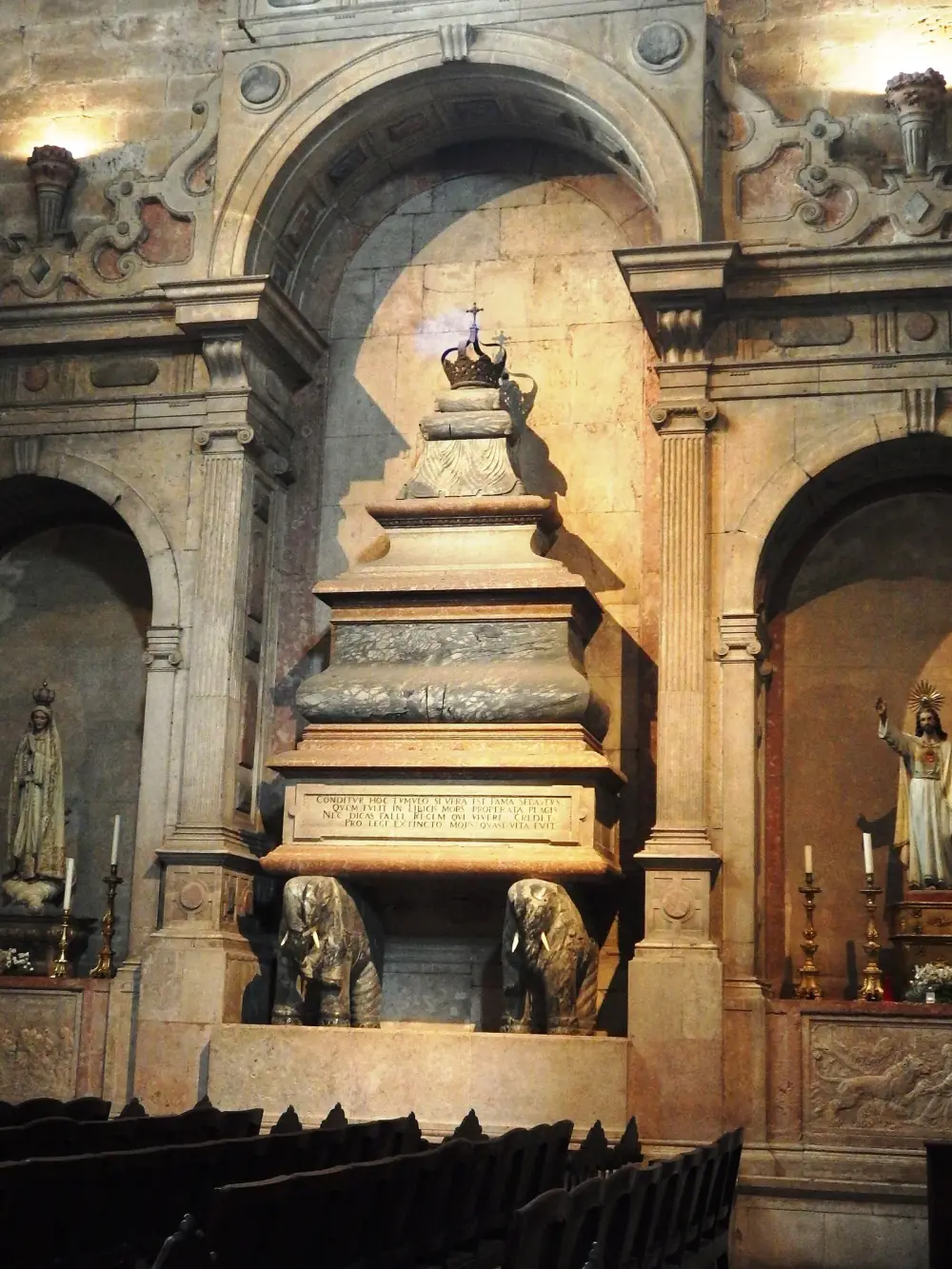
In the church of the Jerónimos monastery in Belém, Lisbon. Philip II had the remains brought there from Ceuta in 1582, and the present marble tomb, resting on two elephants, was made in 1682.
On the timeline
Open the timelineNearby moments from the age of discoveries (1415–1580).
By his comrade Castanhoso's date (others give 29 or 31 August), the Adal imam Ahmad Grañ overruns the camp of Cristóvão da Gama, Vasco da Gama's son, at Wofla in the Ethiopian highlands. Found wounded and hiding next morning, Gama is beheaded by the imam. Survivors of his 400 men helped defeat the imam, who was killed, the following year.
The mathematician and cosmographer Pedro Nunes is appointed to the chair of Mathematics at the University of Coimbra, the most prestigious post then open to a Portuguese mathematician. Inventor of the nonius, a scale for precise angle readings, and a pioneer of the mathematics of navigation, he held the chair until he retired in 1562.
Tomé de Sousa arrives at the Bay of All Saints (Baía de Todos os Santos) in Brazil as the first Governor-General, accompanied by approximately 1,000 settlers, soldiers, and six Jesuits. He founds the city of Salvador, establishing it as the capital of Portuguese Brazil.
King Sebastião, the Desired
Sebastião, the future king known as 'o Desejado' (the Desired), is born in Lisbon and named after the saint whose feast falls that day. His disappearance at Alcácer Quibir in 1578 would give rise to Sebastianism, the enduring legend that he would one day return to save Portugal.
Jesuit missionaries sent by Manuel da Nóbrega, among them the young José de Anchieta, celebrate Mass on the Piratininga plateau, where Tibiriçá's people built them a thatched house, on the feast of the Conversion of St Paul, founding the settlement that would grow into São Paulo, Brazil's largest city.
Death of King João III in Lisbon, aged 55. His reign of more than three decades saw the colonisation of Brazil through hereditary captaincies and the establishment of the Inquisition; having outlived all his children, he leaves the throne to his three-year-old grandson Sebastião, whose disappearance at Alcácer Quibir in 1578 would doom the House of Aviz.
Death in Lisbon of Martim Afonso de Sousa, who led the 1530 expedition that began the systematic colonisation of Brazil. In 1532 he founded São Vicente, the first permanent Portuguese town in the colony, and planted the sugar cane, soon worked by enslaved labour, that would define the colony's economy; he later served as Governor of Portuguese India.
Coming up in history
All long reads 22 January 1961Operation Dulcineia: Galvão's rebels seize the liner Santa Maria
 23 January 1963The attack on Tite and Portugal's war in Guinea, 1963 to 1974
 24 January 1969António Sérgio dies in 1969: essayist, minister, exile, co-operativist
 25 January 1554A thatched hut on the plateau: the founding of São Paulo, 25 January 1554
19 sources
Archives, scholarship and reporting this article was checked against.
- 1
Revisitar a Batalha de Alcácer Quibir (Luís Filipe Guerreiro da Costa e Sousa)e-Stratégica, no. 1, 2017, pp. 111-159 (via Dialnet)
- 2
O Marrocos (Mohammed El Fasi), in História Geral da África, vol. V: África do século XVI ao XVIII, ed. Bethwell Allan OgotUNESCO, Portuguese edition, 2010 (copy hosted by the Universidade Estadual de Londrina)
- 3
Frei José Teixeira, defensor do Falso de Veneza: sebastianismo e cultura política na Europa seiscentista (Filipe Duret Athaide)Temporalidades, Revista de História, vol. 8, no. 3, Universidade Federal de Minas Gerais, 2016
- 4
Mosteiro dos Jerónimos: fundação, o mosteiro, panteãoMuseus e Monumentos de Portugal, Mosteiro dos Jerónimos e Torre de Belém
- 5
O Desejado e o Encoberto: potências de movimento de um mito andarilho (Marcio Honorio de Godoy)Revista USP, no. 82, Universidade de São Paulo, 2009
- 6
Uma carta de Robert Cecil, secretário de Estado da Inglaterra, sobre o falso Sebastião de Veneza (1601?) (Luís Filipe Silvério Lima)Revista de Fontes, vol. 11, no. 20, Universidade Federal de São Paulo, 2024
- 7
O historiador do futuro e o profeta disfarçado: profecia, história e retórica na História do Futuro, do Padre Antônio Vieira (Marcus De Martini)Matraga, vol. 20, no. 33, Universidade do Estado do Rio de Janeiro, 2013
- 8
Padre António Vieira nos cárceres da InquisiçãoArquivo Nacional Torre do Tombo, virtual exhibition
- 9
D. Sebastião: um Rei e um Mito (Eliane de Alcântara-Teixeira)Razón y Palabra, vol. 20, no. 94, 2016 (via Redalyc)
- 10
- 11
Battle of Ksar el-Kebir (Richard L. Smith)EBSCO Research Starters, 2022
- 12
Why the Battle of the Three Kings Lives On in Moroccan Memory (Oussama Aamari)Morocco World News, 4 August 2021
- 13O dia em que Portugal perdeu a última batalha pela independênciaObservador
- 14
- 15
D. Sebastião e as Máscaras (José Henrique Dias)Interacções, no. 7, Instituto Superior Miguel Torga, 2004
- 16
Review of Ruth MacKay, The Baker Who Pretended to Be King of Portugal (André Belo)Análise Social, no. 218, Instituto de Ciências Sociais da Universidade de Lisboa, 2016
- 17
As Trovas de Gonçalo Anes Bandarra, sapateiro de Trancoso (Leandro Henrique Magalhães)Temas & Matizes, no. 6, Universidade Estadual do Oeste do Paraná, 2004
- 18
Bloco 21, Fernando Pessoa, Mensagem: poema “D. Sebastião, Rei de Portugal”Direção-Geral da Educação, #EstudoEmCasa, Português 12.º ano
- 19
Muly MoloccoLost Plays Database, Folger Shakespeare Library
Image credits
- The battle of Alcácer Quibir as imagined in an engraving signed by Debrie and dated 1751, nearly two centuries after the event: the Moroccan crescent closes around the Christian army. Unknown author, Public domain, via Wikimedia Commons.
- Sebastião as a boy of about eight, in armour with a halberd and a hound, around 1562. The portrait, attributed to Alonso Sánchez Coello, is in the Kunsthistorisches Museum in Vienna. Attributed to Alonso Sánchez Coello, Public domain, via Wikimedia Commons.
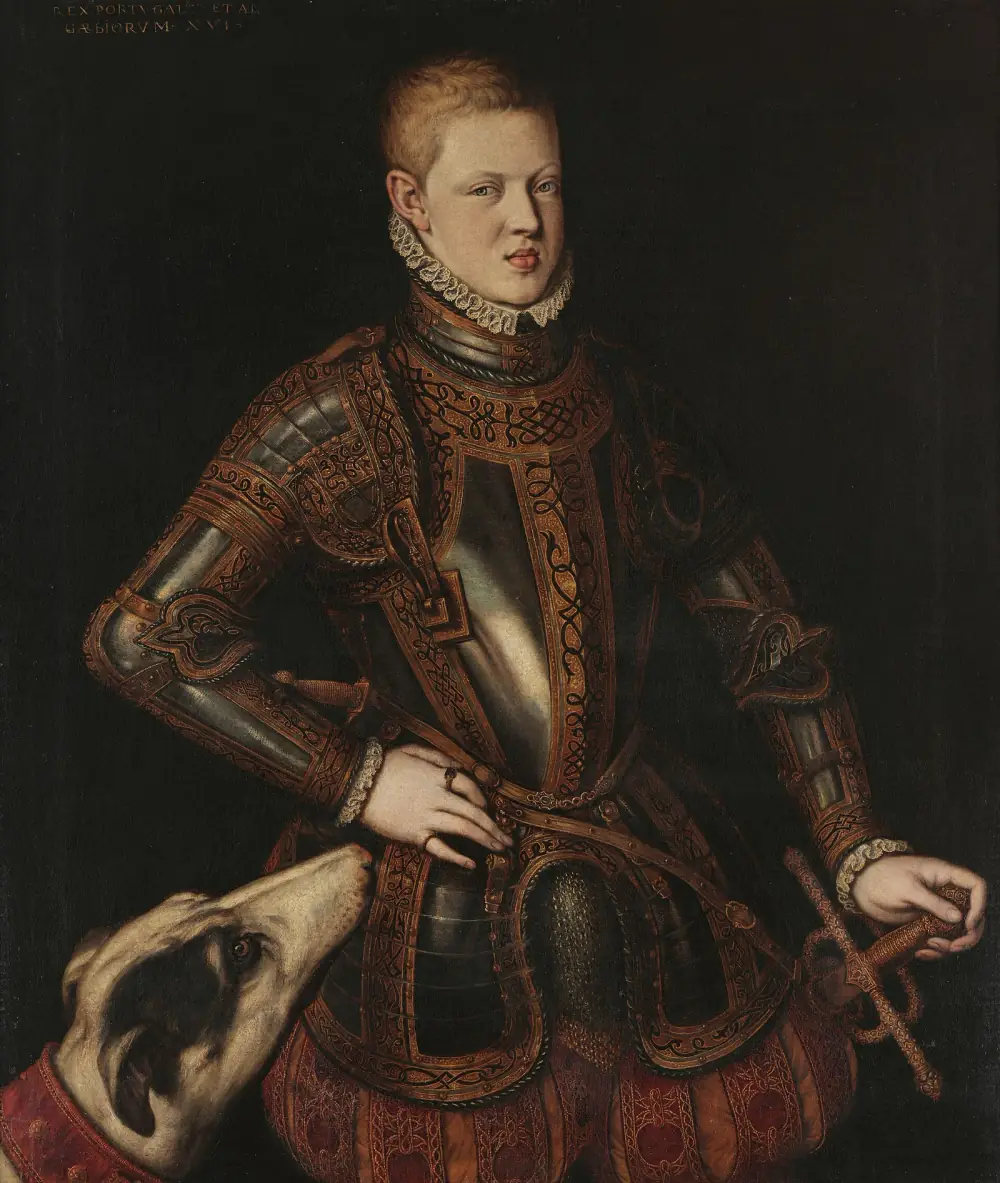
- King Sebastião in armour, painted by Cristóvão de Morais in about 1571 to 1574. The inscription calls him the sixteenth king of Portugal and the Algarves. Cristóvão de Morais, Public domain, via Wikimedia Commons.
- The Christian order of battle sketched in a sixteenth-century Portuguese manuscript, part of a volume of papers mostly from Sebastião's reign: the infantry terços in a block between lines of carts, one of them labelled for the Spanish and Italians together, with notes on the horsemen of the king, the Duke of Aveiro, Duarte de Meneses and the sharif. The text above says the battle lasted four hours. AlvoMaia, Public domain, via Wikimedia Commons.
- Sebastião's tomb in the church of the Jerónimos, photographed in 2017. The Latin verses carved on its base begin “Conditur hoc tumulo, si vera est fama, Sebastus”: “In this tomb lies, if report is true, Sebastião.” Palickap, CC BY-SA 4.0, via Wikimedia Commons.