

A thatched hut on the plateau: the founding of São Paulo, 25 January 1554
About a dozen Jesuits climbed from the coast of Brazil to a plateau where Tupiniquim villagers built them a hut. Their letters, read closely, tell a story in which the chiefs who sheltered them matter as much as the priests.
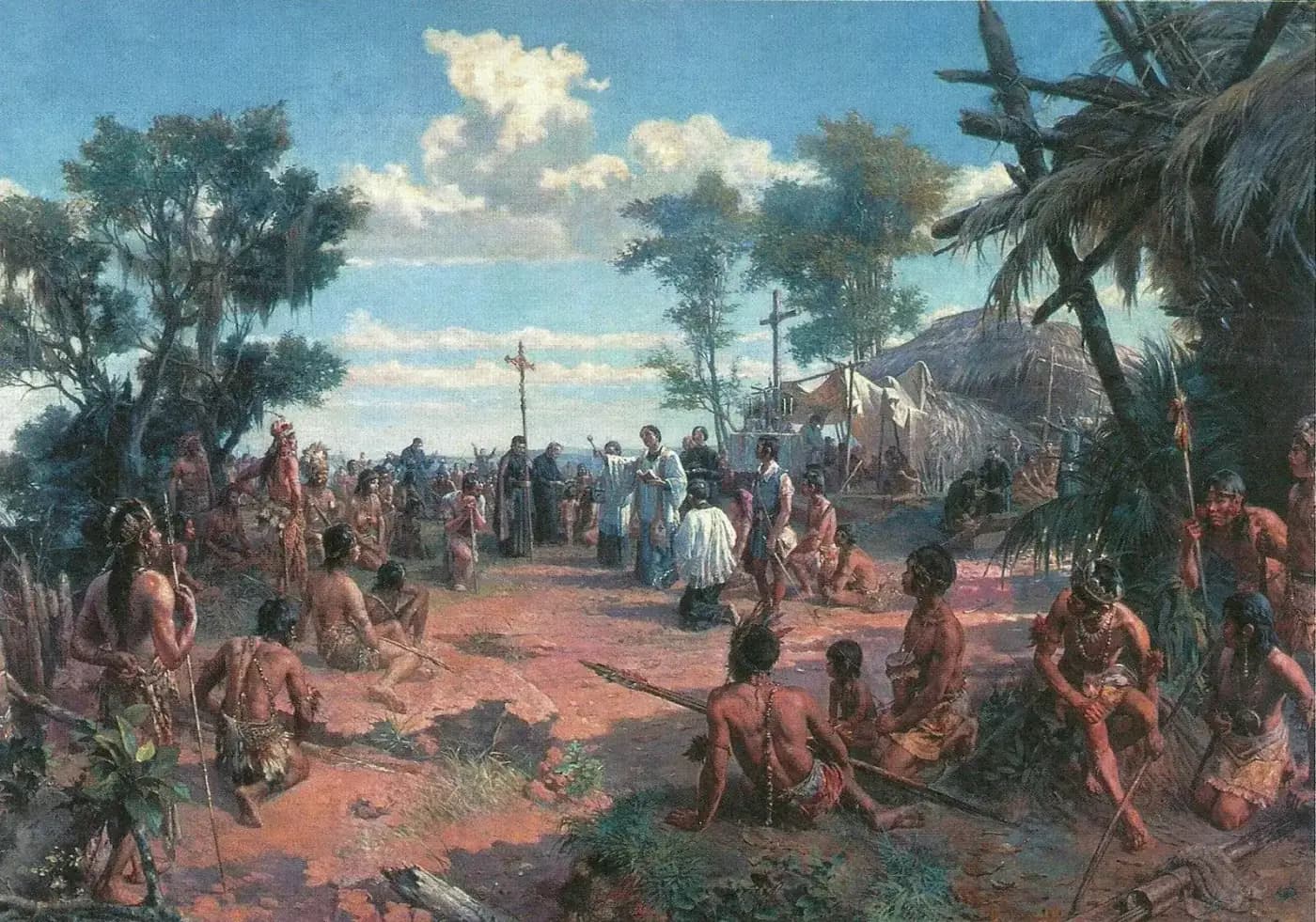
At a glance
- On 25 January 1554, the feast of the Conversion of Saint Paul, Jesuit missionaries said Mass in a small house on the Piratininga plateau and dedicated their house to the apostle. São Paulo dates its founding to that day.
- Their lodging, a mud-and-thatch hut fourteen paces by ten, was built by Indigenous villagers who followed the Tupiniquim chiefs Tibiriçá and Caiubi and had chosen to settle around the site.
- Manuel da Nóbrega, head of the Jesuits in Brazil, chose the place and ordered the move. José de Anchieta, a 19-year-old novice, wrote the letter that records the day. Who led the party on the climb is disputed.
- In July 1562 Tibiriçá led the defence of the settlement against an attack by inland villages of his own people that included his brother and nephew. He died on 25 December 1562 and the Jesuits called him the founder of their house.
- In the seventeenth century São Paulo lived on Indigenous captives brought back by slaving expeditions, the bandeiras. It became a city by royal letter in 1711 and had 11,451,999 people in the 2022 census.
A hut on the plateau
In the first weeks of 1554, a few days after Epiphany, a dozen or so Jesuits left the coastal town of São Vicente and climbed the forested wall of the Serra do Mar. It was one of the hardest paths anywhere in the world, Anchieta later wrote. At the top the forest gave way to open fields, and they made for a low hill between two streams, the Tamanduateí and the Anhangabaú.
There the local people built them a house. It was small, of mud and timber under a thatched roof, fourteen paces long and barely ten wide. The builders were Indigenous villagers who followed two chiefs, Tibiriçá and Caiubi, and who had chosen to gather near the spot.
On 25 January, the feast of the Conversion of Saint Paul, the Jesuits said their first Mass there. Months later one of them, a 19-year-old novice from Tenerife called José de Anchieta, described the day in a long report in Latin to his superiors in Europe.
“So some of us brothers, sent to this village, which is called Piratininga, arrived on 25 January in the year of the Lord 1554, and we celebrated the first Mass in a very poor and very narrow little house, on the day of the Conversion of the Apostle Saint Paul, and for that reason we dedicated our house to him.”
The house of Saint Paul gave its name to the village, and the village grew into São Paulo, a city of more than 11 million people. The founding is usually told as a story about priests. Anchieta's letters, read in full, are just as much about the Indigenous families who built the house, fed its occupants and, eight years later, fought to keep it standing.
Brazil in 1554
In 1549 the Portuguese crown sent its first governor-general, Tomé de Sousa, to Bahia, on the north-east coast. A small group of Jesuits sailed with him under Manuel da Nóbrega, who wrote home that they arrived on 29 March 1549 after eight weeks at sea and found forty or fifty settlers in the existing village.
The south was the captaincy of São Vicente, granted to Martim Afonso de Sousa. Above its coastal strip lay the Piratininga plateau, home to Tupiniquim villages. A Portuguese settler, João Ramalho, had lived among them for nearly fifty years. He lived with Bartira, also called M'bicy, a daughter of Tibiriçá, as his wife (Anchieta, who disapproved, called her his concubine), and their sons, of mixed Portuguese and Indigenous descent (mamelucos), were an influential family on the plateau.
Ramalho's settlement on the edge of the forest was made a vila, a chartered town with its own council, in 1553, under the name Santo André da Borda do Campo. Nóbrega looked further on. On 29 August 1553, guided by one of Ramalho's sons, he visited the villages in the open fields beyond, closer to the river Tietê, which ran inland towards Paraguay and the peoples he hoped to reach.
The Indigenous side of the bargain appears in a letter Nóbrega wrote on 12 June 1553. Three villages in the fields, he reported, wanted to join into one so that they could be taught. The Jesuit historian Hélio Viotti read this as the villagers' own initiative, which Nóbrega welcomed: without it, he argued, the college would not have gone up the hill. Serafim Leite, another Jesuit historian, put it the other way round and cited Anchieta's statement that the Indians built the new village on Nóbrega's orders.
Anchieta had landed at Bahia in July 1553 with the second governor, Duarte da Costa. He reached São Vicente on 24 December, in time for Nóbrega's next move. In January 1554 Nóbrega sent priests and brothers to start a college in the fields of Piratininga, 12 or 13 leagues from São Vicente.
The people on the plateau
| Person | Who they were | Role in 1554–1562 |
|---|---|---|
| Tibiriçá (baptised Martim Afonso) | Tupiniquim chief of Piratininga | His people helped build the hut; he led the defence in 1562 and died on 25 December that year |
| Caiubi (baptised João) | Chief of Jeribatiba, said to be over 100 | His people helped build the hut; he was “the first to begin to settle” the village; died in 1561 |
| Bartira (M'bicy, baptised Isabel) | Tibiriçá's daughter | Lived with João Ramalho as his wife, a link between the chief's family and the Portuguese |
| João Ramalho | Portuguese settler living among the Tupiniquim | His settlement became the town of Santo André; he and his sons clashed with the Jesuits |
| Manuel da Nóbrega | Head of the Jesuits in Brazil | Chose the site and ordered the move; Serafim Leite argued he founded the house in person |
| Manuel de Paiva | Jesuit priest | Superior of the party in January 1554 according to the 1933 editor, a role Leite disputed |
| José de Anchieta | Jesuit novice, 19, born in Tenerife | Taught Latin, wrote the letters that record the founding |
| Jagoanharo | Tibiriçá's nephew | Named by a later chronicler as the near-captain of the attackers killed in 1562 |
Baptismal names and identifications come from Anchieta's letters and the notes of their 1933 editor.
The first year, in Anchieta's words
- Date
- 25 January 1554, feast of the Conversion of Saint Paul
- Place
- A hill between the Tamanduateí and Anhangabaú streams, Piratininga plateau
- Party
- About a dozen Jesuits; the 1933 editor counts thirteen and names nine with certainty
- Building
- Mud and timber under thatch, 14 paces by 10
- Built by
- The people of Tibiriçá and Caiubi
- Distance
- 12 to 15 leagues inland from São Vicente, by different Jesuit accounts
Anchieta's report, quoted here in Lisboeta's translation of the 1933 Portuguese edition, is the fullest eyewitness account of the first year. The hut was at once school, infirmary, dormitory, refectory, kitchen and storeroom, and at times more than twenty people slept in it. Smoke filled it so badly that the brothers often taught Latin grammar outside, preferring the cold of the plateau to the fire indoors.
He was plain about who had built it. “The Indians by themselves built this house for our use,” he wrote, adding that a slightly bigger one was now planned, “with the sweat of our brow and the help of the Indians.” The new house and church were finished on 1 November 1556.
The Jesuits lived on manioc flour, game, beans, pumpkins and mustard greens, with river fish only now and then. Their main support was a brother who worked as a blacksmith for the villagers without asking for payment; in return the Indians brought flour, vegetables and sometimes meat and fish. Parents brought their children to the school of their own accord. In the village 130 people had been called to catechism and 36 to baptism, which the priests held back until after a long trial.
Anchieta also learned the coastal Tupi language well enough to write its grammar, printed at Coimbra in 1595. The letter shows how much the mission depended on interpreters such as the brother Pero Correia, whom it calls one of the leading men of the land and a great master of the Indians' language. Before he joined the Jesuits, the 1933 editor notes, Correia had spent years raiding villages and taking captives.
The same letter already argued for force. Little or no fruit could be gathered from the Indians, Anchieta wrote, unless the secular arm came to subdue them. He closed by welcoming news of gold, silver and iron inland as the best and easiest means of conversion: Christians drawn by metals would bring the Indigenous peoples under Christ's yoke and make them do by force what they would not do for love.
Myth and record
Four hundred years later the founding became a matter of civic pride, and of argument. In 1954, the fourth centenary, supporters of Nóbrega and of Anchieta quarrelled publicly over which of them was the true founder. The geographer Virgílio Corrêa Filho summed it up: one had planned the enterprise and chosen the site, the other was a young novice in the party led by Paiva.
The date itself is safer than the cast. Anchieta's letter gives 25 January 1554 plainly, and the city's administrative history counts from it. Leite traced the village back to 29 August 1553, when Nóbrega, by his own account, solemnly made some fifty catechumens. Viotti argued that this episode belonged to Nóbrega's journey to Maniçoba, a village some 35 leagues into the interior, and not to Piratininga.
Even the building is argued over. The 1933 editor took the hut the Indians built and the little house of the first Mass to be the same; Leite read Anchieta as describing a separate small church beside the brothers' house. When Oscar Pereira da Silva painted the scene in 1909 he set the Mass in the open air before a crowd.
From village to town, 1560
For six years Santo André, three leagues nearer the sea, and the Jesuit village coexisted on the plateau. In 1560 the governor-general Mem de Sá, after taking the French fort of Coligny, reached São Vicente on 31 March. At the request of Nóbrega and Luís da Grã he abolished Santo André and moved its pillory, the symbol of a town's jurisdiction, to São Paulo, where it was planted in front of the college. The new town council was installed in June 1560.
In 1561 Anchieta gave two reasons for the move: Santo André was in danger from enemies who had cut paths through the forest towards it, and it had no priest of its own. In 1584 he repeated only the second. Many historians of São Paulo have seen the move instead as a blow against João Ramalho and his mameluco sons, the priests' rivals for influence over the Indigenous villages.
The Indigenous families made their own decision. Anchieta wrote in June 1561 that the Indians had left Piratininga to live as they wished, though some of Caiubi's family stayed. The 1933 editor links their departure to the arrival of the Santo André settlers and says they founded new villages at Pinheiros and São Miguel. Caiubi, the old chief who had been the first to settle at Piratininga, died in 1561, more than a hundred years old by Anchieta's reckoning.
The siege of 1562
The attack that nearly ended São Paulo came from its own neighbours. Anchieta calls them “thieves of the house”: villages of the same people as the Indians of Piratininga, scattered inland, who had threatened war for years and had killed Portuguese traders in their lands. He keeps them distinct from the Tamoio, the enemies to the north. Among the attackers were Tibiriçá's brother, whom later writers call Araraí or Piquerobi, and that brother's son Jagoanharo.
In Anchieta's account the spark was the fate of an Indigenous Christian woman. Her Portuguese husband had been killed, and a village chief seized her to hold for ransom and to take as a concubine. She slipped out at night and was never seen again. Her captors said she had killed herself rather than submit; the Jesuits suspected they had murdered her.
An Indigenous man who had relatives in the village broke away from the attackers and ran ahead to warn the Jesuits. Converts from seven or eight villages came in by night with torches, shivering with cold, to help defend the place. Tibiriçá gathered his people from three small villages, pulling down their houses and leaving their fields to the enemy. For five days he walked the streets preaching to his followers to defend the church the priests had built for their children.
The assault came on the octave of the Visitation: 10 July 1562 by the 1933 editor's reckoning, 9 July in Serafim Leite's. Painted and feathered warriors attacked in the morning and besieged the village for two days. Brothers shot at brothers, cousins at cousins, nephews at uncles; two Christian sons fought on the Jesuit side against their own father. Portuguese women and children sheltered in the Jesuits' house and church.
On the second day the attackers killed the settlers' cattle and fled. Among their dead was a former catechumen, almost the attackers' captain, who stormed the fence of the Jesuits' garden and was killed by an arrow. The seventeenth-century chronicler Simão de Vasconcelos named him as Jagoanharo, and said he had first tried to talk his uncle out of defending the village.
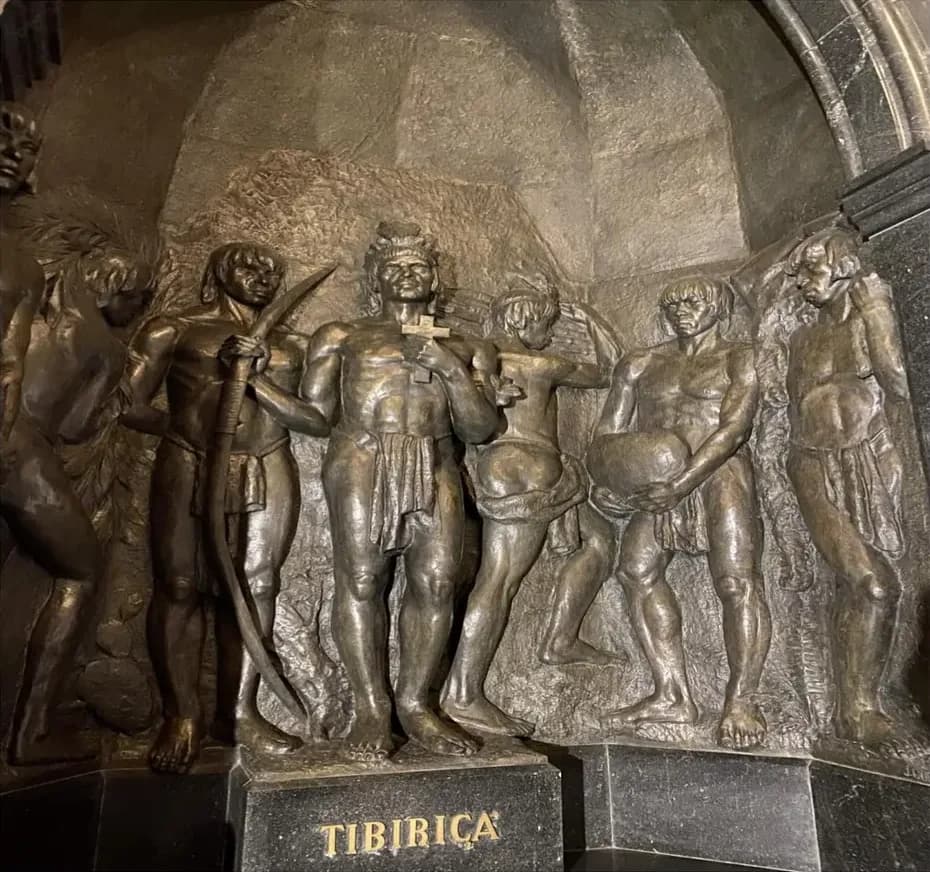
Tibiriçá fell ill with dysentery later that year. He made his confession, left a will telling his wife and children to follow the priests' teaching, and died on Christmas Day 1562. He was buried in the Jesuit church, followed by the Portuguese settlers carrying the candles of their confraternity.
“More than anyone, I believe, we of the Society owe him, and so it was decided to count him as a benefactor and also as founder and preserver of the house of Piratininga and of our lives, because he helped to build it with his own hands and helped to sustain us from the very start of its foundation, when there were no Portuguese at all.”
The same letter shows the hardening of Jesuit thinking. The war forced the converts to leave their scattered villages and gather inside Piratininga, behind a new wattle-and-daub wall they had built with the Portuguese. There they could be taught every day, and an alcaide, a local officer, made them go to church. “For this kind of people,” Anchieta wrote, in our translation, “there is no better preaching than the sword and the iron rod.”
Two days after writing that letter, on 18 April 1563, Anchieta and Nóbrega left São Vicente for Iperoig, on the coast, to negotiate peace with the Tamoio, and Anchieta stayed on there as a hostage.
Aldeias, bandeiras and slaves
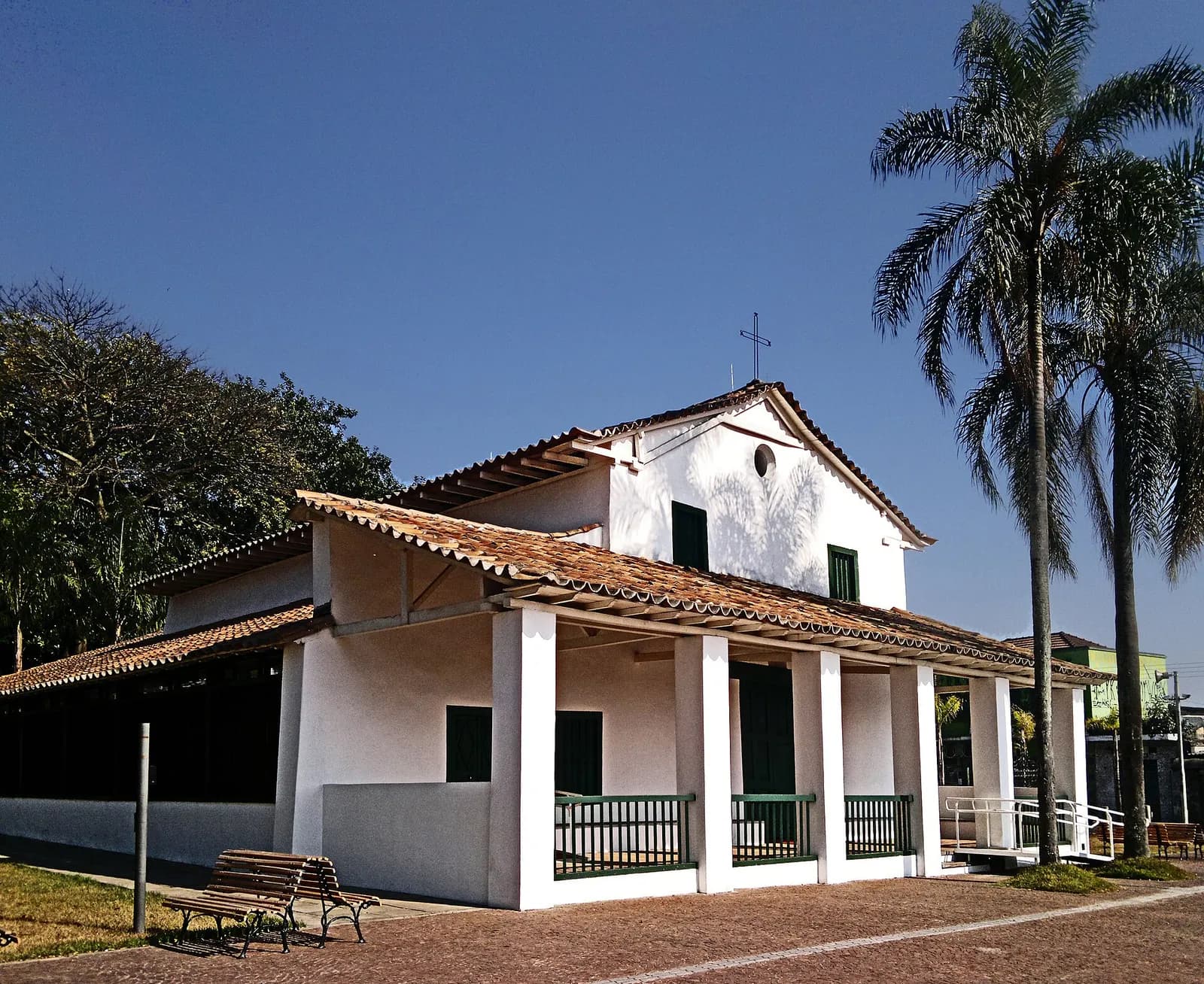
Around the college the Jesuits ran a ring of aldeias, mission villages built on existing Indigenous settlements. Four were entrusted to them as royal villages: São Miguel, Pinheiros, Barueri and Guarulhos. From the mid-seventeenth century they also founded aldeias of their own, also called Jesuit farms, at Carapicuíba, M'Boy, Itapecerica, Itaquaquecetuba and São José.
The settlers wanted that labour too. Through the seventeenth century São Paulo's settlers organised frequent armed expeditions into the interior, known as bandeiras, to capture Indigenous people and bring them back as slaves. The historian John Monteiro showed that the hunt for slaves, more than exploration or the search for mineral wealth, drove this expansion. In the 1620s and 1630s Paulistas attacked the Spanish Jesuit missions of Guairá and Tape.
Royal laws and papal bulls upheld Indigenous freedom, from the law of 1570 to restatements in 1596, 1609, 1611, 1639 and 1696. In São Paulo the settlers got round them with a system called private administration. Monteiro found that “administered” Indians were sold, traded and left in wills like any other property, and that short of flight or rebellion their only way out was a deed of manumission.
When the Jesuits read out a papal brief against Indigenous slavery in public in 1640, the settlers threw them out of São Paulo, on 13 July 1640. The town council took over the royal aldeias. A royal decree of 3 October 1643 ordering the priests' return was ignored, and they came back only under an agreement of 14 May 1653, in which they gave up the papal brief and promised not to shelter Indigenous people who fled from the settlers.
Average number of Indigenous captives per probate inventory in São Paulo
captives per estate
From probate inventories studied by John Monteiro, who warns that there are no precise population figures for the period. The 1640s bar marks a floor (the average was above 38) and the post-1710 bar a ceiling (below 10). Captures fell as expeditions went further and met more resistance, and many settlers left for the gold mines found in the 1690s.
Show the data
| Average holding | |
|---|---|
| 1640s | 38 |
| 1680s | 23 |
| 1690s | 14 |
| After 1710 | 10 |
By the mid-seventeenth century captives were harder to find. Expeditions had to go deeper into unknown country and met fiercer resistance. Some planters bought enslaved Africans instead, and some, such as Fernão Dias Pais, sank their fortunes into the search for precious metals. After gold was found in the 1690s, freed Indigenous people brought lawsuits and petitions with the support of crown judges, and Monteiro concluded that their growing resistance hastened the end of Indigenous slavery in São Paulo.
A city in 1711
São Paulo grew slowly. At the start of the seventeenth century it had fewer than two hundred white residents, surrounded by thousands of Indigenous people and many mamelucos. It became the head of its captaincy by a provision of 22 March 1681.
In 1711 a royal letter raised the town to the rank of city. Sources disagree on the day: a 2011 notice of a tercentenary conference in the FAPESP research magazine dates the act to July 1711, the São Paulo court's official history to 24 July and the IBGE's municipal record to 11 June. The new city was installed on 3 April 1712. City status gave it more administrative and legal autonomy at a time when it was the base for expansion into the interior.
29 March 1549
Nóbrega and the first Jesuits land at Bahia with Tomé de Sousa
1553
Santo André da Borda do Campo, João Ramalho's settlement, becomes a vila
July 1553
Anchieta lands at Bahia; he reaches São Vicente on 24 December
29 August 1553
Nóbrega visits the villages on the plateau
January 1554
About a dozen Jesuits climb to Piratininga, where the people of Tibiriçá and Caiubi build them a hut
25 January 1554
First Mass; the house is dedicated to Saint Paul
1 November 1556
The new house and church are inaugurated
1560
Mem de Sá moves Santo André's pillory and council to São Paulo
1561
Caiubi dies
9 or 10 July 1562
Two-day siege of Piratininga, led on the defenders' side by Tibiriçá
25 December 1562
Tibiriçá dies and is buried in the Jesuit church
1620s–1630s
Paulista expeditions attack the Guairá and Tape missions
13 July 1640
Settlers expel the Jesuits from São Paulo
14 May 1653
An agreement lets the Jesuits return
22 March 1681
São Paulo becomes head of the captaincy
1690s
Gold is found in the interior; Indigenous slavery declines
1711
Royal letter raises São Paulo to a city
3 April 1712
The city is formally installed
Why it still matters
The village of 1554 is now a city of millions: the 2022 census counted 11,451,999 people in the municipality of São Paulo, which still dates its founding to 25 January 1554. The same census counted 19,783 people in the city who identify as Indigenous, 1,429 of them living in Indigenous lands within its borders.
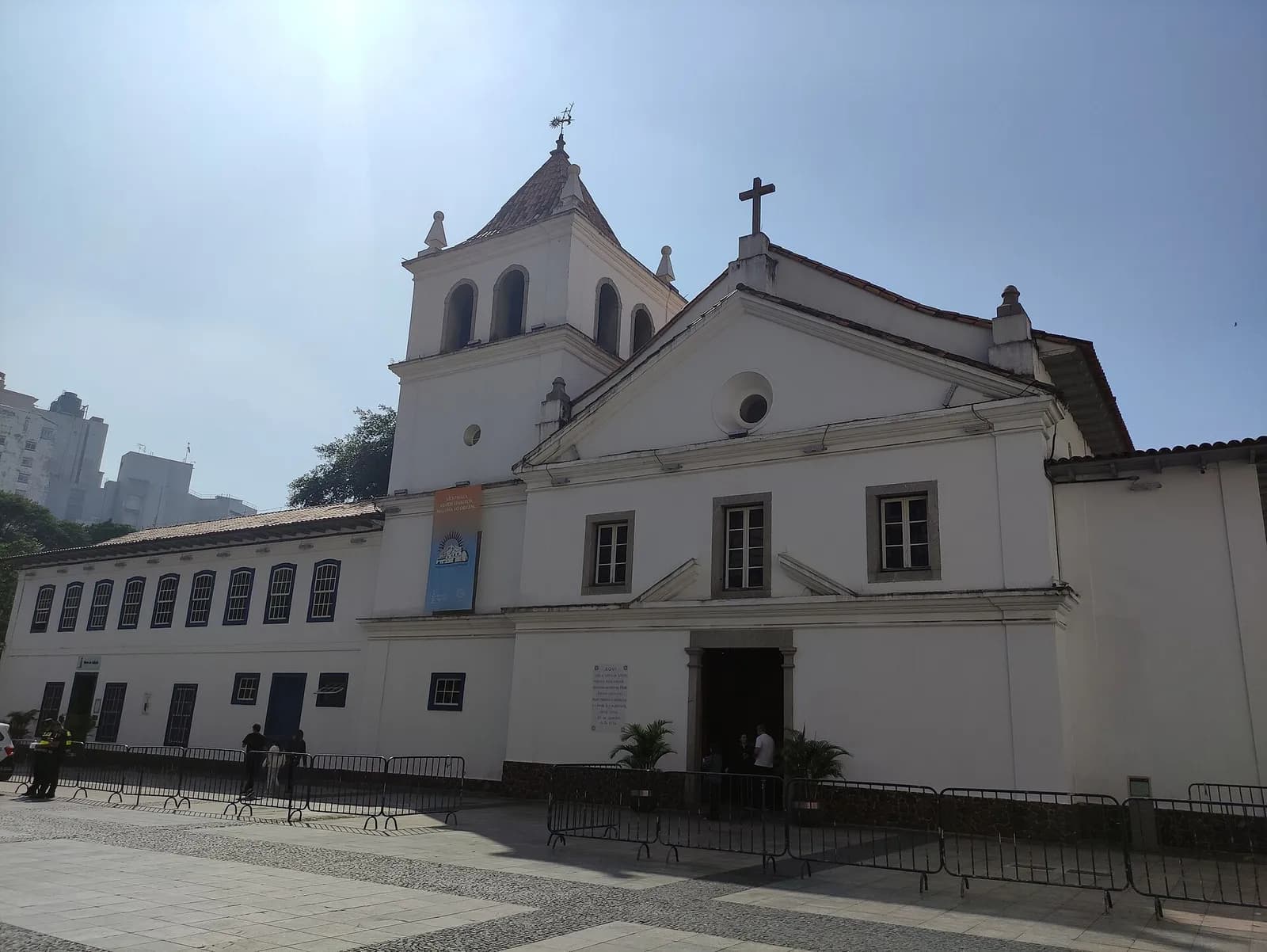
The founding site has been rebuilt more than once. In 1759 the crown expelled the Jesuits from Portugal and its empire, and by the nineteenth century the square housed the seat of the provincial government. The Jesuit church, its roof brought down by a storm in 1896, was demolished soon after. A monument to the founders opened on the square on 11 June 1925.
The fourth centenary spurred a campaign that ended with the land handed back to the Jesuits, who rebuilt the church and college. The Museu Anchieta opened there in 1979 and keeps two walls from the sixteenth and seventeenth centuries.
Anchieta was beatified in 1980 and canonised by Pope Francis on 3 April 2014. Tibiriçá has had a quieter afterlife: his remains lie in a crypt about seven metres below the high altar of the cathedral.
FAQs
When was São Paulo founded?
São Paulo dates its founding to 25 January 1554, when Jesuit missionaries said Mass on the Piratininga plateau on the feast of the Conversion of Saint Paul and dedicated their house to him. It became a town in 1560 and a city by royal letter in 1711.
Who founded São Paulo?
Manuel da Nóbrega, head of the Jesuits in Brazil, chose the site and sent about a dozen Jesuits; the 1933 editor of Anchieta's letters names Manuel de Paiva as their superior, while the Jesuit historian Serafim Leite argued that Nóbrega founded the house in person. José de Anchieta, then a 19-year-old novice, was among them. The hut they lived in was built by Indigenous villagers led by the chiefs Tibiriçá and Caiubi, and the Jesuits later called Tibiriçá the founder of their house.
Who was Tibiriçá?
Tibiriçá, baptised Martim Afonso, was a Tupiniquim chief of Piratininga and the father of Bartira, who lived with the Portuguese settler João Ramalho. His people helped found the Jesuit village, and in July 1562 he led its defence against inland villages of his own people that included his brother and nephew. He died on 25 December 1562 and is buried in the crypt of São Paulo Cathedral.
Who were the bandeirantes?
They were settlers from São Paulo who led armed expeditions, the bandeiras, into the interior from the late sixteenth century onwards. Their main business in the seventeenth century was capturing Indigenous people to work as slaves, including raids on the Spanish Jesuit missions of Guairá and Tape in the 1620s and 1630s.
On the timeline
Open the timelineNearby moments from the age of discoveries (1415–1580).
The mathematician and cosmographer Pedro Nunes is appointed to the chair of Mathematics at the University of Coimbra, the most prestigious post then open to a Portuguese mathematician. Inventor of the nonius, a scale for precise angle readings, and a pioneer of the mathematics of navigation, he held the chair until he retired in 1562.
Tomé de Sousa arrives at the Bay of All Saints (Baía de Todos os Santos) in Brazil as the first Governor-General, accompanied by approximately 1,000 settlers, soldiers, and six Jesuits. He founds the city of Salvador, establishing it as the capital of Portuguese Brazil.
Sebastião, the future king known as 'o Desejado' (the Desired), is born in Lisbon and named after the saint whose feast falls that day. His disappearance at Alcácer Quibir in 1578 would give rise to Sebastianism, the enduring legend that he would one day return to save Portugal.
The founding of São Paulo
Jesuit missionaries sent by Manuel da Nóbrega, among them the young José de Anchieta, celebrate Mass on the Piratininga plateau, where Tibiriçá's people built them a thatched house, on the feast of the Conversion of St Paul, founding the settlement that would grow into São Paulo, Brazil's largest city.
Death of King João III in Lisbon, aged 55. His reign of more than three decades saw the colonisation of Brazil through hereditary captaincies and the establishment of the Inquisition; having outlived all his children, he leaves the throne to his three-year-old grandson Sebastião, whose disappearance at Alcácer Quibir in 1578 would doom the House of Aviz.
Death in Lisbon of Martim Afonso de Sousa, who led the 1530 expedition that began the systematic colonisation of Brazil. In 1532 he founded São Vicente, the first permanent Portuguese town in the colony, and planted the sugar cane, soon worked by enslaved labour, that would define the colony's economy; he later served as Governor of Portuguese India.
Portuguese captain Estácio de Sá founds the city of São Sebastião do Rio de Janeiro in Brazil, establishing a strategic settlement to expel French colonists from Guanabara Bay.
Coming up in history
All long reads 27 January 1757Gomes Freire de Andrade: the Vienna-born general Lisbon hanged in 1817
 28 January 1908The plot at the library lift: Lisbon's failed coup of 28 January 1908
 29 January 1678Jerónimo Lobo, the Lisbon Jesuit who saw the springs of the Blue Nile
 30 January 1574After the Inquisition: the death of Damião de Góis, 30 January 1574
30 sources
Archives, scholarship and reporting this article was checked against.
- 1
José de Anchieta, “Carta de Piratininga (1554)”, in Cartas, informações, fragmentos históricos e sermões do Padre Joseph de Anchieta (1554–1594), Cartas Jesuíticas IIICivilização Brasileira, Rio de Janeiro, 1933, digitised by the Internet Archive
- 2
- 3
- 4
- 5
John M. Monteiro, Blacks of the Land: Indian Slavery, Settler Society, and the Portuguese Colonial Enterprise in South America, ed. and trans. James Woodard and Barbara WeinsteinCambridge University Press, 2018 (first published as Negros da terra, 1994)
- 6
John M. Monteiro, “Alforrias, litígios e a desagregação da escravidão indígena em São Paulo”, Revista de História, n. 120, 1989, pp. 45–57Universidade de São Paulo
- 7
- 8
- 9
- 10
- 11
Virgílio Corrêa Filho, “P. José de Anchieta: vultos da geografia do Brasil”, Revista Brasileira de Geografia, v. 16, n. 2, 1954, pp. 229–233IBGE
- 12
Censo Demográfico 2022, table 4709: resident population, São Paulo (SP)IBGE, SIDRA
- 13
- 14
- 15
Davi Molinari, “Cripta da Sé preserva memória de líder indígena essencial à fundação de São Paulo”Agência Alesp, Assembleia Legislativa do Estado de São Paulo, 26 August 2026
- 16
São Paulo: histórico e formação administrativaIBGE, Biblioteca, Enciclopédia dos Municípios Brasileiros
- 17
- 18
- 19
- 20
- 21
- 22
São José de AnchietaPateo do Collegio (Society of Jesus)
- 23
- 24
Luiz Pedro Dario Filho, “As minas de Paranaguá e a restituição da Companhia de Jesus a São Paulo (1649–1653)”, Ars Historica, n. 13, 2016, pp. 93–111Universidade Federal do Rio de Janeiro
- 25
“Cidade há 300 anos”Revista Pesquisa FAPESP, 2011
- 26
Memória: história das comarcasTribunal de Justiça do Estado de São Paulo
- 27
- 28
Expulsão dos JesuítasArquivo Nacional Torre do Tombo
- 29
- 30
Image credits
- Oscar Pereira da Silva's Fundação de São Paulo, painted in 1909, imagines the Mass of 25 January 1554 as a ceremony in the open air. Anchieta's own letter describes something smaller: a Mass said in a very poor and very narrow little house. Oscar Pereira da Silva, Public domain, via Wikimedia Commons.
- The bronze relief over Tibiriçá's tomb in the crypt of São Paulo Cathedral, photographed in 2022 (cropped). His remains were moved to the crypt in 1930. ElisaFGarcia, CC BY-SA 4.0, via Wikimedia Commons.
- The Capela de São Miguel Arcanjo, in São Miguel Paulista in the east of the city, photographed in 2011. Indigenous builders of the aldeia raised it in rammed earth; the inscription over its door dates the rebuilding to 1622. Carlos Alkmin, CC BY-SA 4.0, via Wikimedia Commons.
- The Pátio do Colégio in central São Paulo in July 2024. The church and college are a twentieth-century reconstruction on the site of the 1554 hut. Ferik80, CC BY-SA 4.0, via Wikimedia Commons.