

Jerónimo Lobo, the Lisbon Jesuit who saw the springs of the Blue Nile
He measured the springs of the Blue Nile with a plumb line, was handed to the Ottomans and ransomed, and died in Lisbon on 29 January 1678. A young Samuel Johnson turned his memoirs into a book.
At a glance
- Jerónimo Lobo, a Portuguese Jesuit born in Lisbon in 1593, 1595 or 1596 (sources differ), died at the Jesuit house of São Roque in Lisbon on 29 January 1678.
- He reached Ethiopia in 1625 with the Catholic patriarch Afonso Mendes, three years after Emperor Susenyos had made Catholicism the state religion, and worked there until the Jesuits were driven out in 1633 and 1634.
- Around 1629 he visited and described the springs of the Blue Nile at Gish Abay. The Spanish Jesuit Pedro Páez had described them first, after a visit usually dated 21 April 1618.
- Handed to the Ottomans at Massawa in 1634, Lobo bargained the governor of Suakin down from 30,000 to 4,300 crowns, then sailed to India and Europe seeking an armed expedition that never came.
- His memoirs, the Itinerário, were not printed in Portuguese until 1971, but Joachim Le Grand's French version of 1728 became Samuel Johnson's first book, A Voyage to Abyssinia (1735).
Two holes in a wet hillside
The springs did not look like much. On a gentle slope in Sakala, a district of the Ethiopian province of Gojjam, Jerónimo Lobo found two holes in the ground, each about two feet across and a stone's throw apart. His party lowered a plumb line into the first and it stopped at about five and a half feet, perhaps caught on tree roots. In the second, ten feet of line found no bottom, and the local people told him nobody had ever found one.
This was the head of the river the Ethiopians called the Abbay, which Lobo translated as the Father of Waters, and which Europeans call the Blue Nile. The ground was so soft that water welled up underfoot. On a hill above, he was told, the Agaw people met once a year to sacrifice cattle and throw a cow's head into one of the springs. Near by was a village he wrote down as Guix, today's Gish.
“This spring, or rather these two springs, are two holes, each about two feet diameter, a stone's cast distant from each other.”
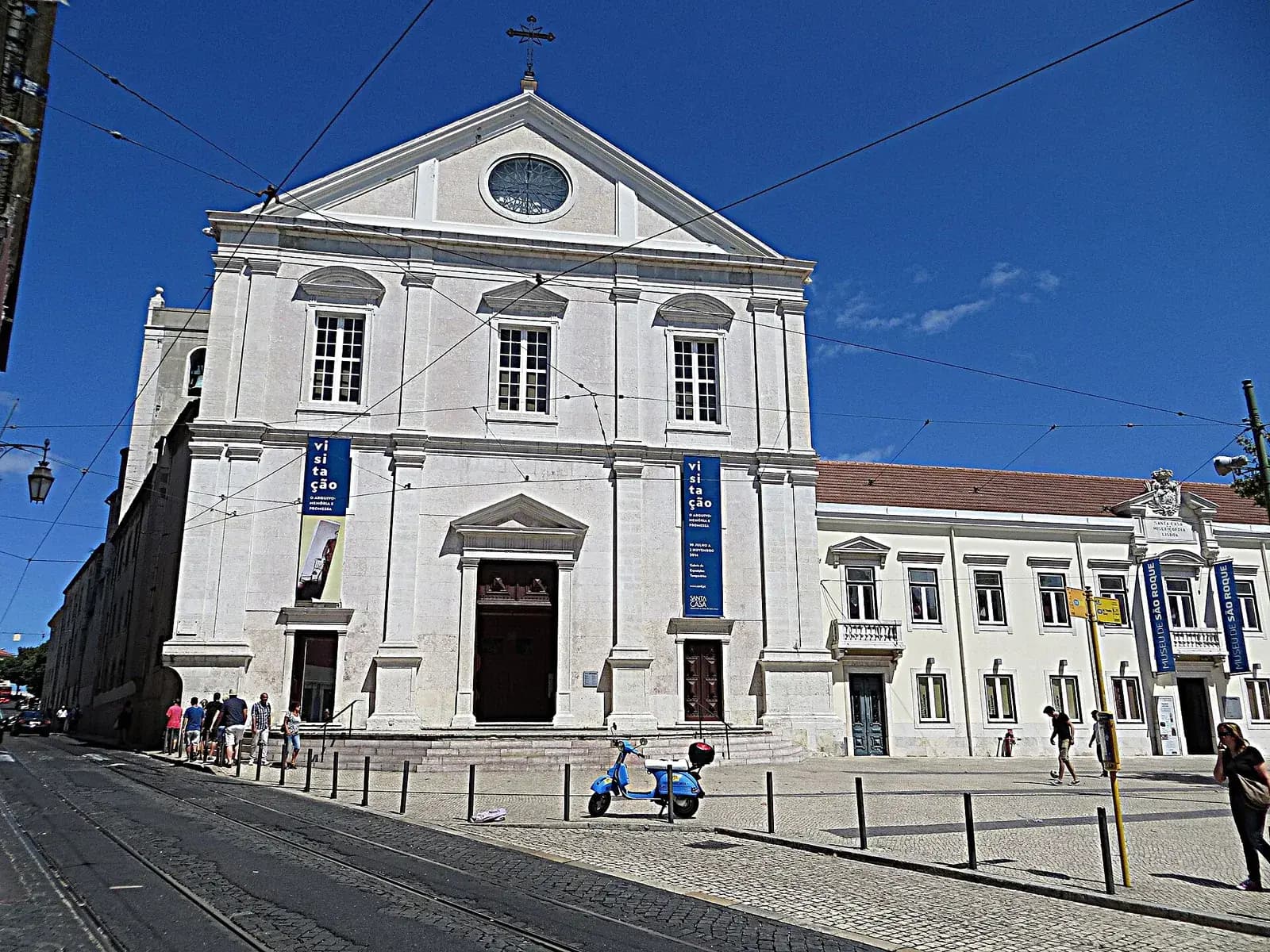
Lobo stood there around 1629, a Portuguese Jesuit sent to a Christian empire that his order hoped to bring under the Pope. He lived almost another half-century. He survived a shipwreck, Ottoman captivity and a ransom haggled down from 30,000 crowns, and he died in the Jesuit house of São Roque in Lisbon on 29 January 1678.
His memoirs waited more than three centuries to be printed in Portuguese. A French version of them reached a poor young Englishman named Samuel Johnson, who abridged it into English in 1735. It was the first book Johnson published.
A Jesuit from Lisbon
Lobo was born in Lisbon, but nobody agrees on the year. Henry Morley's introduction of 1887 and the 1911 Encyclopaedia Britannica give 1593; the Encyclopaedia Aethiopica and the New Catholic Encyclopedia give 1595; Portugal's National Library catalogues him as born in 1596. He entered the Society of Jesus in 1609 as a novice at Coimbra. He taught Latin at Braga, studied theology at Coimbra and was ordained a priest in 1621.
The Jesuits had looked towards Ethiopia almost from the start. Their founder, Ignatius of Loyola, saw a field for missions in the highland empire that Europeans knew as Abyssinia, or the land of Prester John, and from 1555 it was an early focus of the young order.
Lobo was posted to India. He sailed from Lisbon in March 1622 in the fleet of the new viceroy, the Count of Vidigueira. Near Mozambique a squadron of three English and three Dutch ships attacked, and the Portuguese lost three vessels. The rest reached Goa, the capital of Portugal's Asian empire, on 16 December 1622. There Lobo finished his theology and heard letters read from Ethiopia: the emperor had joined the Church of Rome, and more missionaries were needed.
- Born
- Lisbon; 1593, 1595 or 1596 depending on the source
- Died
- 29 January 1678, at the Jesuit house of São Roque, Lisbon
- Order
- Society of Jesus, from 1609; ordained 1621
- In Ethiopia
- June 1625 to May 1634, mainly in Tigray and Damot
- Known for
- His description of the Blue Nile springs and his memoirs, the Itinerário
- English translator
- Samuel Johnson, A Voyage to Abyssinia (1735), from Le Grand's French
A Catholic emperor in an Orthodox land
The man who made the mission work was Pedro Páez, a Spanish Jesuit who reached the mission house at Fremona, in northern Ethiopia, on 15 May 1603. He won the trust of the emperor Susenyos, who reigned from 1607. Shortly after receiving Susenyos into the Catholic Church, Páez died at Gorgora, by Lake Tana, in May 1622.
Susenyos proclaimed Roman Catholicism the official religion of Ethiopia in 1622. In a letter he called Páez “our spiritual father, the shining sun of the faith who purified Ethiopia from the darkness of Eutyches”. His half-brother Se'ela Krestos backed the new faith, and many of his subjects followed, some only outwardly.
Rome then sent a patriarch to govern the Ethiopian Church. Afonso Mendes, a Portuguese Jesuit, was, in the historian Adrian Hastings's words, “totally self-assured” and ignorant of the country. At the ceremony of 11 February 1626 he lectured the court on church history and the authority of Rome; Leonardo Cohen, who has translated the Jesuit account of the day, finds him more interested in old heresies than in the concerns of his hosts.
The long road to Fremona
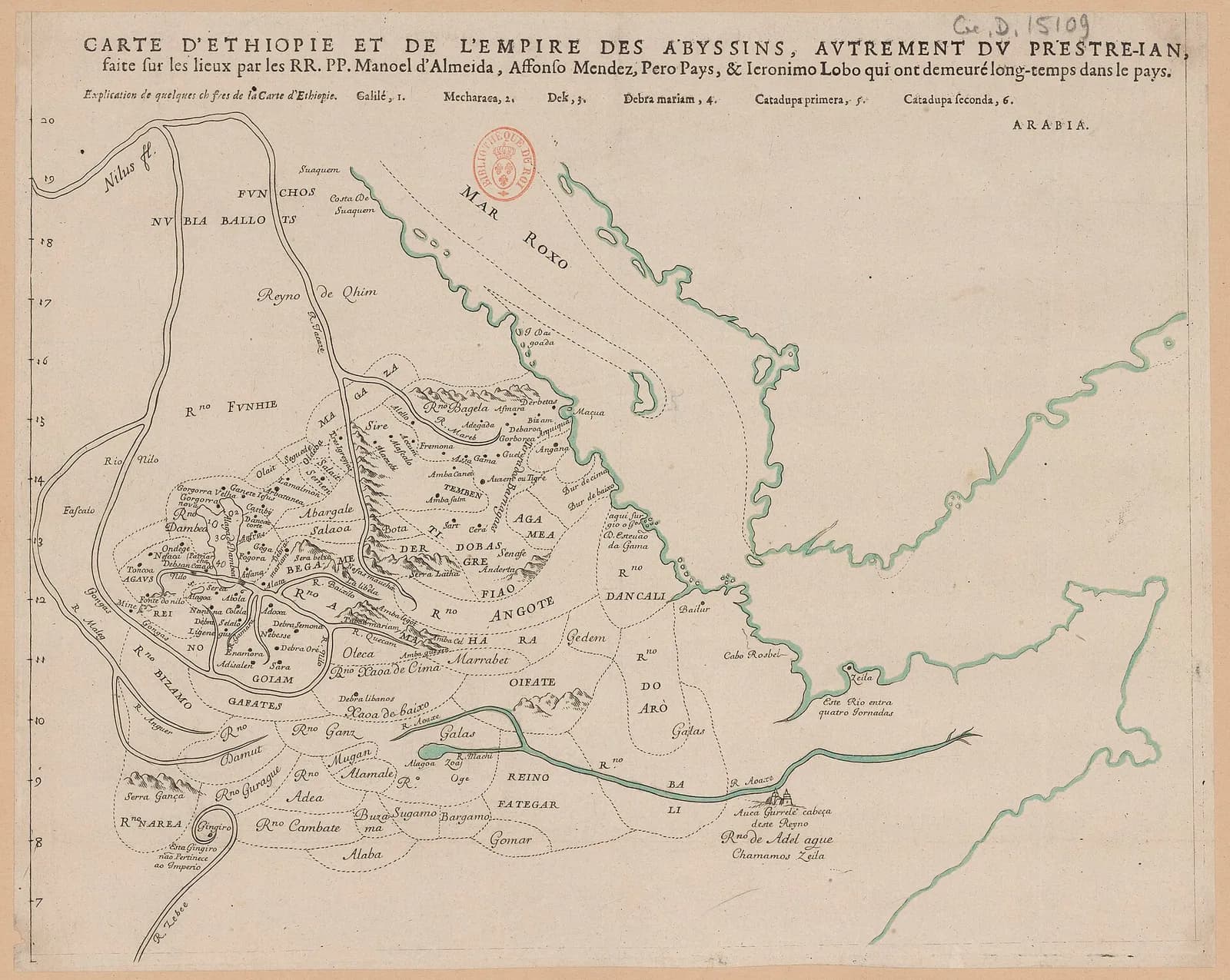
Getting in was the problem. The Ottoman Turks held Massawa, the usual port for the highlands. Eight Jesuits were chosen at Goa: four went by sea, two by way of Zeila on the Somali coast, and Lobo and a companion by a new route through Melinde, in today's Kenya. The two who went by Zeila were thrown into a dungeon by its ruler and beheaded.
Lobo left Goa on 26 January 1624 and landed at Pate, an island off the Kenyan coast, eleven days later. He tried to find a way inland from the mouth of the Jubba, failed, and went back to India. There he joined Mendes, who had arrived from Lisbon, and on 3 April 1625 they sailed together from Diu.
To avoid Massawa they landed at Beilul, near the mouth of the Red Sea, on 1 May. Weeks of crossing the hot, barren land of the Afar followed, under the eye of a king who let them go only after long haggling, and they reached Fremona on 21 June 1625.
Fremona, near Adwa in Tigray, was the Jesuits' headquarters, one of eighteen mission sites recorded in the sources. Lobo was put in charge of the house and of the Catholics scattered across Tigray, and made the patriarch's vicar for the province. One year a plague of locusts brought famine. He wrote of bodies in the roads and of wolves, maddened by hunger, dragging children from houses.
The Father of Waters
After a spell preaching in Tigray and Shire, Lobo was sent to Damot, beyond the Abbay, where he helped to build a church. On 5 January 1629 he made his solemn profession as a Jesuit at Enfraz. Travelling to Damot he crossed the Abbay on a raft, poled across a river full of hippopotamuses and crocodiles, and the trip set him thinking about the old riddle of where the Nile began.
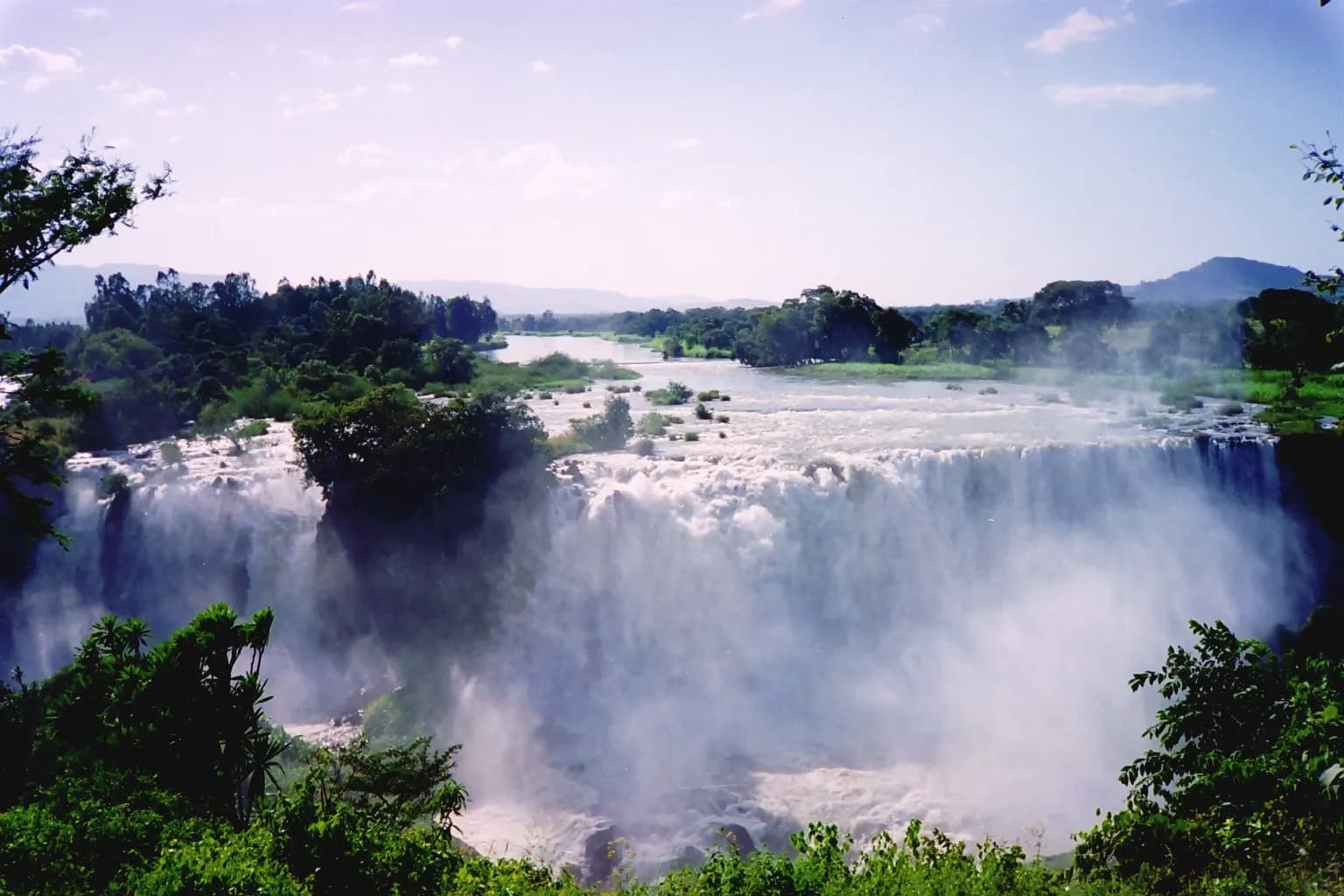
His account follows the river from the springs through Lake Tana to a great waterfall in the land of Alata, the falls now called Tis Abay. Below them he crossed a bridge of beams, later replaced by a bridge of one arch that Susenyos had built by masons brought from India.
“I passed under it without being wet; and resting myself there, for the sake of the coolness, was charmed with a thousand delightful rainbows, which the sunbeams painted on the water in all their shining and lively colours.”
Lobo was not the first European at the springs. Pedro Páez had described them in his History of Ethiopia after a visit usually dated 21 April 1618, the date given in Athanasius Kircher's Latin version of 1652. Lobo's own book put Páez's visit in 1613, and the Scottish traveller James Bruce later argued for 1615.
Bruce reached Gish Abay on 4 November 1770, claimed to be the first European there and dismissed Páez's account as a later insertion. The scholar Hartmann exposed the claim in 1796, and the geographer Charles Beke later defended what Lobo had written about the Abbay against Bruce.
Backlash and expulsion
Mendes pushed hard. Having decided that Ethiopian sacraments were of doubtful validity, he ordered everyone rebaptised and all the clergy reordained. The Ethiopian calendar of feasts was to give way to the Roman one, circumcision was forbidden, and so was keeping Saturday as a holy day.
The change was imposed by force, and Lobo took part. In Damot he proclaimed the emperor's edict ordering every subject to renounce their errors and join the Roman Church. He records that sixty monks threw themselves from a precipice rather than obey, and that in a battle with the emperor's troops six hundred monks, marching in front with altar stones on their heads, were among the first killed. He presented their deaths as a lesson that won converts.
Many Ethiopians saw an attack on their faith. Belaynesh Michael, writing in the Encyclopaedia Africana, records “bitter resentment among the clergy and adherents of the Ethiopian Orthodox Church”, and rebellions spread through the provinces. Jesuit letters describe noblewomen preaching against the missionaries. Walatta Petros, a noblewoman married to one of the emperor's counsellors, left her husband, defied Susenyos and Mendes, and was exiled; the Ethiopian Orthodox Church later made her a saint.
Her life, written down by a monk in 1672 at the request of her disciples, is the oldest known book-length biography of an African woman by an African author. Its publisher describes her movement as a successful, nonviolent effort to preserve African Christian beliefs in the face of European protocolonialism. The church's own account today speaks of persecution.
“Again during the 17th century, the church suffered persecution at the hands of the Jesuit Alphonzo Mendez and his followers.”
In Tigray, Lobo watched the emperor's heir, a Catholic only for show, begin countermanding his father. The governor of Tigray seized the Jesuits' lands and blockaded Fremona.
Susenyos won the battle of Wayna Daga on 2 June 1632, but, by the Encyclopaedia Africana's account, Fasilides, his eldest surviving son, reminded him that the 8,000 dead were his own subjects. On 24 June, urged on by his wife and Fasilides, Susenyos proclaimed the restoration of the Alexandrian faith. He handed power to Fasilides and died at Danqaz on 16 September. In 1633 Fasilides banished the Jesuits from court; some who stayed behind were later hunted down and executed. Lobo joined the patriarch and eighteen companions at Fremona.
A ransom haggled down at Suakin
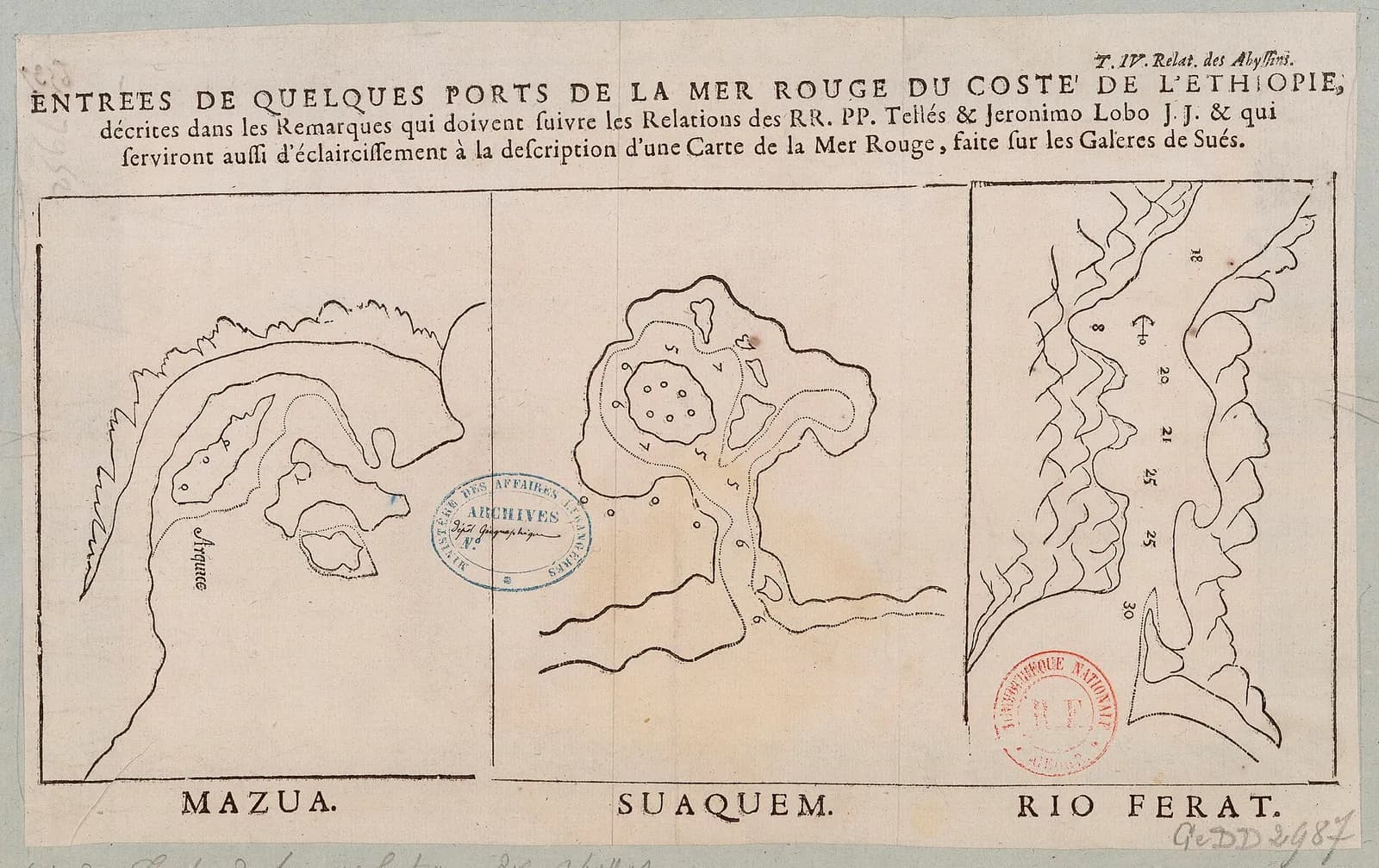
The missionaries hid for a time under the protection of a local lord, Yohannes Akay. On 20 May 1634 he handed Lobo, the patriarch and their companions to Ottoman soldiers, who took them to Massawa. The governor's men searched them for the gold they were said to have carried out of Ethiopia and found two chalices and some relics, but squeezed about six hundred crowns out of them with threats.
On 24 June they were shipped to Suakin, seat of the pasha who governed the coast. He raged at the ragged priests and threatened to cut off their heads, then asked for 30,000 crowns. Lobo, who negotiated for the group, pleaded poverty. The demand fell to 20,000, then 5,000 less, with talk of impaling and flaying. Some of the pasha's favourites, fearing a Portuguese fleet in the Red Sea if the priests died, offered to advance the money, and the parties settled on 4,300 crowns.
What the pasha of Suakin demanded for the Jesuits, 1634
crowns
Figures from Lobo's narrative in Samuel Johnson's English version (1735). Johnson gives no figure for the third demand, only that the pasha offered to “abate five thousand” of the 20,000; the 15,000 shown is Lisboeta's arithmetic. Johnson's “crowns” translate the French version, not Lobo's Portuguese.
Show the data
| Ransom asked or agreed | |
|---|---|
| First demand | 30,000 |
| Second demand | 20,000 |
| Third demand (calculated) | 15,000 |
| Agreed | 4,300 |
At the last moment the pasha kept the patriarch and two priests as security. One was over eighty, and Lobo offered to stay in his place; the pasha agreed to take a younger Jesuit, and the lot fell on Father Francisco Marques. The rest sailed in August in an Arab ship crowded with Mecca pilgrims, sleeping on deck, and reached Diu after forty days.
In Goa Lobo begged the viceroy to seize Massawa, build a fort there and reopen the road to Ethiopia. The viceroy would raid the coast but would not garrison it. So it was agreed that Lobo should go to Europe and make the case in person.
Lisbon, Madrid, Rome and back
He left India in 1635. His ship was wrecked on the coast of Natal, in southern Africa; he was captured by the Dutch; and he reached Europe by way of Cartagena de Indias, where, according to the Encyclopaedia Aethiopica, he inspired the Jesuit Alonso de Sandoval's treatise on the salvation of Africans, published in Madrid in 1647.
Mendes wrote that Lobo had been chosen because he was the most learned and ingenious of the brethren at Goa and the most able in business. In Lisbon he was heard kindly and sent on to the King of Spain, who in those years also ruled Portugal. Madrid would not pay for an expedition, and neither would Rome.
Lobo returned to India in 1640 and spent most of the next two decades in senior posts: superior of the old college of St Paul in Goa, rector at Bassein, vice-provincial. Older accounts call him provincial. After a quarrel with the political authorities of Goa, during which he was imprisoned, he sailed for Portugal in 1657; Morley dates his return to 1658.
He spent his last eighteen years at São Roque, the Jesuits' professed house in Lisbon. There he helped Baltasar Teles, whose history of Ethiopia, printed at Coimbra in 1660, drew heavily on Lobo's writings. Teles reckoned that Lobo had travelled 38,000 leagues for the sake of souls. Lobo died at São Roque on 29 January 1678.
1593, 1595 or 1596
Born in Lisbon
1609
Enters the Jesuit novitiate at Coimbra
16 December 1622
Reaches Goa after sailing from Lisbon in March
1624
Fails to reach Ethiopia from the Kenyan coast
21 June 1625
Arrives at Fremona with Patriarch Afonso Mendes
c. 1629
Visits the springs of the Blue Nile
Solemn profession at Enfraz on 5 January 1629.
24 June 1632
Susenyos restores the Orthodox faith
20 May 1634
Handed to the Turks at Massawa; ransomed at Suakin
1635 to 1640
Shipwreck in Natal; pleads in Lisbon, Madrid and Rome
1640
Back in India in senior Jesuit posts
1657 or 1658
Returns to Lisbon
29 January 1678
Dies at São Roque, Lisbon
The Itinerário and the young Samuel Johnson
Lobo's memoirs, known as the Itinerário, say more about the land and its peoples than about the mission. He made two copies: one around 1639 or 1640, during his stay in Lisbon, and another in the 1660s. Neither was printed in his lifetime. A shorter work on the Nile was published in London in 1669 in Sir Peter Wyche's English translation.
The later copy found a translator. Joachim Le Grand, a French priest who spent five years in Lisbon as secretary to an ambassador, published it in French in 1728 with essays and documents of his own. That copy has since been lost. The earlier one survived and was edited by the Portuguese priest Manuel Gonçalves da Costa, who published it in 1971.
Samuel Johnson read Le Grand's book as a student at Pembroke College, Oxford. A few years later, short of money and lodging in Birmingham with his school friend Hector at the house of the bookseller Warren, he agreed to translate it for five guineas. He cut Le Grand's two volumes to about a fifth of their length.
A Voyage to Abyssinia came out in 1735 under a London imprint, though it was printed in Birmingham. It was Johnson's first separate publication in book form. In his preface the young Protestant praised the Jesuit for telling nothing improbable, while advising readers unhappy with “a Popish account of a Popish mission” to turn to Dr Geddes's history of the Ethiopian Church.
“He meets with no basilisks that destroy with their eyes, his crocodiles devour their prey without tears, and his cataracts fall from the rock without deafening the neighbouring inhabitants.”
Johnson was not proud of it later. On 31 March 1776 James Boswell showed him a copy as a curiosity. Johnson told him not to talk of it, and when Boswell said his style had improved since, answered with a triumphant smile: “Sir, I hope it is.”
| Year | Edition | Language | Notes |
|---|---|---|---|
| 1660 | Baltasar Teles, history of Ethiopia (Coimbra) | Portuguese | Draws heavily on Lobo, who advised Teles |
| 1669 | A Short Relation of the River Nile (London), translated by Sir Peter Wyche | English | A shorter work; a London edition of 1673 also survives |
| 1728 | Joachim Le Grand, Relation historique d'Abissinie (Paris; also Amsterdam) | French | From the lost second copy, with Le Grand's essays |
| 1735 | Samuel Johnson, A Voyage to Abyssinia (London imprint, printed in Birmingham) | English | Abridged from Le Grand; reprinted in 1789 |
| 1971 | Itinerário e outros escritos inéditos, ed. M. Gonçalves da Costa | Portuguese | First printing of the surviving manuscript |
| 1984 | The Itinerário of Jerónimo Lobo, Hakluyt Society | English | Translated by Donald M. Lockhart, notes by C. F. Beckingham |
From Lobo to Rasselas
Ethiopia stayed with Johnson. In 1759, to pay for his mother's funeral and her small debts, he wrote a philosophical tale in the evenings of one week, he told Joshua Reynolds, sending it to the press in pieces as he went. He set it in Abyssinia.
“Rasselas was the fourth son of the mighty Emperor in whose dominions the father of waters begins his course.”
The phrase “father of waters” is the one Lobo used for the Abbay, and Rasselas is confined in a palace with the other royal children until the succession calls him. How much Johnson owed to Lobo, and how much to wider reading about Ethiopia, is argued over: in 1963 Donald Lockhart, who later translated the Itinerário, found the scholarship split between the two views and set out to trace the specific Ethiopian sources.
Why it still matters
The Catholic interlude left marks on Ethiopia. Archaeologists working between 2006 and 2014 surveyed ten of the Jesuit mission sites, several of them crumbling. In the Ethiopian Orthodox Church's own account the years of Mendes were a time of persecution, and Walatta Petros, who resisted, is a saint.
Gish Abay, the spring Lobo measured, is now inside a small church. Pilgrims collect its holy water, which, the church there teaches, cures sins, sickness and misfortune.
For more than two centuries Lobo's story was read mainly in French and English; his surviving manuscript was printed in his own language only in 1971.
FAQs
When and where did Jerónimo Lobo die?
He died on 29 January 1678 at São Roque, the Jesuits' professed house in Lisbon, where he had lived since returning from India in 1657 or 1658. His birth year is given as 1593, 1595 or 1596.
Did Jerónimo Lobo discover the source of the Blue Nile?
No. He visited and described the springs at Gish Abay around 1629, but Pedro Páez had described them after a visit usually dated 21 April 1618, and the local Agaw people had long held rites there.
Why were the Jesuits expelled from Ethiopia?
Patriarch Afonso Mendes ordered rebaptism, reordination of the clergy and the Roman calendar, and banned circumcision and Saturday observance. Revolts followed; in 1632 Susenyos restored the Orthodox faith, and in 1633 Fasilides banished the Jesuits.
What is the link between Lobo and Samuel Johnson?
Johnson abridged Joachim Le Grand's 1728 French version of Lobo's memoirs into English as A Voyage to Abyssinia (1735), his first book. Ethiopia later became the setting of his tale Rasselas (1759).
Can you read Lobo's Itinerário today?
Yes. The Portuguese text was edited by Manuel Gonçalves da Costa in 1971, and the Hakluyt Society published an English translation by Donald M. Lockhart in 1984. Johnson's abridgement is free on Project Gutenberg.
On the timeline
Open the timelineNearby moments from restoration and the gold of brazil (1640–1750).
Queen Luísa de Gusmão (born Luisa de Guzmán), widow of João IV, dies in Lisbon. Credited, perhaps apocryphally, with urging her husband to take the crown in 1640 because it was better to be queen for a day than duchess for life, she later ruled as regent and helped secure the Bragança dynasty.
Spain formally recognises Portuguese independence through the Treaty of Lisbon, ending the 28-year Portuguese Restoration War.
The Esnoga, the Portuguese Synagogue of Amsterdam, is inaugurated with great ceremony. It was built by a Sephardic community largely descended from Jews who had fled Portugal and its Inquisition, and it is still in use today, lit by candlelight during services.
Jerónimo Lobo in Ethiopia
Jesuit missionary Jerónimo Lobo dies in Lisbon. He had spent years in Ethiopia and in 1629 visited the source of the Blue Nile; an abridged English version of his account, 'A Voyage to Abyssinia' (1735), was the first book published by Samuel Johnson.
Death in Óbidos of Josefa de Óbidos, the Seville-born painter who became one of the very few women to make a professional career in 17th-century European art. Over nearly four decades she produced more than 100 works — luminous still lifes, devotional paintings and altarpieces — most of them signed and dated.
Zumbi, the last leader of the Quilombo dos Palmares — the largest community of escaped slaves in Portuguese Brazil, which held out in the hills of what is now Alagoas for most of the century — is ambushed and killed by colonial forces. Brazil marks the date as its Day of Black Consciousness.
An Omani army lays siege to Fort Jesus, Portugal's stronghold at Mombasa in today's Kenya. The siege lasts 33 months; hunger and disease kill thousands of defenders and refugees, and the fort's fall in December 1698 all but ends Portuguese power on the Swahili coast north of Mozambique.
Coming up in history
All long reads 31 January 189131 January 1891: the sergeants' revolt that proclaimed a republic in Porto
 1 February 1908Shots in the Terreiro do Paço: the Lisbon regicide of 1 February 1908
 2 February 1542Cristóvão da Gama storms Baçente: Portugal's war in Ethiopia, 1542
 3 February 1488Bartolomeu Dias passes the Cape unseen and lands at Mossel Bay, 1488
23 sources
Archives, scholarship and reporting this article was checked against.
- 1
Lobo, Jerónimo, in Encyclopaedia Aethiopica, vol. 3: He–N, ed. Siegbert Uhlig (Wiesbaden: Harrassowitz, 2007; publisher's date January 2008)Encyclopaedia Aethiopica, text of the entry as reproduced on Sewasew (author and page not given there)
- 2
A Voyage to Abyssinia, by Father Jerome Lobo, translated from the French by Samuel Johnson (Cassell edition of 1887, introduced by Henry Morley)Project Gutenberg
- 3
Gish Abay: the source of the Blue Nile (T. Oestigaard and A. F. Gedef)WIT Transactions on Ecology and the Environment 153 (2011), WIT Press
- 4
Susneyos (Belaynesh Michael)Dictionary of African Christian Biography, from the Encyclopaedia Africana Dictionary of African Biography (1997)
- 5
- 6
Lobo, Jerónimo (F. M. Rogers)New Catholic Encyclopedia, via Encyclopedia.com
- 7
Catalogue records under the authority heading Lobo, Jerónimo, 1596-1678, S.J.Biblioteca Nacional de Portugal (Open Data)
- 8
Ethiopian Orthodox Tewahedo ChurchWorld Council of Churches, member church profile
- 9
Jerónimo Lobo, 1596?-1678: A Short Relation of the River Nile (London, 1669), translated by Sir Peter WychePrinceton University Library, Maps Division exhibition on explorers of Africa
- 10
LOBO, Jerome. A Voyage to Abyssinia. London: Printed for Bettesworth and Hitch, 1735 (lot description)Christie's
- 11
Lobo, JeronimoEncyclopædia Britannica, 11th edition (1911), on Wikisource
- 12
Review of V. M. Fernández, J. de Torres, A. Martínez d'Alòs-Moner and C. Cañete, The Archaeology of the Jesuit Missions in Ethiopia (1557–1632) (David W. Phillipson)Aethiopica 21 (2018), Universität Hamburg
- 13
22 May 1622: Death of the discoverer of the sources of the Blue Nile (Wenceslao Soto Artuñedo SJ)Society of Jesus, General Curia (from the Archivum Romanum Societatis Iesu)
- 14
The Catholic Kingdom of Ethiopia: Father Manuel de Almeida's Account of the Imperial Conversion Ceremony (Leonardo Cohen, Lusitania Sacra 29, 2014)Jesuit Online Bibliography, Boston College
- 15
The Portuguese Expedition to Abyssinia in 1541–1543, as narrated by Castanhoso, with some contemporary letters, the short account of Bermudez, and certain extracts from Correa, translated and edited by R. S. WhitewayHakluyt Society, London, 1902 (Internet Archive scan)
- 16
The Saint Who Sent the Jesuits Packing (Allison Miller)Perspectives on History, American Historical Association, November 2015
- 17
The Life of Walatta-Petros: A Seventeenth-Century Biography of an African Woman, translated and edited by Wendy Laura Belcher and Michael KleinerPrinceton University Press
- 18
- 19
Museu de São RoqueSanta Casa da Misericórdia de Lisboa, on Google Arts & Culture
- 20
- 21
Review of M. G. da Costa (ed.), The Itinerário of Jerónimo Lobo, translated by Donald M. Lockhart, introduction and notes by C. F. Beckingham (Hakluyt Society, Second Series 162, 1984)D. L. Appleyard, Bulletin of the School of Oriental and African Studies 49:2 (1986), Cambridge University Press
- 22
- 23
Image credits
- Map of Ethiopia “made on the spot” by the Jesuits Manuel de Almeida, Afonso Mendes, Pedro Páez and Jerónimo Lobo, as printed in Melchisédech Thévenot's collection of travel accounts, about 1672. Fremona, Maçua (Massawa), Suaquem (Suakin), Bailur (Beilul) and Damut are all marked. Thévenot, Melchisédech (1620-1692), Public domain, via Wikimedia Commons.
- The Blue Nile Falls at Tis Abay, near Bahir Dar, in February 2006. Lobo, who called the place Alata, wrote that he passed under the falls without getting wet. CT Snow from Hsinchu, Taiwan, CC BY 2.0, via Wikimedia Commons.
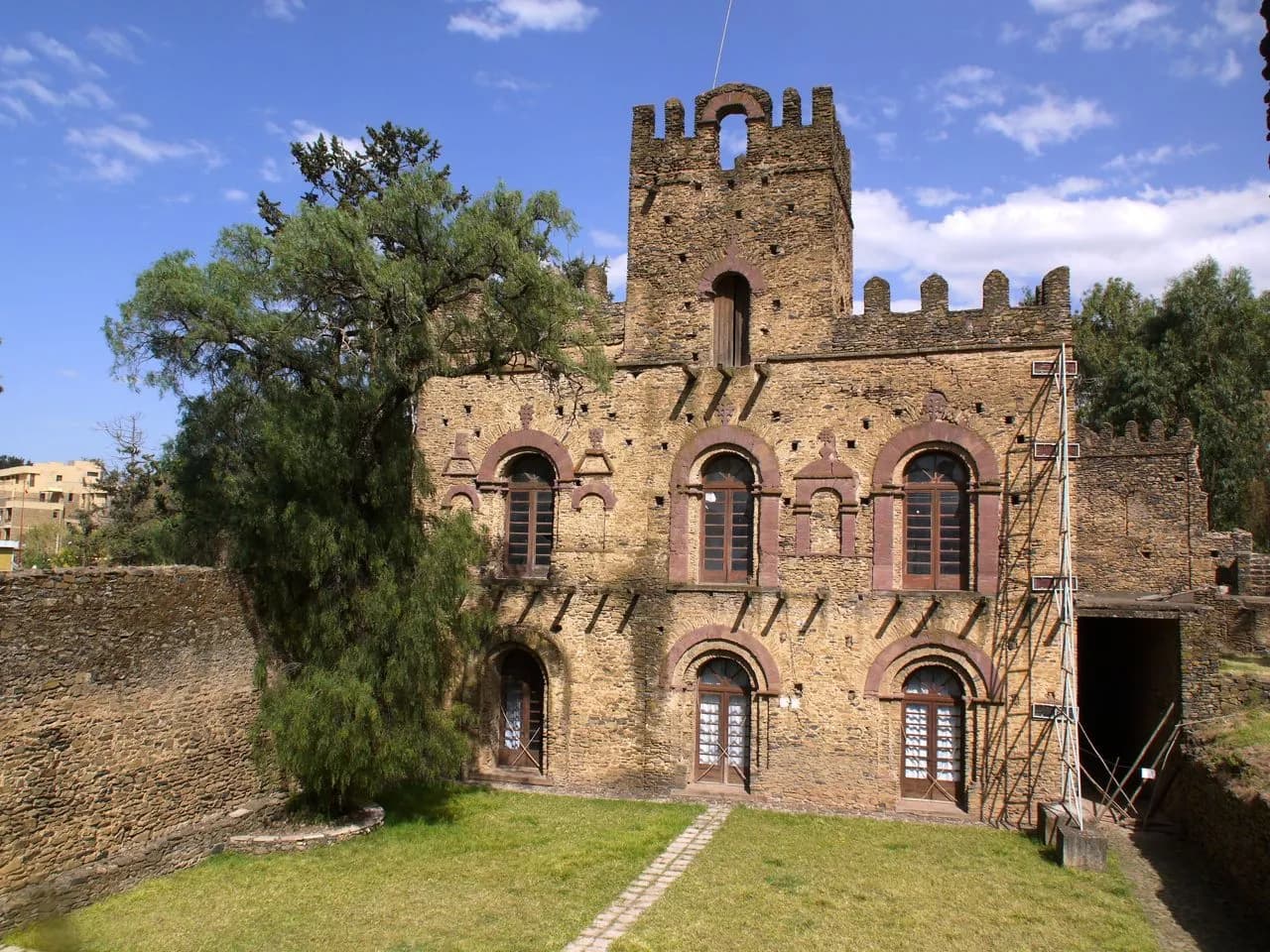
- Empress Mentewab's castle, an eighteenth-century addition to the Fasil Ghebbi, the walled royal compound at Gondar, photographed in 2012. Fasilides, who expelled the Jesuits, made Gondar, north of Lake Tana, his capital. Martijn.Munneke from Netherlands, CC BY 2.0, via Wikimedia Commons.
- Plans of the harbours of Massawa (Mazua) and Suakin (Suaquem), with a river mouth labelled Rio Ferat, printed to accompany the accounts of Baltasar Teles and Jerónimo Lobo in Thévenot's collection, about 1672. Telles, Baltezar (1595-1675) and Lobo, Gerónimo (1595?-1678), cartographers, Public domain, via Wikimedia Commons.
- The Igreja de São Roque in Lisbon, with the Jesuits' former professed house, where Lobo spent his last years and which now holds the Museu de São Roque, on the right, photographed in August 2014. Mister No, CC BY 3.0, via Wikimedia Commons.