

Shots in the Terreiro do Paço: the Lisbon regicide of 1 February 1908
The royal family came home from the Alentejo in an open carriage to show they were not afraid. In the corner of Lisbon's great riverside square, a teacher with a carbine and a former shop worker with a pistol were waiting, by one account, for the prime minister.
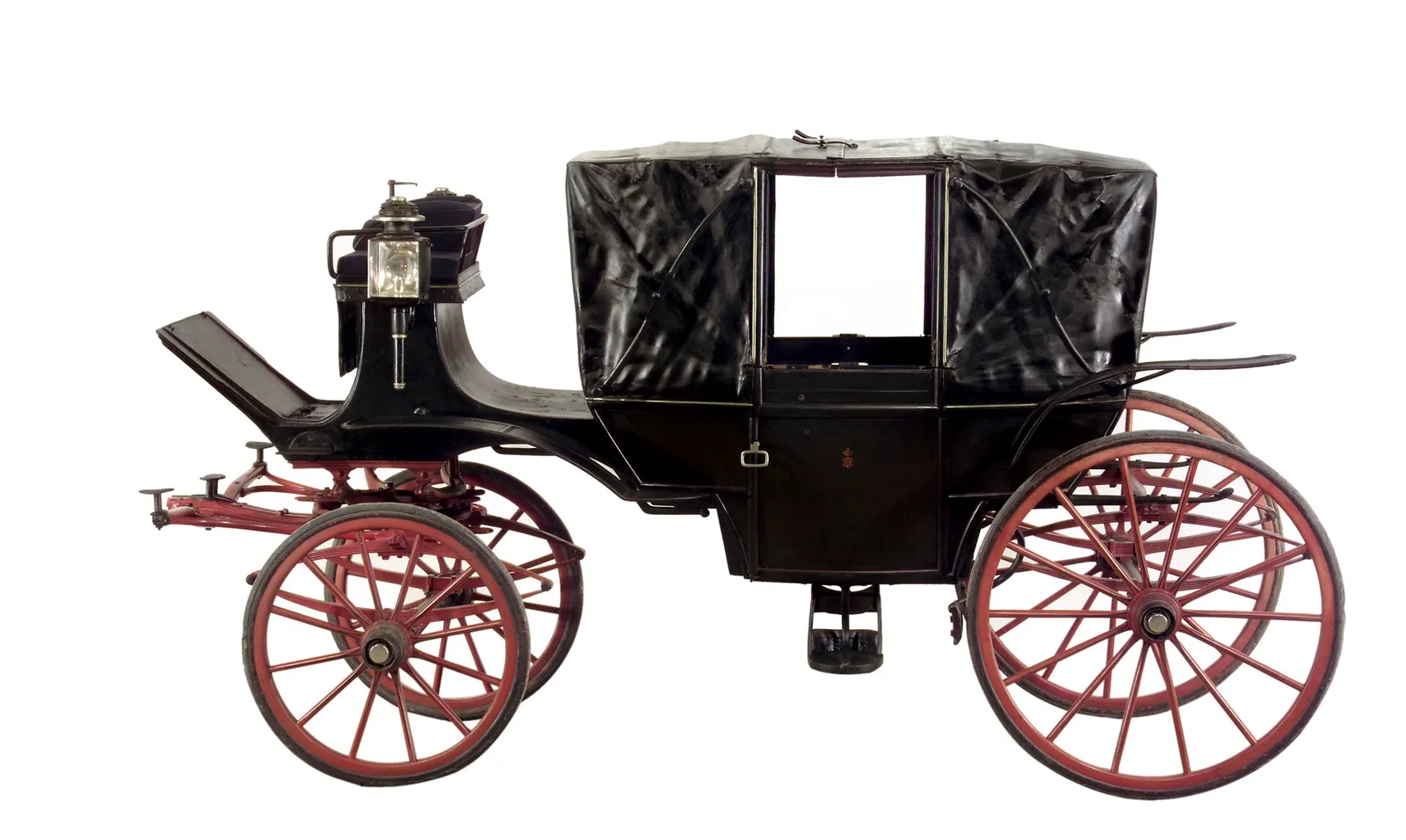
At a glance
- Shortly after 5 pm on Saturday 1 February 1908, gunmen opened fire on the open carriage carrying Portugal's royal family across the Terreiro do Paço in Lisbon, as it turned into the Rua do Arsenal.
- King Carlos I was killed by two bullets in the back, and Crown Prince Luís Filipe by bullets to the chest and the left cheek. Infante Manuel, 18, was hit in the arm. Queen Amélia was unhurt.
- The gunmen were Manuel Buíça, a primary school teacher and former cavalry sergeant, and Alfredo Costa, a former shop worker and small publisher, both members of the republican secret society called the Carbonária. Police killed both on the spot, and an innocent passer-by, João Sabino da Costa.
- The king had backed João Franco, who ruled without parliament from May 1907. Within days of the killings Franco was gone, his decrees were annulled and the republicans arrested after a failed rising on 28 January were free.
- The judicial case file later disappeared, and historians still disagree over whether the two men acted alone or for a wider conspiracy. The monarchy lasted 32 more months.
A man in a long cloak
The carriage left the river station slowly. Infante Manuel, the king's younger son, had gone down to the quay to meet his parents and his brother, and now he sat with them in an open landau while his mother told him how their train had come off the rails on the way from the Alentejo. It was a little after five on the afternoon of Saturday 1 February 1908.
They were crossing the Terreiro do Paço, also called the Praça do Comércio, the great arcaded square on the river that English residents called Black Horse Square. There was no crowd at the far corner, where the road turns into the Rua do Arsenal.
“I was looking towards the statue of Dom José and saw a man with a black beard, in a big cloak. I saw that man open the cloak and take out a carbine. I was so far from thinking of a horror like this that I said to myself, knowing how inflamed everything was, “what a bad joke”.”
Within a minute or two his father and his brother were dead. The man with the beard was Manuel Buíça, a primary school teacher. A second gunman, Alfredo Costa, ran out from under the arcades and fired a pistol into the carriage at point-blank range. Police killed both gunmen within minutes, and an innocent passer-by.
A king, a dictator and a failed rising
Portugal was a constitutional monarchy, and Carlos I had reigned since October 1889. In January 1890 he gave way to a British ultimatum over Africa, and in 1891 the state went partly bankrupt. The census of 1900 had counted 5.4 million people in Portugal, and that of 1911 would count almost 6 million. Most of them were poor, and many in Lisbon saw their stout, cigar-smoking king as a symbol of waste.
In May 1906 Carlos broke the rotation and made João Franco prime minister, although Franco had no majority of his own. When the Progressistas withdrew their support in the spring of 1907, the king dissolved parliament without calling elections, and Franco ruled by decree. Contemporaries called it a dictatorship. In an interview with the Paris daily Le Temps in November 1907, the king backed Franco and mocked the old parties.
On 28 January 1908 republicans, the Carbonária and a breakaway monarchist faction tried to overthrow Franco and failed, a story told in our article on the Elevador da Biblioteca coup. Franco answered with a decree, signed by the king at Vila Viçosa and published on 31 January, that let the government send people judged a danger to the state into exile or to the colonies.
The royal family had spent almost all of January at Vila Viçosa, where Carlos liked to hunt. According to Jorge Couto, then director of the National Library, the king came back to show that he did not fear the republicans, and asked for an open landau instead of his usual motor cars.
A teacher and a travelling salesman
Manuel Buíça came from the north. He was a primary school teacher, a former cavalry sergeant and a widower with two young children. The writer Aquilino Ribeiro, then a young republican conspirator who knew him, remembered a sociable, hot-tempered man with a black beard, a regular at the Café Gelo in the Rossio, whose back room was a meeting place for revolutionaries.
Alfredo Luís da Costa came from the south. He had been a shop worker and a commercial traveller, presided over the Lisbon association of commerce employees and spent his savings on a small publishing house that printed pamphlets against the regime. In 1906 he said that crushing the oppressor in a justified impulse of revolt was a duty for everyone.
Both belonged to a Masonic lodge and to the Carbonária, and both had contacts among the republican leaders. On the night of 28 January they led a group of about twenty armed men who came under fire from the Municipal Guard while waiting for the signal to rise.
On the morning of 1 February, by Aquilino's account, Costa came to the attic where the writer was hiding from the police. A member of the republicans' military committee had told him the troops would not move while Franco was at large, so he had a group of five ready to wait for the dictator: himself, Buíça, a young wine-warehouse worker called Domingos Ribeiro and two customs guards Franco had dismissed. Buíça already had his carbine. If they missed Franco in the street, Costa said, they would find him at the Terreiro do Paço that afternoon, meeting the royal family.
A late train and an open carriage
The king, the queen and the crown prince left Vila Viçosa by train for Barreiro, the railhead on the south bank of the Tagus. Barata describes a tense, silent journey; the king, who usually played and joked with his suite on the way, hardly said a word. Near Casa Branca the train ran off the rails, which delayed it badly.
At the river station in Lisbon, the royal family was expected off the Barreiro steamer at a quarter past four. Guilherme Pinto Basto, a friend of the king who had left his office to meet them, found that because of the derailment the boat would be about 35 minutes late. He chatted with Infante Manuel and the king's brother, Infante Afonso, while they waited.
Aquilino has the five conspirators in the square by then, after waiting in vain for Franco in the Rua Alexandre Herculano: Costa near the landing stage, Buíça by a lamp post on the north side, the others strolling under the western arcades. Franco, Aquilino says, slipped in unseen through the gate of the Navy Arsenal.
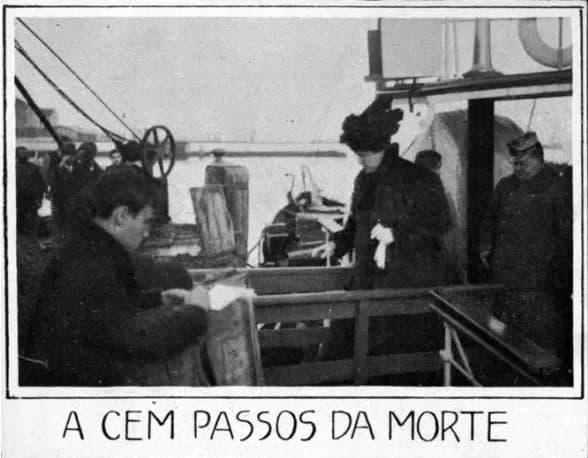
The steamer came alongside at about five. Queen Amélia stepped ashore first, and a godchild gave her a bouquet of flowers. The family walked slowly through the station, stopping to talk, then all four climbed into an open landau drawn by two pairs of horses, the front pair ridden by a postilion. The driver kept to a walk so that the carriage of attendants could catch up, but it had not yet reached the square.
So the royal carriage crossed the square alone. Pinto Basto, walking about forty paces behind it, could see nobody between him and the landau but the king's adjutant, Francisco Figueira, and two small boys running after it. There were policemen about, but they let people go where they liked.
Five and twenty past five
Aquilino's reconstruction, from what a conspirator told him, gives the last exchange. Seeing the royal carriages pass without Franco, Costa overtook the slow landau, reached Buíça and asked whether they should finish off the whole lot. Buíça stepped away from the lamp post: “Vamos a eles!”, let's go for them.
Pinto Basto heard the first shot at about 5.25, just as the front horses began to turn into the Rua do Arsenal by the telegraph office. Buíça had stepped off the pavement behind and to the left of the carriage and was firing his carbine, a repeating rifle that could fire seven or eight shots in quick succession. Costa ran at the landau from behind, jumped onto the step and fired his pistol at the king's back.
“I saw the poor King, however, put his hands to the back of his neck: then they dropped down, and at the same time his head fell forward on his chest. I saw at once that he had been shot dead instantly.”
Queen Amélia stood up in the carriage and struck at the arm of the man firing from behind with the only thing in her hands, the bouquet. Luís Filipe, who sat facing his father, drew a Belgian automatic pistol and stood to fire back. His attendant had loaded it with six cartridges that morning at Vila Viçosa, and two were left when it was found in the carriage, so he probably fired four shots before he was hit in the chest and in the left cheek. Pinto Basto believed it was the prince who brought Costa down.
The coachman and the postilion whipped the horses into the Rua do Arsenal. Manuel, by his own account, was hit in the upper right arm after the turn, a blow that felt like a whipcrack. He looked down at his brother, slumped to one side with blood pouring from a huge wound in his face, and pressed a handkerchief to it. The handkerchief, he wrote, was soaked at once.
Behind them the square was in chaos. Pinto Basto counted thirty or forty shots and saw at least one more man firing at the carriage from further off. Francisco Figueira went at Buíça with his sword and took a bullet in the leg. One policeman covered Pinto Basto with a revolver until he raised his arms and shouted that he was the king's friend.
Both gunmen were killed by the police within minutes, and so was João Sabino da Costa, a goldsmith's journeyman who had nothing to do with the plot. Aquilino says the police fired blindly, killing a passer-by he describes as a 17-year-old shop boy and wounding several others. Policemen fired into Costa as they dragged him to their station.
- Date and time
- Saturday 1 February 1908, about 5.25 pm by one eyewitness's account
- Place
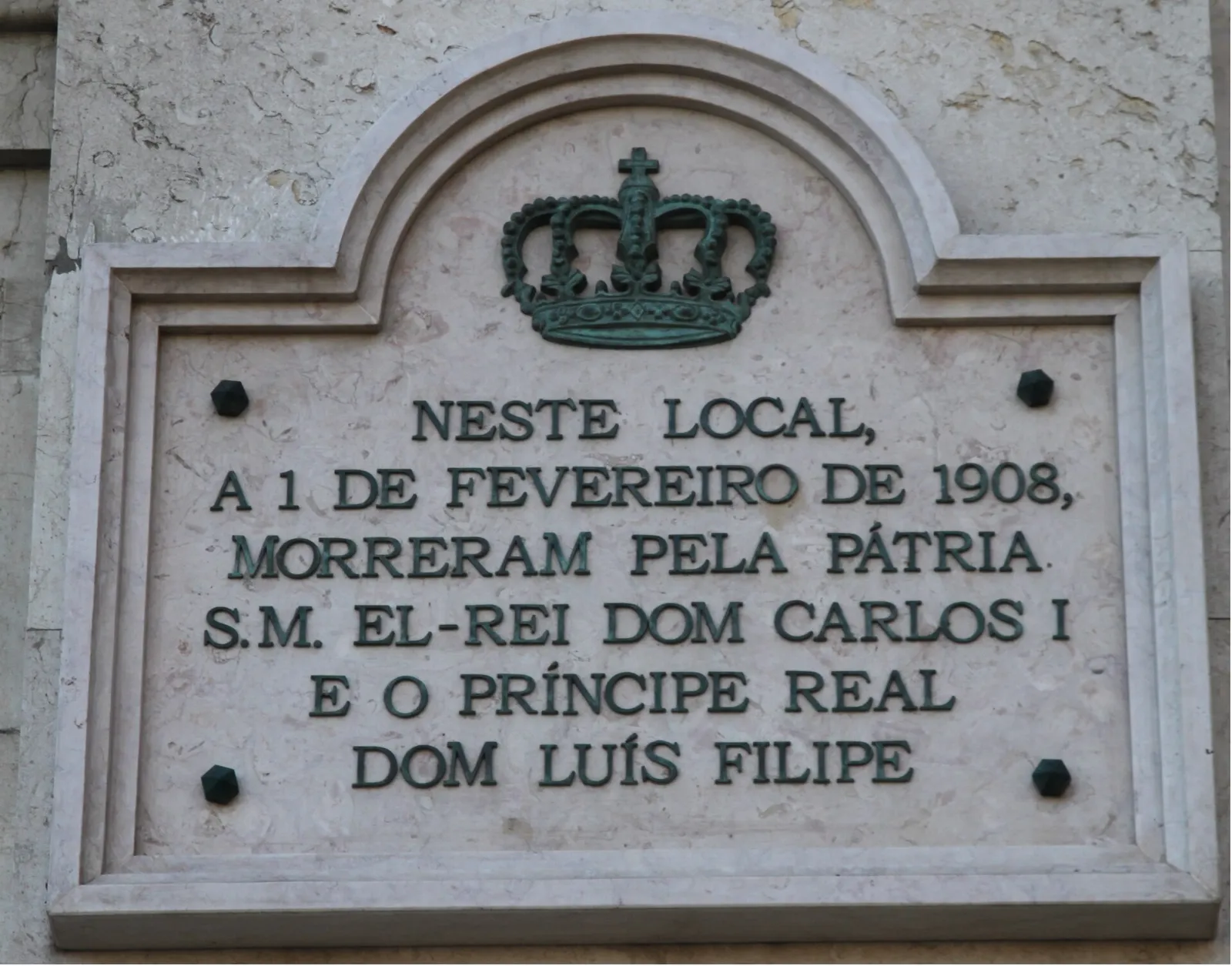
- Western corner of the Terreiro do Paço, where it meets the Rua do Arsenal, Lisbon
- Killed
- King Carlos I and Crown Prince Luís Filipe
- Wounded
- Infante Manuel, 18 (right arm); the king's adjutant Francisco Figueira (leg)
- Gunmen
- Manuel Buíça (carbine) and Alfredo Costa (pistol), both killed by police
- Bystander killed
- João Sabino da Costa, a goldsmith's journeyman
In the Navy Arsenal
Nobody knew where to take the carriage. Manuel recalled talk of the hospital at Estrela; Pinto Basto, running behind, saw the coachman look back as he passed the gate of the Navy Arsenal and shouted to him to turn in, because there was an ambulance room inside. Pinto Basto and four others lifted out the crown prince first, because someone thought he was still alive, then the king.
A Dr Moreira certified both deaths. Dr Bossa, who Manuel thought was the first doctor to arrive, told him days later that when he first struck a match the pupils still contracted, and when he tried again there was no sign of life left. Bossa then dressed Manuel's arm. Queen Maria Pia, the king's mother, came to the Arsenal but did not go into the room where her son lay.
Charles Page Bryan, the American minister, reached the Arsenal soon after and saw the two bodies. The two queens and Manuel were hurried away under heavy guard. That evening the dead, dressed again and covered with the national flag, were driven to the Necessidades palace with their chamberlains seated beside them.
There was no formal autopsy: the Minister of Justice decided it was not needed, since the gunmen were dead and there would be no trial. Before the embalming began on 2 February, the royal physicians examined the king. Two bullets had entered his back. One broke his spine at the base of the neck and came out under his chin; the other lodged in his right lung.
A new king, a new government and a quiet funeral
Manuel, aged 18, was proclaimed king at three o'clock the next afternoon. That day he sent for Franco and asked him not to stand in the way of a new government. Franco resigned and three days later left for Spain, Italy and France. Part of the political class blamed him for his intransigence and for failing to protect the royal family.
On 4 February Rear-Admiral Ferreira do Amaral formed a cabinet of the two old parties and independents, known as the government of acalmação, or appeasement. It restored press freedom, released the republican leaders, amnestied the sailors of the naval revolts of 1906 and annulled Franco's decrees, the deportation decree among them.
Foreign newspapers ran the story on their front pages, but in Lisbon the killings caused more astonishment than grief. The funeral was held on 8 February, and father and son were laid in the royal pantheon of the Braganzas at the monastery of São Vicente de Fora. The daily papers reported 20,000 to 40,000 people coming there to see the bodies. Twenty-five years later they were moved into a marble tomb in the church.
Couto notes that photographs of the funeral show official pomp but no great crowds. The British minister, Sir Francis Villiers, reported the absolute indifference of the people, mingled in some cases with satisfaction.
“Although crowds gathered to witness the funeral cortege ... hardly a hat was raised when the biers passed by ... and the usual avocations of the people have suffered no interruption.”
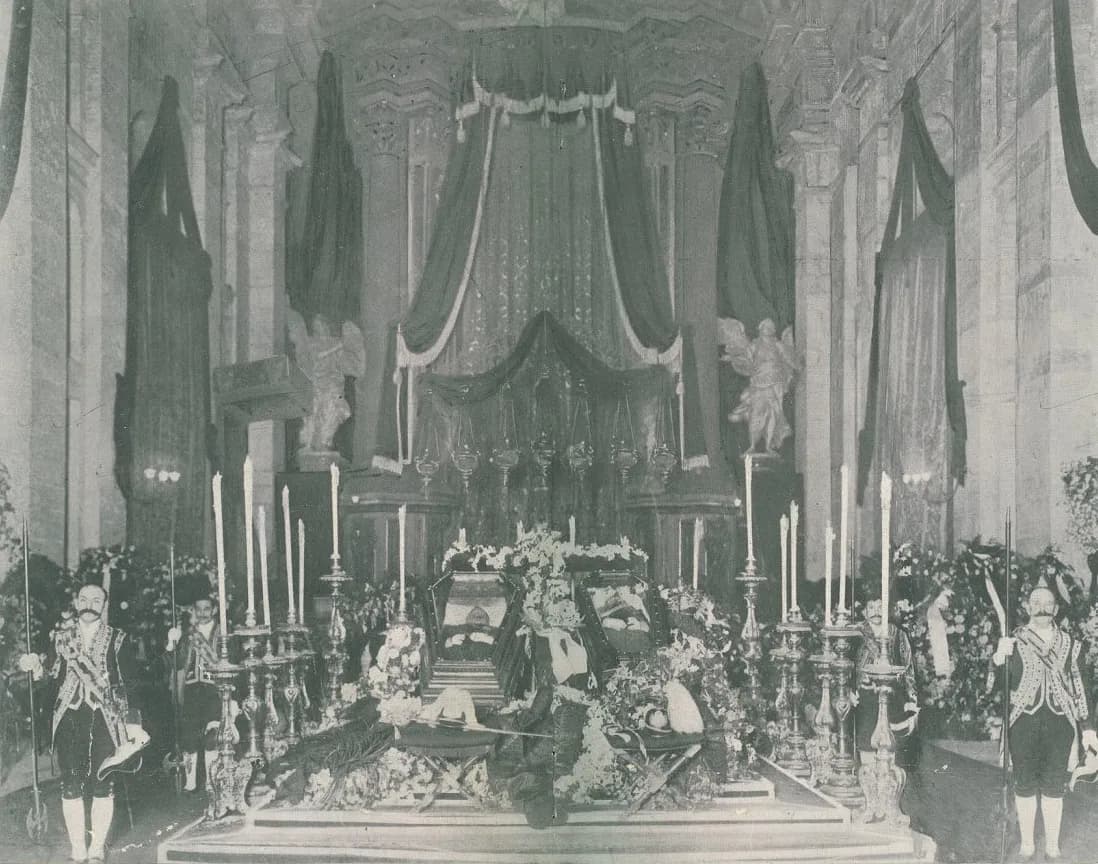
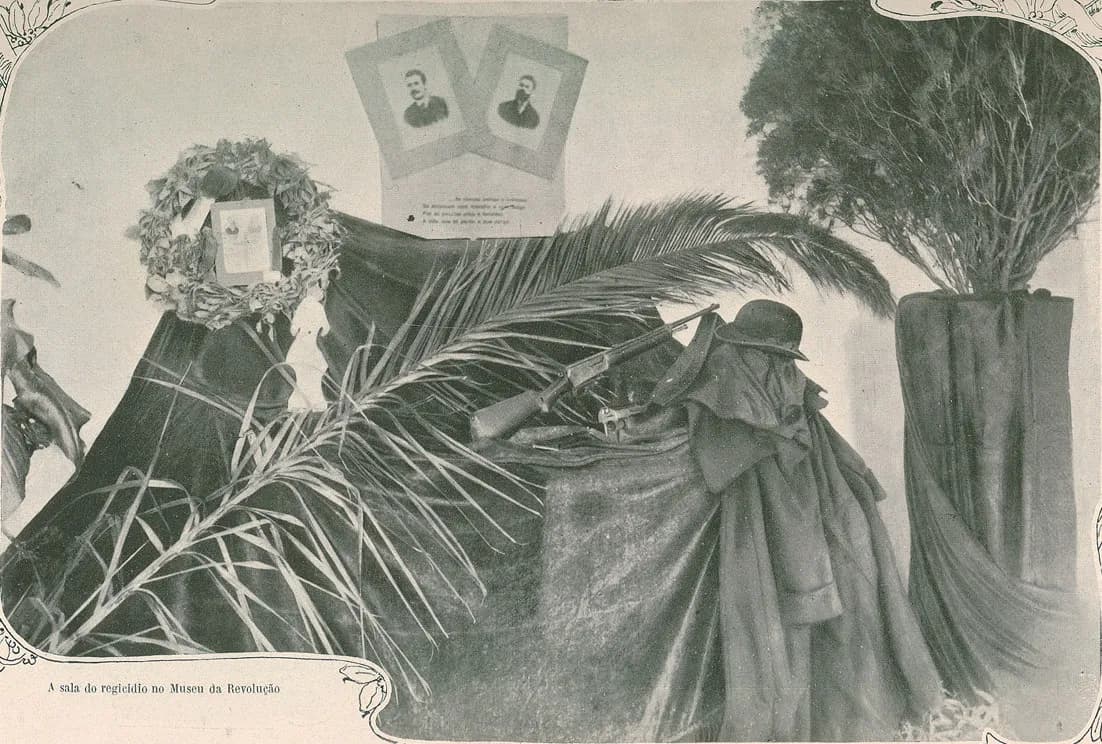
The gunmen drew more visitors. Many people went to the morgue to see their bodies, their graves were covered in flowers, and their portraits were sold in the streets and shown in the shop windows of the Baixa. The republican press raised a subscription for Buíça's orphaned children. A pilgrimage to the regicides' graves at the Alto de São João cemetery, organised by the Associação do Registo Civil, drew about 80,000 people according to sources of the time, and the monarchist and republican papers argued over it.
The republican poet Guerra Junqueiro wrote to the Porto paper A Voz Pública to deny reports that he had condemned the attack. He called the king a monster and the killers heroes.
“They did not kill the King: he killed himself. ... The Republican Party neither organised nor advised the attack. The attack was the work of two men alone. And yet the bullets of death came from the soul of the nation.”
What the investigations found
A judicial case was opened, but the gunmen were dead, so there was no trial to prepare for, and the contents of the case file later vanished. The historian Reto Monico points out that the new governments showed little interest in the truth: the word of the day was acalmação, and a thorough investigation might have implicated politicians now in power.
The Swiss daily Basler Nachrichten wrote on 9 February that the official inquiry had revealed nothing, perhaps because the ruling parties feared being compromised. Bryan, the American minister, wrote on 3 February that the killers seemed to have acted as their own agents, moved by anger at the deportation decree, and not as the tools of any organisation.
Other evidence points to more people. Pinto Basto saw a third man firing, and Monico notes talk of at least four men in the square. Aquilino names five conspirators. The British minister later described José Maria de Alpoim, leader of the breakaway monarchist faction, as implicated by his own admission in the conspiracy that preceded the killings. Couto writes that once the king's return was announced, some republican leaders and the Carbonária quickly planned an attack, and that the Viscount of Ribeira Brava undertook to buy the rifles.
Historians still split two ways, Monico writes: some see the regicide as the isolated act of Buíça and Costa, others as a conspiracy of the Republican Party and the monarchist opposition. Rui Ramos argues the killers hit exactly whom they meant to, because a new Franco could always be found, but not a new king.
| Account | King Carlos | Crown Prince Luís Filipe |
|---|---|---|
| Manuel II, written account, 1908 | Buíça opened fire first; a man who ran from the arcade then fired point-blank, hitting him in the back and the nape | Found with a huge wound in the left side of his face |
| Guilherme Pinto Basto, eyewitness, 1908 | Fired on from behind by a man following the carriage, though later in his statement he says the king was shot by the man with the carbine | Fired on by the man with the carbine; hit in the right side of the chest and the left cheek |
| Medical report on the king, 2 February 1908 | Two bullets, both entering the back | Not examined in the report quoted |
| Aquilino Ribeiro, memoir published 1974 | Fell under Buíça's bullets | Shot point-blank by Costa |
| Reto Monico, 2016 | Buíça fired the fatal shots with his Winchester carbine; Costa fired at least two pistol shots from the step | Killed in the same attack |
Aquilino wrote from what a conspirator and others told him, decades later. Pinto Basto walked about forty paces behind the carriage. Manuel sat in it but says he remembered little after the first shots.
Why it still matters
28 January 1908
Failed republican rising in Lisbon
About 120 people detained.
31 January 1908
Deportation decree published
Signed by the king at Vila Viçosa.
1 February 1908, about 5 pm
The royal family lands at the Terreiro do Paço
Late, after a derailment near Casa Branca.
1 February 1908, about 5.25 pm
Carlos I and Luís Filipe shot dead
2 February 1908
Manuel II proclaimed king
Embalming of the bodies begins at the Necessidades palace.
4 February 1908
Ferreira do Amaral's government of appeasement
Franco's decrees annulled, prisoners freed.
8 February 1908
Funeral of the king and the crown prince
5 April 1908
General election
The republicans grow to seven deputies.
1 November 1908
Republicans win every seat on Lisbon's city council
5 October 1910
The Republic is proclaimed
The killings did not set off the revolution some conspirators had hoped for; on 3 February the American minister cabled that perfect calm prevailed. But, as Jorge Couto puts it, they ended Franco's dictatorship and the king's personal role in politics in a crime. The government of appeasement freed the republican leaders and let them honour the killers in public, while the monarchist parties went back to their quarrels.
Portugal had three governments in 1908 alone, and the monarchy lasted only 32 more months, through six governments. The republicans, weak in the countryside, took Lisbon: its seats in the April election and every seat on its council in November. On 5 October 1910 the Republic was proclaimed from the balcony of Lisbon's town hall, and Manuel II went into exile.
In the years that followed, the republicans honoured Buíça and Costa as great patriots. Political murder did not end with the monarchy: in December 1918 a gunman shot President Sidónio Pais dead at Lisbon's Rossio station.
FAQs
What was the Lisbon regicide?
The killing of King Carlos I of Portugal and his heir, Crown Prince Luís Filipe, on 1 February 1908. Two gunmen fired on the open royal carriage as it crossed the Terreiro do Paço in Lisbon on the family's return from Vila Viçosa. The younger son, Manuel, was wounded and became King Manuel II.
Who killed King Carlos I?
Manuel Buíça, a primary school teacher and former cavalry sergeant armed with a carbine, and Alfredo Costa, a former shop worker and publisher armed with a pistol. Both belonged to the Carbonária, a republican secret society. Police shot both dead at the scene. Accounts differ on which of them fired the fatal shots at the king and at his son.
Did the Republican Party order the regicide?
It has never been proved either way. The gunmen were killed on the spot and the contents of the case file disappeared. Republicans such as the poet Guerra Junqueiro insisted at the time that the party had neither organised nor advised the attack, and Aquilino Ribeiro's memoir says the gunmen were waiting for the prime minister, João Franco, and turned on the king when Franco eluded them. Other historians, such as Rui Ramos, argue the king was the intended target and that some political leaders knew of the plans.
How did Queen Amélia survive?
She was not hit. Eyewitnesses say she stood up in the carriage and struck at one of the gunmen with the bouquet she had been given on landing, then tried to shield her sons. Her younger son, Manuel, survived with a wound to his upper right arm.
Where is the regicide carriage today?
In the Museu Nacional dos Coches, the National Coach Museum, in Belém, Lisbon, where it went back on display in 2019. A 2016 agreement lets it move between the museum and the ducal palace at Vila Viçosa. The bullet marks from 1 February 1908 are still visible on it.
On the timeline
Open the timelineNearby moments from regeneration and the last kings (1851–1910).
Miguel Torga (Adolfo Correia da Rocha), doctor and writer regarded as one of the greatest Portuguese authors of the twentieth century, is born in São Martinho de Anta, Trás-os-Montes.
Hermínia Silva, the fado singer and revue actress whose humorous style made her one of the most beloved performers of Lisbon's stage in the 1930s and 1940s, is born at the Hospital de São José in Lisbon.
Republicans and dissident monarchists attempt a coup against João Franco's dictatorship, the 'Elevador da Biblioteca' plot, but it is betrayed and leaders including Afonso Costa are arrested. The crackdown that followed helped set the stage for the regicide four days later.
The Lisbon regicide of 1908
King Carlos I and Crown Prince Luís Filipe are assassinated by republican revolutionaries at Terreiro do Paço in Lisbon, in what became known as the Lisbon Regicide.
Manuel II takes his oath before the Cortes in Lisbon at his formal acclamation as King of Portugal, three months after inheriting the throne through the assassination of his father Carlos I and elder brother Luís Filipe. He would be Portugal's last king.
Birth in Funchal of Fernão de Ornelas, the lawyer who as president of the city council from 1935 to 1946 led a sweeping programme of public works that modernised Madeira's capital. Ousted after a clash with the island's governor, he was posthumously awarded Funchal's Medal of Honour in 2008.
An earthquake centred near Benavente strikes the Tagus valley at about 5 pm, wrecking much of Benavente, Samora Correia, Santo Estêvão and Salvaterra de Magos and killing 46 or 47 people. Aid poured in from across the country, but in 1913 Benavente still had a camp of wooden huts.
Coming up in history
All long reads 3 February 1488Bartolomeu Dias passes the Cape unseen and lands at Mossel Bay, 1488
 4 February 1961The night Luanda's prisons were attacked: 4 February 1961
 5 February 1570Gaspar da Cruz, the plague friar who wrote Europe's first book on China
 6 February 1608António Vieira: the Lisbon-born Jesuit who preached to the fish
16 sources
Archives, scholarship and reporting this article was checked against.
- 1
The Tragedy of Lisbon: graphic account, incidents and details of the King's death. Statement made by Senhor Guilherme Pinto BastoBritish Historical Society of Portugal, 24th Annual Report and Review (1997), reprinting The Standard of 18 February 1908
- 2
Uma nosografia de D. Carlos I no centenário do regicídio (José Barata)Medicina Interna: Revista da Sociedade Portuguesa de Medicina Interna, vol. 15, no. 2 (2008), pp. 141–145
- 3
1908: do Regicídio à ascensão do Republicanismo (exhibition catalogue, with an essay by Jorge Couto and a chronology of January 1908)Biblioteca Nacional de Portugal, 2008
- 4
A tragédia do Terreiro do Paço na imprensa rio-grandina (fevereiro de 1908), by Reto MonicoHistoriæ (Universidade Federal do Rio Grande), vol. 7, no. 1 (2016), pp. 175–202
- 5
O atentado de 1 de Fevereiro de 1908 (Regicídio) na versão de Aquilino Ribeiro, extracts from Um Escritor Confessa-se (1974)Associação República e Laicidade
- 6
Minister Bryan to the Secretary of State, Lisbon, 3 February 1908 (No. 374)Office of the Historian, US Department of State: Papers Relating to the Foreign Relations of the United States, 1908, document 669
- 7
Sir Francis Villiers and the End of the Portuguese Monarchy (John Villiers)The Treaty of Windsor (1386) and 620 Years of Anglo-Portuguese Relations, papers of a conference held at St Peter's College, Oxford, 18 October 2006
- 8
O Regicídio na Imprensa Suíça, by Reto MónicoCaleidoscópio: Revista de Comunicação e Cultura, no. 5/6 (2005), Universidade Lusófona
- 9
1900 - 1 de Dezembro (IV Recenseamento Geral da População)Instituto Nacional de Estatística, Censos em Portugal de 1864 a 2001
- 10
- 11Luís Filipe de Bragança, o herdeiro que reinou por minutos e que a história esqueceu (Sâmia Fiates)Observador, 7 September 2025
- 12
- 13
São Vicente de Fora na História: documentos do Arquivo Histórico do Patriarcado de LisboaAgência Ecclesia, 13 July 2010
- 14
José Relvas: um político republicano, by Vítor NetoRevista de História das Ideias, vol. 34 (2016), Universidade de Coimbra
- 15Sidónio, 100 anos depois do Presidente-Rei, by Rui RamosObservador, 8 December 2017
- 16O Landau do Regicídio voltou para o Museu dos Coches (Rita Cipriano)Observador, 29 November 2019
Image credits
- The landau in which King Carlos and Crown Prince Luís Filipe were shot, photographed by the Museu Nacional dos Coches with its hoods raised. On 1 February 1908 it was driven open, and bullet marks are still visible on it. Museu Nacional dos Coches, CC0, via Wikimedia Commons.
- The royal party landing from the Barreiro steamer at the Terreiro do Paço on 1 February 1908, minutes before the attack. Illustração Portugueza printed it under the title “A cem passos da morte”, a hundred paces from death. Illustração Portugueza, Public domain, via Wikimedia Commons.
- The coffins of King Carlos and Crown Prince Luís Filipe lying in state before the funeral of 8 February 1908, in a photograph published by Ilustração Portuguesa on 17 February. Unknown author, Public domain, via Wikimedia Commons.
- The regicide room of the Museu da Revolução in Lisbon, photographed by Joshua Benoliel for Ilustração Portuguesa of 9 January 1911, three months after the Republic. It showed Buíça's cloak and carbine and Costa's revolver beneath portraits of the two men. Joshua Benoliel, Public domain, via Wikimedia Commons.
- The plaque on the Terreiro do Paço. It reads: “On this spot, on 1 February 1908, His Majesty King Dom Carlos I and the Prince Royal Dom Luís Filipe died for the fatherland.” Photographed in 2011. João Carvalho, CC BY-SA 3.0, via Wikimedia Commons.