

Gaspar da Cruz, the plague friar who wrote Europe's first book on China
Gaspar da Cruz spent a few weeks in Canton in the winter of 1556 and turned them into what historians call the first book printed in Europe about China alone. He died of plague at Setúbal on 5 February 1570, a fortnight before the printer in Évora finished it.
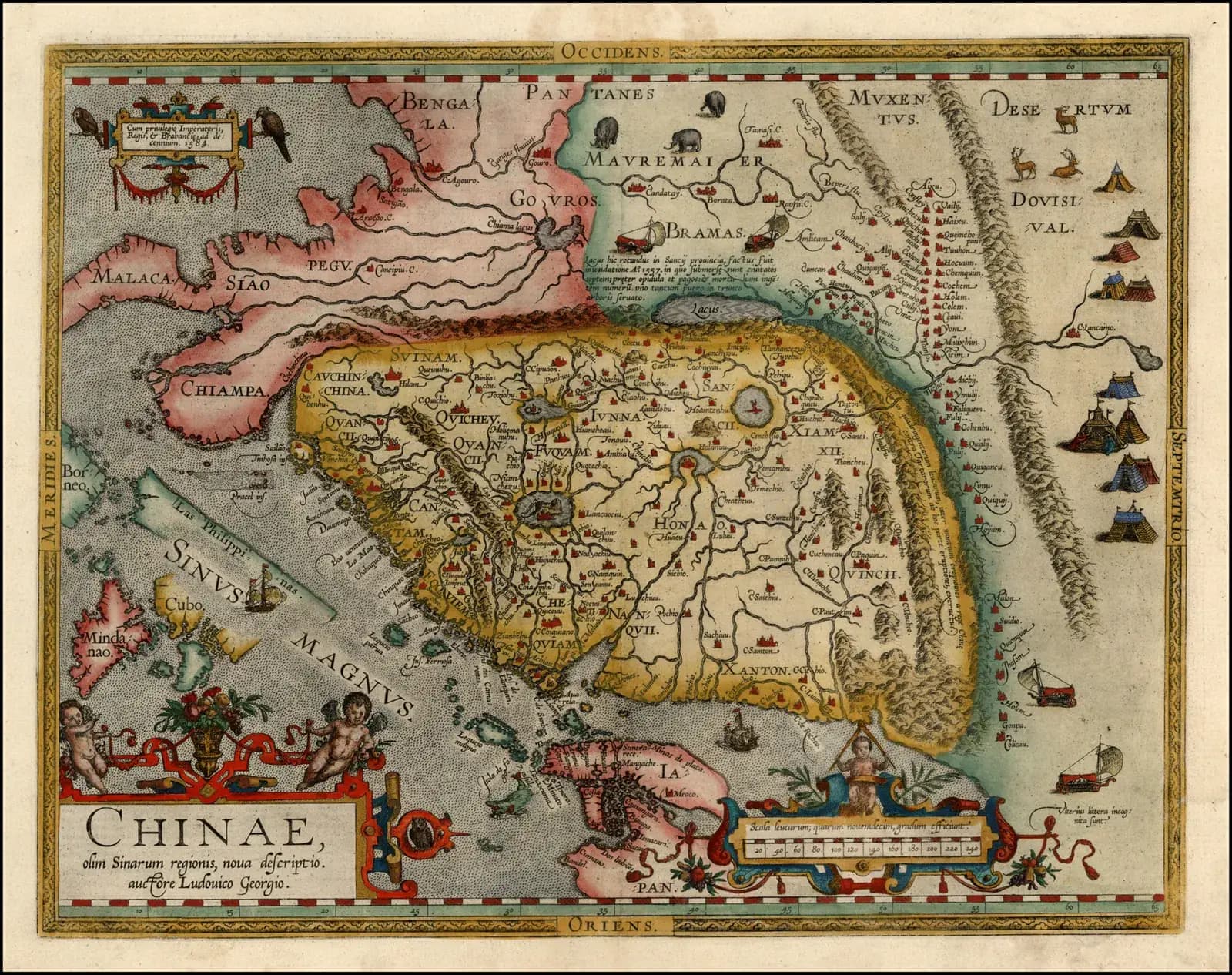
At a glance
- Gaspar da Cruz, a Dominican friar probably born in Évora around 1520, sailed for India in 1548 and worked in Goa, Malacca, Cambodia and Hormuz.
- In December 1556 he spent a few weeks in Canton (Guangzhou), long enough to see its streets, courts, prisons and banquets, but he was not allowed to stay and preach.
- His Tractado das cousas da China, printed by André de Burgos in Évora, is described by historians as the first book printed in Europe devoted entirely to China; its 29 chapters describe tea, chopsticks, foot binding, printing, the mandarins and Chinese justice.
- Cruz nursed and confessed the sick during Lisbon's great plague of 1569, carried on at Setúbal and died there of the disease on 5 February 1570.
- The title page is dated 1569, but the colophon says the printing was finished on 20 February 1570, two weeks after his death.
Two weeks too late
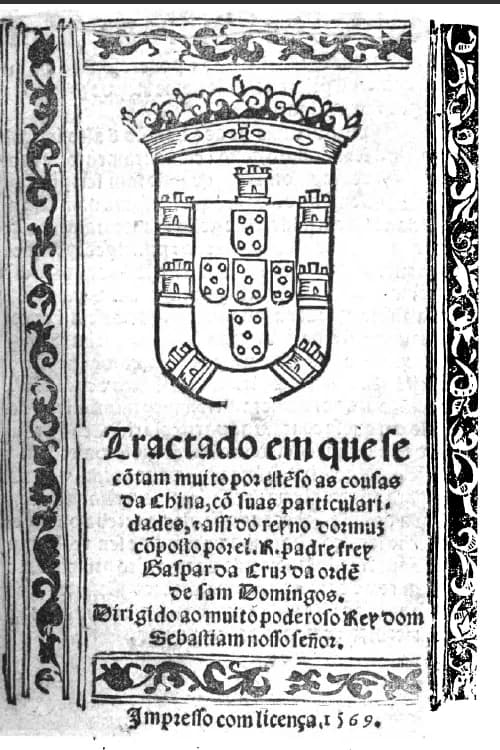
On 20 February 1570, in the house of André de Burgos in Évora, the last sheet of a short book on China was printed. Burgos, a Granada-born printer who had worked in the city since the early 1550s, signed himself printer and knight of the household of the Cardinal Infante, Henrique. He closed the book with the usual printer's note giving the place and the day.
“This treatise of China was printed in the very noble and ever loyal city of Évora, in the house of André de Burgos, printer and knight of the household of the Cardinal Infante. It was finished on the twentieth day of February, one thousand five hundred and seventy.”
The author never held a copy. Gaspar da Cruz, a Dominican friar who had spent many years in the East, had died fifteen days earlier at Setúbal, south of Lisbon. He had caught the plague while caring for its victims, first in Lisbon during the epidemic of 1569 and then at Setúbal.
Historians count his book as the first printed in Europe that dealt with China and nothing else. Marco Polo had described Cathay long before, but as one marvel among many in the East. Cruz wrote about one country, from what he had seen himself in a few weeks at Canton and from the reports of Portuguese who had been prisoners inside China.
Even its date is split. The title page says 1569, the colophon February 1570, so catalogues usually give both. The book was dedicated to King Sebastião, who had turned sixteen that January.
Portugal at the edge of Ming China
Portuguese ships had been trading on the south China coast since about 1513. China was then ruled by the Ming dynasty, which forbade its own subjects to sail abroad. Cruz explained the ban to his readers as the decision of an emperor long before, who saw his kingdom decaying while his men chased conquests overseas.
“he with-drew himselfe with his men to his owne Kingdome, making a publike Edict under paine of death that none of the Countrey should sayle out of the Kingdome of China: the which lasteth to this day.”
So the Portuguese traded where they could, often in partnership with Chinese merchants and with the connivance of provincial officials, and sometimes at a high price. In 1549 Chinese forces seized two junks belonging to the merchant Diogo Pereira, and their crews were taken inland as prisoners. Some of them later wrote or told what they had seen, and those reports became a main source for Cruz's book.
By the time Cruz arrived the trade was moving to safer ground. Portuguese merchants settled on the Macau peninsula in the mid-1550s with the consent of Chinese officials; sources give 1553, 1554 or 1557 for the start.
From Évora to the court of Cambodia
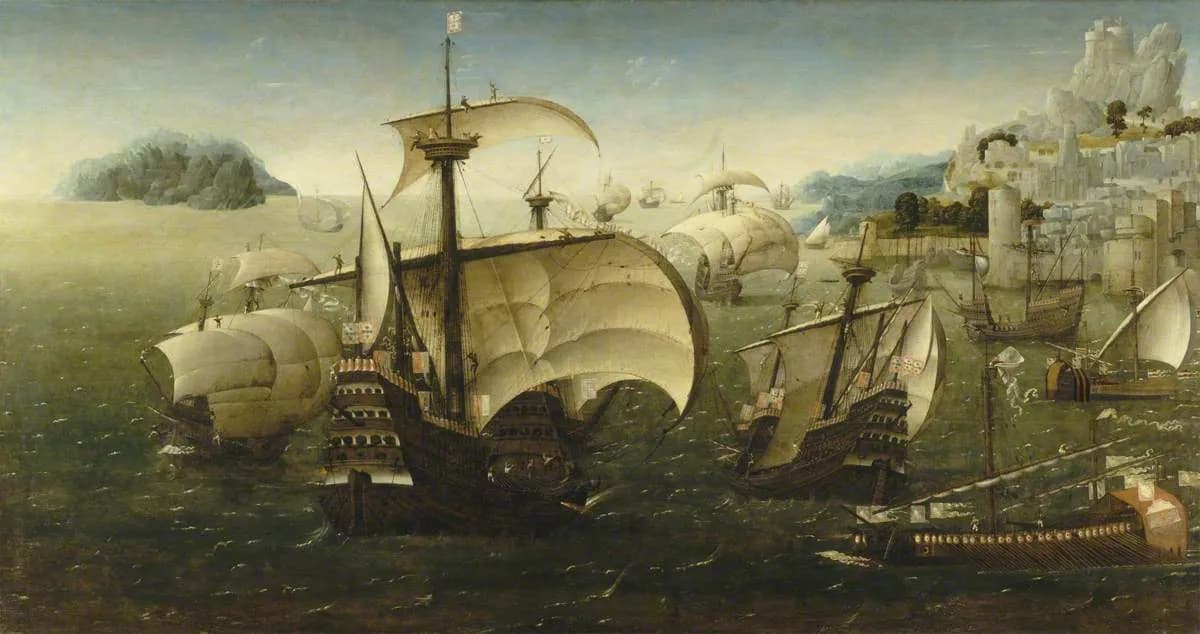
Almost nothing is known of Cruz's early life. He was probably born in Évora around 1520 and became a friar of the Dominicans, the Order of Preachers, at their convent in Azeitão, near Setúbal. In 1548 he sailed for India as one of twelve missionaries led by the Castilian Diego Bermúdez, superior of the convent of São Domingos in Lisbon. King João III and the order had agreed to plant Dominican houses in the East, and this was the group sent to do it.
Cruz helped found the convent in Goa and houses at Chaul and Cochin, and visited Ceylon. Then he went to Malacca, the Portuguese port on the strait between Sumatra and the Malay peninsula, to start another convent there. The Dominican chronicler João dos Santos later remembered him as a man of great virtue and a good preacher.
In September 1555 he left Malacca for Cambodia, where he had heard there was a great opening for the Gospel. He found the opposite. The king did nothing without consulting Brahmins and diviners, the monks held the people's loyalty, and the Portuguese there quarrelled among themselves. In his own telling, the king's first question was whether Cruz was a witch.
After about a year, ill and with a single baptism to show for it, he gave up. People told him “many things of China, and the people of it to have a disposition to Christianitie, and that they loved reason”. He took passage on a Chinese ship then in Cambodia, whose crew gave him the best room on board and charged him nothing.
A few weeks in Canton
By December 1556 Cruz was on the China coast, and he went up the Pearl River to Canton (Guangzhou), the capital of Guangdong province. The mandarins, the officials who ran the province, did not allow Portuguese to stay long in the city, and Chinese were forbidden to lodge them. His stay was short: Francisco Roque de Oliveira, who has studied the book closely, puts it at five or six weeks.
He used the time well. He walked the city, saw an official deal with a woman's petition, and went with other Portuguese to the house of a senior provincial official, the ponchasi, to bargain for the release of Portuguese prisoners with eight ounces of ambergris. Portuguese friends took him to see a banquet a rich merchant gave, with tables set in three parts of the house and fruit piled in little towers. He questioned an old Chinese man, a Venetian merchant who had come in on a Portuguese ship, and a lord from Persia.
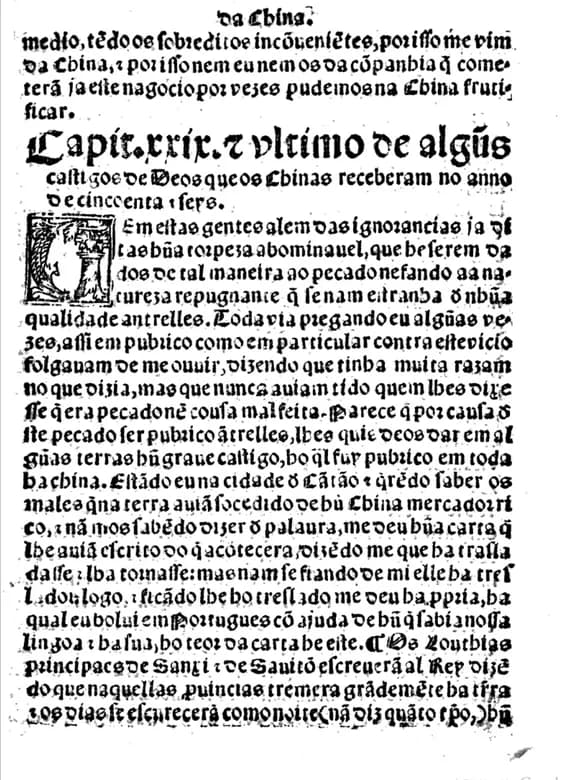
One rich merchant, asked about recent disasters in the interior, could not explain them in words and handed him a letter instead. Cruz had it translated into Portuguese with the help of an interpreter and put it in his book as its final chapter: a report to the emperor of earthquakes, storms and days that turned dark as night in inland provinces in 1555 or 1556.
He also preached, in public and in private conversation, and once tested his welcome too far. In a temple he knocked over the stones on an altar. The worshippers ran at him, angry. He answered, smiling, that men who could see and walk should not worship stones, and he says they agreed with him and left the temple with him. The Chinese seem to have taken him for an eccentric rather than a threat.
No Chinese dared convert without the mandarins' leave, and preaching freely would need a licence from the emperor himself. Cruz came to the conclusion the Jesuits had reached before him: only an embassy could open China.
“a solemne Embassage were sent with a solemne present to the King of China, in the name of the King of Portugall, religious men going with the Ambassadour to obtayne the licence to goe about the Countrey, shewing themselves to bee men without Armes.”
Nothing of the kind was within reach of one friar. Early in 1557 he was back in Malacca.
Twenty-nine chapters on China
The Tractado runs to 29 chapters, moving from geography to society and from the street to the throne. It ends with a separate chronicle of the kings of Hormuz, which the printer may have added on his own account.
What the 29 chapters of the Tractado cover
chapters
Chapters I to XXIX grouped by subject, following Francisco Roque de Oliveira's analysis. The appended chronicle of the kings of Hormuz is not counted.
Show the data
| Chapters | |
|---|---|
| Land and setting | 4 |
| Provinces | 1 |
| Cities and buildings | 3 |
| Society, trade, farming | 4 |
| Dress and customs | 3 |
| Government and exams | 5 |
| Justice and prisons | 2 |
| Portuguese in China | 4 |
| Religion | 2 |
| Disasters of 1556 | 1 |
Cruz looked closely at daily life. He described the men's long gowns and long fingernails, the many dishes at a meal, and the two little sticks people ate with, so deftly that not a grain of rice fell. He also described the drink that guests were offered on arrival.
“with a kinde of drinke which they call Cha, which is somewhat bitter, red, and medicinall, which they are wont to make of a certaine concoction of herbes somewhat bitter: with this they welcome commonly all manner of persons that they doe respect, be they strangers or be they not; to me they offered it many times.”
He noted that girls of good family had their feet bound: “From their child-hood they wrap their feete in cloathes, that they may remayne small”, a custom, he added, “used yet among the noble people, and not among the basest”.
He wrote about plays, music and painting, about fishing with trained cormorants, and about a writing system of more than 5,000 characters, each standing for a thing, which people of different regions could read even when they could not understand each other's speech. The Chinese, he added, had been printing books and pictures for more than 900 years.
Five chapters deal with government. Cruz set out the ranks of the mandarins, the examinations held every three years, the inspectors sent to check on officials and the monthly couriers to Beijing. He admired the system but did not idealise it: he wrote that some posts went by favour or as rewards rather than by merit, and that eunuchs, officials and their deputies were inclined to take bribes.
Justice impressed and horrified him. He praised the care taken over witnesses and the rule that death sentences went to the emperor for confirmation, then described the floggings with canes in detail, the 15,000 or more prisoners he was told were held in Canton, the chains and the wooden collars put on the condemned.
He named some of his sources. Besides Galeote Pereira and other former prisoners, he drew on Chinese he talked to in Canton and, it seems, on the third Década of João de Barros's history of the Portuguese in Asia, printed in 1563. His great weakness was to take what he saw in one southern city, and what Pereira saw in two provinces, as true of the whole empire.
Hormuz, and the long road home
Cruz did not go home at once. He was still in Malacca in September 1557 and seems to have sailed on to Makassar and to Mylapore, on India's east coast. In mid-1560 he went from Goa to Hormuz, the Portuguese fortress at the mouth of the Persian Gulf, with other Dominicans who were to found a house there. The chronicle of the kings of Hormuz printed at the end of his book, summarised in Portuguese from a chronicle said to have been written in Arabic by a king of Hormuz, was probably his work or a companion's.
When he returned to Portugal is uncertain. The usual date is 1569. The historian Rui Manuel Loureiro has argued for an earlier return, leaving India in 1564 and landing in the first months of 1565. One line in the book points to Portugal as the place where at least part of it was written: he mentions the serpents woven in gold thread on Chinese officials' robes, “of which many have come to Portugal” to be used in church vestments (as he put it, in translation).
André de Burgos addressed his own prologue to the young king. He wrote that Sebastião loved new things, especially from China, and that Francisco Henriques, the new captain of Malacca, had already given him a short report on the country. That report has been lost.
The plague year
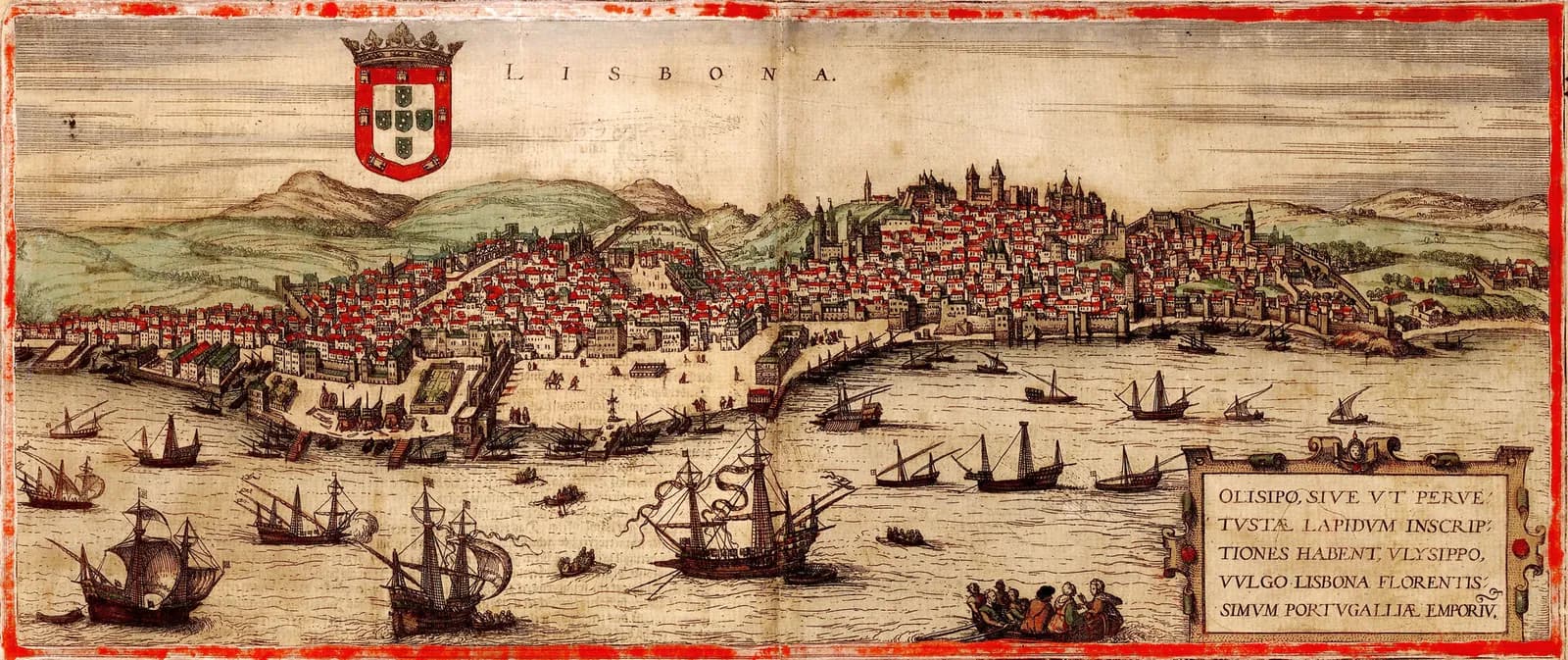
In 1569 Lisbon was struck by the epidemic remembered as the Peste Grande, the Great Plague. The first deaths came in the spring, perhaps earlier. On 21 June the king left for Sintra, and on 8 July the people were officially warned. Those who could leave the city did; the poor stayed behind with the sick.
By late August 500 to 600 people were dying every day. Sebastião named three governors to run the city and sent for two doctors from Seville, who arrived on 2 August and wrote a set of health rules. The epidemic eased from September and was largely over by Christmas, but the city gates stayed shut until 28 July 1570.
| Estimate | Who gives it | Comment |
|---|---|---|
| About 50 a day in late June 1569 | Teresa Rodrigues, historian of Lisbon's mortality | Rising to 300 to 400 a day in July |
| 500 to 600 a day in late August 1569 | Teresa Rodrigues | The worst weeks; deaths fell from September |
| Never fewer than 500 to 700 a day in July and August | Pero Roiz Soares, Lisbon chronicler of the time | A contemporary's impression |
| More than 44,000 buried | Men who did the burying, as quoted in sermons at São Domingos | Teresa Rodrigues adds about 1,400 deaths at the plague hospital |
| 40,000 to 50,000 in all | Modern estimate from contemporary records | The most widely accepted range, though still a guess |
| Up to 60,000, half the estimated population | An estimate cited by Mário Jorge Bastos (2021) | The upper end |
| More than 80,000 in June 1569 alone | Frei Cláudio da Conceição, nineteenth century | Rejected: called exorbitant by Freire de Oliveira and arbitrary by Mário da Costa Roque |
Parish priests stopped being able to record the dead, so every total is an estimate.
Members of the religious orders stayed to confess the dying and nurse the sick. One anonymous Dominican, who said he had worked among them, wrote a short account that year comparing Lisbon to a ship wrecked in a storm, abandoned by its officers and crew and left with only the poor clinging to the hull.
Gaspar da Cruz was among the friars who went round the stricken city confessing and caring for the sick. When the epidemic in Lisbon was under control he went on with the same work at Setúbal. There he caught the disease, and he died on 5 February 1570.
A book others borrowed from
The Tractado was not reprinted until the nineteenth century and drew little notice in Portugal; the humanist bishop Jerónimo Osório took no account of it in his history of King Manuel. The historian Francisco Roque de Oliveira blames above all the narrow reach of Portuguese and of the country's book trade, and notes that the book came out in a plague year. Yet it was read, and copied, often without credit.
The Goa chronicler Diogo do Couto used it in his Soldado Prático of about 1573. The Spaniard Bernardino de Escalante drew on it for his Discurso de la navegación in 1577. Above all, the Augustinian Juan González de Mendoza leaned on Cruz and on the friar Martín de Rada for his Historia del gran reino de la China, first printed in Rome in 1585 and a European success from its first edition.
In 1625 the English editor Samuel Purchas printed a translation in his collection of travels, cut by about a third; from the chapters on justice he kept mostly the cruel parts. The inventory of books left by Philip II's architect Juan de Herrera in 1597 lists a “tratado de la China, por fray Gaspar de la Cruz en portugués”.
Modern editions have followed. The Macau Maritime Museum published a Chinese translation in 1996, Rui Manuel Loureiro a modernised Portuguese text in 1997, reissued in 2010, and U.Porto Press a new edition by Zulmira Santos and Luís de Sá Fardilha in 2019.
c. 1520
Probably born in Évora
Later joins the Dominican convent at Azeitão.
1548
Sails for India
One of twelve Dominicans sent to found houses in the East.
1549
Portuguese captured in China
Diogo Pereira's junks are seized; Galeote Pereira is among the prisoners.
September 1555
Leaves Malacca for Cambodia
Stays about a year.
December 1556
In Canton
A few weeks in the city; back in Malacca early in 1557.
1560
Goes to Hormuz
Stays about three years.
1564 to 1569
Returns to Portugal
The date is disputed.
1569
Lisbon's Great Plague
Cruz nurses and confesses the sick.
5 February 1570
Dies at Setúbal
Of the plague he caught caring for its victims.
20 February 1570
Printing finished in Évora
The title page is dated 1569.
1585
Mendoza's Historia
Printed in Rome, drawing heavily on Cruz.
1625
English abridgement
Printed by Samuel Purchas.
Why it still matters
Cruz's book gave Europe its first book-length printed portrait of China, and its details of daily life were copied for decades. It also set a tone. He wrote it, he said, to show how the Chinese excelled all known peoples “in multitude of people, in greatness of kingdom, in excellence of order and government and in abundance of possessions and riches” (translated from Portuguese), and so that readers would pity “so many souls lost in ignorance of the truth” (also translated).
The word cha in his chapter on customs, from the Chinese ch'a, is the word Portuguese still uses for tea. Through Mendoza, who borrowed so much of the Tractado, Cruz's China reached readers across Europe who never heard his name.
Cruz wrote in the years when the Portuguese were settling at Macau, which Portugal ran until 1999. Macau's Maritime Museum chose his treatise for a Chinese edition in 1996, three years before the handover.
FAQs
Was Gaspar da Cruz's Tratado really the first European book on China?
Historians, including Francisco Roque de Oliveira and the editors of the 2019 U.Porto Press edition, describe it as the first book printed in Europe devoted entirely to China. Marco Polo had described Cathay much earlier, but as part of a wider account of the East. Galeote Pereira's shorter account reached print earlier, in an Italian translation published in Venice in 1565. Fernão Mendes Pinto's Peregrinação, which also describes China, was not printed until 1614.
Was the Tratado das cousas da China published in 1569 or 1570?
Both dates appear in the book. The title page says 1569, while the colophon says the printing was finished in Évora on 20 February 1570, so it is usually cited as 1569–1570.
How and when did Gaspar da Cruz die?
He died of plague at Setúbal on 5 February 1570. He had nursed and confessed the sick during Lisbon's epidemic of 1569 and carried on the same work at Setúbal, where he caught the disease.
How long did Gaspar da Cruz spend in China?
Only a few weeks, in Canton (Guangzhou) from December 1556; one detailed study puts it at five or six weeks. Much of his book relies on the reports of Portuguese who had been prisoners in China, above all Galeote Pereira.
On the timeline
Open the timelineNearby moments from the age of discoveries (1415–1580).
Death of King João III in Lisbon, aged 55. His reign of more than three decades saw the colonisation of Brazil through hereditary captaincies and the establishment of the Inquisition; having outlived all his children, he leaves the throne to his three-year-old grandson Sebastião, whose disappearance at Alcácer Quibir in 1578 would doom the House of Aviz.
Death in Lisbon of Martim Afonso de Sousa, who led the 1530 expedition that began the systematic colonisation of Brazil. In 1532 he founded São Vicente, the first permanent Portuguese town in the colony, and planted the sugar cane, soon worked by enslaved labour, that would define the colony's economy; he later served as Governor of Portuguese India.
Portuguese captain Estácio de Sá founds the city of São Sebastião do Rio de Janeiro in Brazil, establishing a strategic settlement to expel French colonists from Guanabara Bay.
Gaspar da Cruz and his China book
Dominican friar Gaspar da Cruz dies of plague in Setúbal, where he had carried on nursing the sick after Lisbon's epidemic of 1569. His 'Tratado das cousas da China', finished at the press in Évora two weeks later, is often called the first European book devoted entirely to China.
João de Barros, the humanist historian whose 'Décadas da Ásia' chronicled the Portuguese conquests in the East and earned him the title of the 'Portuguese Livy', dies at Ribeira de Litém near Pombal, aged about 74.
Damião de Góis, the humanist chronicler of King Manuel I and friend of Erasmus, dies at Alenquer, just over a year after the Inquisition sent him to life confinement at Batalha. Whether he died from a fall into the fire, a fit or a blow, his death remains one of the mysteries of the Portuguese Renaissance.
King Sebastião I and much of the Portuguese nobility are killed at the Battle of Alcácer Quibir in Morocco, the 'Battle of the Three Kings'. The disaster triggered a succession crisis that led to Spanish rule over Portugal from 1580 and gave rise to the enduring myth of Sebastianism.
Coming up in history
All long reads 7 February 1992Maastricht, 7 February 1992: Portugal signs the treaty that made the EU
 8 February 2002Alqueva: the day the Guadiana was stopped, 8 February 2002
 9 February 1927The February 1927 revolt: Porto and Lisbon rise against the dictatorship
 10 February 1763The Treaty of Paris and the Fantastic War: Portugal, 1762 to 1763
13 sources
Archives, scholarship and reporting this article was checked against.
- 1
Tractado em que se cõtam muito por estẽso as cousas da China, cõ suas particularidades, e assi do reyno dormuz (Gaspar da Cruz)Évora, André de Burgos, 1569 (colophon dated 20 February 1570); digitised copy, Internet Archive (Google Books)
- 2
O Tractado das cousas da China de Fr. Gaspar da Cruz (1570) e o Discvrso de la navegacion de Bernardino de Escalante (1577), chapter 11 of A construção do conhecimento europeu sobre a China, c. 1500–c. 1630 (Francisco Roque de Oliveira, PhD thesis)Universitat Autònoma de Barcelona, 2003
- 3
- 4
Frei Gaspar da Cruz (Évora ? - Setúbal, 1570) (Maria Luísa Cabral)Enciclopédia Virtual da Expansão Portuguesa, CHAM, Universidade NOVA de Lisboa
- 5
Política de Saúde, Política de Morte: A Peste e a Realeza em Portugal (Séculos XIV-XVI) (Mário Jorge da Motta Bastos)Anais de História de Além-Mar XXII (2021): 137-155
- 6Pecados e castigos divinos. Em 1569, a Peste Negra esvaziou as ruas de Lisboa (Rita Cipriano)Observador, 2020
- 7
Tratado das Cousas da China. De Frei Gaspar da Cruz (ed. Zulmira Santos and Luís de Sá Fardilha)U.Porto Press, 2019
- 8
Tratado das coisas da China (Évora, 1569-1570), ed. Rui Manuel Loureiro (catalogue record)Biblioteca Nacional de Portugal, Bibliografia Nacional
- 9
O Desejado e o Encoberto: potências de movimento de um mito andarilho (Marcio Honorio de Godoy)Revista USP, no. 82, Universidade de São Paulo, 2009
- 10
History (Macao Yearbook 2023)Government Information Bureau of the Macao SAR
- 11
- 12Água de rosas, cebolas assadas e galos depenados. Como os lisboetas tentaram curar a Peste Negra em 1569 (Rita Cipriano)Observador, 28 March 2020
- 13
Tratado em que se contam muito por extenso as cousas da China, trans. Fan Weixin (Macau, 1996)Biblioteca Nacional Digital, Biblioteca Nacional de Portugal
Image credits
- Luís Jorge de Barbuda's map of China, first published in Abraham Ortelius's atlas in 1584, here in a coloured copy of 1589. West is at the top. It appeared fourteen years after Gaspar da Cruz's book. Abraham Ortelius (1527-1598), Luis Jorge de Barbuda (also known as Ludovicus Georgius, fl. 1575-99), Public domain, via Wikimedia Commons.
- The title page of Gaspar da Cruz's Tractado, under the arms of Portugal and dedicated to King Sebastião. It is dated 1569; the colophon at the back gives 20 February 1570. Gaspar da Cruz, Public domain, via Wikimedia Commons.
- Portuguese Carracks off a Rocky Coast, painted in about 1540 by an unknown artist from the circle of the Flemish painter Joachim Patinir. Ships of this kind sailed the India route that Cruz took in 1548. Unknown author, Public domain, via Wikimedia Commons.
- The opening of chapter XXIX, the last of the book, where Cruz introduces the letter a Canton merchant gave him about disasters in the provinces in 1556. Gaspar da Cruz (1520-1570), Public domain, via Wikimedia Commons.
- Lisbon in Georg Braun and Frans Hogenberg's Civitates orbis terrarum, published in 1572, three years after the Great Plague emptied its streets. Franz Hogenberg & Georg Braun, Public domain, via Wikimedia Commons.