

António Vieira: the Lisbon-born Jesuit who preached to the fish
Born beside Lisbon Cathedral and raised in Brazil, Vieira became the great preacher of the Portuguese Baroque. He defended Indigenous people and New Christians, accepted African slavery, and spent two years in the Inquisition's cells.
At a glance
- António Vieira was born on 6 February 1608 in Rua dos Cónegos, against the walls of Lisbon Cathedral, and was baptised there on 15 February.
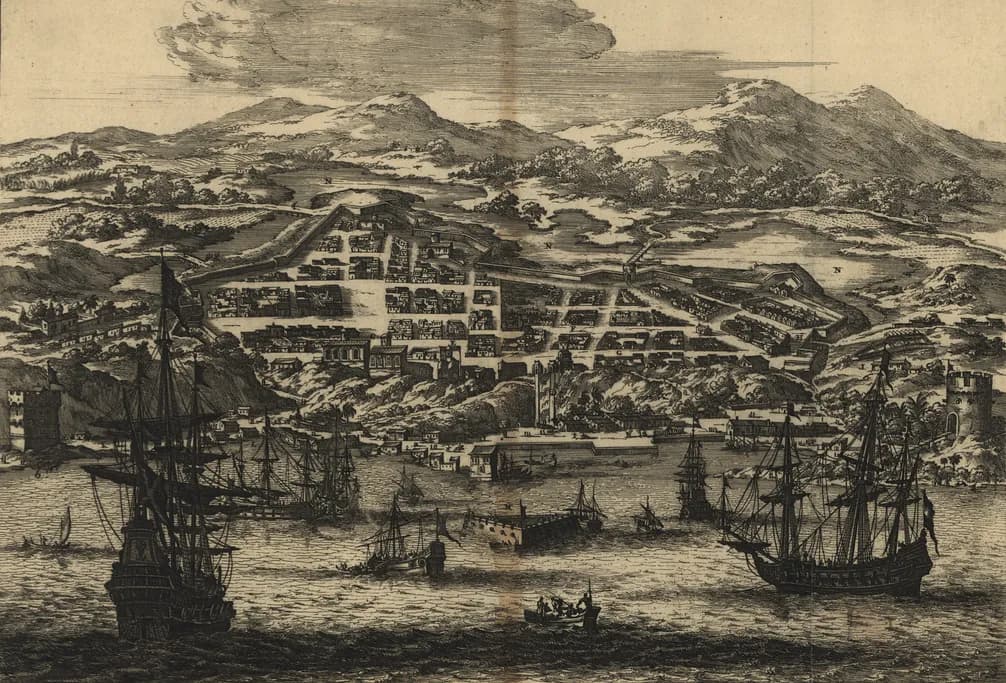
- His family took him to Bahia, in Brazil, in 1614. He entered the Jesuit novitiate there in 1623 and was ordained priest in December 1634.
- After Portugal broke away from Spain in 1640 he became João IV's preacher and envoy, and urged the king to protect the New Christians and use their capital.
- As head of the Jesuit missions in Maranhão and Pará in the 1650s he fought the settlers over the enslavement of Indigenous people, but he accepted African slavery.
- The Inquisition jailed him in 1665 and sentenced him on 23 December 1667 over his prophecies. He died in Bahia on 18 July 1697, aged 89.
A boy born against the cathedral wall
On 6 February 1608 a boy was born in Rua dos Cónegos, a street that runs against the walls of Lisbon Cathedral. A few steps away was the place where Saint Anthony of Lisbon had been born more than four centuries earlier, and his biographer Aníbal Pinto de Castro thinks that is why the parents called the child António.
Nine days later the baby was baptised in the cathedral. Walking with him was Fernão Teles de Meneses, the future Count of Unhão, whose household the family had served.
The family was not noble, whatever Vieira later claimed. His father, Cristóvão Vieira Ravasco, came from Santarém, and his own father had been a servant of the Unhão household who married, in Castro's words, “a certain mulatta or Indian woman”. His mother, Maria de Azevedo, was the daughter of Brás Fernandes, an armourer of the royal household, and her dowry was a post in the courts or the administration for whoever married her.
Vieira never spoke of that ancestry, but it showed in his face. In 1666 the Inquisition looked into his forebears, and when his father and his brother Gonçalo applied to join the Order of Christ, in 1663 and 1683, they struggled to prove the “purity of blood” it demanded.
- Born
- 6 February 1608, Rua dos Cónegos, parish of the Sé, Lisbon
- Baptised
- 15 February 1608, Lisbon Cathedral
- Parents
- Cristóvão Vieira Ravasco, a court clerk, and Maria de Azevedo
- Religious order
- Society of Jesus, novice from 5 May 1623
- Ordained
- 10 December 1634, cathedral of Bahia (some older editions say 1635)
- Died
- 18 July 1697, Bahia, aged 89
A Lisbon child raised in Bahia
Portugal in 1608 had no king of its own. Since 1580 the kings of Spain had also been kings of Portugal, and they would remain so until a coup in Lisbon on 1 December 1640.
The mother's dowry soon paid off. Cristóvão was appointed a clerk of the High Court in Bahia, in Brazil, and sailed in 1609, leaving his wife and son in Lisbon. He came back three years later and stayed until 1614, when he took the whole family across the Atlantic. António was six when he first saw Brazil.
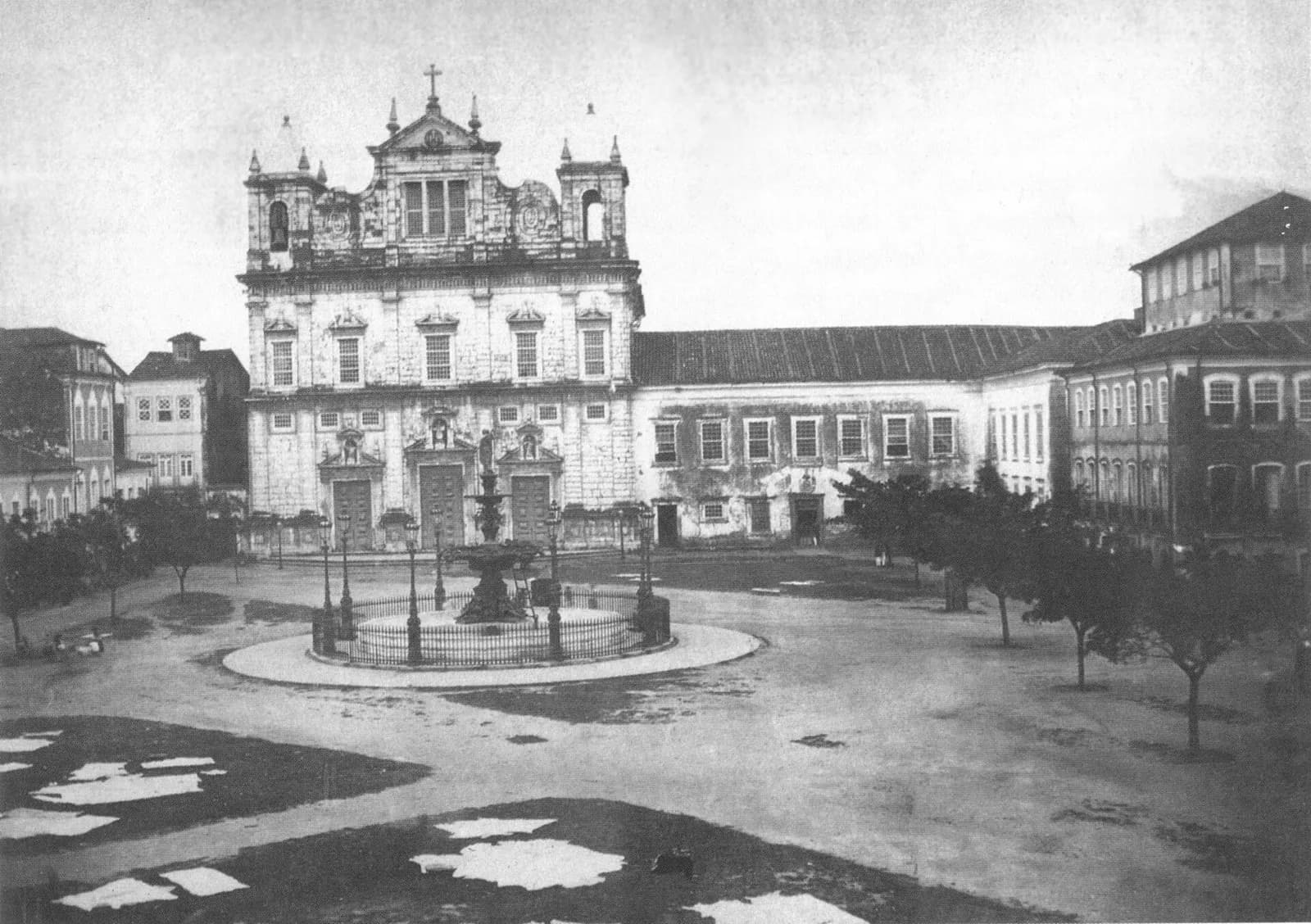
The only school in Bahia was the Jesuits' college. They had taught reading and writing in the city since about 1550, and the college grew out of that first school; Castro dates its foundation to 1590. It taught what the order's schools taught everywhere from Lisbon to Macau: grammar, rhetoric, poetics, history and philosophy.
Novice, missionary, preacher
On 5 May 1623, aged 15, Vieira knocked on the door of the college to begin his novitiate, and the rector, Fernão Cardim, took him in. Older biographers say he ran away from home at night to do it. Castro doubts it: his father was a practical man, and a son in the Jesuits opened doors.
As a novice he was sent to the Jesuit mission of Espírito Santo, seven leagues from the city. There he learned Tupi, an Indigenous language, and met the people he would spend much of his life arguing about. He took his first vows on 6 May 1625.
His superiors soon trusted him with words. He wrote the province's annual report to Rome for 1624 and 1625, which had to describe the Dutch capture of Bahia in 1624, and from about 1627 taught rhetoric at Olinda. He was ordained priest in the cathedral of Bahia on 10 December 1634.
He was already preaching. His first official sermon was on the fourth Sunday of Lent 1633, in Bahia's church of the Conceição. On 27 December that year he preached to the Black brotherhood of a sugar mill, enslaved Africans devoted to Our Lady of the Rosary, a sermon later printed as the fourteenth of his Rosary sermons.
War gave him a bigger stage. In 1638 Dutch forces under Maurits of Nassau began a siege that lasted forty days. In May or June 1640, in Bahia, Vieira preached for the success of Portugal's arms against Holland, and held God himself responsible for the sufferings of the war.
Preacher to the king, envoy to Europe
When news came that Portugal had a king again, João IV, the viceroy in Bahia sent an envoy to Lisbon to assure him of the colony's loyalty, and Vieira went too, in 1641. On 1 January 1642 he preached in the Royal Chapel, and the king made him his preacher and confidant.
João IV used him as a diplomat. In 1646, 1647 and 1650 Vieira went on missions to The Hague, Paris and Rome, refusing the title of ambassador. Much of the business was peace with the Dutch, who still held Pernambuco in Brazil.
His letters from those years are blunt about what Brazil ran on. Arguing against handing Angola to the Dutch, he wrote: “Without Blacks there is no Pernambuco, and without Angola there are no Blacks.” In another letter he suggested that if Pernambuco had to be given up, the enslaved Africans and the sugar mills should be taken out first.
Vieira's answer to an empty treasury was New Christian money. In a proposal of July 1643 he told the king that if he favoured these merchants and invited the exiles back, “Lisbon will be the greatest empire of riches”. In 1646 he asked for an end to the confiscation of their property, and for accusations to be made openly, naming the crime and the accusers.
Part of the plan came true in 1649, with the founding of the General Company of Commerce of Brazil, a trading company Vieira had urged as a home for New Christian capital. The same year the Inquisition began collecting denunciations of Vieira. Only the king's protection kept it from acting on them.
Maranhão, and a sermon to the fish
In 1652 Vieira left the court for the Jesuit mission in Maranhão, on Brazil's northern coast. The settlers there depended on Indigenous labour, and many of their Indian slaves had, in Vieira's view, been taken unjustly.
On the first Sunday of Lent 1653, in São Luís, he told the whole town it was going to Hell. Smallpox, famine and the Dutch had all come to Maranhão, he said, because of unjust captivity. Then he offered a deal.
“There cannot be a Turk so Turkish in Turkey, nor a devil so possessed in Hell, as to say that a free man can be a captive.”
The deal was not freedom for all. Indians who agreed to stay could remain with their masters, and captives from a “just war”, or bought from rival peoples who would have killed them, stayed slaves. Indians freed by a board would live in mission villages and work six months a year for settlers, at two lengths of cotton cloth a month.
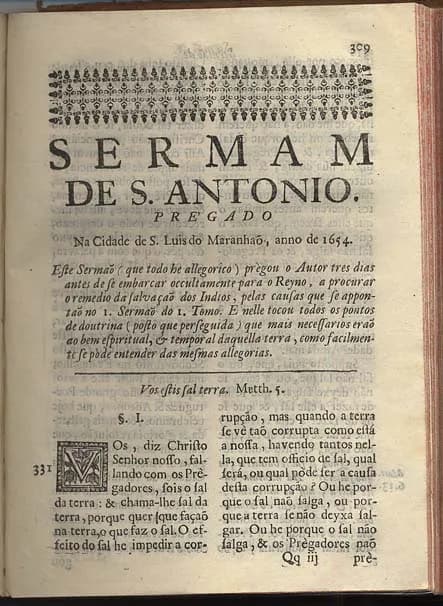
On 13 June 1654, the feast of Saint Anthony, Vieira preached in São Luís on Christ's words to preachers, “You are the salt of the earth”, and asked why the earth stayed corrupt. Like the saint at Rimini, who preached to the fish when the heretics would not listen, he turned his sermon to the sea.
“The first thing that scandalises me in you, fish, is that you eat one another. It is a great scandal, but the circumstance makes it greater still. Not only do you eat one another, the big ones eat the small. … Do you think only the Tapuias eat one another? The butchery here is far bigger: the whites eat one another much more.”
The fish stood for the colonists of Maranhão. When the sermon was printed in Lisbon in 1682, a note explained that he had preached it three days before he “embarked secretly for the kingdom, to seek a remedy for the salvation of the Indians”.
In a letter of 1654 he put nineteen measures to João IV. He won the king's support and sailed back in 1655 at the head of the missions of Maranhão and Pará. He demanded that the Jesuits govern the mission villages in temporal as well as spiritual matters, arguing that whoever converted the Indians also needed the power to defend them.
João IV died in November 1656. The next year Vieira wrote to the boy king, Afonso VI. The queen mother, Luísa de Gusmão, had lost her eldest son and eldest surviving daughter in 1653, and Vieira hinted that their deaths were God's punishment for laws that allowed Indians to be enslaved, as Pharaoh had lost his first-born for holding the Hebrews captive.
“Sire, kings are vassals of God, and if kings do not punish their vassals, God punishes His. … Among all injustices, none cry out to heaven so loudly as those that take away the liberty of those who were born free, and those that do not pay the sweat of those who work.”
The settlers lost patience. They turned on the Jesuits, and in 1661 they shipped Vieira back to Lisbon. Alcir Pécora dates his expulsion to 1662.
The slaves he did not defend in the same way
Vieira's defence of Indigenous freedom did not extend to Africans. Several of his thirty sermons on the Rosary deal with African slavery: João Batista Pereira counts three, the fourteenth, twentieth and twenty-seventh, and Guilherme Amaral Luz adds the sixteenth. None of them asks for it to end. In the fourteenth, preached in 1633 to the sugar-mill brotherhood, he likened the slaves' labour to Christ's suffering.
“There is no work, nor any way of life, more like the Cross and Passion of Christ than yours in one of these mills.”
In a sermon to a Black brotherhood he told his listeners to thank God for taking them from their lands, where they had lived as heathens, to this one, where they could live as Christians and be saved. In the fourteenth he promised that the Rosary would turn the mill's inferno into paradise, and that their masters had more reason to envy their sufferings than they had to envy their masters' pleasures.
The literary scholar Alcir Pécora warns against reading Vieira as an abolitionist. For Vieira, captivity, of Indians or of Africans, was unjust but less of an evil than ignorance of Christ, and the master's duty was to teach his slaves the faith, not free them. “Keep them, Christians, and keep many,” he told the slave owners of São Luís in 1657, “but keep them in such a way that they help carry your soul to heaven, and you theirs.”
His letters were more practical than his sermons. In 1691 he argued against sending Jesuits to the quilombo, or runaway-slave community, of Palmares: its people would settle for nothing less than complete freedom, and that, he wrote, “would be the total destruction of Brazil”.
| Group | What he argued | What he accepted | Main texts |
|---|---|---|---|
| Indigenous peoples of Brazil | Born free; unjust captivity damned the masters; the Jesuits should govern the mission villages | Slavery of captives from a “just war” or bought from rival peoples; Indians working half the year for settlers | Lent sermon, São Luís, 1653; Sermon of Saint Anthony, 1654; letter to Afonso VI, 1657 |
| Enslaved Africans | Masters had to teach them the faith; their suffering was like Christ's Passion | Slavery itself, as necessary to Brazil; he opposed freedom for Palmares | Rosary sermons XIV, XVI, XX and XXVII; letters on Angola, Pernambuco and Palmares (1691) |
| New Christians | No confiscation of property; open accusations; Jewish merchants invited back to Portugal | The aim was their full conversion, and their capital for the crown | Proposals to João IV, 1643 and 1646; Esperanças de Portugal, 1659 |
Summary drawn from Alcir Pécora's two studies, Cleonice Berardinelli, João Batista Pereira and Guilherme Amaral Luz.
Historians still argue over how to read this. Guilherme Amaral Luz writes that Brazilian historiography is “very rich in misunderstandings” about the Jesuits and slavery. He and Pécora read the sermons as the work of a seventeenth-century theologian, not a modern reformer.
Hopes of Portugal, and the Inquisition
Before he left Maranhão, Vieira had written the letter that would ruin him. In April 1659 he sent the queen's confessor, André Fernandes, a text later called Esperanças de Portugal (Hopes of Portugal). Reading the rhyming prophecies of the shoemaker Bandarra, which also fed the cult of the lost King Sebastião, he argued that João IV would rise from the dead.
That resurrection belonged to what Vieira called the Fifth Empire. After the empires foretold in the Book of Daniel, the last of them Rome, would come a new age, spiritual under the Pope and temporal under a Portuguese king. The Turk would be defeated, the lost tribes of Israel would reappear and be converted, and people would live long lives in peace.
The Inquisition got hold of the private letter and sent it to Rome, where nine of its propositions were censured. Politics did the rest. In 1662 Afonso VI took power and handed the government to the Count of Castelo Melhor, an enemy of the queen mother's circle, and Vieira was sent to Porto and then to Coimbra.
He first appeared before the Coimbra tribunal on 21 July 1663. For two years he argued as a theologian: João IV's resurrection was probable, not certain, and an error made without bad intent was no crime. Pleading illness, he asked for more time; he was coughing up blood. On 1 October 1665, after an angry petition to the Inquisition's council, he was locked in its cells.
In prison the questions turned to Judaism. His inquisitors accused him of using the Fifth Empire as a cover for the Jewish hope of a Messiah, and of his old plan to bring the Jews back to Portugal. At the start of almost every session, the notary wrote the same line: he “said he had no faults to confess”.
On 18 October 1667 the tribunal itself agreed that nothing in the case legally proved him guilty of heresy or Judaism. It condemned him anyway. On 23 December the sentence was read to him in Coimbra over two and a quarter hours: he lost forever the right to preach and any voice in his order, and was confined to a Jesuit house.
By then the government had fallen. In November 1667 Afonso VI's younger brother Pedro took power as regent, and Vieira's friends returned to court. In June 1668 the Inquisition pardoned him, leaving in force only his promise not to discuss the propositions again.
April 1659
Esperanças de Portugal
Vieira's letter on the resurrection of João IV reaches the queen's confessor.
21 July 1663
First hearing
He appears before the Inquisition in Coimbra.
5 April 1664
A plea for time
He asks for time to write his defence, saying he is ill and coughing blood.
1 October 1665
Prison
He is locked in the tribunal's custody cells in Coimbra.
July 1666
Written defence
He hands in the two parts of his defence, written in prison without his books.
18 October 1667
No legal proof
The tribunal finds no legal proof that he said or did anything heretical or Jewish.
23 December 1667
Sentence
He loses the right to preach and is confined to a Jesuit house.
30 June 1668
Pardon
At the Lisbon Inquisition he is told the penalties have been lifted.
August 1669
To Rome
With the king's licence he leaves for Rome.
Rome, Bahia and the last sermons
Vieira left for Rome in August 1669 and stayed six years. His preaching won over the cardinals and Queen Christina of Sweden, who asked him in vain to become her spiritual director, and he pleaded the cause of Portugal's New Christians. In 1675 a papal brief removed him for good from the Portuguese inquisitors' jurisdiction, leaving him answerable only to the Roman one, and lifted any censures against him.
He returned to Lisbon in 1675. In 1679 the first volume of his sermons was printed in Lisbon, and in 1681 he sailed for Bahia, this time for good.
His last years were not quiet. From 1688 to 1691 he was visitor, or inspector, of the Jesuit province of Brazil, and he was accused of conniving in the murder of a colonial official. Mostly he worked on his sermons and on the Clavis Prophetarum (Key of the Prophets), the Latin work on Christ's kingdom on earth that he had begun in 1649.
On 13 July 1697 he dictated a letter to the head of the Jesuits in Rome. He had lost “almost all the faculty of seeing and hearing”, he said, but half-dead as he was, he had finished dictating the twelfth volume of his sermons, and with the help of his secretary, the Jesuit António Maria Bonucci, he hoped to finish the Clavis within a year.
He died at dawn on 18 July 1697, in the city of Bahia, after three days of high fever. He was 89. The twelfth volume of sermons reached Lisbon on the same ship as the news of his death. The unfinished Clavis was locked in a chest with two keys, one for the Jesuit provincial of Brazil and one for the rector of the Bahia college.
Where Vieira spent his 89 years (Lisboeta's estimate)
years (rounded)
Lisboeta's calculation from the years of his moves given in the sources, rounded to whole years. The Maranhão bar includes his voyage to Lisbon and back in 1654 to 1655. By this count he spent about 52 of his 89 years in Brazil.
Show the data
| Years | |
|---|---|
| Lisbon, 1608–1614 | 6 |
| Bahia and Olinda, 1614–1641 | 27 |
| Portugal and missions in Europe, 1641–1652 | 11 |
| Maranhão and Pará, 1652–1661 | 9 |
| Portugal, 1661–1669 | 8 |
| Rome, 1669–1675 | 6 |
| Lisbon, 1675–1681 | 6 |
| Bahia, 1681–1697 | 16 |
Why Vieira still matters
Portuguese teenagers meet Vieira at school. The Sermon of Saint Anthony is set for the eleventh year of secondary school, and the Ministry of Education's study guides walk pupils through his life, the fish and their faults. The same guides repeat the phrase Fernando Pessoa gave him in the twentieth century: “the emperor of the Portuguese language”.
His trial file, catalogued as case 1664 of the Lisbon Inquisition, is in the Torre do Tombo, Portugal's national archive, with autograph letters and copies of the sentence. Another copy of the sentence is in the Ets Haim library in Amsterdam, the city where many Portuguese Jewish exiles had settled.
His writings are now in print as a whole, in a complete edition edited by José Eduardo Franco and Pedro Calafate, and the trial records were published in São Paulo in 1995. They show a man who argued for the freedom of Indigenous people and for tolerance of New Christians, and for keeping the Angolan slave trade.
FAQs
When and where was Father António Vieira born?
On 6 February 1608 in Lisbon, in Rua dos Cónegos, a street beside the cathedral. He was baptised in the cathedral on 15 February. His family moved to Bahia, in Brazil, in 1614.
What is the Sermon of Saint Anthony to the Fish about?
Vieira preached it in São Luís do Maranhão on 13 June 1654. Like Saint Anthony, who preached to the fish when people would not listen, he addressed the fish, praising and then rebuking them. The fish stand for the settlers, who enslaved Indigenous people: the big fish eat the small. He sailed secretly for Lisbon three days later to plead the Indians' cause.
Why did the Inquisition put Vieira on trial?
Officially for propositions in his letter Esperanças de Portugal (1659), which used the prophecies of the shoemaker Bandarra to argue that João IV would rise from the dead and lead a Fifth Empire. His inquisitors also suspected him of favouring Judaism, because he had urged the crown to protect the New Christians. He was jailed in 1665, sentenced in December 1667 and pardoned in June 1668.
Was António Vieira against slavery?
Only in part. He fought the enslavement of Indigenous people in Brazil, though he accepted some captives as lawful slaves. He never called for an end to African slavery: his sermons told enslaved Africans to bear their labour as Christ bore the cross, and his letters treated African slaves as necessary to Brazil.
Where did Vieira die?
In the city of Bahia, today's Salvador, at dawn on 18 July 1697, after three days of fever. He was 89, almost blind and deaf, and still working on his Clavis Prophetarum.
On the timeline
Open the timelineNearby moments from the iberian union (1580–1640).
The Battle of Sesimbra Bay — an English squadron under Sir Richard Leveson and William Monson defeats a fleet of Spanish galleys and captures a large Portuguese carrack returning from the East Indies. The engagement takes place during the Anglo-Spanish War, while Portugal is bound to Spain under the Iberian Union.
Birth of João, future Duke of Braganza, at Vila Viçosa (some sources give 18 March). In 1640 the Restoration conspirators proclaimed him King João IV, ending 60 years of Spanish rule and founding the Braganza dynasty that reigned until 1910.
Bento de Góis, a Jesuit lay brother from the Azores, dies at Suzhou (now Jiuquan) on China's western frontier. Disguised as an Armenian merchant, he had trekked for three years from Agra across Afghanistan and the Pamirs, proving that Marco Polo's 'Cathay' and China were one and the same country.
The birth of António Vieira
Father António Vieira is born in Lisbon, in a house near the Sé. The Jesuit preacher, diplomat and royal adviser became the great prose stylist of the Portuguese Baroque — Pessoa's 'emperor of the Portuguese language' — and a fierce defender of Brazil's indigenous peoples.
Captain Francisco Caldeira Castelo Branco's expedition from São Luís founds the Forte do Presépio on Guajará Bay, near the mouth of the Amazon, the nucleus of Belém do Pará; 12 January is the traditional date, reckoned from a report that the voyage took 18 days.
Death in Goa of the chronicler Diogo do Couto, aged about 74. Sent to India as a teenage soldier, he found his friend Luís de Camões stranded and penniless on the Island of Mozambique in 1569 and, with others, helped him get home with the manuscript of 'Os Lusíadas'. Later keeper of the Goa archives, he continued João de Barros's 'Décadas da Ásia'.
Baruch (Bento) de Espinosa is born in Amsterdam to a family of Portuguese Jews who had fled the Inquisition. Expelled from the city's Portuguese-Jewish congregation in 1656 for his heterodox views, he became one of the great philosophers of the early modern age, author of the 'Ethics'.
Coming up in history
All long reads 8 February 2002Alqueva: the day the Guadiana was stopped, 8 February 2002
 9 February 1927The February 1927 revolt: Porto and Lisbon rise against the dictatorship
 10 February 1763The Treaty of Paris and the Fantastic War: Portugal, 1762 to 1763
 11 February 2007Portugal’s 2007 abortion referendum: a yes vote that did not bind
22 sources
Archives, scholarship and reporting this article was checked against.
- 1
O essencial sobre o Padre António Vieira (Aníbal Pinto de Castro), opening chaptersImprensa Nacional-Casa da Moeda, 2008 (publisher's excerpt)
- 2
Padre António Vieira nos cárceres da InquisiçãoArquivo Nacional Torre do Tombo, virtual exhibition
- 3
Vieira, a inquisição e o capital (Alcir Pécora)Topoi, Revista de História, no. 1, Universidade Federal do Rio de Janeiro
- 4
A escravidão nos sermões do Padre Antonio Vieira (Alcir Pécora)Estudos Avançados, vol. 33, no. 97, Universidade de São Paulo, 2019
- 5
Pretos, índios e judeus nos sermões de Vieira (Cleonice Berardinelli)Metamorfoses, Cátedra Jorge de Sena, Universidade Federal do Rio de Janeiro
- 6
A estética barroca do Latim da Clavis Prophetarum do P. António Vieira (Arnaldo do Espírito Santo)Ágora. Estudos Clássicos em Debate 1, Universidade de Aveiro, 1999
- 7
Sermoens do P. Antonio Vieira, da Companhia de Iesu, Prégador de Sua Alteza. Segunda parte (Lisbon: Miguel Deslandes, 1682)John Carter Brown Library copy, Internet Archive
- 8
Para ler e compreender os sermões de Antônio Vieira (1608-1697) (Andrea Gomes Bedin)Cadernos CERU, série 2, vol. 35, no. 1, Universidade de São Paulo, 2024
- 9
A short story of 1st December (José Miguel Sardica)Universidade Católica Portuguesa
- 10
Latim e retórica nos sermões de Vieira: o Sermão XIV do Rosário (Ronald Ferreira da Costa)Classica, vol. 20, no. 2, Sociedade Brasileira de Estudos Clássicos, 2007
- 11
Antonio Vieira (John Reville)The Catholic Encyclopedia, vol. 15, New York, 1912 (New Advent transcription)
- 12
- 13
Sentence of the Inquisition of Lisbon against Antonio Vieira, 1667, late 17th century copy (EH 48 E 39)Ets Haim Library, Amsterdam (Ets Haim Manuscripts)
- 14
O Padre Antonio Vieira: orador e profeta do V Império (João Batista Pereira, summary of an MA dissertation)Diálogos, vol. 9, no. 1, Universidade Estadual de Maringá, 2005
- 15
Review of François Soyer, The Persecution of the Jews and Muslims of Portugal: King Manuel I and the End of Religious Tolerance (1496–7) (Brill, 2007)Ariel Hessayon, Reviews in History (Institute of Historical Research), review no. 797, September 2009
- 16
Notas sobre a Inquisição portuguesa: história e historiografiaGrayce Mayre Bonfim Souza, Politeia: História e Sociedade (Uesb), v. 20, n. 1, 2021
- 17
- 18
Guião de Trabalho Autónomo n.º 12, Português 11.º ano: o Sermão de Santo António (as repreensões)Direção-Geral da Educação, Ministério da Educação
- 19
Rosário da Concórdia: Vieira e os fundamentos místicos da paz social (Guilherme Amaral Luz)Clio, Série Revista de Pesquisa Histórica, no. 27-2, Universidade Federal de Pernambuco, 2009
- 20
Vieira: vencedor ou vencido? (Maria José Bueno Casseb)Anais do XXIII Simpósio Nacional de História, ANPUH, Londrina, 2005
- 21
O historiador do futuro e o profeta disfarçado: profecia, história e retórica na História do Futuro, do Padre Antônio Vieira (Marcus De Martini)Matraga, vol. 20, no. 33, Universidade do Estado do Rio de Janeiro, 2013
- 22
Image credits
- São Salvador da Bahia, where Vieira grew up and where he died, in an engraving published in 1671 by the Dutch writer Arnoldus Montanus. Montanus, Arnoldus (1625?-1683), Public domain, via Wikimedia Commons.
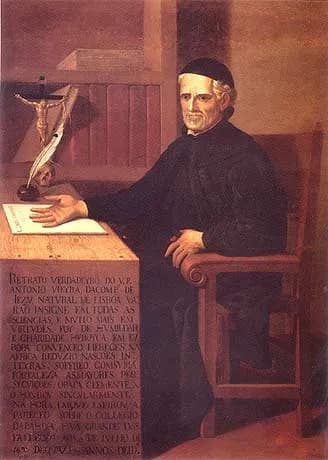
- António Vieira at his desk, in an anonymous portrait of the early eighteenth century at the Casa Cadaval in Muge. The inscription begins “True portrait of the Venerable Father António Vieira of the Society of Jesus, native of Lisbon”. Unknown author, Public domain, via Wikimedia Commons.
- The sermon in the second volume of Vieira's Sermoens (Lisbon, 1682), where it was first printed. The italic note says he preached it three days before secretly embarking for Portugal to plead for the Indians. António Vieira (1608-1697), Public domain, via Wikimedia Commons.
- The Terreiro de Jesus in Salvador in 1862, with the church of the former Jesuit college, now the city's cathedral, and the college buildings beside it. Vieira went to school and began his novitiate at the college. Unknown author, Public domain, via Wikimedia Commons.
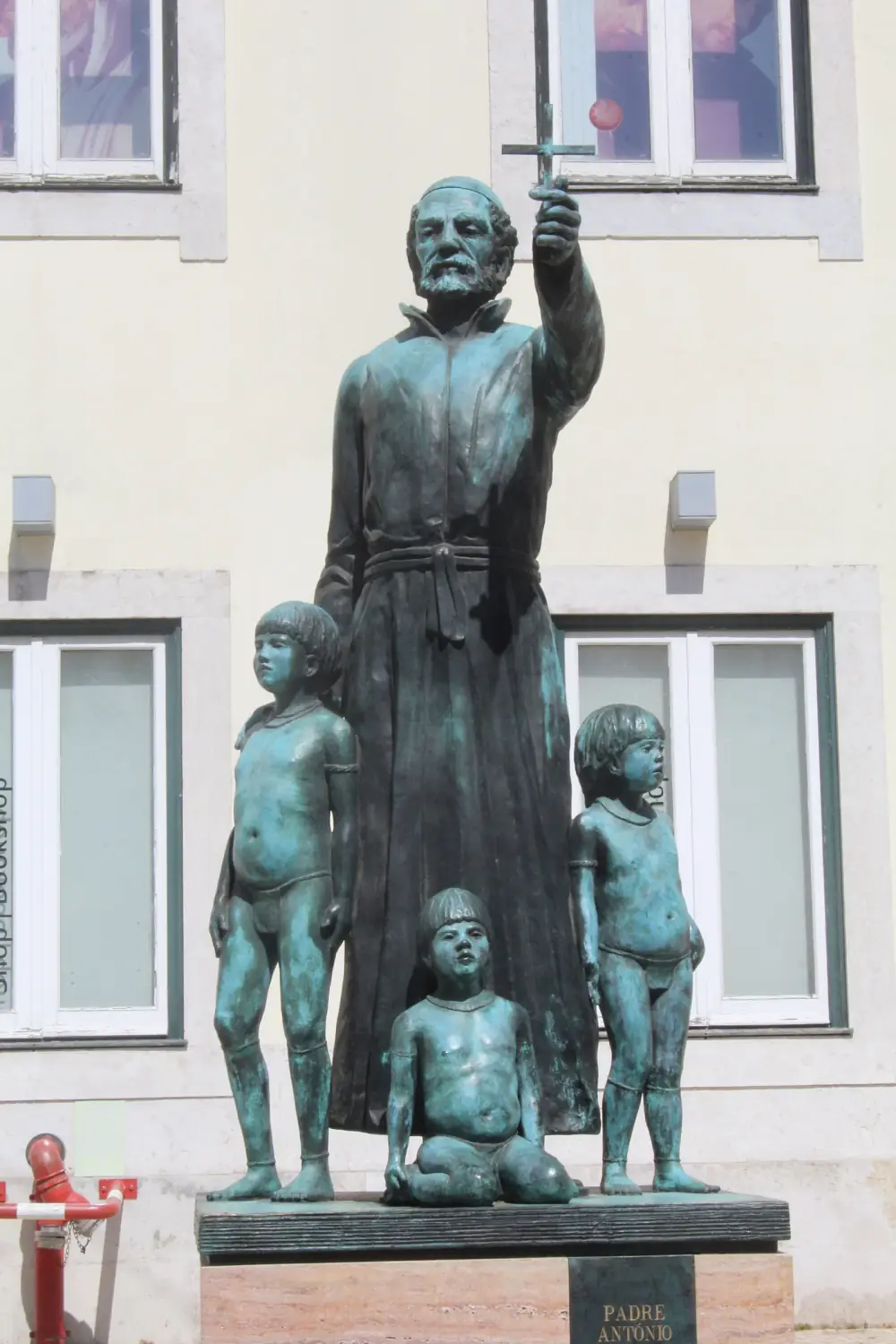
- The statue of Vieira with three Indigenous children in Largo Trindade Coelho, Lisbon, beside the church of São Roque, photographed in 2019. It was unveiled in 2017; the sculptor was Marco Telmo Areias Fidalgo. Chabe01, CC BY 4.0, via Wikimedia Commons.