

Maastricht, 7 February 1992: Portugal signs the treaty that made the EU
Six years after joining the European Community, Portugal chaired it for the first time. In that half-year its ministers signed the treaty that created the European Union, EU citizenship and the road to a single currency.
At a glance
- On 7 February 1992 ministers of the twelve European Community states, in most cases their foreign and finance ministers, signed the Treaty on European Union in Maastricht, in the Netherlands.
- João de Deus Pinheiro, foreign minister, and Jorge Braga de Macedo, finance minister, signed for Portugal, which had held the Community's rotating presidency since 1 January 1992 for the first time.
- The treaty created the European Union and citizenship of the Union, set a timetable for a single currency starting no later than 1 January 1999, and promised a Cohesion Fund for the poorer member states.
- Portugal ratified it without a referendum, after a constitutional revision in November 1992 and a parliamentary vote in December. It deposited its ratification on 16 February 1993, and the treaty came into force on 1 November 1993.
- Portugal received ECU 18.2 billion in structural and cohesion funds for 1994 to 1999, almost double the 1989 to 1993 amount, and adopted the euro with ten other countries on 1 January 1999.
Twelve pairs of signatures in Maastricht
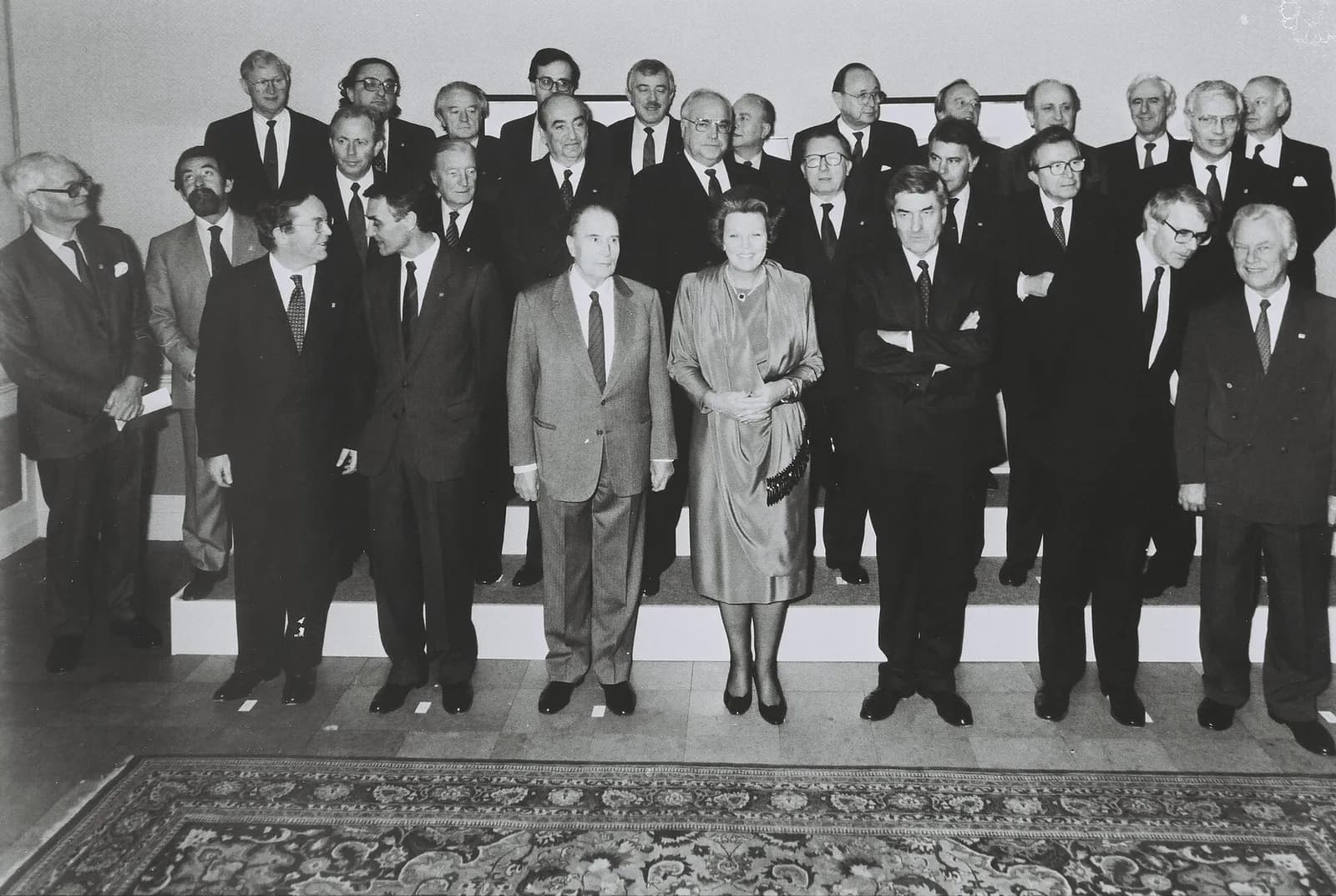
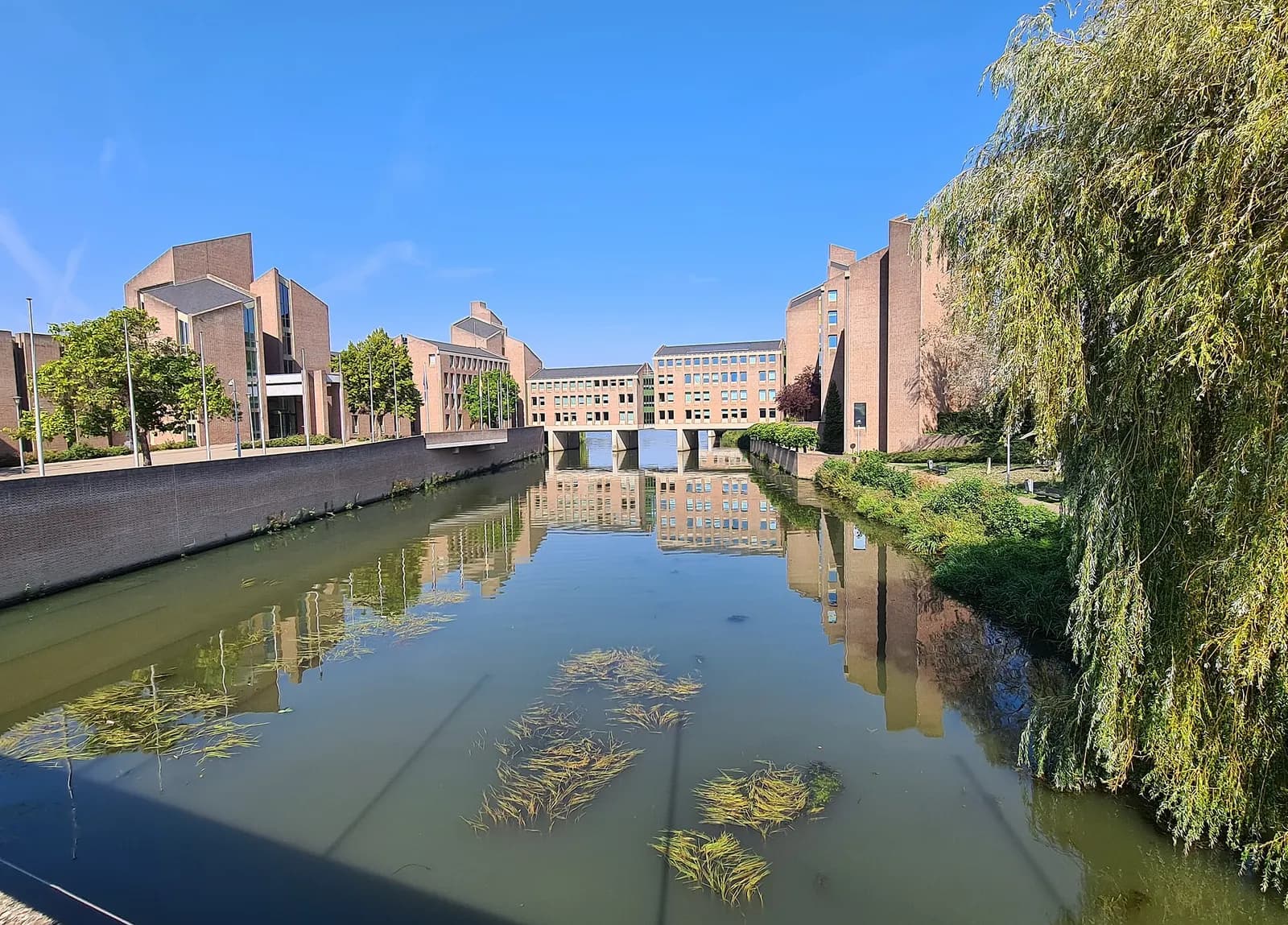
On the evening of 7 February 1992 the foreign and finance ministers of the twelve member states of the European Community met in the Dutch town of Maastricht, in the building that houses the government of the province of Limburg. Their heads of government had agreed the text in the same building two months earlier. The document they had come to sign ran to more than 300 pages.
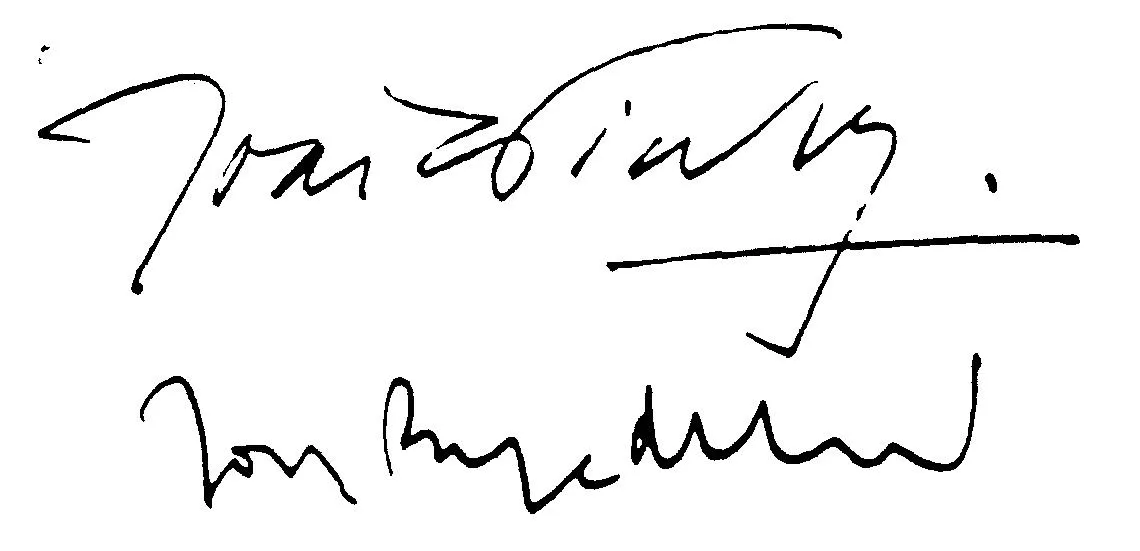
Two men signed for Portugal. In the treaty's list of plenipotentiaries, under “the President of the Portuguese Republic”, come João de Deus Pinheiro, Minister for Foreign Affairs, and Jorge Braga de Macedo, Minister for Finance. Their names follow those of the Dutch pair, Hans van den Broek and Willem Kok.
Portugal also chaired the occasion. Since the start of the year it had held the six-month rotating presidency of the Community for the first time, and its prime minister, Aníbal Cavaco Silva, came to Maastricht as President of the Council, alongside the Dutch prime minister Ruud Lubbers, under whose presidency the treaty had been concluded. Cavaco Silva later wrote that he had had the honour of presiding over the signing ceremony.
According to the Luxemburger Wort, whose German report is quoted here in an English translation, Cavaco Silva called the outcome of the sometimes heated negotiations “a reasonable balance between ambition and caution” and said the Community would in future be able to act more energetically on the international stage. Not everyone was pleased. Egon Klepsch, the newly elected President of the European Parliament, said the treaty had “weaknesses, shortcomings and uncertainties”, above all because it gave the Parliament too little say.
“This is a historic moment for the almost 340 million citizens of the European Community, a moment of satisfaction and of hope.”
The treaty renamed the club and widened its ambitions. It created the European Union, a citizenship shared by the nationals of every member state and a timetable for a single currency. For Portugal, one of the four members poor enough to qualify, it also promised a new fund to help the less prosperous states keep up.
A young member in the chair
Portugal had joined the European Community with Spain on 1 January 1986, after negotiations that opened in 1978. By 1992 the Community had twelve members, and each took a six-month turn chairing the Council, where national ministers make decisions. Portugal's first turn ran from January to June 1992, when it had been a member for only six years.
Its government was in a strong position. Aníbal Cavaco Silva, an economist and leader of the centre-right Social Democratic Party (PSD), had been prime minister since 1985 and had won two absolute majorities in a row. Over ten years in office he took part in 29 European Councils, the summits of heads of government.
The treaty grew out of the upheavals of 1989 to 1991. Cavaco Silva later traced it to Mikhail Gorbachev's reforms in the Soviet Union and the reunification of Germany in October 1990. There was an economic logic too: in his view, a single market where a dozen currencies could still be devalued against each other was open to competitive devaluations and the quarrels they caused.
Portugal's priority was money for development. Since the Single European Act added economic and social cohesion to the Community's aims, Lisbon had pushed for transfers to the poorer regions, usually alongside Spain, Ireland and Greece. For 1989 to 1993 Portugal was allocated ECU 9.2 billion from the Community's structural funds, the third-largest amount after Spain and Italy.
What the treaty created
The first article set the tone: “By this Treaty, the High Contracting Parties establish among themselves a European Union.” The Union rested on the existing Communities, plus two new fields where governments would cooperate: a common foreign and security policy, and justice and home affairs. Klepsch disliked this design of “three pillars”, because the two new fields stayed largely outside the control of the Community's institutions.
“Citizenship of the Union is hereby established. Every person holding the nationality of a Member State shall be a citizen of the Union.”
Citizenship came with specific rights. A Portuguese citizen could move to and live in any member state. Living in, say, Luxembourg, they could vote and stand in its municipal elections and in elections to the European Parliament there, on the same terms as locals. Outside the Union, in a country where Portugal had no embassy or consulate, they could seek help from those of any other member state, and they gained the right to petition the European Parliament and to complain to a new European Ombudsman.
The treaty also wrote down a calendar for economic and monetary union. Its second stage would begin on 1 January 1994. If the leaders had not set a start date for the third stage by the end of 1997, it would begin automatically on 1 January 1999, with exchange rates fixed for good and a single currency run by a European System of Central Banks whose first objective was price stability. The treaty called that currency the ECU; it arrived under the name euro.
Two clauses mattered most in Lisbon. Article 130d required a Cohesion Fund to be set up before 31 December 1993 to pay towards environmental and transport projects, and a protocol limited it to states with a gross national product per head below 90% of the Community average that ran a programme to meet the convergence tests. And a short Protocol on Portugal let the country keep an interest-free credit line that the Banco de Portugal gave to the autonomous regions of the Azores and Madeira, while committing Portugal to end it as soon as possible.
| What it created | Where in the treaty | What it meant for Portugal |
|---|---|---|
| The European Union | Article A | Portugal became one of twelve founding members of the Union |
| Citizenship of the Union | Articles 8 to 8e | Portuguese living elsewhere in the Union could vote in local and European elections there, and vice versa |
| Economic and monetary union | Articles 109e and 109j | A single currency by 1 January 1999 at the latest for states meeting the convergence tests |
| Cohesion Fund | Article 130d and the Protocol on economic and social cohesion | Money for environment and transport projects in states below 90% of average GNP per head |
| Committee of the Regions | Article 198a | 12 of the 189 seats for Portuguese regional and local representatives |
| Common foreign and security policy | Title V | Foreign policy cooperation by governments, outside the Community's usual rules |
| Justice and home affairs cooperation | Title VI | Cooperation on asylum, borders, police and courts, also between governments |
Article numbers are those of the 1992 text; the treaties were renumbered in 1997 and 2007.
Seats in the new Committee of the Regions, by member state
members
The treaty created an advisory Committee of the Regions of 189 members, drawn from regional and local bodies. Portugal had 12 seats, as many as Belgium, Greece and the Netherlands. Figures from Article 198a; the Economic and Social Committee was given the same allocation under Article 194.
Show the data
| Members | |
|---|---|
| Germany | 24 |
| France | 24 |
| Italy | 24 |
| United Kingdom | 24 |
| Spain | 21 |
| Belgium | 12 |
| Greece | 12 |
| Netherlands | 12 |
| Portugal | 12 |
| Denmark | 9 |
| Ireland | 9 |
| Luxembourg | 6 |
Portugal did not get everything it asked for. Cavaco Silva later recalled that Portugal argued, without success, for a shared stabilisation mechanism to cushion a member state hit by an economic shock of its own, once it could no longer respond with its own currency and interest rates.
Six months in the chair
The signing was one event in a crowded half-year. Four days later, on 11 February, the European Commission presented the “Delors II package”, a programme and budget that put numbers on the promised Cohesion Fund. Jacques Delors, the Commission's president, told the European Parliament that the fund would help member states meet the convergence criteria for monetary union.
1 January 1992
Portugal takes over the presidency
Its first turn in the chair, for the first half of 1992.
7 February 1992
Treaty on European Union signed in Maastricht
Pinheiro and Braga de Macedo sign for Portugal; Cavaco Silva presides.
11 February 1992
Commission tables the Delors II budget package
6 April 1992
The escudo joins the European exchange rate mechanism
2 May 1992
European Economic Area agreement signed in Porto
The same day a meeting with the Mercosur countries took place in Guimarães.
21 May 1992
Agriculture ministers agree the MacSharry reform of the CAP
Portugal's agriculture minister, Arlindo Cunha, chairs the Council.
2 June 1992
Danish voters reject the treaty in a referendum
50.7% vote No.
4 June 1992
Foreign ministers meet in Oslo
18 June 1992
Irish voters approve the treaty in a referendum
26–27 June 1992
Lisbon European Council
Leaders keep the ratification timetable and agree to set up the Cohesion Fund early in 1993.
The biggest piece of business was farming. On 21 May the agriculture ministers, chaired by Portugal's agriculture minister Arlindo Cunha, reached political agreement on a reform of the common agricultural policy (CAP) proposed by the agriculture commissioner, Ray MacSharry. It made prices, above all for cereals, more competitive and paid farmers direct aid instead. MacSharry called the break in the link between price support and production the essential change.
Cunha later wrote the history of the deal with the economist Alan Swinbank. Their account says the reform, adopted under a Portuguese presidency despite the opposition of farm lobbies and the early hostility of many member states, fundamentally changed the shape of the CAP. Whilst it did not cut the policy's cost, it let the Community accept the farm deal then emerging in the Uruguay Round of world trade talks.
On 2 May the Community and the countries of the European Free Trade Association (EFTA) signed the treaty creating the European Economic Area in Porto. The same day Guimarães hosted a meeting with the Mercosur countries of South America. At Lisbon in June the leaders said the EEA had opened the way to membership talks with the EFTA countries that wanted to join. Austria, Finland and Sweden joined on 1 January 1995.
The wars that broke up Yugoslavia hung over the presidency. José Cutileiro, a Portuguese diplomat born in Évora, coordinated the Community's peace conference on the former Yugoslavia during the Portuguese term, and was sent to Serbia and to Bosnia and Herzegovina.
As the Community's envoy, Cutileiro chaired talks between the leaders of Bosnia's three main national parties. On 18 March 1992 they produced a statement of principles, sometimes called the Carrington–Cutileiro plan, for an independent Bosnia made up of three constituent units based on national lines. The parties adopted it but never signed it, the Bosnian presidency later rejected it, and war broke out in Bosnia that year. In June the leaders meeting in Lisbon adopted a declaration on Yugoslavia.
Then, on 2 June, Danish voters rejected the treaty in a referendum by 50.7% to 49.3%, a margin of 46,847 votes. Three weeks earlier their parliament had approved it by 130 votes to 25. The presidency had to keep the other eleven on course, and the foreign ministers met in Oslo on 4 June.
On 18 June Irish voters approved the treaty, by more than two-thirds of those voting. At the Lisbon European Council on 26 and 27 June the leaders welcomed the Irish result, confirmed the conclusions reached in Oslo and insisted on the ratification timetable, which aimed at entry into force on 1 January 1993.
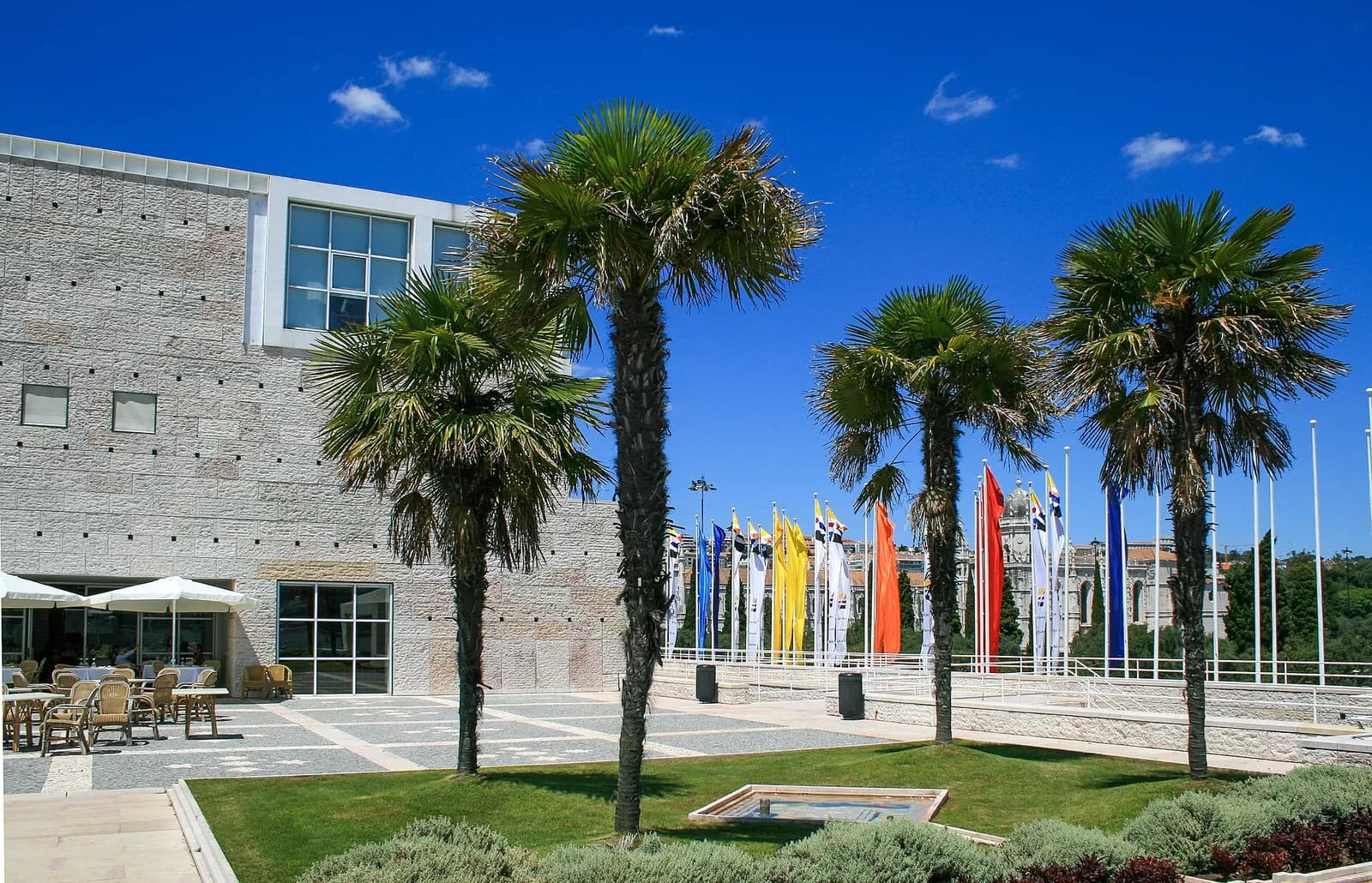
Lisbon did not settle the budget. The leaders decided to set up the Cohesion Fund early in 1993 for the states below 90% of average national product per head, and left the rest of the Delors II package to the Edinburgh summit in December. The new conference centre of the Centro Cultural de Belém in Lisbon hosted the presidency.
No referendum in Portugal
The Danish vote stirred a debate in Lisbon. In July 1992 a small group of activists from the left and the right handed out leaflets and collected signatures for a referendum on a shopping street near the Praça do Comércio, where banners joining the Portuguese and European flags hung on the ministries. Cavaco Silva said no. The largest parties backed the treaty, he argued, and voters had elected parliament to decide such matters.
“Portugal is still a young democracy and we lack citizenship. But how can you encourage that sense of involvement if you deny the people the right to participate in something that will have such a huge effect on them politically and economically?”
The campaigners faced a legal wall: the constitution then ruled out referendums on international treaties. It was already being revised to make room for Maastricht. On 17 November 1992 parliament approved the third revision of the 1976 constitution, intended to allow ratification. It let citizens of other member states living in Portugal vote in European elections and opened the way to a single currency. The PSD and the Socialists voted for it. The 13 Communist deputies, the single Green, the four CDS deputies and two independents voted against, and the one deputy of the National Solidarity Party abstained.
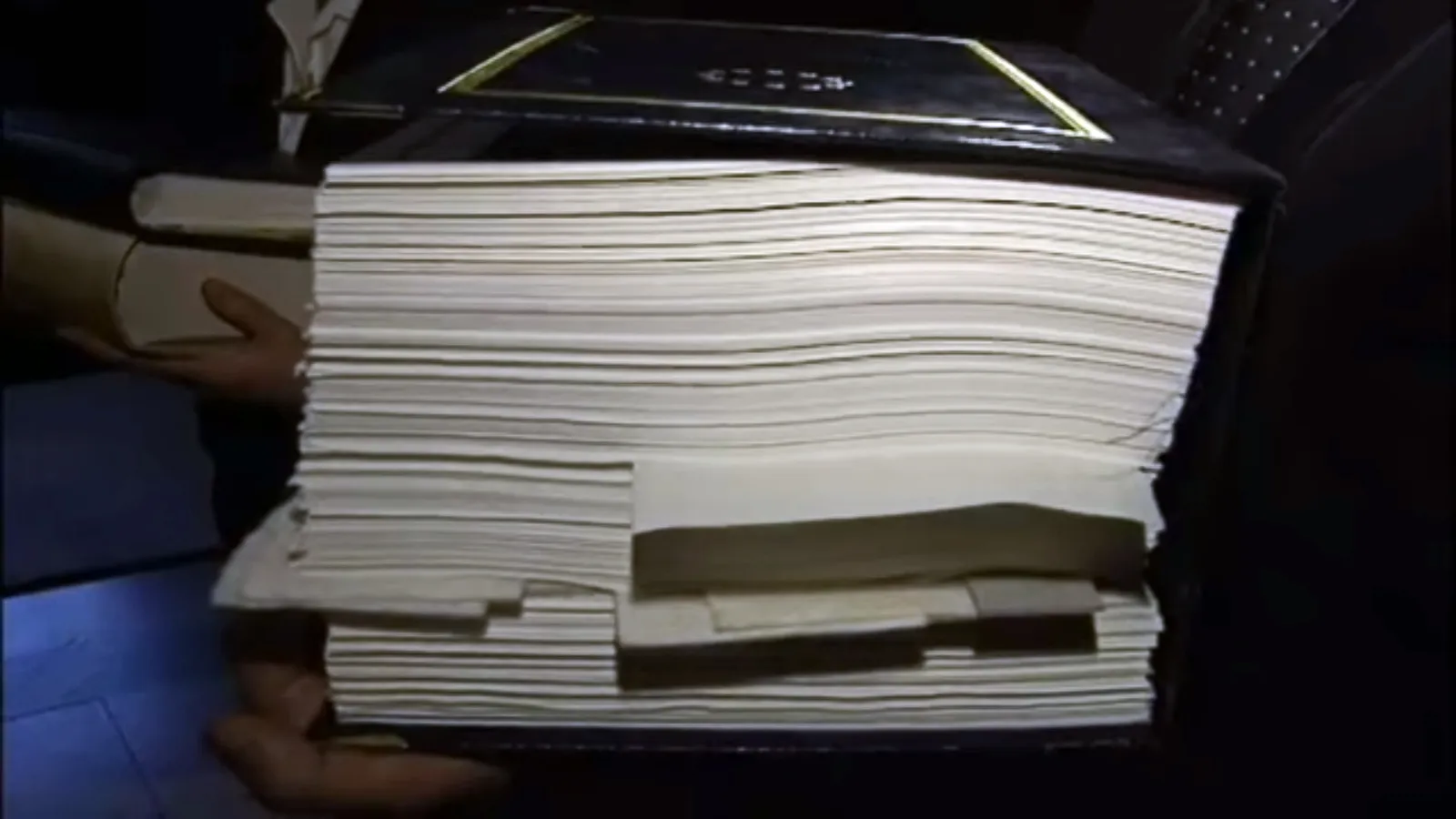
On 10 December parliament approved the treaty itself for ratification, and Portugal deposited its instrument of ratification with the Italian government on 16 February 1993.
Denmark held a second referendum on 18 May 1993, on the treaty together with the special arrangements agreed for Denmark at Edinburgh, and 56.7% voted yes. It deposited its ratification on 17 June 1993, the United Kingdom on 2 August and Germany, the last, on 13 October. The treaty came into force on 1 November 1993, ten months later than the leaders had planned in Lisbon.
The cohesion money
The compromise came at Edinburgh on 11 and 12 December 1992. For 1994 to 1999 the leaders set aside about ECU 153 billion for the structural funds and ECU 15 billion for the new Cohesion Fund, together a third of the Community budget and, year for year, double the sums of the previous period. The Cohesion Fund regulation, adopted in May 1994, gave it ECU 15.15 billion. It could pay up to 85% of the cost of large environmental and transport projects, and its money went to Greece, Ireland, Portugal and Spain.
For Portugal the result was almost a doubling. Its share of the structural and cohesion funds rose from ECU 9.2 billion in 1989 to 1993 to ECU 18.2 billion in 1994 to 1999, a period one year longer. The Commission estimated that the structural funds added 4.7% to Portugal's real GDP over that period, the largest figure it gave for any country, and listed among the results of rail investment a journey between Lisbon and Faro shortened by 1 hour 35 minutes.
EU structural and cohesion funds allocated to Portugal, by programming period
billion ECU (to 1999) or euro, current prices
The first period after Maastricht almost doubled Portugal's allocation. Periods differ in length (five, six and seven years) and the figures are not adjusted for inflation; one ECU became one euro in 1999. Figures from the European Commission's 2008 review of cohesion policy, which lists the main beneficiary countries for each period.
Show the data
| Portugal | |
|---|---|
| 1989–1993 | 9.2 |
| 1994–1999 | 18.2 |
| 2000–2006 | 22.8 |
| 2007–2013 | 21.5 |
From Maastricht to the euro
From the moment of signing, meeting the Maastricht convergence criteria became the immediate priority of economic policy in Portugal, according to Carlos da Silva Costa, a later governor of the Banco de Portugal. The first step came two months after Maastricht: on 6 April 1992 the escudo joined the exchange rate mechanism of the European Monetary System, with a wide band of 6% either side of its central rate.
In the currency storms of 1992 and 1993 the escudo's central rate was realigned more than once, a story told in our article on the escudo's conversion rate. By early 1998 Portugal had passed the tests. On 3 May 1998 the leaders found that its inflation in the year to January 1998 had averaged 1.8% and its long-term interest rate 6.2%, below reference values of 2.7% and 7.8%, and that it was not subject to an excessive deficit decision.
Eleven countries qualified, Portugal among them, and the euro was launched on 1 January 1999. Greece did not yet meet the conditions, and Sweden had never joined the exchange rate mechanism. The United Kingdom had an opt-out written into the treaty, and Denmark had notified that it would not take part, as agreed at Edinburgh after its no vote.
Cavaco Silva, whose government prepared the country for the euro, described the choice as a cost-benefit calculation. The gains were the end of exchange-rate risk, cheaper borrowing and a place in the Union's core. The cost was the loss of the national tools of monetary and exchange-rate policy, plus tighter limits on budgets. In a 2018 lecture he blamed later policy errors, not the euro itself, for the near-bankruptcy that led Portugal to a €78 billion rescue loan in 2011.
Why it still matters
Much of what Maastricht created is part of everyday life in Portugal. The euro is the currency. Citizens of other EU countries who live in Portugal vote in its local and European elections, and Portuguese living elsewhere in the Union can do the same where they live, under rights first written into the 1992 treaty and the constitutional revision that followed.
The Cohesion Fund still exists on the rule set at Maastricht, paying for environmental and transport projects in member states whose national income per head is below 90% of the EU average. For 2021 to 2027 Portugal is one of fifteen countries that qualify. Of the four original recipients, only Greece is still on the list with it.
The presidency of 1992 was the first of four. Portugal chaired the Council again in 2000 under António Guterres, in 2007 under José Sócrates, when the Treaty of Lisbon was signed, and in the first half of 2021.
FAQs
Who signed the Maastricht Treaty for Portugal?
João de Deus Pinheiro, the foreign minister, and Jorge Braga de Macedo, the finance minister, signed it on 7 February 1992. Prime minister Aníbal Cavaco Silva attended as President of the Council, because Portugal held the Community's rotating presidency.
Why was the treaty signed in Maastricht if Portugal held the presidency?
The text was concluded under the Dutch presidency and agreed by the heads of government in Maastricht in December 1991. The ministers signed it in the same building two months later, with Cavaco Silva and the Dutch prime minister Ruud Lubbers both present.
Did Portugal hold a referendum on the Maastricht Treaty?
No. Campaigners collected signatures for one in 1992, but the constitution then ruled out referendums on treaties and the government opposed a vote. Parliament revised the constitution in November 1992, approved the treaty on 10 December, and Portugal deposited its ratification on 16 February 1993.
What is the Cohesion Fund and why did it matter to Portugal?
It is an EU fund created under the Maastricht Treaty for environmental and transport projects in member states with national income per head below 90% of the average. The leaders agreed in Lisbon in June 1992 to set it up early in 1993, and its regulation of May 1994 gave it ECU 15.15 billion. Portugal was one of four recipients and still qualifies for 2021 to 2027.
When did Portugal adopt the euro?
On 1 January 1999, as one of the eleven founding members, after the leaders found on 3 May 1998 that it met the Maastricht conditions. Euro notes and coins replaced the escudo in 2002.
On the timeline
Open the timelineNearby moments from portugal in europe (1986–today).
Angolan President José Eduardo dos Santos and UNITA leader Jonas Savimbi sign the Bicesse Accords in Portugal, mediated by the Portuguese government with US and Soviet observers. The deal briefly halts Angola's civil war and paves the way for multi-party elections in 1992.
Portugal wins the FIFA World Youth Championship (under-20) on home soil at the Estádio da Luz in Lisbon, defeating Brazil on penalties. Back-to-back champions after their 1989 win in Saudi Arabia, the 'Golden Generation' of João Pinto, Rui Costa and Luís Figo heralds a new era of Portuguese football.
Indonesian troops open fire on a peaceful procession of more than 2,000 people at the Santa Cruz cemetery in Dili, East Timor, killing scores of young Timorese. Footage smuggled out by the British cameraman Max Stahl was shown around the world and revived the cause of independence for Portugal's former colony.
Portugal and the Maastricht Treaty
A month into Portugal's first presidency of the European Community, foreign minister João de Deus Pinheiro and finance minister Jorge Braga de Macedo sign the Maastricht Treaty for Portugal. The treaty created the European Union and set the course for the euro, which Portugal adopted in 1999.
Death of Captain Fernando José Salgueiro Maia, hero of the Carnation Revolution. On 25 April 1974 he led the armoured column from the Santarém cavalry school to Lisbon, occupied the Terreiro do Paço and surrounded the Carmo barracks, where Marcelo Caetano surrendered. He died of cancer aged 47.
Martinair Flight 495, a DC-10 carrying 340 people, mostly Dutch holidaymakers from Amsterdam, crashes while landing at Faro Airport in a thunderstorm with strong, shifting winds. It hits the runway so hard that the fuselage splits in two and catches fire. Fifty-six people are killed and 106 badly injured.
The composer Fernando Lopes-Graça dies in Parede, aged 87. A lifelong opponent of the Estado Novo, he came top in the 1931 competition for a piano-teaching post at the National Conservatory but was arrested and banished to Alpiarça before he could take it up, lost a Paris scholarship in 1937 for political reasons, and built much of his music on Portuguese folk song.
Coming up in history
All long reads 9 February 1927The February 1927 revolt: Porto and Lisbon rise against the dictatorship
 10 February 1763The Treaty of Paris and the Fantastic War: Portugal, 1762 to 1763
 11 February 2007Portugal’s 2007 abortion referendum: a yes vote that did not bind
 12 February 2002José Travassos and the Cinco Violinos, Sporting's forward line
25 sources
Archives, scholarship and reporting this article was checked against.
- 1
Treaty on European Union (with final act, protocols and declarations), signed at Maastricht on 7 February 1992 (No. 30615)United Nations Treaty Series, vol. 1757 (1993)
- 2
Ceremonial signing of the new Treaty on Union (Tobias Freudenberg), Luxemburger Wort, 8–9 February 1992CVCE.eu, University of Luxembourg (English translation)
- 3
- 4
Portugal e o aprofundamento da União Europeia, Palestra Tocqueville (Aníbal Cavaco Silva)Nova Cidadania 65 (summer 2018), Instituto de Estudos Políticos, Universidade Católica Portuguesa
- 5
EU Cohesion Policy 1988–2008: investing in Europe's future (Inforegio Panorama 26)European Commission, Directorate-General for Regional Policy, June 2008
- 6
Portuguese begin grass-roots drive for vote on EC treatyThe Christian Science Monitor, 8 July 1992
- 7
Council Decision 98/317/EC of 3 May 1998 in accordance with Article 109j(4) of the TreatyEUR-Lex, Official Journal of the European Communities L 139, 11 May 1998
- 8
- 9
- 10
- 11Presidência da UE. Portugal preside pela quarta vez à União Europeia a partir de janeiroObservador, 2 November 2020
- 12
- 13
- 14
Convergence Report, March 1998 (chapter on Portugal)European Monetary Institute, via the European Central Bank
- 15
Arlindo Cunha, former Minister of Agriculture (speaker biography)Faculdade de Economia da Universidade do Porto, seminars
- 16
The Danish Yes to Maastricht and Edinburgh: the EC referendum of May 1993 (Palle Svensson)Scandinavian Political Studies 17:1 (1994), via tidsskrift.dk
- 17
Previous referendumsReferendum Commission (Ireland)
- 18
The 1992 MacSharry Reform, in An Inside View of the CAP Reform Process (Arlindo Cunha and Alan Swinbank)Oxford University Press, 2011
- 19Morreu o embaixador José CutileiroObservador, 17 May 2020
- 20
Statement of Principles for New Constitutional Arrangements for Bosnia and Herzegovina (Carrington-Cutileiro Plan of March 1992)PA-X Peace Agreements Database, University of Edinburgh
- 21
About CCBCentro Cultural de Belém
- 22Nos 40 anos da Constituição portuguesa, já aprovadas sete revisões ao textoObservador, 1 April 2016
- 23
A Assembleia da República no processo de integração europeia (enquadramento normativo) (Alves Pardal)Instituto de Estudos Estratégicos e Internacionais (IEEI), via e-cultura.pt
- 24
Two decades with the euro: Portugal's perspective, lecture by Carlos da Silva Costa, Governor of the Banco de Portugal, Zagreb, 20 September 2019Bank for International Settlements, Central bankers' speeches (text from the Banco de Portugal)
- 25
Image credits
- Heads of government, foreign ministers and European Commission members at the Maastricht European Council on 9 December 1991, the summit that agreed the treaty text. Queen Beatrix of the Netherlands stands at the centre of the front row. Aníbal Cavaco Silva is the slim man between Belgium's Wilfried Martens and France's François Mitterrand, and the bearded João de Deus Pinheiro is second from the left in the row behind. Christian Lambiotte, EC - Audiovisual Service, CC BY 4.0, via Wikimedia Commons.
- The Gouvernement aan de Maas, seat of the government of the Dutch province of Limburg, where the Maastricht summit of December 1991 and the signing of 7 February 1992 took place. Photographed in 2023. Kleon3, CC BY-SA 4.0, via Wikimedia Commons.
- The signatures of João de Deus Pinheiro (above) and Jorge Braga de Macedo on the Treaty on European Union, as reproduced in the treaty's published text. Unknown author, Public domain, via Wikimedia Commons.
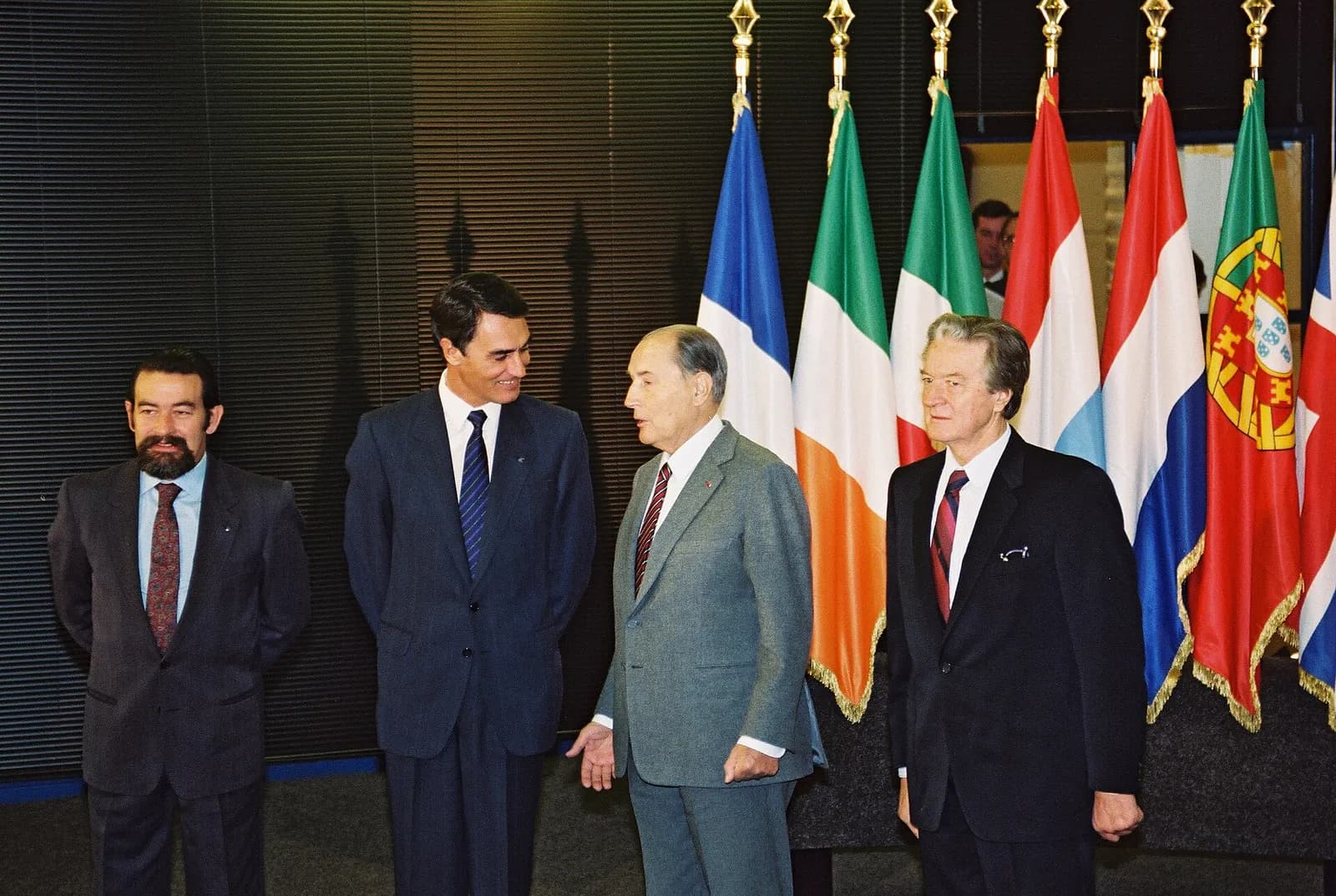
- João de Deus Pinheiro (left) and Aníbal Cavaco Silva with France's president François Mitterrand and foreign minister Roland Dumas at the Strasbourg European Council on 9 December 1989, two years before the Maastricht summit. Christian Lambiotte / European Communities, 1989 / EC - Audiovisual Service, CC BY 4.0, via Wikimedia Commons.
- The Treaty on European Union on display at the Palazzo dei Conservatori in Rome in March 1997, for the fortieth anniversary of the Treaties of Rome. Italy keeps the treaty's original. Still from a European Commission video. European Commission, CC BY 3.0, via Wikimedia Commons.
- A terrace of the Centro Cultural de Belém in Lisbon, whose conference centre hosted Portugal's first presidency in 1992, with the Jerónimos Monastery behind the flags. Photographed in July 2007. Szilas, CC0, via Wikimedia Commons.