

José Travassos and the Cinco Violinos, Sporting's forward line
Five forwards played together for Sporting for only three seasons, from 1946 to 1949, and won the league each time. The inside left, José Travassos, became the first Portuguese footballer chosen for a Rest of Europe side.
At a glance
- José Travassos, inside left of Sporting's Cinco Violinos (Five Violins), died in Lisbon on 12 February 2002, aged 75.
- The Five Violins were Jesus Correia, Vasques, Peyroteo, Travassos and Albano. They played together from 1946 to 1949, and Sporting won the league in all three seasons.
- In 1946/47 Sporting scored 123 goals in 26 league games. The centre forward, Fernando Peyroteo, scored 43 of them; his record of about 1.68 league goals a game has never been matched in Portugal.
- On 13 August 1955 in Belfast, Travassos became the first Portuguese player to appear for a Rest of Europe side, which beat Great Britain 4–1. He was called “Zé da Europa” from then on.
- Weeks later, on 4 September 1955, Travassos played in Sporting's 3–3 draw with Partizan at Jamor, the first match ever played in the European Cup.
A round of applause in Lisbon
On 13 February 2002 the Sporting family said goodbye to José Travassos with a strong, emotional round of applause. He had died in Lisbon the day before, on a Tuesday, ten days short of his 76th birthday. Hilário, who had played alongside him, told the sports paper Record that Travassos “left us without a single enemy”.
Travassos had been retired for more than 40 years. People still knew him as one of the Cinco Violinos, the Five Violins, the forward line that won three league titles in a row for Sporting in the late 1940s. Older fans also knew him as “Zé da Europa”, Europe's Joe, a nickname he earned in Belfast in 1955.
Of the five, Fernando Peyroteo had died in 1978 and Albano in 1990. Vasques and Jesus Correia, the last two, both died in 2003.
Portuguese football before 1946
Portugal's national league was young. An experimental league began in 1934/35, and the official first division, whose winners were national champions, only started in 1938/39. Before that the title of Champion of Portugal went to the winner of a knockout cup.
Sporting Clube de Portugal, founded in Lisbon in 1906, won its first two national league titles in 1940/41 and 1943/44. Both came under Joseph Szabo, a Hungarian who had first come to Portugal as a player in 1926. He coached Sporting for 11 seasons in all and is still the club's coach with the most games, 299, and the most trophies, 12.
Szabo trained his players hard and fined those who came late. He brought Jesus Correia from Paço de Arcos to the club, and he gave the young centre forward Peyroteo extra coaching sessions. When a skinny 13-year-old called José Travassos came for a trial, Szabo sent him home. Club tradition says the boy was told to eat more cod and potatoes.
“To me, sir, when you walk on to the pitch you are not Peyroteo, you are the number 9.”
Five players, one line
Teams of the 1940s attacked with five forwards in a row: two wingers, two inside forwards and a centre forward. Sporting's line had Jesus Correia on the right wing, Peyroteo in the centre, Travassos at inside left and Albano on the left wing, with Vasques completing it. The journalist and coach Tavares da Silva called them the Five Violins because they played like an orchestra.
| Player | Nickname | Came from | With Sporting | Died |
|---|---|---|---|---|
| Jesus Correia | Necas | Paço de Arcos; also a roller hockey player | To 1953, when he chose roller hockey | 2003 |
| Manuel Vasques | Malhoa | Barreiro; worked at the CUF works from 12 | 1946 to 1958 | 2003 |
| Fernando Peyroteo | Stradivarius | Humpata, Angola; arrived in Lisbon in 1937 | 1937 to 1949 | 28 November 1978 |
| José Travassos | Zé da Europa | Lisbon (Lumiar); played for CUF | 1946 to 1959 | 12 February 2002 |
| Albano | – | Seixal; came through Barreirense | 1943 to 1957 | March 1990 |
Travassos and Vasques joined Sporting on the same day, 8 September 1946, and left on the same day, 7 September 1958; Travassos still played a few games until May 1959.
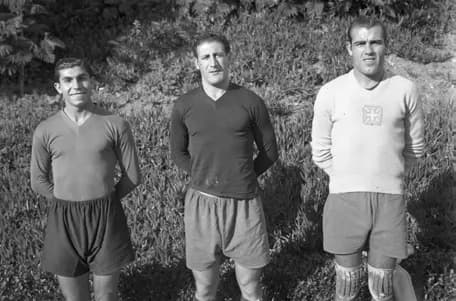
Travassos was born on 22 February 1926 at the Quinta do Lumiar in Lisbon, where Sporting then had its ground. Sporting's website gives his birth year as 1922, but Lisbon City Council, Mais Futebol and his age at death all point to 1926. He went to work at 16 in the shipyards of CUF (Companhia União Fabril), a big industrial group, and played for its football team. He was also a sprinter in Sporting's athletics section.
In 1946 FC Porto almost signed him. Its officials kept him for some days in a hotel in Porto and then in Escaramão, a village in the Minho. His brother helped him get back to Lisbon, the Porto officials believing he was going to a military medical inspection, and the next day he signed for Sporting instead.
Vasques grew up in Barreiro, across the Tagus from Lisbon, and was a carpenter's apprentice at CUF at 12 before moving to an office job. Benfica had not wanted him. He joined Sporting in 1946, stayed until 1958 and won eight league titles, and Observador counts him the club's third-highest scorer of all time.
Albano, a small left winger from Seixal, came through the youth teams of Barreirense and cost Sporting 20 contos in 1943, a fee the fans thought too high at first. He was known for his dribbling. Jesus Correia, a fast and skilful right winger, had been turned down by Belenenses before Szabo took him to Sporting.
“It rained so much that I shrank another two centimetres.”
Three seasons, three titles
The five first played together on 6 October 1946, in a Lisbon championship game against Belenenses. Their first league game together came on 24 November at Famalicão. Sporting conceded after 43 seconds and won 9–5; Peyroteo scored five, Vasques two, Travassos and Albano one each.
That season Sporting won 23 of their 26 league games, drew one and lost two, and scored 123 goals, almost five a game. Peyroteo scored 43. At home to Benfica they won 6–1, with three goals by Travassos, who was given a gold watch for it. The coach was an Englishman, Robert Kelly.
The second title, in 1947/48, came down to a derby. Sporting and Benfica finished level on 41 points, and Sporting had lost 3–1 at home to Benfica. In April 1948, at Benfica's ground, Sporting needed a win by a clear margin. They won 4–1, and Peyroteo scored all four. In the final table Sporting's goals, 92 for and 40 against, were three better than Benfica's 84 and 35, and that settled the title, though Observador's accounts of the exact tie-break differ.
Cândido de Oliveira, who was also a journalist, took charge for 1947/48 and 1948/49. In the third season Sporting scored 100 league goals and finished five points clear of Benfica. They also reached the final of the Latin Cup, an early international club tournament, beating Torino on the way and losing the final 2–1 to Barcelona.
8 September 1946
Travassos plays his first game for Sporting
A friendly against Vitória de Setúbal. Vasques joins the club the same day.
6 October 1946
The five play together for the first time
A Lisbon championship game against Belenenses.
24 November 1946
First league game as a line
Famalicão 5–9 Sporting.
1946/47
First title
123 goals in 26 games, six points clear of Benfica.
April 1948
Benfica 1–4 Sporting
Four goals by Peyroteo settle the 1947/48 title.
1948/49
Third title in a row
100 league goals; Latin Cup final lost to Barcelona.
25 September 1949
Peyroteo's farewell match
Sporting beat Atlético 2–1. He was 31.
Peyroteo's numbers
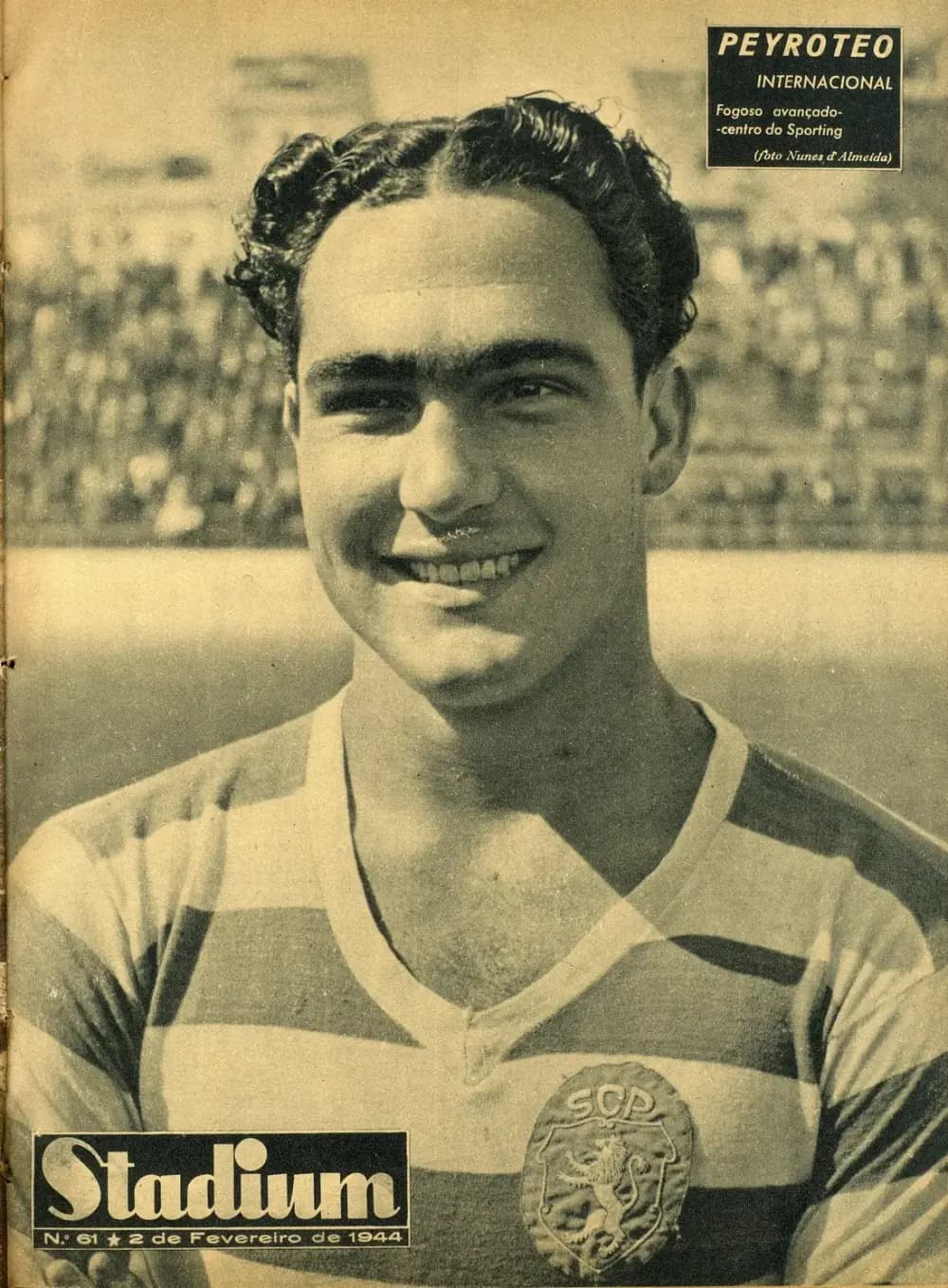
Fernando Peyroteo was born on 10 March 1918 at Humpata, in Angola, then a Portuguese colony. He reached Lisbon on 26 June 1937, aged 19, and scored twice on his debut that September, a 5–3 win over Benfica.
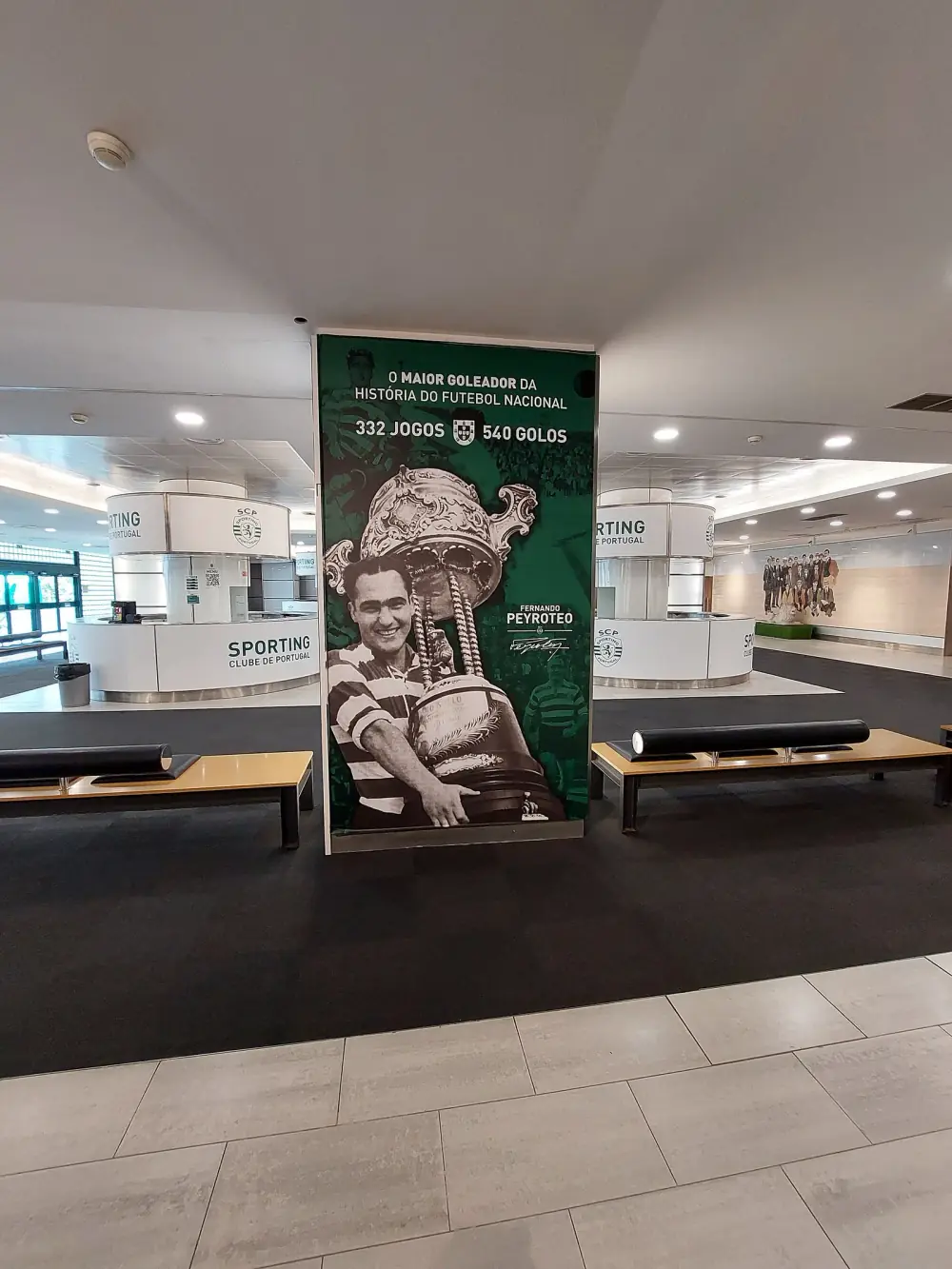
His goal totals depend on who counts and which games count. Diário de Notícias gives 544 goals in 334 official games for Sporting between 1937 and 1949; Observador has given both 544 and 541 in 332. In the league, RSSSF counts 330 goals in 197 games and Diário de Notícias 331, an average of 1.68 a game. A Bola notes that none of his league goals was a penalty.
Peyroteo's league goals in the six seasons he was top scorer
goals
Seasons from RSSSF's list of Portuguese top scorers. Season length varied: 14 rounds in 1937/38 and 1940/41, 18 in 1939/40, 22 in 1945/46 and 26 from 1946/47. The 1937/38 league was the experimental one, before the official first division, and in 1939/40 he shared the top spot with an FC Porto forward. Highlighted: Five Violins seasons. Observador gives 39 for 1948/49.
Show the data
| League goals | |
|---|---|
| 1937/38 | 34 |
| 1939/40 | 29 |
| 1940/41 | 29 |
| 1945/46 | 37 |
| 1946/47 | 43 |
| 1948/49 | 40 |
Some of his matches are still remembered. He scored nine goals against Leça in 1942, five in 22 minutes in another match, and eight against Boavista in his last season. He was also the first man to score at the Estádio Nacional, in a 3–2 win over Benfica after extra time when it opened in 1944.
He retired in 1949, aged 31. A Bola says he wanted to give all his time to the sports shop he had opened in Lisbon; Observador adds that the shop was close to failing and that the takings of his farewell match, on 25 September 1949, were to pay off his debts. In 1961 he briefly coached Portugal and gave Eusébio his international debut, in a 4–2 defeat by Luxembourg. He died of a heart attack on 28 November 1978, aged 60.
After the violins: four in a row
Benfica won the league in 1949/50, the first season without Peyroteo. Sporting then won four titles in a row, from 1950/51 to 1953/54, the first time any Portuguese club had done so. Vasques was the league's top scorer in 1950/51 with 29 goals. The first three titles came under another Englishman, Randolph Galloway, and the fourth under Szabo.
| Season | Champion | Runner-up | Sporting's coach |
|---|---|---|---|
| 1946/47 | Sporting | Benfica, 6 points behind | Robert Kelly |
| 1947/48 | Sporting | Benfica, level on points | Cândido de Oliveira |
| 1948/49 | Sporting | Benfica, 5 points behind | Cândido de Oliveira |
| 1949/50 | Benfica | Sporting, 6 points behind | – |
| 1950/51 | Sporting | FC Porto, 11 points behind | Randolph Galloway |
| 1951/52 | Sporting | Benfica, 1 point behind | Randolph Galloway |
| 1952/53 | Sporting | Benfica, 4 points behind | Randolph Galloway |
| 1953/54 | Sporting | FC Porto, 7 points behind | Joseph Szabo |
Two points for a win. Champions and points gaps from RSSSF; Sporting's coaches in their title seasons as listed by Observador.
The line was breaking up. Jesus Correia was also a roller hockey star, and at 28 he could no longer combine both sports with his job; he chose hockey. Travassos and Vasques stayed. In 1950/51, with other clubs at home and abroad interested in them, the club president, António Ribeiro Ferreira, raised their pay and put up a down payment so the two could set up a factory making refrigerators.
Travassos paid for his dribbling. He was tackled hard for years, and three of the four menisci in his knees had to be removed.
Zé da Europa: Belfast, 13 August 1955
In the summer of 1955 Travassos was on holiday when an invitation arrived to play for a Rest of Europe team against Great Britain in Belfast. The match celebrated the 75th anniversary of the Irish Football Association. No Portuguese player had been picked for such a side before.
“You can't imagine how happy I was to get the news. I think my performances against foreign teams must have helped me get the call-up.”
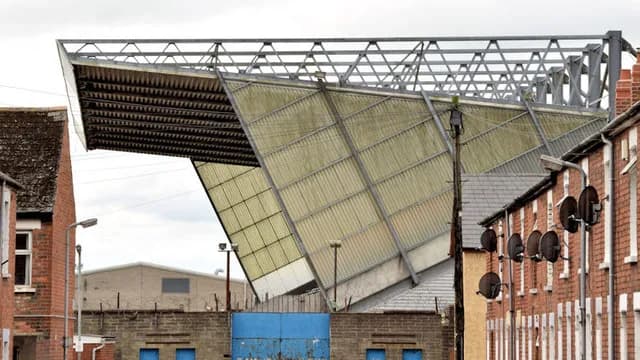
The game was played at Windsor Park on 13 August 1955 before about 35,000 people. Great Britain had Stanley Matthews, John Charles and Danny Blanchflower. The European side, chosen from eight countries, included Ernst Ocwirk of Austria, Raymond Kopa and Jean Vincent of France and the Yugoslav Bernard Vukas. Travassos played at inside left.
Robert Johnstone put Britain ahead after 25 minutes, and Vincent equalised two minutes later. Then Vukas scored three in eleven minutes near the end, the last a penalty, and Europe won 4–1. Travassos later said the British press praised Europe's three central forwards, calling them the wonder trio.
By then Travassos was a Portugal regular. He played in a 2–2 draw with Switzerland in Lisbon on 5 January 1947, and three weeks later helped beat Spain 4–1. He was in the side England beat 10–0 in Lisbon in May 1947, and in the one that beat England 3–1 in Porto on 22 May 1955. Mais Futebol credits him with 35 caps and six goals; Lisbon City Council's booklet gives 28 caps.
- Match
- Great Britain 1–4 Rest of Europe
- Date and place
- 13 August 1955, Windsor Park, Belfast
- Occasion
- 75th anniversary of the Irish Football Association
- Crowd
- About 35,000
- Scorers
- Johnstone 25; Vincent 27, Vukas 77, 87, 88 (penalty)
- Referee
- Jan Bronkhorst (Netherlands)
A crowd met him at Portela airport when he flew home, and from then on he was Zé da Europa. Sporting's account says he was paid £25 and given a commemorative plaque.
The first night of the European Cup
Three weeks later Travassos played in another first. The European Champion Clubs' Cup, today's Champions League, began in 1955/56, and clubs took part by invitation. Sporting had been chosen as champions of 1953/54, their seventh title in eight years. Benfica won the 1954/55 league, with Sporting third, but the invitation stood.
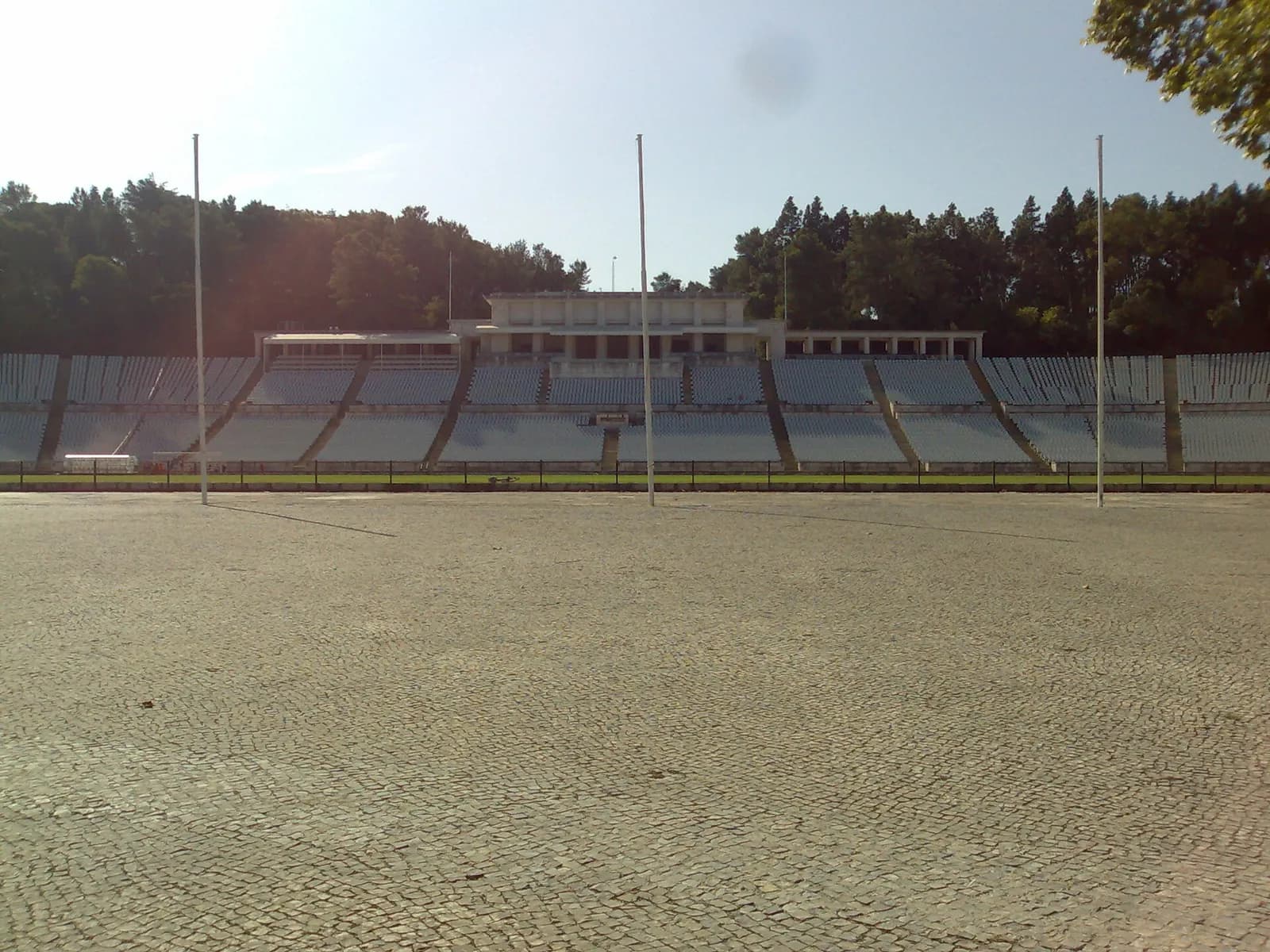
Sporting's new stadium at Alvalade was still being built, so on 4 September 1955 they played Partizan Belgrade at the Estádio Nacional at Jamor, before about 40,000 people. It was the first match of the competition. After 14 minutes João Martins scored the first goal in any UEFA club competition. UEFA's account says Vasques had won the ball from Partizan's centre half, Branko Zebec, to set it up.
Zebec was hurt in that challenge and, with no substitutes allowed, played on as a passenger. Partizan were the better side and led 3–2 until Martins equalised in the 78th minute. In Belgrade on 12 October, Miloš Milutinović scored four times and Partizan won 5–2. Travassos and Vasques played in both legs.
Last seasons and a long retirement
The Estádio José Alvalade opened on 10 June 1956. Travassos became captain in 1957, and in 1957/58 Sporting won the title on equal points with FC Porto, their first at the new stadium. It was his eighth league title. Fans carried him and Vasques off the pitch.
Sporting held a match in his honour on 7 September 1958 and beat Benfica 2–0. He played on into 1959, and his last game was a Portuguese Cup tie at Coimbra on 24 May 1959. Afterwards he coached Sporting's youngest players for a few years, winning titles with them, then gave it up for hunting, his other passion.
| Measure | Figure | Source |
|---|---|---|
| League titles with Sporting | 8 (1946/47 to 1948/49, 1950/51 to 1953/54, 1957/58) | Mais Futebol; Lisbon City Council |
| Portuguese Cups | 2 (1947/48 and 1953/54) | Lisbon City Council; Sporting |
| Games and goals for Sporting, club's count | 321 games, 127 goals | Sporting (2016) |
| All games for Sporting, including friendlies | 457 games, 172 goals | Lisbon City Council (2015) |
| League games and goals | 249 games, 99 goals | Lisbon City Council (2015) |
| Portugal caps and goals | 35 caps, 6 goals | Mais Futebol (2002) |
Mais Futebol lists only the 1953/54 Portuguese Cup among his honours. Lisbon City Council's booklet gives 28 caps.
He won the Medal of Sporting Merit and, in 1986, Sporting's Stromp prize. Mais Futebol's obituary remembered a creative midfielder with rare vision, an unexpected pass and a hard shot.
Why the Five Violins still matter
Peyroteo's league record has lasted more than 75 years. A Bola counts 331 top-flight goals, 14 more than Eusébio and Fernando Gomes, and no one has come close to his rate of goals per game. In 2018, his centenary year, Sporting's board proposed making him member number 9, the number he wore.
The name still carries weight at the club. In 2017 Sporting played a pre-season friendly against Fiorentina for a trophy named after the Cinco Violinos, and Observador counted the five's combined record at 1,211 goals.
Lisbon put Travassos's name on a street beside the Estádio José Alvalade in 2007. The city's 2015 booklet about the street calls him one of the greatest players in the history of Sporting and of Portuguese football.
FAQs
Who were Sporting's Cinco Violinos?
The Cinco Violinos, or Five Violins, were Sporting's forward line of the late 1940s: Jesus Correia, Vasques, Peyroteo, Travassos and Albano. They played together from 1946 to 1949 and won the Portuguese league in all three seasons. The journalist Tavares da Silva gave them the name.
Why was José Travassos called Zé da Europa?
On 13 August 1955 he became the first Portuguese player to appear for a Rest of Europe team, which beat Great Britain 4–1 at Windsor Park, Belfast, for the Irish Football Association's 75th anniversary. A crowd met him at Lisbon airport when he came home, and from then on he was Zé da Europa, Europe's Joe.
How many goals did Fernando Peyroteo score?
Counts differ. The most cited total is 544 goals in 334 official games for Sporting from 1937 to 1949; Observador has also given 541 in 332. In the league he scored 330 or 331 goals in 197 games, about 1.68 a game.
Who played the first European Cup match?
Sporting and Partizan Belgrade, at the Estádio Nacional near Lisbon on 4 September 1955. It finished 3–3, and Sporting's João Martins scored the competition's first goal after 14 minutes. Partizan won the second leg 5–2.
When did José Travassos die?
He died in Lisbon on 12 February 2002, aged 75. A street beside the Estádio José Alvalade, Rua José Travassos, is named after him.
On the timeline
Open the timelineNearby moments from portugal in europe (1986–today).
UNESCO inscribes the Alto Douro Wine Region on its World Heritage List as an 'evolving, living cultural landscape'. Its steep schist terraces, carved by hand over centuries along the Douro and its tributaries, produce port wine in a region demarcated in 1756, often called the world's first officially demarcated wine region.
Portugal's banks and shops open for the first full business day of the euro. Notes and coins had gone into circulation at midnight on New Year's Day, and the escudo, the currency of the Republic since 1911, was withdrawn from use at the end of February.
The floodgates of the Alqueva dam on the Guadiana are closed, and the reservoir begins to fill. Covering some 250 square kilometres when full, it is often called the largest artificial lake in Western Europe. Its water brought irrigation and olive and almond groves to the parched Alentejo, and it drowned the old village of Luz, rebuilt nearby.
Travassos and the Cinco Violinos
Death of José Travassos, one of Sporting's 'Cinco Violinos' (Five Violins), the forward line that ruled Portuguese football in the 1940s. Nicknamed 'Zé da Europa', in 1955 he became the first Portuguese player picked for a Rest of Europe XI, against Great Britain.
Portuguese legislative elections are held, won by the PSD under José Manuel Durão Barroso, who would later become President of the European Commission (2004–2014).
Portugal crash out of the World Cup in Incheon, beaten 1–0 by co-hosts South Korea after finishing with nine men. Striker João Pinto, sent off for a lunge on Park Ji-sung, punches the Argentine referee Ángel Sánchez in the stomach and is banned by FIFA for four months — an inglorious end for the 'Golden Generation' at its first World Cup.
The first line of the Metro do Porto, running from Senhor de Matosinhos to Trindade, is inaugurated by Prime Minister Durão Barroso. Part metro, part street-running tram, the light-rail network has since grown to six lines and some 85 stations.
Coming up in history
All long reads 14 February 1797Nelson's bridge off the Algarve: the Battle of Cape St Vincent, 1797
 15 February 1941The 1941 cyclone: the February storm that wrecked Portugal’s coast and forests
 16 February 1986From 8 per cent to Belém: Mário Soares wins the 1986 run-off
 17 February 1843The Ponte Pênsil: Porto's first fixed bridge over the Douro, 1843
21 sources
Archives, scholarship and reporting this article was checked against.
- 1
José Travassos, futebolista, 1926-2002 (Rua José Travassos)Câmara Municipal de Lisboa, Comissão Municipal de Toponímia (text by Isménia Neves), March 2015
- 2
O Zé da Europa (biografia)Mais Futebol, 12 February 2002
- 3Quem eram os Cinco Violinos, a famosa linha avançada que marcou mais de 1.200 golos? (Bruno Roseiro)Observador, 29 July 2017
- 4A máquina de golos, uma fábrica de frigoríficos, Chirola e o “será do guaraná”: as histórias que marcaram 20 campeonatos do SportingObservador, 20 May 2024
- 5
Matches of supranational representative teams 1937-1970RSSSF (Rec.Sport.Soccer Statistics Foundation)
- 6
Sixty-five years of European club football (José Nuno Pimentel)UEFA.com, 3 September 2020
- 7Do espólio perdido na guerra às memórias do filho de PeyroteoDiário de Notícias, 3 February 2018
- 8
Sporting: faz hoje 46 anos que Peyroteo morreuA Bola, 28 November 2024
- 9
- 10
József Szabó: mais jogos e troféus e o primeiro 'tetra'Record, 17 March 2017
- 11Peyroteo, o goleador que desafiava o impossível e só falhou o curso de medicina veterináriaObservador, 11 March 2018
- 12
O homem que nasceu Travassos e se tornou o Zé da EuropaSporting Clube de Portugal, 28 July 2016
- 13
- 14
Portugal: list of topscorersPaulo Claro, Simon Preston, João Nunes and Roberto Di Maggio, RSSSF
- 15
- 16
- 17
- 18Liga dos Campeões: João Martins, o corticeiro alentejano que marcou o primeiro golo da prova em 1955Observador, 3 June 2017
- 19
- 20
- 21
Image credits
- The Estádio Nacional at Jamor, west of Lisbon, photographed in the late 2000s. Opened in 1944, it is where Sporting and Partizan played the first match of the European Cup on 4 September 1955. Tagido, Public domain, via Wikimedia Commons.
- Travassos (left) with Serafim of Belenenses and the FC Porto goalkeeper Barrigana, Portugal players at the Estádio Nacional, some time between 1944 and 1950. Firmino Marques da Costa, Public domain, via Wikimedia Commons.
- Peyroteo on the cover of the Lisbon sports magazine Stadium, 2 February 1944, described as Sporting's “fiery centre forward”. The photograph is credited to Nunes d'Almeida. Stadium: revista desportiva S. 2, n.º 61, 2 Fev. 1944, Public domain, via Wikimedia Commons.
- Windsor Park, Belfast, seen from the neighbouring streets in June 2014. The ground has since been largely rebuilt. Albert Bridge, CC BY-SA 2.0, via Wikimedia Commons.
- A panel in the reception of Sporting's Estádio José Alvalade, photographed in 2023, calls Peyroteo the greatest goalscorer in the history of Portuguese football and credits him with 540 goals in 332 games. Threeohsix, CC BY-SA 4.0, via Wikimedia Commons.