

Nelson's bridge off the Algarve: the Battle of Cape St Vincent, 1797
A British fleet that had sailed from Lisbon met a Spanish fleet almost twice its size off Portugal's south-western corner. A commodore left the line on his own initiative, and by dusk four Spanish ships were in British hands.
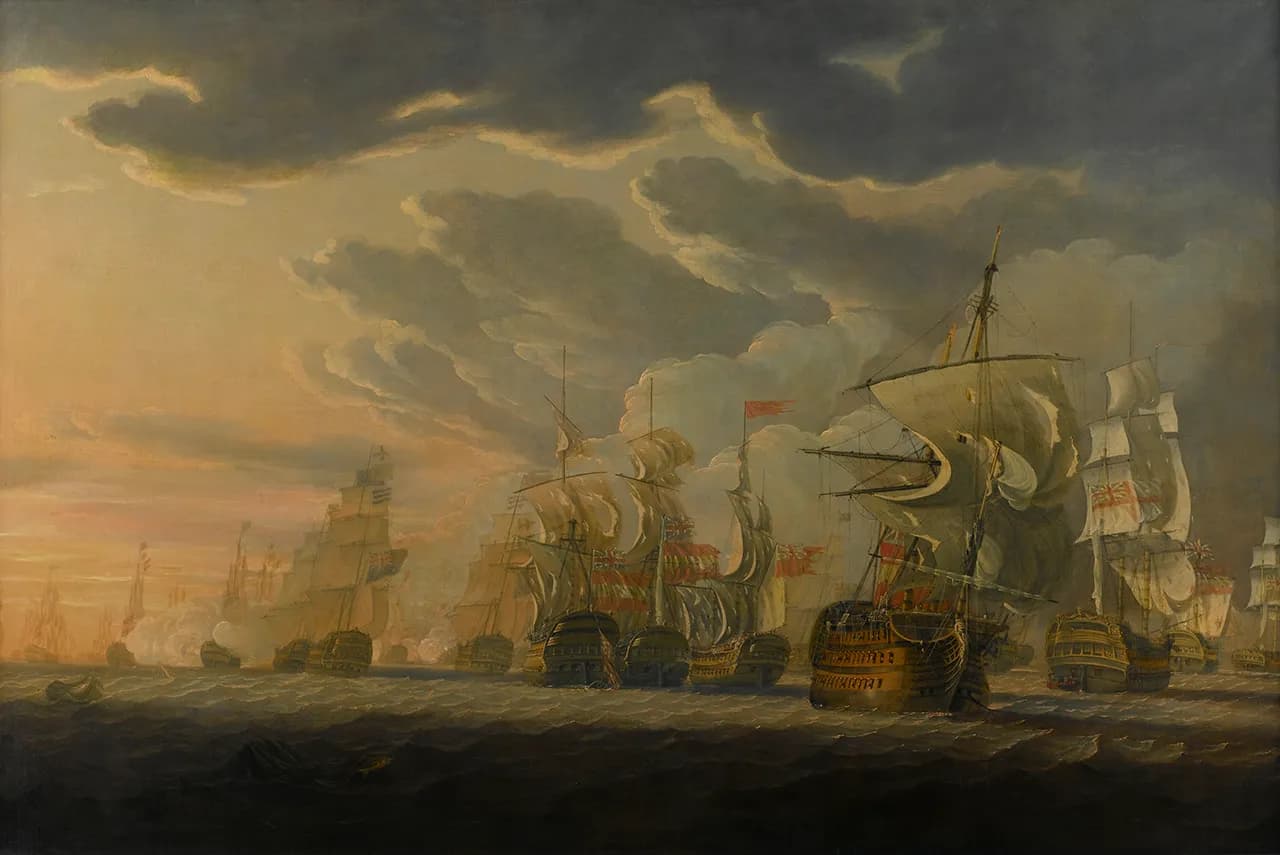
At a glance
- On 14 February 1797 a British fleet of 15 ships of the line under Admiral Sir John Jervis attacked a Spanish fleet of up to 27 under José de Córdoba, some eight leagues west-south-west of Cape St Vincent, the south-western tip of the Algarve.
- Jervis had sailed from the Tagus on 18 January; his orders were now to defend Portugal, Britain's ally, after Spain declared war on Britain on 5 October 1796.
- Commodore Horatio Nelson wore his ship, the Captain, out of the British line to block the Spanish, then boarded the San Nicolás and crossed from her deck to take the three-decker San José.
- Four Spanish ships were captured. Jervis's official returns gave 73 British killed and 227 wounded, and 261 killed and 342 wounded in the four prizes alone.
- The fleet and its prizes anchored in Lagos Bay on 16 February and reached Lisbon on 28 February. Jervis was made Earl of St Vincent; Córdoba was dismissed and banned from the court.
Signal guns in the dark
At half past two in the morning of 14 February 1797, a small Portuguese frigate, the Carlotta, came alongside the British flagship Victory somewhere off the coast of the Algarve. Her captain, a man named Campbell whom James believed to be a Scot, brought news that the British had half guessed from the signal guns they had heard all night: the Spanish fleet was only about five leagues to windward.
Day broke dark and hazy. Admiral Sir John Jervis had 15 ships of the line formed in two compact columns, with Cape St Vincent about eight leagues away to the east by north. At 10.49 the sloop Bonne Citoyenne signalled that the strange ships to the south-west were ships of the line, 25 of them. Jervis had known the Spanish could hardly have fewer than 19 and might have as many as 30.
Jervis did not wait for the Spanish to form up. Their ships were straggling in two loose groups with a wide gap between them, and he steered his line straight for the gap.
“Such a Moment was not to be lost; and, confident in the Skill, Valour and Discipline of the Officers and Men I had the Happiness to command, and judging that the Honor of His Majesty's Arms and the Circumstances of the War in these Seas required a considerable Degree of Enterprize, I felt myself justified in departing from the regular System.”
Portugal between Britain, France and Spain
Portugal's usual policy in the late eighteenth century was to stay neutral while keeping its old alliance with England and avoiding a quarrel with France or Spain. Lisbon's first concerns, in the historian Luís de Oliveira Ramos's summary, were the country's independence and its overseas empire. Neutrality also paid: Portugal re-exported Brazilian sugar and cotton to the rest of Europe, and its trade balance stayed in surplus. The French Revolution broke that comfortable position.
After Louis XVI was executed in 1793, Portugal joined Spain and Britain in the coalition against France and sent troops to fight beside the Spanish in Roussillon and Catalonia. The campaign went badly. In 1795 Spain made a separate peace with France at Basel, leaving Portugal still formally at war with the French and exposed to an attack overland.
Spain then changed sides altogether, allied itself with France and declared war on Britain in a manifesto dated 5 October 1796. With the French and Spanish fleets combined, the British fleet in the Mediterranean was outnumbered 38 ships of the line to 13, and by the end of the year it had pulled out. Its new orders were plain. Nelson, evacuating the British base on Elba, wrote that the fleet's object now was “the defence of Portugal, and keeping in the Mediterranean the Combined Fleets”.
Lisbon became the fleet's base. Jervis entered the Tagus on 21 December 1796, and at the turn of the year he lay there with 11 ships of the line, while the 74-gun Zealous was repaired in the city.
When Jervis sailed on 18 January 1797, his first task was to escort a convoy of Brazil merchantmen and Portuguese warships out to a safe latitude. The start was not lucky. The 98-gun St George ran foul of a Portuguese frigate, then stuck fast on the South Cachopo, one of the sandbanks at the mouth of the river, and had to go back for repairs.
1793
Portugal joins the coalition against France
Portuguese troops fight beside the Spanish in Roussillon and Catalonia.
1795
Peace of Basel
Spain makes a separate peace with France; Portugal is left at war.
5 October 1796
Spain declares war on Britain
21 December 1796
The British fleet reaches Lisbon
Driven out of the Mediterranean, Jervis enters the Tagus.
18 January 1797
Jervis sails from Lisbon
He escorts a Portuguese convoy, then heads for his rendezvous off Cape St Vincent.
1 February 1797
Córdoba leaves Cartagena
His fleet is bound for Cádiz with 27 ships of the line.
6 February 1797
Parker's five ships join Jervis
The British fleet rises to 15 of the line.
13 February 1797
Nelson rejoins in the frigate Minerve
He has sighted the Spanish fleet near the Strait of Gibraltar.
The corner of Portugal
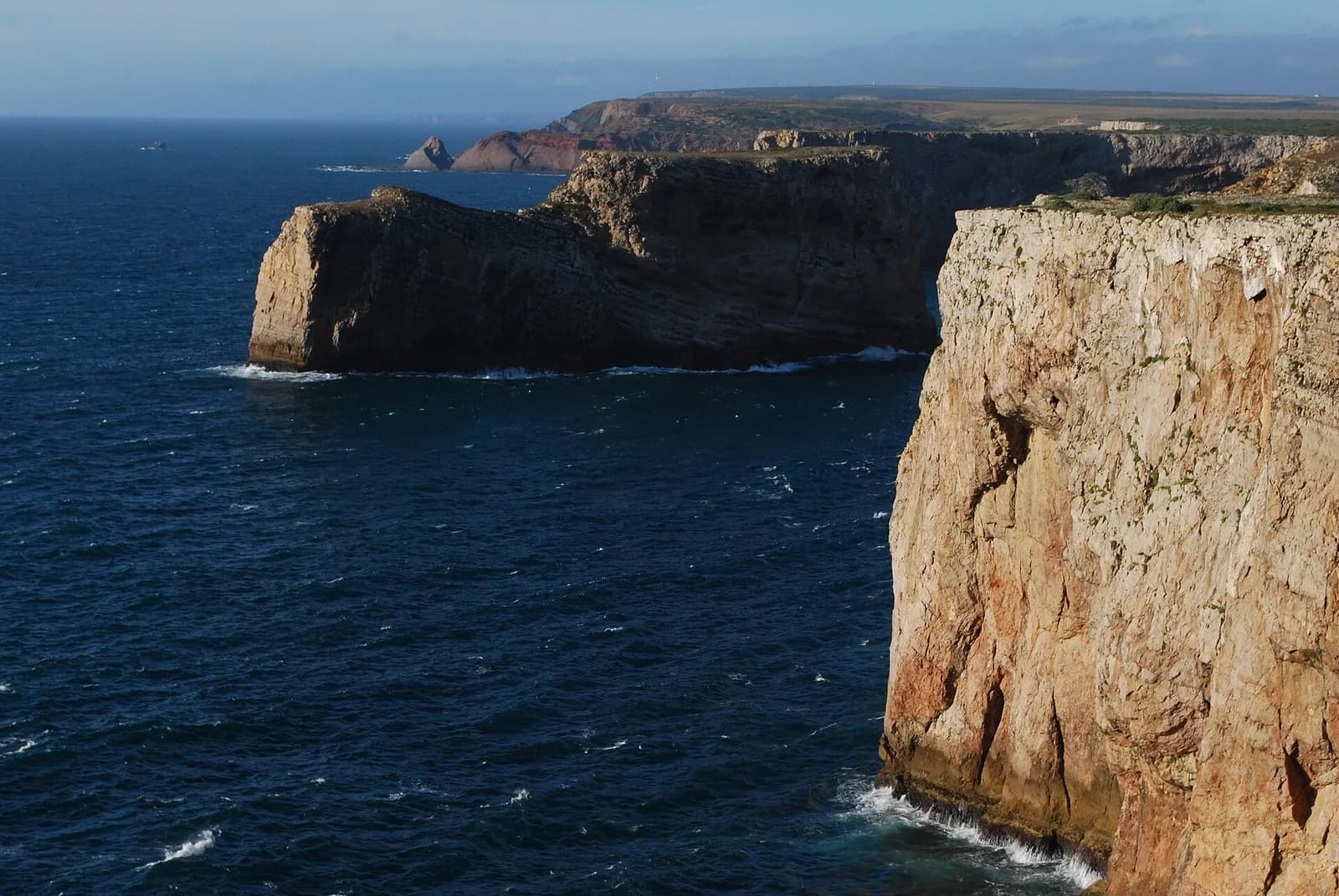
Cape St Vincent, Cabo de São Vicente in Portuguese, is where the country's west coast turns east into its south coast. It is the tip of a wedge of high, wind-beaten coast in the south-west Algarve that the Romans called the Promontorium Sacrum, the sacred headland. The cape is named after Saint Vincent, a fourth-century martyr whose relics were kept on the promontory until they were carried by sea to newly conquered Lisbon in the twelfth century. Sagres, the town associated with Prince Henry the Navigator, stands on the same promontory.
Any ship sailing between the Strait of Gibraltar and Lisbon had to round it, and Jervis had fixed his rendezvous with the reinforcements from England in the waters off the cape. Strong south-easterly winds kept him from reaching it for days. The same winds decided the Spanish route: Córdoba was bound for Cádiz, but the easterly gale that rushed him through the Strait drove his fleet well out into the Atlantic, past his own port.
Where he meant to go after Cádiz is less certain. James says Cádiz was his destination and that talk of his sailing on to Brest, to join the French for an invasion of Britain, was only a rumour. Royal Museums Greenwich, describing one of its paintings of the battle, says he was bound for Brest by way of Cádiz.
The battle was fought out at sea, roughly 45 kilometres west-south-west of the cape. Its Portuguese chapter came afterwards, on the sheltered south coast to the east, in the Bay of Lagos.
Fifteen against twenty-seven
Jervis's list of the enemy, sent home with his dispatch, named 27 Spanish ships of the line. They included six three-deckers of 112 guns and the four-decked Santísima Trinidad of 130 guns, Córdoba's flagship and the largest ship on either side. Not all 27 were together that morning. Three had been detached to escort troop transports into Algeciras, across the bay from Gibraltar, and only one had rejoined, so 25 were present when the British counted them.
The Spanish fleet was weaker than its numbers. William James, the British naval historian whose detailed account first appeared in the 1820s, said its crews were largely pressed landsmen and newly raised soldiers, with only 60 to 80 real seamen in each ship. The Spanish had also been told by an American ship that Jervis had only nine of the line. When the haze cleared and they saw 15 in two tight columns, their ships were still scattered.
- Date
- 14 February 1797, about 11.30 a.m. to 5 p.m.
- Place
- Atlantic, about eight leagues west-south-west of Cape St Vincent, Algarve
- British
- 15 ships of the line under Admiral Sir John Jervis
- Spanish
- 27 ships of the line on Jervis's list (25 present that morning) under José de Córdoba
- Spanish ships taken
- San José and Salvador del Mundo (112 guns), San Nicolás (80), San Ysidro (74)
- Where the prizes went
- Lagos Bay, Algarve, on 16 February; Lisbon on 28 February
Nelson leaves the line
Jervis's column passed through the gap at about half past eleven, firing as it went, and cut off a smaller Spanish group to leeward from the main body of about 16 ships. Then, at about noon, the British began to tack one after another, turning through the wind onto the opposite course, to chase the main body. The Culloden, under Thomas Troubridge, led the way round.
Tacking in succession was slow. Each ship had to sail on to the point where the leader had turned, and the rear of the British line was still heading away from the enemy. Third from the rear was the Captain, a 74 flying the broad pendant of Commodore Horatio Nelson, aged 38, a captain given temporary command of a squadron. Shortly after one o'clock he saw the leading Spanish ships bear away before the wind, as if to slip round the tail of the British line and rejoin their separated division.
Nelson did not wait for his turn. He ordered the Captain to wear, turning away from the wind, and took her out of the line between the Diadem and the Excellent, straight across the bows of the leading Spanish ships. By his own account he was in action by about a quarter past one with the Santísima Trinidad, the San José, the Salvador del Mundo, the San Nicolás and others, one 74 against several far bigger ships. Troubridge's Culloden soon came up to support him.
Whether he had permission is still argued over. Nelson's signed account says Jervis had just signalled the fleet to tack in succession and that he chose to do something else. James argued that Jervis had hoisted a signal at 12.51 telling ships to take suitable stations and engage as they came up, so that Nelson obeyed its spirit. Nicolas, who edited Nelson's letters in the 1840s, rejected this firmly.
Jervis did not seem to mind. At dusk, by Nelson's account, the admiral embraced him on the Victory's quarter-deck and said he could not sufficiently thank him. Later that evening, in an anecdote told by Jervis's biographer Jedediah Tucker, his first captain, Robert Calder, hinted that the move had been unauthorised. Jervis agreed it was a breach of orders, and said that if Calder ever committed such a breach he would forgive him too.
2.30 a.m.
A Portuguese frigate reports the Spanish fleet to windward
10.49 a.m.
The Bonne Citoyenne signals 25 ships of the line
About 11.30 a.m.
Jervis's line passes between the two Spanish groups
About 12 noon
The Culloden leads the British round in pursuit
About 1.10 to 1.15 p.m.
Nelson wears the Captain out of the line
Nelson's two accounts give slightly different times.
About 2.53 p.m.
The San Ysidro strikes to the Excellent
Mid afternoon
Nelson boards the San Nicolás, then the San José
About 5 p.m.
The action ends
The Spanish reunite their divisions; Jervis gathers his ships and prizes.
“Nelson's Patent Bridge for boarding First-Rates”
For about an hour the Captain and the Culloden took the fire of the leading Spanish ships, until the Blenheim came between them and the enemy. Cuthbert Collingwood's Excellent, called up from the rear by Jervis, then battered the Salvador del Mundo and forced the San Ysidro to strike her colours; the Salvador del Mundo surrendered soon afterwards as the Victory came up. Collingwood sailed on to ease the pressure on Nelson, an old friend, and passed within ten feet of the San Nicolás with a full broadside.
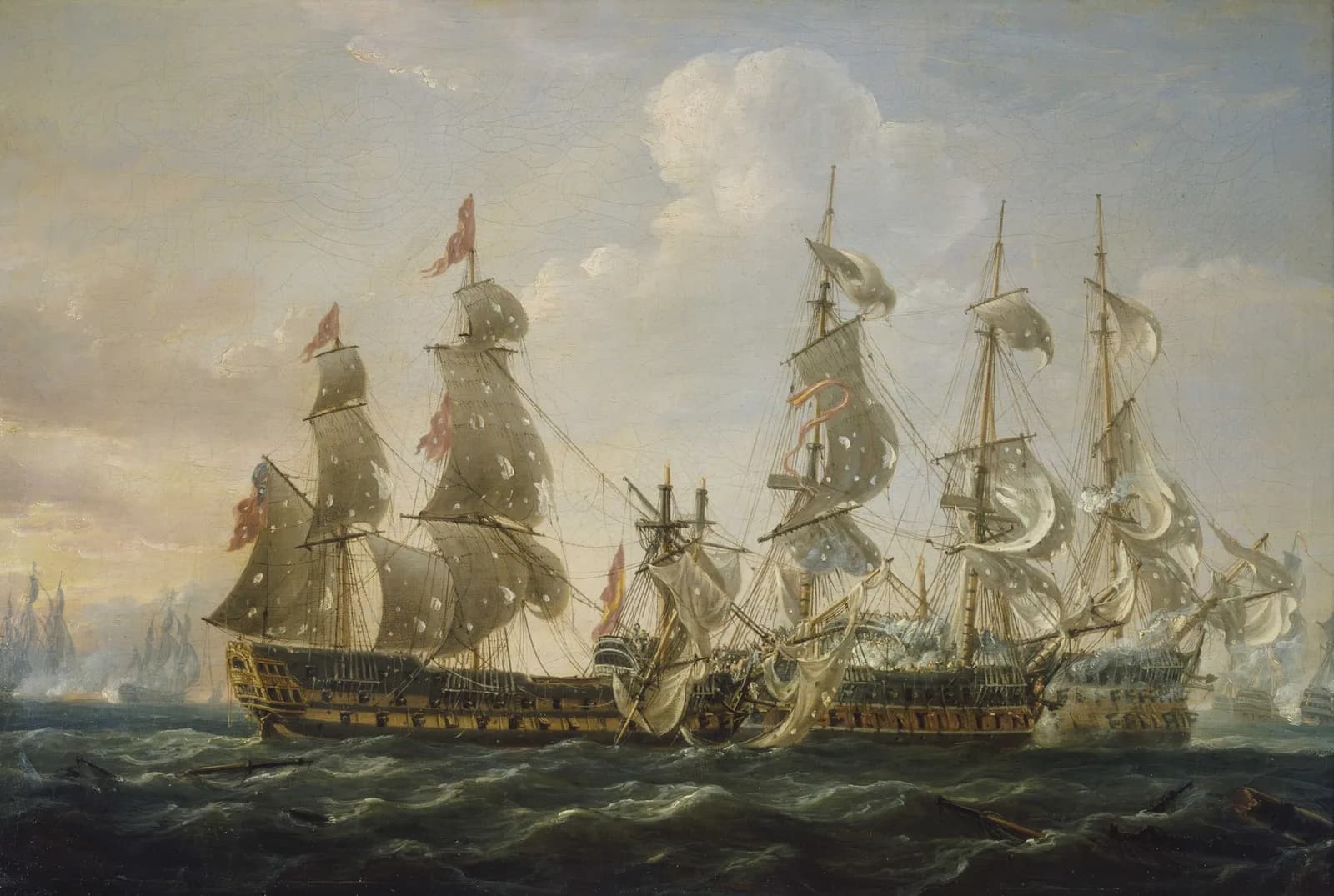
The San Nicolás swung up into the wind and fell foul of the bigger San José, which had already lost her mizzen mast. The Captain was by now a wreck. Her fore-topmast was down, her wheel shot away, and she had “not a sail, shroud, or rope left”, Nelson wrote. She could neither keep the line nor chase. So he put the helm over, ran her into the San Nicolás and called for boarders.
Edward Berry, Nelson's former first lieutenant, was first into the Spanish ship's mizzen chains. One of the soldiers of the 69th Regiment serving aboard smashed the window of the upper quarter-gallery and jumped in; Nelson followed. The cabin doors were fastened and Spanish officers fired their pistols, but the boarders broke through and the Spanish commodore fell. Nelson later recorded that Tomás Geraldino was killed on board. By the time Nelson reached the quarter-deck, Berry held the poop and the Spanish ensign was coming down.
Then muskets and pistols opened from the stern gallery of the San José, lying alongside. Nelson had soldiers fire back, sent more men into the San Nicolás and led a second party across her deck into the three-decker's main chains. A Spanish officer leaned over the rail and said they surrendered. On the quarter-deck the Spanish captain presented his sword and told Nelson that the admiral, Francisco Xavier Winthuysen, was dying of his wounds below.
“on the quarter-deck of a Spanish First-rate, extravagant as the story may seem, did I receive the Swords of vanquished Spaniards; which, as I received, I gave to William Fearney, one of my bargemen, who put them with the greatest sangfroid under his arm.”
Nelson put his losses in the boarding at about seven killed and ten wounded, with about 20 Spaniards killed in what he called a foolish resistance; none died taking the San José. The sailors soon had a name for what he had done, using one enemy ship as a gangway into another. Nelson repeated it with pleasure in his letters: “Nelson's Patent Bridge for boarding First-Rates”.
Not everyone gave him all the credit. James pointed out that the Prince George had been firing into the San José as she fouled the San Nicolás. Nelson himself told a friend that he did not pretend the two ships might not have fallen had he not boarded them, though they might just as well have got away to the rest of the Spanish fleet.
Counting the cost
The fighting died away at about five in the evening. The Santísima Trinidad, badly damaged, may have struck her colours, but she was never taken possession of and was towed away. With night coming on and the Spanish divisions reunited, Jervis gathered his fleet around the four prizes instead of pressing on. James later wondered whether a night action might have taken more.
Jervis's return, printed in the Gazette, listed 73 British killed and 227 wounded, a total of 300. The losses fell on a handful of ships. Nelson's Captain had 24 killed and 56 wounded, the most in the fleet, while the Egmont had not a man hurt. James thought the official figure too low, because, unusually, the slightly wounded had been left off the returns, and suggested at least 400.
British killed and wounded by ship, 14 February 1797
men
- Killed
- Wounded
From Jervis's return of killed and wounded in the London Gazette of 3 March 1797, which gives 73 killed and 227 wounded in all. The ships that fought the Spanish main body at close range, led by Nelson's Captain, took most of the losses.
Show the data
| Killed | Wounded | |
|---|---|---|
| Captain | 24 | 56 |
| Blenheim | 12 | 49 |
| Excellent | 11 | 12 |
| Culloden | 10 | 47 |
| Prince George | 8 | 7 |
| Irresistible | 5 | 14 |
| Namur | 2 | 5 |
| Victory | 1 | 5 |
| Barfleur | 0 | 7 |
| Orion | 0 | 9 |
| Goliath | 0 | 8 |
| Colossus | 0 | 5 |
| Diadem | 0 | 2 |
| Britannia | 0 | 1 |
| Egmont | 0 | 0 |
Spanish losses were much heavier. The four captured ships alone had 261 killed and 342 wounded among about 2,900 men. The San Nicolás, which Nelson's men had fought into and across, lost 144 killed. Spanish accounts quoted by James put the losses in the Santísima Trinidad at more than 200 killed and wounded. Jervis's returns covered only the prizes, so the losses in the rest of the Spanish fleet are not known exactly; James guessed that the Spanish total fell little short of 1,000.
| Ship | Guns | Men aboard | Killed | Wounded |
|---|---|---|---|---|
| San José | 112 | 917 | 46 | 96 |
| Salvador del Mundo | 112 | 850 | 42 | 124 |
| San Nicolás | 80 | 630 | 144 | 59 |
| San Ysidro | 74 | 525 | 29 | 63 |
| Total | 378 | 2,922 | 261 | 342 |
Killed and wounded from the Spanish returns printed with Jervis's dispatch. Guns and men from James, who took the crews from the prize-money warrants. Jervis's list gives the San Nicolás 84 guns; Nelson and James give 80. The British often wrote the San José as San Josef, the name she kept in the Royal Navy.
Lagos, Lisbon and Córdoba's disgrace
On 15 February the Spanish, though still stronger and to windward, bore down once and then hauled off. On the 16th, at about three in the afternoon, the British fleet and its prizes anchored in Lagos Bay, on the Algarve's south coast. Jervis wrote his dispatch there, and the roughly 3,000 Spanish prisoners from the prizes were landed on Portuguese soil against a receipt from the proper officer.
The fleet left Lagos on 23 February and anchored in the Tagus on the 28th. The four prizes, jury-rigged and short-handed, were said to have beaten every British ship working up the river, and Lisbon greeted the victory warmly. They served for a time on the Lisbon station before sailing for England in the autumn. Córdoba's fleet limped into Cádiz on 3 March; the crippled Santísima Trinidad got there later in the month.
In London the news arrived with Jervis's first captain, Robert Calder, and was published on 3 March. In May Jervis was made Earl of St Vincent, with a pension of £3,000 a year; a peerage had already been promised before the battle. Nelson was made a Knight of the Bath. His promotion to rear-admiral came through on 20 February in a general promotion of flag officers.
Jervis's public dispatch praised only Calder and singled out none of the captains who had fought hardest. He commended Troubridge and Nelson in a private letter to Lord Spencer, the First Lord of the Admiralty. Sir John Barrow, an Admiralty secretary, later claimed that Calder had persuaded Jervis to leave Nelson out because praising a disobedient officer would set a bad example.
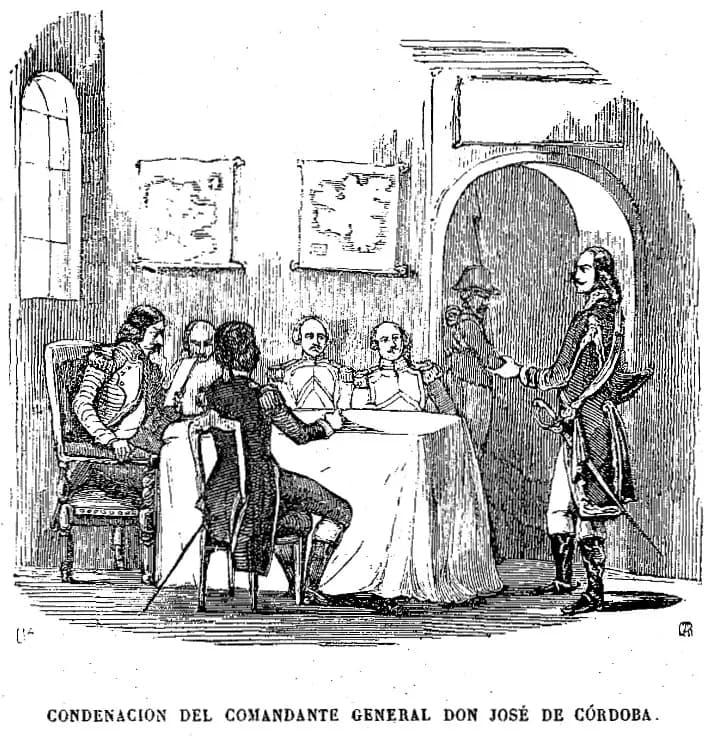
In Spain the defeat was punished. According to James, Córdoba was deprived of all his offices, declared unfit ever to serve again and banned from the court and the main seaport towns. His second in command, the Count of Morales de los Ríos, lost his rank, as did four captains, and other officers were suspended or reprimanded. James thought the Spanish government itself was to blame for sending such badly manned ships to sea.
Why it still matters
In Britain the victory brought Jervis his earldom, baronetcies for two of his admirals and the Order of the Bath for Nelson, and the City of London gave Nelson its freedom. James's verdict was cooler: the victory was great politically, he wrote, but less so as a feat of arms given how little resistance most Spanish ships put up. It did keep the Spanish fleet bottled up in Cádiz, where Jervis blockaded it from April, using Lisbon as his base.
For Portugal the British fleet in the Tagus was protection, but it also tied the country to Britain while France threatened it overland. That August Portugal's envoy in Paris, António de Araújo de Azevedo, signed a peace treaty with France that would have restricted Portuguese trade with Britain and help for British fleets. Under British protests Lisbon never ratified it, and the French declared it void that autumn.
Not every Portuguese observer was impressed by British sea power. Miguel Pereira Pinto Teixeira, a judge of the Porto appeal court, urged the Minister of the Kingdom in 1798 to break with Britain and come to terms with France. He wanted British warships sent out of Portuguese ports and the British officers serving in Portugal's army and navy retired. He waved away Jervis's victory and Adam Duncan's defeat of the Dutch at Camperdown in October 1797.
“naval victories are like those of fighting cocks, which decide nothing; on the contrary, after those of Jervis and Duncan, England is worse off every day”
In a later letter he added that twelve days after the battle the “Bank of London” had failed. What had happened was less dramatic. After a run on coin that it blamed on “ill-founded or exaggerated Alarms”, the Privy Council ordered the Bank of England on 26 February 1797 to stop paying out cash until Parliament had considered the matter.
Portugal could not stay out of the war for good. Ten years later, as a French army marched on Lisbon, the royal family sailed for Brazil under British escort on 29 November 1807.
FAQs
Where exactly was the Battle of Cape St Vincent fought?
In the Atlantic off the south-western tip of Portugal. At dawn on 14 February 1797 Jervis put Cape St Vincent about eight leagues, roughly 45 kilometres, to the east by north of his fleet. The British and their prizes then anchored in Lagos Bay, on the Algarve's south coast.
Was Portugal involved in the battle?
Not as a fighting navy. Portugal was Britain's ally, and the British fleet was based in Lisbon with orders to defend Portugal. A Portuguese frigate gave Jervis the Spanish fleet's position in the early hours of the battle, the prizes and prisoners were brought to Lagos Bay, and the fleet then returned to the Tagus.
What was “Nelson's Patent Bridge”?
The fleet's joke name for Nelson's boarding of the San José by way of the San Nicolás. After his men took the 80-gun San Nicolás, which had fouled the 112-gun San José, he led a second party across her deck into the bigger ship, which surrendered.
How many ships and men were lost?
Four Spanish ships were captured. Jervis's returns gave 73 British killed and 227 wounded, and 261 killed and 342 wounded in the four Spanish prizes. Losses in the rest of the Spanish fleet were not fully published; the Santísima Trinidad alone reportedly had more than 200 killed and wounded.
Did Nelson disobey orders?
He left the line without a specific order, after Jervis had signalled the fleet to tack in succession. The historian William James argued that an earlier signal to engage as ships came up covered the move; Nelson's editor Nicolas disagreed. Jervis treated it as a breach of orders that he was happy to forgive.
On the timeline
Open the timelineNearby moments from earthquake and enlightenment (1750–1807).
Joaquim José da Silva Xavier, known as Tiradentes ('Tooth-Puller'), is hanged in Rio de Janeiro for his leading part in the Inconfidência Mineira, a plot for Brazilian independence from Portugal betrayed in 1789. He is now Brazil's national hero.
Bernardo de Sá Nogueira de Figueiredo, later Marquis of Sá da Bandeira, is born in Santarém. A liberal soldier and statesman, he served as Prime Minister five times and led the drive to abolish the slave trade in the Portuguese empire.
A royal charter issued in Queen Maria I's name and signed by her son Prince João, acting for her during her illness, creates the Real Biblioteca Pública da Corte in Lisbon, today's Biblioteca Nacional. Built around the library of the royal censorship board, it opened in 1797 in the western pavilion of Terreiro do Paço to the general public, not just to scholars.
The Battle of Cape St Vincent
Off Cape São Vicente, the south-western tip of the Algarve, 15 British ships of the line under Sir John Jervis defeat a Spanish fleet of up to 27. Commodore Horatio Nelson makes his name by leaving the British line and boarding two Spanish ships in succession, the San Nicolás and the San José.
Porto's Real Teatro de São João opens on the birthday of Prince João, the future João VI, with the comedy 'Os Militares Heróis ou as Vivandeiras Ilustres'. Gutted by fire in 1908, it was rebuilt to a design by José Marques da Silva and reopened in 1920; today it is the São João National Theatre.
António Luís de Seabra is born at sea, aboard the ship 'Santa Cruz' off Cape Verde on its way to Rio de Janeiro. A judge, minister and rector of Coimbra University, he wrote Portugal's first Civil Code, approved in 1867 — the 'Código de Seabra', which governed private life in the country for a full century.
Almeida Garrett is born in Porto. Poet, playwright, novelist, journalist and liberal politician, he is regarded as the greatest figure of Portuguese Romanticism, author of 'Viagens na Minha Terra' and the drama 'Frei Luís de Sousa'.
Coming up in history
All long reads 16 February 1986From 8 per cent to Belém: Mário Soares wins the 1986 run-off
 17 February 1843The Ponte Pênsil: Porto's first fixed bridge over the Douro, 1843
 18 February 1899António Aleixo, the lottery seller who became the Algarve's poet
 19 February 1649The Second Battle of Guararapes: the rout that doomed Dutch Brazil
11 sources
Archives, scholarship and reporting this article was checked against.
- 1
The London Gazette Extraordinary, issue 13987, 3 March 1797: Sir John Jervis's dispatch from the Victory, Lagos Bay, 16 February 1797, with the list of the Spanish fleet and the returns of killed and woundedThe London Gazette (official archive)
- 2
The Dispatches and Letters of Vice Admiral Lord Viscount Nelson, vol. II (1795 to 1797), ed. Sir Nicholas Harris NicolasHenry Colburn, London, 1845 (digitised by the Internet Archive)
- 3
- 4
Memória sobre as relações diplomáticas de Portugal no final do século XVIII. Duas cartas de Miguel Pereira Pinto Teixeira (1798-1799) (Antero Ferreira)Revista de Guimarães 120-121 (2010-2011), Sociedade Martins Sarmento and Universidade do Minho
- 5
The Battle of Cape St Vincent, 14 February 1797 (Robert Cleveley, BHC0486)Royal Museums Greenwich, National Maritime Museum
- 6
- 7
Portugal na Europa napoleónica (Luís de Oliveira Ramos)Janus 1999-2000, Universidade Autónoma de Lisboa
- 8
- 9
História do Promontório de SagresFortaleza de Sagres (Museus e Monumentos de Portugal)
- 10
- 11
Image credits
- The close of the action, painted by Robert Cleveley in 1798. The battered ship in the right foreground is the captured Salvador del Mundo; in the centre Nelson's Captain lies locked together with the San Nicolás and the San José, both of which he had boarded. Robert Cleveley, Public domain, via Wikimedia Commons.
- The cliffs at Cabo de São Vicente in June 2010. The fleets met far out to sea, roughly eight leagues west-south-west of the cape. Concierge.2C, CC BY-SA 3.0, via Wikimedia Commons.
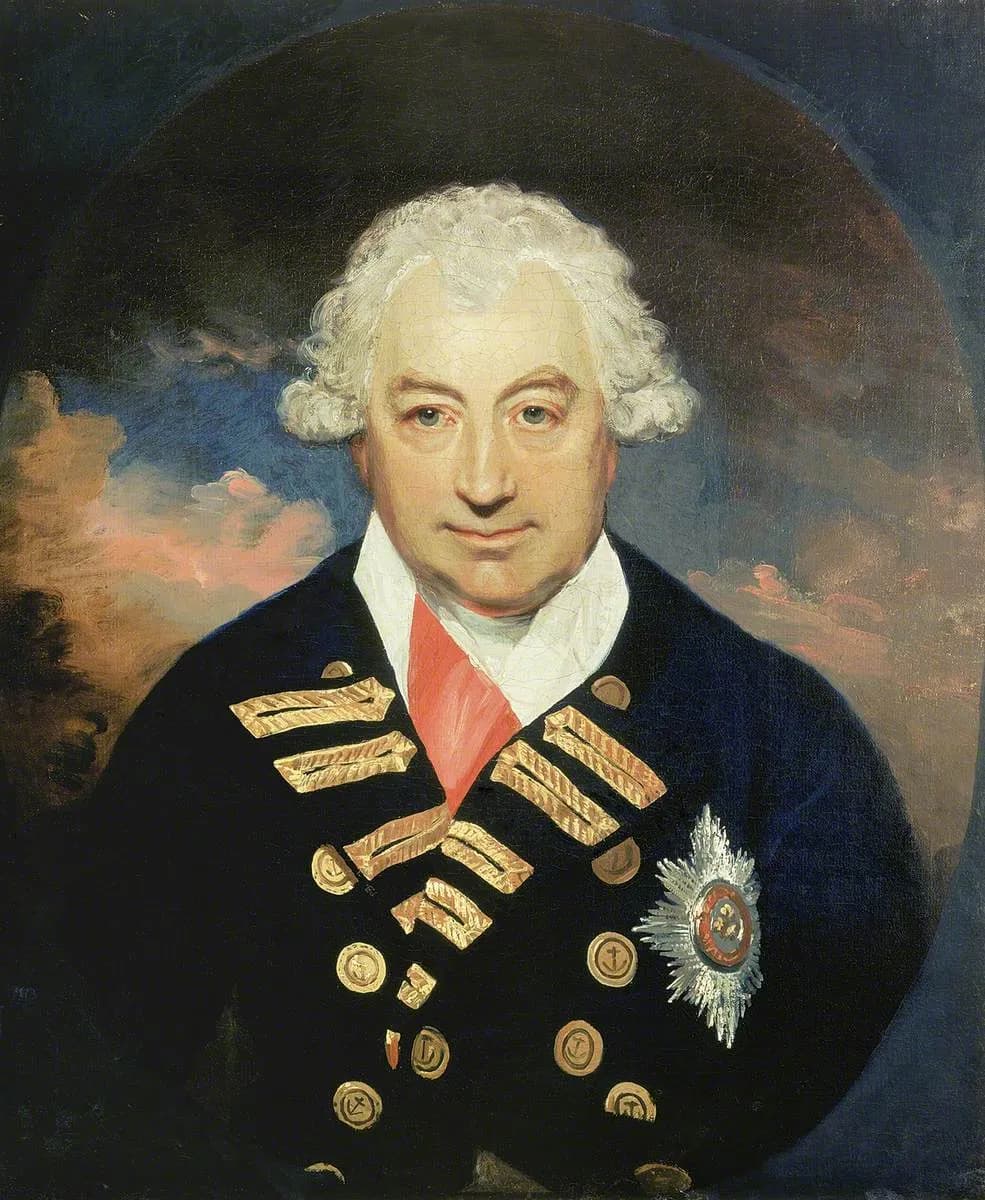
- Sir John Jervis, painted by William Beechey around 1787 to 1790, wearing the star of the Order of the Bath. After the battle he took the title Earl of St Vincent. William Beechey, Public domain, via Wikimedia Commons.
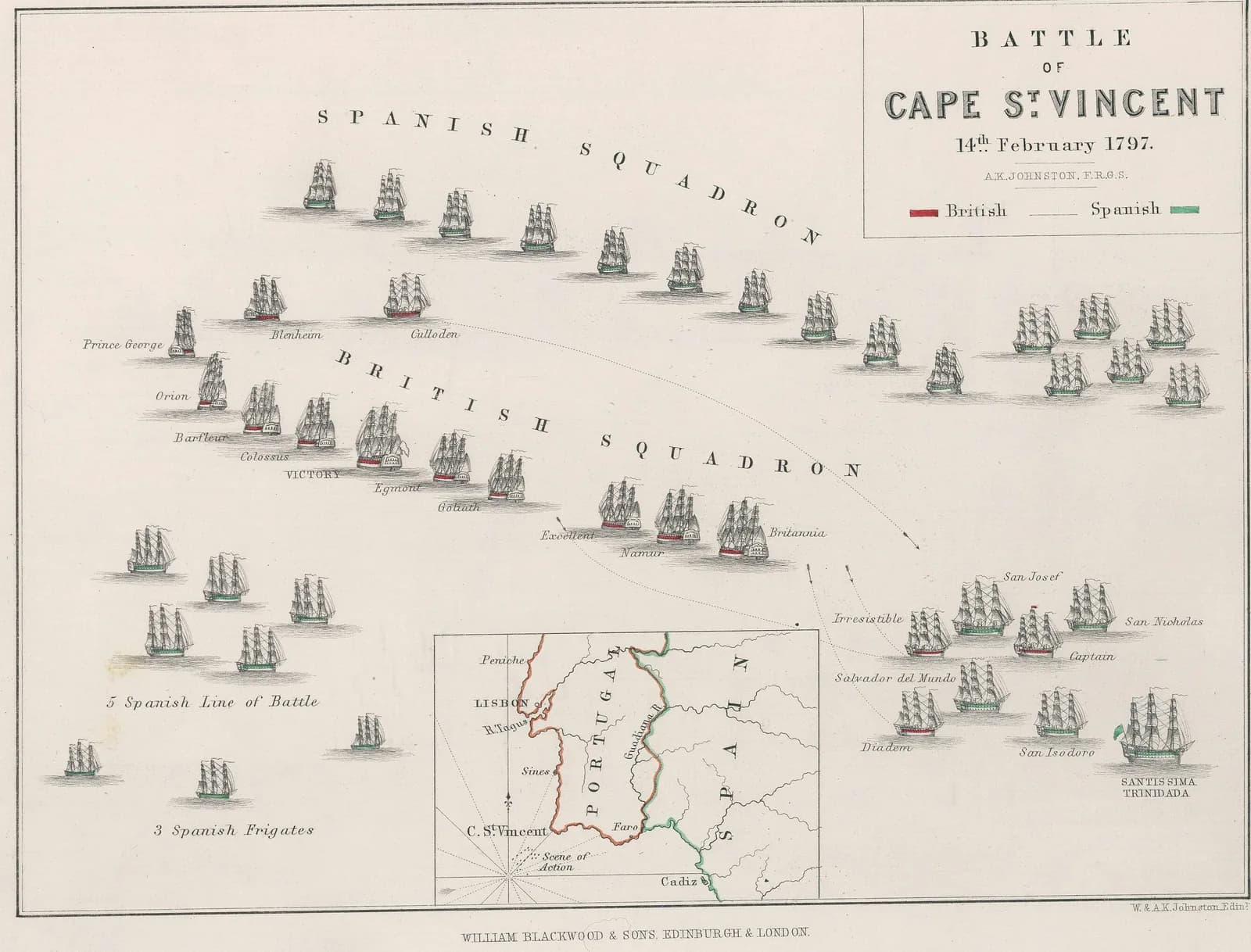
- The battle as drawn for the atlas to Archibald Alison's History of Europe, engraved by A. K. Johnston and published in 1852. The plan simplifies the action: on the right the Captain lies among the San José, the San Nicolás and the Santísima Trinidad. The inset marks the scene of action off Cape St Vincent, between Lisbon and Cádiz. Alison, Archibald, Sir, bart., 1792-1862 Johnston, Alexander Keith 1804-1871, Public domain, via Wikimedia Commons.
- Nicholas Pocock's painting of the Captain (left) against the San Nicolás, whose bowsprit is caught in the rigging of the San José beyond. The San Nicolás's ensign is being hauled down. The museum dates it 1801; the canvas is signed and dated 1808. Nicholas Pocock, Public domain, via Wikimedia Commons.
- “Condenación del comandante general don José de Córdoba”: an imagined scene of Córdoba's condemnation, drawn by Vicente Urrabieta and published in 1844. Vicente Urrabieta, Public domain, via Wikimedia Commons.