

1750–1807
Earthquake and Enlightenment
José I was acclaimed king in September 1750 and gave the government to Sebastião José de Carvalho e Melo, later Marquis of Pombal. At 9.30 on the morning of 1 November 1755 an earthquake, a tsunami and fires left Lisbon in ruins, and the city was rebuilt. In 1759 the Jesuits were expelled, and Pombal's reforms brought new trading companies and factories.
3 key moments · 32 in all
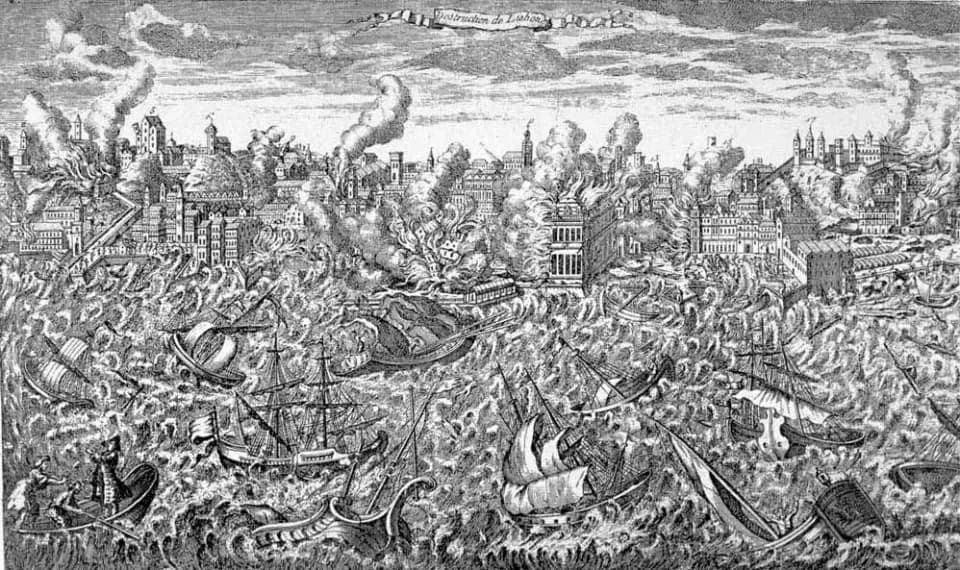
At about 9.40 on the morning of All Saints' Day, with much of the population at Mass, a massive earthquake devastates Lisbon. Some 40 minutes later a tsunami surges up the Tagus into the lower town while fires sweep the city; tens of thousands die in one of the deadliest disasters in European history.
By royal charter, King José I and his minister Sebastião José de Carvalho e Melo, the future Marquês de Pombal, create the Companhia Geral da Agricultura das Vinhas do Alto Douro to control the port wine trade. Its granite boundary stones, the 'marcos pombalinos', went on to mark out what is considered the world's oldest demarcated wine region.
Gomes Freire de Andrade is born in Vienna, son of Portugal's ambassador to the Austrian court. A soldier of fortune who fought for Catherine the Great against the Turks and marched into Russia with Napoleon, he was hanged in 1817 as the alleged leader of a liberal plot against the British-dominated regency; Lisbon's Campo dos Mártires da Pátria honours the conspirators.
King José I survives an assassination attempt when horsemen ambush his carriage outside Lisbon, wounding him in the arm and shoulder; the affair leads to the trial and brutal execution of the Távora family, strengthens the hand of the future Marquês de Pombal and paves the way for the expulsion of the Jesuits a year later.
Leading members of the Távora family, accused of plotting the September 1758 attempt on King José I's life, are publicly tortured and executed on a scaffold at Belém. Many historians suspect the case was engineered by the future Marquis of Pombal to break the power of the old aristocracy.
The Jesuit priest Gabriel Malagrida is garrotted and his body burned at an auto-da-fé in Lisbon's Rossio square, condemned as a heretic by the Inquisition at the instigation of the Marquis of Pombal, whom he had enraged by preaching that the 1755 earthquake was God's punishment for Lisbon's sins.
A royal charter of King José I, drafted by the future Marquis of Pombal, creates the Real Erário (Royal Treasury), abolishing the old accounting offices and channelling all crown revenue into a single treasury. It is the direct ancestor of Portugal's Ministry of Finance and Court of Auditors.
Birth in Lisbon of Marcos Portugal, the most internationally famous Portuguese composer of his age. He wrote 21 operas for Italian theatres in the 1790s, then joined the exiled court in Rio de Janeiro in 1811 and stayed on in Brazil until his death in 1830.
The Treaty of Paris ends the Seven Years' War, with Portugal acceding alongside Britain, France and Spain. Spain, which had invaded Portugal in 1762, agrees to hand back its conquests, including the colony of Sacramento on the River Plate.
The poet Manuel Maria Barbosa du Bocage, the finest Portuguese exponent of Arcadian verse and a celebrated satirist and improviser, is born in Setúbal.
Nicolau Nasoni, the Tuscan-born architect whose Baroque works include Porto's Clérigos Church and its landmark tower, dies in poverty in the city aged 82 and is buried in the Clérigos Church he designed.
King José I dies in Lisbon after a 27-year reign. Within weeks his daughter and successor, Maria I, removed the all-powerful Marquis of Pombal and freed many of his political prisoners — the change of course remembered as the 'Viradeira'.
Portugal and Spain sign the preliminary Treaty of San Ildefonso on South American borders: Portugal cedes Colónia do Sacramento and drops its claim to the Sete Povos mission lands, while Spain returns the island of Santa Catarina and recognises Portuguese rule in Rio Grande de São Pedro, today's southern Brazil.
 Long readThe Treaty of San Ildefonso: Portugal and Spain redraw South America, 1777
By the Treaty of El Pardo, Portugal hands Spain the islands of Fernando Pó (Bioko) and Annobón in the Gulf of Guinea, in return for settling the borders of southern Brazil. They become the nucleus of Spanish Guinea — today's Equatorial Guinea, where Annobón still speaks a Portuguese-based creole.
Birth in Castelo de Vide of José Xavier Mouzinho da Silveira, the liberal jurist whose sweeping decrees of 1832, issued in the Azores and besieged Porto during the civil war, abolished tithes, the medieval 'forais' (feudal charters and dues) and small entailed estates. Historians often credit him with laying the legal foundations of modern Portugal.
The Marquis of Pombal dies in disgrace at Pombal, aged 82. Virtual ruler of Portugal under King José I from 1750 to 1777, he rebuilt Lisbon after the 1755 earthquake and expelled the Jesuits, but was banished from court after Maria I took the throne.
João Carlos de Saldanha, later Duke of Saldanha, is born. A grandson of the Marquis of Pombal, he fought in the Peninsular War, commanded liberal forces in the civil war of 1832–34 and dominated politics for decades, serving several times as prime minister and twice seizing power by military pronouncement.
Joaquim José da Silva Xavier, known as Tiradentes ('Tooth-Puller'), is executed in Rio de Janeiro for leading the Inconfidência Mineira, a failed rebellion for Brazilian independence from Portugal. He is now Brazil's national hero.
Bernardo de Sá Nogueira de Figueiredo, later Marquis of Sá da Bandeira, is born in Santarém. A liberal soldier and statesman, he served as Prime Minister five times and led the drive to abolish the slave trade in the Portuguese empire.
A royal charter of Queen Maria I creates the Real Biblioteca Pública da Corte in Lisbon, today's Biblioteca Nacional. Housed in the western tower of Terreiro do Paço and built around the library of the royal censorship board, it was, unusually for the age, open to the general public, not just to scholars.
Off Cape São Vicente, the south-western tip of the Algarve, a British fleet under Sir John Jervis defeats a much larger Spanish fleet. Commodore Horatio Nelson makes his name by breaking the line and boarding two Spanish ships in succession, the San Nicolás and the San José.
Porto's Real Teatro de São João opens with the comedy 'A Vivandeira', timed for the birthday of Prince João, the future João VI. Gutted by fire in 1908, it was rebuilt to a design by José Marques da Silva and reopened in 1920; today it is the São João National Theatre.
António Luís de Seabra is born at sea, aboard the ship 'Santa Cruz' off Cape Verde on its way to Rio de Janeiro. A judge, minister and rector of Coimbra University, he wrote Portugal's first Civil Code, approved in 1867 — the 'Código de Seabra', which governed private life in the country for a full century.
Almeida Garrett is born in Porto. Poet, playwright, novelist, journalist and liberal politician, he is regarded as the greatest figure of Portuguese Romanticism, author of 'Viagens na Minha Terra' and the drama 'Frei Luís de Sousa'.
Spanish forces under Manuel de Godoy invade the Alentejo, beginning the brief War of the Oranges. Godoy sends orange branches from Elvas to the Spanish queen, giving the war its name; the Treaty of Badajoz in June forces Portugal to cede Olivenza to Spain — a dispute unresolved to this day.
The Treaty of Badajoz is signed between Portugal and Spain, ending the brief War of the Oranges. Portugal cedes the border town of Olivença to Spain — a loss that the Portuguese state has never formally recognised, and which remains a small but enduring point of friction with Madrid.
Portugal signs the Treaty of Madrid with Napoleonic France, closing its ports to British shipping, paying an indemnity of 20 million francs and ceding territory in northern Brazil, in the aftermath of the War of the Oranges.
Miguel, the future absolutist king who would seize the throne from his niece Maria II and fight the Liberal Wars of 1832–34, is born at the Palace of Queluz, son of João VI and Carlota Joaquina.
Colonel António Teixeira Rebelo founds the Colégio Militar, a military boarding school, at a fort in Oeiras; it moved to Luz, in Lisbon, in 1814. Its banner is the most decorated in the Portuguese armed forces, and the school admitted its first girls only in 2013.
Birth of António Bernardo da Costa Cabral in Fornos de Algodres. The dominant and divisive strongman of the young constitutional monarchy, admired as a reformer but accused of corruption and nepotism, popular anger at his rule fuelled the 1846 Maria da Fonte peasant revolt in the Minho, which forced him into exile — only for him to return and head the government again a few years later.
A catastrophic flood devastates Madeira, when torrential rain sends the Funchal streams bursting through the city and floods spread to other parts of the island. With 800 to 1,000 dead, mostly in Funchal, it remains the deadliest flood in the island's recorded history.
France and Spain sign the secret Treaty of Fontainebleau, agreeing to invade Portugal and partition it into three: a northern kingdom for the King of Etruria, a southern principality for Godoy, and the centre held in reserve until a general peace. Junot's army entered Lisbon on 30 November.
Back to the full timeline of Portugal, with key moments, search and long reads.