

Operation Autumn: how the PIDE murdered General Humberto Delgado, 1965
The opposition leader who had promised to sack Salazar crossed into Spain to meet officers he believed were ready to revolt. Four policemen with false passports were waiting for him instead.
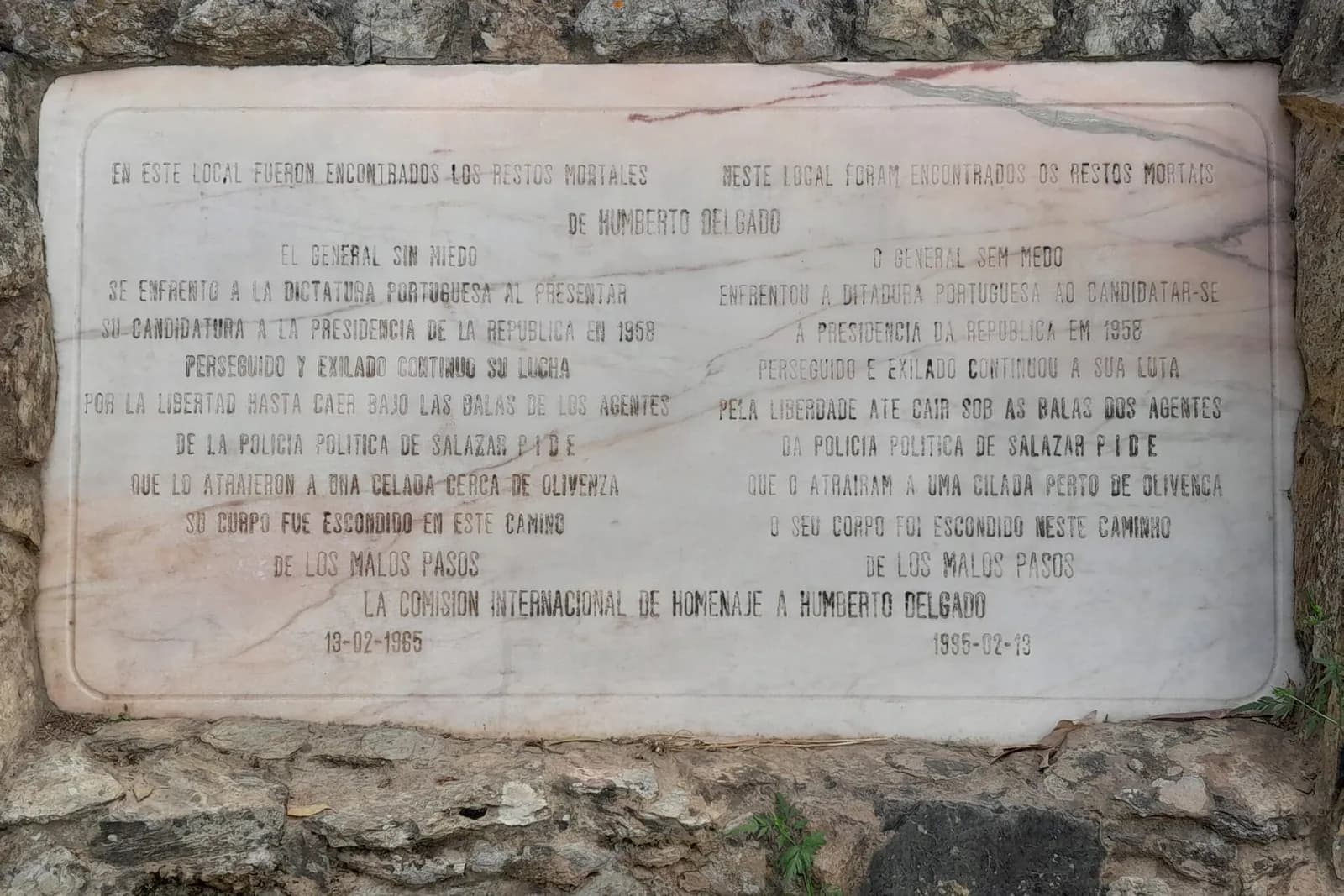
At a glance
- On the afternoon of 13 February 1965, General Humberto Delgado, the best-known opponent of António de Oliveira Salazar's dictatorship, and his Brazilian secretary Arajaryr Campos were killed by agents of the PIDE, Portugal's political police, on Spanish soil near Olivença.
- Delgado had gone to Badajoz to meet officers he believed were plotting a revolt. The meeting was a trap, code-named Operação Outono (Operation Autumn), set up through PIDE informers in Rome and Paris.
- The four-man brigade, led by Inspector António Rosa Casaco, buried the bodies in quicklime at Los Malos Pasos, near Villanueva del Fresno. Two boys found them on 24 April 1965.
- A Lisbon military court ruled on 27 July 1981 that the plan had been to kidnap, not kill. Only the gunman, Casimiro Monteiro, tried in his absence, was convicted of the killings, with 19 years and eight months, which he never served.
- Delgado's biographer disputes the court's finding that he was shot and argues that he was beaten to death. Historians still debate whether murder was planned from the start and how much Salazar knew.
Dark glasses at Badajoz station
It was a Saturday in Badajoz, the Spanish city just across the border from the Portuguese Alentejo. Shortly before three in the afternoon of 13 February 1965 a man in dark glasses, with a scarf pulled up over part of his face, waited at the railway station with a woman in her thirties. There was no sun to shade his eyes from. The glasses were a disguise.
The man was Humberto Delgado, a 58-year-old air force general who had run for president of Portugal in 1958 and had lived in exile ever since. The woman was Arajaryr Campos, his Brazilian secretary. They were waiting for “Dr Castro e Sousa”, presented to Delgado as an opposition lawyer from Portugal, who was to drive them to a meeting with army officers ready to rise against the dictator António de Oliveira Salazar.
The “lawyer” arrived and led them to a Renault Caravelle parked nearby. Delgado sat beside the driver; Campos sat in the back and tried to ease the tension with small talk. The driver was in fact Ernesto Lopes Ramos, a sub-inspector of the PIDE, Salazar's political police. Ahead of them, on the road to Olivença, three more PIDE officers were waiting.
The general without fear
Delgado had been a man of the regime. Born in Torres Novas on 15 May 1906, he fought on the side of the military coup of 28 May 1926 that ended Portugal's First Republic, served in the regime's youth and militia organisations, headed civil aviation, helped found the national airline TAP in 1945 and was military attaché in Washington. At 47 he was the youngest general in the Portuguese forces.
In 1958 he broke with it. As the opposition candidate for president he drew huge crowds; the official count gave him 236,528 votes against 758,998 for the regime's Américo Tomás, a result the Panteão Nacional, the state body that now holds his tomb, calls fraudulent. Suspended from the army in January 1959, he took refuge in the Brazilian embassy in Lisbon and left for Rio de Janeiro on 21 April.
From exile Delgado called for armed revolt. He slipped into Portugal on a false passport for the failed attack on the Beja barracks on New Year's night 1962, told in its own article, and got out again. He moved to Algeria, where the exiled opposition had its base, and in June 1964 became president of the Patriotic Front for National Liberation (FPLN).
The front was a quarrelsome coalition of communists, Delgado's followers and smaller revolutionary groups, divided over armed struggle, the colonies and the general's own temperament. Delgado broke with it in October 1964 and on 12 January 1965 founded his own Portuguese National Liberation Front in Algiers. He was isolated, impatient and looking for officers inside Portugal who would act.
The secretary from Rio
Arajaryr Moreira Campos was Brazilian, the daughter of a Portuguese mother and a Spanish father, and thought of herself first as a Carioca, a native of Rio de Janeiro. She was 28, separated from her husband and had a young daughter, Rosângela. She had followed his 1958 campaign in the Brazilian papers. On 27 May 1959, at a birthday party at the home of Horácio Ribeiro, a supporter who had sounded her out about the job a few days before, she met Delgado and became his secretary.
She typed, took shorthand and spoke English, French, German and Italian. She soon did more than paperwork. For the Beja rising she travelled with Delgado through Morocco and Spain and into Portugal on her own Brazilian passport, carrying his dress uniform and the proclamation he meant to read if Salazar fell. She paid her own fares and took no salary.
“Why, then, do I do it? Because I was born in a democratic land, and also because a little Portuguese blood runs in my veins.”
She wrote often to her daughter under her own name and address, promising they would soon live together again, and she always travelled on her real passport. She made no secret of who she was.
Operation Autumn
According to the historian Luís Farinha, a former director of the Museu do Aljube, the plan to lure Delgado to the border was drawn up after Beja by the three men who ran the PIDE: its director, Major Fernando da Silva Pais, his deputy Agostinho Barbieri Cardoso, and Álvaro Pereira de Carvalho of the information service. The Museu do Aljube also dates the plan to the beginning of 1962.
The PIDE needed people the general would trust. Barbieri Cardoso and Pereira de Carvalho found them in Rome: a doctor, Ernesto Bisogno, and Professor Mário de Carvalho, who took the code name Oliveira and a PIDE salary of 10,000 escudos a month. In the last days of December 1964, at the Hotel Caumartin in Paris, Mário de Carvalho and a supposed lawyer, Ernesto de Castro e Sousa, persuaded Delgado that soldiers and civilians in Portugal were ready for revolution and wanted to meet him near Badajoz.
No names of the plotters inside Portugal were given. Some of Delgado's friends in Paris warned him of the danger, but he was set on the “decisive action”, and he accepted. Castro e Sousa was Ernesto Lopes Ramos, the PIDE sub-inspector who became his contact in Paris.
| Officer | Rank | Car | False identity |
|---|---|---|---|
| António Rosa Casaco | Inspector, head of the brigade | Renault Caravelle | Roberto Vurrita Barral, a Guatemalan |
| Ernesto Lopes Ramos | Sub-inspector, Delgado's contact | Renault Caravelle | Ernesto de Castro Sousa, the “lawyer” of the Paris meeting |
| Casimiro Monteiro | Brigade chief | Green and cream Opel | Washdeo Kundaumal Nilpuri, from Jersey |
| Agostinho Tienza | Brigade chief | Green and cream Opel | Filipe Garcia Tavares |
Ranks, cars and cover names as given by Luís Farinha from the trial record and later statements.
Rosa Casaco later said the brigade had been put together behind his back by the PIDE leadership, and that the aim was to kidnap the general, put him under chloroform and drive him in the boot of a car across the border at São Leonardo to stand trial in Portugal for terrorism. Farinha treats the first claim as an alibi. Casaco's own account of the preparations points the other way.
“Already in Spain, I noticed that in Tienza's car there were a large jar, a bag of lime, a pickaxe and a shovel.”
Saturday 13 February 1965
The brigade spent the night of 12 February in a guest house in Reguengos de Monsaraz, in the Alentejo, and crossed into Spain at the São Leonardo border post on the morning of the 13th, every man and every car with false papers. After the meeting in Badajoz, Lopes Ramos drove Delgado and Campos out along the main road from Badajoz to Olivença, towards the officers they expected to meet.
Late December 1964
Hotel Caumartin, Paris
Mário de Carvalho and “Castro e Sousa” persuade Delgado to attend a meeting near Badajoz.
12 January 1965
A new front in Algiers
Delgado founds the Portuguese National Liberation Front after breaking with the FPLN.
12 February
Reguengos de Monsaraz
The PIDE brigade spends the night in a guest house near the border.
13 February, morning
São Leonardo border post
The brigade crosses into Spain in two cars with false papers.
13 February, c. 15:00
Badajoz to the Olivença road
Lopes Ramos drives Delgado and Campos to the meeting place, where they are killed.
13 February, later
Los Malos Pasos
The bodies are stripped, covered with sulphuric acid and quicklime and buried near Villanueva del Fresno.
24 April 1965
Discovery
Two boys out hunting birds find the remains.
Farinha says they reached the agreed spot at about three in the afternoon. One Portuguese account names it as Los Almerines, near Olivença. The versions of what happened next differ in detail, but Farinha sets out the core: as Delgado got out of the car, Casimiro Monteiro fired at him with a Unique revolver fitted with a silencer, and the shot killed him.
Arajaryr Campos was killed moments later. The court that tried the case held that Monteiro alone had fired, so that the same revolver killed her too. Rosa Casaco later said it was Tienza who killed her.
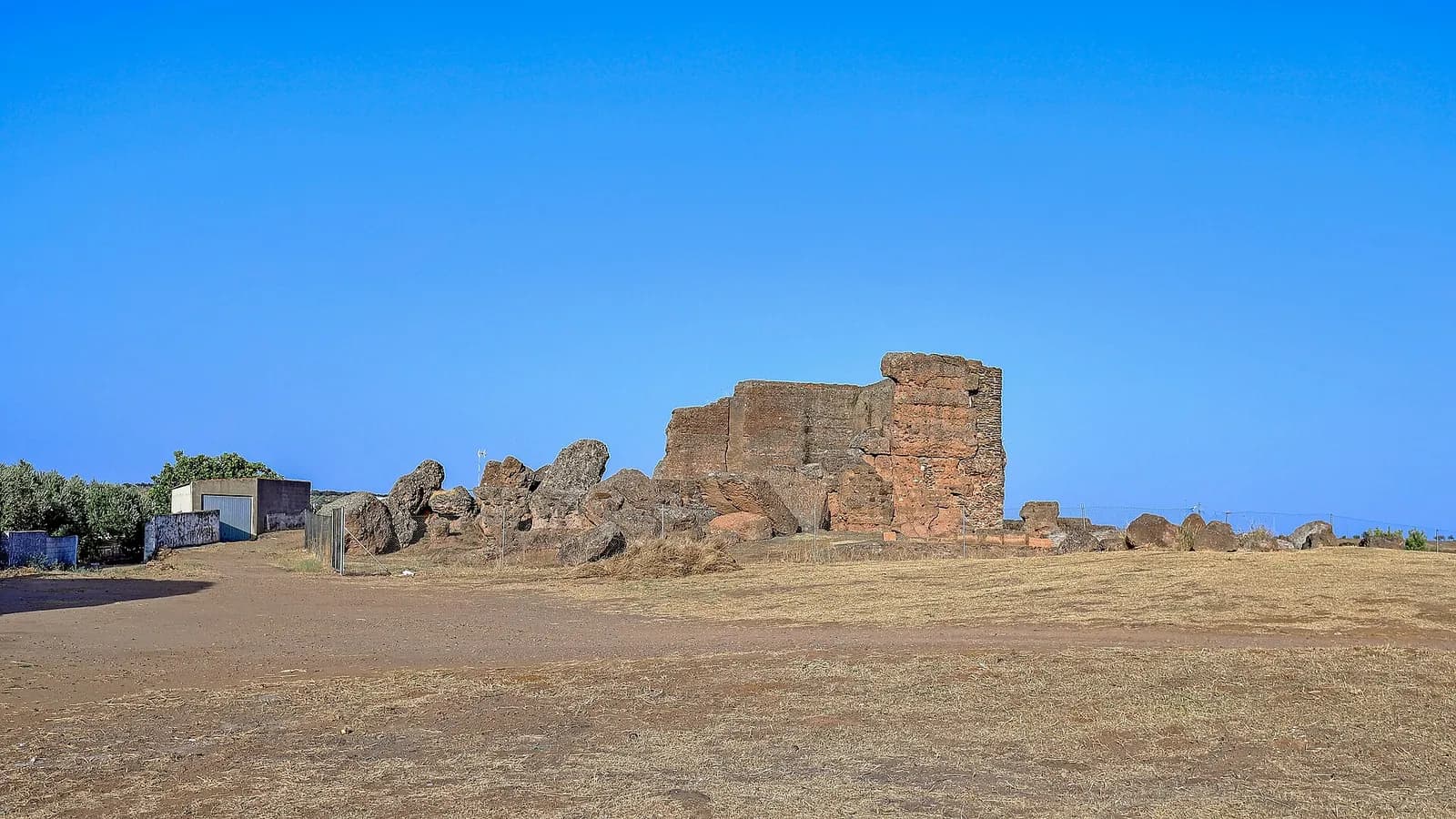
The bodies went into the boots of the cars, or into the Opel alone according to the court, and were driven to a lonely spot called Los Malos Pasos, about six kilometres south of Villanueva del Fresno, a town a little over thirty kilometres south of the scene of the killing. There they were stripped of their belongings, covered with sulphuric acid and quicklime and buried in a natural ditch.
Seventy days of silence
For ten weeks Delgado was simply missing. On 24 April 1965 two Spanish boys out hunting birds came across the half-buried remains at Los Malos Pasos. Most accounts give that date; one RTP report gives 13 April.
Lisbon denied any part in the killing. The official version blamed the opposition and its feuds. In Franco's Spain the investigation went ahead all the same. The lawyer Jaime Cortezo, charged by the Spanish government with the inquiry, sought the extradition of the two informers in Rome, Bisogno and Mário de Carvalho, to be tried in Spain.
“The passivity of the Portuguese police in carrying out an investigation requested almost nine months ago is strange, above all when it concerns a matter in which the good name of the Portuguese state is at stake.”
Nothing came of it in Portugal. The PIDE chiefs kept their posts. Mário de Carvalho's PIDE salary rose to 16,000 escudos. Casimiro Monteiro was sent to Mozambique on special missions and promoted to sub-inspector in 1970.
According to Silva Pais's own account, as Farinha gives it, when he reported to Salazar what had happened at Badajoz, the prime minister asked for the greatest silence about the facts, to save the country from a very grave situation. In Paris the exiled opposition leader Emídio Guerreiro told O Estado de S. Paulo that Portuguese democrats would only thank Spain when it issued an arrest warrant for the man chiefly responsible: Salazar himself.
The trial at Santa Clara
Only after the Carnation Revolution of 25 April 1974 could the case be tried in Portugal. It went to the 2nd Military Territorial Tribunal of Lisbon, which sat at Santa Clara, as if the killing had been a military crime, and the hearings began in October 1978. Seven men were charged. Three appeared in court: Silva Pais, Pereira de Carvalho and Tienza. Barbieri Cardoso was in Brussels, Lopes Ramos and Rosa Casaco in Brazil, Monteiro in South Africa. They were tried in their absence.
At a hearing on 20 October 1978, Silva Pais said that when he told Salazar and the interior minister, Alfredo dos Santos Júnior, of the planned operation, Salazar advised “great care” and the minister said with a smile, “let's see if we can lay hands on him”. His written defence said the plan had been “tacitly approved” by both men. Silva Pais died on 27 January 1981, before the verdict.
The judgment was read at Santa Clara on the afternoon of 27 July 1981 and took about two hours. The court accepted that Operation Autumn was meant to arrest Delgado and bring him to trial, and that Casimiro Monteiro alone had fired. The others were cleared of the deaths and convicted of lesser crimes such as forgery and using false identities. Many of the other charges, from destroying the cars used in the operation to hiding the bodies, were held to have lapsed or been amnestied.
The lawyer Abranches Ferrão, for the private prosecution, appealed at once to the Supreme Military Court. On 8 July 1982 it upheld the sentences, but an amnesty passed for Pope John Paul II's visit to Portugal that year cut them by six months, and an arrest warrant was issued for Barbieri Cardoso.
| Defendant | Role | Sentence in 1981 | Luís Farinha's account |
|---|---|---|---|
| Casimiro Monteiro | Gunman (in absence) | 19 years and 8 months | Same, for the double homicide |
| António Rosa Casaco | Head of the brigade (in absence) | 8 years, plus a fine | 8 years, for six counts of forgery and two of theft of documents |
| Agostinho Barbieri Cardoso | Deputy director of the PIDE (in absence) | 4 years | 4 years, for four counts of forgery |
| Ernesto Lopes Ramos | The false lawyer (in absence) | 22 months | 22 months, for using a false identity |
| Agostinho Tienza | Brigade chief | 24 months, already served | 14 months, for using a false identity |
| Álvaro Pereira de Carvalho | PIDE information chief | 22 months, already served | Acquitted |
| Fernando da Silva Pais | Director of the PIDE | None | Died on 27 January 1981, before judgment |
Third column: Diário de Lisboa's report of the reading, 28 July 1981. “Already served” means time spent in custody covered the sentence, so Tienza and Pereira de Carvalho walked free. Farinha gives the outcome without separating the 1981 verdict from the 1982 appeal; he and the newspaper disagree on Tienza and Pereira de Carvalho. The Supreme Military Court upheld the sentences in July 1982, less six months under that year's amnesty. Monteiro, Rosa Casaco and Lopes Ramos were abroad and served nothing.
Rosa Casaco stayed out of reach for years. In 1998 the journalist José Pedro Castanheira of Expresso interviewed him in Spain, where he had been living under a false identity; two months later he was detained outside a bank in Madrid. In that interview he said that the plan had been to put the general under chloroform and take him to Portugal, and that the deaths surprised him.
What is still disputed
Frederico Delgado Rosa, the general's grandson and biographer, called the 1981 verdict Delgado's “second death”, echoing the title of a 1982 book by Manuel Geraldo, the journalist who had covered the trial for Diário de Lisboa. In Delgado Rosa's view the judges deliberately bent the facts to clear the PIDE hierarchy and, beyond it, Salazar.
The second question is whether the PIDE meant to kill. Rosa Casaco's chloroform story was what the court accepted. Farinha points to the lime, the pickaxe and the shovel in Tienza's car. The historian Irene Flunser Pimentel told Lusa in 2015 that, almost certainly, part of the brigade and of the PIDE leadership, Barbieri Cardoso above all, already meant simply to eliminate him.
The third is Salazar. No written order to kill has come to light. Pimentel does not believe he gave one; she says a dictator tells his followers what he wants and they act with more or less zeal, and that everything important done inside the PIDE had his approval. Farinha writes that it was impossible for Salazar not to know.
- Killed
- Saturday 13 February 1965, mid-afternoon
- Where
- Near Olivença, on the road from Badajoz, Spain (Los Almerines in one account)
- Buried
- Los Malos Pasos, about 6 km south of Villanueva del Fresno
- Found
- 24 April 1965 (13 April in one RTP report)
- Verdict
- 27 July 1981, 2nd Military Territorial Tribunal of Lisbon
- Appeal
- 8 July 1982, Supreme Military Court upheld the sentences
Even the place is described loosely. Portuguese reports often say Delgado was killed “near Badajoz”, and some say at Villanueva del Fresno, which is where the bodies were found. The plaque at Los Malos Pasos and the Panteão Nacional both say the trap was near Olivença.
A marshal in the Pantheon
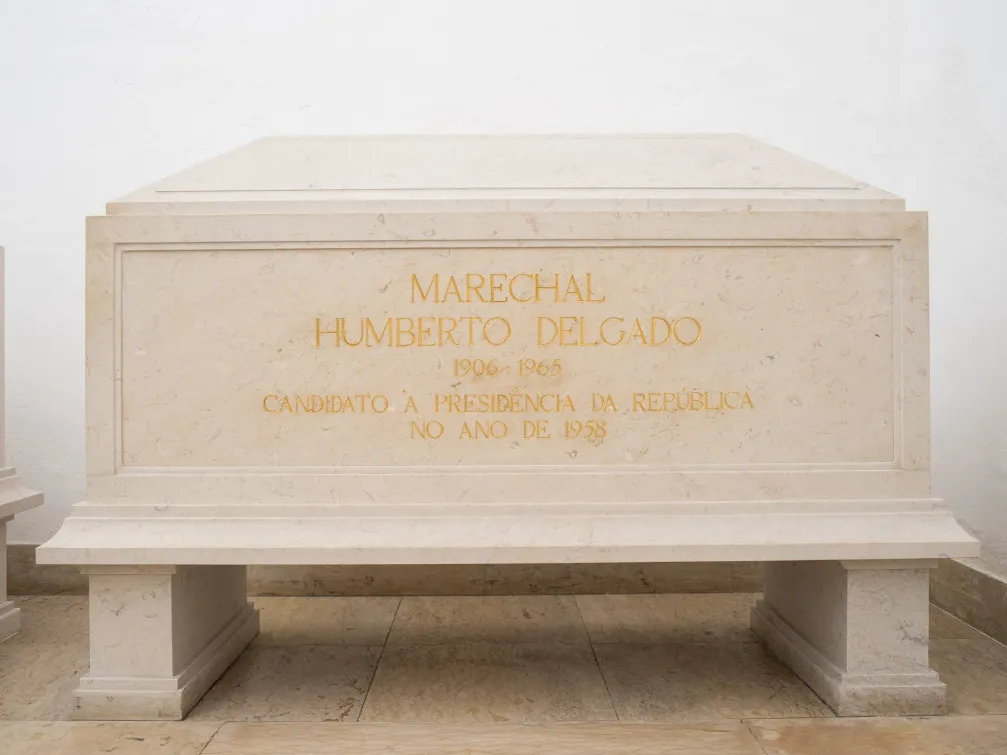
Delgado was first buried in Spain. His remains were brought to Lisbon in 1975 and moved to the National Pantheon, in the church of Santa Engrácia, in 1990. He was promoted posthumously to marshal, the rank carved on his tomb.
Arajaryr Campos was remembered more slowly. Her daughter, seven when she died, was not told the truth and heard it at fourteen from a schoolmate. In 1995, at a tribute organised by the Confederation of Brazilian Women, Delgado's daughter Iva told Rosângela that her mother had been a heroine. Iva Delgado later edited her writings as Uma Brasileira contra Salazar, launched at the Torre do Tombo in February 2006.
In April 2016 the municipal assembly of Badajoz voted unanimously to name streets after both of them, at the request of a regional historical memory association that called it an act of reparation. A month later, on 15 May, Lisbon's airport took the name Humberto Delgado.
The case file nearly did not survive. In 2007 the general's biographer found it piled on the floor of a basement at the Boa Hora court in Lisbon, where a clerk told him old files like it would one day go to the rubbish. In April 2008 it was handed to the Torre do Tombo, the national archive; he counted 69 appended volumes, against the 45 announced at the handover.
FAQs
Who killed Humberto Delgado?
A four-man brigade of the PIDE, Portugal's political police, led by Inspector António Rosa Casaco with Ernesto Lopes Ramos, Casimiro Monteiro and Agostinho Tienza. A Lisbon military court found in 1981 that Monteiro killed him and sentenced him in his absence to 19 years and eight months.
Where was Humberto Delgado killed?
In Spain, near Olivença, on the road from Badajoz; one Portuguese account names the spot Los Almerines. The bodies were buried at Los Malos Pasos, about six kilometres south of Villanueva del Fresno, and found there on 24 April 1965.
Who was Arajaryr Campos?
A Brazilian from Rio de Janeiro who became Delgado's secretary in exile in 1959 and worked unpaid for the Portuguese opposition. She was killed with him on 13 February 1965. Badajoz voted to name a street after her in 2016.
Did Salazar order the murder?
No written order is known. The PIDE director, Silva Pais, told the court that Salazar and his interior minister had tacitly approved the operation. The historian Irene Pimentel doubts an explicit order but says everything important in the PIDE had Salazar's approval.
What was Operação Outono?
Operation Autumn was the PIDE's code name for the plan to lure Delgado to the Spanish border with a fake meeting of military conspirators. The PIDE and the 1981 court described it as a kidnapping; critics say murder was the aim from the start.
On the timeline
Open the timelineNearby moments from dictatorship and the estado novo (1926–1974).
Death in Lisbon, aged 70, of Marshal Francisco Craveiro Lopes, President of the Republic from 1951 to 1958. His cool relations with Salazar and his sympathy for opponents of the regime cost him a second term, and he was later linked to the failed Botelho Moniz coup attempt of April 1961.
FRELIMO guerrillas attack the Portuguese administrative post at Chai in Cabo Delgado province, launching the Mozambican War of Independence. The conflict lasted a decade, ending only after the Carnation Revolution opened the way to Mozambican independence.
Fire guts the Teatro Nacional D. Maria II on Lisbon's Rossio in the early hours, sparing little more than the outer walls, entrance hall and Salão Nobre; Columbano Bordalo Pinheiro's painted ceiling and the company's wardrobe are lost. Superstition blames 'Macbeth', performed there that evening. Rebuilt behind its neoclassical façade, the national theatre only reopened in 1978.
The murder of Humberto Delgado
General Humberto Delgado, the most prominent opponent of the Salazar dictatorship, is lured by the PIDE to a fake meeting of conspirators in Spain and murdered near Olivenza with his Brazilian secretary, Arajaryr Campos. Their bodies are found near Villanueva del Fresno in April.
Actress and director Maria de Medeiros is born in Lisbon. She played Anaïs Nin in 'Henry & June' and Fabienne, Bruce Willis's girlfriend, in 'Pulp Fiction', and directed 'Capitães de Abril' (2000), a film about the Carnation Revolution screened at Cannes.
Birth in Madeira of José Tolentino de Mendonça, priest, theologian and one of the most admired Portuguese poets of his generation. Called to Rome by Pope Francis as Archivist and Librarian of the Holy Roman Church in 2018, he was made a cardinal in 2019 and later became Prefect of the Vatican's Dicastery for Culture and Education.
Portugal beat the Soviet Union 2–1 at Wembley to finish third at the FIFA World Cup in England, on their first appearance at the tournament. Eusébio converts a penalty to end as the competition's top scorer with nine goals, and José Torres strikes the late winner.
Coming up in history
All long reads 15 February 1941The 1941 cyclone: the February storm that wrecked Portugal’s coast and forests
 16 February 1986From 8 per cent to Belém: Mário Soares wins the 1986 run-off
 17 February 1843The Ponte Pênsil: Porto's first fixed bridge over the Douro, 1843
 18 February 1899António Aleixo, the lottery seller who became the Algarve's poet
16 sources
Archives, scholarship and reporting this article was checked against.
- 1
13 de fevereiro de 1965: o assassinato do general Delgado, by Luís FarinhaEsquerda.net (news site of the Bloco de Esquerda party), 13 February 2021
- 2Julgamento da PIDE em 1981 foi a “segunda morte” de Humberto DelgadoObservador (Lusa), 10 February 2015
- 3Será que o assassinato de Humberto Delgado teve o aval de Salazar?Observador (Lusa), 10 February 2015
- 4
Arajaryr Moreira Campos, mulher e brasileira: a participação feminina na luta contra o salazarismo, by Hélio Gustavo da Silva AndradeUniversidade do Sagrado Coração, Bauru (conference proceedings, 2018)
- 5
Balas da PIDE mataram Humberto Delgado há 60 anos, by Soares NovaissinalAberto, 17 February 2025
- 6
Humberto DelgadoPanteão Nacional
- 7
Humberto Delgado: biografia, by Rita CorreiaHemeroteca Municipal de Lisboa
- 8
O homem que matou Humberto Delgado, by Ricardo SilvaSábado, 3 July 2018
- 9
Patriotic Front for National LiberationMuseu do Aljube Resistência e Liberdade
- 10
Casimiro Monteiro transformado em “bode expiatório” da PIDE, by Manuel GeraldoDiário de Lisboa, 28 July 1981, pp. 1 and 10 (Fundação Mário Soares e Maria Barroso, Casa Comum archive)
- 11Arquivo digital Humberto DelgadoRTP Notícias
- 12Família do PIDE Silva Pais perde processoRTP Notícias, 22 July 2011
- 13
- 14José Pedro Castanheira alerta para risco de saudosismo do Estado Novo em livro sobre a PIDERTP Notícias (Lusa), 23 October 2025
- 15A terceira morte do Gen. DelgadoDiário de Notícias, 2 May 2008
- 16Humberto Delgado e Arajaryr Campos vão entrar para a toponímia de BadajozRTP Notícias (Lusa), 15 April 2016
Image credits
- The plaque on the track of Los Malos Pasos, near Villanueva del Fresno in Spain, where the remains of Humberto Delgado were found in April 1965. Dated 13 February 1995 and signed by an international committee in his honour, it says he was lured into a trap near Olivenza and his body hidden on this track. Photographed in 2024. Cardoazul, CC BY-SA 4.0, via Wikimedia Commons.
- The ruined castle of Villanueva del Fresno, a small Spanish town close to the Portuguese border in the province of Badajoz, photographed in 2020. The remains of Delgado and Campos were buried in open country south of the town. Hovallef, CC BY 4.0, via Wikimedia Commons.
- Delgado's tomb in the National Pantheon in Lisbon, photographed in 2020. The inscription calls him Marshal Humberto Delgado, candidate for the presidency of the Republic in 1958. António Fragoso, CC BY 2.0, via Wikimedia Commons.
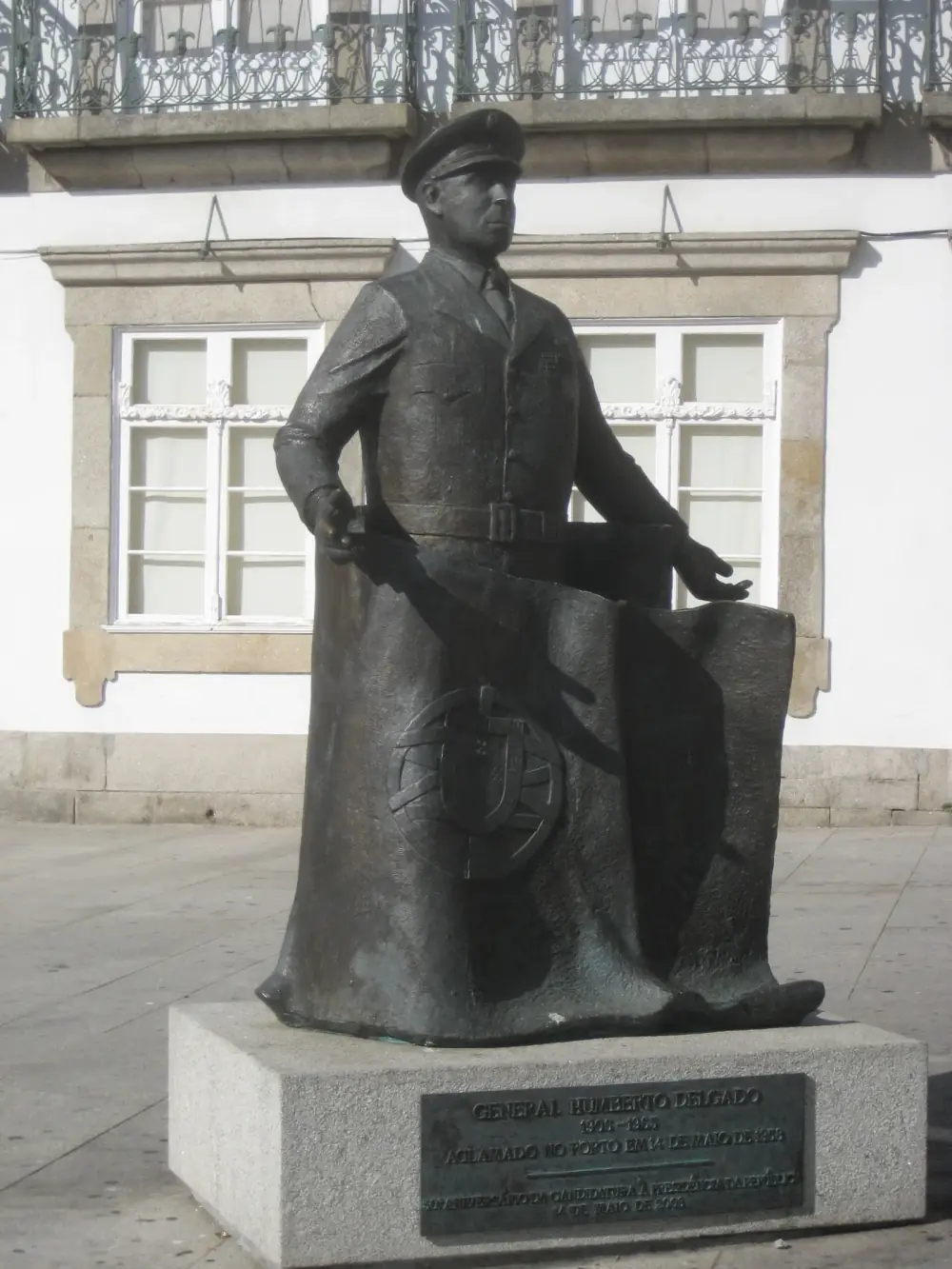
- José Rodrigues's statue of Delgado in Praça de Carlos Alberto, Porto, photographed in 2015. The plaque recalls his welcome in Porto on 14 May 1958 and marks the 50th anniversary of his candidacy, 14 May 2008. Vysotsky, CC BY-SA 4.0, via Wikimedia Commons.