

The Ponte Pênsil: Porto's first fixed bridge over the Douro, 1843
For centuries Porto crossed the Douro by boat. In 1843 a French company hung a wooden road from iron wire between stone obelisks, and the city had its first fixed bridge. It lasted 44 years.
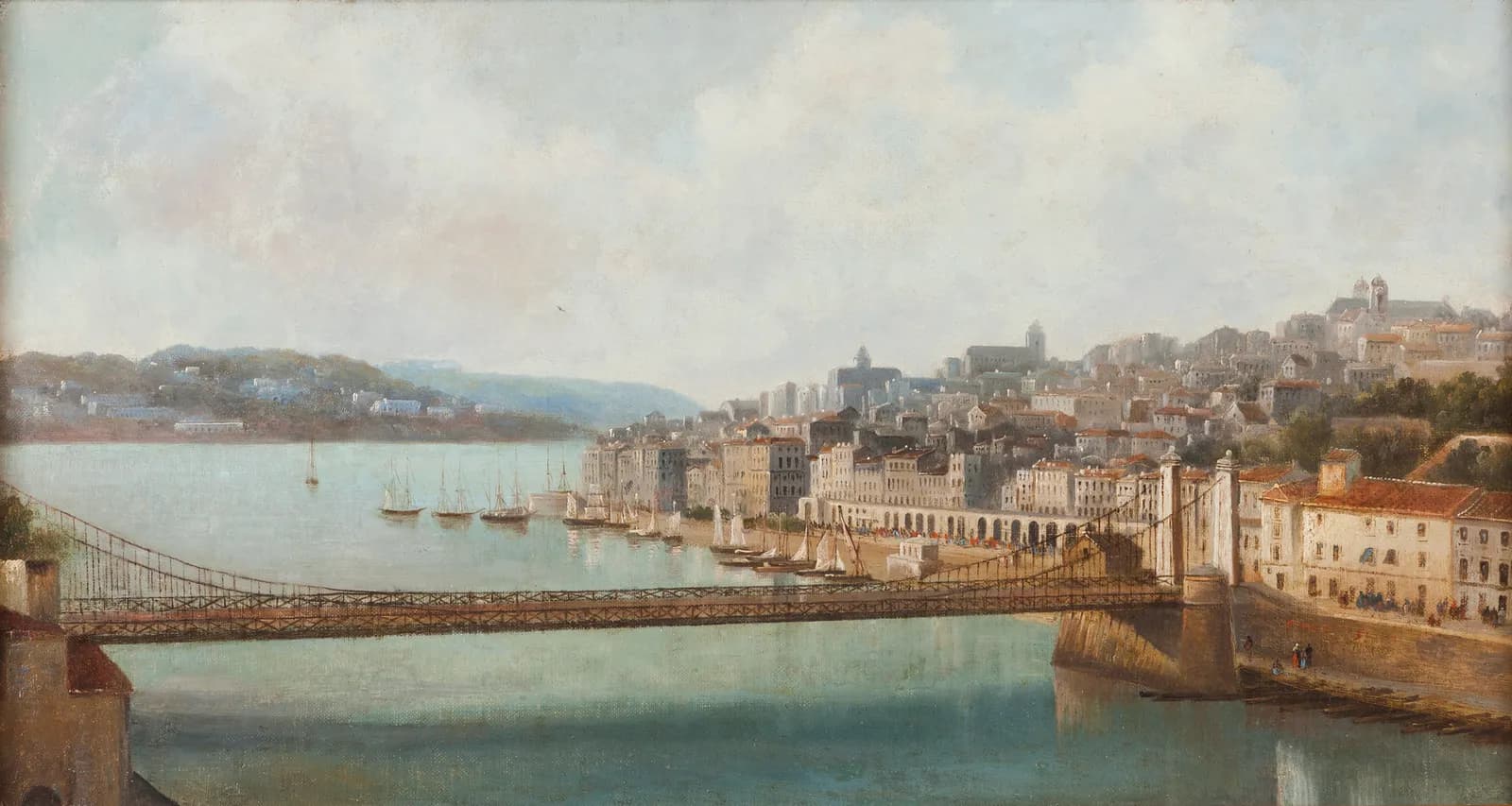
At a glance
- Porto's suspension bridge over the Douro, officially the Ponte D. Maria II but always called the Ponte Pênsil, opened to public traffic on 17 February 1843.
- It replaced a bridge of boats that had to be taken apart whenever the river flooded, and it was the first fixed bridge on the Portuguese stretch of the Douro.
- The French company of Claranges Lucotte built it under an 1837 contract that also covered the Lisbon to Porto road, to designs by the engineer Stanislas Bigot, and kept the tolls until 1876 or 1877.
- Eight cables of parallel iron wires hung a wooden deck 6 metres wide across a span of about 170 metres, from four stone obelisks 18 metres tall.
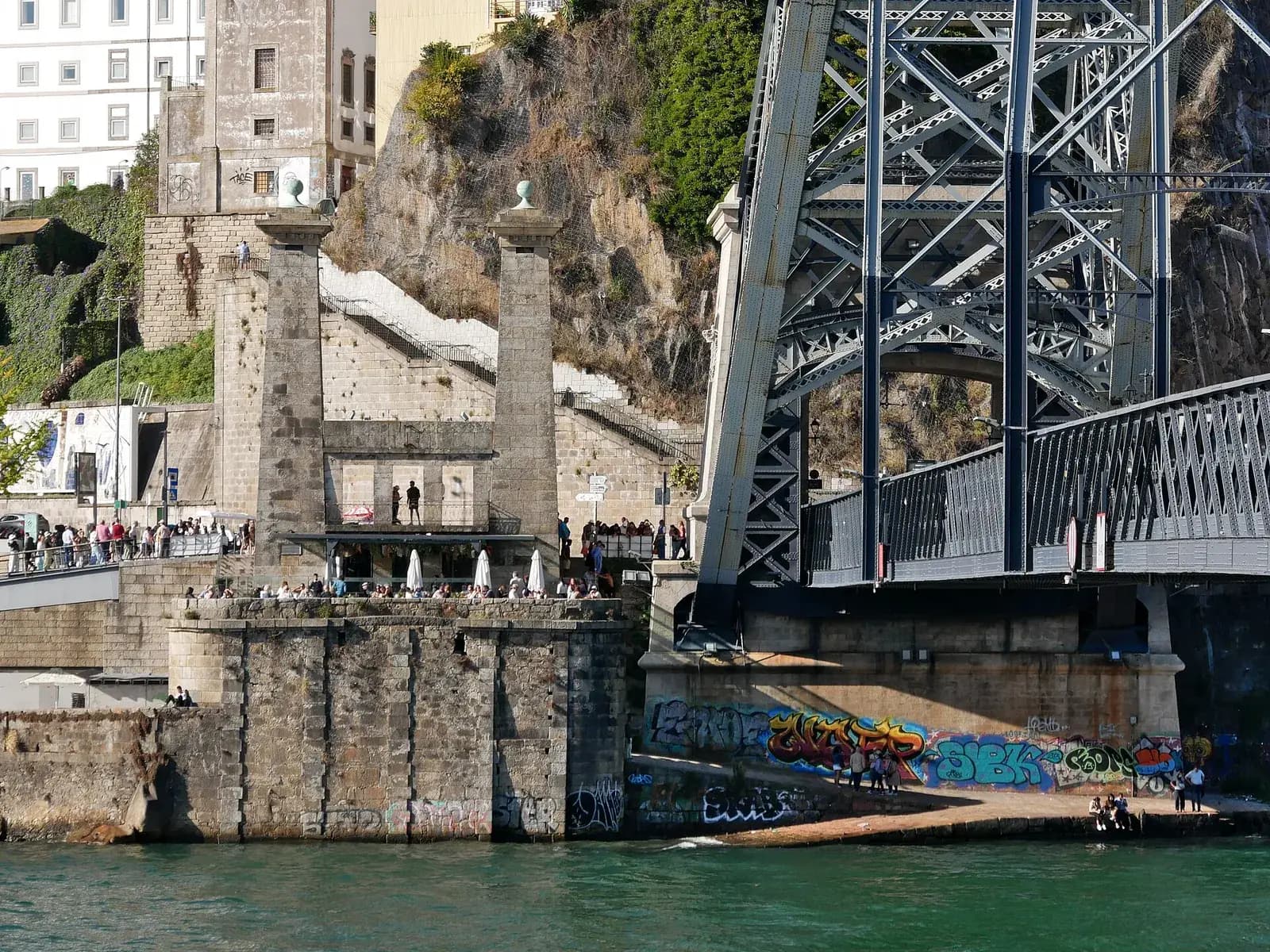
- Doubts about its safety led to the Luís I bridge, built beside it. The suspension bridge was taken down in 1887, and its two obelisks on the Porto bank still stand.
A party in October, traffic in February
On Saturday 15 October 1842 much of Porto came down to the river. Between two pairs of stone obelisks, one on each bank of the Douro, a road of timber now hung from iron cables. The weather was mild, and ladies in their finery strolled out over the rushing water. Amid the bang of countless fireworks, the crowd cheered the master of the works by name.
“On Saturday the 15th the suspension bridge that crosses the Douro in front of Porto was inaugurated and first used. It was a fine spectacle; the whole population of the city and its surroundings came.”
That was the party, but regular service came later. According to Pinho Leal's dictionary of the 1870s, on 4 January 1843 the builders lined both sides of the deck with pipas, large casks, full of water, and left the load on it for sixteen hours. Nobody noticed the slightest change. On 17 February 1843 the bridge was opened “definitively” to public service.
That same night, 17 to 18 February, the Douro rose suddenly and flooded the Praça da Ribeira, the riverside square at the foot of the old town. A second flood followed about a week later, and by 28 February the water stood only three palmos, about 66 centimetres, below the great flood of 1823.
“Near the suspension bridge, the meeting of two very strong backwashes lifted the paving of the ramp, churned up and carried away the fill; the wall was left bare, and a large part of it was knocked down.”
The paper added that people complained the ramp had been built of stones that were too small, although the government had given eight contos de réis, 8 million réis, towards it. The reports mention no damage to the bridge itself, which stood on rock chosen because it rose above the highest floods. Unlike the bridge of boats, it did not have to be taken apart when the river rose, so Porto and Vila Nova de Gaia, on the south bank, were no longer cut off by every flood.
A river that would not take a bridge
Porto stands on the north bank of the Douro and Vila Nova de Gaia on the south bank, facing each other across a river with steep, rocky sides. For most of their history the two towns were joined by boats, and from 1744 by a regular ferry.
On 15 August 1806 the government opened a bridge of boats: about 20 boats moored side by side and tied with iron cables, with a wooden roadway on top for people, animals and carts. It rose and fell with the tide and could be opened to let larger ships through. On 29 March 1809, as French troops under Marshal Soult stormed Porto, crowds fleeing across it fell into the river through a gap in the middle, and thousands drowned.
The French destroyed the bridge on the night of 11 to 12 May 1809 to stop Arthur Wellesley's Anglo-Portuguese army from crossing. Manuel de Azeredo, a professor in the University of Porto's engineering faculty who wrote a history of the city's bridges, says they burned it; the British historian Charles Oman says they blew it up. Two improved bridges of boats followed. Both had the same weakness: the Douro floods hard and fast, and every year the bridge had to be taken apart more than once so the current would not carry it off. Each time, the two banks were cut off again.
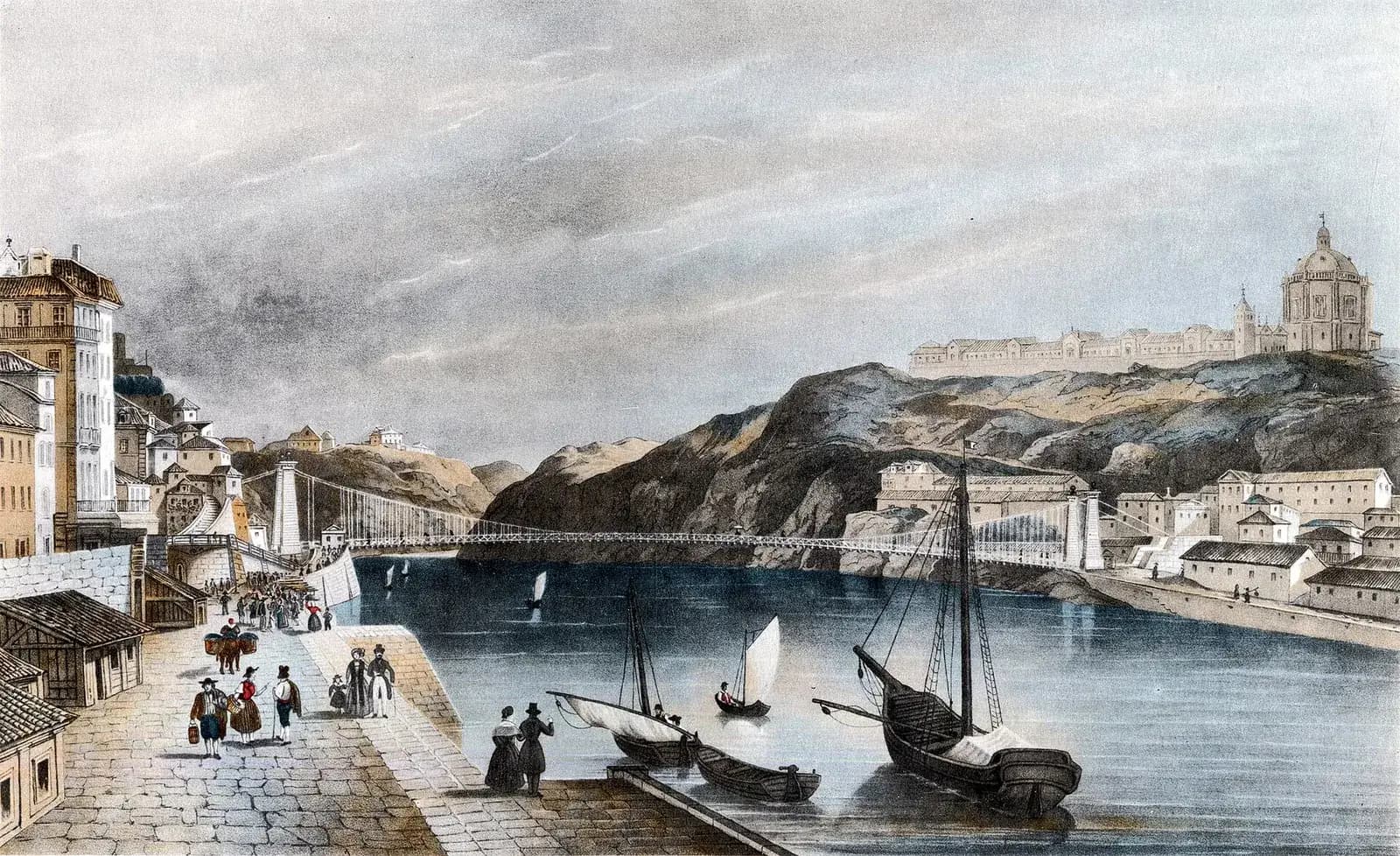
A road contract and a French engineer
The government's answer came in 1837. It signed a contract with the French contractor Claranges Lucotte, whom later sources call the Count of Claranges Lucotte, to build the main road from Lisbon to Porto and a bridge over the Douro at Porto “on the system of suspension in iron”. The contract was approved by a law of 7 April 1837 and sealed by deed on 5 May. In return the company would collect the tolls on the bridge.
Work did not begin until 1841. The first design, by the engineers Mellet and Bigot, would have carried Rua de São João, a street running down to the river, straight across to the main street of Gaia. It was not built. Another of Bigot's designs, from the Praça de São João Novo across to Gaia, had two spans of 120 metres and “a great triumphal arch in the middle of the river”. That was abandoned too.
The site was settled by Luís da Silveira Mouzinho de Albuquerque, inspector general of public works, who agreed to a crossing about 80 metres upstream of the bridge of boats. It was off to one side of the places the bridge had to serve. Its advantage was that two rocky knolls, one on each bank, rose above the level of the highest floods.
Bigot, a French civil engineer, designed the bridge and published a 23-page account of the works in French, Pont suspendu de Porto, printed in Lisbon in 1843. Manuel Bernardes Branco's 1879 summary of that report names Amédée Carruette as the other engineer. Some later accounts, such as Grace's Guide, also name the Portuguese engineer José Vitorino Damásio as co-designer, but the summaries of Bigot's report do not. Bigot is not mentioned in the French literature on suspension bridges, but Azeredo thinks he must have known the work of Marc Seguin closely. Seguin and his brothers are thought to have built several dozen suspension bridges, and their bridge at Tournon, on the Rhône, built in the 1820s and rebuilt in 1847, had much the same structure as Porto's, though with two spans.
For a span of 170 metres, a suspension bridge was still a fairly new idea. The first permanent ones, in eighteenth-century England and then in the United States, hung from iron chains, and a single bad link could bring one down. Seguin preferred cables of parallel iron wires bound together at intervals: if one wire broke, the cable lost only the load that wire carried. In Azeredo's list of earlier bridges, only a few had longer spans than Porto's, the longest of them in Switzerland.
Spans of some suspension bridges built up to 1843
metres
Main spans as listed by Manuel de Azeredo (FEUP) in his table of suspension bridges built before the Ponte Pênsil, which draws on Bernard Marrey, Antoine Picon and Armando Campos e Matos. Tournon had two spans of 85 metres. Azeredo notes that his sources do not always agree, and other references give slightly different figures for some bridges.
Show the data
| Main span | |
|---|---|
| Schuylkill Falls, USA (1816) | 124 |
| Berwick, Tweed (1820) | 132 |
| Tournon, Rhône (1824) | 85 |
| Menai, Wales (1826) | 176 |
| Fribourg, Switzerland (1834) | 271 |
| La Roche-Bernard, France (1839) | 198 |
| Gottéron, Switzerland (1840) | 227 |
| Porto (1843) | 170 |
Iron wire, stone and oak
Work began with a ceremony attended by the Porto authorities on 2 May 1841, the date in Bigot's report and in Pinho Leal; Azeredo's technical table gives 2 February 1841. Masons built four obelisks of dressed stone, two on each bank, each 18 metres tall. The cables were made in a yard set up for the purpose on the beach at Miragaia, about a kilometre downstream.
The materials came from several countries. According to Bigot, most of the iron castings came from England, with extras cast by Hargreave and Company in Porto; the forgings were made locally from Norwegian iron; and the wire came from Besançon, in eastern France.
At Miragaia the wire was drawn through a boiler of hot coal-tar oil to coat it, hung up to dry and then laid out on trestles. It ran in one continuous length, looping round at each end, so that each finished cable ended in an eye. The wire often had flaws, which the workers found by running it between their fingers, and every splice was tested with a lever. Bigot wrote that two men pulling together sometimes forced a splice until the wire snapped, and it broke on one side of the joint or the other.
Each of the eight cables, four on each side, was a bundle of 400 parallel iron wires 3.2 millimetres thick, tied at intervals with finer wire, according to Bigot's report as summarised by Azeredo. Pinho Leal's dictionary of the 1870s gives 220 wires and says each cable weighed 6,000 kilograms. The cables passed through windows just below the tops of the obelisks, resting on cast-iron rollers that let them move a little, and were then anchored to 32 iron ties sunk in vertical shafts cut into the rock.
- Official name
- Ponte D. Maria II
- Main span
- 170.14 metres
- Width of the river below
- About 155 metres
- Deck
- Timber, 6 metres wide, with two 1-metre footpaths
- Height above the river
- About 10 metres
- Towers
- Four stone obelisks, 18 metres tall
- Cables
- Eight, four on each side, of parallel iron wires
- Wires per cable
- 400 of 3.2 millimetres (Bigot); 220 (Pinho Leal)
- Anchor ties
- 32, 16 on each bank
- Anchorage shafts
- 8 metres deep on the Porto side, 14 metres on the Gaia side
The deck was timber, 6 metres wide, with a footpath one metre wide on each side, about 10 metres above the water. Its railings were lengths of square oak 1.5 metres long, set crosswise and nailed to the floor. An iron band joining the tops of the obelisks carried the words “D. Maria II, 1842”, after Queen Maria II, and small cast-iron plates gave the names of the engineers and the contractors.
On top, each obelisk had a Doric capital carrying a bronze ball 1.1 metres across. At the Porto end a house was built between the two obelisks, its facade closing the end of the bridge, for the men who ran it. Traffic did not drive straight on. It came up a ramp along the bank from the Ribeira, past a small booth where the toll was paid. At the Gaia end the road ran straight onto the deck.
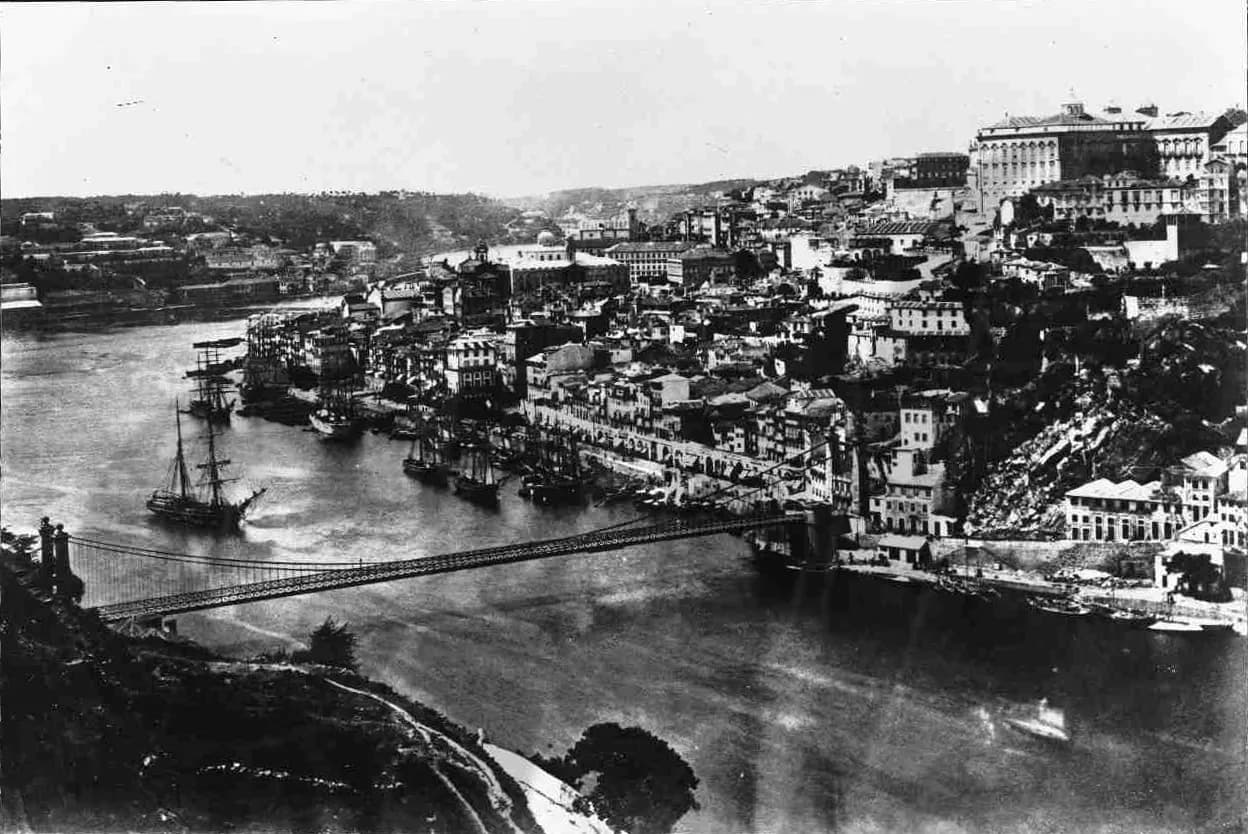
Five réis to cross
The bridge was a business. Because a company had built it, the company kept what travellers paid to cross. According to Pinho Leal, quoting the Diário Ilustrado, a person on foot paid 5 réis, a horse 20 réis and a carriage 200 réis, and every rate doubled at night.
| Crossing | By day | At night |
|---|---|---|
| Person on foot | 5 réis | 10 réis |
| Horse | 20 réis | 40 réis |
| Carriage | 200 réis | 400 réis |
Day rates as given by Pinho Leal, quoting the Diário Ilustrado; he states that night rates were double.
The concession ran for more than three decades. Pinho Leal says it ended in 1876, when the government took over the bridge; Azeredo dates the end to 17 January 1877.
Pinho Leal, writing in the 1870s, found it handsome and elegant, and recommended the view from the middle of the bridge, up or down the river.
A bridge that trembled
From early on, people did not quite trust it. Some writers said the bridge trembled “like green twigs”, a Portuguese phrase for shaking with fear, when people walked over it. Bigot reported the opposite: in his tests, groups of 40 to 50 people marching across caused no oscillation worth noting.
Then two French bridges of the same type failed. On 16 April 1850, in a strong wind, the suspension bridge at Angers collapsed as a battalion of 487 men marched across it, and about 200 died. In 1852 the deck of the bridge at La Roche-Bernard, in Brittany, fell when the cables on one side broke.
The government ordered tests. On 18 and 19 March 1853 the director of public works for the district of Porto loaded the bridge and measured how far the cables sagged. The despatch on the results was signed by António Maria de Fontes Pereira de Melo.
“the sag of the curve formed by the suspension cable did not exceed 47 centimetres during the whole time the bridge was loaded, and the same cable, after the load was removed, returned at once to its ordinary state, without damage appearing in any part of the said bridge.”
The despatch said all doubts should now disappear, but it also ordered the director to examine the bridge thoroughly every year. When the concession ended, the bridge was tested again and passed. The worry that remained was rust. Part of the anchor cables lay in sealed chambers that could not be inspected, and nobody could see whether the iron wires there were still sound.
The Minister of Public Works, António de Serpa Pimentel, put that argument in the preamble to a bill for a competition for “a metal bridge over the river Douro” in front of Porto, “to replace the present suspension bridge”. Upstream, meanwhile, a single iron arch already crossed the gorge: the Maria Pia railway bridge, built by Gustave Eiffel's company, had opened in November 1877.
Replaced and taken down
The competition for the new road bridge drew 12 proposals from 10 firms. The Belgian Société de Willebroeck won with a design by the engineer Théophile Seyrig: a single iron arch with two decks, one at the level of the quays and one at the level of the upper town. Work began in 1881, right beside the suspension bridge, and the upper deck of the Ponte Luís I opened on 31 October 1886.
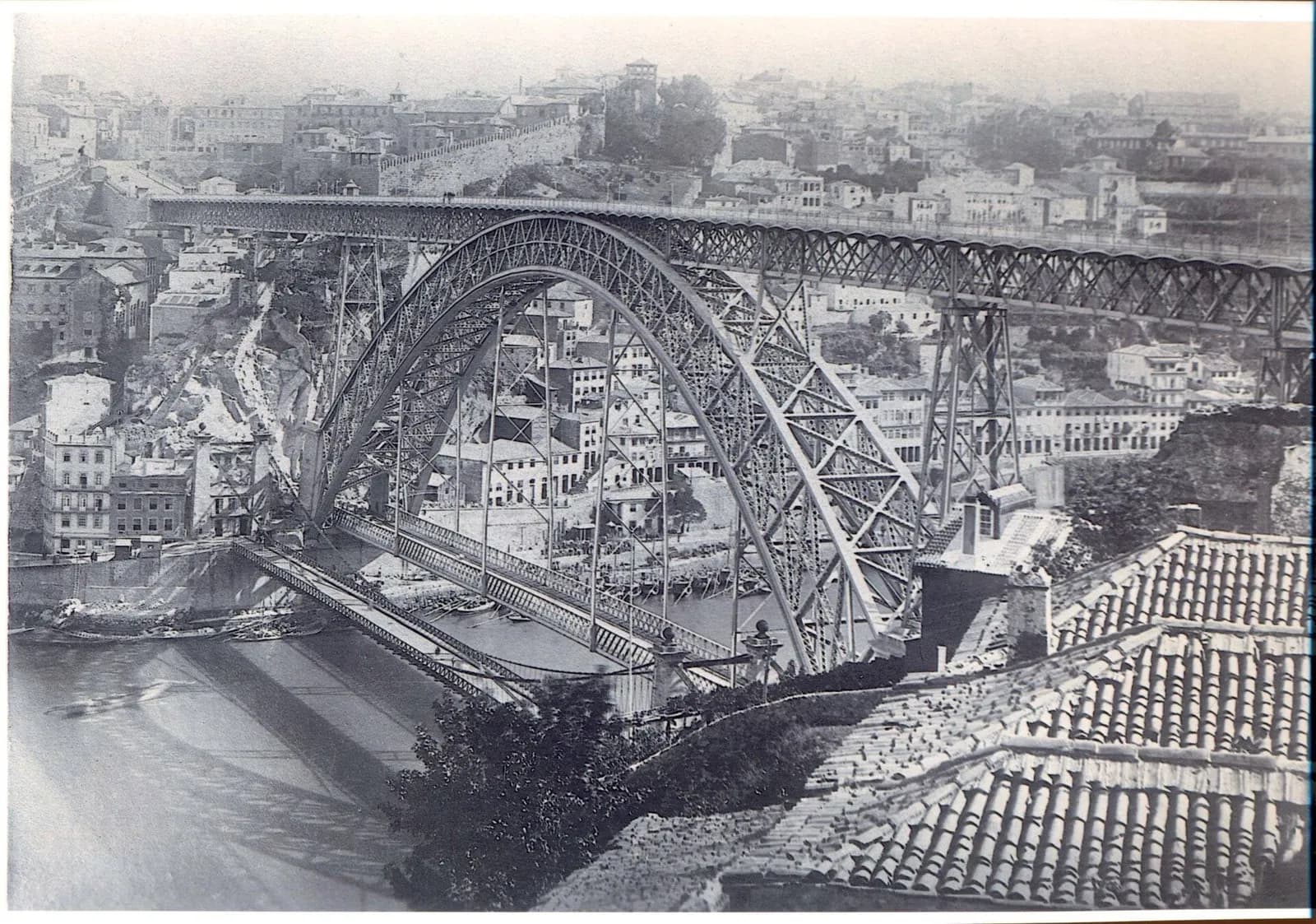
The suspension bridge was dismantled in 1887. To take the cables off, the capitals on top of the obelisks had to come off as well. On the Gaia bank the obelisks themselves were then demolished. On the Porto bank they were left standing, because pulling them down would have destroyed the bridge house between them, and only the capitals were removed. They were restored much later.
It had carried traffic for 44 years. Azeredo calls it Porto's first permanent bridge and the shortest-lived of them all, and writes that within very few years the rapid rusting of its iron parts had raised doubts about its safety.
1744
Regular ferry
A regular boat service starts between Porto and Gaia.
15 August 1806
Bridge of boats
A roadway on about 20 boats opens to the public.
29 March 1809
Disaster
Crowds fleeing Soult's troops drown at a gap in the bridge of boats.
7 April 1837
Contract approved
A law approves the contract with Claranges Lucotte for the Lisbon to Porto road and an iron suspension bridge.
2 May 1841
First stone
Work begins with a ceremony attended by the Porto authorities.
15 October 1842
Celebration
Crowds and fireworks celebrate the bridge's inauguration and first use.
4 January 1843
Load test
Casks of water are left on the deck for sixteen hours.
17 February 1843
Open to traffic
The bridge opens to public service as the Douro floods.
18–19 March 1853
Safety tests
After the Angers disaster the government has the bridge load-tested and orders yearly inspections.
1876 or 1877
State takes over
The builders' concession ends.
4 November 1877
Maria Pia bridge
Eiffel's railway bridge opens upstream.
31 October 1886
Luís I bridge
The upper deck of the new road bridge opens beside the old one.
1887
Dismantled
The suspension bridge is taken down; two obelisks remain on the Porto bank.
Why it still matters
The Ponte Pênsil was the first fixed bridge anywhere on the Portuguese Douro. It put Porto's road crossing between two rocky knolls just upstream of the Ribeira, and the Luís I bridge that replaced it was built right beside it.
Its doubts also shaped what came next. Fear of corroded wire in places no inspector could reach is one reason the state asked for a metal bridge, and Seyrig's double-decker arch is now part of Porto's UNESCO World Heritage site.
The suspension bridge also left a detailed written record. Bigot's 1843 memoir describes how the wire was coated, spliced and tested, and how the cables were anchored. In the 1990s the Porto engineering professor Manuel de Azeredo drew on it to explain how the bridge was made.
FAQs
When did the Ponte Pênsil open?
It opened to public traffic on 17 February 1843. The finished deck had already been celebrated with a festive first crossing on Saturday 15 October 1842, and it passed a 16-hour load test on 4 January 1843.
Why was it called the Ponte D. Maria II?
That was its official name, after Queen Maria II, and an iron beam on the obelisks carried the words “D. Maria II, 1842”. People in Porto always called it the Ponte Pênsil, the suspension bridge.
Who designed and built it?
The French engineer Stanislas Bigot designed it, with Amédée Carruette as the other engineer named in a summary of Bigot's 1843 report; some later accounts also credit the Portuguese engineer José Vitorino Damásio. The French company of Claranges Lucotte built it under an 1837 contract with the Portuguese government and collected the tolls until the concession ended in 1876 or 1877.
Why was the suspension bridge demolished?
Its safety was doubted for decades, especially after similar bridges collapsed at Angers in 1850 and La Roche-Bernard in 1852. It passed load tests, but part of its anchor cables could not be inspected for rust. The state held a competition for a metal bridge, and once the Luís I bridge opened beside it in 1886, the suspension bridge was taken down in 1887.
Can you still see the Ponte Pênsil?
Yes, in part. Its two stone obelisks still stand on the Porto bank at the Cais da Ribeira, beside the Luís I bridge, with the facade of the bridge house between them. The obelisks on the Gaia bank were demolished in 1887.
On the timeline
Open the timelineNearby moments from invasions, brazil and the liberal wars (1807–1851).
The future King Pedro V, 'the Hopeful', is born at the Necessidades Palace in Lisbon. Acclaimed on his 18th birthday in 1855 — the day Lisbon's first electric telegraph line was inaugurated — the studious, modernising king died in an epidemic in 1861, aged just 24, along with two of his brothers.
Joaquim Guilherme Gomes Coelho, better known as Júlio Dinis, is born in Porto. A doctor who died of tuberculosis at 31, he wrote gentle novels of rural and provincial life such as 'As Pupilas do Senhor Reitor' and 'A Morgadinha dos Canaviais' that remain classics of Portuguese fiction.
Birth of Antero de Quental in Ponta Delgada, on the Azorean island of São Miguel. A charismatic student leader at Coimbra and a central figure of the Generation of '70, he is counted among the finest sonnet writers in the Portuguese language, taking Camões's sonnets as his model.
Porto's suspension bridge opens
Porto's D. Maria II suspension bridge opens to traffic over the Douro as the river floods, four months after crowds had celebrated its first crossing. Replaced by the Luís I bridge and dismantled in 1887, it is still recalled by two stone obelisks on the Porto bank.
Teófilo Braga is born in Ponta Delgada, in the Azores. A prolific historian of Portuguese literature and positivist thinker, he headed the Provisional Government after the 5 October 1910 revolution and briefly served as President of the Republic in 1915.
Eça de Queirós is born in Póvoa de Varzim, the illegitimate son of parents who married only years later. The great realist novelist of 'O Crime do Padre Amaro' and 'Os Maias' spent much of his life as a consul abroad — in Havana, Newcastle, Bristol and Paris — turning a sharply ironic eye on Lisbon society.
Rafael Bordalo Pinheiro is born in Lisbon into a family of artists. In satirical papers such as 'O António Maria' he mocked kings, ministers and Britain alike, and in 1875 he gave the nation its enduring cartoon alter ego, Zé Povinho, the shrugging, put-upon everyman.
Coming up in history
All long reads 19 February 1649The Second Battle of Guararapes: the rout that doomed Dutch Brazil
 20 February 2010Mud in the streets of Funchal: the Madeira floods of 20 February 2010
 21 February 2009Lagoa Henriques, the sculptor who sat Pessoa down in the Chiado
 22 February 1943The Yankee Clipper crash: when a wartime flying boat fell into the Tagus
12 sources
Archives, scholarship and reporting this article was checked against.
- 1
As Pontes do Porto (Manuel de Azeredo, 1997–1999)Faculdade de Engenharia da Universidade do Porto (U.Porto web archive)
- 2
- 3
Portugal antigo e moderno, vol. 7, entry “Porto”, annals for 1806 (pp. 316–317) (Augusto Pinho Leal)Mattos Moreira, Lisbon, c. 1876 (Getty Research Institute copy, Internet Archive)
- 4
- 5
- 6
- 7
Ponte Pensil (Porto)Grace's Guide to British Industrial History
- 8
A History of the Peninsular War, vol. II: January–September 1809 (Charles Oman)Clarendon Press, Oxford, 1903; Project Gutenberg edition
- 9
Piers of the Suspension BridgeVisit Porto (Câmara Municipal do Porto)
- 10
Ponte Maria PiaInfraestruturas de Portugal
- 11
- 12
Centro Histórico do Porto, Ponte Luiz I e Mosteiro da Serra do PilarComissão Nacional da UNESCO (Portugal)
Image credits
- Porto and the Ribeira quay seen from upstream, with the D. Maria II suspension bridge in the foreground and its two obelisks on the Porto bank. Oil painting by an unknown artist of the English school, nineteenth century. Unknown author, Public domain, via Wikimedia Commons.
- Porto's riverside quays with the suspension bridge beyond and the monastery of Serra do Pilar on the hill above Vila Nova de Gaia. Coloured engraving by Charles Legrand, published around 1850. Charles Legrand, Public domain, via Wikimedia Commons.
- The suspension bridge and Porto's riverside seen from the hill on the Gaia side, upstream of the bridge. Photograph by an unknown photographer, taken before work on the Luís I bridge began in 1881. Unknown author, Public domain, via Wikimedia Commons.
- The new Luís I bridge, its upper deck finished, with the old suspension bridge still in place below it. Photograph by George Tait, taken from the Gaia side between late 1886 and May 1887. George Danson Tait, Public domain, via Wikimedia Commons.
- The two surviving obelisks of the suspension bridge on the Porto bank, with the facade of the bridge house between them, beside the Luís I bridge in September 2025. TIMRAAB227, CC BY-SA 4.0, via Wikimedia Commons.