

The Yankee Clipper crash: when a wartime flying boat fell into the Tagus
In the war years Pan Am's transatlantic flying boats came down on the river at Lisbon, the European end of their route from New York. One evening in February 1943 the most famous of them caught a wing tip in the water as it turned to land.
At a glance
- On 22 February 1943, at about 6.47 in the evening Greenwich time, Pan American Airways' Boeing 314 flying boat Yankee Clipper crashed into the Tagus about two miles east of the Cabo Ruivo seaplane base in Lisbon.
- The US Civil Aeronautics Board counted 39 people aboard. Nineteen passengers and five crew died; eight passengers and seven crew survived.
- Lisbon was then the main European terminus of Pan Am's Atlantic route from New York by way of Bermuda and Horta in the Azores, because Portugal was neutral in the Second World War.
- The investigators found no failure in the aircraft and gave the probable cause as the left wing tip touching the water during a descending turn, probably through misjudged height in fading light.
- The singer Jane Froman, on her way to entertain American troops, survived with terrible injuries; the writer Ben Robertson and the Broadway singer Tamara Drasin were among the dead.
Dusk over the Tagus
On the evening of 22 February 1943 a Pan American launch was waiting on the Tagus off Cabo Ruivo, on Lisbon's eastern waterfront. The sun had officially set at 6.20 by Greenwich time, so the ground crew had laid out a string of landing lights on the river. At about 6.35 the flying boat they were waiting for, the Yankee Clipper, appeared overhead, 15 minutes early. It had left New York the day before and stopped in Bermuda and at Horta in the Azores.
The aircraft flew north-east over the landing area at about 135 knots and between 500 and 600 feet. About a mile and a half east of the centre light it began a descending turn to the left. The turn continued until the Clipper was heading west. Then its left wing tip skimmed the surface, dug in, and the 42-ton aircraft went into the river.
It stayed partly afloat for about ten minutes and then sank. The launch that had been standing by reached the wreck about ten minutes after the crash and began pulling people out of the water. A launch of the British airline BOAC and a second Pan American boat joined it some ten minutes later.
Of the 39 people aboard, 24 died. Among the survivors was Jane Froman, one of the best-known singers on American radio, who had been on her way to her first USO show for the troops in Europe. In the water she was helped by a junior officer of the crew, John Burn, who had himself broken his back.
Lisbon, the open door
Portugal was a dictatorship in 1943. The Estado Novo (New State) of António de Oliveira Salazar had kept the country neutral when the war began in 1939, while keeping its old alliance with Britain. Neutral Lisbon traded with both sides, sheltered refugees from occupied Europe and was full of diplomats, businessmen and spies.
That made it the European end of Pan Am's passenger service across the Atlantic. The flying boats left New York, refuelled in Bermuda and at Horta, and landed on the Tagus; the February trip was then to go on to Foynes in neutral Ireland. In 1943 the trip from New York to Lisbon took about 27 hours, including the stops.
A seat cost a fortune. In 1939 the one-way fare from New York to Marseilles was $375, and there was only one class; José Correia Guedes, a former captain with TAP, the Portuguese national airline, puts that at $8,500 to $9,000 in today's money. The wealthiest refugees waiting in Lisbon bought tickets on the Clipper, which flew twice a week between Lisbon and New York. Most of the rest waited, often for months, for passage by sea.
By early 1943 it took serious money or influence to get a seat, and many of those on the February flight were travelling on war business of one kind or another. About a dozen United States Army officers were aboard in civilian clothes, using commercial flights through neutral territory.
The river was not a safe runway. Six weeks before the Clipper crash, on 9 January 1943, a British flying boat, the Golden Horn, exploded after a fuel leak on a test flight and fell into the Tagus at Cabo Ruivo. Thirteen of the 15 people aboard died, many of them airport staff who had gone along for the ride against the rules.
The biggest airliner in the world
The Boeing 314 was built for Pan Am in Seattle. The airline ordered six in July 1936 for $4.8 million, and the first flew on 7 June 1938. Only 12 were ever built. In 1939 it could carry more passengers than any airliner in service, up to 74, in five compartments with a dining room, dressing rooms and sleeping berths.
- Type
- Boeing 314 flying boat with Wright R-2600 engines of 1,500 hp
- Built
- 12 aircraft; first flight 7 June 1938
- Size
- About 106 feet long and 42 tons
- Capacity
- Up to 74 passengers, the most of any airliner in 1939
- Range
- 5,200 miles ferry range in the later 314A version
- Fare in 1939
- $375 one way, New York to Marseilles
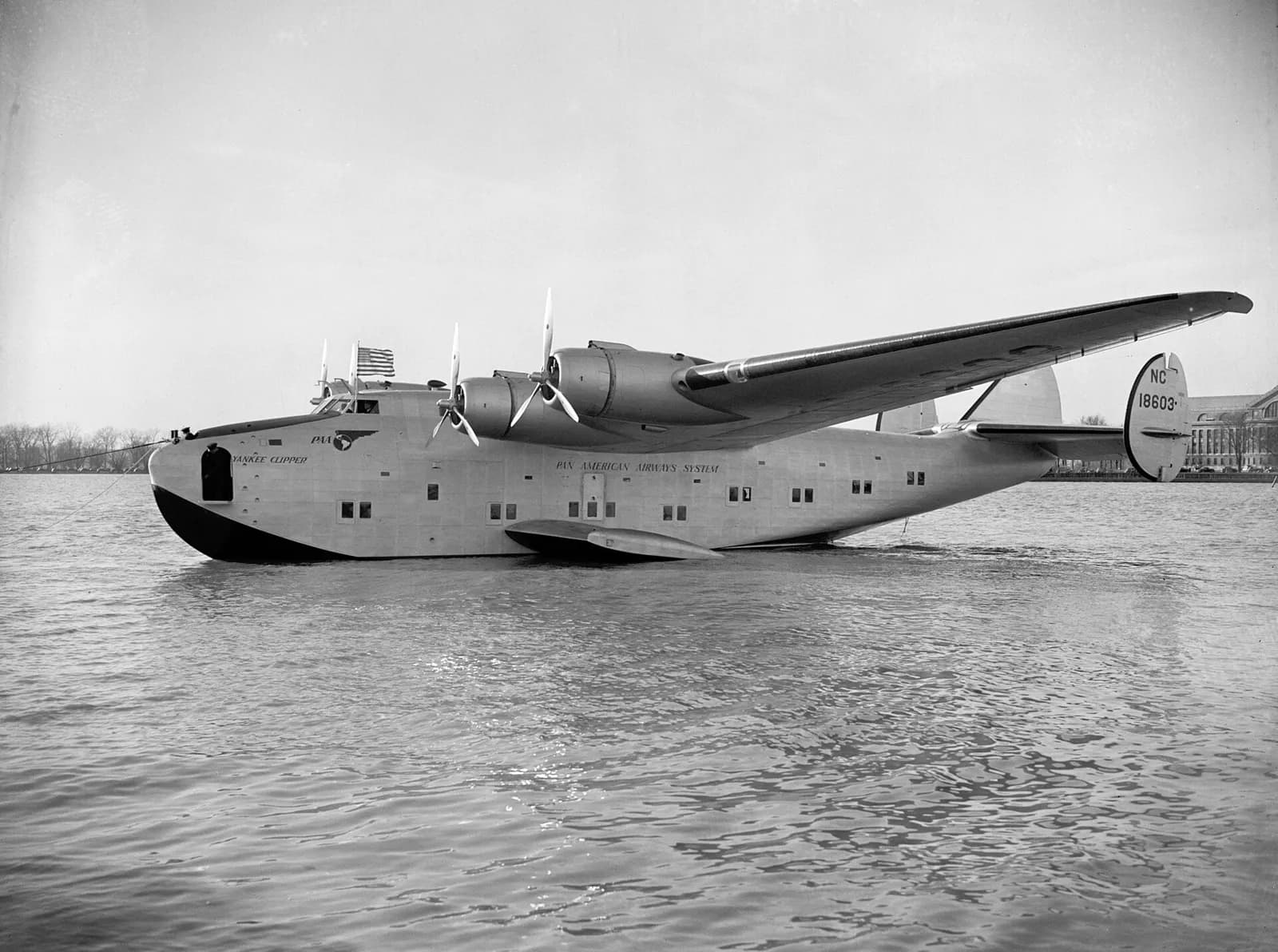
The Yankee Clipper, registration NC18603, was christened by Eleanor Roosevelt in 1939. On 20 May that year it flew the first scheduled transatlantic airmail service, Foreign Air Mail route 18, from New York towards Marseilles, with the pilot Arthur LaPorte in command. Mail for Lisbon on that first flight arrived on 21 May.
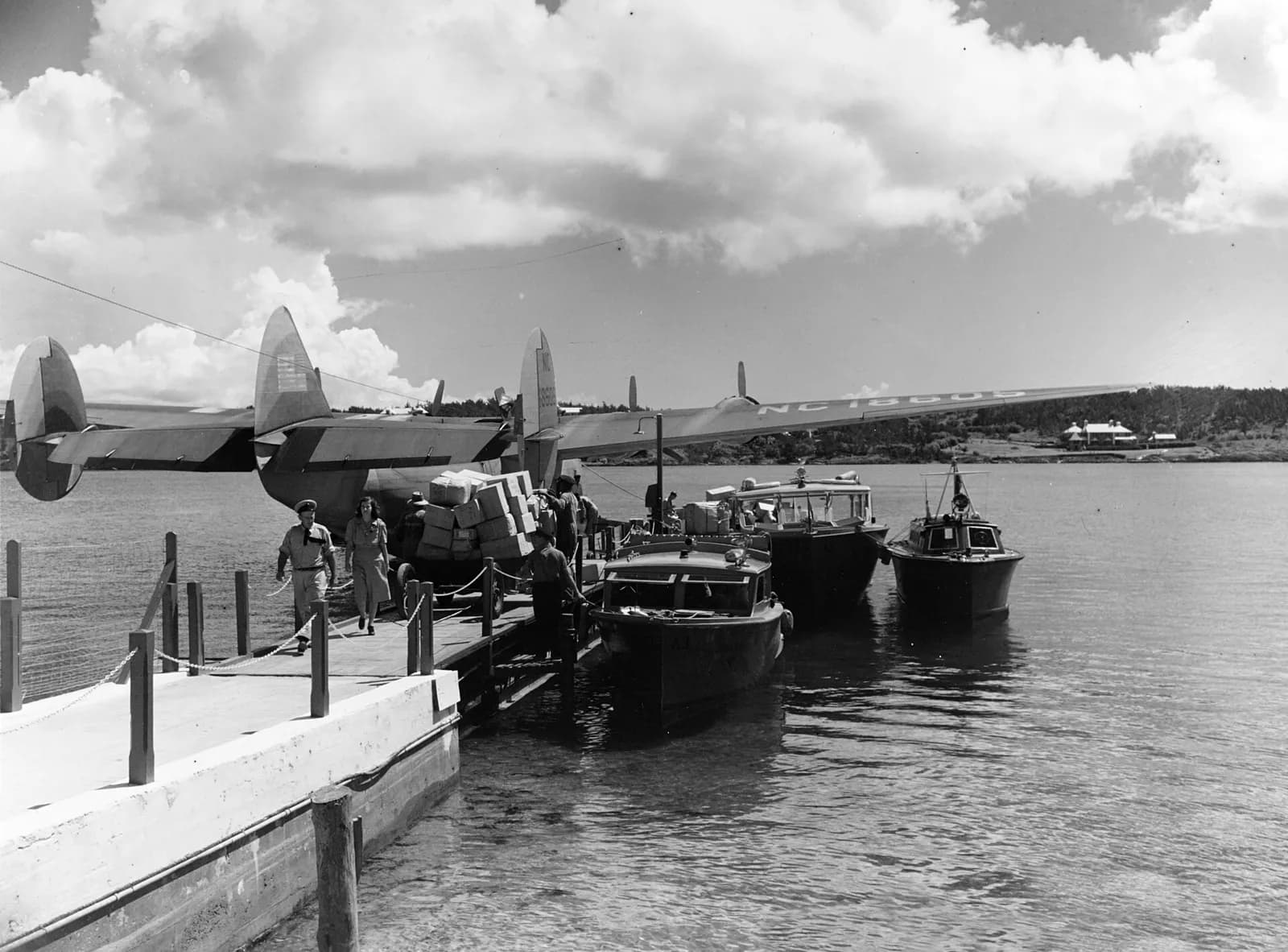
When the United States entered the war in December 1941 the Clippers kept flying, now carrying high-priority passengers and cargo for the American and British forces. In January 1943 the Dixie Clipper flew Franklin Roosevelt across the Atlantic on his way to the Casablanca Conference, making him the first sitting president to fly.
The Yankee Clipper was one of the busiest. In January 1943, the month before the crash, it became the first airliner to fly more than a million miles across the Atlantic. Its captain on the February trip, R. O. D. Sullivan, known as Sully, was the first pilot to log 100 transatlantic flights; a fellow officer recalled the celebration two weeks before the crash.
Trip 9035 and its passengers
The flight was Pan Am trip 9035, scheduled from New York to Bermuda, Horta, Lisbon and Foynes. It left New York's Marine Air Terminal on 21 February 1943 with 27 passengers and a crew of 12. The historian Brooke Blower, who has written a book about seven of the people aboard, calls theirs a Casablanca story of the Second World War rather than a Saving Private Ryan one.
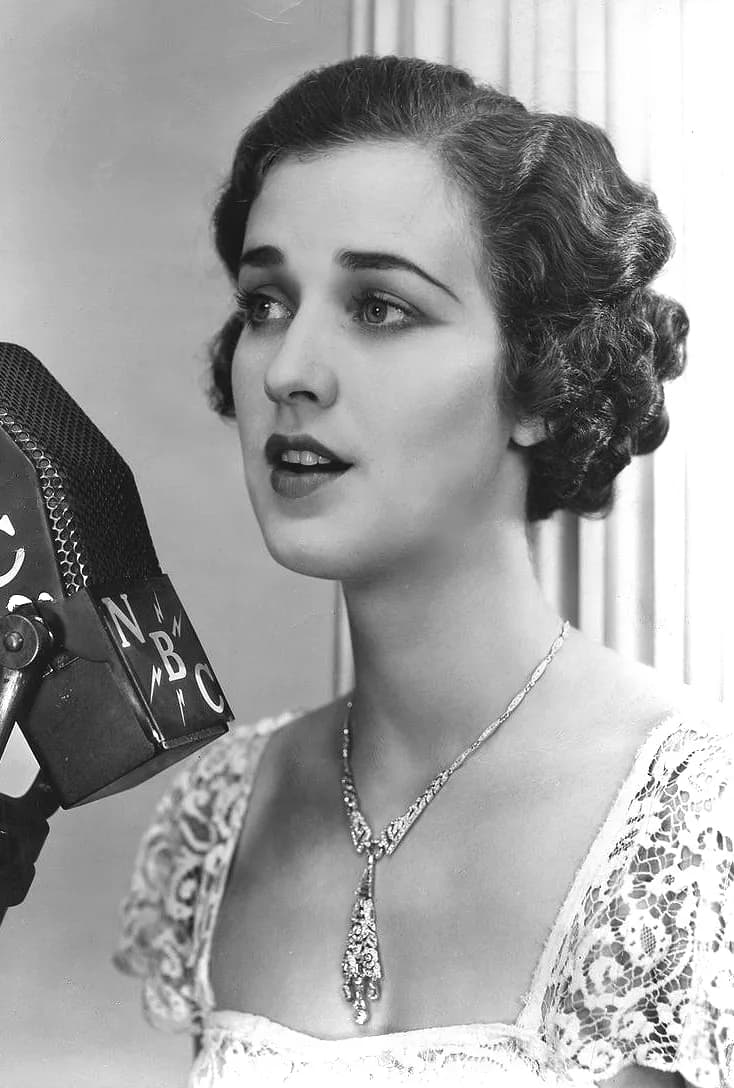
Seven of the passengers were a troupe of entertainers sent by the USO, the organisation that put on shows for American servicemen. Jane Froman was its star. With her were Tamara Drasin, a Ukrainian-born Broadway singer who had been the first to sing Smoke Gets in Your Eyes, the accordionist Gypsy Markoff, and the performer Roy Rognan and his wife Jean.
Across the aisle from Froman sat Ben Robertson, a South Carolina journalist she knew from the University of Missouri. He had watched the Battle of Britain from a bluff at Dover with his friend Edward R. Murrow of CBS, written a successful book about Britain at war, I Saw England, and a memoir of the American South, Red Hills and Cotton. He was going back to London to run the New York Herald Tribune's bureau.
“I lost my sense of personal fear because I saw that what happened to me did not matter. We counted as individuals only as we took our place in the procession of history.”
Others had stranger stories. Frank Cuhel, a former Olympic athlete, had become an export salesman and then a radio war correspondent. Manuel Diaz Riestra, a Spanish-born shipping magnate and supporter of Franco, was suspected by the American government of helping the Axis. James N. Wright was a State Department diplomatic courier.
Ten minutes in the water
Nobody aboard seems to have expected a crash. The surviving crew and passengers told the investigators that they thought the aircraft was making a normal landing. Seat belts had not yet been called for, according to a Pan Am officer who later spoke to the captain and to John Burn, and one crew member was standing on the flight deck between the pilots.
The aircraft was demolished, in the investigators' word. Froman had a gash below her left knee that nearly severed the leg, a right leg so badly broken that doctors considered amputating it, broken ribs and multiple fractures of the right arm.
Guedes, who has written a novel about the crash, points out that Lisbon had no rescue service on the river: in his words, it was private boats that went to fetch the survivors. Froman was taken to the Hospital de São José, which she later called medieval in an interview, he says.
21 February
The Yankee Clipper leaves New York's Marine Air Terminal for Bermuda
22 February
After a stop at Horta in the Azores it flies on to Lisbon, 3 hours 52 minutes away
18.20 GMT
Official sunset at Lisbon; the Pan Am ground crew sets out a string of landing lights on the river
About 18.35 GMT
The Clipper arrives over Cabo Ruivo, 15 minutes ahead of schedule
Shortly before 18.47
Over the landing area, heading north-east at 500 to 600 feet and about 135 knots
The aircraft begins a descending left turn about a mile and a half east of the centre landing light.
About 18.47 GMT
The left wing tip touches the water and the aircraft crashes, heading west, about two miles east of Cabo Ruivo
About 10 minutes after
The waiting Pan Am launch reaches the wreck, which sinks at about the same time
About 20 minutes after
A BOAC launch and a second Pan Am launch join the rescue
Who died and who survived, by passengers and crew
people
- Killed
- Survived
Figures from the Civil Aeronautics Board report. Of the eight surviving passengers, two were seriously injured, two slightly and four were unhurt; the seven surviving crew had injuries from minor to serious.
Show the data
| Killed | Survived | |
|---|---|---|
| Passengers | 19 | 8 |
| Crew | 5 | 7 |
The dead included the first officer, H. S. Rush, and the third officer, Andy Freeland, as well as Tamara Drasin, Roy Rognan, Ben Robertson, Frank Cuhel, Manuel Diaz and the courier James Wright. Captain Sullivan survived. Later accounts put the number aboard at 38 or 42, but the investigators counted 39.
What went wrong
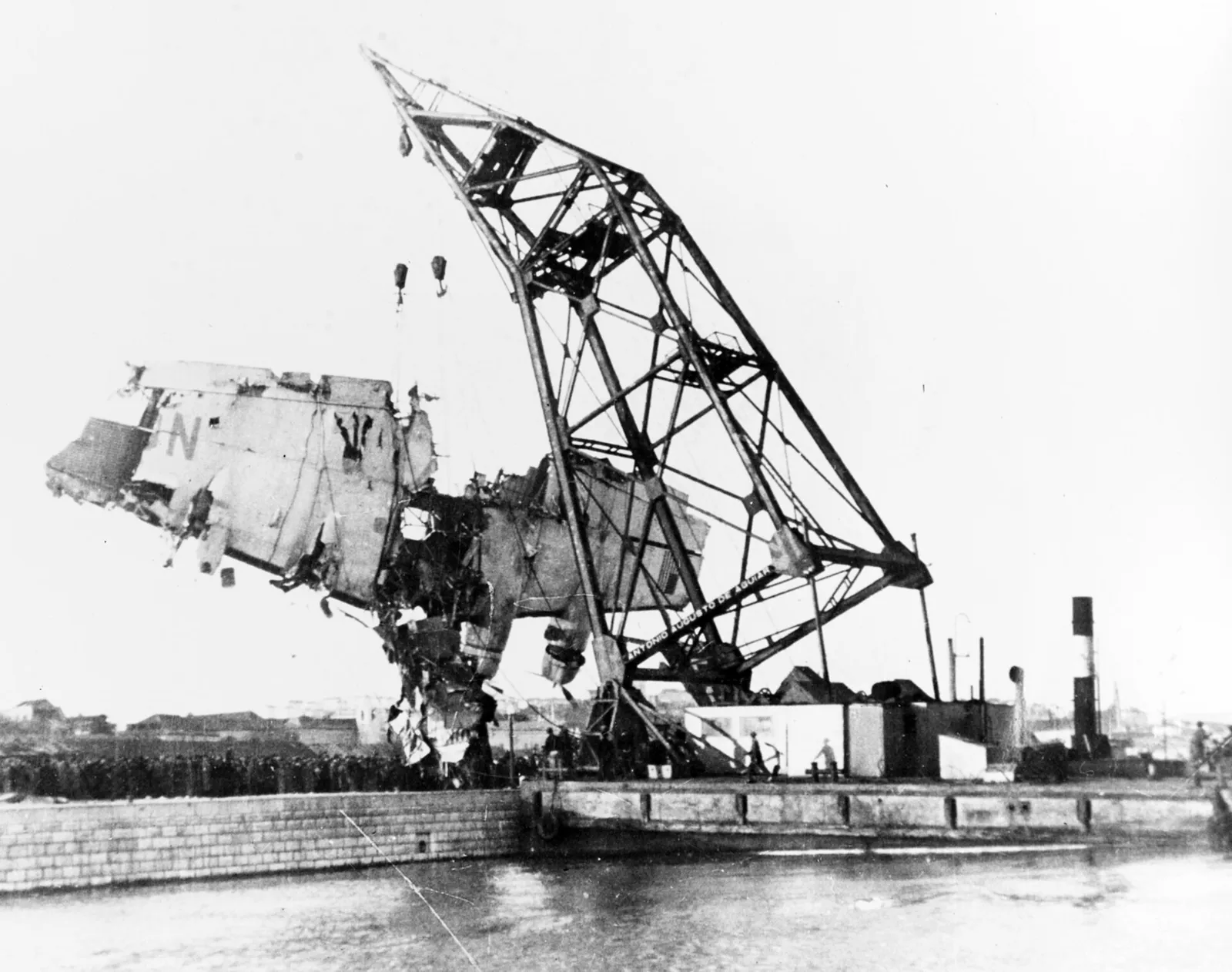
Bill Nash, a junior Pan Am officer, had been due to fly on the Yankee Clipper as third officer until he was switched to an earlier trip two days before it left. Andy Freeland took his place. Nash was in Lisbon when the Clipper crashed. His crew stayed three weeks, working on the wreck after it was lifted from the riverbed, taking out instruments and parts that might explain the crash and packing them in barrels. They also had to identify crew friends, Freeland among them, in the morgue.
Captain Sullivan told the investigators that the aircraft had gone into an abnormally steep dive, about 45 degrees from 400 feet, and that the first officer had tried to help him regain control. The Civil Aeronautics Board did not accept his account. It found nothing in the wreckage of the controls to explain a failure, and no other survivor had noticed anything unusual.
“It appears that the probable cause of this accident was an inadvertent contact of the left wing tip of the aircraft with the water while making a descending turn preparatory to landing.”
The Board suggested that the wind and the coming darkness may have led Sullivan to land from east to west across the line of landing lights, and that in the last of the daylight he misjudged his height in the turn. Guedes, the former TAP pilot, makes a similar point: at dusk the surface of water acts like a mirror and makes height very hard to judge.
Sullivan was dismissed by Pan Am after a hearing. Accounts of his later life differ: Nash says he flew for Firestone in Africa, while Guedes says he never went back to the United States and ended up commanding coastal ships. Of the three Boeing 314s lost in accidents, the Yankee Clipper is the only one whose loss was put down entirely to pilot error.
Aftermath
In Portugal the crash made little noise. Guedes found the story by chance in a 1943 copy of the Diário de Lisboa while researching something else, and says the press of the time gave it scant space; censorship under the Estado Novo kept wartime news thin. In the United States it was front-page news.
The river gave up its dead slowly. Ben Robertson's body was recovered several days later and sent home in a Portuguese casket to be buried at Liberty, South Carolina. On 28 February Murrow spoke about him on CBS. A Liberty ship, the SS Ben Robertson, was launched at Savannah in January 1944.
“He is out of the war, and into peace. There was never a night so black Ben couldn't see the stars.”
Froman spent about two months recovering in Portugal. Later in 1943 she was back on the Broadway stage in Artists and Models, singing from a wheelchair, and in 1945 she toured Europe on crutches, performing for about 30,000 servicemen. She had an estimated 39 operations in her lifetime and wore a leg brace for the rest of her life.
She also went to court. In April 1944 Pan Am answered her million-dollar suit by saying that it was not liable and that, if it were, the Warsaw Convention on international air travel capped what it owed her. In 1958, fifteen years after the crash, Congress passed a private act paying compensation to her and two of the other entertainers.
| Claimant | Claim or offer | Amount |
|---|---|---|
| Jane Froman | Suit against Pan Am, answered by the airline in April 1944 | $1 million |
| Jane Froman | Pan Am's maximum under the Warsaw Convention, if found liable | $8,705 ($8,291 for injuries, $414 for baggage) |
| Don Ross, Froman's husband | Suit for hospital costs and loss of services, plus baggage | $100,000 and $10,000 |
| Jean Rognan, widow of Roy Rognan | Suit pending in 1944 | $425,000 |
| Gypsy Markoff | Suit pending in 1944 | $100,000 |
| Jane Froman | Private Law 85-713, 27 August 1958 | $23,403.58 |
| Gypsy Markoff | Private Law 85-713, 27 August 1958 | $23,403.58 |
| Jean Rosen, formerly Jean Rognan | Private Law 85-713, 27 August 1958 | $24,625.30 |
The 1958 sums were what the three would have received under the Federal Employees' Compensation Act had they been federal employees, since they were travelling to entertain the armed forces. Variety did not report how the 1944 suits ended.
Froman married John Burn in 1948, after divorcing Don Ross; they separated in 1955. In 1952 Twentieth Century Fox told her story in With a Song in My Heart, with Susan Hayward in the lead and Froman's own voice in the songs. Part of the film is set in Lisbon. Froman died in Columbia, Missouri, in 1980, aged 72.
Why it still matters
Renascença, the Portuguese Catholic radio station, has called it the biggest air accident in Lisbon's history. It came in the years when Pan Am's airliners from New York touched Europe on the river at Lisbon. Its passenger list reads like a cross-section of the Americans who passed through Lisbon in those years: entertainers, reporters, officers in civilian clothes, a courier and a businessman under suspicion.
The era of the big flying boats ended soon after the war. Pan Am flew its last Boeing 314 Clipper service in 1946, and none of the 12 Boeing 314s survives. Seaplane traffic at Cabo Ruivo ended in the 1950s: Portugal Resident gives 1950, Time Out Lisboa 1959.
FAQs
How many people died in the Yankee Clipper crash in Lisbon?
Twenty-four of the 39 people aboard: 19 passengers and five crew, according to the US Civil Aeronautics Board. Fifteen survived, eight passengers and seven crew. Some later accounts give 38 or 42 people aboard.
What caused the crash?
The Civil Aeronautics Board found no failure of the aircraft. It gave the probable cause as the left wing tip touching the water during a descending turn before landing, probably because the captain misjudged his height in fading light. The captain said the controls had pulled the aircraft into a dive, and one Pan Am officer later blamed an autopilot valve.
What happened to Jane Froman after the crash?
She survived with severe injuries to both legs and her right arm, spent about two months recovering in Portugal and had an estimated 39 operations in her lifetime. She returned to the stage in 1943, married John Burn, the crew member who helped her in the water, and her story became the 1952 film With a Song in My Heart.
Why did transatlantic flights land in Lisbon during the Second World War?
Portugal was neutral, so Pan Am could keep flying there from New York by way of Bermuda and the Azores while the war closed most of Europe. Its Boeing 314 flying boats landed on the Tagus at Cabo Ruivo, and some went on to Foynes in neutral Ireland.
Where was Lisbon's seaplane airport?
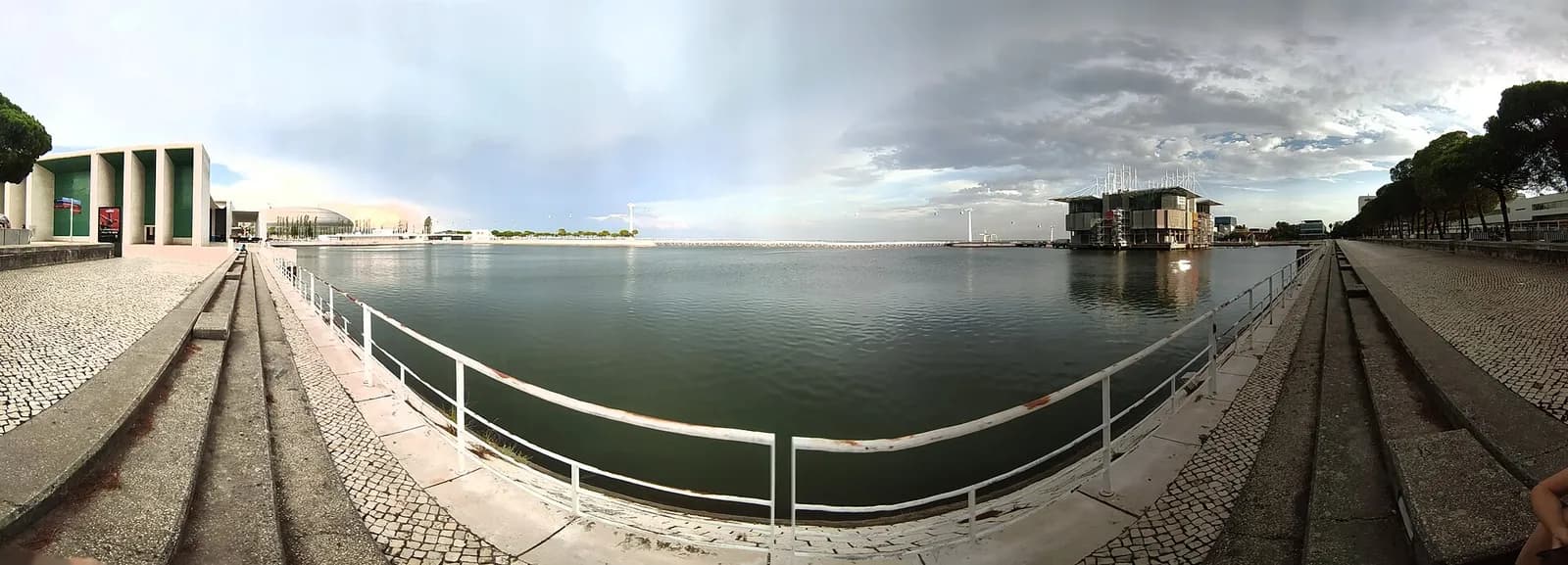
At Cabo Ruivo on the eastern waterfront, where Parque das Nações and the Oceanário stand today. The Doca dos Olivais there was built in the 1940s for the seaplanes, and Avenida de Berlim was built to link the river terminal with the land airport at Portela.
On the timeline
Open the timelineNearby moments from dictatorship and the estado novo (1926–1974).
Birth in Porto of José Mário Branco, one of the great voices of Portuguese protest song. In exile in France he arranged José Afonso's 1971 album 'Cantigas do Maio', which includes 'Grândola, Vila Morena', the song broadcast as a signal for the Carnation Revolution; his own epic 'FMI' (1982) voiced the disillusion that followed it.
Birth in Lisbon of António Lobo Antunes, psychiatrist turned novelist whose books drawing on the colonial war in Angola made him one of Portugal's greatest modern writers; he was awarded the Prémio Camões in 2007.
Birth in Bengo province, near Luanda, of José Adelino Barceló de Carvalho — Bonga. Recruited by Benfica, he became Portugal's 400-metre record holder while secretly carrying messages for Angolan independence fighters, then went into exile in the Netherlands, where his 1972 debut album 'Angola 72' became a landmark of the independence struggle.
The Yankee Clipper crash, 1943
Pan Am's 'Yankee Clipper' flying boat crashes while landing on the Tagus in Lisbon, wartime Europe's gateway to America. Twenty-four of the 39 people aboard die; Broadway singer Jane Froman, travelling to entertain US troops, survives badly injured — a story Hollywood retold in 'With a Song in My Heart'.
Winston Churchill tells the House of Commons that Britain, invoking the alliance treaty of 1373, has asked neutral Portugal for facilities in the Azores and that Portugal has agreed. British forces had landed on 8 October, and within weeks RAF aircraft were hunting U-boats from Lajes on Terceira, extending air cover over the mid-Atlantic convoy routes.
Manuel António Pina is born in Sabugal, in the Beira Alta. A Porto journalist who spent three decades at the 'Jornal de Notícias', he wrote spare, playful poetry and much-loved children's books, and in 2011 won the Camões Prize, the highest award in Portuguese-language literature.
Death in Porto, aged 93, of Bernardino Machado. Born in Rio de Janeiro — the only president of Portugal born outside the country — he was twice elected head of state of the First Republic, and both terms were cut short by military coups, in 1917 and 1926, each followed by exile.
Coming up in history
All long reads 24 February 1843Teófilo Braga, the Azorean scholar who led the Republic’s first government
 25 February 1869The 1869 decree that abolished slavery in the Portuguese empire, on paper
 26 February 1885The Berlin Conference of 1885 and Portugal's lost Congo mouth
 27 February 1666Luísa de Gusmão: the Andalusian duchess who ruled Restoration Portugal
20 sources
Archives, scholarship and reporting this article was checked against.
- 1
Report of the Civil Aeronautics Board on the investigation of an accident involving aircraft of United States registry NC 18603, in the Tagus River, Lisbon, Portugal, on February 22, 1943 (adopted 7 September, released 9 September 1943): extractsCivil Aeronautics Board; extracts transcribed by Wayne Blanchard, Deadliest American Disasters and Large-Loss-of-Life Events
- 2
Broadway Singers, a Nazi Sympathizer, and the Doomed Flight of the Yankee ClipperBoston University, The Brink (Andrew Thurston), 5 September 2023
- 3
R.O.D. Sullivan and the Yankee Clipper Crash (Bill Nash)Clipper Pioneers Newsletter, vol. 51, no. 5, June 2016
- 4
Jane FromanState Historical Society of Missouri, Historic Missourians
- 5
Benjamin Franklin Robertson, Jr.Clemson University, Scroll of Honor (Clemson Corps)
- 6
Private Law 85-713, An Act for the relief of Jane Froman, Gypsy Markoff, and Jean Rosen, 27 August 1958 (72 Stat. A187–A188)United States Statutes at Large, GovInfo
- 7The river airport in Lisbon (Peter Booker)Portugal Resident, 13 June 2022
- 8
Americans in a World at War: Intimate Histories from the Crash of Pan Am's Yankee ClipperCenter for Advanced Study in the Behavioral Sciences, Stanford University
- 9
Lisbon: Harbor of Hope and Intrigue (Gene Santoro)HistoryNet, 2 June 2011
- 10
Boeing's Model 314 Clipper Flying Boat (Essay 3253, Anthony E. Pomata)HistoryLink.org, 21 April 2001
- 11
A história do avião de luxo que acabou em acidente no rio Tejo (Maria João Costa)Renascença, 13 February 2026
- 12
O pátio das antigas: um aeroporto aberto ao mundo em 1942 (Eurico de Barros)Time Out Lisboa, 9 June 2024
- 13
Pan American Airways (Pan Am) (USA) Foreign Air Mail (FAM 18) First Transatlantic Scheduled Airmail Flight Flown Letter (NASM.2015.0021)Smithsonian National Air and Space Museum Archives
- 14
Airmail flight cover: Pan American Airways, FAM-18, first airmail flight, New York – Lisbon routeSFO Museum, Aviation Museum and Library collection
- 15
Pan Am's Boeing 314 Clippers, 10: The first lossesSan Diego Air & Space Museum, online exhibit
- 16
Pan-American Files Reply in Froman Suit; Only Will Pay $8,705Variety, 5 April 1944, p. 6 (Internet Archive)
- 17
James Wright, Diplomatic Courier, deceased February 22, 1943United States Department of State, Diplomatic Security Service Memorial
- 18
Accident reports, September 1943 (Ralph J. Moore Aviation Collection, Box 2, Folder 43)The Museum of Flight Archives, Seattle
- 19
Lisboa '88 '98 2008: da oportunidade à aptidãoLuís Viana Baptista, Portus (RETE), 2008
- 20A beleza cruel de uma terra de ninguémDiário de Notícias, 18 May 2018
Image credits
- The Boeing 314 Yankee Clipper, registration NC18603, photographed by the Washington studio Harris & Ewing around 1939, the year it opened Pan Am's transatlantic airmail service. Harris & Ewing, photographer, Public domain, via Wikimedia Commons.
- The Dixie Clipper, a sister ship of the Yankee Clipper, being loaded at Darrell's Island, Bermuda, the first stop on the route to Lisbon, on 18 September 1942. In January 1943 this aircraft flew President Roosevelt across the Atlantic on his way to the Casablanca Conference. T/4 Fred A. Courter, U.S. Army, Public domain, via Wikimedia Commons.
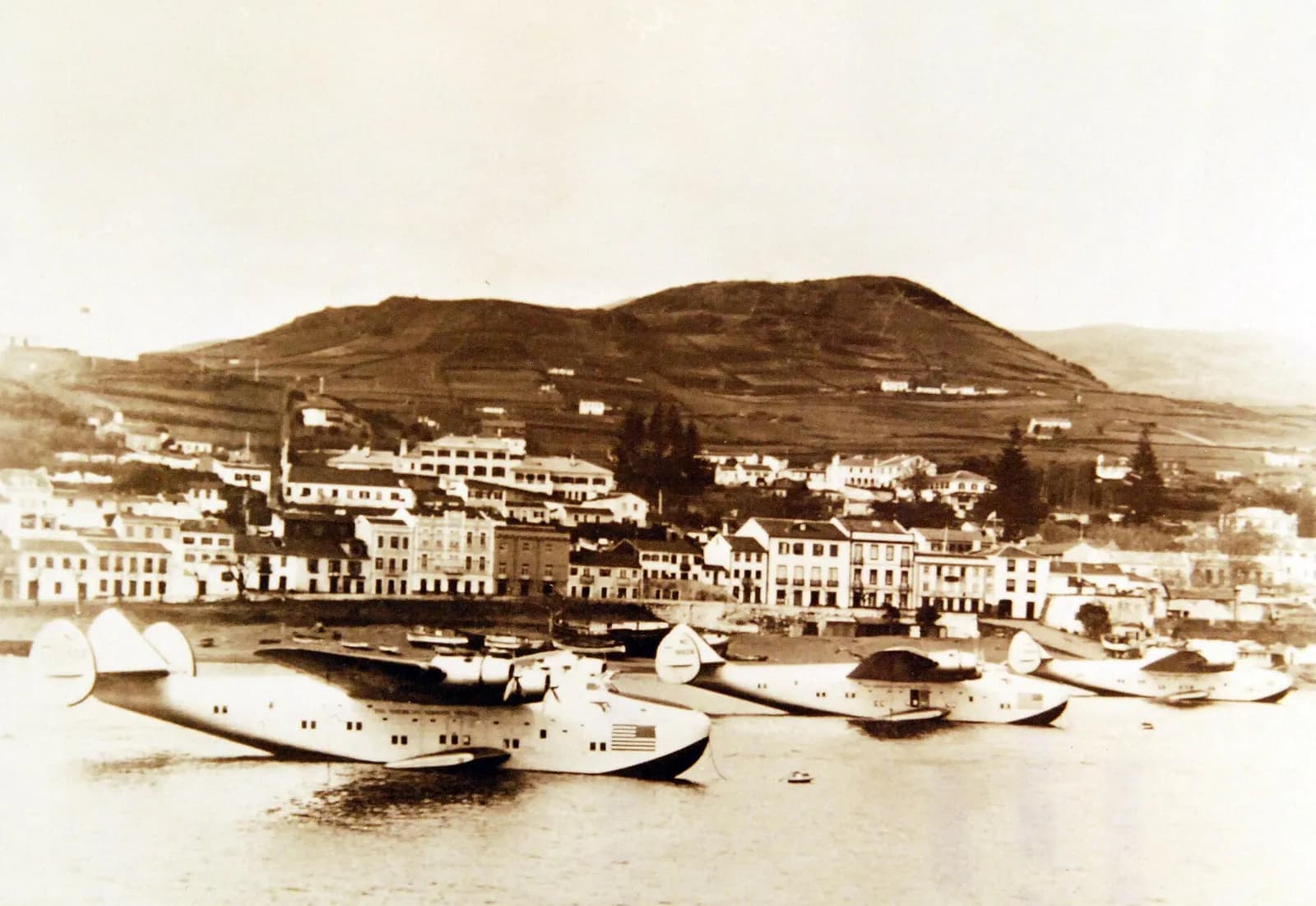
- Pan Am Clippers at their moorings in the harbour of Horta, on the island of Faial in the Azores, the last stop before Lisbon. Undated US Navy photograph. National Museum of the U.S. Navy, Public domain, via Wikimedia Commons.
- Jane Froman in an NBC radio publicity photograph of 1934, nine years before the crash. Polls in the 1930s voted her the top female singer on American radio. NBC Radio, Public domain, via Wikimedia Commons.
- A floating crane lifts part of the Yankee Clipper's wreck onto a quay in Lisbon during the salvage in the days after the crash, 1943. Crowds line the quay. Unknown author, Public domain, via Wikimedia Commons.
- The Doca dos Olivais at Parque das Nações in 2022, on the site of Lisbon's seaplane airport, with the Pavilhão de Portugal on the left and the Oceanário on the right. Leeturtle, CC BY-SA 4.0, via Wikimedia Commons.