

The 1869 decree that abolished slavery in the Portuguese empire, on paper
A royal decree ended the legal state of slavery in every Portuguese territory in 1869. It changed the word more than the work, and on the cocoa islands of São Tomé the labour system that replaced it was still being called slavery forty years later.
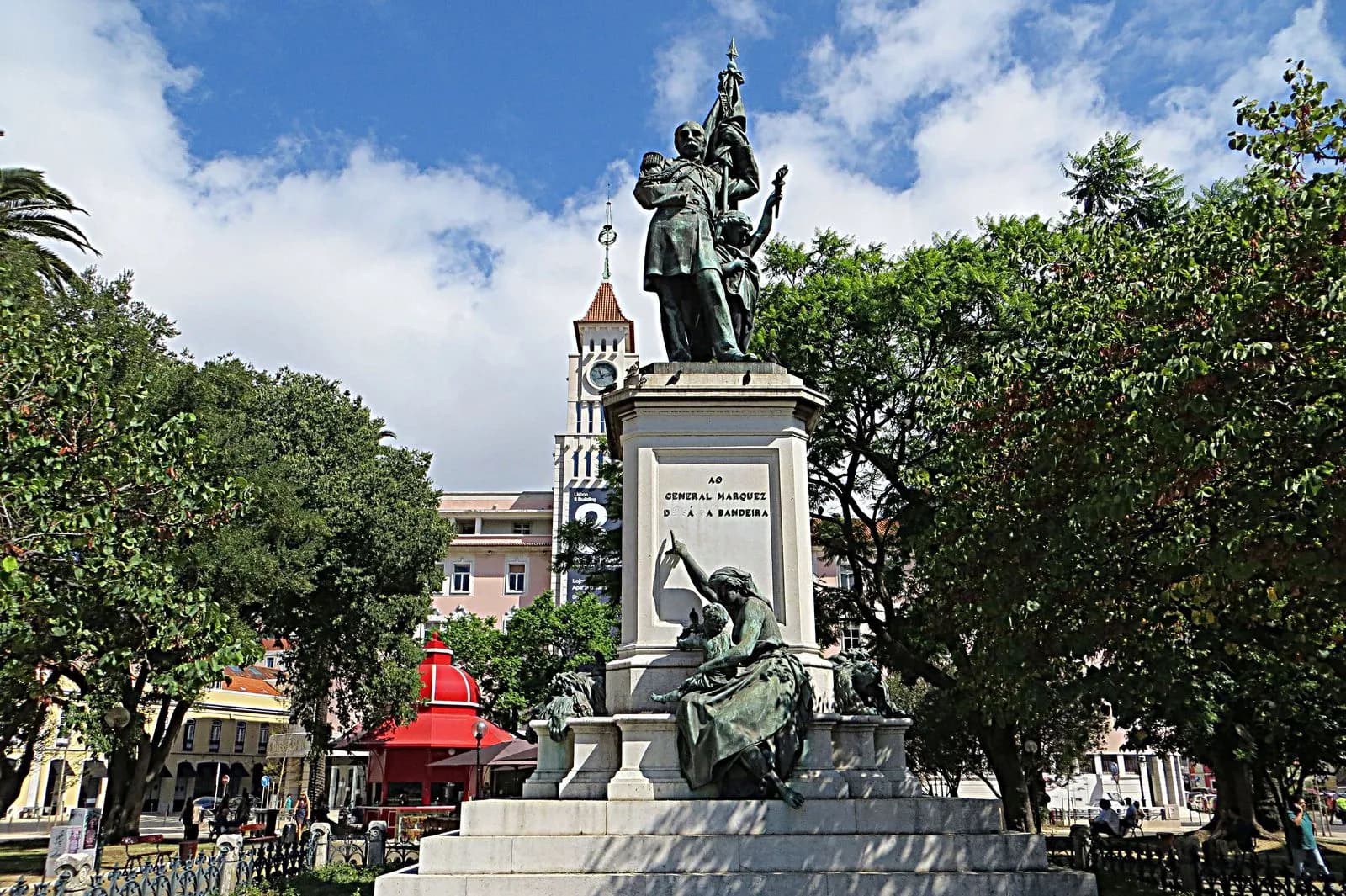
At a glance
- On 25 February 1869 King Luís signed a decree abolishing “the state of slavery in all the territories of the Portuguese monarchy”; it was published in the Diário do Governo two days later.
- Every enslaved person became a liberto, a freed person who still owed service to the former master until 29 April 1878, the date set by a decree of 1858.
- The official count in 1856 to 1858 found 93,416 enslaved people in the African colonies, 61,711 of them in Angola.
- A law of 29 April 1875 ended liberto status early but obliged the freed people to sign two-year labour contracts, and the regulation of 21 November 1878 kept compulsory work for anyone deemed a vagrant.
- Under that system, Angolans shipped to the cocoa plantations of São Tomé as “serviçais” were denounced as slaves in 1905, and British chocolate makers boycotted the islands' cocoa from 1909.
A decree signed twice
On the last day of 1868 King Luís signed a decree that ended slavery in the Portuguese empire with immediate effect. Every minister countersigned it. It was never promulgated, and without publication it was not law.
Its author was José Maria Latino Coelho, minister of the navy and overseas territories in the government of the Marquis of Sá da Bandeira. On 9 January 1869 he wrote to the 73-year-old marquis about what had happened. A disagreement inside the cabinet, he said, had blocked the text.
“I am deeply pained by the incident that hindered the publication of a measure that would have been celebrated in Europe as a civilising act, worthy of a liberal and enlightened government… I regret that a disagreement prevented us from leaving a lasting monument of our administration.”
Eight weeks later, on 25 February 1869, a second text was signed at the palace. This one went through. It appeared in the Diário do Governo, the official gazette, on 27 February, signed by the king, by Sá da Bandeira and by five other ministers. Its first article took one line: “The state of slavery is abolished in all the territories of the Portuguese monarchy from the day of publication of the present decree.”
The second article explained what that meant. Every person of either sex who was enslaved on that day would pass to the condition of liberto, with the rights and duties already laid down for libertos in 1854. The third article said whom they would serve: the people who had been their masters. Their obligation would end on 29 April 1878.
What you need to know first
In 1869 Portugal was a constitutional monarchy whose overseas territories lay mostly in Africa, from Cape Verde and Guinea to São Tomé and Príncipe, Angola and Mozambique, with smaller holdings in India and Macau. Almost all the enslaved people the decree covered lived in the African colonies.
In mainland Portugal slavery had begun to be wound down in the eighteenth century. A law of 19 September 1761, from the government of the Marquis of Pombal, banned the shipping of Black people from Africa, Asia or America to the kingdom and freed those who arrived. A law of 16 January 1773 declared free every child born in Portugal from then on, though most people already enslaved there stayed so. Both applied only to the kingdom, not to the colonies; a decree of 1832 extended them to the Azores and Madeira.
Historians still argue about Pombal's motives. The curators who wrote the text for the 2019 commemorative stamps say the 1761 law was meant to send the trade in captives to the mines and plantations of Brazil, and that this aim weighed more than the humanitarian concerns it also voiced.
Thirty-three years of half-measures
The man behind most of the laws was Bernardo de Sá Nogueira, Marquis of Sá da Bandeira. Born in Santarém on 26 September 1795, he joined the liberal revolution of 1820 and served as minister for the overseas territories, on and off, from 1832 to 1870. In 1836 he put a bill to the upper house that would have banned the slave trade, freed all children born to enslaved mothers and forced owners to register their slaves. It did not pass.
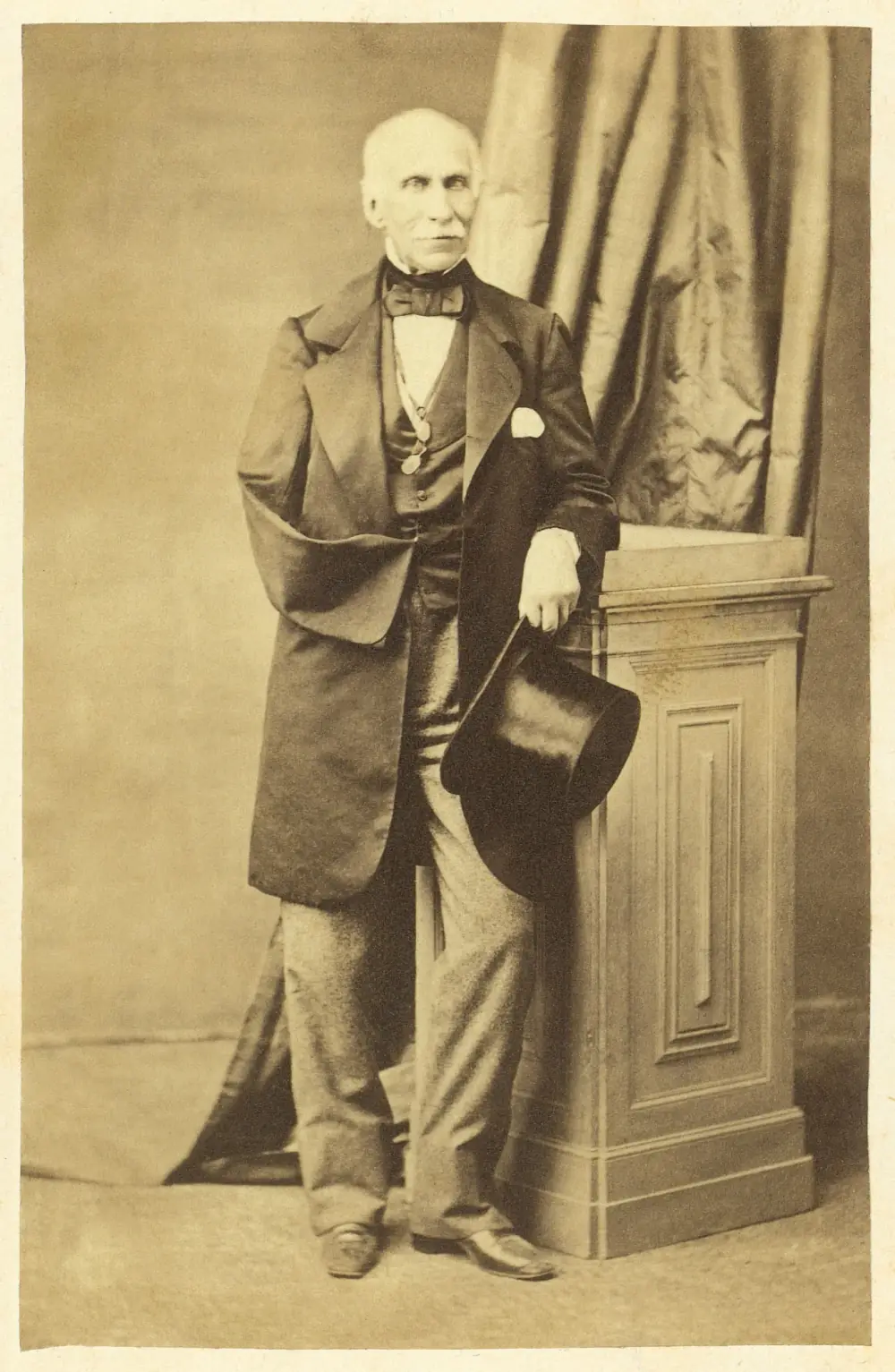
He had one arm. In the civil war between liberals and absolutists he was military governor of besieged Porto, and on 8 September 1832, leading reinforcements at the Alto da Bandeira on the Gaia side of the Douro, he was hit by a bullet that shattered his right arm. He stayed in command until the attack was beaten off, and surgeons then amputated the arm. The title of baron of Sá da Bandeira, granted in April 1833, rewarded that day's fighting.
What survived was narrower. A decree of 10 December 1836 banned the export of slaves from all Portuguese territories, by sea or by land, but dropped the parts about freeing children and registering slaves. A treaty with Britain followed on 3 July 1842. Neither touched slavery itself inside the colonies.
The 1850s brought a burst of laws. The decree of 14 December 1854 ordered every slave to be registered within 30 days and freed, as libertos, all slaves owned by the state and anyone left off the register. A law of 24 July 1856 declared free the children born to enslaved women after its publication, but the deputies amended it so that those children had to serve their mothers' masters without pay until the age of 20.
In a few places slavery ended outright. It was abolished in 1856 in the newly occupied district of Ambriz and the rest of Angola north of the river Loge, and in Macau, where the owners had freed their slaves of their own accord. A decree of 10 March 1857 freed the handful of slaves on the Cape Verdean island of São Vicente.
Then, on 29 April 1858, a three-article decree set a deadline: slavery would end everywhere under Portuguese rule 20 years later, on 29 April 1878. Sá da Bandeira presented it to King Pedro V as a memento of his wedding, which took place in Berlin that same day. Owners who still held slaves in 1878 were promised compensation under “a special law”. Parliament never passed one.
Enslaved people in Portugal's African colonies, official count of 1856–1858
people
Total 93,416. Official statistics of 1856 to 1858, as given by João Pedro Marques (Análise Social, 2001, note 112); they cover the African colonies only. Sá da Bandeira put the number in all the colonies at the time of the 1869 decree at about 100,000, and by 1875 the government itself doubted the official registers.
Show the data
| Enslaved people | |
|---|---|
| Angola | 61,711 |
| Mozambique | 15,918 |
| São Tomé and Príncipe | 7,706 |
| Cape Verde | 5,181 |
| Guinea | 2,900 |
Marques, who has studied how Portugal's parliament handled emancipation, reads the 1850s differently from the way Sá da Bandeira and later historians did. He calls the decade a capitulation, in which the abolitionists gave up their first aims and passed laws that suited their opponents. The title of his article calls the whole process from 1836 to 1875 “uma cosmética demorada”, a long-drawn-out cosmetic exercise.
19 September 1761
Pombal's law
Shipping enslaved people to mainland Portugal banned; those who arrive are freed.
16 January 1773
Free birth in the kingdom
Children born in Portugal from then on are free.
10 December 1836
Export of slaves banned
Applies to all Portuguese territories, by sea or by land.
3 July 1842
Anglo-Portuguese treaty against the slave trade
14 December 1854
Registration decree
Slaves to be registered within 30 days; state slaves and the unregistered become libertos.
24 July 1856
Free womb law
Children of enslaved women born free, but bound to serve until 20.
29 April 1858
Twenty-year deadline
Slavery to end on 29 April 1878.
31 December 1868
First abolition decree signed
Never published.
25 February 1869
Abolition decree
All slaves become libertos, bound to serve until 1878.
29 April 1875
Libertos law
Liberto status to end one year after publication; two-year labour contracts imposed.
21 November 1878
Labour regulation
Keeps contract labour and compulsory work for “vagrants”.
What the decree changed, and what it did not
Read beside the laws of the 1850s, the decree of 1869 moved the end date for nobody. A person enslaved in Luanda in January 1869 owed work to the same master until 29 April 1878, exactly as before. The only change was the word for that person's condition.
Marques argues that its main weight was diplomatic. It let Portugal say that slavery had formally ended on its territory, and in 1871 Lisbon and London signed an additional convention to the 1842 treaty that wound up the mixed commissions set up to judge captured slave ships. In practice, he writes, the new decree changed nothing.
Slave owners had fought even the idea. When Sá da Bandeira's abolition bill of 1865 was sent to the colonies for comment, the president of Angola's general council voted against it on 17 May 1865 and warned that it would bring Angola a ruin greater than the barbarian invasions had brought Europe. Four members voted with him. Luanda's commercial association called the captivity of the day “mild” and slavery an excellent way to give Africans a taste for work.
When the 1869 decree reached Luanda, a letter from the city dated 25 April reported that it had caused no upheaval at all. The decree did stir the Associação Comercial de Lisboa, the capital's chamber of commerce, which in 1872 published a pamphlet on the labour question in the African colonies, with special reference to São Tomé and Príncipe.
The question of compensation explains much of the design. Sá da Bandeira estimated that buying out the owners would have cost 3,000 to 4,000 contos, a sum he thought parliament would hardly vote given the state of the public finances. He explained the solution in a book published in 1873.
“There was no other means of compensating the masters except with the labour of the individuals who had been their slaves… The Portuguese government acted with great prudence in this question; it was generous with the owners of slaves and proceeded in such a way that work did not suffer interruption.”
In other words, the enslaved paid for their own emancipation in years of work. Marques notes that emancipation laws in the Americas, from New York to Venezuela, often built in transitions of about 25 years for the same reason, and that Portugal followed that model while presenting itself as the equal of its European peers.
From libertos to serviçais, 1875 to 1878
In 1874 Sá da Bandeira and the overseas minister Andrade Corvo proposed bringing forward the end of liberto status. The upper house approved the bill at once; the lower house passed it unanimously in March 1875. The law of 29 April 1875 had 39 articles. One year after its publication in each colony there would be no more libertos. They would be fully free, but “subject to public tutelage” until 29 April 1878.
Tutelage meant work. The former libertos, now called serviçais, were “obliged to contract their services” for two years, preferably with their old masters, and could be contracted to serve in another colony, which met São Tomé's need for labour. Anyone judged a vagrant faced up to two years of compulsory work. Compensation for the owners was deferred again and made to depend on strict inquiries, so in Marques's words the state carried out emancipation without spending anything.
The deadline of April 1878 did not end the system either. A regulation of 21 November 1878 kept its principles, including the rules on vagrancy, and it was under that regulation and the 1875 law that labour contracts were still being drawn up in Angola in the 1900s.
| Status | Period | What the law said | What it meant in practice |
|---|---|---|---|
| Escravo (slave) | Until 1869 | Property of an owner; to be registered from 1854 | Could be bought and sold; selling spouses or young children apart banned from 1854 |
| Liberto (freed person) | 1842 to about 1876 | Free in law but bound to serve a master for a fixed term | The term of service could be sold; all slaves became libertos in 1869 |
| Serviçal (contracted worker) | From 1875 | Free, but obliged to sign labour contracts; vagrants liable to compulsory work | Contracts were renewed as a formality on the São Tomé plantations |
Compiled from the decree of 1869, Marques (2001) and Nascimento (2004). The first libertos were Africans freed from captured slave ships under the 1842 treaty with Britain; the decree of 1854 turned many slaves into libertos.
Sá da Bandeira knew the system was abused. In April 1873 he drew the upper house's attention to official reports of “inhuman treatment” of libertos on São Tomé, and to the duty of the authorities to give many of them the full freedom the law already owed them.
On São Tomé the historian Augusto Nascimento describes what happened next. Many of the newly emancipated refused to keep working for their former masters, and the authorities could not force them. The planters, including local landowners, turned instead to labourers brought from Angola. Nascimento judges that from the last decades of the nineteenth century until about 1910 the serviçais differed little from slaves.
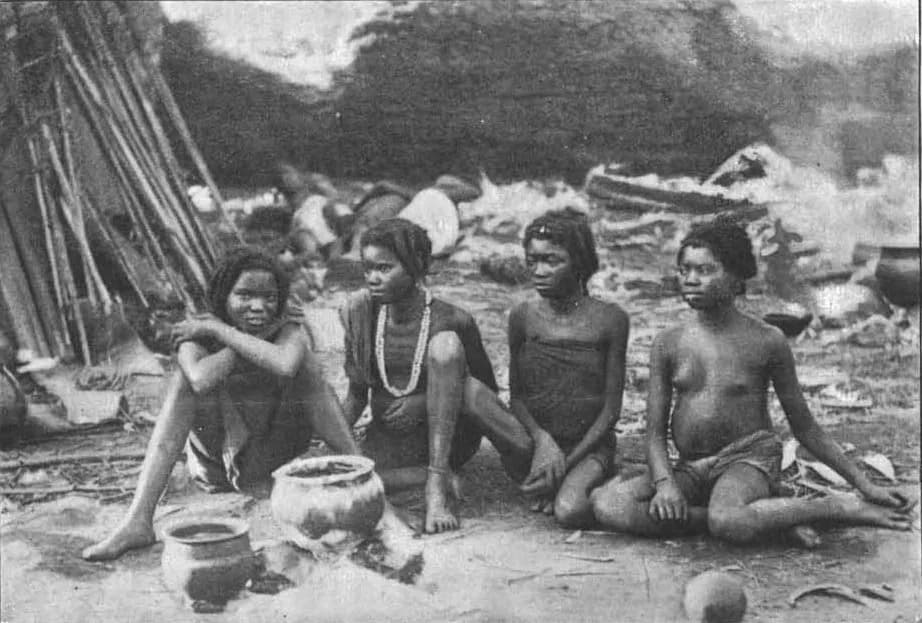
Foreign visitors noticed. In 1897 Héli Chatelain, a former United States commercial agent in Luanda who had written grammars of Angolan languages, gave a lecture to the American Geographical Society on the slave trade inside Africa, illustrated with lantern slides. Scientific American printed a digest with his pictures, including one captioned as young enslaved girls in a trader's yard in Luanda.
Cocoa and “a modern slavery”
Cocoa had made the plantations rich. Their cocoa exports grew fourfold in the ten years to 1901, from 3,597 tons to 14,914. The official returns of 1900, quoted by the British journalist Henry Nevinson, put São Tomé's population at 37,776, of whom 19,211 were serviçais, and Príncipe's at 4,327, including 3,175 serviçais. In 1901 another 4,572 arrived.
Cocoa exports from São Tomé and Príncipe, 1902–1907
tons
Figures from the Gordian, a Hamburg trade journal, as printed by William Cadbury in Labour in Portuguese West Africa (1910). He counts world cocoa exports in 1907 at 148,267 tons, so the two islands supplied about a sixth; in his table only South America and the West Indies exported more.
Show the data
| Exports | |
|---|---|
| 1902 | 17,619 |
| 1903 | 22,050 |
| 1904 | 20,496 |
| 1905 | 25,669 |
| 1906 | 24,619 |
| 1907 | 24,193 |
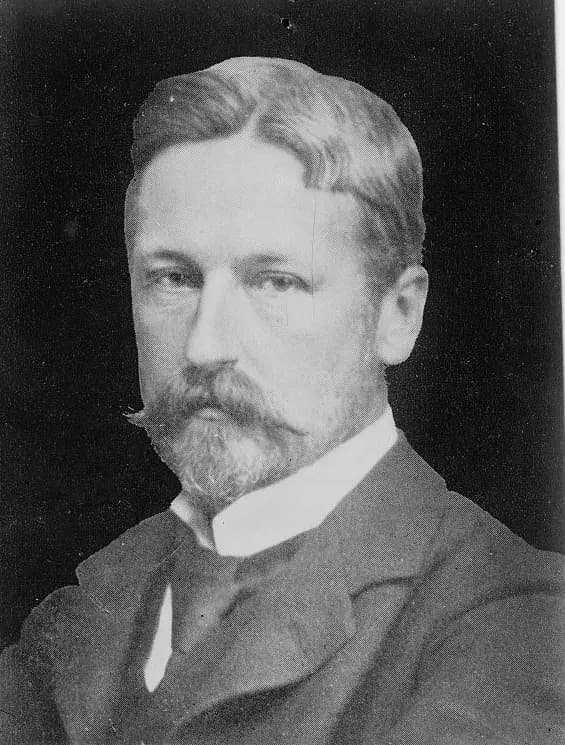
Nevinson travelled through Angola and to the islands between December 1904 and July 1905 for Harper's Monthly Magazine, and his reports came out as a book, A Modern Slavery, in 1906. He followed the labour route from the interior to the coast. At Benguela he watched the official ceremony that turned captives into contracted workers.
“They went into the Tribunal as slaves, they have come out as “contracted laborers.” No one in heaven or on earth can see the smallest difference.”
The contract form he copied declared that the worker came “of his own free will” under the law of 29 April 1875 and the regulation of 21 November 1878, for five years. Nevinson reckoned that a little under 4,000 people a year, not counting babies, were being shipped to the islands. On Príncipe, he wrote, citing British consular reports, 867 serviçais died in 1901, a death rate of 20.67 per cent. A plantation doctor on São Tomé put the yearly death rate on his estate at 12 to 14 per cent and named the main cause as anaemia brought on by “tristeza”, unhappiness.
Nevinson also tried to hear the workers themselves. He had learnt some Umbundu, the language of the central Angolan highlands, and as his ship anchored off São Tomé in June 1905 he questioned two sisters of about 15 or 16 from Bihé. They answered in whispers.
““Why are you here?” “We were sold to the white men.” “Did you come of your own free will?” “Of course not.” “Where did you come from?” “From Bihé.” “Are you slaves or not?” “Of course we are slaves!””
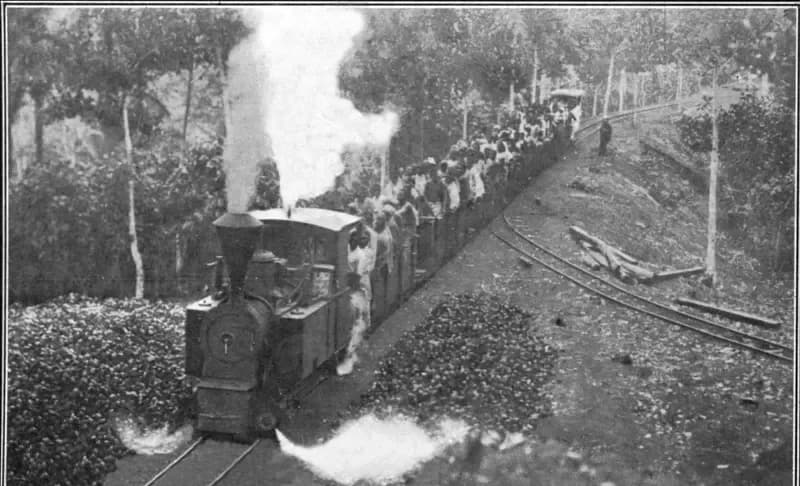
The scandal reached the British chocolate makers. Cadbury Brothers had bought São Tomé cocoa since 1886, and around 1901 the islands supplied 45 to 55 per cent of its beans, depending on the account. With other chocolate firms it sent an investigator, Joseph Burtt, whose report reached the planters in 1907, and it lobbied Lisbon and the Foreign Office rather than stop buying.
In September 1908 the Standard, a Conservative newspaper, accused the Quaker firm of hypocrisy. Cadbury announced a boycott of São Tomé cocoa on 19 March 1909 and sued for libel. In November 1909 a jury found for Cadbury but awarded damages of one farthing, a quarter of a penny.
Repatriation, the test of whether a contract was free, had existed in law for years. When William Cadbury visited Angola in late 1908, the Curador at Novo Redondo, the official in charge of contract workers, told him that ten men who had landed there from São Tomé on 4 December were the first ever repatriated. One of them, Bumba, carried 80 milreis, about £16, a little less than a five-year worker's repatriation fund owed him. The other nine had nothing.
A long tail
Sá da Bandeira did not see any of this. He died in Lisbon on 6 January 1876, before the deadline he had set for 1878 arrived. With his will he left a short note on his life as a soldier: “I was wounded four times in the siege of Porto; in one I lost an arm. The country owes me nothing.”
Nascimento dates the shift on São Tomé to around 1910, after the fall of the monarchy, when the planters' arbitrary power over the serviçais began to recede. After that, he writes, contract labour and forced labour alternated or existed side by side on the plantations, depending on the group of workers and the politics of the moment.
International pressure returned in the 1920s, and in 1930 the International Labour Organization adopted a convention against forced labour. Portugal ratified it only in 1956, and a second convention, on abolishing forced labour, in 1959. Nascimento describes the 1930s on São Tomé, when planters kept Angolan and Mozambican workers beyond their contracts with the authorities' consent, as a kind of re-enslavement.
When forced labour ended is still disputed. Nascimento notes that some authors take 1960 as the end date on São Tomé, and he rejects as unscholarly the claim that it lasted in the Portuguese colonies until 1974. The Barrow Cadbury Trust's own history of the scandal says coerced labour continued until independence in 1975.
In Angola, Mozambique and Guinea the Estatuto do Indigenato, which denied Portuguese citizenship to most Black Africans and kept them under a separate “native” regime, was repealed on 6 September 1961, months after war broke out in Angola. All natives of the colonies became Portuguese citizens, at least on paper.
Why it still matters
For a long time the end of slavery was told in Portugal as a national honour. A bill put to parliament in 1865 claimed that Portugal had been the first European nation to abolish slavery in some of its overseas lands, and Marques describes a country that wanted to be seen in the vanguard of abolition. The fuller record shows a state that set a date for freedom in 1858 and then spent two decades making sure that work on the plantations would not stop.
In 2019 the postal service CTT marked the 150th anniversary with two stamps, issued on 25 February. The images chosen for the issue include the decree itself, kept in the parliamentary archive, the Arquivo Histórico Parlamentar. The accompanying text, by the curators of Lisbon City Council's project on testimonies of slavery, places the decree at the end of a cycle that began in 1441, when Portuguese ships carried off the first Africans captured on the coast south of Cape Bojador.
Parliament also keeps online a navy ministry memoir of 1889 on the end of slavery and the slave trade, which lists the laws from Pombal to 1869 in the official version of the time.
FAQs
When did Portugal abolish slavery?
In stages. Mainland Portugal stopped the import of enslaved people in 1761 and freed children born there from 1773. In the colonies, the decree of 25 February 1869 abolished the legal state of slavery, but the people it covered became libertos who owed service until 1878, and a law of 29 April 1875 replaced that status with compulsory labour contracts.
Who was Sá da Bandeira?
Bernardo de Sá Nogueira, Marquis of Sá da Bandeira (1795–1876), was a liberal soldier, who lost his right arm in the siege of Porto in 1832, and a politician who served repeatedly as minister for the overseas territories and headed the government that issued the 1869 decree. He drafted or promoted most of the anti-slavery laws from 1836 onwards.
Were slave owners compensated?
No money was paid. A decree of 1858 promised compensation under a special law that was never passed, and the 1875 law put the burden of proof on the owners. Sá da Bandeira wrote that the masters were compensated with the labour of their former slaves.
What was the São Tomé cocoa scandal?
In the early 1900s Angolans were shipped to the cocoa plantations of São Tomé and Príncipe on five-year contracts that were rarely ended by repatriation. Henry Nevinson called the system “a modern slavery” in 1906, and Cadbury and other chocolate makers boycotted the islands' cocoa from March 1909.
On the timeline
Open the timelineNearby moments from regeneration and the last kings (1851–1910).
António Nobre, whose only book 'Só' became a landmark of Portuguese symbolist and saudosista poetry, is born in Porto.
Birth of Manuel António Gomes, the 'Padre Himalaya', at Cendufe, Arcos de Valdevez. A priest so tall he was nicknamed after the mountains, he was a pioneer of solar power: his 'pyrheliophor', a 13-metre-high frame holding 6,117 small mirrors that melted metals with sunlight, was reported to have won a grand prize at the 1904 St Louis World's Fair and was hailed by the 'New York Times'.
Carlos Viegas Gago Coutinho is born in Lisbon. A naval officer and geographer who adapted the sextant for use in aircraft, he navigated the first aerial crossing of the South Atlantic with Sacadura Cabral in 1922, a feat celebrated on both sides of the ocean.
Abolition of slavery, 1869
A decree championed by the Marquis of Sá da Bandeira abolishes slavery throughout the Portuguese empire. But the people it freed became 'libertos', still obliged to serve their former masters until a further law in 1875, and forced labour persisted in the African colonies well into the 20th century.
Óscar Carmona is born in Lisbon. The general who emerged as the leading figure of the military dictatorship after the 1926 coup, he remained head of state until his death in 1951, the figurehead under whom Salazar built the Estado Novo.
King Luís I raises Covilhã, the wool-manufacturing town on the slopes of the Serra da Estrela, to the status of city. The date remains the municipal holiday.
Birth of Domitila de Carvalho in Travanca, near Santa Maria da Feira. In 1891 she became the first woman admitted to the University of Coimbra since its 1772 reform — on condition that she always dress in black — and graduated in mathematics, philosophy and medicine; in 1934 she was one of the first three women elected to Portugal's parliament.
Coming up in history
All long reads 27 February 1666Luísa de Gusmão: the Andalusian duchess who ruled Restoration Portugal
 28 February 1969The earthquake of 28 February 1969: Portugal’s strongest of the century
 29 February 1796A leap-day charter: Lisbon gets a public library, 29 February 1796
 1 March 1290How Portugal got its first university: King Dinis's charter of 1290
23 sources
Archives, scholarship and reporting this article was checked against.
- 1
Decree of 25 February 1869 abolishing the state of slavery in all territories of the Portuguese monarchy, with its preamble (Diário do Governo no. 45, 27 February 1869)Faculdade de Direito, Universidade Nova de Lisboa (reproduction)
- 2
Uma cosmética demorada: as Cortes perante o problema da escravidão (1836-1875) (João Pedro Marques)Análise Social, vol. XXXVI (158-159), 2001, pp. 209-247
- 3
- 4
Escravatura, trabalho forçado e contrato em S. Tomé e Príncipe nos séculos XIX-XX: sujeição e ética laboral (Augusto Nascimento)Africana Studia 7 (2004), pp. 183-217 (Repositório ISCTE)
- 5
A Modern Slavery (Henry W. Nevinson, 1906)Project Gutenberg
- 6
Labour in Portuguese West Africa, second edition (William A. Cadbury, 1910)George Routledge and Sons, London (Internet Archive)
- 7
“Esperança de liberdade”: interpretações populares da abolição ilustrada (1773-1774) (Luiz Geraldo Silva)Revista de História 144 (2001), Universidade de São Paulo, pp. 107-149
- 8
150 anos da abolição da escravatura em Portugal / 150 years of the abolition of slavery in Portugal (stamp issue brochure, 25 February 2019)CTT Correios de Portugal; text by Anabela Valente and Ana Cristina Leite, Gabinete de Estudos Olisiponenses
- 9
Efeméride: nomeação do Marquês de Sá da Bandeira para ministroMarinha Portuguesa, Biblioteca Central
- 10
- 11
Memória acerca da extinção da escravidão (Ministério da Marinha, 1889)Assembleia da República, Biblioteca Passos Manuel
- 12
- 13
The bitter sweetness of chocolate (Roger Southall), review of Lowell J. Satre, Chocolate on Trial: Slavery, Politics and the Ethics of Business (2005)Africa Review of Books, CODESRIA, September 2006
- 14
Background paper on the origins of the endowment of the Barrow Cadbury Trust and the São Tomé and Príncipe slave tradeBarrow Cadbury Trust, 2024
- 15
Cadbury Brothers and the issue of contract labourSelly Manor Museum (Bournville Village Trust), 2020
- 16
Convenção n.º 29, sobre o Trabalho Forçado ou Obrigatório, 1930DGERT, Ministério do Trabalho (Portugal)
- 17
- 18
O Estado Novo português e a reforma do Estado colonial em Angola: o comportamento político das elites brancas (1961-1962) (Fernando Tavares Pimenta)História (São Paulo), vol. 33, n.º 2, 2014, pp. 250-272
- 19
Estatuto dos Indígenas Portugueses das Províncias da Guiné, Angola e Moçambique (decree-law of 20 May 1954), textFaculdade de Direito, Universidade Nova de Lisboa (reproduction)
- 20
Giovanni Ciniselli (1832–1883): biographyPublic Statues and Sculpture Association, Public Sculpture of Britain
- 21
Monumento ao Marquês de Sá da Bandeira (Giovanni Ciniselli and Germano José de Sales, 1884), index entryRevistas de Ideias e Cultura, Suplemento de A Batalha indexes
- 22
Jardim da Praça de Dom Luís ou Praça Sá da BandeiraAll About Portugal
- 23
Who is this woman in the statue at Mercado da RibeiraVisit Lisboa (Turismo de Lisboa)
Image credits
- The monument to the Marquis of Sá da Bandeira in Praça Dom Luís I, near Cais do Sodré in Lisbon, photographed in 2014. It was unveiled in 1884, eight years after his death. Mister No, CC BY 3.0, via Wikimedia Commons.
- Bernardo de Sá Nogueira de Figueiredo, Marquis of Sá da Bandeira (1795–1876), in an undated nineteenth-century photograph from the archive of the Casa de Mateus. The empty right sleeve is the arm he lost at Porto in 1832. Unknown author, Public domain, via Wikimedia Commons.
- “Young girl slaves in a trader's yard at Loanda”: a photograph published in Scientific American on 13 March 1897 to illustrate a lecture by Héli Chatelain, a former United States commercial agent in Luanda, 28 years after the abolition decree. Unknown author, Public domain, via Wikimedia Commons.
- Henry Woodd Nevinson (1856–1941), the British journalist whose reports from Angola and São Tomé were published as A Modern Slavery, in a Bain News Service photograph of about 1910. Bain News Service, publisher, Public domain, via Wikimedia Commons.
- Serviçais taken to work by train on the Uba Budo plantation, São Tomé, in a published photograph of about 1910. Unknown author, Public domain, via Wikimedia Commons.