

Teófilo Braga, the Azorean scholar who led the Republic’s first government
A boy who set type for his own newspaper in the Azores became one of Portugal’s most prolific scholars, a leading positivist and, at 67, head of the government that replaced the monarchy.
At a glance
- Joaquim Teófilo Fernandes Braga was born in Ponta Delgada, on the Azorean island of São Miguel, on 24 February 1843, and left for Coimbra at 18, never to return.
- As a law student he joined Antero de Quental in the Coimbra Question of 1865, a pamphlet war against the literary establishment led by António Feliciano de Castilho.
- His bibliography runs to more than 300 titles, among them a history of Portuguese literature he reworked for almost fifty years, and he taught modern literatures in Lisbon from 1872 for more than fifty years.
- One of Portugal’s leading followers of Auguste Comte’s positivism, he co-organised the Camões centenary of 10 June 1880 and drafted the Republican Party’s programme of 1891.
- He presided over the Provisional Government from 5 October 1910 to 3 September 1911 and was President of the Republic from 29 May to 5 October 1915. He died in Lisbon on 28 January 1924.
A passenger on tram 261
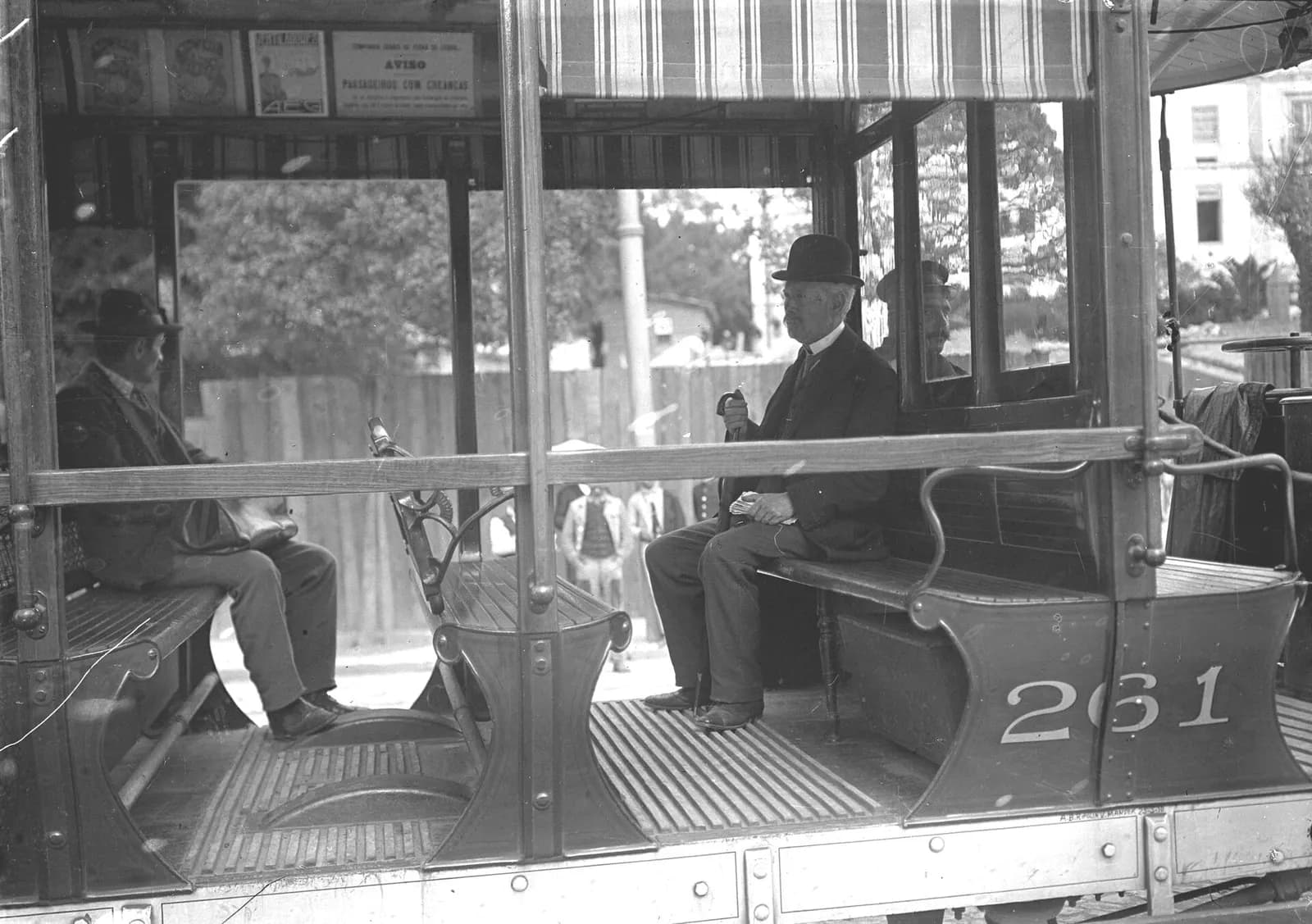
In October 1910, in the weeks after the monarchy fell, the photographer Joshua Benoliel followed the new head of government around Lisbon. In one picture Teófilo Braga, aged 67, sits on the open bench of Carris tram number 261 in a bowler hat, a walking stick in one hand and a fold of papers in the other. The city archive, which holds the negative, places the tram at the Praça da Estrela.
The weekly Ilustração Portugueza printed the photographs on 24 October with an interview by the journalist Rocha Martins. One caption has Braga asking when the tram will leave for the stop nearest his ministry. The other says that, as in his days as a plain professor, the head of government prefers the tram to grander means of transport.
Martins pressed him: surely a head of government needed a carriage? Braga allowed one, as long as it was “without show”, to take him between home and ministry, partly so that he could escape being greeted in the street.
“We have a great deal to do, but none of the pomp of royalty: we are of the people, and we must live as the people do! The republic was not made for ridiculous imitations.”
Braga had not helped to plan the revolution of 5 October 1910. He learned on the day itself that the republicans had chosen him to lead their Provisional Government. The Museu da Presidência, the museum of Portugal’s presidency, puts the choice down to his prestige as a scholar and as the theorist of Portuguese republicanism.
He had been making the case in print for forty years. His bibliography runs to more than 300 titles by the museum’s count, and to 360 by that of the Encyclopedia of Romantic Nationalism in Europe: poems and folk tales, philosophy and politics, and a history of Portuguese literature that he kept reworking for almost fifty years.
A printer’s boy in Ponta Delgada
Joaquim Teófilo Fernandes Braga was born in Ponta Delgada, the main town of São Miguel in the Azores, on 24 February 1843. He was the seventh child of Joaquim Manuel Fernandes Braga, who taught at the town’s liceu, the state secondary school, and Maria José da Câmara Albuquerque.
His mother died in 1846, when he was three. Life with his stepmother, whom the presidency museum describes as austere and distant, left wounds he wrote about later. Even his name was partly his own doing: he added Teófilo to it in 1853, when he started primary school.
He wanted to write from the start. At 15 he published his first poem, “A Canção do Guerreiro”, in A Estrela Oriental, a newspaper in the nearby town of Ribeira Grande, and founded a literary paper of his own in Ponta Delgada, O Meteoro. The next year came O Santelmo, a fortnightly on which he was also the typesetter.
At 16, with the backing of a local patron, the Visconde da Praia, he published his first book of verse, Folhas Verdes (1859). At 18, his secondary schooling finished, he sailed for the mainland and the University of Coimbra. He never went back to the Azores, though he stayed attached to the islands for the rest of his life.
- Full name
- Joaquim Teófilo Fernandes Braga
- Born
- 24 February 1843, Ponta Delgada, São Miguel, Azores
- Studied
- Law at the University of Coimbra; degree 1867, doctorate 1868
- Taught
- Modern Literatures, Curso Superior de Letras, Lisbon, from 1872
- Offices
- President of the Provisional Government 1910–1911; President of the Republic 1915
- Died
- 28 January 1924, Lisbon
- Buried
- Jerónimos Monastery; moved to the Panteão Nacional in 1966
Coimbra and a quarrel about poetry
Braga enrolled in law at Coimbra in the academic year 1862–63. He finished the course in the summer of 1867 and took his doctorate the next year with a thesis on the forais, the charters of medieval towns, dedicated to his brother João Maria, who had died in Mozambique in 1866 on a military campaign. In April 1868 he married Maria do Carmo Xavier de Barros Leite, whom he had met as a student.
Coimbra made him a poet with a programme. Visão dos Tempos (1864) was an epic of humanity influenced by Victor Hugo’s Légende des siècles, and it was well received in Portugal, Italy and Brazil. Tempestades Sonoras followed the same year.
In 1865 António Feliciano de Castilho, the reigning authority of Lisbon letters, wrote an afterword to Poema da Mocidade by the young poet Pinheiro Chagas. It praised Chagas and disparaged the “literary school of Coimbra” of Antero de Quental and Braga.
Antero replied on 2 November 1865 with an open letter, Bom-Senso e Bom-Gosto, that attacked Castilho’s authority and the “school of mutual praise” around him. Braga followed with a pamphlet of his own, As Theocracias Litterarias, signed in November 1865 and printed in Lisbon. The row became known as the Questão Coimbrã, the Coimbra Question.
“We live in a land where the truth, to be heard, has to come in the form of a scandal.”
The pamphlet was personal. Braga set Castilho beside Goethe and said the difference between them was the one a zero makes as a denominator. Castilho, he wrote, wanted in the last quarter of his life to proclaim himself the supreme arbiter of literature and to impose his courtiers on posterity.
Braga and Antero became leading figures of what was later called the Generation of 1870. Braga was among the signatories of the Casino Conferences of 1871 in Lisbon, a series of public lectures meant to bring the philosophical and social debates of Europe to Portuguese readers. His friendship with Antero later soured almost into enmity.
A history of literature that nobody wanted to print
Doors closed on him. He was passed over in a competition for a chair at the Polytechnic Academy of Porto in 1868 and again at the University of Coimbra in 1871. The press, says João Palma-Ferreira in his preface to the Imprensa Nacional edition of Braga’s literary history, drew a sanitary cordon of silence around him.
He went on publishing. In 1867 came the Cancioneiro and the Romanceiro Geral, collections of folk songs and ballads with a history of popular poetry, and in 1869 the Cantos Populares do Arquipélago Açoriano, songs of his own islands. The first volume of his História da Literatura Portuguesa appeared in 1870, partly, he said, to help a friend who did not want to lay off the workers in his print shop during a sudden slump.
Between 1869 and 1872 he published eleven volumes of literary history to near total silence. When the critics did take notice, they were savage. The historian Joaquim Pedro de Oliveira Martins attacked his method in 1869, and Antero and Pinheiro Chagas joined in later.
“A vast pandemonium in which one may examine how far talent can go together with audacity and folly.”
Martins granted that Braga had begun philosophical history in Portugal, but thought his daring undid it. Braga explained Portuguese literature by race: a popular element he called Mozarabic, which had produced the town charters and the ballads, set against an aristocratic one that imitated foreign fashions, from medieval French epics to English constitutionalism. Palma-Ferreira finds the scheme exaggerated, rigid and of its time, but credits it with the first attempt to put the subject in order.
In 1872, at 29, he finally won a university post, though not in law. He took the chair of Modern Literatures at the Curso Superior de Letras in Lisbon, the forerunner of today’s Faculty of Letters of the University of Lisbon, and taught there for more than five decades.
| Year | Title | What it was |
|---|---|---|
| 1859 | Folhas Verdes | First book of poems, published at 16 |
| 1864 | Visão dos Tempos | Epic poem of humanity, after Victor Hugo |
| 1865 | As Theocracias Litterarias | Pamphlet in the Coimbra Question |
| 1867 | Cancioneiro and Romanceiro Geral | Folk songs and ballads, with a history of popular poetry |
| 1869 | Cantos Populares do Arquipélago Açoriano | Folk songs of the Azores |
| 1870 | História da Literatura Portuguesa: Introdução | First volume of his literary history |
| 1877 | Traços Gerais de Filosofia Positiva | Outline of Comte’s positivism |
| 1879 | Soluções Positivas da Política Portuguesa | Positivist programme for Portuguese politics |
| 1880 | História das Ideias Republicanas em Portugal | History of republican ideas |
| 1883 | Contos Tradicionais do Povo Português | Traditional tales |
| 1884 | Sistema de Sociologia | His sociology, on Comte’s model |
| 1909–1918 | História da Literatura Portuguesa | Recast history in volumes on the Middle Ages, the Renaissance, the seventeenth century and the Arcadians |
A small selection. The Museu da Presidência counts more than 300 titles in his bibliography; the Encyclopedia of Romantic Nationalism in Europe gives 360.
Comte, Camões and the case for a republic
Positivism gave Braga a theory of history in which the monarchy was a stage to be left behind: the republic, he argued, would prevail as part of a natural order. He co-founded the review O Positivismo, which ran from 1878 to 1882, and wrote Traços Gerais de Filosofia Positiva (1877) and Sistema de Sociologia (1884).
Politics followed from the theory. He held federal republican views from 1875, and in 1878, as a candidate for deputy, set out his principles: freedom of conscience, teaching, the press, worship and assembly, the right to property, and freedom of industry, trade and contract. Soluções Positivas da Política Portuguesa (1879) and a history of republican ideas in Portugal (1880) followed.
In 1880 he turned an anniversary into a political event. With the writer Ramalho Ortigão he coordinated the third centenary of the death of Luís de Camões, the national poet, on 10 June 1880. The festivities, modelled on the civic festivals of the French Revolution, were held all over the country, and Braga presented Camões as the symbol of national identity.
The remains of Camões and of the navigator Vasco da Gama were moved to the Jerónimos Monastery in Belém, which became a national pantheon. Republicans used the occasion to present themselves as the alternative to the monarchy, and the presidency museum counts the centenary as a landmark in the spread of republican ideas. Braga set out the theory behind it in 1884, in an essay on centenaries as an “affective synthesis” of modern societies.
At home there was grief. His first son, Joaquim Teófilo, died at birth in 1869. Within a few months in 1886 and 1887 tuberculosis killed the other two: Teófilo, aged 13, and Maria da Graça, aged 16.
On 11 January 1890 Britain demanded that Portugal withdraw its forces from lands in central Africa it had hoped would link Angola and Mozambique. Braga criticised the ultimatum in public, and the republicans used the national humiliation against the monarchy. He then drafted the programme of the Portuguese Republican Party, approved on 11 January 1891. It imagined a federal republic built from the bottom up: municipalities would choose provincial assemblies, and federations of provinces would send representatives to a national assembly.
That federal dream did not survive the Republic’s arrival: the Constitution of 1911 created a unitary state with some local decentralisation. In January 1910, nine months before the revolution, Braga joined the party’s political directorate.
President of the Provisional Government
On 5 October 1910 the Republic was proclaimed in Lisbon, and the Provisional Government was formed the same day at the city hall, with Braga as its president. Braga was head of state and head of government at once, and his ministers governed without a parliament until a Constituent Assembly was elected on 28 May 1911 and met on 19 June.
Among his ministers was the Minister of Justice, Afonso Costa, whose Law of Separation of 20 April 1911 cut the ties between the state and the Catholic Church.
Braga threw himself into the fight over the new regime’s symbols. The government approved a green and red flag on 29 November 1910, and when champions of the old blue and white, the poet Guerra Junqueiro among them, argued back in the press, Braga led its defence. In his time the Republic adopted both its flag and its anthem, A Portuguesa.
The Constituent Assembly approved the Constitution on 21 August 1911, and Braga signed it. Three days later the assembly elected Manuel de Arriaga as the first President of the Republic and Braga ceased to act as head of state. A decree of 3 September 1911 formally discharged his government.
That year his wife died. He had always been solitary, and after 1911 he withdrew further into his books.
Four months as President, 1915
He was called back once. On 14 May 1915 a revolt in Lisbon brought down the dictatorship of General Pimenta de Castro, and Manuel de Arriaga offered his resignation. Under the Constitution of 1911 the president was chosen by Congress, the two houses of parliament sitting together, and not by the voters.
On 29 May 1915 Congress accepted Arriaga’s resignation and, at six in the evening, voted for his successor. Braga received 98 of the 102 ballots, one went to Duarte Leite and three were blank. He reached the Congress building at seven, was cheered in the chamber and the galleries, and gave his pledge of honour.
Votes in the Congress of the Republic, 29 May 1915
votes
102 ballots were cast, the exact number of members voting. Figures from the Diário das Sessões do Congresso, session of 29 May 1915, page 7.
Show the data
| Votes cast | |
|---|---|
| Teófilo Braga | 98 |
| Duarte Leite | 1 |
| Blank | 3 |
He took a narrow view of the job. The presidency museum says he accused Arriaga of meddling illegitimately in events, and his message to Congress, read out that evening, set out the alternative.
“Let every citizen raised to the presidency of the Republic consider himself a magistrate, whose aim is respect for national sovereignty, watching with interest and love, but without illegitimate intervention, the normal working of the democratic parliamentary regime.”
The Constitution backed that view. It gave the president no veto over laws and, until a revision in 1919, no power to dissolve parliament. Under Braga the Democratic Party governed, led by José de Castro, and general elections were held on 13 June.
On 6 August 1915 Congress elected Bernardino Machado as his successor, two months before the term ran out, as the Constitution required. Braga handed over on 5 October 1915, after a little over four months in office.
The state commissioned his official portrait from the painter Columbano Bordalo Pinheiro in 1917. After the coup of December 1917, the new president, Sidónio Pais, is thought to have had it taken down from the wall at the Belém palace.
Last years in the Travessa de Santa Gertrudes
He went back to his desk. The disappointments of the Republic’s first years, the presidency museum says, drove him to books and writing. He lived almost as a recluse in his house in the Travessa de Santa Gertrudes in Lisbon, working on the new edition of his História da Literatura Portuguesa, which came out in volumes from 1909 to 1918.
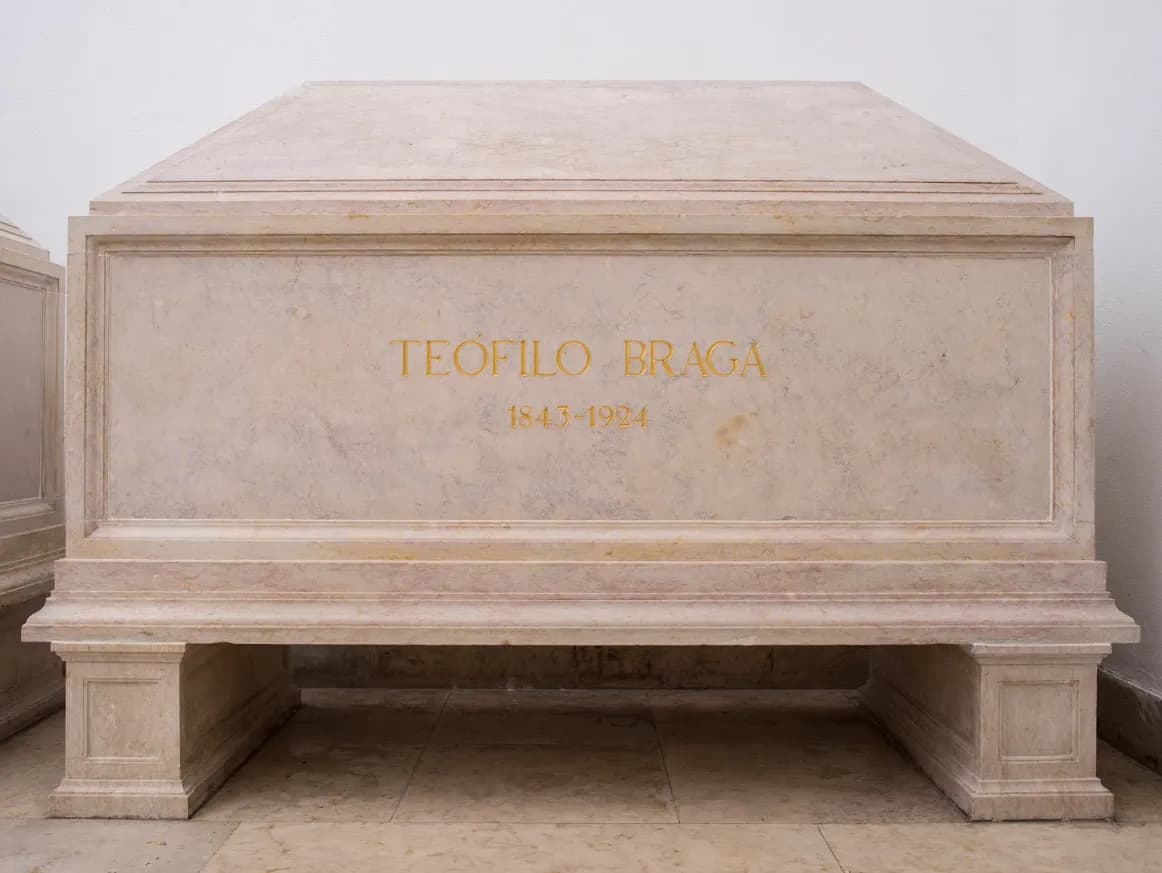
He died on 28 January 1924, about a month before his 81st birthday. He was given a state funeral and the government declared a day of national mourning. He was buried in the chapter house of the Jerónimos Monastery, the old national pantheon, near the poets Almeida Garrett, João de Deus and Guerra Junqueiro.
In February 1926 the city renamed his street after him. In 1966, when the long-unfinished church of Santa Engrácia was completed as the National Pantheon, his remains were moved there with the five others from the Jerónimos chapter house: the former presidents Sidónio Pais and Óscar Carmona and the three poets.
24 February 1843
Born in Ponta Delgada
Seventh child of a teacher at the town’s liceu.
1859
Folhas Verdes
First book of poems, at 16.
1862
Enrols in law at Coimbra
He has left the Azores at 18, never to return.
1865
The Coimbra Question
As Theocracias Litterarias attacks Castilho.
1868
Doctorate and marriage
Marries Maria do Carmo Xavier de Barros Leite in April.
1872
Chair of Modern Literatures
At the Curso Superior de Letras in Lisbon.
10 June 1880
Camões centenary
Co-organised with Ramalho Ortigão.
11 January 1891
Republican programme
His draft is approved by the party.
5 October 1910
Heads the Provisional Government
Formed at Lisbon city hall.
3 September 1911
Government discharged
Arriaga has been President since 24 August.
29 May 1915
Elected President
By Congress, to finish Arriaga’s term.
5 October 1915
Hands over to Bernardino Machado
28 January 1924
Dies in Lisbon
Buried at the Jerónimos.
1966
Moved to the Panteão Nacional
What is left of him
Much of his scholarship has dated. The preface to the edition of his literary history published by Imprensa Nacional, the state press, calls it a polemical work even today, full of exaggeration and rigid schemes, and also the first attempt to lay out the whole subject. His collections of folk songs, ballads and tales still draw scholars: a doctoral thesis of 2000 at the Nova University of Lisbon examined his work on the oral ballad tradition.
Some of his public work is part of everyday life. After the centenary of 1880, 10 June became a holiday, first in Lisbon and then across the country, and it is still one of Portugal’s compulsory public holidays. The green and red flag he defended in 1910 is still the national flag.
His republic did not turn out as he had planned. The federal state of his 1891 programme never came, and the parliamentary regime he served as president fell to a military coup in May 1926, two years after his death.
FAQs
When and where was Teófilo Braga born?
Joaquim Teófilo Fernandes Braga was born on 24 February 1843 in Ponta Delgada, on the island of São Miguel in the Azores. He left for the University of Coimbra at 18 and never returned to the islands. He died in Lisbon on 28 January 1924.
Was Teófilo Braga President of Portugal?
Twice, in different ways. He was president of the Provisional Government from 5 October 1910, acting as head of state until Manuel de Arriaga was elected on 24 August 1911; his government was discharged on 3 September 1911. Then, on 29 May 1915, Congress elected him President of the Republic to finish Arriaga’s term, and he served until 5 October 1915.
What was the Coimbra Question?
A pamphlet war in 1865 between the young writers of Coimbra, led by Antero de Quental and Teófilo Braga, and António Feliciano de Castilho, the dominant figure in Lisbon letters. It began when Castilho mocked the Coimbra school in an afterword to a poem by Pinheiro Chagas; Antero answered with Bom-Senso e Bom-Gosto on 2 November 1865 and Braga with As Theocracias Litterarias.
Why is Teófilo Braga linked to 10 June?
With Ramalho Ortigão he coordinated the third centenary of the death of the poet Luís de Camões on 10 June 1880, a nationwide civic festival that republicans used to promote their cause. The date became a holiday, first in Lisbon and later nationally, and 10 June is still a compulsory public holiday in Portugal.
Where is Teófilo Braga buried?
In the Panteão Nacional, the former church of Santa Engrácia in Lisbon. He was first buried at the Jerónimos Monastery in 1924 and moved to Santa Engrácia in 1966, when it was completed as the National Pantheon.
On the timeline
Open the timelineNearby moments from invasions, brazil and the liberal wars (1807–1851).
Joaquim Guilherme Gomes Coelho, better known as Júlio Dinis, is born in Porto. A doctor who died of tuberculosis at 31, he wrote gentle novels of rural and provincial life such as 'As Pupilas do Senhor Reitor' and 'A Morgadinha dos Canaviais' that remain classics of Portuguese fiction.
Birth of Antero de Quental in Ponta Delgada, on the Azorean island of São Miguel. A charismatic student leader at Coimbra and a central figure of the Generation of '70, he is counted among the finest sonnet writers in the Portuguese language, taking Camões's sonnets as his model.
Porto's D. Maria II suspension bridge opens to traffic over the Douro as the river floods, four months after crowds had celebrated its first crossing. Replaced by the Luís I bridge and dismantled in 1887, it is still recalled by two stone obelisks on the Porto bank.
Teófilo Braga is born
Teófilo Braga is born in Ponta Delgada, in the Azores. A prolific historian of Portuguese literature and positivist thinker, he headed the Provisional Government after the 5 October 1910 revolution and briefly served as President of the Republic in 1915.
Eça de Queirós is born in Póvoa de Varzim, the illegitimate son of parents who married only years later. The great realist novelist of 'O Crime do Padre Amaro' and 'Os Maias' spent much of his life as a consul abroad — in Havana, Newcastle, Bristol and Paris — turning a sharply ironic eye on Lisbon society.
Rafael Bordalo Pinheiro is born in Lisbon into a family of artists. In satirical papers such as 'O António Maria' he mocked kings, ministers and Britain alike, and in 1875 he gave the nation its enduring cartoon alter ego, Zé Povinho, the shrugging, put-upon everyman.
In the palace coup known as the Emboscada, Queen Maria II dismisses the Duke of Palmela's government and hands power to Marshal Saldanha, reigniting the unrest of the Maria da Fonte revolt and precipitating the Patuleia civil war.
Coming up in history
All long reads 26 February 1885The Berlin Conference of 1885 and Portugal's lost Congo mouth
 27 February 1666Luísa de Gusmão: the Andalusian duchess who ruled Restoration Portugal
 28 February 1969The earthquake of 28 February 1969: Portugal’s strongest of the century
 29 February 1796A leap-day charter: Lisbon gets a public library, 29 February 1796
21 sources
Archives, scholarship and reporting this article was checked against.
- 1
Teófilo Braga: biografiaMuseu da Presidência da República
- 2
Braga, Teófilo (Rogério Miguel Puga)Encyclopedia of Romantic Nationalism in Europe, ed. Joep Leerssen, Study Platform on Interlocking Nationalisms, University of Amsterdam (2022)
- 3
Preface to Teófilo Braga, História da Literatura Portuguesa, vol. I (sample pages)Imprensa Nacional-Casa da Moeda
- 4
Joaquim Teófilo Fernandes BragaArchontology.org
- 5
As Theocracias Litterarias: relance sobre o estado actual da litteratura portugueza (Teófilo Braga, Lisbon, Typographia Universal, 1865)Project Gutenberg, eBook 25240
- 6
Educação, religião e progresso em Teófilo Braga: uma releitura do Sistema Sociológico (1884) (José António Afonso)Aula, no. 21 (2015), pp. 131-147, Ediciones Universidad de Salamanca
- 7
Utopias federais na I República Portuguesa: a inscrição em programas políticos e projectos constitucionais republicanos (Ernesto Castro Leal)Congresso Comemorativo do Bicentenário da Revolução Liberal de 1820, Faculdade de Letras da Universidade do Porto
- 8
Teófilo BragaPanteão Nacional, Museus e Monumentos de Portugal
- 9
Teófilo Braga como passageiro do elétrico n.º 261 da Carris, na Praça da Estrela (Joshua Benoliel, October 1910)Arquivo Municipal de Lisboa, via Wikimedia Commons
- 10
“O chefe do Governo Provisorio” (Rocha Martins, text; Joshua Benoliel, photographs), Ilustração Portugueza, no. 244, 24 October 1910Hemeroteca Digital, Câmara Municipal de Lisboa
- 11Cavaco Silva será o 18.º Presidente da República desde 1910RTP Notícias, March 2006
- 12
- 13
Commemorations, festivals: Portuguese (Daniel Melo)Encyclopedia of Romantic Nationalism in Europe, ed. Joep Leerssen, Study Platform on Interlocking Nationalisms, University of Amsterdam (2022)
- 14
Lord Salisbury's 1890 Ultimatum to Portugal and Anglo-Portuguese Relations, by Teresa Pinto CoelhoSt John's College, Oxford / Universidade Nova de Lisboa (conference paper)
- 15
A 1.ª República (1910-1926)Assembleia da República
- 16
Para lá do anticlericalismo: a separação das igrejas do Estado como embate cultural (Sérgio Ribeiro Pinto)Centro de Estudos de História Religiosa, Universidade Católica Portuguesa
- 17
- 18
Diário das Sessões do Congresso, no. 15, session of 29 May 1915, pp. 6–8Assembleia da República, Debates Parlamentares
- 19
- 20
- 21
Lei n.º 8/2016, de 1 de abril (restoring national holidays)Procuradoria-Geral Distrital de Lisboa, legislation database

Image credits
- Teófilo Braga, president of the Provisional Government, on Carris tram no. 261 in Lisbon in October 1910. Ilustração Portugueza printed it on 24 October with the caption, in translation: “the head of government prefers the tram to grander means of transport.” Photograph by Joshua Benoliel. Joshua Benoliel, Public domain, via Wikimedia Commons.
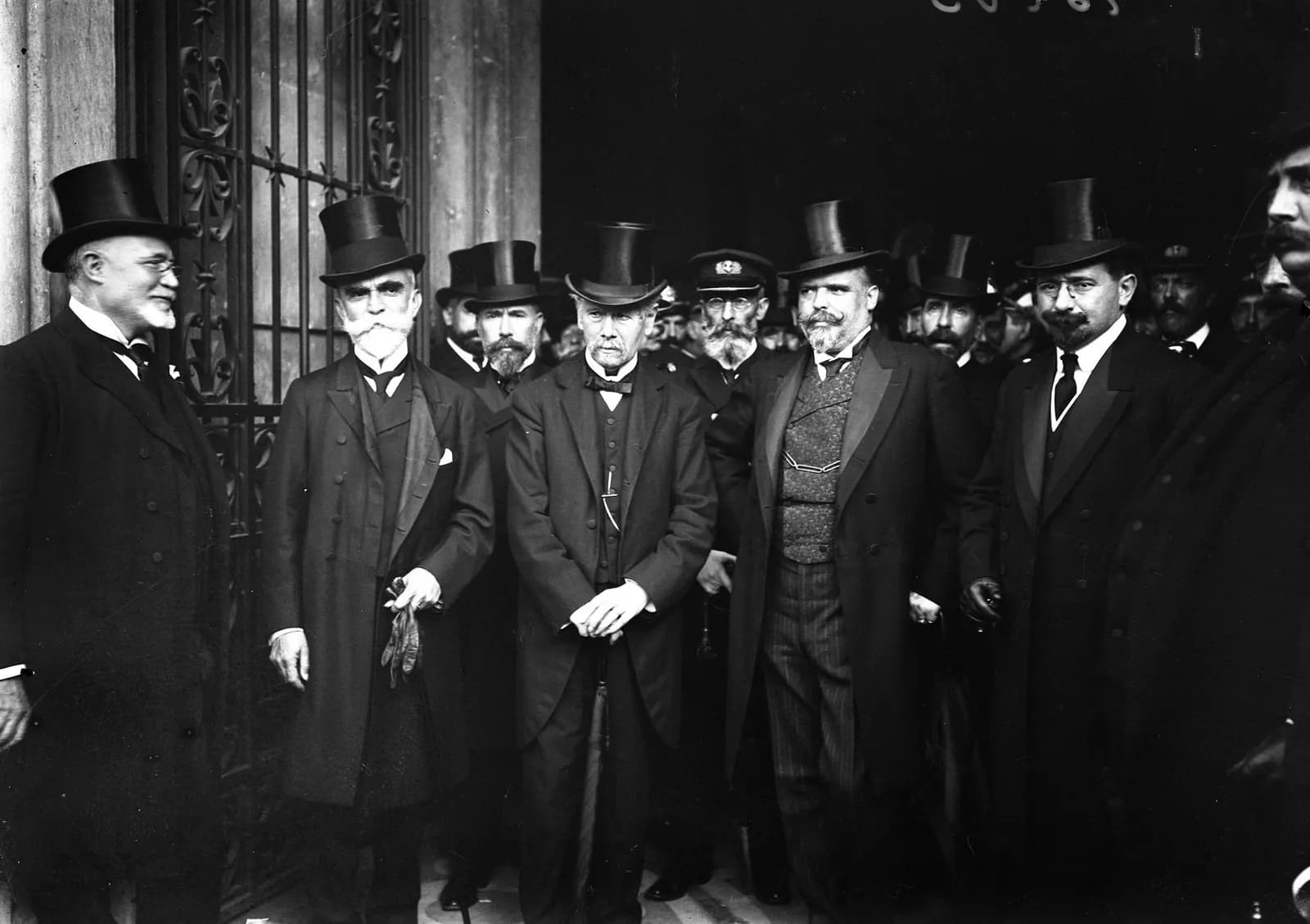
- Teófilo Braga (centre) with Bernardino Machado (second from left), António José de Almeida and Afonso Costa (right) after a ceremony in memory of those killed in the revolution, 16 October 1910. Photograph by Alberto Carlos Lima. Alberto Carlos Lima, Public domain, via Wikimedia Commons.
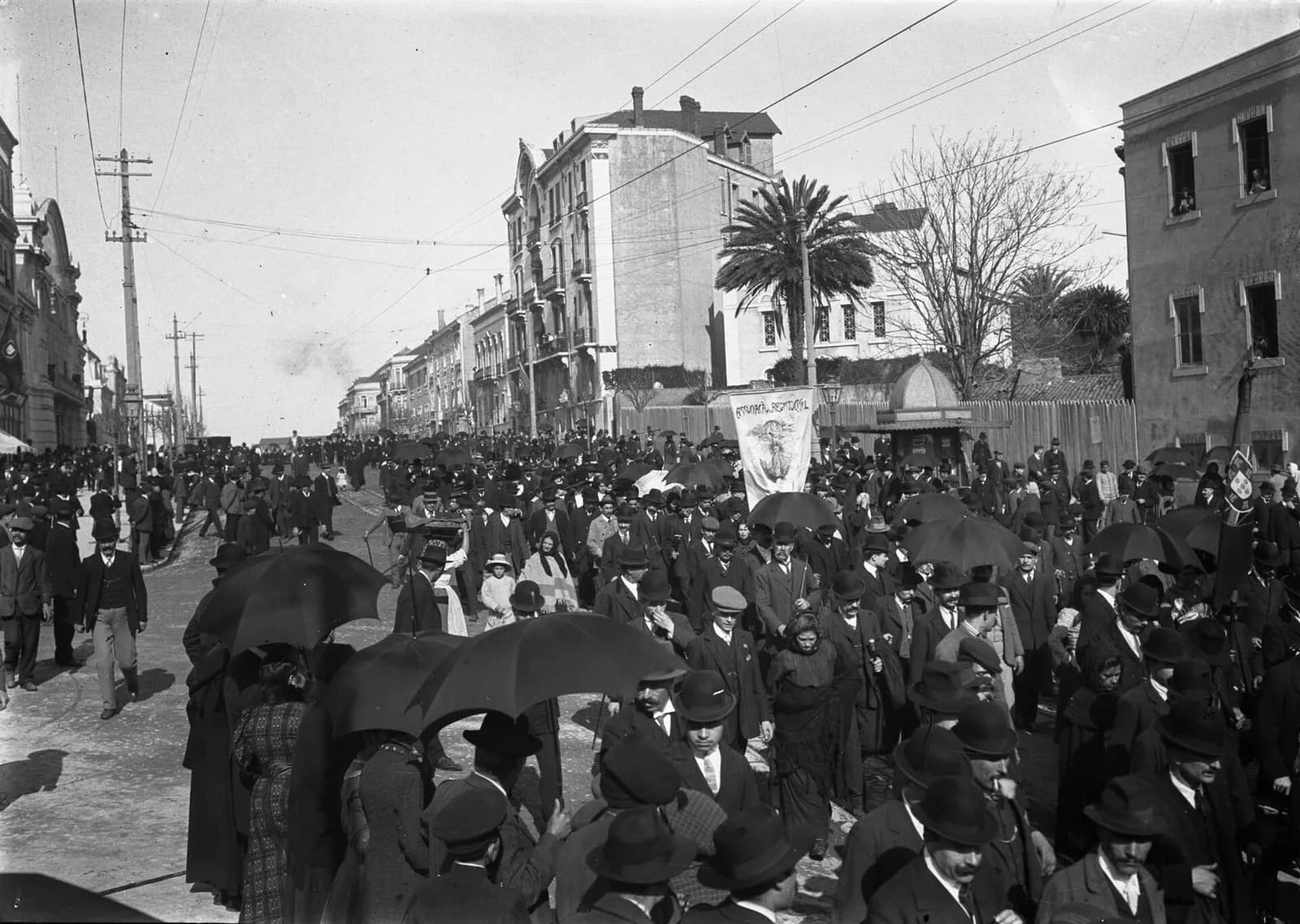
- A procession in homage to Teófilo Braga passes along Rua Alexandre Herculano in Lisbon on 25 March 1912. Photograph by Joshua Benoliel, published in Ilustração Portuguesa on 1 April 1912. Joshua Benoliel, Public domain, via Wikimedia Commons.
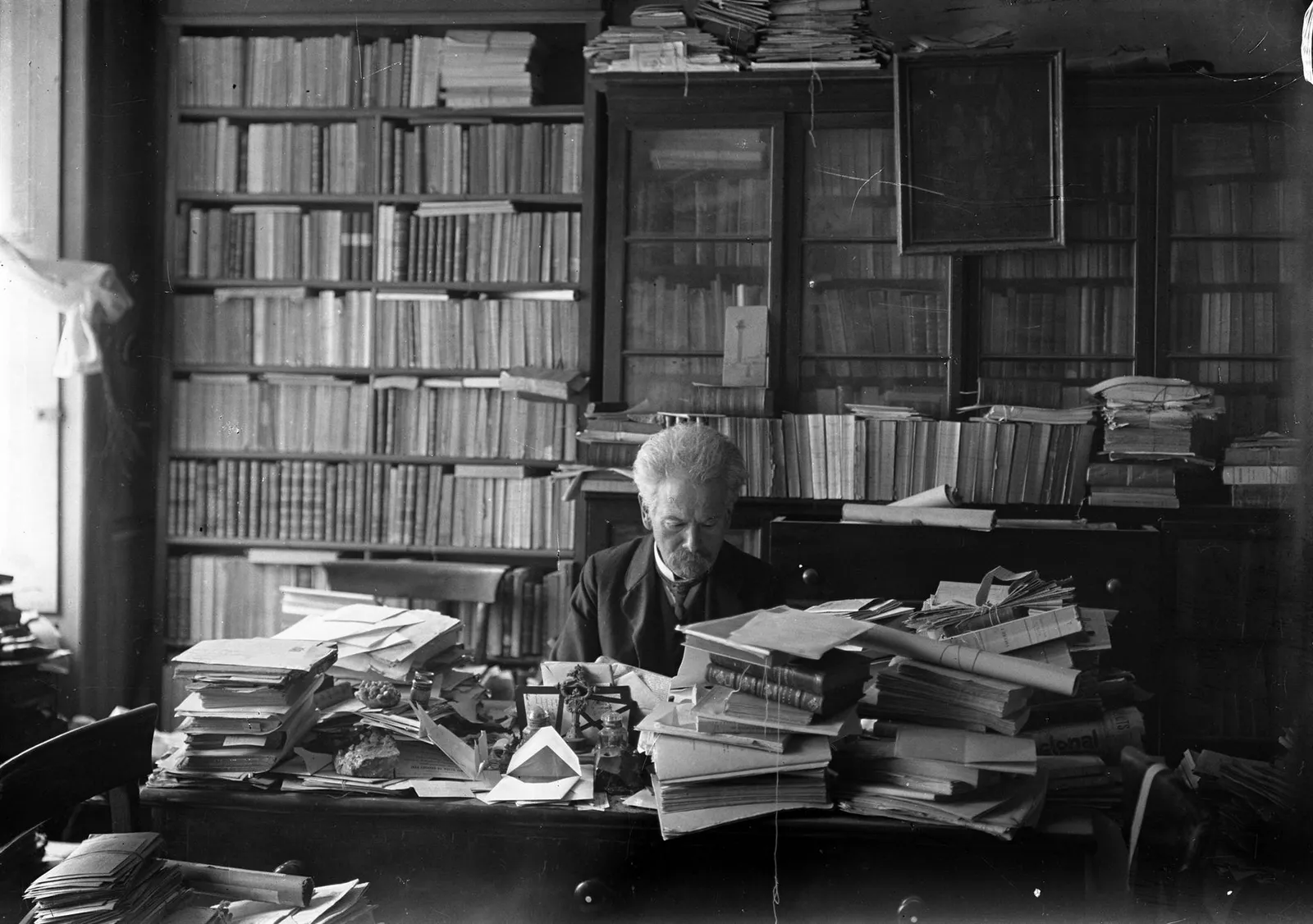
- Teófilo Braga in his study in 1910. Ilustração Portugueza printed the picture on 24 October 1910, weeks after he became head of the Provisional Government. Photograph by Joshua Benoliel. Joshua Benoliel, Public domain, via Wikimedia Commons.
- Teófilo Braga’s tomb in the Panteão Nacional, the former church of Santa Engrácia in Lisbon, photographed in 2020. António Fragoso, CC BY 2.0, via Wikimedia Commons.