

The Berlin Conference of 1885 and Portugal's lost Congo mouth
Portugal went to Berlin to defend four centuries of claims at the mouth of the Congo. It came home with Cabinda, the south bank and a new rule that new claims on the coast had to be backed by authority on the ground.
At a glance
- On 26 February 1885 the plenipotentiaries of 14 states, Portugal among them, signed the General Act of the Berlin Conference, which had opened in Bismarck's official residence on 15 November 1884.
- The conference grew out of a treaty Britain and Portugal signed in London on 26 February 1884, recognising Portuguese rule at the mouth of the Congo. France, Germany, King Leopold II and British merchants opposed it, and Britain dropped it that June.
- In a side convention of 14 February 1885 Portugal gave the north bank of the Congo, with Banana and Boma, to Leopold's International Association of the Congo. It kept the south bank up to Noqui and the enclave of Cabinda.
- Articles 34 and 35 of the Act required powers to notify new coastal acquisitions and to establish authority there, under a chapter on what made new occupations effective. The rule weakened Portugal's argument from historic rights.
- Pushed to occupy what it claimed, Portugal sought recognition of a belt from Angola to Mozambique in 1886, the Pink Map, which ran into Britain's ultimatum of January 1890.
A quiet last sitting in the Wilhelmstrasse
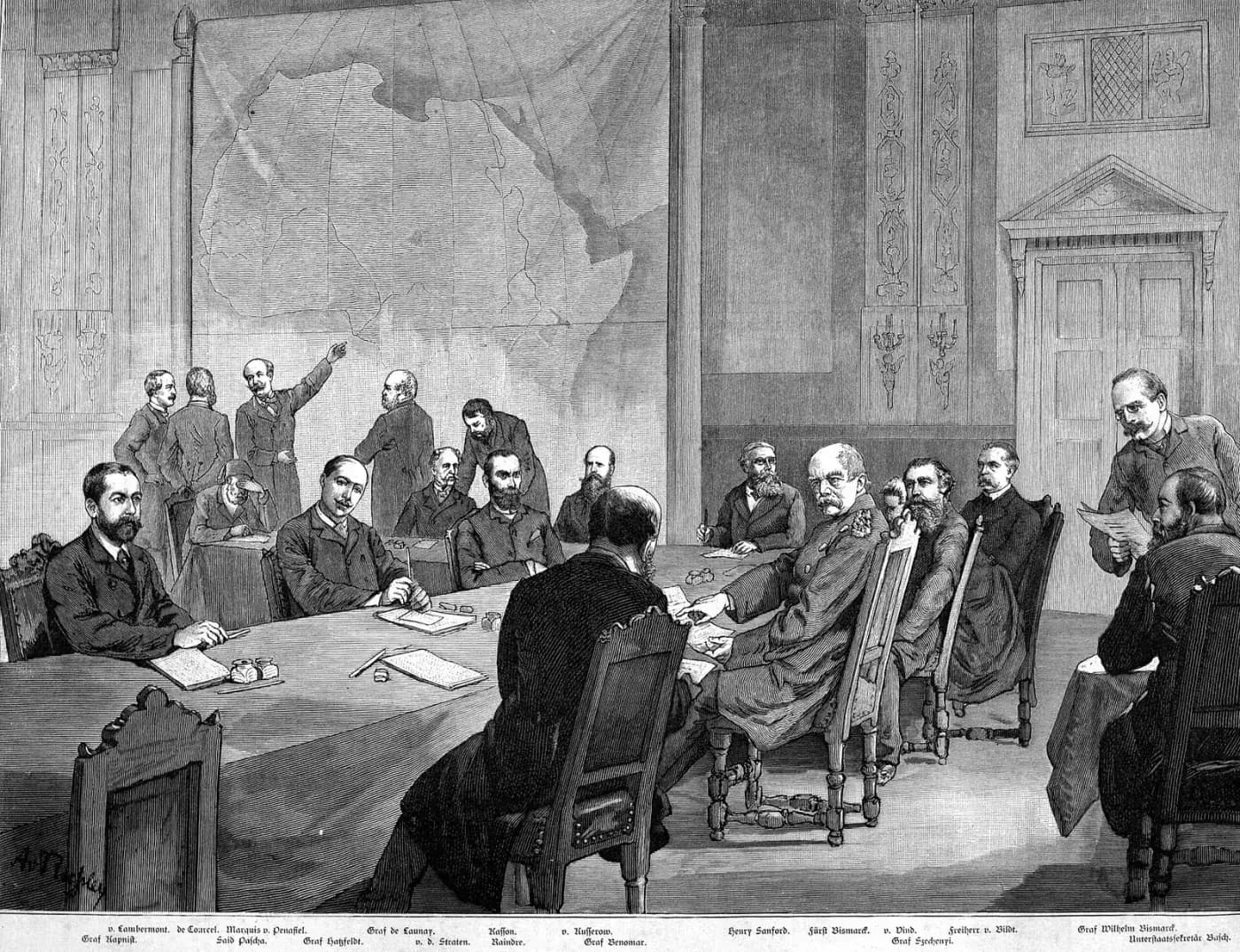
On Thursday 26 February 1885 the diplomats met for the last time in the conference hall of the Reich Chancellor's palace at Wilhelmstrasse 77, in Berlin. They had been coming there since November. Otto von Bismarck, the German chancellor, summed up their work, praised the spirit of conciliation and wished well to the enterprise of King Leopold II of the Belgians in Africa. The Italian ambassador, Count de Launay, replied with praise for the chancellor and thanks, on behalf of all, for the emperor's hospitality.
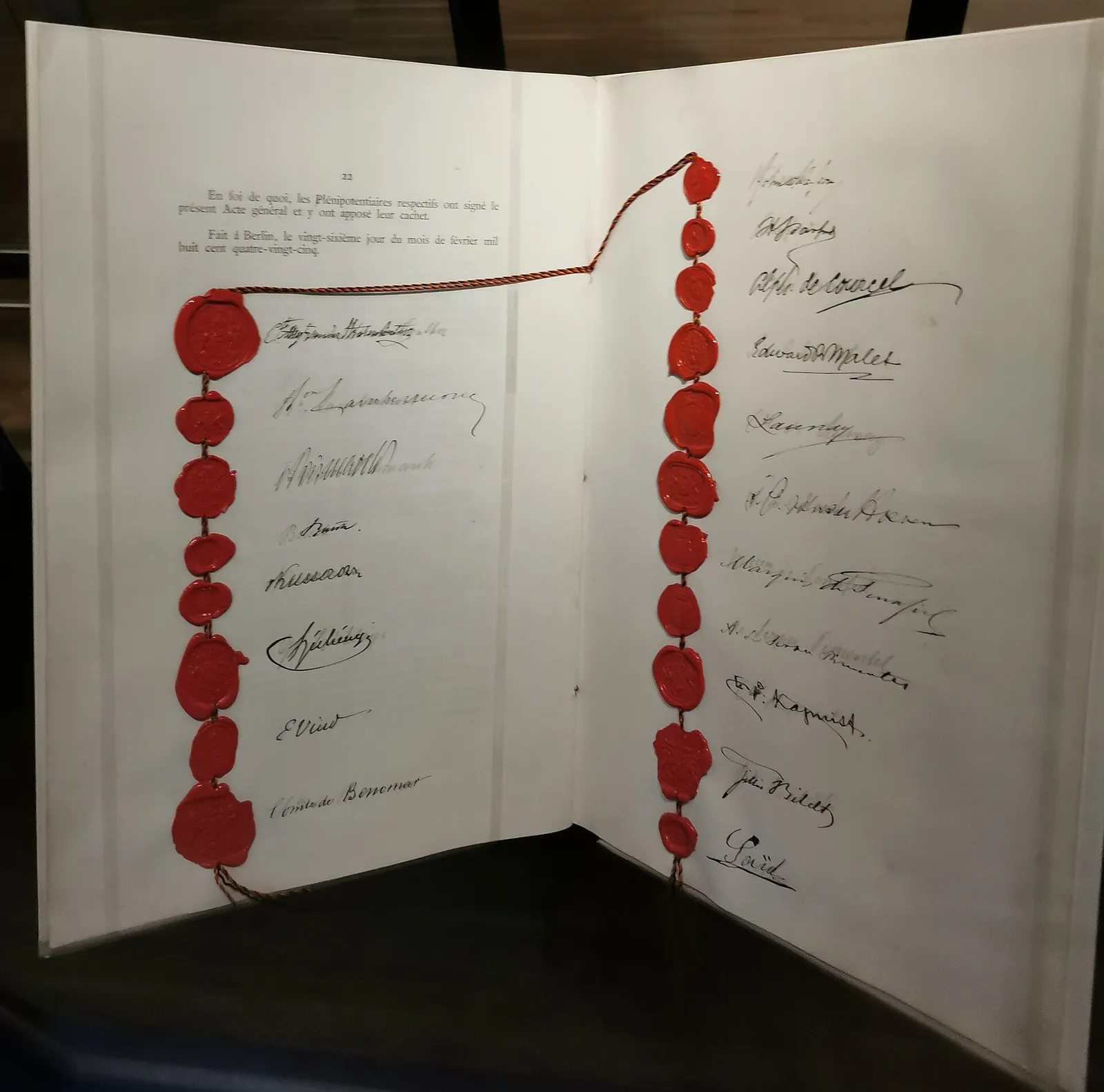
Before the session closed, Bismarck announced a document in which Leopold's International Association of the Congo adhered to what the conference had agreed. Then the plenipotentiaries signed the General Act and pressed their seals into red wax. For Portugal the signatures were those of the Marquis of Penafiel, its minister in Berlin, and António de Serpa Pimentel, a councillor of state.
Penafiel's report to Lisbon the next day was flat. Neither Bismarck's speech nor the reply, he wrote, had contained anything particularly remarkable. The hard part had happened twelve days earlier, when Portugal signed away the north bank of the Congo, on a coast Lisbon said had belonged to its crown for centuries.
An old claim on the Zaire
In the early 1880s Portugal was a constitutional monarchy under King Luís, and its African empire was mostly a matter of coastal towns and forts. Portuguese explorers had crossed the interior without occupying any of it. North of Luanda, Lisbon claimed the whole coast between latitudes 8° and 5° 12' south, from Ambriz past the mouth of the Congo, which the Portuguese called the Zaire, to Cabinda and Molembo.
The claim rested on discovery, on centuries of dealings with the kingdom of Kongo and on old treaties. Britain, which policed the Atlantic against the slave trade, had refused since 1846 to recognise Portuguese rights north of the river Loge. Portugal answered by moving troops north: it occupied Ambriz in 1855, Bembe in 1856 and São Salvador, the Kongo capital, in 1858, though the fort it began there was abandoned in 1866.
Kongo still had its own king, the ntotila, who lived in São Salvador. Lisbon called the kingdom a vassal of its crown, as Penafiel was still doing in 1885. The archaeologist Bruno Pastre Máximo points out that Kongo's own envoy to Madrid had said in 1607 that his king was under the protection of the Iberian crown but not directly its vassal.
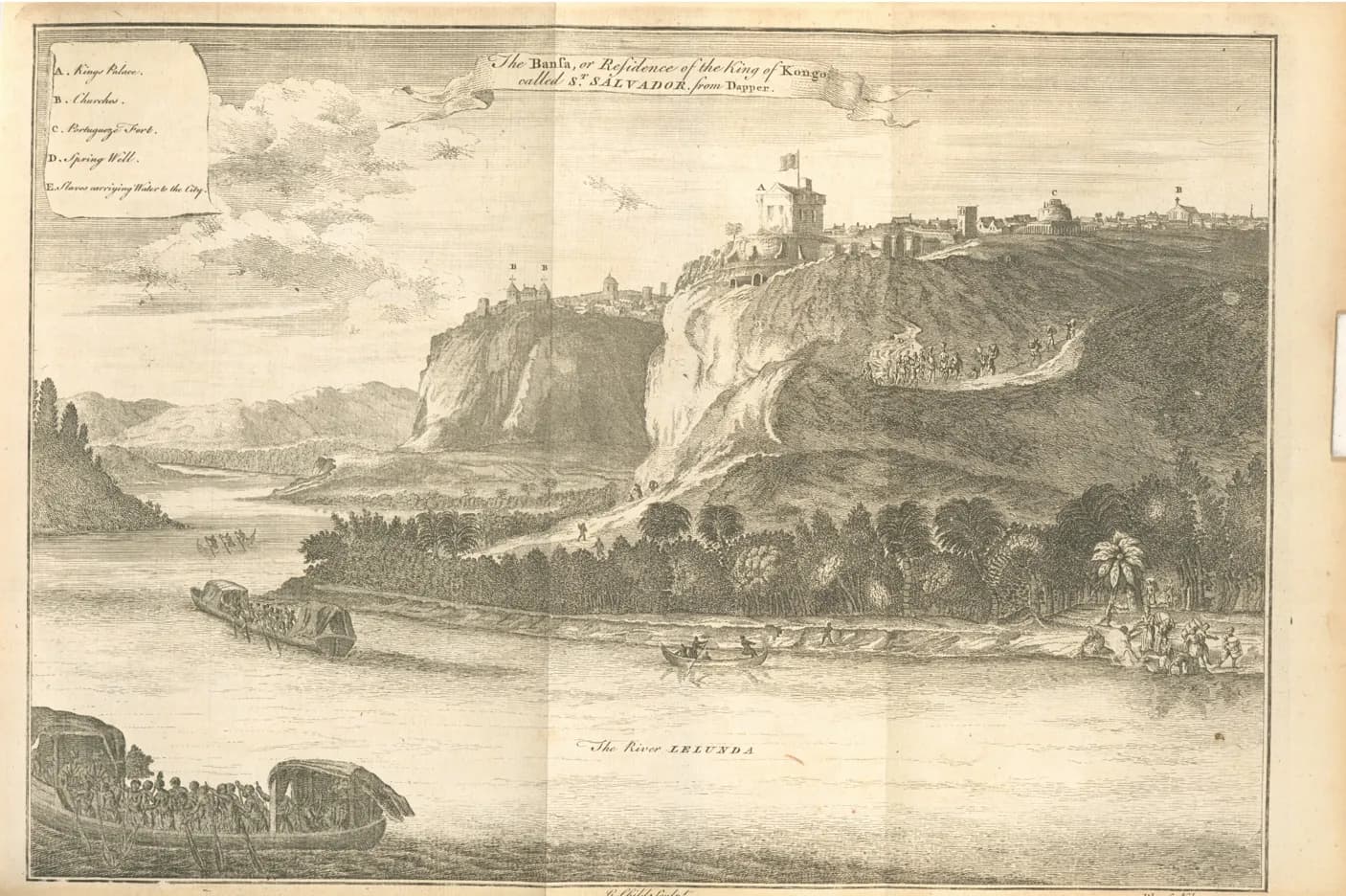
The pressure grew in the 1870s. The Lisbon Geographical Society, founded in 1875, became the centre of Portuguese colonial thinking, and in 1883 it published a memorandum on the Zaire question and Portugal's rights that gathered its arguments in one place. Its secretary, Luciano Cordeiro, listed the kinds of proof that should count: public acts, political occupation and trade, prolonged occupation, repeated acts of sovereignty, claims and reservations of rights, and documents, ruins and traditions.
“Frenchmen, Belgians, Germans and Americans have their eyes fixed on the territory of the Zaire, and expeditions are flocking there from every side. The occupation of the territories to which Portugal reserves its rights in the treaties has not yet been achieved, but once the various nations have set foot there firmly, that occupation will become impossible.”
Corvo, who had left the colonial ministry in 1877, proved right about the expeditions. By the early 1880s Henry Morton Stanley was signing treaties with chiefs along the river for Leopold II, whose private body was renamed the International Association of the Congo in 1882. In November 1882 France ratified the treaties that Pierre Savorgnan de Brazza had made on the north bank.
The treaty that died in four months
Britain, worried that France would close the river to free trade, reopened talks with Lisbon in 1882. On 26 February 1884, exactly a year before the Berlin Act, Earl Granville, the British foreign secretary, and Miguel Martins d'Antas, Portugal's minister in London, signed a treaty on the Congo and the Zambezi.
Britain recognised Portuguese sovereignty over the coast between 8° and 5° 12' south and up the Congo as far as Noqui. In return Portugal promised free navigation, a low tariff and a joint Anglo-Portuguese commission to regulate traffic on the river. Another clause said Portugal's claims on the Shire, a river far away in east Africa, would not extend beyond its meeting with the Ruo.
The treaty satisfied almost no one else. On 18 March France's minister in Lisbon delivered a note of objections. Bismarck refused to recognise it. Leopold II, Dutch traders at Banana and the merchants of Manchester, who feared Portuguese customs officers, all campaigned against it, and even the British press was unfavourable.
In May London told Lisbon it could not ratify without first satisfying the other powers. José Vicente Barbosa du Bocage, Portugal's foreign minister, telegraphed Portugal's legations on 12 May that the treaty would not be debated in the Cortes that session. The same day he wrote that a conference seemed the only way to reach a workable result, and said he had suggested one to the British minister. On 13 May he floated the idea in a circular to the legations.
“The objections raised by the German Government, together with those taken by other Powers, to the Treaty of February 26th 1884, are of so decided and serious a character as to leave in the opinion of Her Majesty's Government no hope of the Treaty being accepted as a whole.”
Bismarck's invitation
Bismarck took up the idea that summer, in agreement with the French government of Jules Ferry. On 12 October 1884 the German minister in Lisbon delivered the invitation. Germany and France proposed to settle three points: freedom of trade in the basin and mouths of the Congo; free navigation of the Congo and the Niger; and the formalities that would make new occupations on the coasts of Africa count as effective.
The conference opened at two in the afternoon on 15 November 1884 in the chancellor's palace. Penafiel reported that the plenipotentiaries sat around the table in the alphabetical order of the powers they represented. Fourteen states took part: Germany, Austria-Hungary, Belgium, Denmark, Spain, the United States, France, Britain, Italy, the Netherlands, Portugal, Russia, Sweden and Norway, and the Ottoman Empire. No African was present, although the borders being negotiated on the side ran through the lands of Kongo and of the Cabinda rulers.
On 19 November Penafiel read Portugal's declaration. Lisbon, he said, had perhaps been the first to propose such a meeting, in Bocage's circular of 13 May, and fully accepted free trade and navigation on the Congo. He pointed to the recent occupation of Kakongo and Massabi, north of 5° 12', by the governor of Angola.
The talks on borders happened outside the formal sessions. Britain, France and Germany were agreed that Portugal must not control both banks of the Congo mouth, which they feared would threaten the free-trade zone. Leopold's Association, meanwhile, was collecting conventions of recognition, signed with the United States in April 1884, Germany in November and Britain on 16 December.
A month of holding out
Portugal's quarrel with the Association moved from Paris to Berlin at the end of January 1885. On 31 January the French ambassador, Baron de Courcel, acting as mediator, brought Penafiel a proposal that gave the Association the north bank and the coast from the Chiloango river to the Congo, Cabinda included. Penafiel called it completely unacceptable. A second offer, on 2 February, left Portugal Cabinda and Molembo but reduced them, in his words, to proportions that were simply derisory.
Then the great powers wrote. Sir Edward Malet, the British ambassador, told Penafiel on 7 February that London wanted the north bank and the coast up to the Chiloango to go to the Association, except for Cabinda and Molembo, and that Portugal should take the rest of the coast south to Ambriz.
“Her Majesty's Government urgently advise Portugal to follow this example without hesitation.”
On 10 February Lisbon answered that it would give up the north bank, but not Banana, the port at the river mouth. Its people had just asked for Portuguese rule, Bocage argued, and it was one of only three trading ports on the river. On 13 February Germany, France and Britain each replied in writing that Portugal should not insist. Lisbon gave way, and sent its orders to Penafiel by telegram.
On 14 February 1885, at the French embassy, Penafiel signed the convention with Colonel Strauch, president of the Association, with Courcel signing as mediator. Portugal recognised the Association's blue flag with a gold star as that of a friendly government.
“A small nation, long forgotten by the councils of Europe, had dared for a month to hold up the Conference and keep it from reaching a result.”
| Territory | Portuguese claim | Outcome |
|---|---|---|
| Coast from Ambriz north to the Congo mouth | Portuguese | Portuguese, as the British note of 7 February proposed |
| South bank of the Congo, up to Noqui | Portuguese (both banks were claimed) | Portuguese; border along the parallel of Noqui east to the Cuango |
| North bank of the Congo, with Banana and Boma | Portuguese, at least as far as Boma | Ceded to the International Association of the Congo |
| Cabinda, Molembo and Landana, north of the river | Portuguese, as part of the coast claimed up to the French frontier; also protectorate treaties of 1883-85 | Portuguese, as an enclave cut off from Angola by the Association's corridor to the sea |
Claims as Swanepoel describes them from Foreign Office papers: the whole coast from Ambriz to the French frontier, both banks of the Congo and the north bank as far as Boma. Protectorate treaties from Costa Almeida. Outcome from Article III of the convention and the British note of 7 February; Penafiel listed Cabinda, Molembo, Landana and the navigable Chiloango as what Portugal kept north of the river.
Penafiel called the loss of Banana painful. He also passed on what other delegates were telling him: that unlimited resistance to the will of those who ruled the world by the size of their armies and fleets would have been dangerous. Bocage had Portugal's minister in Paris thank the French prime minister, Jules Ferry, for France's part in the settlement.
What the General Act said
- Signed
- Berlin, 26 February 1885
- Conference sat
- 15 November 1884 to 26 February 1885
- Signatory states
- 14, each named with its plenipotentiaries in the preamble
- Length
- 38 articles in 7 chapters
- Ratified
- By all signatories except the United States; deposit recorded in Berlin on 19 April 1886
Most of the Act dealt with trade. It declared complete freedom of trade for all nations in a conventional basin of the Congo, which on the Atlantic ran from latitude 2° 30' south to the mouth of the Loge. Portugal's new northern district lay inside it. Other chapters condemned the slave trade, offered neutrality to the territories of the basin and opened the Congo and the Niger to the ships of every nation.
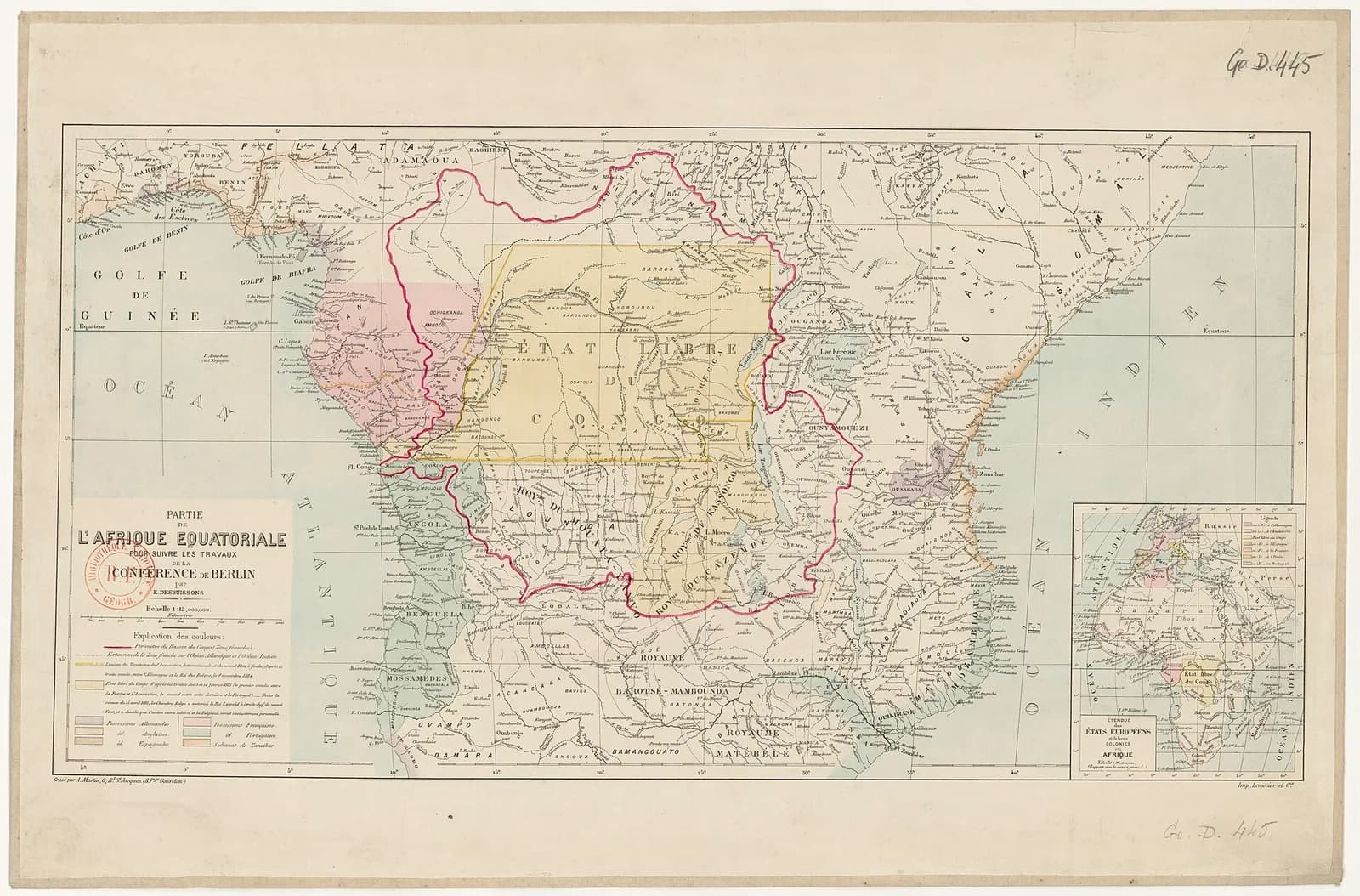
The part that mattered most to Portugal was the short sixth chapter. Article 34 said any power that took possession of land on the African coasts outside its existing possessions, or declared a protectorate there, must notify the other signatories so they could raise any claims of their own.
“The Signatory Powers of the present Act recognize the obligation to insure the establishment of authority in regions occupied by them on the coasts of the African Continent sufficient to protect existing rights, and, as the case may be, freedom of trade and of transit under the conditions agreed upon.”
For Portugal, the historian Nuno Severiano Teixeira argues, this was the conference's gravest consequence. The new colonial law put effective occupation first and left historic rights only a supporting role. Britain wanted the rule applied to the whole continent; the other powers refused, so it covered only the coasts, and inland the race turned to claiming spheres of influence.
“The insistence on effective occupation was probably only intended to abrogate Portugal's ancient but shadowy claims to half the coastline of Africa.”
From Berlin to the Pink Map
In Lisbon the episode left a grudge. The British desertion of the Congo treaty and the passive role of Britain's delegation in Berlin left many Portuguese politicians resentful, according to the diplomat and historian José Calvet de Magalhães, and inclined to look to France and Germany instead.
Bocage, close to the Geographical Society, wanted to join Angola to Mozambique. He opened talks with France and Germany, which his successor, Henrique de Barros Gomes, concluded. In a convention signed in Paris on 12 May 1886, which also fixed the northern border of Cabinda and the borders of Portuguese Guinea, France recognised the King of Portugal's right to exercise his sovereign and civilising influence in the territories between the two colonies, saving rights already acquired by other powers. Germany said the same in a declaration of 30 December 1886.
A map coloured that belt pink, and the plan became known as the Mapa Cor-de-Rosa. Britain had signed nothing of the kind, and the clash it produced over the Shire and Mashonaland, ending in the British ultimatum of 11 January 1890, is told in our article on the ultimatum. In the 1891 treaty that followed, Britain kept the lands between the two colonies.
29 September 1883
Treaty of Chinfuma
Chiefs north of the Chiloango accept Portuguese protection.
26 February 1884
Anglo-Portuguese treaty signed in London
Recognises Portugal on the coast between 8° and 5° 12' south.
12-13 May 1884
Bocage proposes a conference
Britain has said it cannot ratify without the other powers.
28 June 1884
Britain drops the treaty
Petre's note says it has no hope of acceptance.
12 October 1884
German invitation reaches Lisbon
15 November 1884
Conference opens in Berlin
1 February 1885
Treaty of Simulambuco
Cabinda becomes a Portuguese protectorate.
14 February 1885
Convention with the Congo Association
Portugal cedes the north bank, keeps Cabinda and the south bank.
26 February 1885
General Act signed
12 May and 30 December 1886
France and Germany recognise the claim between Angola and Mozambique
11 January 1890
British ultimatum
25 May 1891
Lunda treaty with the Congo Free State
Fixes Angola's border in the Lunda region.
Occupying what was claimed
Berlin's rule, and the appetite of Britain, Germany and the Transvaal for lands Portugal claimed, changed what Portuguese governments asked of their soldiers. In Mozambique, as a study for the Caixa Geral de Depósitos archive puts it, Portuguese authority before then ran to ports, islands and a few posts up the Zambezi along about 2,400 kilometres of claimed coast. Officers such as Eduardo da Costa, using the language of the conference, argued that without prior military occupation there was no effective rule and therefore no colonisation.
Lisbon sent thirteen military expeditions to Mozambique between 1891 and 1901, with about 7,000 men in all. The campaign of 1895 against Gaza, an African kingdom founded about sixty years earlier that ruled much of southern Mozambique, ended on 28 December, when Joaquim Mouzinho de Albuquerque seized its ruler, Gungunhana, at Chaimite.
Military expeditions sent from Lisbon to Mozambique, 1891-1901, as one study summarises them
expeditions
The Caixa Geral de Depósitos study gives these yearly counts in one sentence and does not list the expeditions: one in 1891, then one a year from 1894 to 1901 except three in 1896 and two each in 1900 and 1901, 13 in all, with about 7,000 men. 1892 and 1893, which it does not mention, are shown as zero. Highlighted: 1895, the year of the campaign against Gaza.
Show the data
| Expeditions | |
|---|---|
| 1891 | 1 |
| 1892 | 0 |
| 1893 | 0 |
| 1894 | 1 |
| 1895 | 1 |
| 1896 | 3 |
| 1897 | 1 |
| 1898 | 1 |
| 1899 | 1 |
| 1900 | 2 |
| 1901 | 2 |
In Angola the borders were drawn on paper first. Treaties with France and Germany in 1886, with the Congo Free State in 1891, the Barotse arbitration award of 1905 and an agreement with South Africa in 1926 fixed the lines, according to the Angolan historian Edmar da Silva Paím.
Why it still matters
The deal struck at the French embassy in February 1885 is still on the map. Angola has two separate pieces: Cabinda, about 7,270 square kilometres, and the rest of the country, divided by a strip of land about 60 kilometres wide that belongs to the Democratic Republic of the Congo, Leopold's old corridor to the sea. Paím, who takes these figures from H. Mbunga's 2014 study of Cabinda, notes that the treaties also divided the Bakongo between Angola and the two Congos.
Simulambuco has a second life. Cabindan independence movements have cited the 1885 treaty, which made Cabinda a protectorate rather than a part of Angola: the AREC, founded in 1958, asked Lisbon for independence in 1960 and called for an end to the Simulambuco protectorate, and the FLEC, founded in 1963, and other separatists still invoke it. The researcher Eugénio Costa Almeida points out that no document is known in which the king of Portugal authorised Capelo to sign it, nor any ratification by the queen of Ngoyo.
FAQs
Did the Berlin Conference divide Africa among the European powers?
Not directly. The General Act of 26 February 1885 set rules for free trade and navigation on the Congo and the Niger and for notifying new coastal acquisitions. The borders around the Congo mouth were agreed in side treaties, and most colonial borders came from bilateral agreements signed afterwards.
What did Portugal gain and lose at the Berlin Conference?
In its convention of 14 February 1885 with the International Association of the Congo, Portugal gave up the north bank of the Congo, including the port of Banana and Boma. It kept the south bank up to Noqui, with a border running east to the Cuango, and Cabinda, Molembo and Landana north of the river.
What was the principle of effective occupation?
Articles 34 and 35 of the Berlin Act required a power taking new land on the African coasts to notify the others and to establish enough authority there to protect existing rights. It applied only to the coasts, but it weakened claims based on discovery and history, which was how Portugal had argued.
Why is Cabinda separated from the rest of Angola?
Because in its convention of 14 February 1885, pressed by Britain, France and Germany, Portugal ceded the north bank of the Congo and a strip of coast to Leopold II's Association, now part of the Democratic Republic of the Congo, while keeping Cabinda, which local rulers had placed under its protection in the treaty of Simulambuco.
How is the Berlin Conference linked to the British Ultimatum of 1890?
After Berlin, Portugal tried to secure the interior between Angola and Mozambique through agreements with France and Germany in 1886, the plan known as the Pink Map. Britain, which had not agreed, demanded the withdrawal of Portuguese forces from the Shire and Mashonaland on 11 January 1890.
On the timeline
Open the timelineNearby moments from regeneration and the last kings (1851–1910).
Birth in Porto of naval officer José Carvalho Araújo (two Navy sources say 1880). In October 1918, commanding the small patrol boat 'Augusto de Castilho', he fought the German submarine U-139 for nearly two hours so that the steamer 'São Miguel', carrying 206 passengers from Madeira to the Azores, could escape. He died in the fight, and his ship was sunk.
Birth of Carlos Sampaio Garrido, Portugal's envoy in Budapest during the Nazi occupation of Hungary. In 1944 he sheltered Jews in the legation's country house, among them relatives of the actress Zsa Zsa Gabor; after he left, his successor Teixeira Branquinho extended Portuguese protection to about 1,000 people. Yad Vashem named him Righteous Among the Nations in 2010.
Birth in Loulé of José Mendes Cabeçadas, the naval officer who helped both to make and to unmake the First Republic. A leader of the mutiny aboard the cruiser Adamastor in the 1910 revolution, he raised the 1926 revolt in Lisbon that toppled the Republic and was briefly head of state, until the generals pushed him aside. He spent his last decades conspiring against Salazar.
Portugal at the Berlin Conference
The Berlin Conference ends with 14 nations, Portugal among them, signing its General Act on trade and claims in Africa. Its rule that new coastal claims needed 'effective occupation' pushed Lisbon to back its claims with expeditions and the 'Pink Map' plan to link Angola and Mozambique, crushed by Britain's 1890 ultimatum.
Birth of Aristides de Sousa Mendes at Cabanas de Viriato, Beira Alta. As Portuguese consul-general in Bordeaux in June 1940, he would defy Salazar's standing orders and issue thousands of visas to refugees — many of them Jews — fleeing the Nazi advance, an act of conscience that cost him his career and would later earn him the title 'Righteous Among the Nations'.
The Elevador da Glória opens in Lisbon, linking the Restauradores to the Bairro Alto. Designed by the engineer Raoul Mesnier du Ponsard and electrified in 1915, the funicular became one of the city's best-loved symbols; its derailment on 3 September 2025 killed 16 people.
Cosme Damião is born in Lumiar, Lisbon. A former Casa Pia pupil, he was the driving force among the young founders of Sport Lisboa in 1904, the club that became Benfica, and served it as captain, coach and journalist for two decades — yet always refused to become its president.
Coming up in history
All long reads 28 February 1969The earthquake of 28 February 1969: Portugal’s strongest of the century
 29 February 1796A leap-day charter: Lisbon gets a public library, 29 February 1796
 1 March 1290How Portugal got its first university: King Dinis's charter of 1290
 2 March 1898Amélia Rey Colaço, the actress who ran Portugal's national theatre
17 sources
Archives, scholarship and reporting this article was checked against.
- 1
Negócios externos: documentos apresentados às Cortes na sessão legislativa de 1885. A questão do Zaire (Congo) IIMinistério dos Negócios Estrangeiros, Imprensa Nacional, Lisbon, 1885 (Internet Archive)
- 2
- 3
Britain and the Association Internationale du Congo, January 1884 – February 1885 (Paul Swanepoel)Modern Africa: Politics, History and Society, vol. 13, no. 1 (2025), pp. 161-183
- 4
Política externa e política interna no Portugal de 1890: o Ultimatum Inglês, by Nuno Severiano TeixeiraAnálise Social, vol. XXIII (98), 1987, pp. 687–719
- 5
- 6
A paisagem de São Salvador do Congo e o discurso colonial português frente à Conferência de Berlim (1884-1885) (Bruno Pastre Máximo)Vestígios: Revista Latino-Americana de Arqueologia Histórica, vol. 12, no. 1 (2018), Universidade Federal de Minas Gerais
- 7
Ehemaliges Reichskanzlerpalais Wilhelmstraße 77: Haus der „Berliner Konferenz“Deutsches Historisches Museum, Afrika in Berlin: ein Stadtspaziergang
- 8
HistóriaSociedade de Geografia de Lisboa
- 9
Portugal e Inglaterra: de D. Fernando ao mapa cor-de-rosa (II) (José Calvet de Magalhães)Janus 1999-2000, Universidade Autónoma de Lisboa and Público
- 10
- 11
- 12
- 13
Fronteiras da República de Angola: rastos da Conferência de Berlim (Edmar da Silva Paím)JANUS.NET e-journal of International Relations, vol. 15, no. 1 (2024), Universidade Autónoma de Lisboa
- 14
«Moçambique»: as campanhas de pacificação nas emissões do BNUCaixa Geral de Depósitos, Património Histórico
- 15
The Barotseland Boundary Case (Great Britain, Portugal), award of 30 May 1905United Nations, Reports of International Arbitral Awards, vol. XI, pp. 59–69
- 16
Museu da Sociedade de Geografia de LisboaVisit Lisboa (Turismo de Lisboa)
- 17
Simulambuco Treaty Historical LandmarkVer Angola
Image credits
- A session of the Berlin Conference in the conference hall of the Reich Chancellor's palace, drawn by Adalbert von Roessler for the illustrated weekly Über Land und Meer in 1884-85. The names printed beneath include Bismarck, the French ambassador de Courcel and Portugal's minister in Berlin, the Marquis of Penafiel. Adalbert von Roessler, Public domain, via Wikimedia Commons.
- The signature pages of Belgium's copy of the General Act of Berlin, dated 26 February 1885, on show in the House of European History in Brussels. The right-hand column includes the signatures of the Marquis of Penafiel and António de Serpa Pimentel. Karmakolle, CC BY-SA 4.0, via Wikimedia Commons.
- São Salvador, capital of the kingdom of Kongo (today Mbanza Kongo in Angola), as a European engraver imagined it from Olfert Dapper's seventeenth-century description, for Thomas Astley's collection of voyages in 1745. Portuguese writers of the 1880s cited its ruined churches as proof of Portugal's rights south of the Congo. Thomas Astley, Public domain, via Wikimedia Commons.
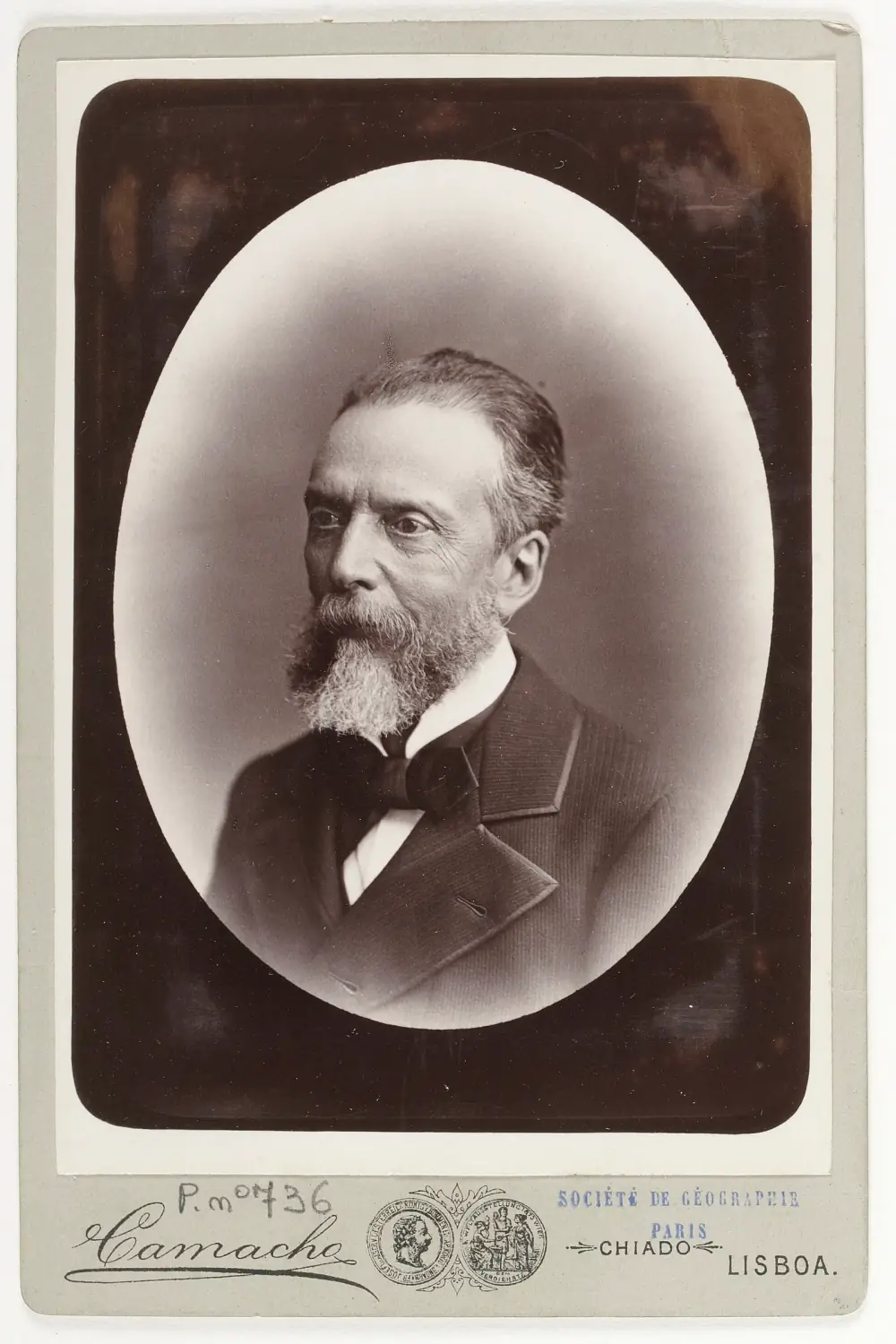
- José Vicente Barbosa du Bocage (1823-1907), Portugal's foreign minister during the Congo crisis, photographed by João Francisco Camacho in Lisbon. João Francisco Camacho, Public domain, via Wikimedia Commons.
- Edouard Desbuissons's map of equatorial Africa for following the work of the Berlin Conference, printed in Paris in 1885. The red line marks the Congo free-trade basin and the yellow area the Congo Free State; the Portuguese coastal territories are tinted on either side. Edouard Desbuissons, Public domain, via Wikimedia Commons.