

Luísa de Gusmão: the Andalusian duchess who ruled Restoration Portugal
Born a Spanish duke's daughter, she became the first queen of the restored Portuguese monarchy, governed for six years while Spain tried to win the kingdom back, and was pushed aside by her own son. She died in a convent of her founding, waiting for him to come.
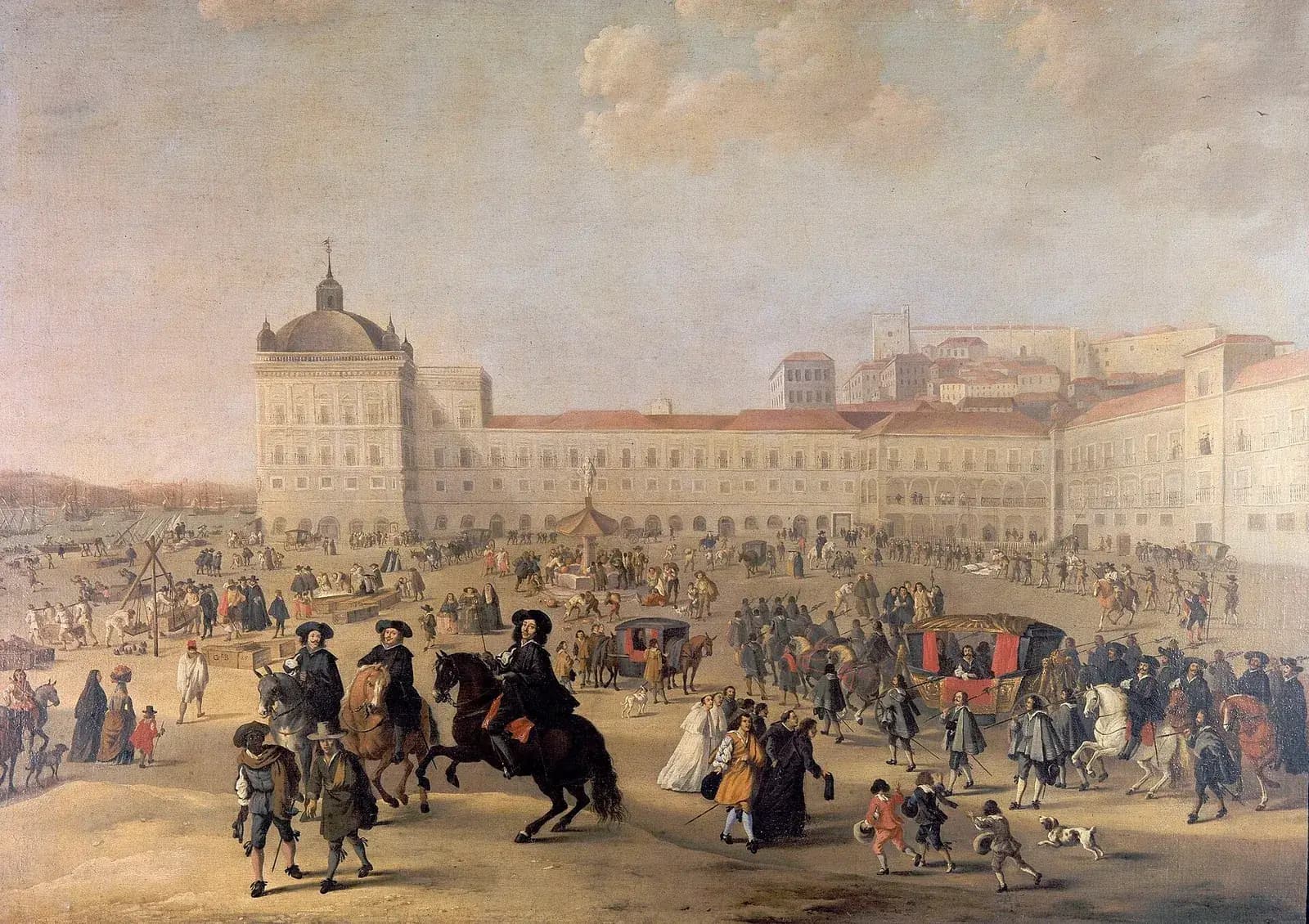
At a glance
- Luísa de Gusmão died at about nine at night on Saturday 27 February 1666, at the Grilo, by the Tagus at Xabregas, east of Lisbon. Her doctors had diagnosed dropsy.
- She was born on 13 October 1613, a daughter of the 8th Duke of Medina Sidonia, the greatest noble house of Castile, and in 1633 married João, Duke of Bragança.
- When Portugal broke from Spain on 1 December 1640 her husband became King João IV. The Count of Ericeira's chronicle of 1679 has her tell him it was better to die reigning than to end up serving.
- On João's death in November 1656 she governed as regent for their son Afonso VI, through the Spanish invasions of 1657-1659 and the English alliance of 1661.
- On 23 June 1662 she handed the royal seals to Afonso after he moved against her with the Count of Castelo Melhor. She later withdrew to a convent she had founded and never held power again.
Waiting for the king
By the evening of Saturday 27 February 1666 the queen mother of Portugal could no longer speak. She lay at the Grilo, an estate above the Tagus at Xabregas, just east of Lisbon, where she had founded a convent and lived in its seclusion. Her doctors had diagnosed dropsy, and since the Wednesday her breathing had been so laboured that they gave her only hours to live.
Her two sons were at Salvaterra, up the Tagus, with the court. She had confessed, made her will and, on Friday 26 February, written to each of them; a third letter went to her daughter in England. On the Saturday, at about five in the afternoon, she slipped into the last crisis. Word ran through the house that the king was coming; when he did not appear, she raised her hand and blessed the door through which her sons would enter.
“Son, I am in such a state that the doctors doubt my life, and I agree with them that I cannot last long. … If He permits that I should die without seeing you, I leave you only my blessing, because that is all I have to leave you.”
Her last words, by the account of the Count of Ericeira, a general of the war with Spain and its chronicler, were to ask everyone present to forgive her any offence. As the clock struck eight Afonso VI and his brother Pedro came in with the Count of Castelo Melhor, the man who now ran the kingdom. They knelt and asked for her blessing. She could answer only with her eyes. They kissed her hand and went back to the palace.
She died at nine o'clock that night. Ericeira did not hide what had happened at Salvaterra when her letters arrived: Pedro wept, and the king made a show of not caring and mocked his brother's tears. Four years earlier the same son had taken the government from her by force.
A Medina Sidonia daughter
Luisa Francisca de Guzmán, as she was born, came from the top of the Castilian nobility. Her father was the 8th Duke of Medina Sidonia, whose family had held the captaincy-general of the Ocean Sea and the coasts of Andalusia since 1588 and kept a small court of its own at Sanlúcar de Barrameda. Her mother was a daughter of the Duke of Lerma, Philip III's all-powerful favourite.
Ericeira gives her birth as Sunday 13 October 1613 at Sanlúcar de Barrameda. The Spanish Royal Academy of History's biographical dictionary agrees on the date and the town, although the heading of its online entry names Huelva. Her surname is Guzmán in Spanish; in Portugal she has always been Luísa de Gusmão.
Portugal then had no king of its own. Since 1580 its crown had been worn by the Habsburg kings of Spain, and the greatest Portuguese house was the ducal family of Bragança, which had its own claim to the throne through Duchess Catarina, a granddaughter of King Manuel I who had claimed the crown in 1580. The match with a Medina Sidonia was promoted by the Count-Duke of Olivares, Philip IV's chief minister, who hoped to bind the Braganças to the Crown; the bride's family was the senior branch of his own Guzmán lineage.
The wedding took place at Elvas, on the Portuguese side of the border, half-way between the Bragança palace at Vila Viçosa and Badajoz, where the bride's party entered Portugal. Valladares and Borgognoni date it to 12 January 1633; Ericeira has 11 January.
She had seven children, five of them before her husband became king. Two were stillborn, and two more died in the same year, 1653. Three outlived her: a daughter who became queen of England and two sons who each became king of Portugal.
| Child | Born | Died | What became of them |
|---|---|---|---|
| Teodósio | 8 February 1634 | 13 May 1653 | Heir to the throne; died aged 19 |
| Ana | 21 January 1635 | 21 January 1635 | Stillborn |
| Joana | 18 September 1635 | 17 November 1653 | Died aged 18 |
| Catarina | 25 November 1638 | 31 December 1705 | Married Charles II; queen of England |
| Manuel | 6 September 1640 | 6 September 1640 | Stillborn |
| Afonso | 12 August 1643 | 12 September 1683 | King Afonso VI from 1656 |
| Pedro | 26 April 1648 | 9 December 1706 | Governed for Afonso from 1667; King Pedro II from 1683 |
Dates from Rafael Valladares's entry in the Diccionario Biográfico Español, and Pedro's death from António Caetano de Sousa's História Genealógica, which places it at half past one in the afternoon on 9 December 1706; ages are calculated from them. Ericeira dates Pedro's takeover to 23 November 1667.
Better to die reigning
On 1 December 1640 a group of Portuguese nobles rose in Lisbon and proclaimed her husband King João IV; our article on the Restoration of 1640 tells that story. Ericeira says that when the conspirators' offer reached Vila Viçosa, the duke would not commit himself without his wife's opinion, and he went to her rooms to ask for it.
“She judged it, generously, the wiser course, even if death should be the consequence of the crown, to die reigning rather than end up serving.”
The story spread early. Borgognoni traces it from a Spanish-language play printed in Lisbon in 1645 to the Italian historian Giovanni Battista Birago in 1647. An English traveller, Richard Flecknoe, put it more bluntly in a letter of 1648.
“…for the Queen…if she be not King, her Ambition was that made the King.”
Her own family paid a price. From 1640 her brother, the 9th Duke of Medina Sidonia, and a cousin, the Marquis of Ayamonte, sounded out foreign powers about a rising in Andalusia. The duke was accused of conspiring against Philip IV and fell from favour. Valladares notes that Bragança commanders on the frontier facing Huelva knew to spare her brother's lands where they could.
As queen consort she kept a low profile. The new dynasty needed a king to promote, not a queen, and Valladares suggests that memories of the last woman to govern Portugal, Philip IV's cousin Margaret of Savoy, the vicereine overthrown in 1640, told against giving her an executive role. She did stand in for her husband when he went to the Alentejo front in 1643. In 1653 she lost both her eldest son, Teodósio, and her daughter Joana.
The regent at war, 1656-1662
João IV died on 6 November 1656. His will left the government to his wife, with all the justice and authority he himself held, and made her guardian of their children. The new king, Afonso VI, was 13. An illness in early childhood had left his right side damaged, and Ericeira wrote that his understanding had plainly suffered the same injury.
Some ministers urged her to put off swearing him in as king until it was clear whether he could ever rule. She refused, judging that to open her government by questioning the heir would invite a civil war on top of the war with Spain, and Afonso was sworn as king on 15 November 1656, on a stage built in the Terreiro do Paço, Lisbon's palace square.
She set up a small council that met at night in the Secretariat of State, the Junta Nocturna, which settled matters by majority vote and sent her only the gravest ones. She balanced its two great rivals, the Count of Odemira, whom she made Afonso's governor, and the Count of Cantanhede, so that neither held power alone. Valladares adds that the Council of State warned her, without success, to share power more widely with the old councils and courts.
The war came quickly. In 1657 Philip IV massed troops at Mérida, and Spanish forces took Olivença and Mourão on the Alentejo border. In 1658 a Portuguese army failed before Badajoz. That autumn the Spanish besieged Elvas; the regent changed commanders, raised a relief army, and on 14 January 1659 it broke the siege, a battle our article on the Lines of Elvas describes. She declared that if Philip came to the front in person, she would go to Elvas herself.
A plan to marry her daughter Catarina to Louis XIV of France foundered on the size of the dowry France wanted, and in November 1659 France and Spain made peace at the Treaty of the Pyrenees, leaving Portugal alone. The regent turned to England, first to Oliver Cromwell in 1657 and then, after 1660, to the restored Charles II.
Her envoy, Francisco de Melo e Torres, offered a dowry of 2 million cruzados, Tangier, Bombay and trade in Brazil and Asia; in return England promised military help against Spain and the Dutch, and respect for Catarina's religion. The treaty is dated 23 June 1661, and in November the regent doubled the sisa, a sales tax, to pay the dowry. The wedding of Catarina and Charles II in May 1662 is the subject of its own article.
6 November 1656
João IV dies
His will makes the queen regent and guardian of Afonso VI, aged 13.
15 November 1656
Afonso VI sworn in
On the Terreiro do Paço, against advice to wait.
1657
Spanish offensive
Olivença and Mourão fall on the Alentejo border.
14 January 1659
Lines of Elvas
A relief army breaks the Spanish siege of Elvas.
7 November 1659
Treaty of the Pyrenees
France and Spain make peace, leaving Portugal without an ally.
23 June 1661
English treaty
Alliance and marriage treaty with Charles II concluded.
June 1662
Conti arrested
The king's favourite is shipped to Bahia on the regent's orders.
21-23 June 1662
End of the regency
Afonso withdraws to Alcântara; two days later she hands him the seals.
The seals, June 1662
At home the regent's problem was her son. The paper later read out in her name complained of men of low rank and bad habits brought into the palace, close to the king, who committed scandalous crimes by night and day. His favourite, António Conti, had rooms next to the king's chamber, met foreign envoys and kept state papers. Ericeira, whose account is openly on the queen's side, says she meant to hand over the government but was persuaded that she could not in conscience do so while Conti stayed at the king's side.
Her advisers, among them the Duke of Cadaval, the Marquis of Marialva and the Jesuit António Vieira, agreed that Conti should be seized inside the palace while the king sat with his mother at the council table. On a Saturday morning in June 1662 the duke and the court magistrate went for him. Conti locked himself in an inner room and, trying to see who might help him, forced his head between the bars of a window and could not pull it out.
Cadaval seized him by the hair and sent to the royal shipyard for axes to break down the door. The Count of Castelo Melhor, the gentleman of the bedchamber on duty that week, arrived and quarrelled with the duke, but Conti opened the door on a promise that his life would be spared. He was rowed out to a ship that sailed at once for Bahia, in Brazil. The regent then had a paper read to the assembled nobles, councils and city representatives explaining why.
The arrest gave her enemies their argument: that she meant to keep power and pass the crown to Pedro, whom, they said, she loved more. Valladares sees two factions behind it, one around Castelo Melhor that wanted a strong king, and one around Cadaval, Marialva, Soure and Ericeira's own family that wanted government through the councils. Rumours that the second group was talking to Madrid pushed things to a head.
At midday on Wednesday 21 June Afonso climbed into a litter with Castelo Melhor and had himself carried to the quinta at Alcântara, then just west of the city, without a word to his mother. From there he summoned the nobility and wrote to the provinces that he had taken over the government. Most nobles called at the palace first to hear the regent, and she sent them on to Alcântara. That night she wrote to her son.
“These kingdoms are yours, and I govern them in your name; and if they were mine, I would want them only for you.”
On Friday 23 June, the eve of St John, Afonso came back to the palace in a coach with his brother. In front of the councils and nobility the regent took the purse with the royal seals from a chair of crimson velvet and gave it to him, saying that these were the seals with which his kingdoms had given her the government under his father's will, and that she now gave him both. The king took them without a word. He was 18; Valladares notes that the age of majority had been set at 20.
- Born
- 13 October 1613, daughter of the 8th Duke of Medina Sidonia
- Married
- January 1633 at Elvas, to João, 8th Duke of Bragança
- Queen consort
- 1 December 1640 to 6 November 1656
- Regent
- November 1656 to 23 June 1662, for Afonso VI
- Retired
- March 1663, to her house and convent at the Grilo, Xabregas
- Died
- About 9 p.m., Saturday 27 February 1666, aged 52 by her birth date (Ericeira says 53)
The convent at the Grilo
Castelo Melhor took the old office of escrivão da puridade, a kind of chief secretary, with what Ericeira calls absolute power to govern. The councillors who had advised the queen on Conti's arrest were sent into exile. She stayed on in the palace, without governing, until March 1663; a nineteenth-century Augustinian history dates her departure to 15 March.
She had long wanted a convent of her own. In her youth she had known the Augustinian Recollect nuns of the Encarnación in Madrid, and she chose to found a house of Discalced, or barefoot, Augustinian nuns on their model, with four or five friars to serve them. For the site she acquired an estate on the Tagus at the Grilo from Francisco de Melo e Torres, the diplomat who had negotiated the English marriage, now Count of Ponte and later Marquis of Sande.
Her confessor, Manuel da Conceição, persuaded her to found a house for friars too. The head of the Augustinian order licensed it on 5 July 1663, and in April 1664, in the presence of the king, his brother and the court, the first five friars took the reformed habit at the Grilo. It was the start of a new Portuguese congregation. By May 1674 it had ten convents and three smaller houses.
The Discalced Augustinians of Portugal in May 1674, ten years after the Grilo foundation
members
153 members in all, spread over ten convents and three hospices. A list sent to Rome in May 1674, as given by Ferreira and Martínez Cuesta; the papal nuncio had reported only about a hundred a few months earlier.
Show the data
| Members | |
|---|---|
| Priests | 60 |
| Novices | 40 |
| Lay brothers | 38 |
| Professed clerics | 15 |
Valladares writes that in these last years she seems to have worked to bring Pedro to the throne, partly for what he calls Pedro's undeniable gifts for kingship and partly out of resentment towards those who had pushed her aside, Afonso included. In her final letter to Pedro she commended to him the fear of God and obedience to his brother.
Funeral and aftermath
On the morning after her death the Council of State met at the Grilo and her will was opened. Her funeral followed the pattern of her husband's. As she had ordered, the body was taken to the hospice of the Discalced Carmelite friars in the city: the litter of black velvet went by the Campo de Santa Clara, through the Porta da Cruz, along the riverside, the Rua Nova and the goldsmiths' street to the square of São Nicolau, where the brothers of the Misericórdia carried the coffin into the church.
The king and his brother went with the body only until it was out in the street, then shut themselves in the palace for nine days. The law courts closed for four, and the court and kingdom went into the same mourning as for João IV. Ericeira opened his eulogy of her with the line: Castile gave her being, and Portugal the crown.
Without her, Ericeira wrote, nothing checked the king, and Castelo Melhor's power became absolute. It did not last. On 23 November 1667 Pedro took the government from his brother. Spain then recognised Portugal's independence in a peace signed for Spain in Madrid on 5 January 1668 and ratified in Lisbon, in Afonso VI's name, on 13 February, with Charles II of England as mediator.
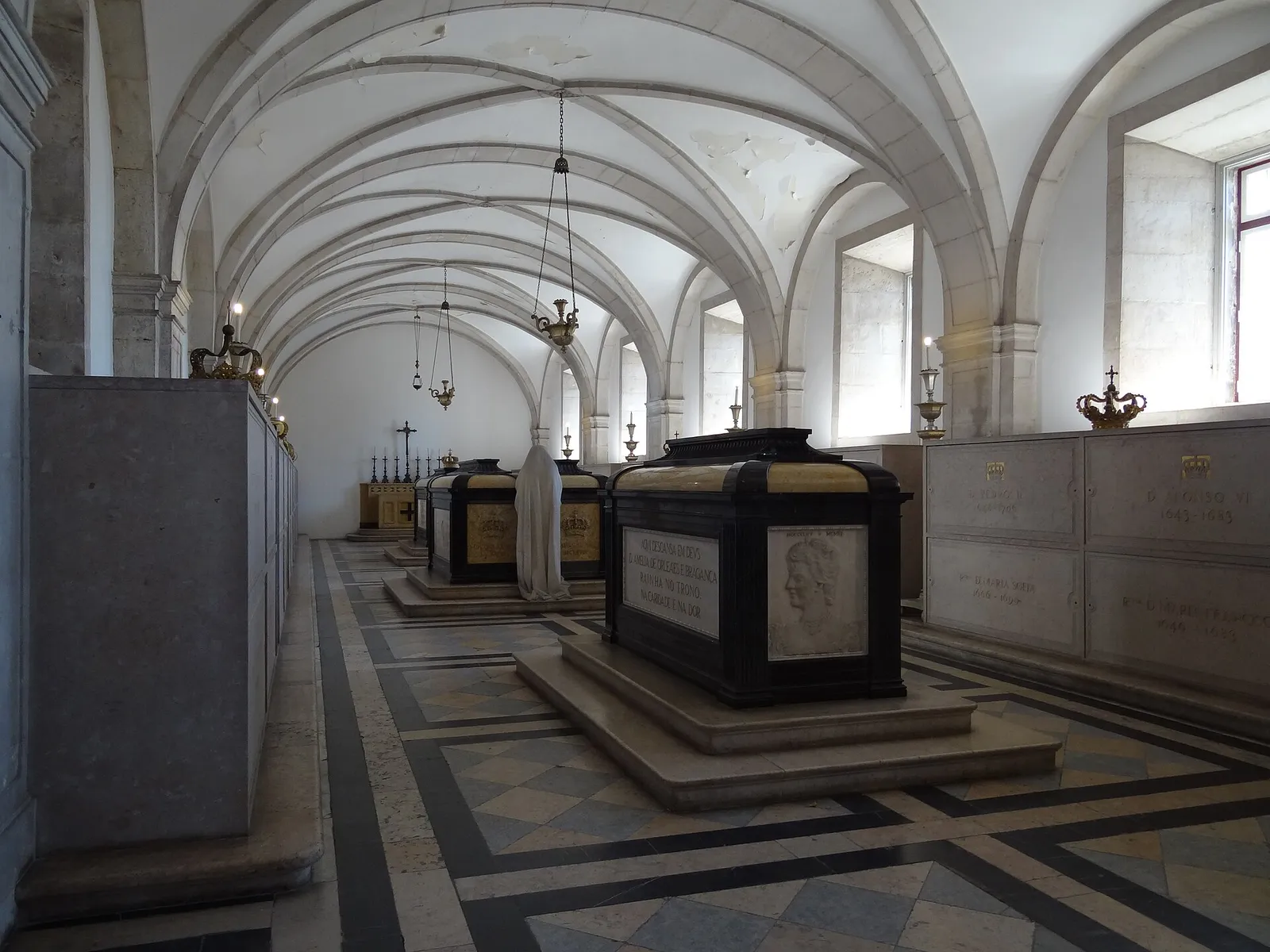
When the architect Raul Lino rearranged the royal pantheon of the Bragança dynasty at the monastery of São Vicente de Fora in 1932 and 1933, Luísa de Gusmão headed the list of kings, queens and regents laid to rest there. The historian Eduardo Sucena warns that the pantheon's labels have contained errors, so the attribution of individual coffins is not beyond doubt.
Why she still matters
The first test of the new dynasty was the six years after João IV's death, when Spain set out to recover Portugal and the crown sat with a boy who could not rule. By the time the regent, an Andalusian by birth, handed over power, the Spanish offensive had been stopped at Elvas and the English alliance was signed.
Historians are still working out how much of that was her doing. Borgognoni notes that until recently the only book devoted to her was Hipólito Raposo's biography of 1947, and that three new studies, by Ana Paula Avelar, Monique Vallance and Maria Paula Marçal Lourenço with Ricardo Pinto, appeared only in 2011 and 2012. He reads her, alongside Mariana of Austria in Spain, as a queen who ran foreign policy and war in her son's name.
Valladares is more sceptical of the heroine. He sees in the chronicles a stock figure, the manly queen that early modern political culture invented whenever it had to justify a woman in power, and argues that a nationalist historiography turned an Andalusian noblewoman defending the interests of her two houses into a Portuguese patriot. Both readings start from the same facts: the regency, the alliance with England and the loss of power in June 1662.
FAQs
When and where did Luísa de Gusmão die?
She died at about nine at night on Saturday 27 February 1666, at her house beside the convent she had founded at the Grilo, Xabregas, on the eastern edge of Lisbon. The Count of Ericeira's chronicle gives the day, the hour and her letters dated 26 February. One modern Spanish reference work gives 27 October 1666, which does not fit that account.
Did she really say it was better to be queen for a day than duchess for life?
Nobody can prove it. The oldest printed version, in Ericeira's chronicle of 1679, has her advise her husband that it was better to die reigning than to end up serving. The queen-for-a-day wording does not appear there, and historians disagree about whether the story is true or was built up afterwards.
Why did her regency end?
Her son Afonso VI, then 18, moved against her with the Count of Castelo Melhor after she had his favourite, António Conti, arrested and shipped to Brazil. On 21 June 1662 Afonso withdrew to Alcântara and declared he had taken over the government, and on 23 June she handed him the royal seals.
Was Luísa de Gusmão Spanish?
Yes, by birth. She was born in Andalusia in 1613, a daughter of the Duke of Medina Sidonia, and married the Duke of Bragança in 1633, seven years before he became King João IV of Portugal.
Where is she buried?
Her body was first deposited in the hospice of the Discalced Carmelites in Lisbon, as she had asked. Since the rearrangement of 1932 and 1933 she has been listed among the royal remains in the Bragança pantheon at São Vicente de Fora, though the pantheon's labels have not always been reliable.
On the timeline
Open the timelineNearby moments from restoration and the gold of brazil (1640–1750).
At the Battle of Castelo Rodrigo (also known as the Battle of Salgadela), a Portuguese force under Pedro Jacques de Magalhães falls on the Spanish army of the Duke of Osuna, which had been besieging the fortress and its garrison of just 150 men. The Spanish are routed and lose their artillery — Osuna is said to have fled disguised as a monk — ending the invasion of the Beira frontier.
Portugal wins the decisive Battle of Montes Claros, near Borba in the Alentejo, under the command of António Luís de Meneses, Marquis of Marialva. An invading Spanish army under the Marquis of Caracena is destroyed, ending Madrid's hopes of reconquering Portugal and effectively closing the Restoration War.
At the Battle of Ambuíla in northern Angola, a Portuguese force from Luanda under Luís Lopes de Sequeira defeats the army of the Kingdom of Kongo. King António I is killed and beheaded, and the once-powerful kingdom slides into civil war.
Death of Luísa de Gusmão
Queen Luísa de Gusmão (born Luisa de Guzmán), widow of João IV, dies in Lisbon. Credited, perhaps apocryphally, with urging her husband to take the crown in 1640 because it was better to be queen for a day than duchess for life, she later ruled as regent and helped secure the Bragança dynasty.
Spain formally recognises Portuguese independence through the Treaty of Lisbon, ending the 28-year Portuguese Restoration War.
The Esnoga, the Portuguese Synagogue of Amsterdam, is inaugurated with great ceremony. It was built by a Sephardic community largely descended from Jews who had fled Portugal and its Inquisition, and it is still in use today, lit by candlelight during services.
Jesuit missionary Jerónimo Lobo dies in Lisbon. He had spent years in Ethiopia and in 1629 visited the source of the Blue Nile; an abridged English version of his account, 'A Voyage to Abyssinia' (1735), was the first book published by Samuel Johnson.
Coming up in history
All long reads 29 February 1796A leap-day charter: Lisbon gets a public library, 29 February 1796
 1 March 1290How Portugal got its first university: King Dinis's charter of 1290
 2 March 1898Amélia Rey Colaço, the actress who ran Portugal's national theatre
 3 March 1803A classroom in a fort: the founding of the Colégio Militar, 1803
14 sources
Archives, scholarship and reporting this article was checked against.
- 1
História de Portugal Restaurado, vol. IV (Luís de Meneses, 3rd Count of Ericeira), Lisbon, 1759 editionInternet Archive (University of Toronto copy)
- 2
Luisa María Francisca de Guzmán (Rafael Valladares)Real Academia de la Historia, Diccionario Biográfico Español (Historia Hispánica)
- 3
Las reinas ibéricas y la diplomacia barroca: un estudio comparativo de las regencias de Luísa de Gusmão y Mariana de Austria (Ezequiel Borgognoni)Intus-Legere Historia, vol. 15, no. 1 (2021), pp. 237-255, Universidad Adolfo Ibáñez
- 4
- 5
- 6
Agustinos descalzos de Portugal, 1564-1834 (Pedro Augusto Ferreira and Ángel Martínez Cuesta)Recollectio 29-30 (2006-2007), pp. 191-271
- 7
D. Maria Ana de Áustria: a rainha desaparecida (Eduardo Sucena)Arqueologia & História, no. 58/59 (2006/2007), Associação dos Arqueólogos Portugueses
- 8
- 9
Batalha das Linhas de Elvas (versão desenvolvida) (Carlos Mareco)Fundação Batalha de Aljubarrota, Centro de Interpretação da Batalha de Aljubarrota, 2007
- 10
Review of Michel and Annie Bougain, La partició de Catalunya: història rocambolesca del Tractat dels Pirineus (Rafael Cerro Nargánez)Índice Histórico Español, no. 135 (2022), pp. 180-182, Universitat de Barcelona
- 11
Diplomacy in the Restoration Period (Pedro Nobre)Encyclopaedia of Portuguese Expansion (EVE), CHAM, NOVA FCSH, 2009
- 12
Casamento de D. Catarina de Bragança com Carlos II de InglaterraArquivo Nacional Torre do Tombo
- 13
- 14
São Vicente de Fora na História: documentos do Arquivo Histórico do Patriarcado de LisboaAgência Ecclesia, 13 July 2010
Image credits
- The Terreiro do Paço, Lisbon's palace square, in a painting by the Dutch artist Dirk Stoop usually dated to 1662. On the left is the royal palace, the Paço da Ribeira, from which Luísa de Gusmão governed and where she gave up the royal seals in June 1662. Dirk Stoop, Public domain, via Wikimedia Commons.
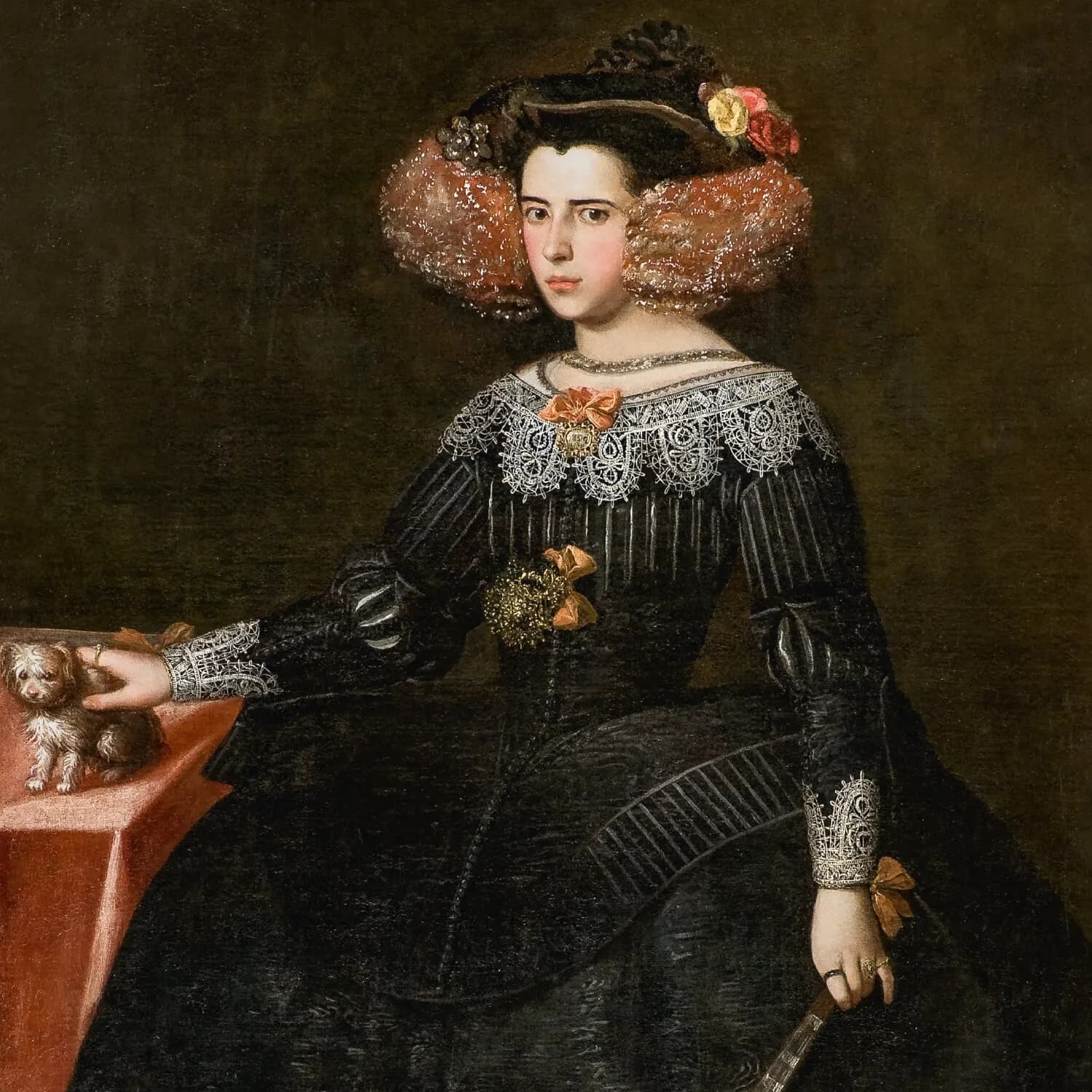
- Probably Luísa de Gusmão, around the time of her marriage: a Spanish portrait of about 1630-35 in the Museo de Bellas Artes de Córdoba. Its sitter is not certain; it was once attributed to Alonso Cano. Formerly attributed to Alonso Cano / Formerly attributed to Juan de Alfaro y Gamez, Public domain, via Wikimedia Commons.
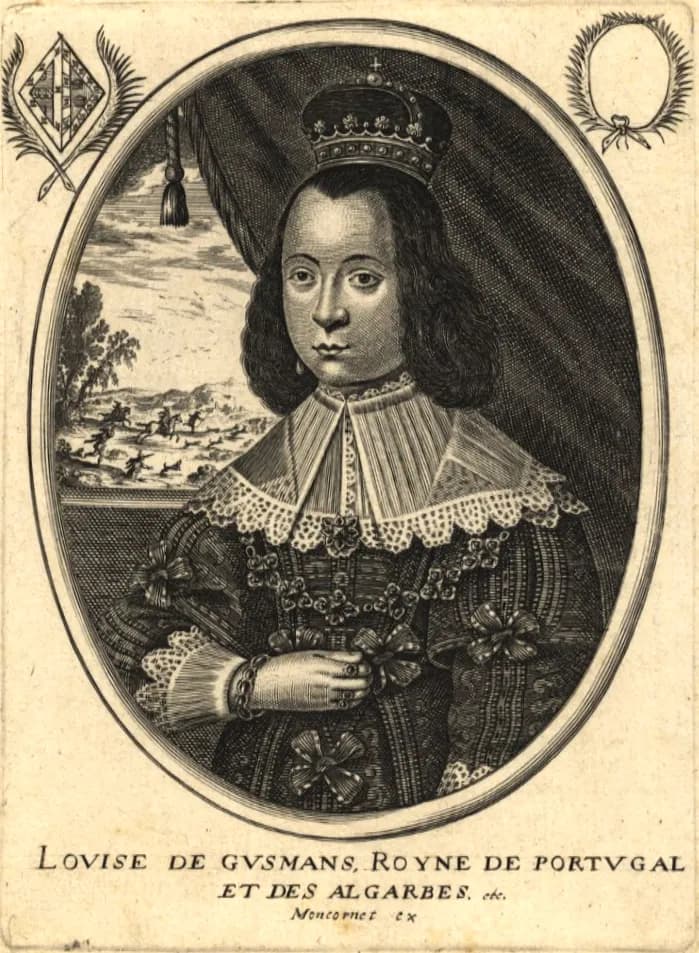
- A French engraving published by Balthasar Moncornet between about 1640 and 1660. Its inscription names the sitter as Louise de Gusmans, Queen of Portugal and the Algarves. Moncornet, Public domain, via Wikimedia Commons.
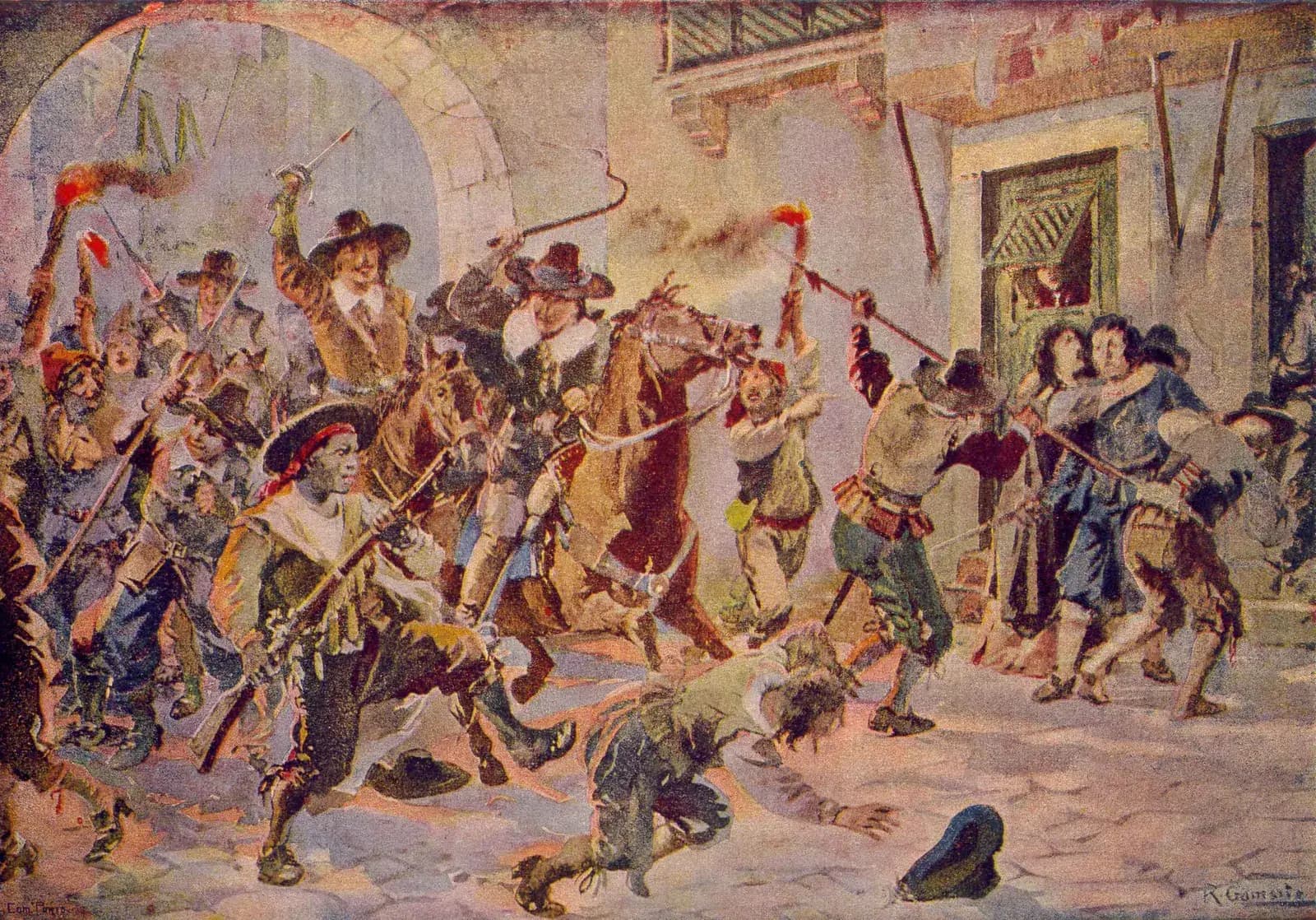
- Afonso VI and his companions terrorising the citizens of Lisbon, as Alfredo Roque Gameiro imagined the scene in Quadros da História de Portugal, published in 1917. Roque Gameiro, Public domain, via Wikimedia Commons.
- The royal pantheon of the Bragança dynasty at São Vicente de Fora, Lisbon, in 2011. The wall niches on the right are inscribed for Luísa's sons Pedro II and Afonso VI and for two queens of the period. Antoine Rex, CC0, via Wikimedia Commons.