

How Portugal got its first university: King Dinis's charter of 1290
A charter dated at Leiria promised royal protection to anyone who came to study in Lisbon. The school it founded moved between two cities five times in 247 years before it found a home in a royal palace.
At a glance
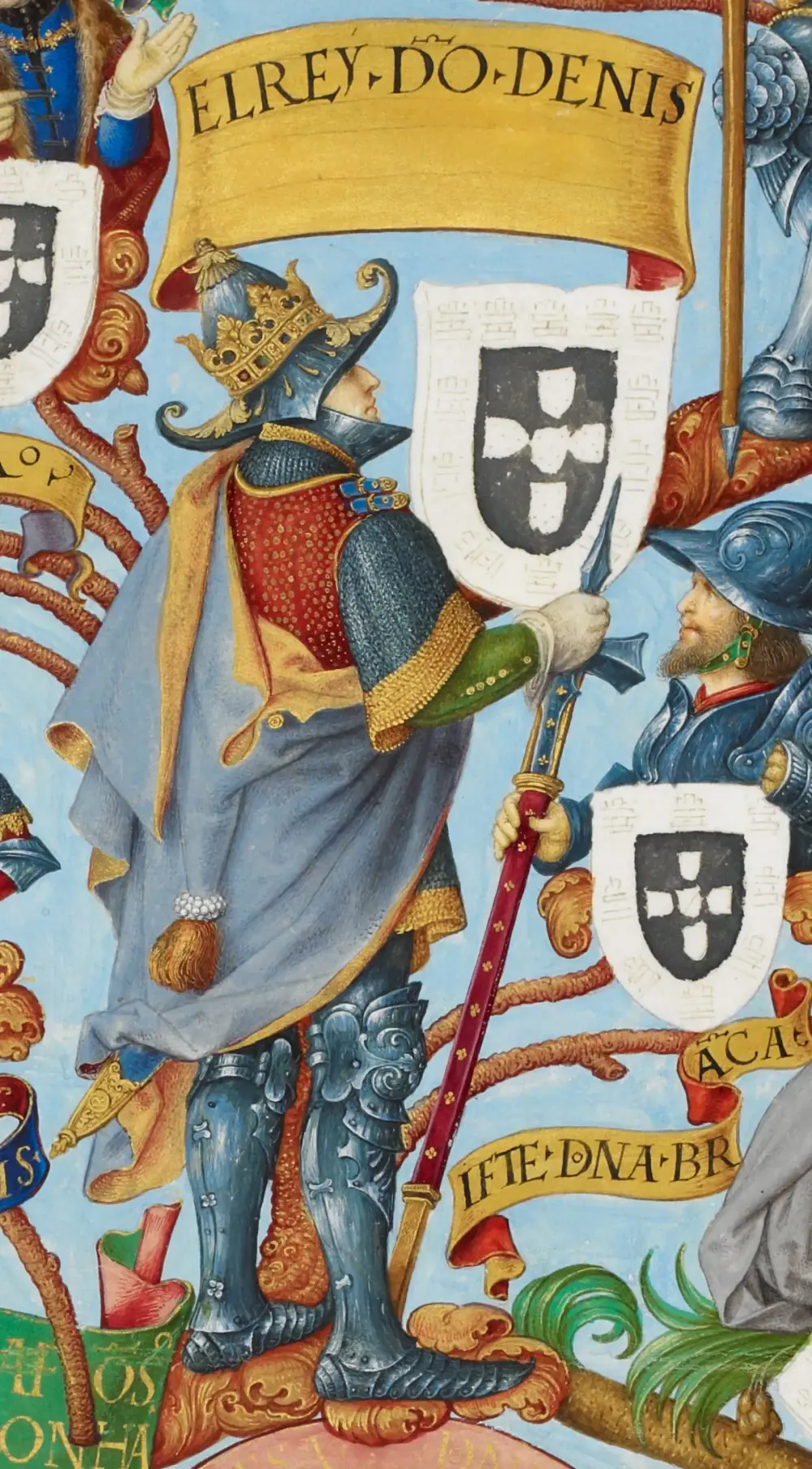
- On 1 March 1290, at Leiria, King Dinis issued the charter known by its opening words, Scientiae thesaurus mirabilis, declaring that he had founded an Estudo Geral, a university, in Lisbon.
- The idea came from churchmen: on 12 November 1288 the heads of Alcobaça, Santa Cruz de Coimbra and São Vicente de Fora, with the rectors of twenty-two parish churches, asked the pope to approve it and offered their revenues to pay the masters.
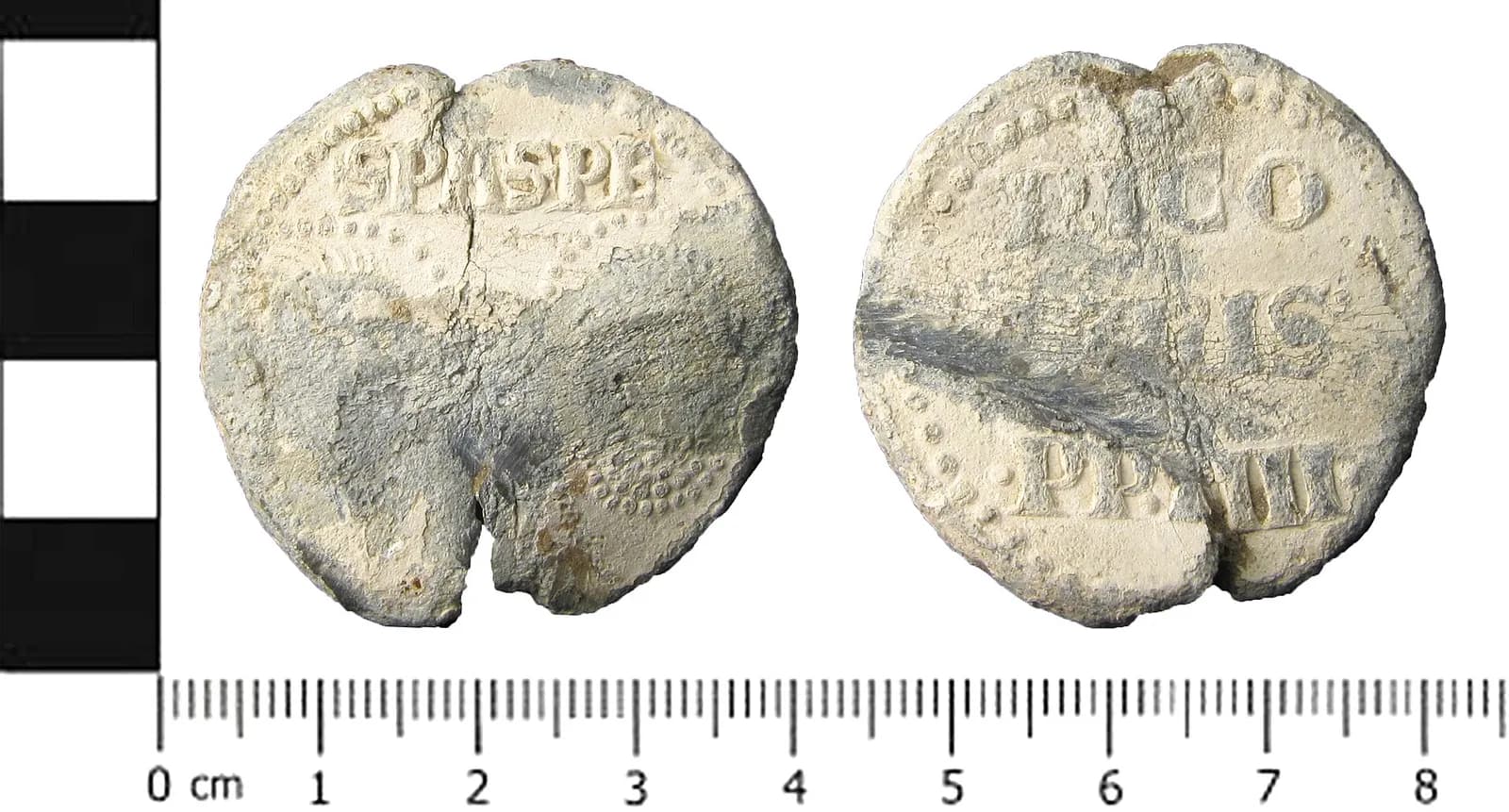
- Pope Nicholas IV approved the school in the bull De statu regni Portugaliae, issued at Orvieto on 9 August 1290, for four faculties: arts, canon law, civil law and medicine.
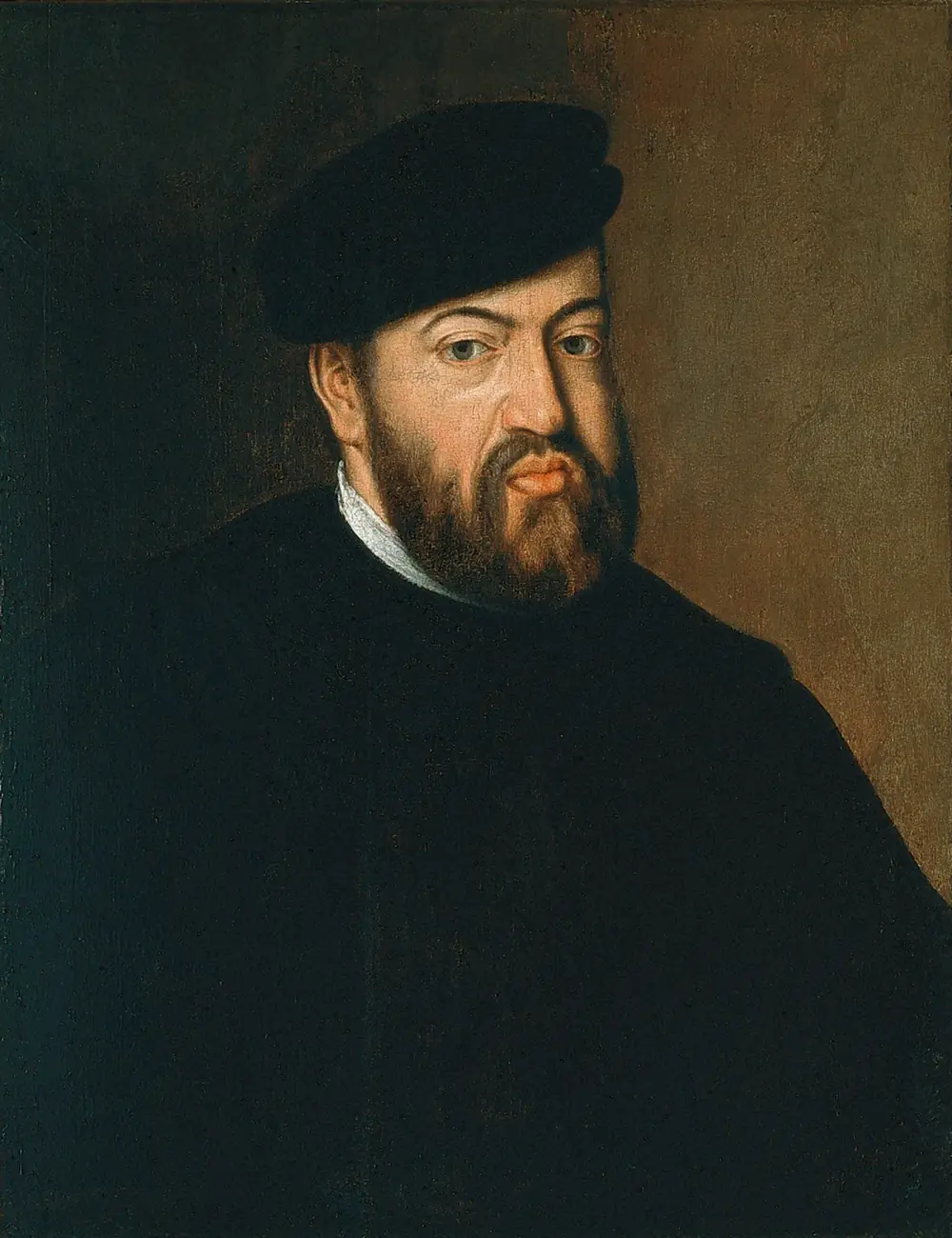
- The university moved to Coimbra in 1308, back to Lisbon in 1338, to Coimbra in 1354 and to Lisbon in 1377, before King João III settled it in Coimbra for good in 1537.
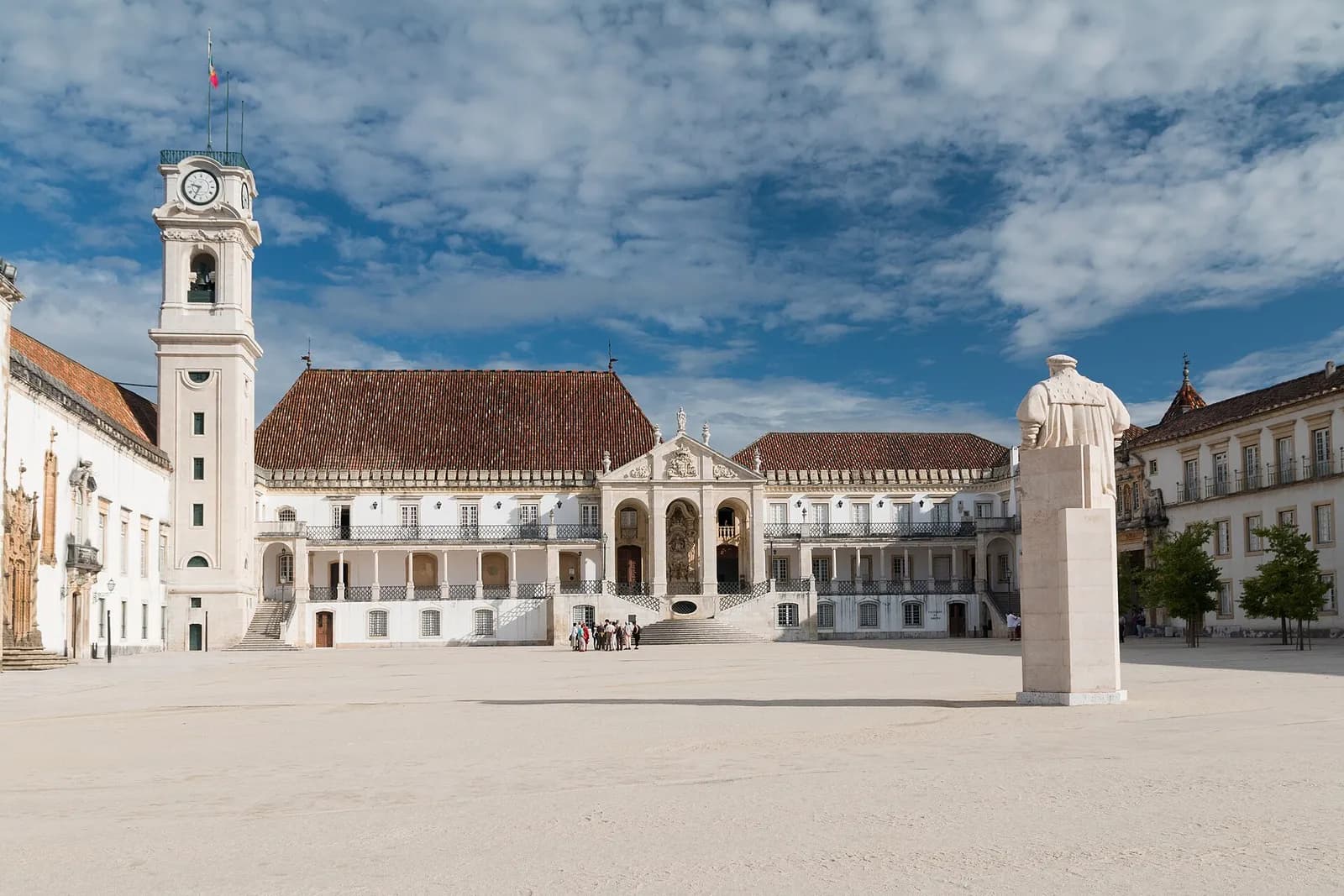
- It has occupied the old royal palace on Coimbra's hill since 1537 and bought it in 1597. The University of Coimbra – Alta and Sofia became a UNESCO World Heritage Site on 22 June 2013.
A charter dated at Leiria
The document is dated at Leiria, on 1 March 1290. King Dinis, who had reigned since 1279, had his chancery draw up a Latin charter that began with praise of learning: Scientiae thesaurus mirabilis, “the wonderful treasure of knowledge”. The preamble said that knowledge should light up both the spiritual and the temporal world.
Then it came to the point. The king declared that he had founded a general school of studies, an Estudo Geral, in Lisbon, dedicated to the Virgin Mary and to Saint Vincent, with many doctors in all the arts. So that students arriving from different places would be safe in their persons and goods, he took all of them, present and future, under royal protection against any offence or injury.
“Now, wishing to enrich our kingdoms with this precious treasure, we have seen fit to ordain, in the royal city of Lisbon […], a general study, which we have both furnished with an abundance of doctors in all the arts and strengthened with many privileges.”
Estudo Geral is the Portuguese for studium generale, the medieval name for a university: a school of several faculties whose graduates could go on to teach elsewhere. Portugal had none. Anyone who wanted to study, or to be ordained, had to travel to distant parts, at great cost and some danger, as a petition to the pope complained two years earlier.
The school the charter announced is today's University of Coimbra, which counts its history from that day and calls itself the oldest university in the Portuguese-speaking world. Yet the charter put it in Lisbon. Over the next 247 years it moved between the two cities five times, and it settled on Coimbra's hill only in 1537.
A kingdom without a university
The first universities had grown up in France and Italy. Castile, Portugal's neighbour, had several: Salamanca dated from 1218, and Palencia, Murcia and Seville also had schools. The Portuguese one came after those and just before Lérida, in the Crown of Aragon. Portuguese students and teachers meanwhile went to Castile, France and Italy.
Dinis had his own reasons to want one. Since 1266 the crown had been in conflict with the Portuguese bishops, most of whom had left for the papal court, and king and kingdom had been under a papal interdict since 1267. In 1289 the two sides signed a general settlement in Rome, the concordat of 40 articles. A school approved by the pope would also train the lawyers and clerks the crown needed.
The first step came from the Church. On 12 November 1288 a letter to Pope Nicholas IV was drawn up at Montemor-o-Novo, in the Alentejo, where the king had been at the start of the month and probably still was. It was signed by the heads of three of the kingdom's great monasteries, Alcobaça, Santa Cruz de Coimbra and São Vicente de Fora in Lisbon, by the priors of the collegiate churches of Guimarães and Santarém, and by the rectors of twenty-two parish churches.
“For these reasons, then, and many others useful and necessary that it would take long to relate in detail, we put all this and much more to the most excellent Dom Dinis, our king and lord, begging him earnestly to deign to make and ordain a general study in his most noble city of Lisbon.”
The king, they told the pope, had agreed. They would pay the salaries of the doctors and masters out of the revenues of their monasteries and churches, and they asked him to confirm the arrangement and protect the work. No bishop signed. Historians put that down to the long quarrel between crown and bishops, then in its last stage.
The churches were not a random group. Maria Helena da Cruz Coelho and her co-authors point out that all twenty-two parishes were under royal patronage, mostly in the towns of the centre and south, and were usually headed by the king's own clerics. The money was to come from the Church, but the king's influence ran through the institutions that would pay for the school.
Three documents in two years
| Document | Date and place | Issued by | What it did |
|---|---|---|---|
| Petition to the pope | 12 November 1288, Montemor-o-Novo | The abbot of Alcobaça, the priors of Santa Cruz and São Vicente, two collegiate priors and the rectors of twenty-two churches | Asked for papal approval of an Estudo Geral in Lisbon and pledged church revenues for the masters' salaries |
| Royal charter, Scientiae thesaurus mirabilis | 1 March 1290, Leiria | King Dinis | Declared the Estudo Geral founded in Lisbon and put its students under royal protection |
| Papal bull, De statu regni Portugaliae | 9 August 1290, Orvieto | Pope Nicholas IV | Approved the foundation, granted privileges and let the Bishop of Lisbon confer degrees in four faculties |
The texts are edited in the Chartularium Universitatis Portugalensis, vol. I (1966), docs. 2, 4–5 and 6–7.
The pope's answer came from Orvieto, in central Italy, on 9 August 1290, addressed to the community of masters and students of Lisbon. Nicholas IV approved the school Dinis had created and the church revenues that funded it, and granted it privileges.
Empty houses in Lisbon were to be let to students at a fair rent, set by two clerics and two laymen, as at Paris and Bologna. The city's officials had to swear to respect the safety of the school's people and goods. Masters who held church livings were excused from living in their parishes. Masters, students and servants of the school answered to church courts.
Students of the four faculties, arts, canon law, civil law and medicine, would receive their degrees, once their masters approved them, from the Bishop of Lisbon, or from the vicar when the see was vacant. They could then teach in any other school without a further examination, except in theology.
The bull followed a run of letters from Nicholas IV that put the settlement of 1289 into effect and lifted the interdict. Coelho, Fernandes and Vilar argue that the founding of the school cannot be separated from that settlement, and that the pope did not separate them either.
Five moves between two cities
The school's first home was at the Pedreira, on the western edge of medieval Lisbon, in a newly built-up district near the Franciscan and Trinitarian convents where the Bairro Alto would rise two centuries later. Dinis had houses built there for it. By 1303 he was giving the houses away for another use, and the university never went back to that side of the city.
In 1308 the king moved the Estudo Geral to Coimbra, which the documents of the time call “locus magis accomudus et conueniens”, a more suitable and convenient place. It was a middling city, quieter than Lisbon, with a bishop and a cathedral school, the monastery of Santa Cruz with its library and scriptorium, and friars who could teach theology. It lay on the road from Lisbon to Braga, by a river navigable to the sea.
In Coimbra the school went up the hill. Dinis seems to have given it buildings of its own near the royal palace in the walled upper town, the Alta, where the court had lived until the reign of Sancho II and where many houses now stood empty. Coelho and her co-authors call purpose-built premises a pioneering step in Europe. Their site now lies within the university's General Library.
In 1309 Dinis gave the school a great charter of privileges, which some historians count as its first statutes. It provided for rectors and for conservators, officials who defended the school's rights, and set up a panel of four, two named by the town council and two by the students, to fix fair rents for student lodgings. Other grants gave the students their own butchers, bakers and wine sellers and let them bring food into the city without paying tolls.
The privileges settled things on paper but not in the streets. Townspeople resented the students' rights over housing, food and justice, which cut into the powers of the town's own rulers. In 1338 Afonso IV, Dinis's son, sent the school back to Lisbon. He said he spent long winters in Coimbra, when the school was busiest, and wanted the students and their brawls and noise away from his palace.
In 1354 Afonso IV moved it back to Coimbra. Nobody knows exactly why; the disruption after the Black Death and fresh trouble with Lisbon's residents have both been suggested. In 1377 King Fernando took it to Lisbon again, claiming that masters from other kingdoms would come to teach only if it were in the capital. This time it stayed for 160 years.
Years the Estudo Geral spent in each seat, 1290–1537
years
Lengths are our subtractions between the years of each move given by Coelho, Fernandes and Vilar (2018, p. 90), so each is approximate. Pimentel gives exactly 160 years for the last Lisbon period. In all, the school spent about 194 of its first 247 years in Lisbon.
Show the data
| Years | |
|---|---|
| Lisbon 1290–1308 | 18 |
| Coimbra 1308–1338 | 30 |
| Lisbon 1338–1354 | 16 |
| Coimbra 1354–1377 | 23 |
| Lisbon 1377–1537 | 160 |
“First, it asked us that it be our grace to give the said Studium a quarter where it used to have one, that is, from the Porta do Sol onwards, and from the Porta de Alfama onwards, and from the Porta de Santo André onwards.”
The gates it named all faced east, so the students' quarter lay around Alfama and the slopes below the castle. Classes were held in the houses of the Moeda Velha, the old mint, on the eastern edge of the city. In 1431 Prince Henry, later known as Henry the Navigator, gave the school its own houses in the parish of São Tomé, below the castle, and its first known statutes date from the same year.
Around 1503 King Manuel moved it again, to a larger building beside the old road to São Vicente de Fora. The road took the name of the Escolas Gerais, and the building was the school's last Lisbon home.
1537: into the king's palace
The last move had been ten years in the making. In 1527 João III and his court came to Coimbra fleeing plague in Lisbon and Almeirim. The king then had the Augustinian monastery of Santa Cruz reformed, and in March 1537 a bull of Pope Paul III recognised the colleges set up there by the friar Brás de Braga as a studium generale.
Early in 1537 the king ordered the Lisbon university to move, in the middle of the academic year, taking its members by surprise. It reached Coimbra that spring. Teaching began on 2 May with a formal lecture at Santa Cruz by Francisco de Monçon, a professor of theology. With no building of its own, the school was split between the rector's house and rooms lent by the monastery.
“I see fit, and I order you, that the schools move at once to my palace, so that lectures may begin there. Now, at the end of the holidays.”
On 13 October 1537 the university entered the alcáçova, the old royal palace at the top of the hill, which had been the residence of Afonso Henriques, the first king of Portugal, from 1131. The arrangement was meant to be temporary, and plans for new school buildings by Santa Cruz came and went. The whole university was gathered in the palace only in October 1544, a month after João III gave it new statutes.
Some of the move took longer still. From late November 1537 the rector could grant degrees in civil law and medicine by royal authority, but degrees in canon law and theology were suspended until papal permission arrived in February 1539. Pimentel dates the legal reconstitution of the university in Coimbra to that point.
Lisbon was left without a university. Higher studies returned to the capital only from the end of the eighteenth century, in schools and institutes that came together in 1911 and 1930 in two universities, now merged as the University of Lisbon. Its history page starts in 1288: it was in Lisbon, it says, that the first Portuguese university was born that year, before its transfer to Coimbra in 1537.
In 1597, with Philip II of Spain ruling Portugal as Philip I, the crown sold the palace to the university. Pimentel calls that year the birth certificate of the Paço das Escolas, the Palace of the Schools. The university took care to keep the building's old status and privileges as a royal palace.
Books, laboratories and a hill of colleges
The university grew around the palace. After João III's reforms it gained more than twenty residential colleges, built as cloistered courtyards with their own chapels, on the hill and along the new Rua da Sofia, which cut through the lower town from Santa Cruz. The Colégio das Artes taught Latin and the humanities as a preparation for university courses; one of its first teachers was the Scottish humanist George Buchanan.
The palace changed with it. A grand entrance, the Porta Férrea or Iron Gate, went up in 1633. Between 1717 and 1728, in the reign of João V, the university built a Baroque library, the Joanina, and in 1728 a new clock tower replaced the one put up in the courtyard in 1561. ICOMOS, the body that advises UNESCO on heritage sites, links the library to the university's opening to the Enlightenment, when it bought scientific books and mathematical instruments abroad.
The Joanina holds about 60,000 books printed between the sixteenth and the eighteenth centuries, and a portrait of João V by Domenico Duprà dominates its main floor. It was the university's library until the first half of the twentieth century.
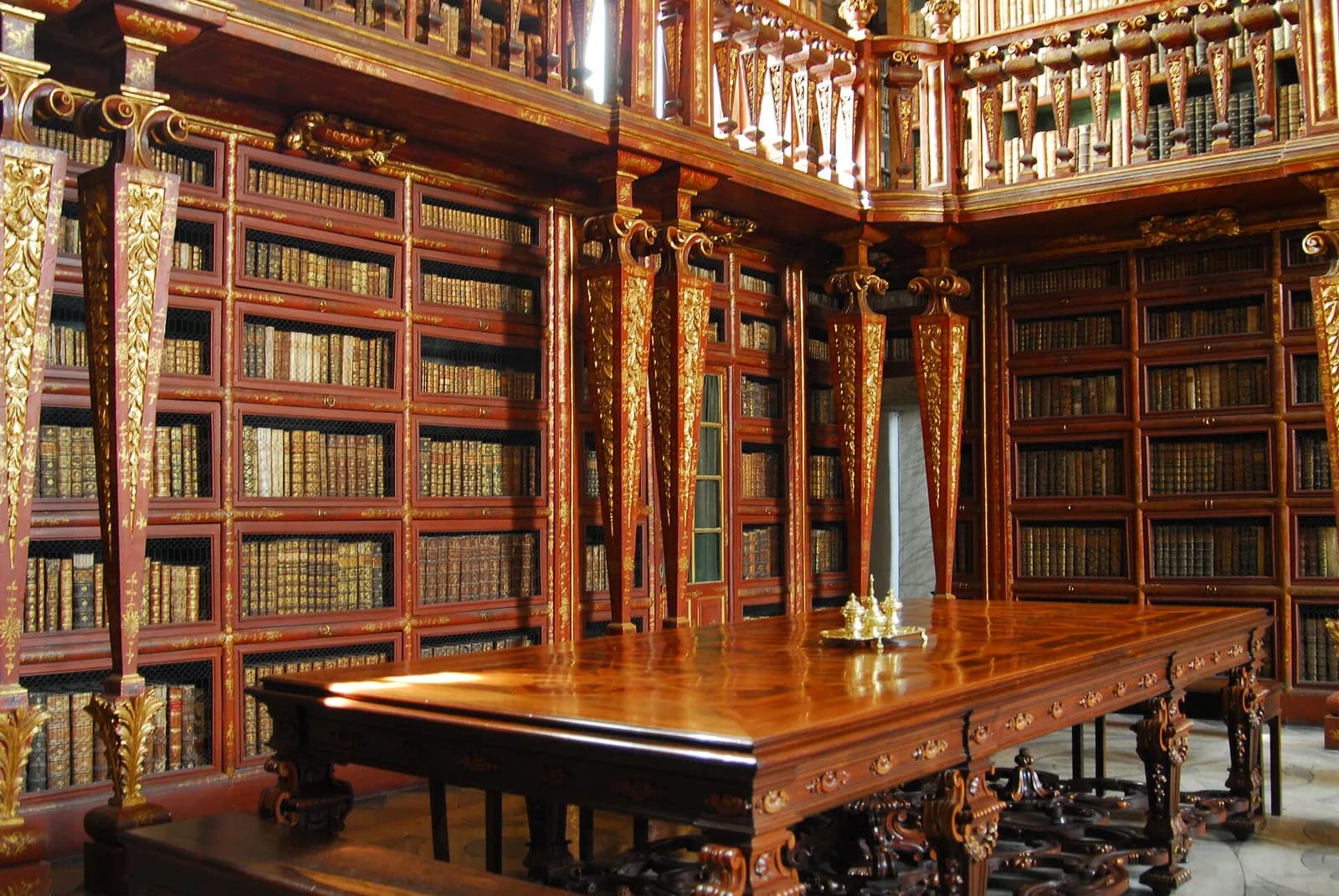
In 1772 the Marquis of Pombal, chief minister of King José I, gave the university new statutes. They created faculties of mathematics and natural philosophy and reformed the teaching of medicine, and the university built a chemistry laboratory, an astronomical observatory, a botanical garden, a natural history gallery, a physics cabinet and a press. The Jesuits' college, empty after the order was expelled in 1759, became the centre of the new sciences.
In the 1940s, under the Estado Novo dictatorship, buildings around the palace were demolished and a large University City of new faculty buildings went up on the hill, closely related to the University of Lisbon's new campus, planned at almost the same time. After the return of democracy in 1974, and especially since 2000, the university has spread beyond the Alta and the Rua da Sofia.
12 November 1288
Churchmen petition the pope for an Estudo Geral in Lisbon
1 March 1290
King Dinis's charter, Scientiae thesaurus mirabilis, at Leiria
9 August 1290
Nicholas IV approves the school in the bull De statu regni Portugaliae
1308
The school moves to Coimbra
Dinis's great charter of privileges follows in 1309.
1338
Afonso IV moves it back to Lisbon
The 1908 Catholic Encyclopedia gives 1339.
1354
Back to Coimbra
1377
Fernando takes it to Lisbon, where it stays 160 years
1431
First known statutes; Prince Henry gives it houses at São Tomé
c. 1503
Manuel moves it to a new Lisbon building
Spring 1537
João III moves it to Coimbra; teaching begins on 2 May
13 October 1537
The university enters the royal palace
October 1544
All faculties gathered in the palace
1597
The university buys the palace, the Paço das Escolas
1717–1728
The Joanina Library is built
1772
Pombal's statutes reform the university
22 June 2013
UNESCO inscribes the University of Coimbra – Alta and Sofia
Why it still matters
On 22 June 2013, at its session in Cambodia, the UNESCO World Heritage Committee inscribed the University of Coimbra – Alta and Sofia on the World Heritage List. The bid had begun, in a different form, in the early 1980s. The listed property has two parts: 29 hectares of the Alta, around the palace and the colleges on the hill, and 6.5 hectares along the Rua da Sofia, inside a buffer zone of 81.5 hectares.
The committee's reasons were about influence as much as buildings. Coimbra trained the elite for all the territories under Portuguese rule and shaped the institutions and architecture of universities across the Portuguese-speaking world. Its city and university, the committee said, are so closely bound that the city's architecture reflects the university's functions. ICOMOS had recommended that the bid be referred back to Portugal until the site and its wider setting were better protected; the committee inscribed it anyway.
- Royal charter
- 1 March 1290, Leiria
- Papal approval
- 9 August 1290, Orvieto
- First seat
- Lisbon
- Settled in Coimbra
- 1537
- Faculties today
- 8
- Students today
- More than 22,000
The university is no longer confined to the hill. By its own count it has eight faculties spread across the city and more than 22,000 students. In 2013 ICOMOS counted about 16,000 students using the Alta and some 500,000 tourists a year.
Two universities look back to the school. Coimbra counts its history from Dinis's charter of 1290; the University of Lisbon's history page starts with the Lisbon school of 1288. Coelho, Fernandes and Vilar treat it as one institution, founded between 1288 and 1290, that wandered between the two cities for almost a century, at the mercy of quarrels with townspeople and the wishes of kings.
FAQs
When was the University of Coimbra founded?
King Dinis's founding charter is dated 1 March 1290, at Leiria, and Pope Nicholas IV approved the school on 9 August 1290. Churchmen had asked the pope for it on 12 November 1288, which is why the University of Lisbon dates the first Portuguese university to 1288.
Was the University of Coimbra founded in Coimbra?
No. It was founded in Lisbon. It moved to Coimbra in 1308, back to Lisbon in 1338, to Coimbra in 1354 and to Lisbon in 1377, and João III settled it in Coimbra for good in 1537.
Is Coimbra the oldest university in Portugal?
It is the oldest Portuguese university and calls itself the oldest in the Portuguese-speaking world. It is not the oldest in Iberia: Salamanca, in Castile, dates from 1218, and older universities existed in France and Italy.
What does Scientiae thesaurus mirabilis mean?
They are the Latin opening words of Dinis's charter of 1290, meaning “the wonderful treasure of knowledge”. The preamble they begin praises learning before the king declares that he has founded an Estudo Geral in Lisbon.
Why did the university keep moving?
Each move was a king's decision. Students' privileges over housing, food and justice caused constant friction with townspeople, and kings had their own reasons: Afonso IV wanted the students away from his palace in Coimbra, and Fernando said foreign masters would only teach in Lisbon.
On the timeline
Open the timelineNearby moments from the burgundian kings (1249–1383).
King Dinis is born in Lisbon, son of Afonso III and Beatriz of Castile. Nicknamed 'o Lavrador' and 'o Rei-Poeta', he fixed the frontier with Castile by the Treaty of Alcañices, made Portuguese the usual language of royal documents, founded the first Portuguese university and enlarged the royal pine forest of Leiria.
Pope John XXI — born in Lisbon and the only Portuguese pope in history — dies in Viterbo, days after the ceiling of a new chamber he had added to the papal palace collapses on him. A physician and scholar, he had reigned for barely eight months.
King Dinis celebrates his wedding to Isabel of Aragon in Trancoso, four months after a proxy marriage in Barcelona; the bride is about 11. The king adds Trancoso to her dower, and Isabel goes on to become the 'Rainha Santa' of Coimbra, the saintly queen of the legend of the miracle of the roses.
Founding the University of Coimbra
King Dinis signs 'Scientiae thesaurus mirabilis', founding the Estudo Geral that becomes the University of Coimbra — one of the oldest universities in continuous operation. It actually began life in Lisbon and shuttled between the two cities before settling for good in Coimbra in 1537.
The future Afonso IV is born in Lisbon, son of King Dinis and Isabel of Aragon, the 'Rainha Santa'. Known as 'the Brave', a name tradition ties to the victory at Salado in 1340, he is remembered just as much for the killing of Inês de Castro, his son Pedro's beloved, by his order or with his consent, in 1355.
By the Treaty of Alcañices, King Dinis of Portugal and Fernando IV of Castile settle the frontier between their kingdoms and seal an alliance of friendship — a border that survives almost unchanged as one of the oldest in Europe.
Pope Clement V dissolves the Knights Templar with the bull 'Vox in excelso'. No Templar is known to have been arrested in Portugal, where King Dinis has already claimed their castles for the Crown; in 1319 they pass to the new Order of Christ, whose red cross would later billow on the sails of the caravels.
Coming up in history
All long reads 3 March 1803A classroom in a fort: the founding of the Colégio Militar, 1803
 4 March 1493Storm-driven into the Tagus: Columbus and João II, March 1493
 5 March 1811Masséna's retreat from Santarém: the French leave Portugal, March 1811
 6 March 1921The Portuguese Communist Party is founded in Lisbon: 6 March 1921
9 sources
Archives, scholarship and reporting this article was checked against.
- 1
O Studium medieval português: singularidades de um caso periférico (Maria Helena da Cruz Coelho, Hermenegildo Fernandes and Hermínia Vasconcelos Vilar)Studia Historica. Historia Medieval 36(2), 2018, pp. 83–115, Ediciones Universidad de Salamanca
- 2
A Morada da Sabedoria, I: O Paço Real de Coimbra das origens ao estabelecimento da Universidade (António Filipe Pimentel)Almedina, 2005, via Estudo Geral, Universidade de Coimbra
- 3
Na inauguração da Faculdade de Medicina da Universidade Católica Portuguesa (Manuel Clemente)Universidade Católica Portuguesa, 14 September 2021
- 4
Coimbra University (Portugal), No 1387: ICOMOS evaluationICOMOS / UNESCO World Heritage Centre, 2013
- 5
- 6
Universidade de Coimbra — Alta e Sofia Património Mundial: do desígnio à realidade (Joana Capela and Vítor Murtinho)Instituto de História Contemporânea, NOVA FCSH, 2018, via Estudo Geral, Universidade de Coimbra
- 7
What to visitUniversidade de Coimbra, UC Tourism
- 8
University of Coimbra (Eduardo de Hinojosa y Naveros)The Catholic Encyclopedia, vol. 4 (New York, Robert Appleton, 1908), via New Advent
- 9
HistóriaUniversidade de Lisboa
Image credits
- The courtyard of the Paço das Escolas, the old royal palace on the hill of Coimbra where the university has met since 1537, with the clock tower on the left and the colonnade of the Via Latina at the back. Photographed in 2014. Daniel VILLAFRUELA, CC BY-SA 4.0, via Wikimedia Commons.
- King Dinis (1261–1325) as imagined by António de Holanda in the Genealogia dos Reis de Portugal, painted between 1530 and 1534, more than two centuries after his death. António de Holanda, Public domain, via Wikimedia Commons.
- A lead seal, or bulla, from a letter of Pope Nicholas IV (1288–1292), found in England; it is not from the Portuguese bull. The bull of 9 August 1290 would have carried a seal of the same kind, with Saints Paul and Peter on one face and the pope's name on the other. West Yorkshire Archaeology Advisory Service, Amy Downes, CC BY-SA 2.0, via Wikimedia Commons.
- João III, king from 1521 to 1557, who moved the university to Coimbra for good. The portrait, attributed to Cristóvão Lopes, is a replica of Anthonis Mor's portrait of 1552 and hangs in the Museu de São Roque in Lisbon. Attributed to Cristóvão Lopes, Public domain, via Wikimedia Commons.
- Inside the Joanina Library, built between 1717 and 1728 in the reign of João V. Photographed in 2008. Trishhhh, CC BY 2.0, via Wikimedia Commons.