

A classroom in a fort: the founding of the Colégio Militar, 1803
Colonel António Teixeira Rebelo started a school for the sons of his regiment with no money but the regiment's savings. It survived Napoleon's wars, six moves and two centuries of reforms, and in 2013 it took in its first girls.
At a glance
- In March 1803 Colonel António Teixeira Rebelo, commander of the Court Artillery Regiment, opened a class for the sons of its officers at the Feitoria fort beside São Julião da Barra, in Oeiras.
- The school keeps 3 March as its birthday; reports written for the centenary in 1903 and a dictionary of 1904–1915 give 2 March.
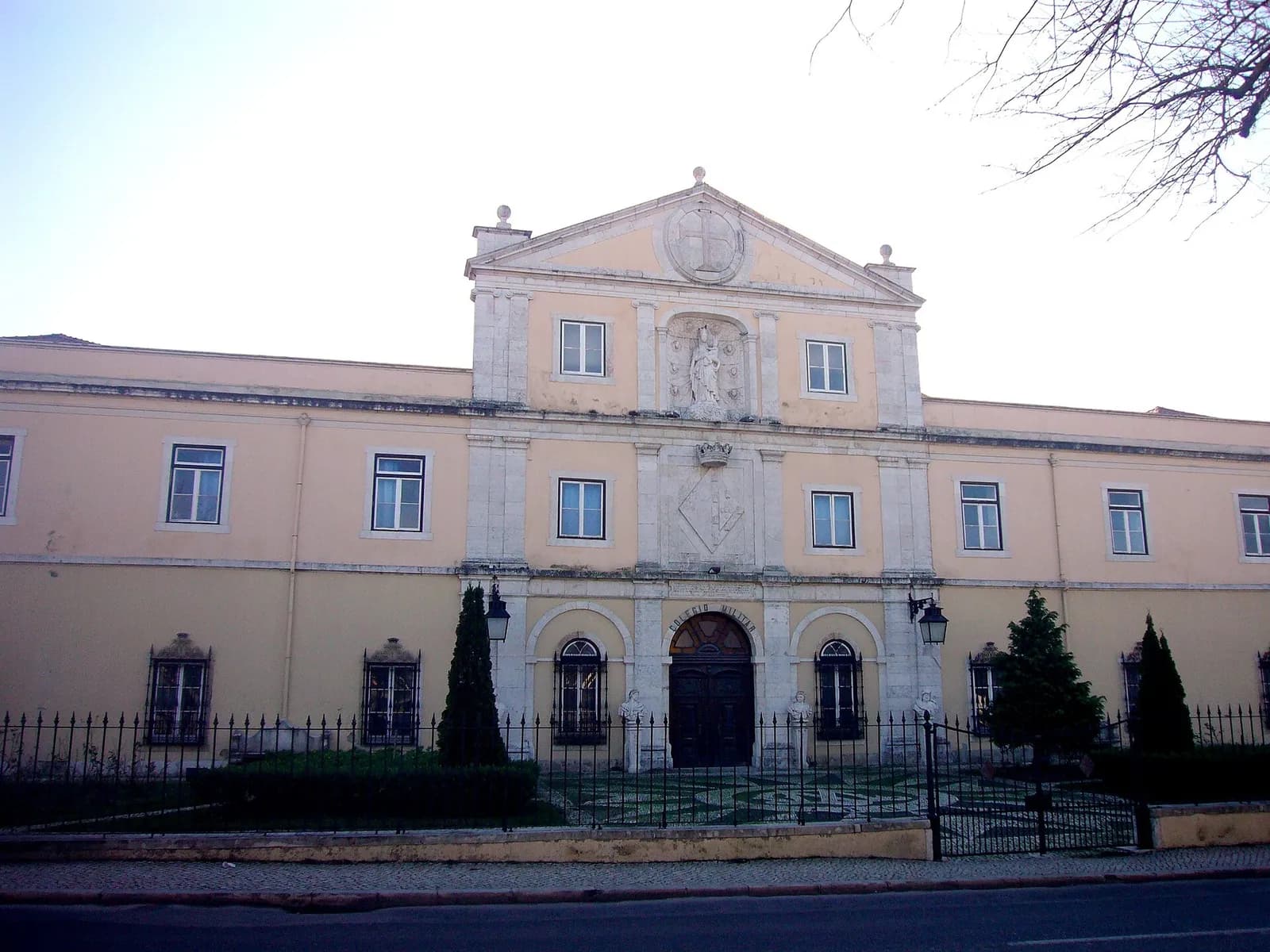
- It was made an official state school, the Colégio Militar, on 24 April 1813, and moved in 1814 to an old hospital at Luz, now in Lisbon's parish of Carnide.
- After stays at Rilhafoles and twice at Mafra it settled at Luz for good in 1873. Pupils are still called the “Meninos da Luz”, and its standard carries the Tower and Sword and other orders.
- A Defence Ministry order of 25 March 2013 made it co-educational from September 2013 and folded in the girls' Instituto de Odivelas, which closed in 2015.
A parade on the Avenida
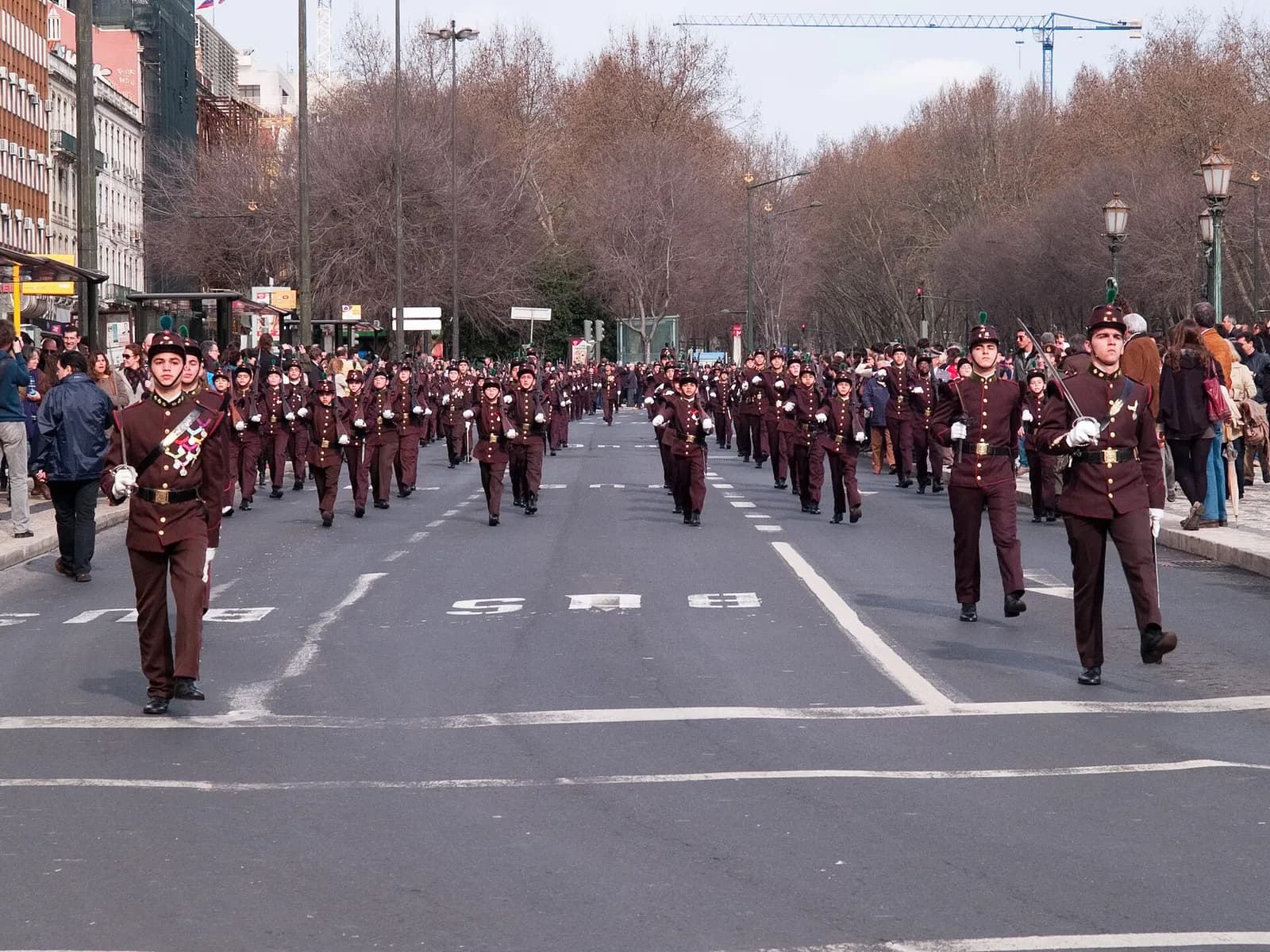
On Sunday 3 March 2019 the pupils of the Colégio Militar formed up at the Marquês de Pombal roundabout, at the top of Lisbon's Avenida da Liberdade, and were presented to the President of the Republic, Marcelo Rebelo de Sousa. Then the Batalhão Colegial, as the pupils' battalion is called, marched down the avenue behind its standard.
Hundreds of people lined the route, and from the pavements came shouts of “Zacatraz”, the greeting of pupils and former pupils. The Defence Minister and the heads of all three armed services were there.
The parade follows the same pattern each year. An Army band plays, and the mounted escort rides horses lent by the Republican National Guard, the GNR. The battalion salutes the monument to the dead of the First World War, goes on through the Restauradores and around the Rossio, and breaks up in the Largo de São Domingos, where a solemn mass follows in the church.
The occasion was the school's 216th birthday. The Colégio Militar is a state school run by the Army, teaching children from primary to the end of secondary school; that year it had more than 700 pupils, the sons and daughters of soldiers and civilians. It began with a few boys in the rooms of a coastal fort in Oeiras.
The colonel and his regiment
In 1803 Portugal was a monarchy ruled from Lisbon by the Prince Regent João, who governed in the name of his mother, Queen Maria I, after her mind failed in 1792. In 1801 the kingdom had fought a short war against Spain, known as the War of the Oranges.
António Teixeira Rebelo was the son of farm workers from Cumieira, a village in the municipality of Santa Marta de Penaguião in Trás-os-Montes. He enlisted as a volunteer in the artillery regiment at Valença while still a boy. In 1780 he enrolled at the Royal Naval Academy in Lisbon, and in the Court Artillery Regiment he won every rank up to major by competitive examination.
He commanded the artillery of the Portuguese force sent to help Spain against revolutionary France in the Roussillon campaign and was praised for his part in the action of 29 May 1794. Back home he rebuilt the fort at Cascais and the coastal batteries as far as Cabo da Roca. He translated John Muller's Treatise of Artillery from English, printed in 1793, and in the 1801 war he set up Portugal's first companies of horse artillery.
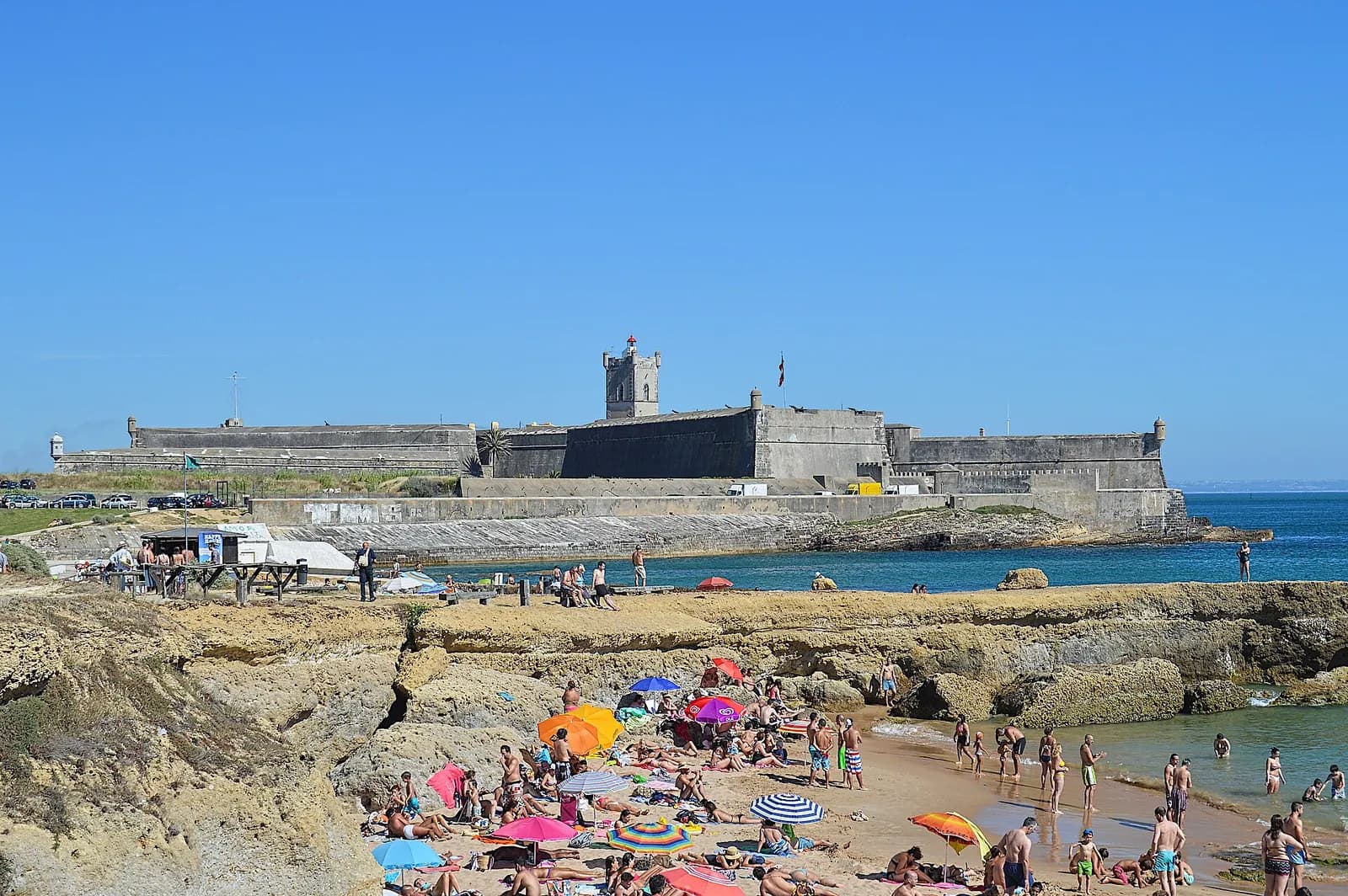
In 1802 he was promoted to full colonel and given command of the Regimento de Artilharia da Corte, the Court Artillery Regiment. Its barracks were at the Feitoria, a fort next to the great fortress of São Julião da Barra on the coast at Oeiras, west of Lisbon.
- Born
- Cumieira, Santa Marta de Penaguião, 17 December 1750, according to the school (1748 in the 1904–1915 dictionary)
- Enlisted
- As a volunteer in the Valença artillery regiment: 1761 in the dictionary, 1764 in O Occidente; the school says before he turned 14
- Studied
- Academia Real de Marinha, Lisbon, from 1780
- Commands
- Artillery of the Portuguese force in Roussillon, from 1792; Court Artillery Regiment from 1802
- Later posts
- Brigadier 1807; director of the Colégio Militar from 1813 in O Occidente (1814 or 1818 in the dictionary); field marshal 1821; Secretary of State for War, 1 February to 8 September 1821
- Died
- Lisbon, 5 October 1825 (6 October in one entry of the dictionary)
A school at the Feitoria
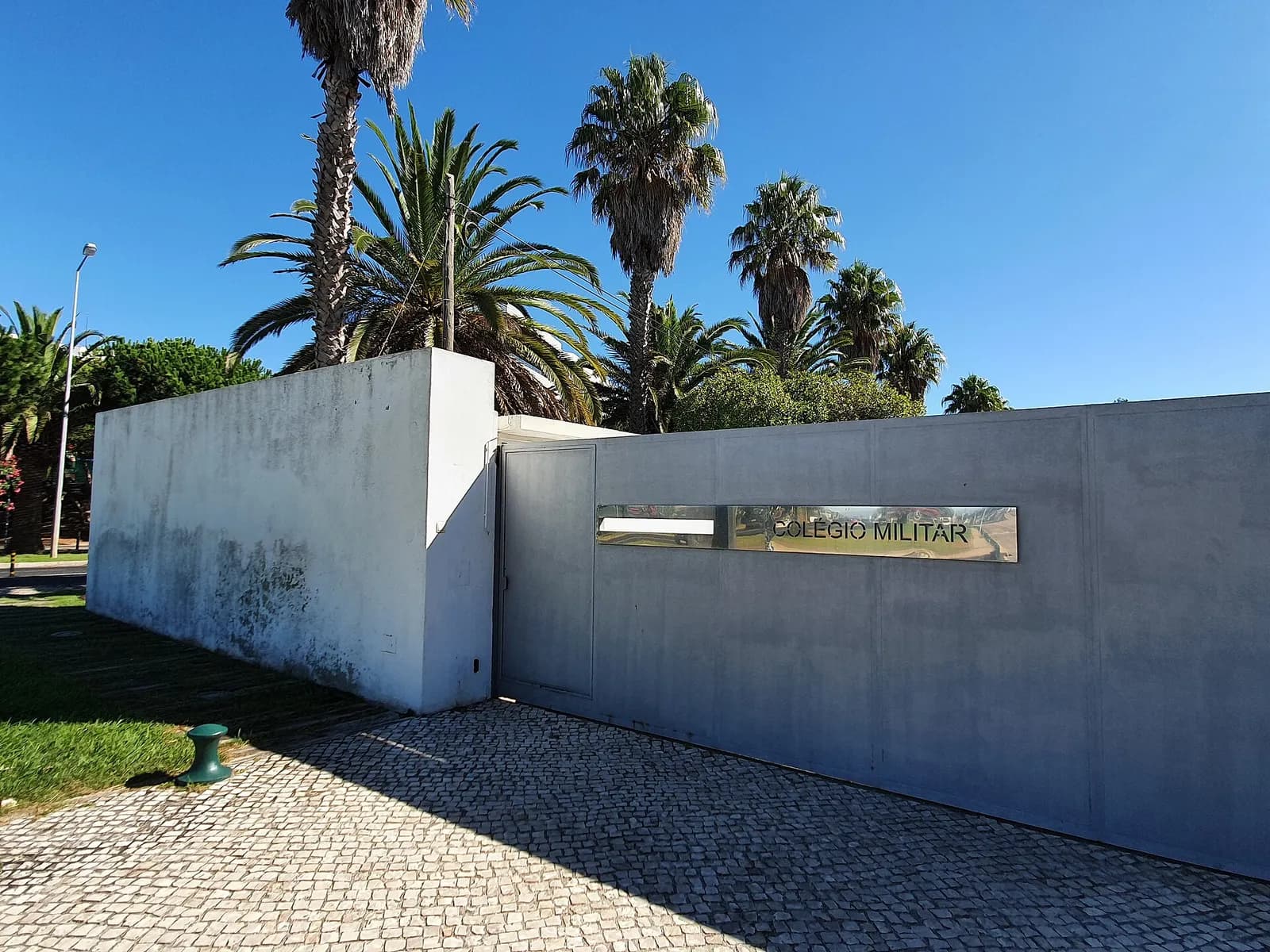
The colonel was concerned about the schooling and occupation of the children of his garrison. In March 1803 he opened a school for them in the rooms of the Feitoria fort. It was called the Colégio de Educação do Regimento de Artilharia da Corte, or simply the Colégio da Feitoria, and its teachers were the regiment's own soldiers.
“Its founder was the artillery colonel António Teixeira Rebello, who on 2 March 1803 opened a class for the instruction of the sons of the officers living at São Julião da Barra, in the rooms of the Feitoria fort nearby.”
At first the state paid nothing. The only money was what the regiment could save from its own accounts, and the teachers were unpaid. Teixeira Rebelo did persuade the government to let his pupils enlist in the regiment, which brought them a soldier's small pay. Later, many civilians obtained his permission to send their sons as well.
By 1805 it had become a small boarding school, and that year the Prince Regent visited. Told how hard it was struggling, he granted each pupil 240 réis a day for his keep and the teachers a modest allowance, their first. With that, the colonel kept the school going.
War, orphans and a royal college
Then came Napoleon's wars. A French army invaded Portugal and the royal court sailed for Brazil on 29 November 1807. The regiments quartered at the Feitoria and São Julião were moved away, while the war killed soldiers by the hundred and left their children with nothing. The little school began to take in orphans of men who had died fighting.
Some of the first pupils went straight from the Feitoria into the army as officers and fought in those campaigns. Teixeira Rebelo, a brigadier from 1807 and still running the school, lobbied for a proper building and for the state to adopt it, so that it would not die with him.
On 24 April 1813 the governors who ran the kingdom while the Prince Regent was in Rio de Janeiro made it an official establishment, for the sons of army and navy officers who could not afford to educate them, with Teixeira Rebelo as its director. An order of 7 January 1814 set its strength at 100 pupils, gave it provisional statutes and moved it to Luz, then on the outskirts of Lisbon.
Sources differ on when it became “royal”. O Occidente's centenary report says the 1813 order named it the Colégio Militar and that the name Real Colégio Militar first appeared in the statutes of 1814. The Portugal dictionary and the school itself date the name Real Colégio Militar to 1813.
When it reopened there, a dispatch from Rio recorded that twelve new boys had been admitted to bring the number kept at the state's expense up to fifty. New statutes signed in Rio in 1816 doubled the school.
“Two hundred pupils shall be admitted to the Royal Military College: one hundred to be maintained at the expense of the State, and the other hundred at the expense of their parents and guardians.”
Of the hundred state places, 84 went to the army and 16 to the navy. Teixeira Rebelo directed the college until his death in 1825, apart from seven months in 1821 as Secretary of State for War. After his death the school hung his portrait in one of its rooms, in 1826 according to one entry of the dictionary and in 1828 according to another, and an obituary was read at the ceremony.
“The memory of Senhor António Teixeira Rebelo will rightly endure in the Royal Military College as the memory of the man to whom it owes the beginnings of its existence.”
Seven addresses in seventy years
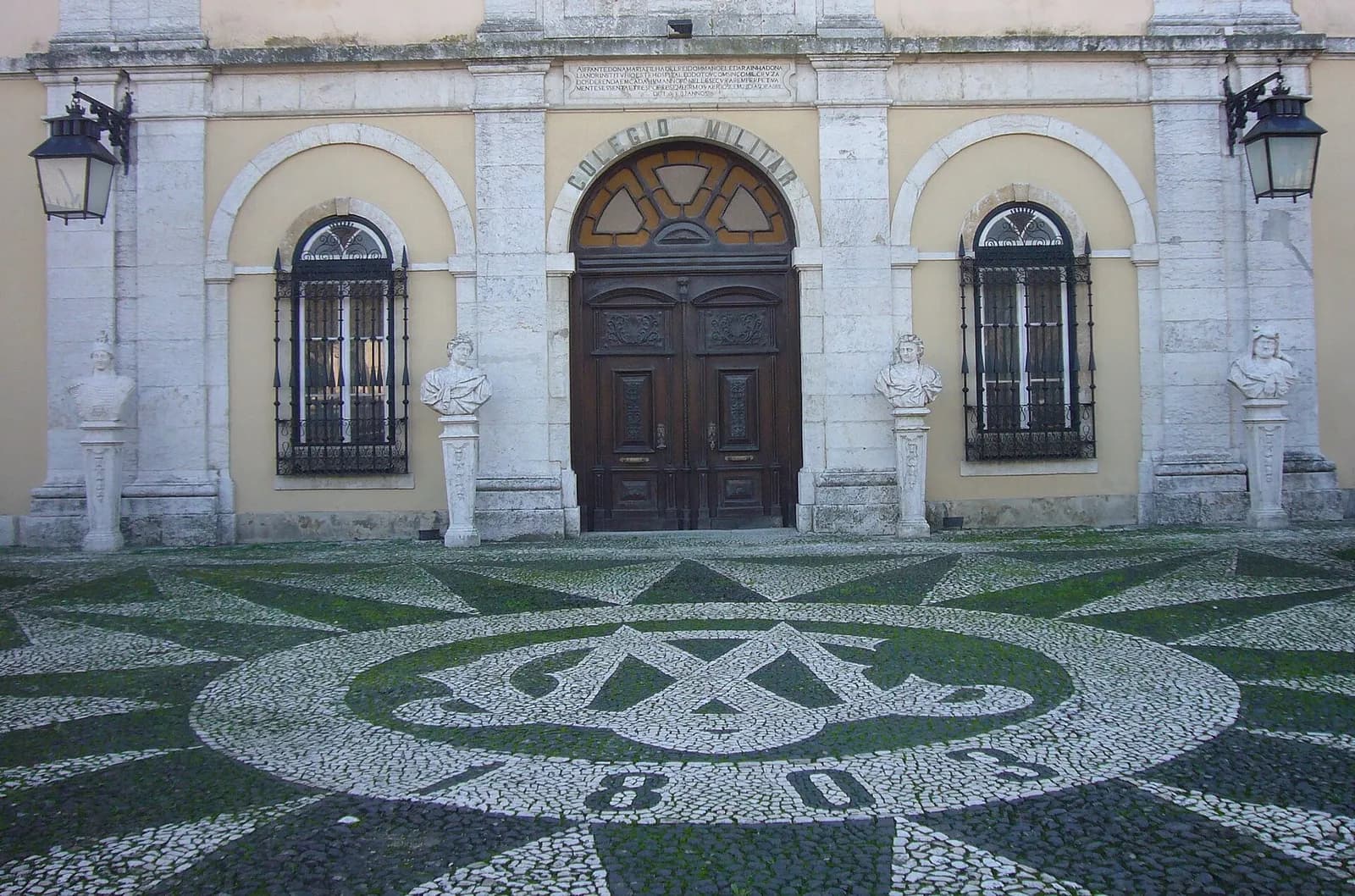
The building at Luz had been a hospital. The Infanta Maria, daughter of King Manuel I and his third wife, Queen Leonor, founded and endowed it; it was finished in 1618 and run by knights of the Order of Christ, who had a convent next door with a church she had paid for and where she is buried. The earthquake of 1755 brought down the knights' convent and most of their church and badly damaged the hospital, which never took patients again.
It was too small almost at once. In 1823 the school rented the neighbouring palace and estate of the Counts of Mesquitela, and in 1835, with numbers rising again, it moved to Rilhafoles, the former house of the Vincentian fathers in Lisbon. A decree of 14 November 1848 sent it to the convent at Mafra, and Rilhafoles became a mental hospital.
Mafra was far from Lisbon and hard to reach, and officers and military widows with sons at the school petitioned parliament to bring it back. It returned to the restored building at Luz in 1859 (1858 in the dictionary). A reform of 1870 turned it into a school for infantry and cavalry officers and sent it back to Mafra, which had more room; the plan was suspended within months and revoked as too expensive, and in 1873 the school came home to Luz for good.
Where the school lived, and for how long
years
Years worked out from the dates of each move given by the Colégio Militar, except that the stay at the Feitoria runs to 1814, when the school moved (the school's page says 1803 to 1813). O Occidente (1903) gives 1869 for the second move to Mafra, and the 1904–1915 dictionary 1858 for the first return to Luz.
Show the data
| Years at each site | |
|---|---|
| Feitoria, Oeiras (1803–1814) | 11 |
| Luz (1814–1835) | 21 |
| Rilhafoles (1835–1848) | 13 |
| Mafra (1848–1859) | 11 |
| Luz (1859–1870) | 11 |
| Mafra (1870–1873) | 3 |
| Luz (1873–2026) | 153 |
By the centenary of March 1903 the Real Colégio Militar was a well-known Lisbon boarding school. Old boys, some of them by then at the top of the army, came to a banquet in the refectory, the pupils staged two comedies in the school theatre, and King Carlos unveiled a bust of the founder. After the Republic was proclaimed in October 1910 it dropped the word “Real” and became plain Colégio Militar again.
| Year | Pupils | What the figure counts |
|---|---|---|
| 1813 | 45, raised to 100 within months | Places set by the government when it took the school over: 50 at state expense, 50 paid by parents |
| 1814 | 50 | Boys kept at state expense when it reopened at Luz |
| 1816 | 200 | Places in the new statutes: 100 state (84 army, 16 navy), 100 paying |
| 1835 | 284 | Places on the move to Rilhafoles: 134 at state expense, 150 paying |
| 1903 | 248 | Pupils on the roll: 148 at state expense, 100 paying |
| 2018–2019 | More than 700 | Pupils enrolled, boys and girls |
The 1813, 1835 and 1903 figures come from O Occidente's centenary report; 1814 and 1816 from the Portugal dictionary; 2018–2019 from figures the Army gave Lusa.
Numbers, cries and honours
The long years at Luz gave the pupils their nickname, the “Meninos da Luz”, the boys of Luz. The school's motto is “Um por todos, todos por um”, all for one and one for all, and its cry is “Zacatraz”, the call by which pupils and old boys make themselves known. Pupils are known by a number as well as a name: in 2016 the commander of the battalion, a final-year boy, was “no. 192”.
The coat of arms shows a silver dome topped by the cross of the Order of Christ, for the chapel at Luz, with two lit golden oil lamps above it. Over the shield a gold lion holds a sword and an open book: the lion for the Army officer who founded the school, the book and sword for learning and military ethics.
The school was given the national flag as its standard in 1888, and that standard has collected decorations ever since. The first, in 1921, was the Military Order of the Tower and Sword, whose collar also surrounds the school's arms.
| Year | Decoration | Country |
|---|---|---|
| 1921 | Knight, Military Order of the Tower and Sword | Portugal |
| 1931 | Grand Cross, Order of Public Instruction | Portugal |
| 1953 | Grand Cross, Military Order of Christ | Portugal |
| 1959 | Order of Military Merit | Brazil |
| 1978 | Military Order of Saint James of the Sword | Portugal |
| 1982 | Order of Rio Branco | Brazil |
| 1990 | Gold Medal for Distinguished Services | Portugal |
| 1997 | Peacemaker Medal | Brazil |
| 1999 | Marshal Trompowsky Medal | Brazil |
| 2002 | Military Order of Aviz | Portugal |
| 2015 | Gold Medal, Order of Merit Conselheiro Thomaz Coelho | Brazil |
As listed by the school. It also holds civic medals, among them those of Oeiras (1967) and Lisbon (1985), and the Portuguese Olympic Committee's collar of sporting merit (2008).
Girls at Luz
For 210 years the Colégio Militar took only boys. Army officers' daughters had their own school, the Instituto de Odivelas, founded in 1900 and housed in the medieval monastery at Odivelas where King Dinis is buried. In 2013, according to a parliamentary question, it had about 300 girls, boarders and day pupils.
Portugal was in a financial crisis, and the minister's order spoke of the exceptional constraints of the moment the country was going through. A study ordered by the Defence Minister, José Pedro Aguiar-Branco, found that the Army's three schools had too many staff and too few pupils. Citing figures it had obtained, the newspaper Correio da Manhã reported that together they had 820 pupils and 550 employees, and how much each pupil cost the state.
Yearly cost to the state per pupil, Army schools, 2013, as reported by Correio da Manhã
euros
Figures obtained and published by Correio da Manhã on 19 March 2013; the ministry did not publish them. The head of the Colégio Militar parents' association told the paper that with the shared services it proposed, parents would go on paying €7,000 a year and a state share of €6,000, equal to the national average, would be enough.
Show the data
| Cost per pupil | |
|---|---|
| Instituto de Odivelas | 10,000 |
| Colégio Militar | 12,000 |
| Instituto dos Pupilos do Exército | 30,000 |
The minister's order of 25 March 2013 set out to make the Colégio Militar a school able to combine “gender integration” with its centuries-old identity, with boarding left to the choice of families. From September 2013 it opened mixed primary classes and admitted girls as day pupils; Odivelas day girls could transfer, and its boarders could keep sleeping at Odivelas and be taken to lessons at Luz. Odivelas would close and a girls' boarding house would be built at Luz.
Announcing the plan, the Secretary of State for Defence, Paulo Braga Lino, said the aim was for the school to “become a reference again” without “losing its military character”. The former pupils' association backed the primary classes but objected to the €6.5 million building planned for the Odivelas girls.
Parents and old boys fought it. In a joint statement the parents' and former pupils' associations of the Colégio Militar said the minister was preparing to “condemn to destruction” two of the most respected military schools. Their main fear was the loss of boarding: the parents' president said a day-school regime had been tried about eight years earlier and had not worked.
Odivelas parents held a vigil at their school against the closure. In April 2013 two members of parliament for the Portuguese Communist Party (PCP), Rita Rato and António Filipe, asked the minister whether the reform rested on any study, why the parents had not been heard, and what would become of the monastery, a national monument since 1910.
18 March 2013
Parents' and old boys' associations accuse the ministry of planning to destroy the two schools
25 March 2013
Despacho 4785/2013: the Colégio Militar to go mixed; Odivelas to close
September 2013
First girls and first primary classes at Luz
6 February 2014
Despacho 2606/2014: the first year “exceeded expectations”; Odivelas to close at the end of 2014–2015
2015
The Instituto de Odivelas closes; girls who choose to move go to Luz
October 2016
The Army says girls are fully integrated, with a waiting list for female boarding
In February 2014 the minister wrote that the opening of the school year had exceeded expectations, with more pupils and full integration of boys and girls. By 2016 some girls held cadet ranks and commanded platoons, and the Army's director of education called the merger “a success story”, while admitting that some senior officers would rather have kept Odivelas as a separate girls' school.
The same year brought a different row. In April 2016 a senior officer at the school told Observador that boys found to be gay were shunned by their classmates and that the school spoke to their parents. Days later the Army Chief of Staff resigned, citing personal reasons, and two months later the officer and the Army's director of education were moved to other posts. New school rules that came into force that year ban discrimination on grounds including sexual orientation.
Hazing by older pupils has also reached the prosecutors. In 2009 eight final-year pupils were charged with ill-treating younger ones. In January 2024 older pupils, most of them in their final year, woke a class of 9th-year pupils before dawn and made them do forced exercises for about two hours; parents told Observador that some needed hospital treatment, which the Army did not confirm. The prosecutor's office opened a criminal inquiry, and the school suspended one pupil for four days, saying it does not tolerate such conduct.
“Congratulations to the Colégio Militar, because today it is what it is with mixed teaching, keeping its quality and with an exceptional capacity to prepare the future.”
Why it still matters
The Colégio Militar calls itself one of the oldest schools in Portugal. It is part of the Army and answers to the Ministry of Defence, but it teaches the national curriculum set by the Ministry of Education, from primary school to the end of secondary school, to children of military and civilian families alike.
Its site at Luz now covers 13 hectares, from the seventeenth-century hospital cloisters and the eighteenth-century Mesquitela palace to additions of the Estado Novo dictatorship and recent buildings made for the girls. The name has spread beyond the gates: the Lisbon Metro station beside it is Colégio Militar/Luz.
The arguments of 2013 have not gone away. The ministry's study found too few pupils for the staff, the school's defenders saw the merger as a threat to its traditions, and the hazing cases raise questions about life in its boarding houses. The parade on the Sunday nearest 3 March keeps the founder's date in public view.
FAQs
When was the Colégio Militar founded?
In March 1803, when Colonel António Teixeira Rebelo opened a class for the sons of his regiment's officers at the Feitoria fort in Oeiras. The school celebrates 3 March; sources from 1903 and the early twentieth century give 2 March. It became an official state school, the Colégio Militar, on 24 April 1813.
Who was António Teixeira Rebelo?
An artillery officer from a family of farm workers in Trás-os-Montes who rose from volunteer private to field marshal. He commanded artillery in the Roussillon campaign against revolutionary France in the 1790s, founded the school in 1803, directed it until his death on 5 October 1825, and was briefly Secretary of State for War in 1821.
Why are its pupils called the Meninos da Luz?
Because the school has lived since 1814, with breaks, in a former hospital at Luz, then on the edge of Lisbon and now in the parish of Carnide. It settled there for good in 1873.
When did the Colégio Militar start admitting girls?
In the 2013–2014 school year, under a Defence Ministry order of 25 March 2013. Girls first came as day pupils; the Army's girls' school, the Instituto de Odivelas, closed at the end of the 2014–2015 school year, and the girls who chose to move went to Luz.
Can you visit the Colégio Militar?
Yes, on paid guided tours on Sunday mornings for booked groups of 5 to 20 people, which cover the old library, the armoury, the collections and the Mesquitela gardens. The annual parade on the Avenida da Liberdade is free to watch.
On the timeline
Open the timelineNearby moments from earthquake and enlightenment (1750–1807).
The Treaty of Badajoz is signed between Portugal and Spain, ending the brief War of the Oranges. Portugal cedes the border town of Olivença to Spain — a loss that the Portuguese state has never formally recognised, and which remains a small but enduring point of friction with Madrid.
Portugal signs the Treaty of Madrid with Napoleonic France, closing its ports to British shipping, paying an indemnity of 20 million francs and ceding territory in northern Brazil, in the aftermath of the War of the Oranges.
Miguel, the future absolutist king who would seize the throne from his niece Maria II and fight the Liberal Wars of 1832–34, is born at the Palace of Queluz, son of João VI and Carlota Joaquina.
The Colégio Militar is founded
Colonel António Teixeira Rebelo founds the Colégio Militar, a military boarding school, at a fort in Oeiras (the school's date; accounts from 1903 say 2 March). It moved to Luz, in Lisbon, in 1814; its standard carries the Tower and Sword among many decorations, and it admitted its first girls only in 2013.
Birth of António Bernardo da Costa Cabral in Fornos de Algodres. The dominant and divisive strongman of the young constitutional monarchy, admired as a reformer but accused of corruption and nepotism, he was driven into exile in 1846 by the Maria da Fonte peasant revolt in the Minho, fuelled by anger at his rule — only to return and head the government again from 1849 to 1851.
A catastrophic flood devastates Madeira, when torrential rain sends the Funchal streams bursting through the city and floods spread to other parts of the island. With 800 to 1,000 dead, mostly in Funchal, it remains the deadliest flood in the island's recorded history.
France and Spain sign the secret Treaty of Fontainebleau, agreeing to invade Portugal and partition it into three: a northern kingdom for the King of Etruria, a southern principality for Godoy, and the centre held in reserve until a general peace. Junot's army entered Lisbon on 30 November.
Coming up in history
All long reads 5 March 1811Masséna's retreat from Santarém: the French leave Portugal, March 1811
 6 March 1921The Portuguese Communist Party is founded in Lisbon: 6 March 1921
 7 March 19577 March 1957: RTP begins regular television broadcasts in Portugal
 8 March 1830João de Deus, the poet whose primer taught Portugal to read
22 sources
Archives, scholarship and reporting this article was checked against.
- 1
“Centenario do Collegio Militar” and “Chronica occidental”, O Occidente, vol. XXVI, no. 871, 10 March 1903O Occidente, digitised by the Hemeroteca Digital de Lisboa
- 2
Real Colégio MilitarPortugal: Dicionário Histórico, Corográfico, Heráldico, Biográfico, Bibliográfico, Numismático e Artístico, vol. VI, pp. 105–108 (João Romano Torres, 1904–1915); online edition by Manuel Amaral
- 3
Síntese históricaColégio Militar
- 4
- 5
Despacho n.º 4785/2013, de 25 de março (Ministro da Defesa Nacional)Diário da República, 2.ª série, n.º 68, 8 April 2013, pp. 11452–11453
- 6
- 7
- 8Colégio Militar. Alunos homossexuais terão “uma vida como a de qualquer outro”Observador, 24 October 2016
- 9Presidente da República destaca “elevada qualidade” do ensino militar em PortugalObservador (Lusa), 3 March 2019
- 10O tardio aniversário do Colégio Militar (opinion, João José Brandão Ferreira)Observador, 15 May 2023
- 11
João VI: biographyArchontology.org
- 12
The London Gazette Extraordinary, issue 16100, 22 December 1807: dispatches of Lord Strangford (Hibernia, off the Tagus, 29 November 1807) and Rear-Admiral Sir Sidney Smith (1 and 6 December 1807)The London Gazette (official archive)
- 13
- 14
- 15
Colégio MilitarOpen House Lisboa, Trienal de Arquitectura de Lisboa
- 16
Pergunta ao Governo: Reforma do Ensino Militar (requerimento 11582)Grupo Parlamentar do PCP, Assembleia da República, 2013
- 17Colégio Militar vai ser externato mistoCorreio da Manhã, 19 March 2013
- 18Turmas mistas no Colégio MilitarCorreio da Manhã, 17 June 2013
- 19Instituto de Odivelas integrado no Colégio MilitarDiário de Notícias, 25 March 2013
- 20Governo quer destruir Colégio Militar e Instituto OdivelasDiário de Notícias (Lusa), 18 March 2013
- 21Praxe violenta no Colégio Militar. Ministério Público investiga agressões entre alunos da instituição, um “graduado” foi suspensoObservador, 18 April 2024
- 22
Image credits
- The Colégio Militar at Luz, in the Lisbon parish of Carnide, in December 2008. The building was put up as a hospital in the early seventeenth century and has housed the school, on and off, since 1814. to lobato from Lisbon, Portugal, CC BY 2.0, via Wikimedia Commons.
- The Batalhão Colegial marching through central Lisbon in the anniversary parade of 6 March 2011. Philip Sheldrake from London, UK, CC BY-SA 2.0, via Wikimedia Commons.
- The fortress of São Julião da Barra, Oeiras, in 2014. The Court Artillery Regiment was quartered at the neighbouring Feitoria, where the school began. Juntas, CC BY-SA 4.0, via Wikimedia Commons.
- The gate of the Colégio Militar's site at the Feitoria in Oeiras, photographed in August 2020. GualdimG, CC BY-SA 4.0, via Wikimedia Commons.
- The main entrance at Luz in 2008. The inscription above the door records that the Infanta Maria, daughter of King Manuel and Queen Leonor, founded the building as a hospital; the cobbled pavement carries the school's monogram and its founding year. to lobato from Lisbon, Portugal, CC BY 2.0, via Wikimedia Commons.