

7 March 1957: RTP begins regular television broadcasts in Portugal
At 9.30 pm on a Thursday in March 1957 a bell rang in a converted film studio at Lumiar, and Portugal's first permanent television service went on air. It reached little beyond Lisbon, ran for about two hours a night and answered to a dictatorship that had only just made up its mind about the new medium.
At a glance
- RTP, Radiotelevisão Portuguesa, began Portugal's first regular television service at 9.30 pm on Thursday 7 March 1957, from a converted film studio at Lumiar, in the north of Lisbon.
- The first night lasted about two hours: a talk by the head of production, the variety show Canções a Granel with Raul Solnado, the news, film of military football matches, a documentary on TAP and a ballet, all live except the films.
- Trial broadcasts had begun at the Feira Popular fun fair on 4 September 1956 and resumed from Lumiar on 3 December. RTP's filmed coverage of Queen Elizabeth II's state visit in February 1957 was the last big test.
- At first the signal reached only the Lisbon area. Transmitters for the centre, Porto, Montejunto and the Algarve followed by April 1958, when, by RTP's count, it covered 58 per cent of the mainland's people.
- A set cost 5,900 escudos or more and a licence of 360 escudos a year was charged from 1958. Scripts and speakers were vetted under the Estado Novo dictatorship.
Silence in the studio
At 9.30 pm on Thursday 7 March 1957 a shrill bell rang in a former film studio at Lumiar, on the northern edge of Lisbon, and a voice called for silence. The RTP ident went on air with its opening march. The assistant director gave a signal, and the announcer Maria Helena Varela Santos smiled into the camera and said “boa noite, senhores espectadores”: good evening, viewers.
She had learned the trade at Rádio Ribatejo, a station her father ran, and had auditioned for RTP the previous September, at 22. Years later she remembered memorising a short text and nearly panicking when the little red light came on. For that night's work she was paid 100 escudos.
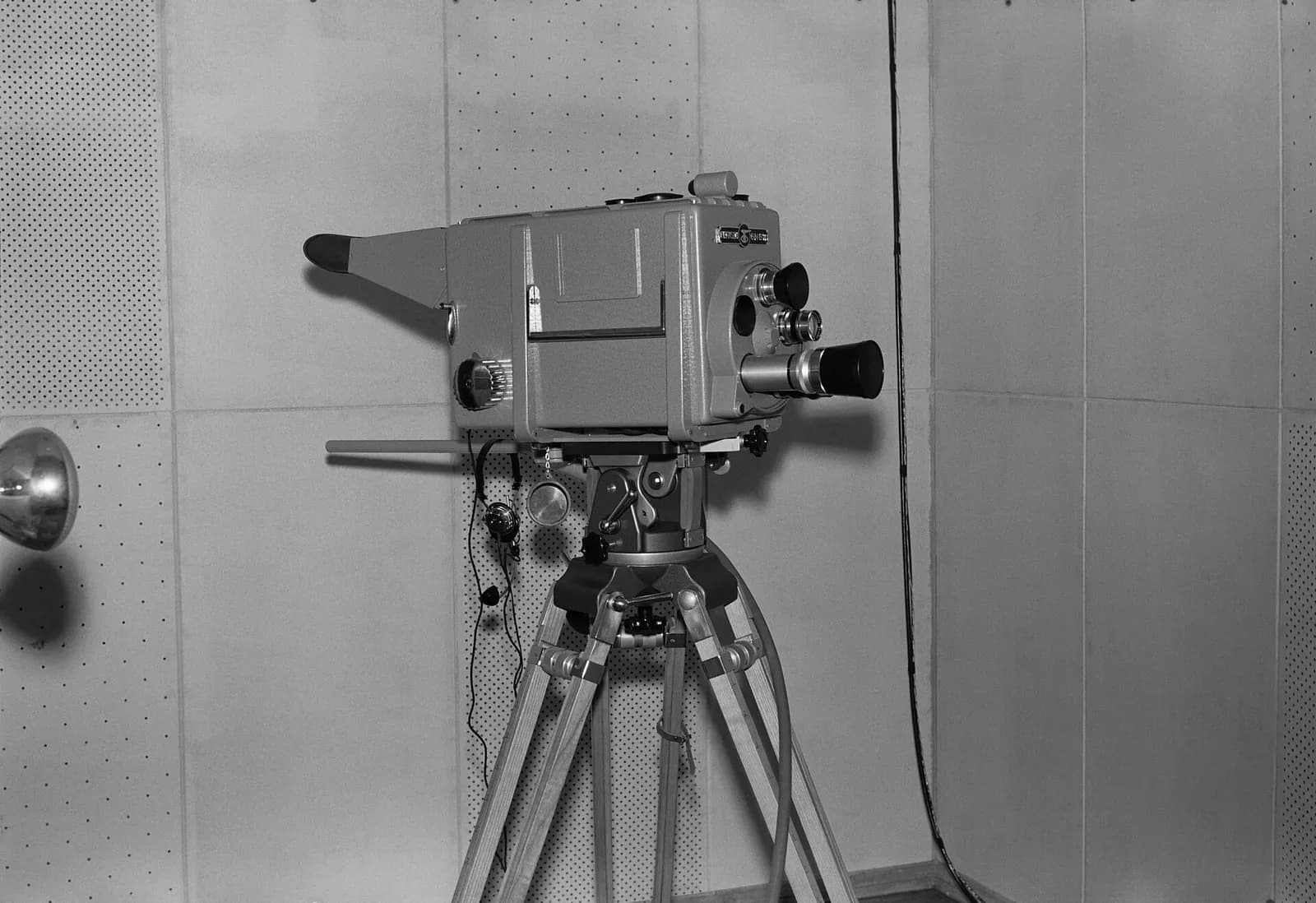
About two hours of television followed, made in one studio with three cameras. Domingos de Mascarenhas, RTP's head of production, spoke for about eight minutes on the present and future of the company. Then came Canções a Granel, a variety show with the singers Maria de Lurdes Resende and Rui de Mascarenhas, the Domingos Vilaça band and the young comic Raul Solnado, who was paid 1,000 escudos.
At ten Gomes Ferreira and Luís Arnaut Pombeiro read the news from a corner of the studio the staff called “the cave”, then talked over newsreel film. Everything except film went out live, and RTP's programme inspectors logged every slip minute by minute.
“21.38: the announcer appeared, nervous, without sound… 21.46: breakdown in the telecine and suspension of the broadcast; caption “the programme continues in a moment”. 21.55: in the long shots, a lot of floor and not much orchestra.”
The night ended with a filmed documentary on the airline TAP, a ballet to music by Tchaikovsky, Os Enganos do Amor, and a short last bulletin at about 11.25 pm. That morning the newspaper O Século had warned its readers not to expect too much.
“The broadcasts of Radiotelevisão Portuguesa begin today. They will not yet be definitive, since this is precisely a trial that will run for some months, until the chain of transmitters that will cover 60% of the metropolitan territory is ready.”
The trial never ended. RTP counts its age from that night. Vasco Hogan Teves, who worked in its newsroom that year and later wrote the company's official history, puts it simply: on 7 March 1957 RTP put a broadcast on the air and never stopped.
| Time | Programme |
|---|---|
| 9.30 pm | RTP ident and opening march; the announcer Maria Helena Varela Santos |
| 9.33 pm | Domingos de Mascarenhas on the present and future of RTP, about 8 minutes |
| Before 10 pm | Canções a Granel, variety, about 20 minutes, directed by Ruy Ferrão |
| 10 pm | Noticiário and Jornal de Actualidades, the news: 17 minutes of a planned 20 |
| After the news | Five-minute interval filled with slides of Paris |
| 10.25 pm | Miradoiro: Domingos Lança Moreira on the military football matches between Portugal and France |
| 10.40 pm | A TAP por dentro, a filmed documentary on the airline |
| 11 pm | Os Enganos do Amor, a ballet to music by Tchaikovsky, directed by Artur Ramos |
| 11.25 pm | Últimas Notícias, the late news, and close |
Order and durations from Vasco Hogan Teves's history of RTP; the clock times after 10 pm from the Diário de Notícias (2017). RTP's inspection report logs some items a few minutes off these times.
A late start under a cautious regime
Portugal came to television late. It was ruled by the Estado Novo, the authoritarian regime António de Oliveira Salazar had built in the early 1930s, with a censored press and no free elections. Teves notes that Portugal and Spain, two countries the Second World War had passed by, were among the last in western Europe. Spain began regular broadcasts on 28 October 1956, for about 3,000 sets in Madrid.
The groundwork was done by engineers at the state radio, the Emissora Nacional. A television study group there got an extra 500,000 escudos in 1953, but a ministerial order of 9 November 1953 told it to go no further than study, because the government thought it premature to take a position. A private company with heavy foreign capital offered to build a network if it could have a monopoly on selling sets for a time, a condition the government would not accept.
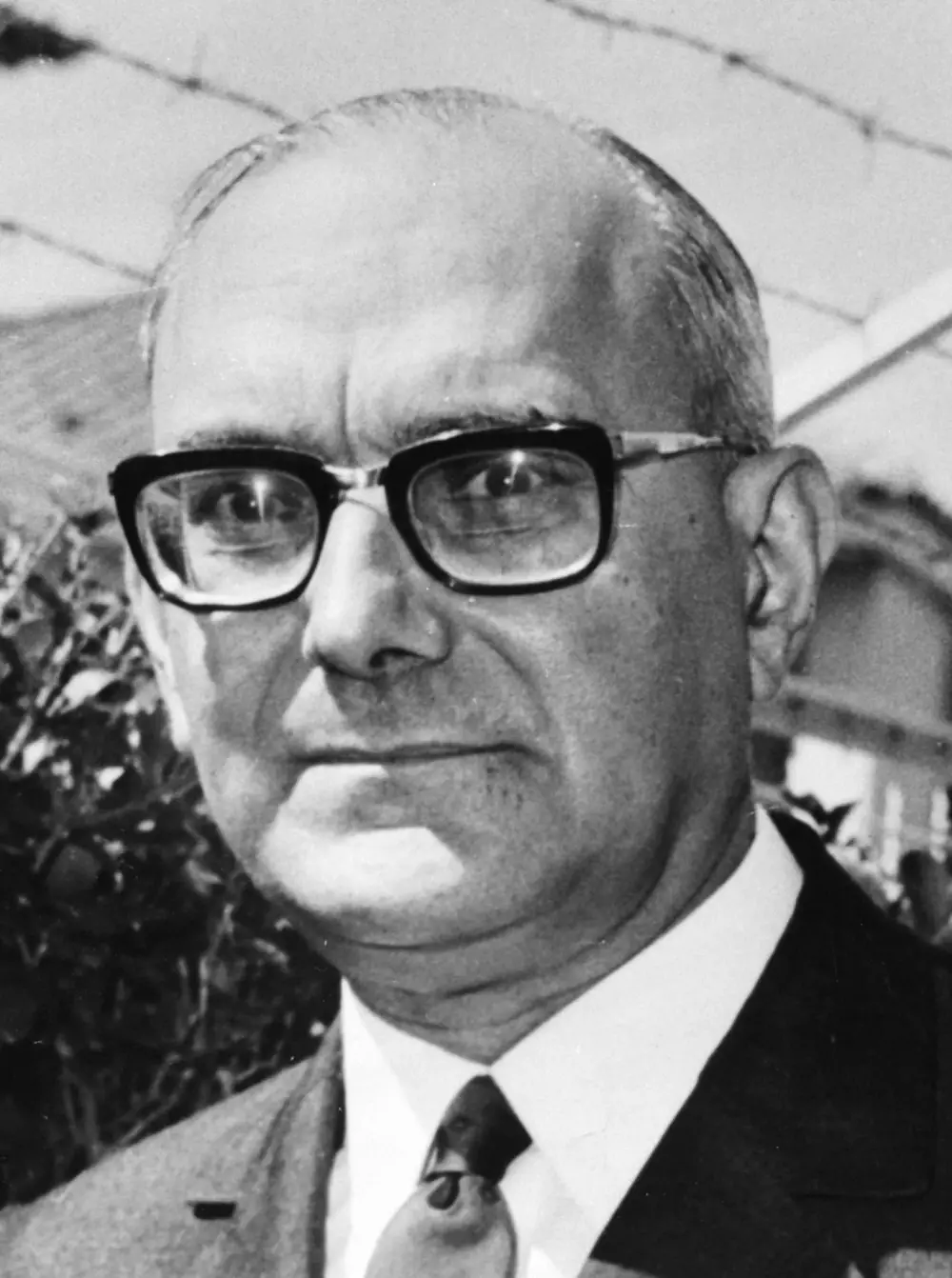
Things moved under Marcello Caetano, the law professor who was Minister of the Presidency. On 27 January 1955 he appointed a commission to propose a solution, and it reported in August. Decree-Law 40 312, published on 9 September, made installing a set subject to authorisation and licence fees and ordered existing ones to be registered. Decree-Law 40 341, published on 18 October, provided for a company to run television as a public service with a 20-year monopoly.
RTP was founded on 15 December 1955 with a capital of 60 million escudos, split equally between the state, the private radio stations and shares sold to the public through the banks. The chairman was Camilo de Mendonça, a 33-year-old agronomist, Caetano's friend and a trusted man of the single party, the União Nacional.
Caetano signed the concession contract for the government at São Bento on 16 January 1956, and told RTP's directors what the government expected of them.
“Television is an instrument of action, beneficial or harmful according to the judgement that governs its use. The Government hopes that the leaders of the new public service will know how to make this instrument a means of raising the moral and cultural level of the Portuguese people.”
According to Teves, Caetano had to overcome Salazar's opposition, and some say Salazar came round only after Francisco Franco, Spain's dictator, urged him not to lose more time. Caetano even oversaw the drafting of RTP's statutes. The engineers worked on a small budget: one of them, Lopes da Silva, later said they had made the cheapest television in Europe.
1953
Television study group at the Emissora Nacional gets extra funding
27 January 1955
Caetano appoints a commission on television
9 September 1955
Decree-Law 40 312: sets to be registered and licensed
18 October 1955
Decree-Law 40 341: a concession company with a 20-year monopoly
15 December 1955
RTP founded
16 January 1956
Concession contract signed
4 September 1956
Trial broadcasts begin at the Feira Popular
3 December 1956
Trials resume from Lumiar through the Monsanto transmitter
17 to 23 February 1957
RTP covers the Queen's state visit on film
7 March 1957
Regular broadcasts begin
23 November 1957
Permanent Monsanto and Lousã transmitters in service
31 December 1957
Monte da Virgem transmitter for Porto
1 January 1958
Licence fee collected for the first time
25 April 1958
Fóia relay completes the first-phase network
A fun fair, a film studio and a borrowed transmitter
Lisbon first saw Portuguese television at a fun fair. O Século ran the Feira Popular in the Palhavã park, where the Gulbenkian Foundation stands today, and gave RTP a plot beside the shooting galleries and the fried-dough stalls. Firms bidding for RTP's contracts lent the equipment: RCA a 0.1-kilowatt transmitter, a camera and 53 sets, and the German company Fernseh a second camera and 20 more sets. A 50-metre mast rose over a prefabricated pavilion whose studio was partly walled in glass, so the crowd could watch programmes being made.
The first programme went out at 9.30 pm on 4 September 1956. Alves Barbosa, who had just won the Volta a Portugal cycle race, pedalled on rollers in the studio, and Benfica's table-tennis champions played a few points. Sets in shop windows, cafés and clubs carried the pictures across the city. The next night the crowd in the Praça dos Restauradores stopped the traffic, and the police had to open a lane for cars and people.
The trials ran every evening except Wednesday until 30 September: 24 evenings and about 50 hours of programmes. By the end, private owners had registered the first thousand sets. RTP then moved into a disused film studio on the Alameda das Linhas de Torres, at Lumiar. The gallows built there for the film O Cerro dos Enforcados was still standing among the fig trees, and the main stage, of 296 square metres, became the studio.
The signal came from a small Siemens transmitter of 1 kilowatt that had been ordered for the Montejunto station. It was set up instead in a room of the navy's transmitting station at Monsanto, the wooded hill on Lisbon's western edge, and fed from Lumiar by a microwave link. From 3 December 1956 it carried test cards and films: travelogues lent by embassies, adult-education documentaries and the first series seen in Portugal, the American Chevy Show and Perry Como Show.
On 7 December, after Soviet troops had crushed the uprising in Hungary, RTP went silent for two minutes in solidarity. From mid-January 1957, at the request of set owners in the Lisbon and Setúbal districts, the trials ran twice a day, Sundays included. Live announcers appeared from 5 February, and a 15-minute news block from the 15th.
| Period | Where from | What was shown | Time on air |
|---|---|---|---|
| 4 to 30 September 1956 | Feira Popular, Palhavã, with a 0.1 kW RCA transmitter | Live studio shows, newsreels and documentaries | About 50 hours over 24 evenings |
| December 1956 | Lumiar, through the 1 kW transmitter at Monsanto | Films and slides, no Sunday broadcasts | About 90 hours over 25 days |
| January 1957 | Lumiar | Films and slides, test card for tuning sets | 71 hours of films, 22 of test card |
| February 1957 | Lumiar | Live announcers, a news block, the Queen's visit | 63 hours |
RTP's figures as given by Vasco Hogan Teves.
A queen as a dress rehearsal
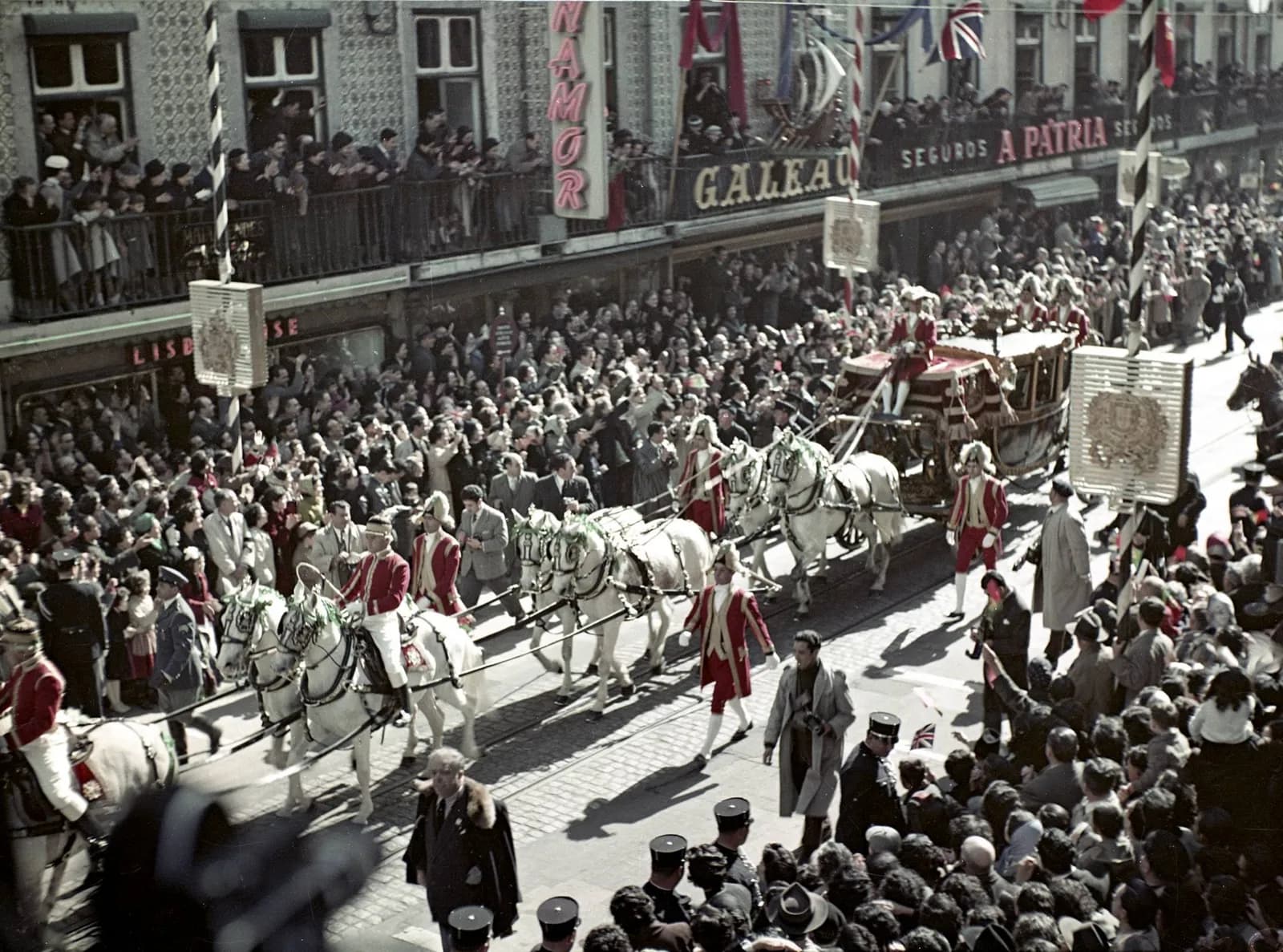
The real test came in February. Queen Elizabeth II flew in on 16 February 1957, landing at the Montijo air base across the Tagus, and spent the weekend aboard the royal yacht Britannia off Setúbal. On the morning of the 18th a historic royal barge brought her to the Cais das Colunas, the riverside steps of Lisbon's main square, to begin the state visit. RTP had no outside-broadcast van yet, so it covered the visit on film.
Manuel Figueira, who ran RTP's film and news section, and João Baptista Rosa, an army lieutenant and cameraman, rounded up every 16 mm operator they knew, from cine-club amateurs to the photographer Augusto Cabrita, who bought a Paillard camera for the occasion. Of the 14 men filming, only Hélder Mendes was on RTP's staff. Baptista Rosa used his uniform to get past security, opened the door of the state coach and filmed the Queen and President Craveiro Lopes smiling inside.
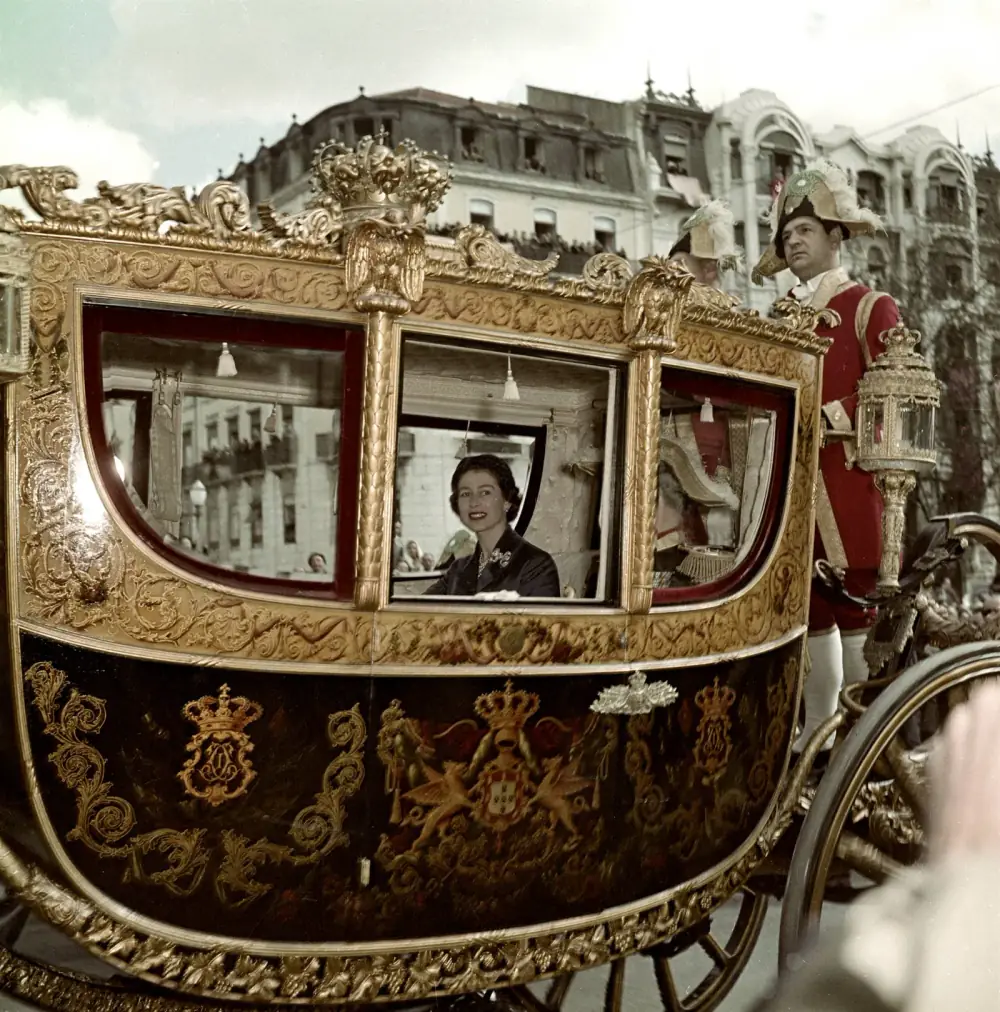
Film was rushed to the Tóbis laboratory, cut by hand and shown the same night, with the commentary read live by an announcer. Teves dates the first pictures, of the arrival at Montijo, to the evening of the 17th; a compilation of about an hour and a half closed the coverage on the 23rd. Estimates at the time put the audience, packed round sets in cafés and public places in the Lisbon, Setúbal and Santarém areas, at a little under a million.
RTP also supplied film to Brazil and to United Press, and helped the BBC, which flew its footage home on an RAF jet; about three hours later Britain was watching its Queen in Lisbon. Teves writes that some saw the coverage as hastening the start of regular broadcasts, because viewers had become a pressure group. Two weeks after the Queen left, RTP went on the air for good.
Live theatre, quizzes and a volcano
The schedule took shape quickly. On 11 March RTP broadcast its first play, Gil Vicente's Monólogo do Vaqueiro, the sixteenth-century piece with which, in the words of RTP's head of drama, Portuguese theatre began. Rui de Carvalho played the herdsman, with 40 extras. The budget ran to 50 contos (50,000 escudos): about half went on fees, most of the rest on costumes and props. Live drama became the touchstone of the schedule, though films still filled most of the air time.
On 13 March came the first Portuguese feature film, Fado, História de uma Cantadeira, with Amália Rodrigues. Quizzes gave away television sets: the first, run with the magazine Rádio e Televisão from 5 April, was won by a man from Cartaxo, who took home a Siemens set with a remote control. RTP's online chronology instead names Quem Sabe, Sabe, presented by Artur Agostinho, as the first quiz, also in April.
There was no Telejornal yet. At first RTP borrowed the news agency copy delivered to the Emissora Nacional, fetched by car; later the agency sheets came to Lumiar by bicycle courier, with the censor's cuts already made, and American newsreels came by plane. In June two cameramen followed President Craveiro Lopes to Brazil and sent their film home by air each day.
In October Teves, then a young newsroom writer, flew to the Azores with the cameraman Carlos Tudela after the Capelinhos volcano began erupting off the island of Faial. On 13 October, by Teves's account, Tudela and a newspaper reporter jumped ashore on the new island of volcanic cinders. RTP's total for 1957 was 665 hours on air.
Transmitters, sets and the licence fee
- First regular broadcast
- Thursday 7 March 1957, 9.30 pm
- Studio
- A converted film studio at Lumiar, Lisbon; main stage of 296 m²
- Transmitter
- Provisional 1 kW Siemens set in a navy building at Monsanto
- Reach
- The Lisbon area; RTP's January 1957 notice named the districts of Lisbon and Setúbal
- Owner
- RTP, a limited company owned in thirds by the state, private radio and public shareholders
- Air time in 1957
- 665 hours
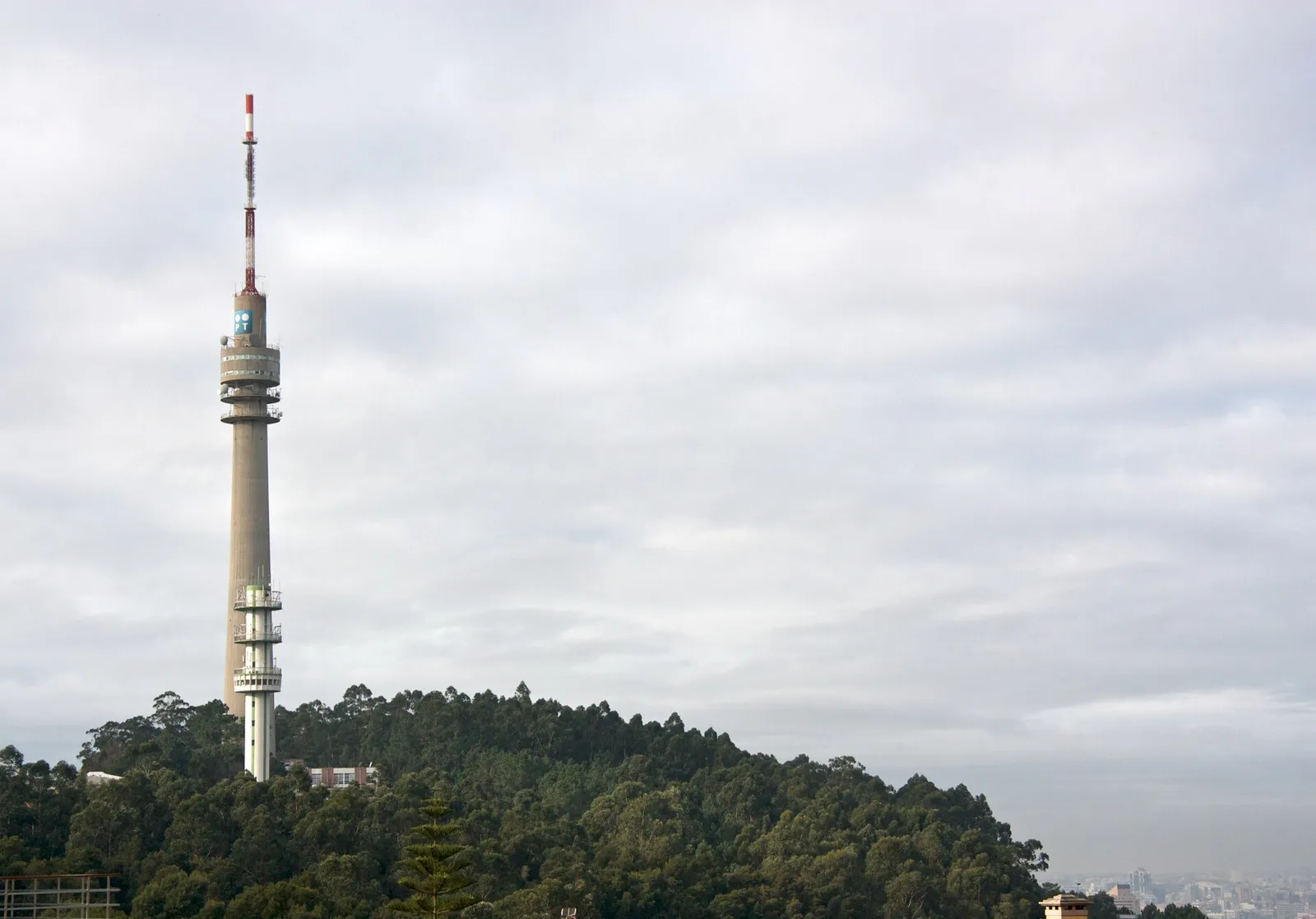
RTP had bought its network from Siemens in December 1956, and it came on air over the following 17 months. The permanent Monsanto transmitter and the Lousã station, serving Coimbra and the centre, started on 23 November 1957. Monte da Virgem, at Vila Nova de Gaia across the Douro from Porto, followed on New Year's Eve with a play called Noite de S. Silvestre. Montejunto opened on 10 March 1958, and the Fóia relay in the Algarve's Serra de Monchique on 25 April. By RTP's count, the four main stations then covered 44 per cent of the mainland's area and 58 per cent of its people.
Sets were dear. In April 1957 RTP's own shop on the Praça de Londres, in Lisbon, advertised them from 5,900 escudos with a 43 cm screen and from 7,800 with a 53 cm one, or from 185 escudos a month over 36 months. The media historian Francisco Rui Cádima gives a higher range for 1957: 7,990 to 18,800 escudos. The Diário de Notícias reckoned in 2017 that a set cost nine months' wages for an unskilled worker. RTP's board noted that a good part of the sets in use stood in public places.
Demand still beat every forecast. RTP had planned on 1,000 sets sold in its first year; in 1957 the magazine Rádio e Televisão reported that Lisbon alone had already bought more. By December 1958, 32,000 sets had been imported, about 2,000 a month that year, a pace RTP's board called four times faster than expected. From 1 January 1958 each set paid a licence of 360 escudos a year. A brochure handed out at the Feira had promised it would cost less than one escudo a day.
| Date | Number | What it counts |
|---|---|---|
| End of September 1956 | About 1,000 | Sets registered by private owners after the Feira trials |
| Before regular broadcasting | 1,000 | RTP's forecast of sets sold in the first year |
| December 1958 | 32,000 | Sets imported by that date; about 2,000 a month in 1958 |
| End of 1960 | 47,372 | Sets registered and paying the licence fee |
| December 1962 | 88,993 | Registered sets |
RTP's figures as given by Vasco Hogan Teves. Registered and imported sets are different measures, and no registration totals for 1957 to 1959 were found in the sources consulted.
Television sets in some countries when RTP began regular broadcasting, 1957
television sets
Figures as given by Vasco Hogan Teves for the time RTP began regular broadcasting; he does not name his source. He adds that the United States had just passed 38 million sets and the Soviet Union was thought to have about 1 million.
Show the data
| Sets | |
|---|---|
| United Kingdom | 6,200,000 |
| West Germany | 550,000 |
| France | 400,000 |
| Italy | 305,000 |
| Belgium | 130,000 |
Hours broadcast by RTP each year, 1957 to 1968
hours
Whole hours broadcast on RTP's main programme, from RTP's figures as given by Vasco Hogan Teves. Regular broadcasting began on 7 March 1957. Years for which his history gives no total are left out.
Show the data
| Hours on air | |
|---|---|
| 1957 | 665 |
| 1960 | 1,285 |
| 1961 | 1,824 |
| 1962 | 1,903 |
| 1963 | 2,011 |
| 1964 | 2,309 |
| 1966 | 2,930 |
| 1968 | 3,126 |
Television under a watchful state
The new medium was watched from the start. Prior censorship suited films but not live programmes, so RTP adopted the solution used in radio: a delegate of the SNI, the regime's propaganda and information office, oversaw scripts and decided with the head of production whether live programmes could go ahead. RTP passed the first screening of texts to its own literary adviser. The historian Rita Luís describes a censorship aimed at people as much as words, which decided who was fit to appear on screen, interviewers included.
A decree of 1 April 1957 barred television from showing events held where minors were not admitted, such as fado, variety theatre and boxing. Caetano softened it: a clarification recorded by the censorship commission for public shows in May 1957 said the rule should not be applied with the technical rigour of its wording.
Inside RTP the tone was set by men of the regime. Domingos de Mascarenhas, the head of production, was a film critic who had studied the regime's doctrine of the National Revolution. Maria Armanda Falcão, one of the first faces of the Feira broadcasts, recalled that he wanted her to sign off with “até amanhã, se Deus quiser”, until tomorrow, God willing, and then told her she had too much personality to keep the job. The director Artur Ramos said he was sacked after four years on information from the PIDE, the political police.
The journalists' union did not accept that RTP employed journalists, so its newsroom staff were called “redactores”, writers; they could join the union only after the revolution of 25 April 1974. Caetano, meanwhile, used the medium early: on 5 June 1957 he spoke from Lumiar for nine minutes on ten years of American aid to Europe. Salazar's first live televised speech came in June 1958, and that September, Cádima notes, he still ranked the press first among the media.
“I was the first member of the Government to use TV to set out to the country, in June 1957, problems of general interest. I do not hide that I followed the first steps of Radiotelevisão Portuguesa with deep interest and even enthusiasm… But I knew from the beginning that it was the ideal instrument for a Government to become popular… if it deserved to be.”
Why it still matters
RTP still counts its age from 7 March 1957, and chose the 23rd anniversary in 1980 to begin regular colour broadcasting. The service that opened that night kept its state monopoly until the private channel SIC went on air in October 1992.
People trained in the Feira pavilion and the Lumiar studio shaped Portuguese television for decades. Fernando Lopes, in 1957 a typist who hung around the newsroom's 16 mm film, became a film director and later ran one of RTP's channels.
The Lumiar studio, taken as a stopgap in 1956, stayed RTP's production centre for half a century. RTP bought the site in 1977 and moved out in 2007, fifty years after the first regular broadcast.
See it today
FAQs
When did television start in Portugal?
RTP made trial broadcasts at the Feira Popular in Lisbon from 4 to 30 September 1956, resumed them from its Lumiar studio on 3 December 1956, and began regular broadcasting at 9.30 pm on 7 March 1957. The company had been founded on 15 December 1955.
What was on RTP's first night of regular broadcasting?
About two hours of mostly live television: a talk by the head of production, Domingos de Mascarenhas, the variety show Canções a Granel with Raul Solnado, the news, film of military football matches, a documentary on TAP, a ballet and a late bulletin at about 11.25 pm.
How many people could watch RTP in 1957?
At first only viewers in the Lisbon area, served by a provisional 1-kilowatt transmitter at Monsanto. RTP planned on 1,000 sets sold in the first year and was overtaken quickly; many people watched in cafés. By RTP's count, four main transmitters covered 58 per cent of the mainland population by April 1958.
How much was the television licence in Portugal in 1958?
The licence fee was 360 escudos a year, collected from 1 January 1958. RTP's own shop sold sets from 5,900 escudos in 1957, or monthly instalments from 185 escudos over three years; the historian Francisco Rui Cádima gives a range of 7,990 to 18,800 escudos.
Was early Portuguese television censored?
Yes. A delegate of the regime's information office vetted scripts and decided whether live programmes could go ahead, agency news arrived with censors' cuts, and a 1957 decree barred events where minors were not admitted, such as fado, variety theatre and boxing.
On the timeline
Open the timelineNearby moments from dictatorship and the estado novo (1926–1974).
Birth in Lisbon of the poet Ana Luísa Amaral. A Porto professor who translated Emily Dickinson and Louise Glück, she won the Reina Sofía Prize for Ibero-American Poetry in 2021, the year before her death.
The Calouste Gulbenkian Foundation is formally established in Lisbon under the will of the Armenian oil magnate who had spent his last years in the city. Endowed with his vast fortune and art collection, it becomes Portugal's leading private patron of the arts, science, education and charity.
Birth in Lisbon of José Pedro Reis — Zé Pedro — guitarist and co-founder in 1978 of Xutos & Pontapés, the punk-rooted band from the Olivais neighbourhood that became Portugal's best-loved rock group. Much of his early childhood was spent in Timor, where his army officer father was posted; he died in 2017.
RTP's first regular broadcast
Radiotelevisão Portuguesa (RTP) begins regular broadcasting at 21:30 from its Lumiar studios in Lisbon, six months after trial transmissions at the city's Feira Popular. The first night's programme ran for about two hours, closing at around 23:30.
At a press conference in Lisbon's Café Chave d'Ouro, opposition presidential candidate General Humberto Delgado is asked what he would do with Salazar if elected. His reply — 'Obviamente, demito-o!' ('Obviously, I'll sack him!') — electrifies the country and becomes one of the most famous phrases in Portuguese politics.
Birth of Rosa Mota in Porto's Foz Velha. A pioneer of women's distance running, she won the first ever women's marathon at a European Championships in 1982 and, at Seoul in 1988, became the first Portuguese woman to win Olympic gold.
The film director Pedro Costa is born in Lisbon (some sources say 1959). His slow, luminous films with Cape Verdean immigrants, many made in Fontainhas, a shanty town on the Lisbon–Amadora boundary, won international acclaim; 'Vitalina Varela', shot in Amadora's Cova da Moura, took the Golden Leopard at the Locarno Film Festival in 2019.
Coming up in history
All long reads
19 sources
Archives, scholarship and reporting this article was checked against.
- 1
Década de 50: “As Emissões Regulares”RTP 50 Anos de História (text by Vasco Hogan Teves, 2007), Museu Virtual RTP
- 2
- 3
- 4
- 5
- 6
Entre o mercado global de informação e o primado da nação: a censura na televisão do Estado Novo, 1957-1974 (Rita Luís)Ler História 81 (2022)
- 7
Imagens e representações da ditadura portuguesa na televisão (1957-1974) (Francisco Rui Cádima)Logos 32, Universidade do Estado do Rio de Janeiro, 2010
- 8Como era Portugal quando a RTP entrou na nossa vidaDiário de Notícias, 7 March 2017
- 9
- 10
Televisão em contexto português: uma abordagem histórica e prospetiva (Filomena Antunes Sobral)Millenium 42, Instituto Politécnico de Viseu, 2012
- 11
- 12
- 13Quando Salazar conheceu Isabel: milhares na rua, récitas e um banquete em que a rainha esfarelou pão na sopaObservador
- 14
- 15
- 16
- 17
- 18Estúdios do Lumiar foram a primeira fábrica de sonhos da TVDiário de Notícias, 7 March 2007
- 19
Image credits
- Lisbon's Baixa on 18 February 1957, as Queen Elizabeth II's state coach passes. RTP, not yet broadcasting regularly, filmed the visit with a team of mostly freelance cameramen and showed the reports within hours. Less than three weeks later it began its regular service. Amadeu Ferrari (1909-1984), Public domain, via Wikimedia Commons.
- The Finnish broadcaster Yle's first television camera, a Fernseh image-orthicon model, photographed on 13 March 1957. RTP equipped its main Lisbon studio with image-orthicon cameras from the same German maker. Archives of the Finnish Broadcasting Company Yle, Public domain, via Wikimedia Commons.
- Marcello Caetano in a portrait dated October 1968, the month after he succeeded Salazar as head of government. As Minister of the Presidency in 1955 and 1956 he pushed through the laws that created RTP and signed its concession. Anefo, CC0, via Wikimedia Commons.
- Queen Elizabeth II in the Portuguese state coach she shared with President Craveiro Lopes, Lisbon, 18 February 1957. RTP's Baptista Rosa filmed the pair from the coach door. Amadeu Ferrari (1909-1984), Public domain, via Wikimedia Commons.
- Monte da Virgem, Vila Nova de Gaia, in 2011, with its telecommunications tower. RTP's transmitter for Porto began broadcasting from this hill on 31 December 1957. Nuno Morão, CC BY-SA 2.0, via Wikimedia Commons.