

The death of João VI and the fight over his crown, 1826
Portugal's king fell ill after breakfast and was dead six days later, leaving a regency decree that named no heir. His two sons stood on opposite sides of the Atlantic and of politics, and more than 170 years later his viscera were found to contain arsenic.
At a glance
- King João VI of Portugal died at the Bemposta palace in Lisbon on 10 March 1826, aged 58, six days after falling ill on the morning of 4 March.
- A decree dated 6 March made his daughter Isabel Maria regent until “the legitimate heir” gave orders, without naming him. His sons, Pedro, Emperor of Brazil, and Miguel, the absolutists' leader, were both abroad.
- Six months earlier, by the treaty of 29 August 1825, Portugal had recognised Brazil's independence in return for £2 million. The treaty let João call himself emperor but said nothing about who would inherit Portugal.
- In December 1997 archaeologists opened the jar holding his viscera at São Vicente de Fora. A 2002 analysis found arsenic levels consistent with acute poisoning; arsenic given as medicine and natural causes have not been ruled out.
- Pedro became Pedro IV, granted a Charter and abdicated for his daughter Maria on condition that Miguel swore the Charter and married her. Miguel took the throne himself in 1828, and the brothers fought a civil war from 1832 to 1834.
Six days at the Bemposta
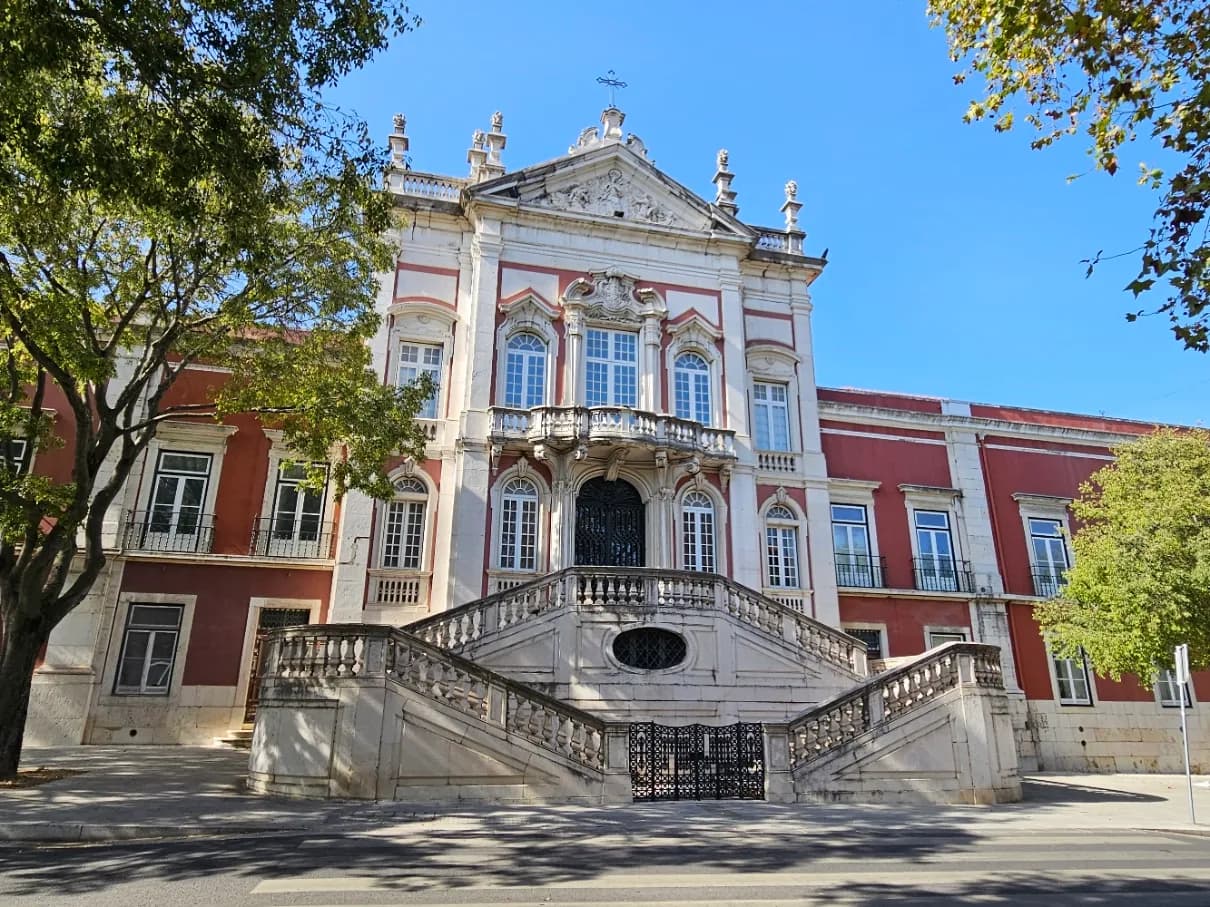
On the morning of 4 March 1826, King João VI of Portugal was taken ill after breakfast. He was 58, overweight and inactive, and he lived at the Bemposta, a palace in Lisbon also known as the Paço da Rainha, where he had kept his court as prince regent in 1803 and to which he had returned on coming home from Brazil.
From 6 March the Gazeta de Lisboa, the official newspaper, printed bulletins from the palace, 27 of them by the end. The first said he was improving. On 7 March a supplement to the Gazeta carried a decree, dated at the Bemposta the day before, that handed the government to his daughter, the Infanta Isabel Maria, and a council, for as long as the illness lasted.
Isabel Maria is said to have urged a reconciliation with her mother. The king, talking with the Patriarch of Lisbon and the papal envoy, agreed to send for Queen Carlota Joaquina, who lived apart from him at the palace of Queluz. She answered that she was too unwell to travel. When the British ambassador, Sir William A'Court, called with his court's condolences a few days after the death, he found the widow and her daughters showing “health, vivacity and no trace whatever of tiredness”.
The bulletins went on speaking of hope, then reported a turn for the worse on 9 March. João VI died on 10 March. The historian Fátima Bonifácio calls the illness a disease of the liver; a 2007 medical review of the sources found that he died with convulsions and gastrointestinal symptoms. Doubts began almost at once: about the decree, about the day he had really died, and about what had killed him.
“Frustrating all of our expectations! A fatal blow that launched the consternation of the Portuguese People! Our Beloved Sovereign, King João VI is no longer with us…”
A king between two continents
João was never meant to reign. Born in Lisbon on 13 May 1767, a younger son of Pedro III and the future Queen Maria I, he became heir in 1788, when his elder brother José died of smallpox. In February 1792, after his mother's mental collapse, he began to govern in her name, and in 1799 he took the title of prince regent. He became king only at her death in 1816.
By then he was in Brazil. On 29 November 1807, with a French army marching on Lisbon, the royal family sailed for Brazil. Rio de Janeiro became the seat of the monarchy, and in 1815 Brazil was raised to a kingdom. That flight has its own article on Lisboeta.
In 1820 a liberal revolution broke out in Porto. Its leaders called Cortes, an elected assembly, to write a constitution, and wanted the king home. On 22 April 1821 João made his elder son Pedro regent of Brazil. He sailed four days later, landed in Lisbon on 4 July and at once swore to the bases of the new constitution.
Fourteen months later Brazil was gone. Pedro refused the Cortes' order to come back, declared Brazil independent on 7 September 1822 and was acclaimed its emperor in October. In Lisbon the Constitution of 1822, sworn by the king on 1 October, placed sovereignty in the nation and most power in a single elected chamber. Queen Carlota Joaquina refused to swear it and backed its enemies.
Their leader was her younger son, Miguel. On 27 May 1823 he rode out to Vila Franca de Xira, on the Tagus north-east of Lisbon, with regiments that had declared against the constitution. After some delay the king went out too, took charge of the rising, dissolved the Cortes and abolished the constitution. The episode is known as the Vilafrancada.
Miguel tried again on 30 April 1824, arresting the king's closest advisers and holding his father in the Bemposta. Foreign diplomats got João out to a British warship in the Tagus, the Windsor Castle, and in May Miguel was stripped of his commands and sent abroad. He settled in Vienna. That coup, the Abrilada, has its own article.
26 April 1821
João VI sails from Rio
Pedro stays behind as regent of Brazil.
4 July 1821
The king lands in Lisbon
He swears to the bases of the constitution the same day.
7 September 1822
Pedro declares Brazil independent
1 October 1822
The king swears the Constitution of 1822
27 May 1823
The Vilafrancada
Miguel's rising ends the constitution within days.
30 April 1824
The Abrilada
Miguel's second coup fails; he leaves for exile in May.
13 May 1825
Letters patent on Brazil
João raises Brazil to an empire and cedes it to Pedro.
29 August 1825
Treaty signed in Rio
Portugal recognises Brazil; ratified in Lisbon on 15 November.
10 March 1826
Death of João VI
The price of Brazil
The last great business of the reign was Brazil, and Britain offered to broker a settlement. George Canning, the British foreign secretary, sent the diplomat Sir Charles Stuart first to Lisbon, to agree the terms with the Portuguese government, and then to Rio, to sign a treaty there as Portugal's plenipotentiary.
Lisbon wanted a form that saved face. On 13 May 1825 João signed letters patent raising Brazil to an empire, taking the imperial title himself and passing its sovereignty to Pedro. The Brazilians would not treat their independence as a gift from the king, and once Stuart reached Rio on 17 July he let the letters patent be set aside: the treaty mentioned them only in its preamble, and Brazil accepted them on condition that they were not published.
The treaty Stuart signed on 29 August 1825 recognised the empire, allowed João to take the title of emperor for his lifetime, and said nothing about who would inherit Portugal.
Money took the hardest bargaining. In May, Lisbon had fixed its demand at £3 million. On 19 August Stuart asked Brazil to take over the loan Portugal had raised in London in 1823, whose charges he put at about £1.3 million, and to pay £1.5 million on top. Brazil offered £1 million. Under pressure from Stuart and the Austrian envoy, Pedro rose to £2 million, to be met by taking over the London loan and paying the rest within a year.
Bargaining over Brazil's independence, 1825
£ million
Compensation for Portugal discussed before the treaty of 29 August 1825, from Valentim Alexandre's account. Stuart's first demand was the 1823 London loan, which he put at about £1.3 million, plus £1.5 million; he then offered to cut it by £0.5 million. The two bars for Stuart's demands are our sums of those figures. Brazil said it might add £250,000 for the king's property and £110,000 for holders of lost offices to its £1 million.
Show the data
| Sum proposed | |
|---|---|
| Lisbon's terms, May | 3 |
| Stuart's demand, 19 Aug | 2.8 |
| Brazil's offer, 19 Aug | 1 |
| Stuart's reduced demand | 2.3 |
| Agreed, 23 Aug | 2 |
In Lisbon the treaty was received with dismay. Merchants complained that Portuguese goods would get no preference in Brazil, paying the same 15 per cent duty as British ones, and courtiers objected to the article giving the king his imperial title. The text reached Lisbon on 9 November and the king ratified it on 15 November. His foreign minister explained that a refusal might look like disregard for Britain, Portugal's oldest ally, which had mediated.
“It was right that Brazil should be independent; it was more than right, indeed, because it was necessary; but [...] that, above all, a Sovereign should be called Emperor on the day he lost the greater part of the inheritance of his forebears, is a combination of circumstances in the highest degree odious.”
The treaty's silence on the succession left the largest question open. Pedro, heir to Portugal, was now the sovereign of a foreign country, and during the talks he told Stuart more than once that he would refuse the Portuguese throne. In October 1825 Canning told the Portuguese ambassador in London, the Marquis of Palmela, what the king should do. As Palmela reported it, in translation, João should “provide, in agreement with his son, for all future contingencies” and “designate the Regency” that would govern the kingdom. In March 1826, Stuart reported from Rio, Pedro still had not made up his mind.
Death and burial, March 1826
4 March, morning
Taken ill
The king falls ill after breakfast.
6 March
Bulletins and a decree
The Gazeta prints the first of 27 bulletins. A decree dated at the Bemposta creates a regency.
7 March
The decree is published
It appears in a supplement to the Gazeta.
9 March
A turn for the worse
10 March
João VI dies
11 March
Embalming
Three surgeons embalm the body; the Gazeta announces the death.
12 March, 1 a.m.
Heart and viscera to São Vicente
Carried by coach under cavalry escort.
13 or 14 March
Lying in state
The court kisses the dead king's hand at the Bemposta. Sources differ on the day.
15 March, 8 p.m.
Funeral procession
It reaches São Vicente de Fora at midnight.
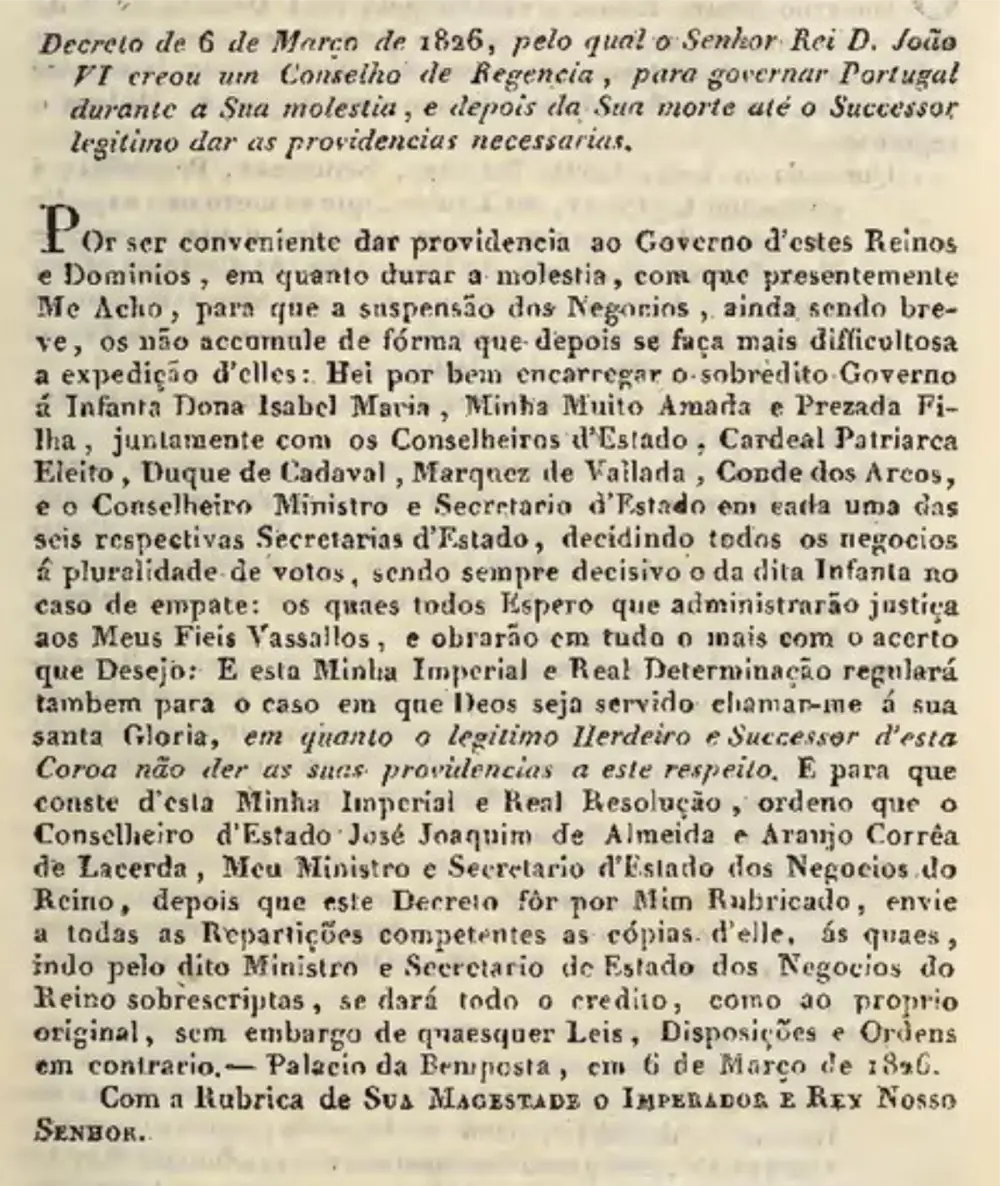
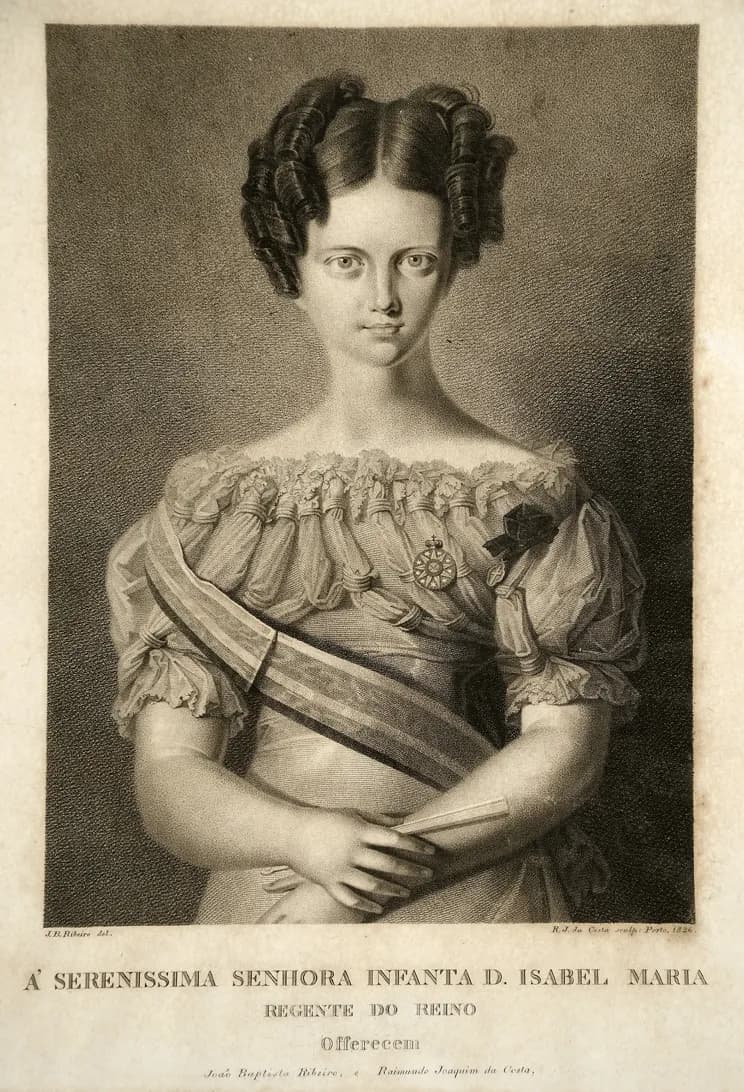
The decree of 6 March gave the government to Isabel Maria, the king's fourth daughter, together with the cardinal patriarch-elect, the Duke of Cadaval, the Marquis of Valada, the Count of Arcos and the six secretaries of state. They were to decide by majority vote, with the infanta's vote breaking a tie. Its last clause looked beyond the illness.
“And this My Imperial and Royal Determination shall also govern the case in which God is pleased to call Me to His holy Glory, until the legitimate Heir and Successor of this Crown gives his orders in this respect.”
The decree named no heir. The historian Fátima Bonifácio argues that nobody could doubt the king meant Pedro, his eldest son, whom he had called “heir and successor of these kingdoms” in the law ratifying the treaty with Brazil. Its effect was to keep the government out of the hands of Carlota Joaquina and Miguel.
As its own text required, the decree was authenticated with the king's rubrica, a short form of his signature. Suspicion fastened on it at once. Rumours ran that the death had been announced late to give time to publish the decree, and some contemporaries held that the king had been dead since 5 March. The official medical bulletins of his illness are missing from the archives, although those of the kings before and after him survive.
The funeral followed rules laid down in 1749, which required a king's body to be embalmed and the organs removed. Three surgeons did the work at the Bemposta on 11 March. At one in the morning of the 12th the heart and viscera, sealed in a large Asian jar inside a box covered in black silk, were driven to the monastery of São Vicente de Fora in a coach escorted by eight attendants with torches and a squadron of cavalry.
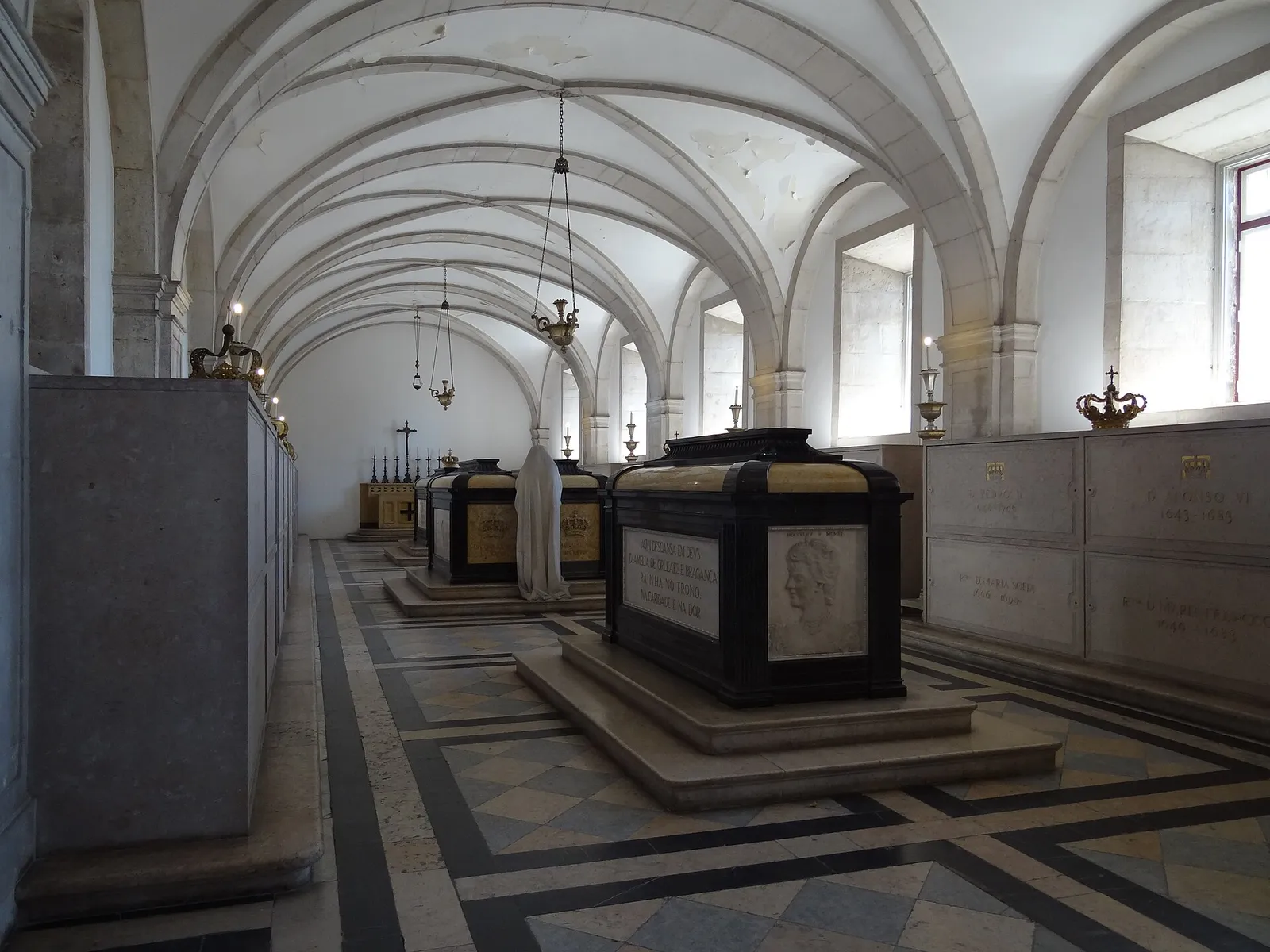
The body lay in state at the Bemposta, where the court, senior officers and servants of the royal household filed past to kiss its hand. The Gazeta de Lisboa put this on Tuesday 14 March; the historian Sandra Coelho gives the 13th. At eight in the evening of 15 March the funeral procession left the palace, crossed the city by the Campo de Santana and the Portas de Santo Antão, and reached São Vicente at midnight. The coffin was laid in the pantheon of the House of Bragança.
The jar in the chapel
The jar was buried under the floor of a side chapel at São Vicente, the chapel of the Meninos de Palhavã, named after the acknowledged illegitimate sons of King João V who lay there. The viscera of João V, José I and Pedro III had gone to the same place. A slab marked the spot: Cor et viscera imperatoris ac regis Ioannis Sexti, anno 1826, “heart and viscera of the Emperor and King João VI, 1826”.
An archaeological team had been digging at São Vicente since 1961 under Fernando Rodrigues Ferreira. On 22, 23 and 24 December 1997 it lifted the four slabs around the epitaph. About 18 centimetres down, under a layer of lime and sand, lay the remains of a small wooden box, about 63 centimetres high, 50 long and 34 wide, on its side. Inside was a pale blue Asian jar. Its lid, sealed with putty, had given way and some of the contents had spilled, but enough remained to sample.
The team read the burial as a sign of haste: the pit had been too shallow for the box to stand upright. Samples went to pathologists and to atomic physicists. Their paper in the journal X-Ray Spectrometry in 2002 reported “very high concentrations of arsenic and lead”, on average a few hundred times normal values for human soft tissue, and judged the results “consistent with acute arsenic poisoning”.
- Excavation
- 22 to 24 December 1997, chapel of the Meninos de Palhavã, São Vicente de Fora
- What was found
- A pale blue Asian jar in a wooden box about 63 by 50 by 34 cm
- Method
- Energy-dispersive X-ray fluorescence (EDXRF)
- Arsenic
- About 6 parts per million in the dried tissue; arsenic and lead on average a few hundred times normal levels
- Lethal dose for an adult
- 120 to 200 mg of arsenic, as given by Coelho
- Published
- X-Ray Spectrometry, vol. 31 (2002), pp. 305-309
The team went further. A lethal dose taken on the morning of 4 March, it argued, would have killed the king by the next morning, not six days later. It also compared the mark on the decree of 6 March with signatures from different periods of his life and found them inconsistent. Together those claims would mean a death hidden for five days and a forged decree. Coelho, revisiting the study in 2022, wrote that its findings supported poisoning “with a high degree of certainty” (in translation).
A regent, two brothers and a girl of seven
In public, at first, nobody disputed the succession. The regency proclaimed Pedro king of Portugal as Pedro IV and issued its acts in his name. Miguel wrote from Vienna to accept his brother's authority, and again to his sister the regent on 6 April. A deputation led by the Duke of Lafões sailed to pay homage in Rio, and the courts of Europe, Spain and Rome among them, recognised the new king.
Pedro heard of his father's death on 24 April, from merchant ships that crossed ahead of the deputation. He knew he could not wear both crowns: Brazil, jealous of its new independence, would not accept it. On 29 April he granted the Portuguese a Constitutional Charter, the subject of its own article, and on 2 May he abdicated the Portuguese crown in favour of his daughter Maria da Glória, born in Rio in April 1819, on two conditions: that the Charter be sworn, Miguel included, and that Miguel marry her.
“This my abdication and cession shall not take effect if either of these two conditions is lacking.”
The decrees reached Lisbon with Stuart on 7 July. Absolutists who had hoped Pedro would abdicate in Miguel's favour reacted with fury. The regency, then staying at the spa of Caldas, held back the Charter, began printing it on 15 July and was slow to fix a day for the oath, until General Saldanha, commanding in Porto, sent a column of troops to make clear that no more delay would be tolerated. It was sworn on 31 July.
Regiments rose for Miguel at Bragança and in the Alentejo. In Vienna, Miguel swore the Charter on 4 October and was betrothed to his niece on 29 October.
The arrangement lasted less than two years. In July 1827 Pedro named Miguel to govern Portugal for his daughter. Miguel landed in February 1828, took over from Isabel Maria and was acclaimed absolute king that year, revoking the Charter. Pedro gave up the throne of Brazil in 1831 to fight for Maria, and the civil war between the brothers, from 1832 to 1834, ended with the Convention of Evoramonte on 26 May 1834.
| Person | Relation to João VI | Where | What happened next |
|---|---|---|---|
| Carlota Joaquina | Wife | Palace of Queluz, near Lisbon | Backed Miguel's claim |
| Pedro | Elder son; Emperor Pedro I of Brazil | Rio de Janeiro | Proclaimed Pedro IV; granted the Charter and abdicated on 2 May 1826 |
| Miguel | Younger son | Exile in Vienna since 1824 | Accepted Pedro in 1826; acclaimed absolute king in 1828 |
| Isabel Maria | Fourth daughter | Lisbon | Regent from March 1826 until she handed over to Miguel in 1828 |
| Maria da Glória | Granddaughter, Pedro's daughter, born 1819 | Rio de Janeiro | Named queen by Pedro's conditional abdication of May 1826; reigned as Maria II only after the civil war |
Why it still matters
The question João VI's decree left open, who the “legitimate heir” was, was settled by war. The Liberal Wars set constitutional monarchy against absolutism, and the Charter Pedro granted in Rio in April 1826 outlived them. Revoked by Miguel in 1828 and restored in 1834, it was set aside again from 1836 to 1842, then stayed in force, amended several times, until the Republic of October 1910: longer than any other Portuguese constitution.
The cause of his death is still argued over. The 1997 excavation turned a rumour of 1826 into a laboratory result, but no document names a poisoner, and medicinal arsenic and natural disease remain possible explanations.
His reputation has changed too. Republican historians in Portugal drew João VI as weak, indecisive and a figure of fun. In Brazil, which he had helped to modernise, his image was always kinder, and recent Portuguese historians have set him back in the difficult times he ruled in.
FAQs
Was King João VI poisoned?
Possibly. Tissue from the jar holding his viscera, excavated at São Vicente de Fora in December 1997, contained arsenic at a few hundred times normal levels, which a 2002 study judged consistent with acute arsenic poisoning. Arsenic was also used as a medicine, and a 2007 medical review did not rule out a stroke, so the cause of death is still debated and no poisoner has been identified.
Where did João VI die and where is he buried?
He died at the Bemposta palace in Lisbon, now the Academia Militar, on 10 March 1826. His embalmed body was taken on 15 March to the pantheon of the House of Bragança at the monastery of São Vicente de Fora, and his heart and viscera were buried separately in a jar under a chapel of the same monastery.
Who ruled Portugal after João VI died?
A regency headed by his daughter, the Infanta Isabel Maria, created by a decree dated 6 March 1826. It governed in the name of Pedro IV, who abdicated for his daughter Maria in May 1826 on conditions; until she was proclaimed, Pedro in effect still reigned through the regent. Miguel took over the government in February 1828.
Why did João VI's death lead to a civil war?
His heir, Pedro, was emperor of an independent Brazil, and his younger son, Miguel, led the absolutists. Pedro abdicated in favour of his daughter on condition that she married Miguel and that the liberal Charter was sworn. Miguel took the throne for himself in 1828, and the brothers fought the civil war of 1832 to 1834.
Why was João VI called Emperor of Brazil?
Under the treaty of 29 August 1825 by which Portugal recognised Brazil's independence, Pedro agreed that his father could take the title of emperor in his own person. Lisbon presented it as João ceding the empire to his son; critics said it made him an emperor on the day he lost Brazil.
On the timeline
Open the timelineNearby moments from invasions, brazil and the liberal wars (1807–1851).
Prince Miguel launches the Vilafrancada in Vila Franca de Xira, an absolutist military coup against the liberal Constitution of 1822 that ends Portugal's first constitutional experiment and restores the traditional powers of King João VI.
The Abrilada (April Revolt): Infante Miguel, commander-in-chief of the army, turns the Lisbon garrison against his father's moderate ministers and holds King João VI in the Bemposta palace. Backed by the diplomatic corps, the king takes refuge on a British warship, strips Miguel of his command and sends him into exile.
By the Treaty of Rio de Janeiro, mediated by Britain, Portugal formally recognises the independence of Brazil, ending the Brazilian war of independence.
The death of João VI
King João VI dies in Lisbon under suspicious circumstances (possible arsenic poisoning), triggering a succession crisis between his sons Pedro (Emperor of Brazil) and Miguel, which would lead to the Portuguese Civil War.
In Rio de Janeiro, Pedro IV — also Emperor Pedro I of Brazil — grants Portugal the Constitutional Charter, a more conservative liberal constitution with a hereditary Chamber of Peers. With interruptions, it would remain in force until the fall of the monarchy in 1910.
Death in Rio de Janeiro of Leopoldina of Austria, wife of Pedro I and Empress of Brazil, aged 29. A Habsburg archduchess with a passion for natural science, she played an important part in Brazil's independence, chairing the council that sent urgent letters to Pedro days before he declared it in September 1822; she was the mother of Portugal's Queen Maria II and of Brazil's last emperor, Pedro II.
The 'Belfastada': the steamer 'Belfast' lands a party of 29 exiled liberals led by the Marquis of Palmela at Matosinhos, near Porto, to take charge of the city's revolt against the absolutist Miguel I. With Miguelist troops closing in, they soon abandon the rebellion and flee aboard the same ship — a fiasco that gives the episode its mocking name and begins years of Liberal exile.
Coming up in history
All long reads 12 March 1514Hanno, the white elephant Manuel I sent to the Pope: Rome, 12 March 1514
 13 March 1696The 33-month siege of Fort Jesus, Mombasa, 1696 to 1698
 14 March 1923Celeste Rodrigues: the fado singer who sang for 73 years
 15 March 1147Two ladders and a broken gate: Afonso Henriques takes Santarém, 1147
19 sources
Archives, scholarship and reporting this article was checked against.
- 1
D. João VI: um caso de envenenamento revisitado (Sandra Coelho)Arqueologia & História, vols. 71-72 (2022), Associação dos Arqueólogos Portugueses
- 2
Arsenic detection in nineteenth century Portuguese King post mortem tissues by energy-dispersive x-ray fluorescence spectrometry (M. L. Carvalho, F. E. Rodrigues Ferreira and others)X-Ray Spectrometry, vol. 31, no. 4 (2002), pp. 305-309
- 3
A desagregação do império: Portugal e o reconhecimento do Estado brasileiro (1824-1826) (Valentim Alexandre)Análise Social, vol. XXVIII (121), 1993
- 4
- 5
Princess Isabel Maria de Bragança: regent of Portugal between D. Pedro and D. Miguel (Ana Carolina Galante Delmas)Revista do Instituto Histórico e Geográfico Brasileiro, vol. 181, no. 484 (2020)
- 6
Manifesto dos direitos de Sua Magestade Fidelissima, a senhora dona Maria Segunda, e exposição da questão portugueza (José António Guerreiro and the Duke of Palmela)Imprensa da Universidade, Coimbra, 1836 (Internet Archive)
- 7
10 March 1826: João VI dies in Lisbon in the Royal Palace of BempostaParques de Sintra, Palácio Nacional de Queluz: King Pedro IV chronology
- 8
- 9
João VI: biographyArchontology.org
- 10
D. Pedro IV e a Independência do Brasil (documents and chronology for the bicentenary)Arquivo Nacional Torre do Tombo, 2022
- 11
The Portuguese Constitution of 1822 (Ron B. Thomson)British Historical Society of Portugal
- 12
Decreto de 22 de Abril de 1821: encarrega o Governo do Brasil ao Príncipe Real constituído Regente (publicação original)Câmara dos Deputados (Brazil), Legislação Informatizada
- 13
- 14
- 15
- 16
- 17
- 18
Estudo de aspectos antropométricos e médicos dos primeiros imperadores do Brasil (Valdirene do Carmo Ambiel, doctoral thesis)Faculdade de Medicina, Universidade de São Paulo, 2023
- 19
A Monarquia Constitucional (1820-1910)Assembleia da República
Image credits
- The Bemposta palace in Lisbon, also called the Paço da Rainha, where João VI lay through his last illness and died on 10 March 1826. It now houses the Academia Militar. Photographed in 2023. GualdimG, CC BY-SA 4.0, via Wikimedia Commons.
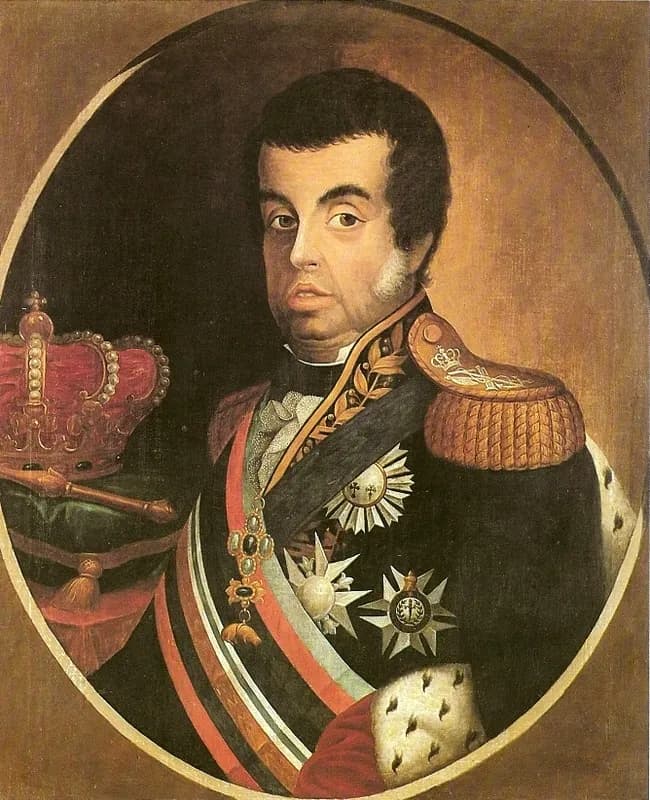
- João VI in an oval portrait by the French painter Jean-Baptiste Debret, who worked in Rio de Janeiro from 1816 to 1831. The painting is dated to 1816, the year João succeeded his mother as king. Jean-Baptiste Debret, Public domain, via Wikimedia Commons.
- The pantheon of the House of Bragança in the old refectory of São Vicente de Fora, where João VI's coffin was laid at midnight on 15 March 1826. Most of the dynasty lie in marble tombs along the walls; the tomb in the foreground is Queen Amélia's, added in the twentieth century. Photographed in 2011. Antoine Rex, CC0, via Wikimedia Commons.
- The decree of 6 March 1826 that made Isabel Maria regent, as printed in 1836 in a manifesto for the rights of Maria II. The clause in italics leaves the government to her “until the legitimate Heir and Successor of this Crown” gives his orders. Governo de Portugal, Public domain, via Wikimedia Commons.
- The Infanta Isabel Maria, “Regente do Reino”, in an engraving drawn by João Baptista Ribeiro and engraved by Raimundo Joaquim da Costa in Porto in 1826, the year her father's decree made her regent. João Batista Ribeiro (1790-1868) and Raimundo Joaquim da Costa (1778-1862), Public domain, via Wikimedia Commons.