

The 33-month siege of Fort Jesus, Mombasa, 1696 to 1698
An Omani fleet sailed into Mombasa harbour and settled down to wait. Almost three years later its men climbed the walls at night and overran the last fourteen or so survivors, shortly before the final relief fleet arrived.
At a glance
- On 13 March 1696 an Omani fleet entered the harbour of Mombasa, in today's Kenya, and laid siege to Fort Jesus, the fortress Portugal had begun there in 1593.
- The siege lasted 33 months. The fort fell on 13 December 1698, when the attackers climbed the walls at night and overran the last fourteen or so exhausted defenders.
- Relief expeditions from Goa and Mozambique landed men and food but never drove off the besiegers, and the last one arrived after the fort had fallen.
- Most defenders were Muslim Swahili and Africans, not Portuguese. Contemporary Portuguese estimates put the dead at roughly 6,500 to 11,000, most of them from hunger and disease.
- Portugal held Fort Jesus again only from 1728 to 1729. Today it is a museum run by the National Museums of Kenya and, since 2011, a UNESCO World Heritage Site.
Two shots at the harbour mouth
On 11 March 1696 seven ships from Muscat appeared off the bar of Mombasa. According to the Portuguese chronicle of the siege, they carried 3,000 men and the Prince of Lamu, a Swahili ruler allied to Oman. The wind was against them, and for two days they could not get in.
On the 13th they tried the channel. The flagship ran onto a sandbank at its entrance, and as she grounded her bow came to rest facing the small fort that guarded the passage. A couple of shots from her bow guns were enough. Its garrison, 300 Swahili and four Portuguese, ran without firing back.
After some hours the Omanis refloated the ship, then took the town and island unopposed. For eight days they did nothing more. On a coral ridge above the harbour stood Fort Jesus, with about fifty Portuguese soldiers inside, and its governor used the pause to fill it with food, arms and people.
The siege that began that day ran for 33 months, until 13 December 1698. The historian C. R. Boxer called it one of the most remarkable sieges in history, for its length, for the loyalty of the Muslim defenders to a Christian king they had never seen, and for the lack of initiative shown by the commanders on both sides.
A fort for the Swahili coast
Mombasa was one of the trading towns of the Swahili coast, the Muslim, Swahili-speaking ports that ran from Somalia to Mozambique and lived on the Indian Ocean trade in ivory, gold and slaves. Relations with the Portuguese went wrong from Vasco da Gama's first visit. Portuguese fleets sacked the town in 1505 and again in 1529, while its rival Malindi became Portugal's firm ally.
For most of the sixteenth century Portugal held the coast by sea alone, with a “captain-major of the Sea of Malindi” and a few small ships. That changed when an Ottoman captain, Mir Ali Bey, raided down the coast with a handful of ships in 1585 and 1586 and again in 1588 and 1589, and most of the Swahili towns submitted to him. On 21 January 1591 the Crown, then held by Philip II of Spain, authorised a fortress at Mombasa.
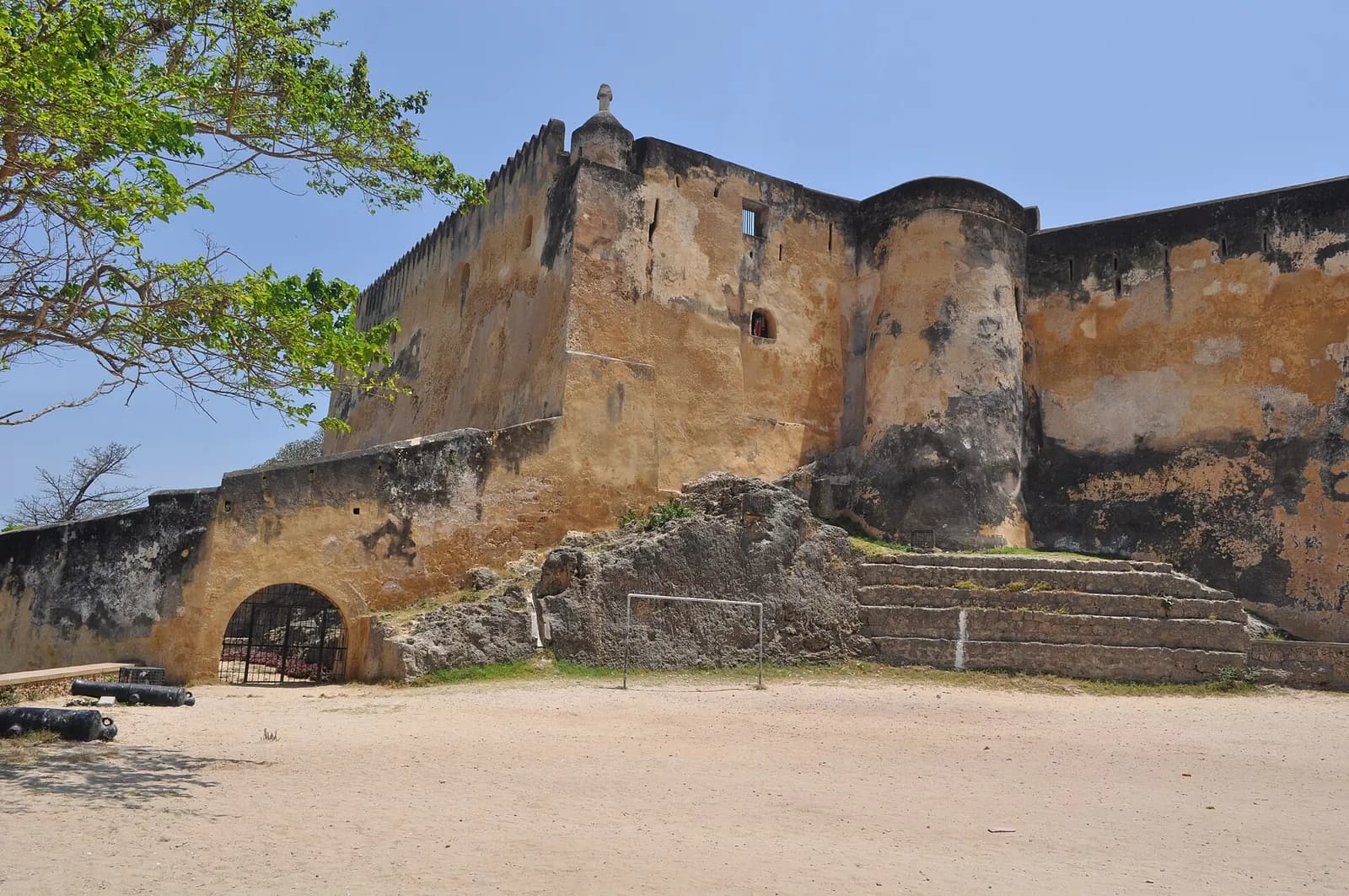
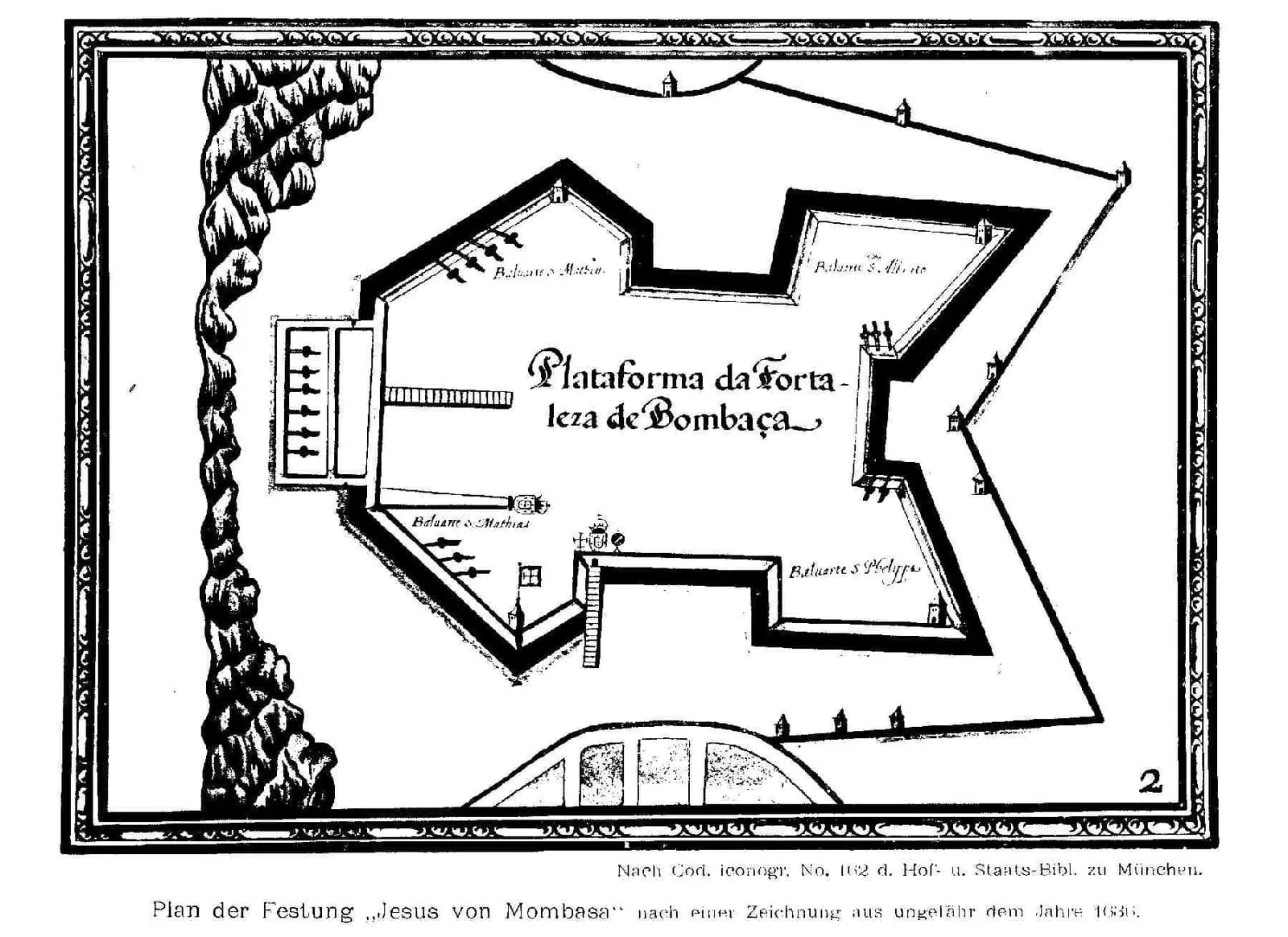
The plan came from Giovanni Battista Cairati, or João Batista Cairato to the Portuguese, the Italian chief architect of Portuguese India. Work began on 11 April 1593 under Mateus Mendes de Vasconcelos, with the Sultan of Malindi's men helping to carry the coral stone. The fort was nearly square, with four corner bastions, a design that followed Renaissance theories of proportion.
“When Philip of Austria the first was reigning in Portugal ... by his order this fortress of the name of Jesus of Mombasa was founded on the eleventh of April of 1593.”
The fort did not keep the town loyal. In August 1631 Mombasa's own sultan, Yusuf bin Hasan, raised a Christian in Goa as Dom Jerónimo Chingulia, entered Fort Jesus during a feast day and killed the garrison. Portugal got the fort back only after he abandoned it in 1632.
Oman builds a navy
The threat in 1696 came from Arabia. After the Portuguese lost Hormuz in 1622, their power in the Persian Gulf rested on Muscat, in Oman. In 1650 Oman's Ya‘rubi dynasty of imams drove them out of Muscat as well.
Oman had sailors but no warships able to stand up to Portuguese guns. In 1650 and 1651 it captured several Portuguese vessels, and Boxer argues that the warships it built soon afterwards were modelled on these prizes.
On 12 February 1661 an Omani squadron, joined by the Sultan of Pate, appeared off Mombasa. Its soldiers sacked the town for about six weeks but left the fort alone. Civil strife in Oman then held back further attacks until the 1690s, when a new imam, Saif bin Sultan, came to power.
In October 1694 Goa heard that Pemba, the island that fed Mombasa, had rebelled and called in the Omanis. A new governor, João Rodrigues Leão, an old soldier, put the revolt down and warned that Oman would return in strength. The viceroy, the Count of Vila Verde, sent him one galliot of supplies and a reassurance: a Portuguese fleet in the Persian Gulf would keep the Omanis busy at home.
Accounts from the coast tell it differently. Mombasa's own Arabic chronicle, copied for the British naval officer William Owen in the 1820s, says the coast people could not bear Portuguese “oppression and tyranny” and complained to the imam of Oman, who came and drove the Portuguese from the fort. Swahili loyalties were split, though: Pate and Lamu sided with Oman, while the Queen of Zanzibar and refugees from Faza, Malindi and Kilifi stood by Portugal.
Thirty-three months
Rodrigues Leão's orders said only Christians were to be let into the fort in a crisis. With fifty Portuguese soldiers, he ignored them. Swahili refugees from Faza, Malindi and other towns who lived in Mombasa were trusted and let in, with the non-combatants crowded into the moat. The chronicle counts about 2,500 armed men in the fort and some 3,000 people in the moat.
The Omanis had no siege artillery. They mounted guns taken from the small outlying forts, which did little harm to the walls. Food came in by night from the Nyika, the peoples of the mainland, in exchange for cotton cloth. On 25 August 1696 the Omani commander sailed home with most of his army and a load of ivory, leaving about 900 men to keep up the blockade.
The defenders now outnumbered the besiegers, with fewer than 100 Portuguese but at least 1,500 armed Swahili. They made sorties but did not try to drive the besiegers away. Rodrigues Leão, who stood watch on the ramparts day and night, died of fever on 23 October 1696. The seventeen-year-old Prince of Faza, who placed himself wherever the fighting was worst, was killed in action. His cousin, Prince Dau, took his place.
Then disease took over. After the first relief ships left in January 1697, the Nyika stopped sending food, and people in the fort and the moat began to die fast. Boxer, following the chronicle, writes of plague; later arrivals died of beriberi. By early June 1697 only four Portuguese were alive: the governor, António Mogo de Melo, the Augustinian prior and two others.
Before dawn on 20 July 1697 the Omanis made their first assault on the walls. They were driven back with about eighty dead, and Prince Dau and some of the women did much of the fighting. Mogo de Melo died on 28 August. The garrison was now seventeen Swahili, four Africans, a few women and one Portuguese, a boy of eleven.
Prince Dau refused every offer of honourable surrender, in what the chronicle calls “short, dry, and resolute words”. Later, in Goa, Dau explained himself to the king.
“Loyalty counted for more with me than ambition or maternal love; and I wished to show the world that even the Muslim vassals of Your Majesty have Portuguese loyalty.”
Portuguese alive in Fort Jesus at points in the siege
people
Portuguese only; the Swahili and African defenders were far more numerous for most of the siege. The rise by January 1698 reflects men landed in September and December 1697 (“about 100” soldiers). Figures from the anonymous Historia de Mombaça and the survivor Brás Fialho, as given by Boxer (1960).
Show the data
| Portuguese in the fort | |
|---|---|
| Mar 1696 | 50 |
| Dec 1696 | 20 |
| Jun 1697 | 4 |
| Aug 1697 | 1 |
| Jan 1698 | 100 |
| 12 Dec 1698 | 9 |
Relief fleets that would not come in
Help was slow. The Queen of Zanzibar sent food throughout the siege, though most of it was intercepted and the Omanis sacked her own town. Goa heard of the siege only in September 1696 and fitted out a squadron under Luís de Melo de Sampaio, an India-born nobleman of poor reputation.
He reached Mombasa on Christmas Day 1696, when only twenty Portuguese were left alive in the fort. His orders were to land men and stores, not to enter Kilindini harbour, where the Omani ships lay. He landed about ninety men in a month and sailed away on 25 January 1697.
He came back on 16 September 1697 and, pushed by his lieutenant-commander José Pereira de Brito, brought the frigate Santo António de Tanná into the channel under the fort. On 20 October her cables parted, by gunfire or accident, and she drifted ashore and was lost; a sortie rescued the 150 men still aboard. Melo de Sampaio died of fever on 19 November. Pereira de Brito, a sailor who had risen from deck-hand, then led sorties that destroyed most of the Omani batteries.
| Sailed | Commander | Force | What happened |
|---|---|---|---|
| Mombasa, 20 March 1696 | José Barroso | A small boat sent for help | Back from Mozambique on 8 August 1696 with 28 Portuguese, 46 slaves and three small vessels of food from the Queen of Zanzibar |
| Goa, late 1696 | Luís de Melo de Sampaio | Two frigates and three smaller vessels | Arrived 25 December 1696; landed about 90 men; left 25 January 1697 |
| Mozambique, 28 August 1697 | Luís de Melo de Sampaio | Frigate Santo António de Tanná and a supply galliot | Arrived 16 September; frigate lost on 20 October; commander died 19 November |
| Goa, 30 November 1697 | Francisco Pereira da Silva | Three frigates and three or four smaller vessels | Arrived 28 December; landed men and stores; left 19 January 1698 with over 400 women from the moat |
| Goa, 21 November 1698 | Francisco Pereira da Silva | Four frigates and a galliot, over 1,200 men | Arrived after the fall (sources give 14 or 20 December); sailed away without landing |
| Lisbon, March 1699 | Henrique Jacques de Magalhães | Five ships, over 900 men | Never reached Mombasa; arrived in Goa in September 1699 having lost a third of its men to disease |
From Boxer (1960), who follows the Historia de Mombaça and the viceroys' letters. The Institute of Nautical Archaeology describes the first Goa squadron as two frigates and two galliots.
A new squadron under Francisco Pereira da Silva reached Mombasa on 28 December 1697. The leaders in the fort begged him to sail into Kilindini and destroy the Omani ships while they attacked from the land side. He refused, saying his orders were to land supplies. When one of his boats was taken, the Omanis came up to the walls and read the captured orders from Goa aloud “in good Portuguese”, mocking them.
He left behind a new governor, Leonardo Barbosa Soutomaior, brave but brutal, who soon alienated the Swahili. Prince Dau and most of the Swahili and African defenders left, some on the frigates. Pereira de Brito sailed too. The squadron took off more than 400 women still alive in the moat and left on 19 January 1698, and Fort Jesus was on its own.
The last night
Goa had only rumours of how the fort fell until 29 October 1701, when an Indian named Brás Fialho arrived there. He had been a servant of the master of the lost Santo António de Tanná, had been taken prisoner and had escaped from Oman by way of Persia and Bombay.
By 12 December 1698, he said, the governor was very ill. The only others alive in the fort were eight Portuguese soldiers, three Indians, two African women and the captain's young slave. Barbosa sent the boy out to gather herbs, and when the boy said the Arabs would catch him, the governor snapped back.
“If they take you, tell them that I am waiting for them and that I am not frightened of them. If they are coming tomorrow, they may as well come today.”
The boy was caught. After dark the attackers climbed the walls in two places, and the defenders fell back to the bastion of Santo António, where they held out until seven in the morning of 13 December, the feast of Saint Lucy. The governor went out with a blunderbuss and was shot down. The rest surrendered.
Fialho also said two Portuguese soldiers, who had offered to show the victors the fort's treasure, led them into the church and the storehouse and blew up the gunpowder, killing themselves and more than 200 Arabs. Boxer doubts some details, since the church was found standing when the Portuguese returned thirty years later, but Arab and Swahili traditions tell a similar story.
The date has support from both sides. A Jesuit in Goa recorded 13 December, and an Omani war song in honour of Imam Saif, recorded by the French naval officer Charles Guillain, gives 9 Jumada II 1110 in the Islamic calendar: 13 December 1698, though Guillain converted it as the 14th.
“As I write this on 27 May 1699, news has reached Goa of the lamentable loss of the fortress of Mombasa, entered by the Arabs on 13 December 1698, the day of the glorious Saint Lucy.”
Pereira da Silva's second fleet, with orders this time to force the harbour whatever the risk, sighted Mombasa within days and saw the red flag of Oman over the fort. The Omanis had hung white cloths over the damaged walls, and he concluded that the fort had fallen long before and been repaired. He did not go closer, and sailed on to Zanzibar and back to Goa.
Counting the dead
Nobody knows exactly how many died. The chronicle puts Portuguese losses at about 1,000, with 2,500 Swahili fighters and some 3,000 of their dependants who died in the moat. The viceroy, writing to the king a year after the fall, gave higher figures. Boxer warns that there is no way of checking them. The attackers' losses were lower, but nobody estimated them reliably.
“What I can affirm to Your Majesty is that the said siege caused this State great ruin, since more than a thousand Portuguese men died in it, and nearly ten thousand of the natives, all vassals of Your Majesty, all caused by the corruption of the airs.”
- Duration
- 13 March 1696 to 13 December 1698, 33 months
- Attackers
- About 3,000 at the start; about 900 after August 1696, later reinforced; under 500 at the fall
- Defenders at the start
- About 50 Portuguese soldiers and 2,500 armed Swahili, with some 3,000 non-combatants in the moat
- Assaults on the walls
- Two, by Boxer's count: 20 July 1697 (repulsed) and the night of 12 to 13 December 1698
- Dead (estimates)
- About 6,500 (the chronicle) to about 11,000 (the viceroy), mostly from disease and hunger
Both counts come from the Portuguese side. The Omani historian Ibn Ruzayq, writing in the nineteenth century, gives no figures: he records only that Imam Saif bin Sultan attacked the Christians and took Mombasa, Pemba and Kilwa from them.
After the fall
Portugal tried to get Mombasa back. The Lisbon squadron of 1699 got no further than Mozambique, and a larger fleet gathered at Goa was wrecked or crippled by a hurricane on the night of 9 to 10 December 1701. The Swahili towns one by one accepted Omani overlordship, though in 1710 Mombasa reportedly had a garrison of only fifty Omanis.
The chance came during a civil war in Oman. In 1728 the Sultan of Pate, who had turned against the Omanis, helped a Portuguese fleet back into Mombasa. Rebel slaves had seized the fort from its Omani garrison, and on 16 March 1728 it was handed to the Portuguese. The new governor, Álvaro Caetano de Melo e Castro, quarrelled with nearly everyone. After the town rose against him in April 1729 he surrendered in October, and on 26 November sailed away with thirty men; most of the rest deserted.
A fleet of five ships and 1,250 men sent to retake the fort looked at it from a distance on 2 February 1730, saw the Omani flag and sailed on to Mozambique. On the way back to Goa a storm sank two of its ships; the flagship went down with its commander and 557 men. Apart from a failed attempt from Mozambique in 1769, Portugal never tried again.
Oman ruled Mombasa through governors from the Mazru‘i clan. When the Busa‘idi dynasty replaced the Ya‘rubis in Oman in the eighteenth century, these governors were a holdover from the old regime, and the new rulers set about bringing the East African ports back under their own authority.
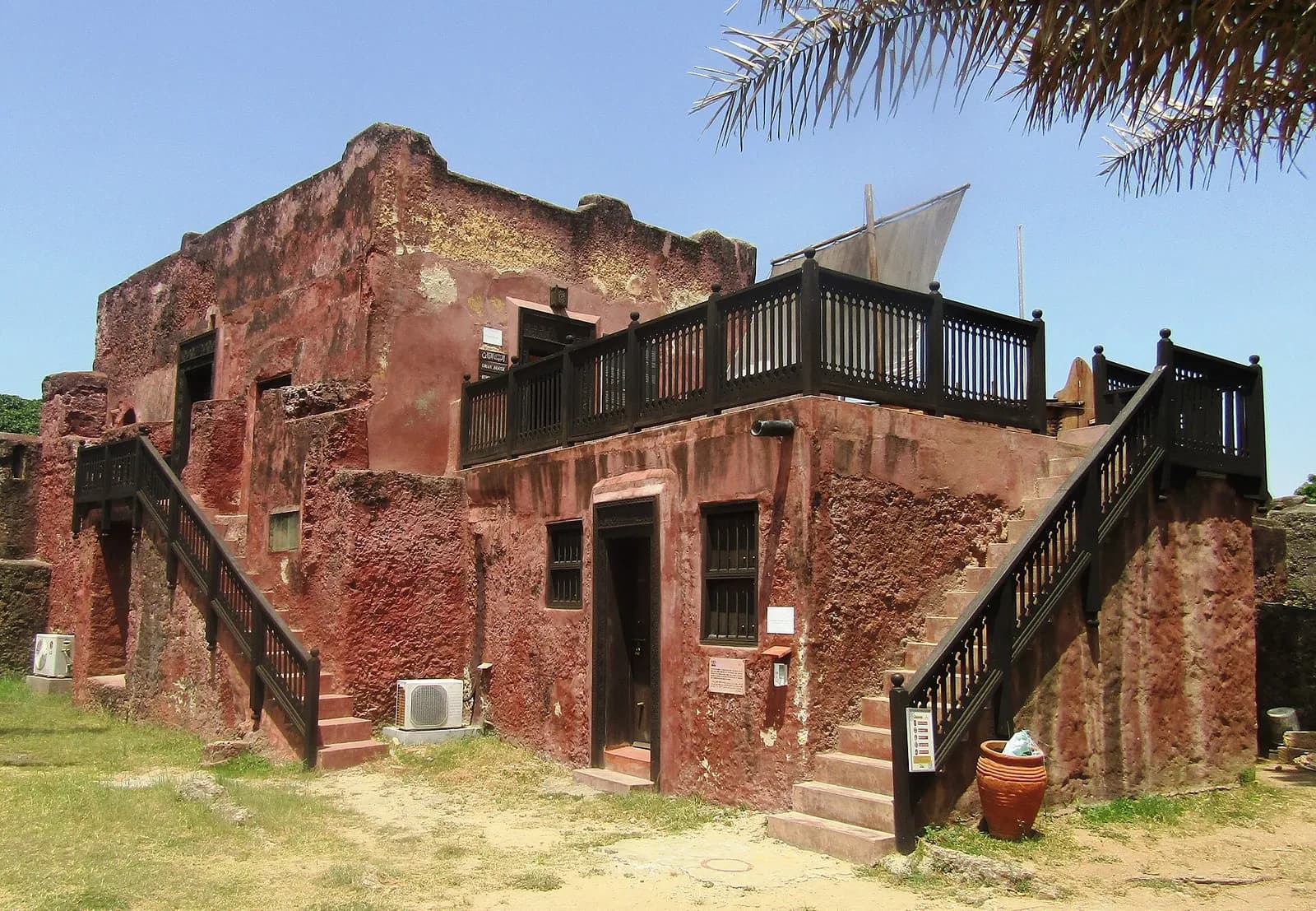
Fort Jesus today
From 1837 to 1895 the fort was used as barracks. When Britain proclaimed its East Africa Protectorate on 1 July 1895, the fort became a prison, and cells were built inside it.
On 24 October 1958 it was declared a national park. Excavations followed, and in 1962 it opened as a museum, built with a grant from the Calouste Gulbenkian Foundation of Lisbon, which also paid for the research behind Boxer and Azevedo's history of the fort.
The wreck of the Santo António de Tanná was excavated between 1977 and 1979 by the Institute of Nautical Archaeology and the National Museums of Kenya. Her guns turned out to be lighter and fewer than expected for a frigate of her size.
In 2011 UNESCO inscribed Fort Jesus on the World Heritage List under criteria (ii) and (iv), as an example of Renaissance military architecture and of exchanges between peoples of African, Arab, Turkish, Persian and European origin. The protected property covers 2.36 hectares, including the moat.
Today the sea threatens the walls. In 2018 the National Museums of Kenya told Lusa, the Portuguese news agency, that waves were eating into the coral rock under the walls, and that Kenya was investing about 500 million shillings, around €4.3 million, in a protective sea wall six metres out. Portugal, which had just resumed diplomatic representation in Kenya, offered its expertise in conservation.
For Portugal the siege ended its hold on the coast north of Mozambique, apart from 1728 and 1729. Kenya remembers it in its own way. Its World Heritage nomination praises the defenders' endurance, and UNESCO calls the fort a place of resistance for the coast's Swahili against domination by any power. In 2018 a museum educator in Mombasa told Lusa that local people regard the fort as theirs, part of the making of Kenya.
FAQs
Who besieged Fort Jesus in 1696?
An army sent by the imam of Oman, Saif bin Sultan, with Baluchi soldiers, Swahili allies from Pate and Lamu, and African slaves among its men. It arrived off Mombasa on 11 March 1696 and entered the harbour on 13 March.
How long did the siege of Fort Jesus last?
Thirty-three months, from 13 March 1696 to 13 December 1698, when the attackers climbed the walls at night and the last defenders surrendered the next morning.
How many people died in the siege of Mombasa?
No exact count exists. The Portuguese chronicle of the siege gives about 6,500 deaths among the defenders and their families; the viceroy of India wrote of more than 1,000 Portuguese and nearly 10,000 local people. Most died of disease and hunger.
Did Portugal ever get Fort Jesus back?
Briefly. The Sultan of Pate, who had received the fort from rebel slaves, handed it to a Portuguese fleet on 16 March 1728. After a rising in 1729 the governor surrendered, and on 26 November 1729 he left with thirty men. Later expeditions never retook it.
Can you visit Fort Jesus today?
Yes. It has been a museum since 1962, run by the National Museums of Kenya, and a UNESCO World Heritage Site since 2011.
On the timeline
Open the timelineNearby moments from restoration and the gold of brazil (1640–1750).
Jesuit missionary Jerónimo Lobo dies in Lisbon. He had spent years in Ethiopia and in 1629 visited the source of the Blue Nile; an abridged English version of his account, 'A Voyage to Abyssinia' (1735), was the first book published by Samuel Johnson.
Death in Óbidos of Josefa de Óbidos, the Seville-born painter who became one of the very few women to make a professional career in 17th-century European art. Over nearly four decades she produced more than 100 works — luminous still lifes, devotional paintings and altarpieces — most of them signed and dated.
Zumbi, the last leader of the Quilombo dos Palmares — the largest community of escaped slaves in Portuguese Brazil, which held out in the hills of what is now Alagoas for most of the century — is ambushed and killed by colonial forces. Brazil marks the date as its Day of Black Consciousness.
The siege of Fort Jesus
An Omani army lays siege to Fort Jesus, Portugal's stronghold at Mombasa in today's Kenya. The siege lasts 33 months; hunger and disease kill thousands of defenders and refugees, and the fort's fall in December 1698 all but ends Portuguese power on the Swahili coast north of Mozambique.
Portugal and England sign the Methuen Treaty in Lisbon. Portugal lifts its ban on English woollen cloth, while Portuguese wine is to pay a third less duty in England than French wine. It helped make port Britain's wine, though critics blamed it for ruining Portugal's own textile industry.
Birth in Coimbra of Carlos Seixas, the outstanding Portuguese keyboard composer of the 18th century. Cathedral organist at 14 and later organist of the royal chapel in Lisbon, he is said to have been sent to Domenico Scarlatti for lessons, only for the Italian to reply: 'You can give me lessons.' Most of his reputed 700 sonatas were lost in the 1755 earthquake.
Birth in Rio de Janeiro of António José da Silva, 'O Judeu' ('the Jew'), whose witty comic operas, performed by puppets at Lisbon's Bairro Alto theatre, were a great success. Condemned by the Inquisition as a relapsed Judaiser at an auto-da-fé in 1739, he was handed to the secular courts, strangled and burned.
Coming up in history
All long reads 15 March 1147Two ladders and a broken gate: Afonso Henriques takes Santarém, 1147
 16 March 1974The Caldas uprising: a column marches on Lisbon alone, 16 March 1974
 17 March 1939The Iberian Pact: Salazar and Franco's treaty of 17 March 1939
 18 March 1900António Nobre, the poet of Só, dies at Foz do Douro: 18 March 1900
11 sources
Archives, scholarship and reporting this article was checked against.
- 1
Fort Jesus and the Portuguese in Mombasa, 1593–1729C. R. Boxer and Carlos de Azevedo (London: Hollis and Carter, 1960), digitised copy at the Internet Archive
- 2
Fort Jesus MuseumNational Museums of Kenya
- 3
- 4
Decision 35 COM 8B.19: Fort Jesus, Mombasa (Kenya)UNESCO World Heritage Committee, 2011
- 5
Santo Antonio de Tanna shipwreck excavationInstitute of Nautical Archaeology
- 6
A Sea of Debt: Law and Economic Life in the Western Indian Ocean, 1780–1950 (prologue)Fahad Ahmad Bishara, Cambridge University Press, 2017
- 7
- 8
- 9
- 10
- 11
Mar ameaça herança de Vasco da Gama no QuéniaLusa, via SAPO 24, 2 December 2018
Image credits
- The walls of Fort Jesus in Mombasa, Kenya, photographed in 2012. Begun by the Portuguese in 1593, the fort has kept the basic shape of its original plan. Alex Wafula, CC BY-SA 3.0, via Wikimedia Commons.
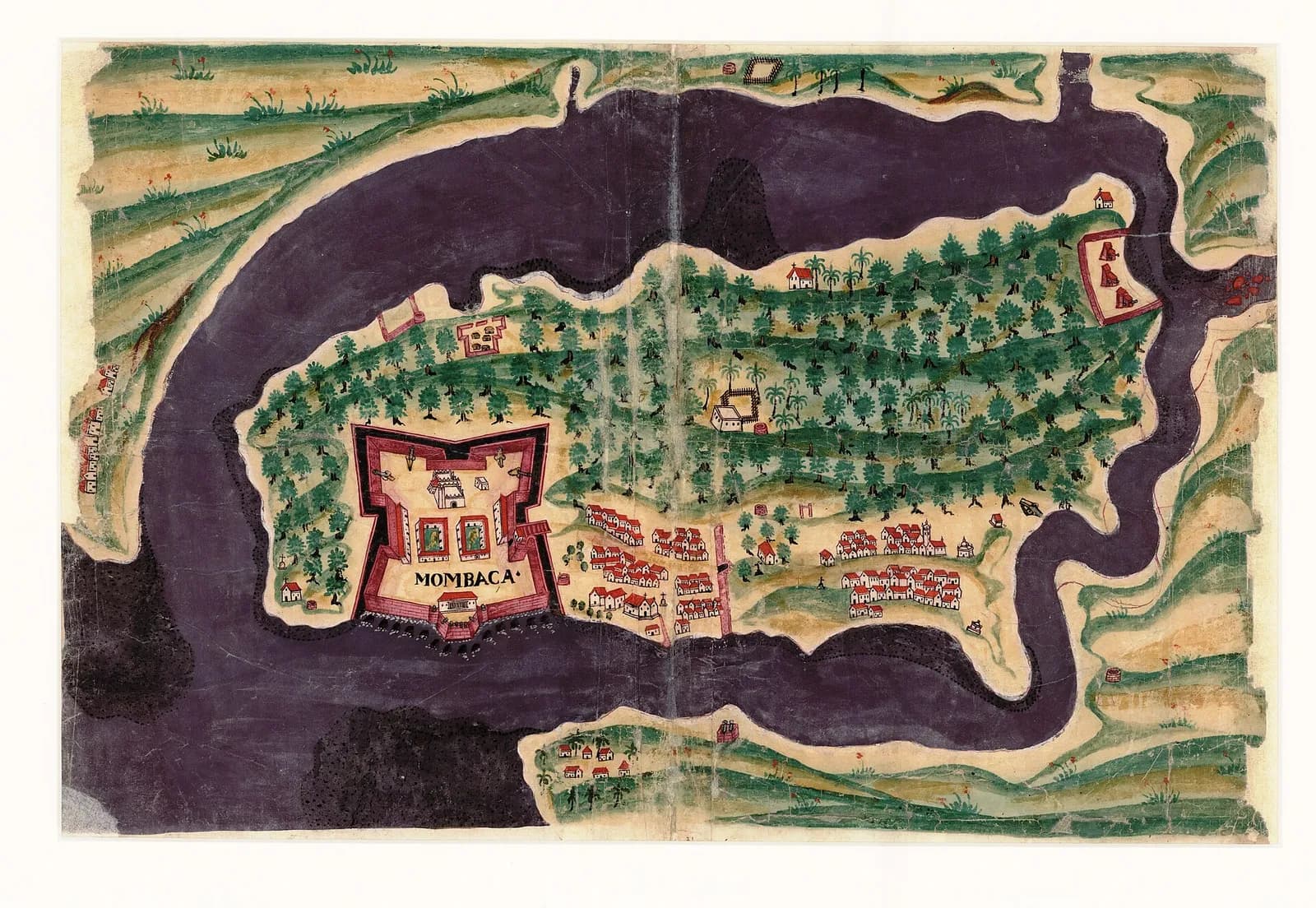
- Mombasa island in 1635, drawn by Pedro Barreto de Resende for António Bocarro's book of plans of the fortresses of the Estado da Índia. Fort Jesus is the bastioned fort beside the town. Pedro Barreto de Resende, Public domain, via Wikimedia Commons.
- Plan of Fort Jesus from a drawing of about 1636 in the Bavarian State Library, Munich, as printed by Justus Strandes in 1899. The bastions are named after saints, among them São Filipe and Santo Alberto. Justus Strandes (1859–1930), Public domain, via Wikimedia Commons.
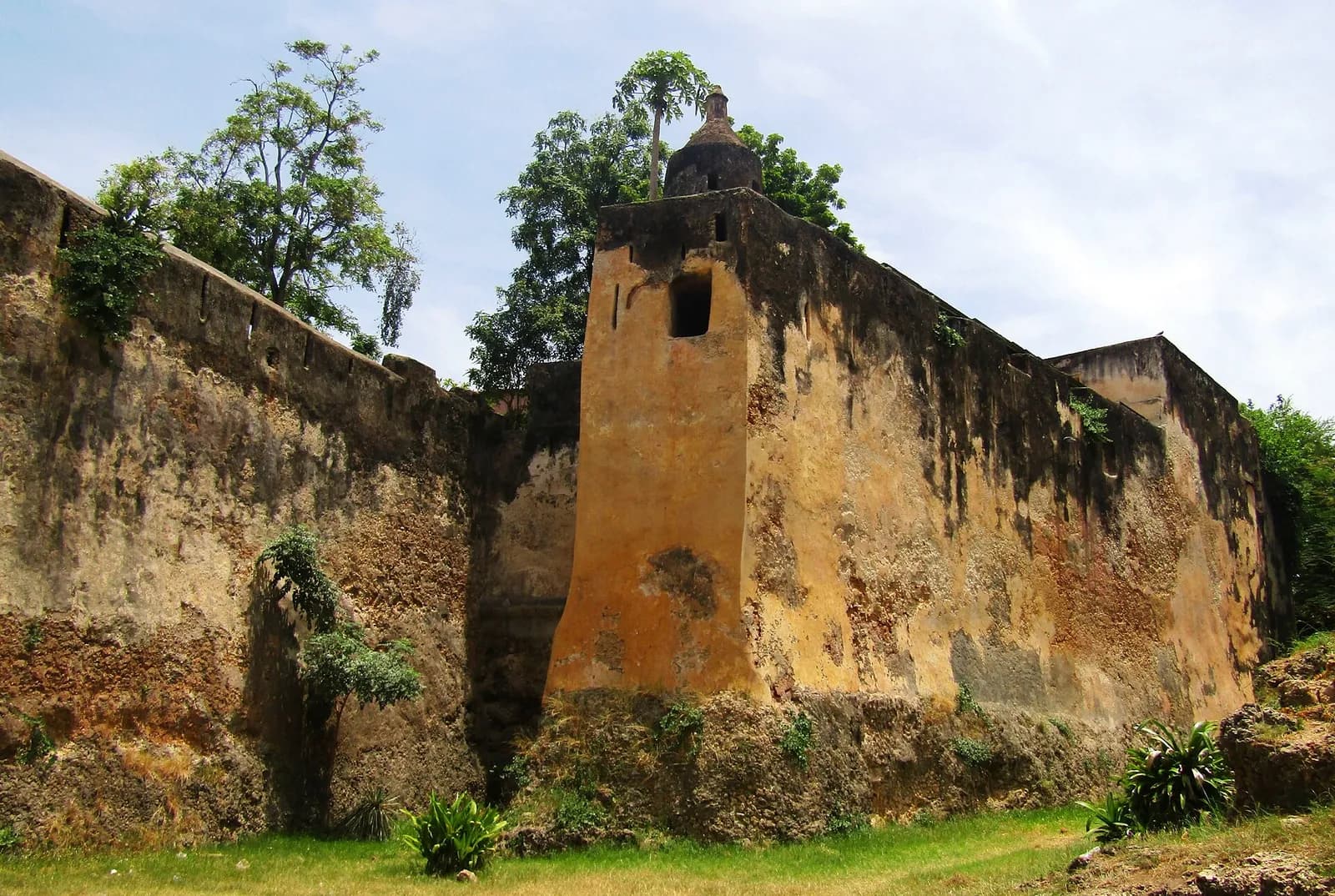
- Walls and a sentry turret of Fort Jesus, photographed in 2021. O.Mustafin, CC0, via Wikimedia Commons.
- The Omani House inside Fort Jesus, photographed in 2021. Restored with Omani government funding, it now holds an exhibition on Omani life near the ruins of the Portuguese chapel. O.Mustafin, CC0, via Wikimedia Commons.