

Two ladders and a broken gate: Afonso Henriques takes Santarém, 1147
A spy, a broken truce and a week's march by back roads brought Portugal's first king under the walls of Santarém. The town fell before sunrise, and many of its Muslim inhabitants were killed or driven out.
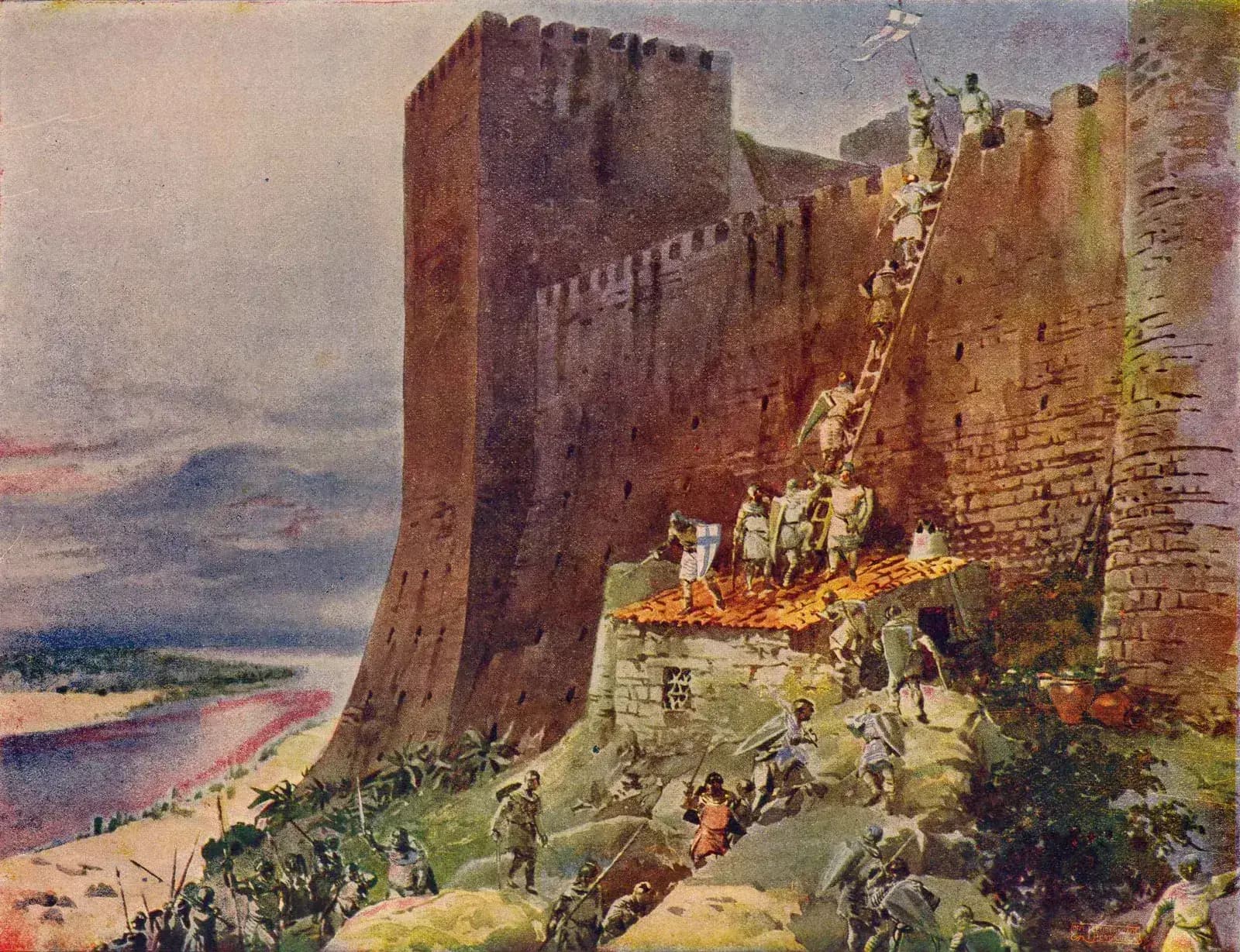
At a glance
- Santarém, a Muslim city on a cliff above the Tagus, taken by the Almoravids in 1111, fell to Afonso Henriques, the first king of Portugal, at dawn on Saturday 15 March 1147.
- Afonso had no siege engines and too few men for a siege. After a truce and a scouting trip by his agent Mem Ramires, he marched from Coimbra by back roads and attacked at night with a small, hand-picked force.
- The main account, De expugnatione Scalabis, says 120 men were chosen to climb ten ladders, but only two ladders went up and about 25 men got onto the wall before an iron hammer broke open a gate.
- The same text has the king order his men to spare no one, of any age or sex. Coimbra annals say the Muslims were killed or driven out, a chronicle of 1419 describes a massacre, and some inhabitants fled to Lisbon.
- Santarém gave Afonso the Tagus valley. With a crusader fleet he took Lisbon that October, and Santarém became the base for raids deep into the Alentejo.
A ladder on the tip of a spear
The men came through a valley below the town, between a hill called Iraz and a spring the Arabs named for its bitter water. They had left their baggage at the last camp and dismounted for the final stretch. Mem Ramires, the king's scout, walked in front because he knew the paths. King Afonso Henriques of Portugal walked at the back.
At the spot they had picked, where they expected no guard, two sentries were keeping each other awake. The attackers lay down in a field of young wheat and waited. When both watchmen had dozed off, Mem led his men up through the Alcudia, perhaps a small quarter outside the wall, and a potter's house built against it.
He lifted a ladder on the tip of a spear and tried to hook it to the top of the wall. It would not hold. It slid down and hit the ground with a crash, and Mem feared the noise would wake the sentries. He bent over and let a young man called Mogueime climb onto his back. Mogueime reached the battlements and tied the ladder to them, and a second man went up with the king's banner and raised it.
Three men were on the wall when the sentries woke and saw the banner beside them. “Manhu?”, they called: who are you? Then they understood and shouted “Annachara!”, an ambush of Christians. Mem called on Saint James and King Afonso for help, and from below the king shouted back: “Saint James and most blessed Virgin Mary, help us! Here is King Afonso. Cut them down, and let not one escape the sword.”
This is how the Latin account called De expugnatione Scalabis, “On the capture of Santarém”, tells it, in the king's own voice. It says the city was taken on the Ides of March, 15 March, “as Saturday was dawning”, in the Spanish Era 1185, which is AD 1147.
A city on a cliff above the Tagus
Santarém, the Roman Scallabis and the Arabs' Shantarin, sits on a plateau high above the River Tagus, about 75 kilometres north-east of Lisbon and upstream from it. Arab geographers praised its farmland, flooded and fertilised by the river like the Nile, and its position, which several of them called impossible to take by force. The Latin account adds that the plain below was so full of marshes and islands that it could only be crossed by boat.
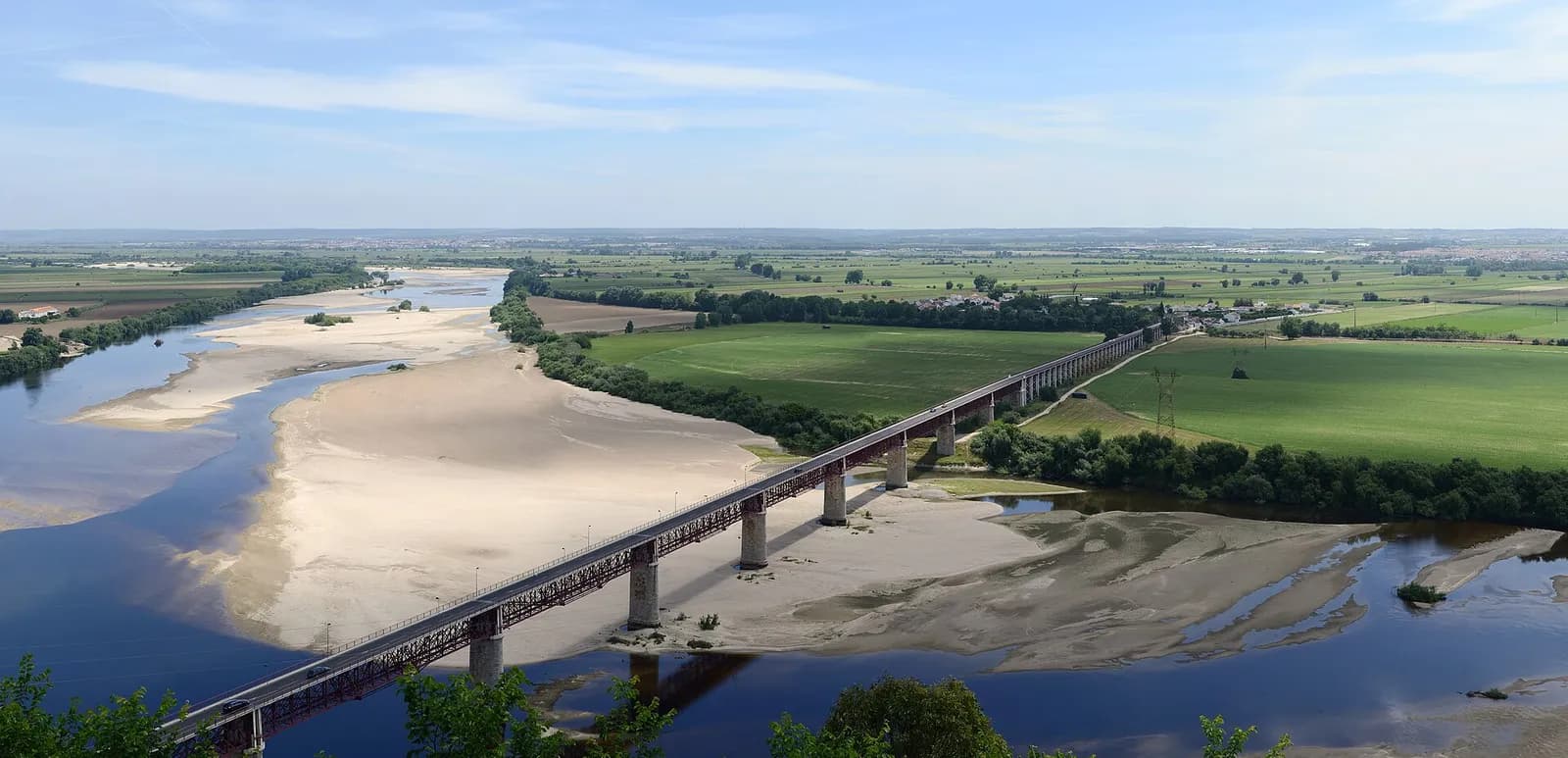
The town had changed hands before. In 1093 the Muslim king of Badajoz handed Santarém, Lisbon and Sintra to Alfonso VI of León and Castile in return for protection. The Almoravids, Berber rulers from North Africa who had crossed into Iberia in 1086, retook Lisbon and Sintra soon after and Santarém in 1111. Annals kept at Santa Cruz in Coimbra date its capture by “King Cyrus” to May of that year; the Latin account calls him king of the Moabites, its word for the Almoravids.
For the next 36 years Santarém was a threat to Coimbra, the Christian frontier city on the Mondego. The Latin account calls it a city “always warlike, lying in wait for Coimbra”. Its governor, Abzecri, who according to the account ruled it for some 34 years, built walls, an outer wall and towers on its western side, the area called Alplan, and had captives carry earth on their shoulders to build up the old slopes. In 1144 the vizier of Santarém attacked the Templar castle of Soure, south of Coimbra, and carried off many prisoners.
By the 1140s the Almoravid empire was breaking up. A new North African movement, the Almohads, was taking its cities, and in Muslim Iberia local lords set themselves up as rulers, the period historians call the second taifas. The Latin account says that in the year Santarém fell the Almohads crossed into Spain and took Seville.
Whose authority Santarém recognised in 1147 is not clear. Abzecri had governed it since the early Almoravid years, and in 1144 its vizier was still part of their command. But the historian Inês Lourinho argues that much of its garrison, like others in the Muslim west, had gone south to help the Almohads take Seville in January 1147, stayed there through the fast of Ramadan, and had not come back by March.
As elsewhere on the middle Tagus, the townspeople were mixed: Muslims descended from local converts and from Arab and Berber settlers, and Mozarabs, Christians living under Muslim rule who had kept their lands and their religion by agreement. Some historians think the Mozarabs were the majority in Santarém until the Almoravids came.
Afonso had a bigger prize in mind. In 1146 or early 1147 word came that a fleet of crusaders would stop on its way to the Holy Land and could help him take Lisbon. João Carvalho, in a 2022 study of the attack, argues that Santarém had to fall first: it was Lisbon's main support on the Tagus, and an army besieging Lisbon could not leave it behind its back.
- Date
- Dawn on Saturday 15 March 1147
- Place
- Santarém (Shantarin), on the Tagus, about 75 km north-east of Lisbon
- Attacker
- Afonso Henriques, king of Portugal, with a small force from Coimbra
- Defenders
- The Muslim garrison and people of the town, taken by the Almoravids in 1111
- Method
- Surprise escalade at night after a truce was ended
- Main source
- De expugnatione Scalabis, a Latin account told in the king's voice
A truce, a spy and a week of back roads
Afonso could not besiege Santarém. He had no siege engines and too few men. An attack on Lisbon in 1142 had failed, and some historians think he may have tried Santarém around the same time. A churchman's life of Saint Teotónio, prior of Santa Cruz in Coimbra, recalls the king attacking the town with “a new kind of combat”, by stealth “as if by theft”, because he had never managed it with other weapons of war.
So he made a truce with Santarém and sent Mem Ramires to study it. In the account the king says he asked Mem to find out “by what path or what part of the wall we could more safely enter by night”. Mem came back sure it would be easy and promised to go in front, to raise the king's banner on the wall and to break the bars of the gates.
Almost nothing else is known about him. Historians usually take him for a Mozarab who spoke Arabic, which would explain how he moved about the town unnoticed; later tradition says he went disguised as a pedlar. The Portuguese chronicle of 1344 and those that copied it call him Mem Moniz instead. The historian José Mattoso thought he died young, because the king gave his lands near Penela to another man before 1157.
The king told almost no one. He left Coimbra on a Monday, 10 March by the calendar, with men of Coimbra, Fernando Peres and a few others of his own. Each day's halt is named. On the second day he sent a man called Martim Moab and two others ahead to tell the people of Santarém that the truce would end in three days.
Why warn the enemy? Alexandre Herculano, the leading nineteenth-century historian of medieval Portugal, thought it was a trick: the town would stand guard for three days, then relax. Mattoso, Pedro Gomes Barbosa and Miguel Gomes Martins read it as a signal to Santarém's Christians, who may have helped from inside. Carvalho finds that more likely, but no source says so outright.
Monday 10 March
Leaves Coimbra
First night's camp at Alfafar, near Penela.
Tuesday 11 March
Chornudelos
Martim Moab and two others ride to Santarém to announce the end of the truce.
Wednesday 12 March
Abdegas
The messengers rejoin the king near Ourém.
Thursday 13 March
Alvardos
The force rests all day and marches on at night.
Friday 14 March, dawn
Ebrahaz, on the heights of Pernes
The king reveals the plan; at nightfall the men ride for Santarém.
Saturday 15 March, before dawn
Santarém
Two ladders go up; a gate is broken open and the town is taken.
On the heights of Pernes, Afonso finally told his men where they were going. He reminded them of the harm the town had done to Coimbra and gave his orders. A hundred and twenty men were to make ten ladders, one for each group of twelve, so that ten men would reach the wall at once. They were to raise his banner first and then break the bars of the gates, while the people inside were still asleep.
“Let no age or sex be spared: let the infant hanging at the breast die, and the old man full of days, the young girl and the decrepit old woman.”
He also told them that some of the watchmen would let them in. In the next sentence the narrator admits it was untrue: “May God pardon me this sin of a lie, for I lied knowingly, so that their spirits would be made firmer.” When he said he would be one of them, and the first, his knights begged him to stay back. He refused. As they rode off at nightfall, a great star like a torch fell across the sky towards the sea, and they took it as a sign.
Two ladders and a broken gate
The plan went wrong almost at once, and worked anyway. Only two of the ten ladders were ever raised. “As those who were there say”, only about 25 men climbed them. Once the sentries had raised the alarm, the king split his men. He took the right, towards Alplan, and sent Gonçalo Gonçalves to hold the path on the left that came up from Seserigo, the riverside quarter, so that the defenders could not reach the gate first and trap the men inside.
Inside, the climbers ran to the gate and hammered at its leaves with stones. From outside, an iron hammer broke the bolts and bars. The gate swung open, and the king was received “with great joy”. He knelt in the gateway to pray. What the fighting was like he will not say: “let those who were there tell it, for it is not mine”. The account ends there.
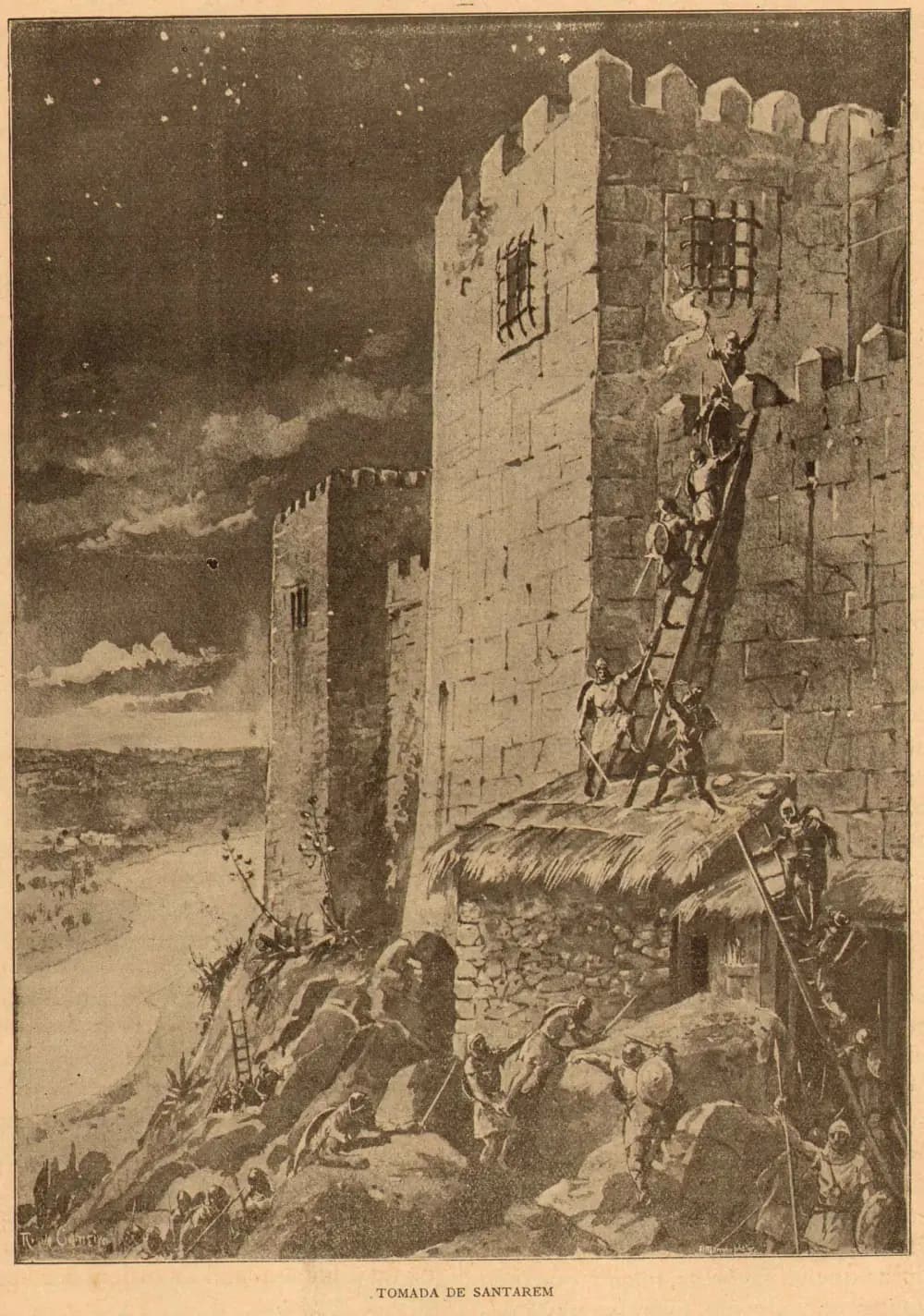
Which gate it was is still argued over. Tradition since the sixteenth century says the king entered by the Porta de Atamarma, whose name echoes the bitter spring of the Latin account. Excavations have shown the gate already existed in the Islamic period. But no medieval account of the attack names it, and the historians Maria Ângela Beirante and Mário Viana reject the tradition; Beirante points out that the spring marked the attackers' path, not the place they climbed.
Later writers filled the gaps. The chronicle of 1344 has Mem Moniz answer the sentry in Arabic and cut off his head. The chronicle of 1419 alone says the Templars took part, under their master Gualdim Pais, and were given three of the ladders. Mattoso and the military historians Miguel Gomes Martins and João Gouveia Monteiro accept that a few Templar knights came; Carvalho notes that the king's grant to the Templars soon afterwards speaks only of a promise made before the attack, not of any fighting. The numbers vary too.
| Source | What it says | Comment |
|---|---|---|
| De expugnatione Scalabis, opening hymn | The king took the city with 25 men “or a little more” | Compared with Abraham's 318 and Gideon's 300 men |
| De expugnatione Scalabis, the king's speech | 120 men chosen to make 10 ladders, 12 to a ladder | The plan, not the outcome |
| De expugnatione Scalabis, the assault | 2 ladders raised; about 25 men climbed; 3 were on the wall when the alarm was raised | Given “as those who were there say” |
| Chronica Gothorum (annals of Santa Cruz, Coimbra) | The king attacked by night “with a few of his men” | No figure |
| Crónica de Portugal de 1419 | Templars under Gualdim Pais given 3 ladders | The only source to name the Templars |
| Frei António Brandão, Monarquia Lusitana (1632) | 250 knights “all of known valour”, some of them Templars | No medieval source gives this figure |
| José Henriques Barata (1939) | Brandão's 250 knights, plus 3 or 4 squires each | Carvalho notes that Barata gives no source |
The 250 knights of many modern summaries go back at least to Brandão's seventeenth-century history; no medieval account gives a figure for the whole force. Carvalho thinks it was probably no more than a few hundred men.
From plan to wall: the men in the main account
men
All three figures are from De expugnatione Scalabis; the 25 is given “as those who were there say”. No medieval source counts the whole force or the defenders.
Show the data
| Men | |
|---|---|
| Chosen for the ten ladders | 120 |
| Climbed the two ladders raised | 25 |
| On the wall when the alarm went up | 3 |
Massacre, flight and a new frontier
The Latin account stops at the gate, so the killing is known from other texts. The Coimbra annals say the king took the castle “with the Saracens who lived in it killed or driven out”. The chronicle of 1419 says the defenders made a stand at the gate and that women and small boys were killed, with so much blood in the streets that it looked as if a great herd of cattle had been slaughtered. Three rich knights were spared for ransom.
How far the king's order to spare no one was meant literally is unclear. Mattoso suggested it might be a literary device covering a different reality. If Santarém's Christians had helped the attackers, they too were in danger in the dark streets. Later chronicles add that the governor slipped out by a postern and rode for Seville.
Some of the inhabitants got away. In June the crusaders reached Lisbon, and a priest in the Anglo-Norman contingent later wrote that the city was crowded with refugees, among them “the citizens of Santarem, who had this year been expelled from their castle”. During the siege that followed, Afonso sold his provisions or sent them to Santarém.
According to the later chronicles, Afonso repaired the defences, left a governor and went back to Coimbra. In April 1147 he gave the Knights Templar the church revenues of Santarém, keeping a promise made before the attack; Paula Pinto Costa and Joana Lencart read the grant as a reward for their part in it. The new bishop of Lisbon, the Englishman Gilbert of Hastings, contested the grant. In 1159 the Templars gave it up and the king gave them the castle of Ceras instead, where they built Tomar, their headquarters in Portugal.
The Templars left their mark on Santarém all the same. An inscription in the church of Santa Maria da Alcáçova, in the old citadel, records its foundation in 1154 by the Templar master Hugo Martónio.
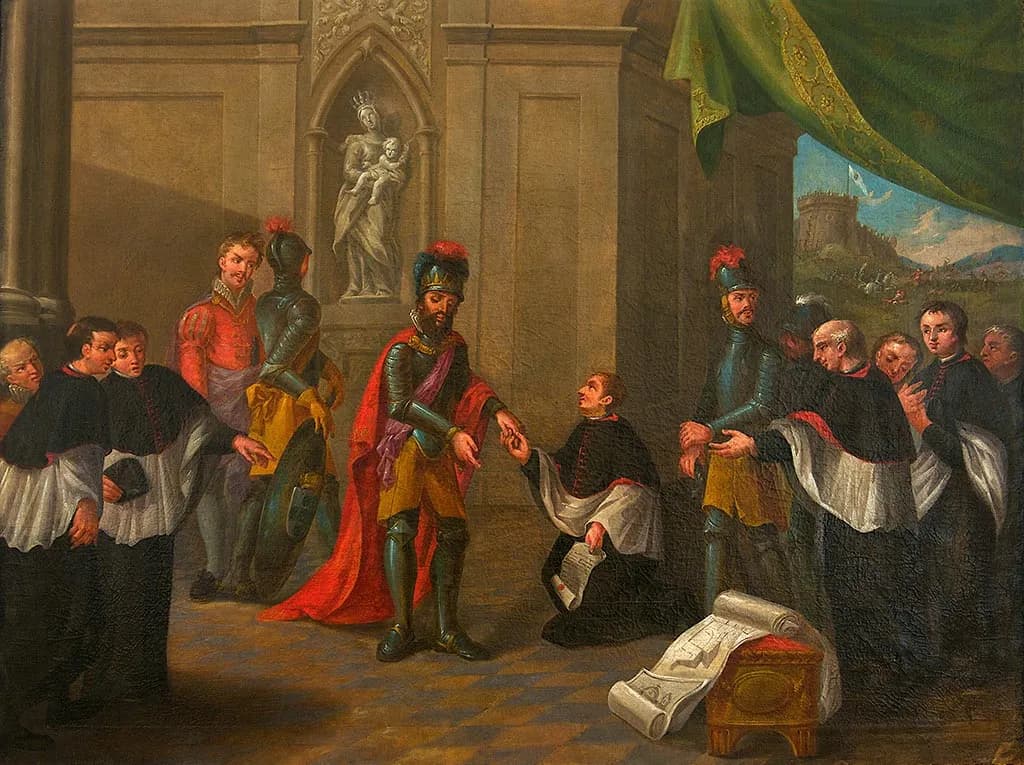
Lisbon fell that October after a siege of about four months, with the help of the crusader fleet; the story has its own article. Afonso also took Sintra, Almada and Palmela, and the lower Tagus was his.
Who told the story
De expugnatione Scalabis survives in a single thirteenth-century copy, added to a manuscript from the library of the Cistercian monastery of Alcobaça. Its own title is “How the city of Santarém was taken by King Afonso, son of Count Henry”. Frei António Brandão printed it in 1632; the Latin name it is known by is the heading it was given in Portugaliae Monumenta Historica in 1856, whose editors thought it was written at the time of the events or soon after.
It opens with a hymn and then hands the story to the king. Mattoso thought the writer used the king's voice to give the text more authority; who that writer was is uncertain. Jonathan Wilson, whose English translation appeared in 2021, argues that it and a poem on the conquest of Alcácer do Sal in 1217 were probably written by the same man, a Cistercian monk called Goswin of Bossut. If so, the text as we have it was written some 70 years after the attack, which is worth remembering when reading the king's speeches. Quotations from it here are our own translations from the Latin of the 1856 edition.
The annals disagree on the day. The Chronica Gothorum, a set of annals from Santa Cruz in Coimbra, gives 11 May “at cockcrow, as Saturday was dawning”, and one copy of the annals gives a date in May as well. But in the Julian calendar then in use, 11 May 1147 was a Sunday, while 15 March, the Latin account's date, was a Saturday, and the account's days of the week fit the march from Coimbra exactly.
Why it still matters
Santarém brought Portugal's frontier down to the Tagus in a single night, and Lisbon followed in the autumn. From then on, Santarém was the base for war further south: Geraldo the Fearless set out from there against Évora in 1166, and the town's knights fought at Alcácer, Beja and Triana, outside Seville.
The Muslim powers knew what they had lost. When the Almohads struck back, they went for Santarém rather than Lisbon. In June 1184 their caliph besieged the town for five weeks and was driven off.
The night attack itself became a model. Carvalho calls it a change in the way war was waged in Portugal: small teams with ladders, surprise and a gate opened from inside. Portuguese raiders took Beja by night in 1162, and Geraldo made the method his own.
FAQs
When did Afonso Henriques take Santarém?
At dawn on Saturday 15 March 1147, according to De expugnatione Scalabis, the main account. One set of Coimbra annals gives 11 May, but also calls the day a Saturday, which 11 May 1147 was not.
How many men took Santarém?
Very few. The main account says 120 men were chosen to climb ten ladders, but only two ladders were raised and about 25 men climbed them before a gate was broken open for the rest. No medieval source counts the whole force; Carvalho thinks it was probably no more than a few hundred men. The often-quoted 250 knights goes back at least to Frei António Brandão's history of 1632.
Who was Mem Ramires?
The king's scout, who studied Santarém's defences during a truce and led the climb. He is known almost only from De expugnatione Scalabis; historians usually take him for an Arabic-speaking Christian. Later chronicles call him Mem Moniz.
Was there a massacre at Santarém in 1147?
The main account has the king order his men to spare no one of any age or sex, the Coimbra annals say the Muslims were killed or expelled, and a chronicle of 1419 describes streets full of blood. Some people escaped to Lisbon. Historians debate how far the order was carried out and whether the surviving text exaggerates it.
Why was Santarém important for taking Lisbon?
It was the main Muslim stronghold on the Tagus upstream of Lisbon and a constant threat to Coimbra. With Santarém in Christian hands, Afonso could besiege Lisbon that summer without an enemy garrison behind him.
On the timeline
Open the timelineNearby moments from from county to kingdom (1096–1249).
Battle of São Mamede, near Guimarães. Afonso Henriques defeats the army of his mother Teresa and her Galician ally Fernão Peres de Trava, asserting himself as sole ruler of the County of Portugal. The engagement is traditionally considered the founding act of the future Kingdom of Portugal.
Battle of Ourique. In the Baixo Alentejo, on the feast day of Saint James, Afonso Henriques's army defeats a much larger Almoravid force under the governor of Córdoba, Muhammad az-Zubayr. According to tradition Afonso is acclaimed 'King' on his shield by his knights immediately after the victory and begins styling himself 'Rex Portugallensis', founding the Kingdom of Portugal.
By the Treaty of Zamora, Alfonso VII of León and Castile recognises his cousin Afonso Henriques as king, with the papal legate Cardinal Guido de Vico as mediator. The date is traditionally taken as the birth of the independent Kingdom of Portugal.
The capture of Santarém, 1147
Afonso Henriques takes Muslim Santarém in a surprise attack before dawn: about 25 of his men climb the walls on two ladders and raise his banner, and a gate is broken open for the rest. The prize opens the road to Lisbon, which he captures that October.
The Siege of Lisbon begins. King Afonso I, having struck a deal with Northern European crusaders bound for the Second Crusade, opens the assault on the great Almoravid city on the Tagus. After almost four months the city falls on 25 October, becoming the future capital of the Kingdom of Portugal.
After a siege of about four months, Afonso Henriques and his crusader allies enter Lisbon, whose starving Muslim defenders had agreed to surrender. The capture was the main success of the Second Crusade, and Sintra and Palmela soon surrendered too.
First naval battle in Portuguese history. Off Cape Espichel, a small fleet assembled by King Afonso Henriques and commanded by Dom Fuas Roupinho intercepts an Almohad squadron returning to Andalusia, kills its admiral and captures several of its galleys. The victory marks the modest birth of Portuguese seapower.
Coming up in history
All long reads 17 March 1939The Iberian Pact: Salazar and Franco's treaty of 17 March 1939
 18 March 1900António Nobre, the poet of Só, dies at Foz do Douro: 18 March 1900
 19 March 1933The 1933 plebiscite: how silence approved Salazar's constitution
 20 March 1602The Dutch East India Company and Portugal's war for Asia, 1602–1663
9 sources
Archives, scholarship and reporting this article was checked against.
- 1
Portugaliae Monumenta Historica: Scriptores, vol. I (Lisbon, Academia das Ciências, 1856): Chronicon Conimbricense, Chronica Gothorum and De expugnatione ScalabisInternet Archive (scan of the 1856 edition)
- 2
Santarém e a Reconquista: a tomada da cidade em 1147 (João Diogo Rodrigues de Carvalho, MA dissertation in Military History, supervised by José Varandas)Faculdade de Letras da Universidade de Lisboa, 2022 (PDF hosted by the NOVA FCSH Digital Humanities Lab)
- 3
- 4
De expugnatione Lyxbonensi: The Conquest of Lisbon, edited from the unique manuscript in Corpus Christi College, Cambridge, with a translation into English by Charles Wendell David (Columbia University Press, 1936)Internet History Sourcebooks Project, Fordham University (full-text PDF of the 1936 edition)
- 5
The Conquest of Santarém and Goswin's Song of the Conquest of Alcácer do Sal: Editions and Translations of De expugnatione Scalabis and Gosuini de expugnatione Salaciae carmen (Jonathan Wilson)Routledge, Crusade Texts in Translation, 2021 (publisher's page)
- 6
Relatos prodigiosos nos códices do Mosteiro de Alcobaça (Catarina Fernandes Barreira and Mário Farelo)In Imago & mirabilia: les formes del prodigi a la Mediterrània medieval, ed. A. Orriols, J. Cerdà and J. Duran-Porta (Publicacions de la UAB, Bellaterra, 2020), pp. 193-201
- 7
Com a espada e a cruz: a imagem de D. Afonso Henriques na escultura medieval portuguesa (Carla Varela Fernandes), in No tempo de D. Afonso HenriquesCITCEM, Faculdade de Letras da Universidade do Porto (repositório Ler Letras)
- 8
D. Afonso HenriquesCastelo de São Jorge (EGEAC, Câmara Municipal de Lisboa)
- 9
New Medieval Books: The Conquest of Santarém and Goswin's Song of the Conquest of Alcácer do SalMedievalists.net, February 2023
Image credits
- The capture of Santarém as imagined by Alfredo Roque Gameiro for Quadros da História de Portugal (1917). He follows the medieval account: the climb from a potter's house against the wall and the king's banner raised on the battlements. The buildings and armour are the artist's imagination. Roque Gameiro, Public domain, via Wikimedia Commons.
- The Tagus and its flood plain seen from the Portas do Sol, the site of Santarém's citadel, in May 2015. The cliff and the river made the town hard to attack from this side. Alvesgaspar, CC BY-SA 4.0, via Wikimedia Commons.
- “Tomada de Santarém”, an illustration by Roque Gameiro for Manuel Pinheiro Chagas's História de Portugal, popular e ilustrada (1899). The night sky, the house against the wall and the banner come from the Latin account. Roque Gameiro, Public domain, via Wikimedia Commons.
- Afonso Henriques founds the church of the Alcáçova: an eighteenth-century Portuguese painting, artist unknown, now in the Diocesan Museum of Santarém. It shows the founding story as it was told six centuries later. Unknown author, Public domain, via Wikimedia Commons.
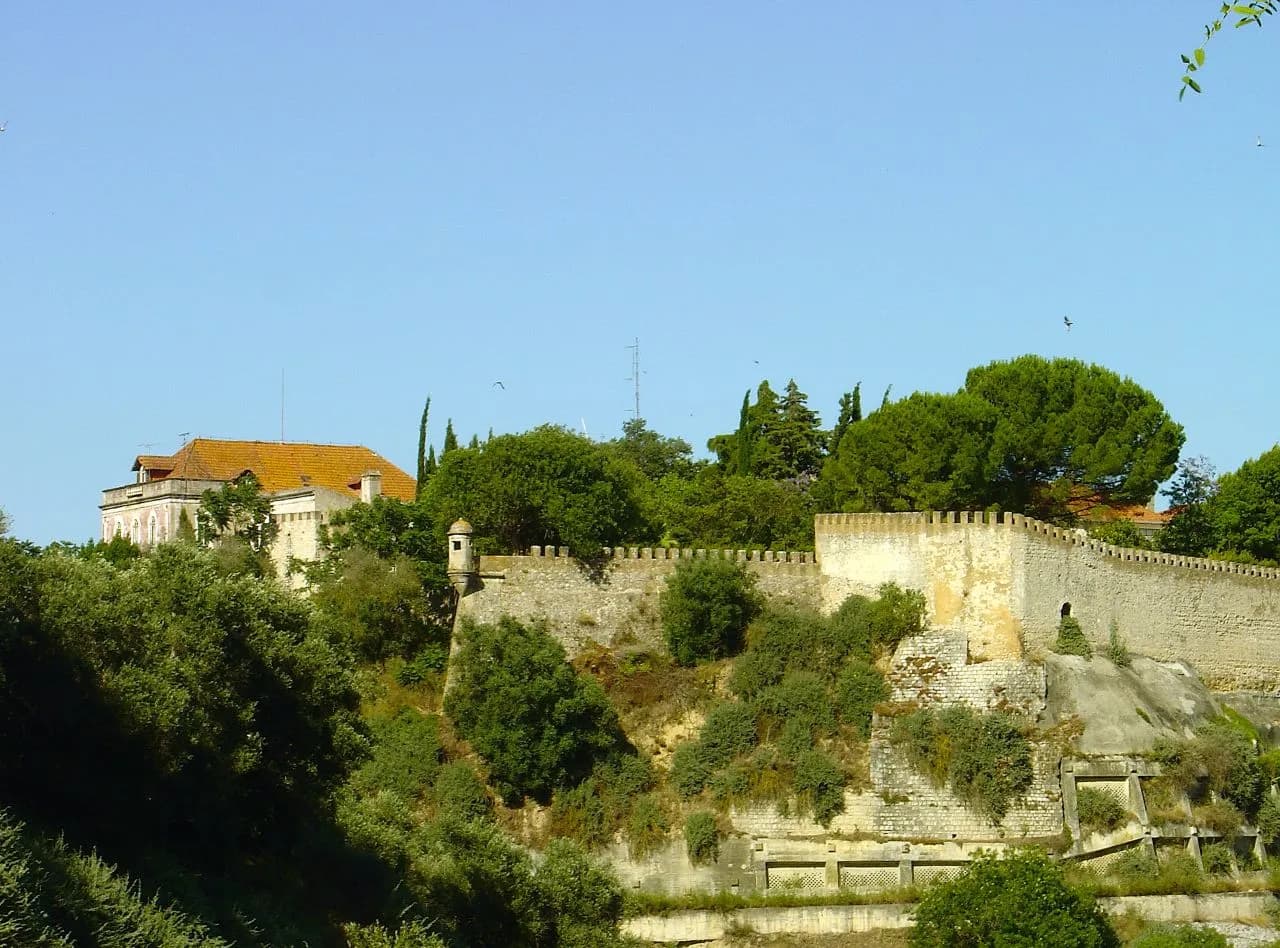
- Surviving stretches of Santarém's walls along the edge of the plateau, photographed in 2007. The defences were repaired after 1147 and rebuilt many times over the following centuries. Vitor Oliveira from Torres Vedras, PORTUGAL, CC BY-SA 2.0, via Wikimedia Commons.